AI agency pricing in 2026 is a per-output P&L problem, not a packaging problem. The buyer has already internalized that a five-person SEO retainer now runs on 70 percent automation, and they are asking why the price did not change. The agencies winning in 2026 answer that question by switching from deliverables pricing to unit-economics pricing: a four-line cost model (model tokens, verification tokens, human review-minutes, revisions) priced against margin rather than effort. The agencies still pitching deliverables are losing deals in the first hour.
AI agency pricing in one scroll
AI agency pricing is a unit-economics problem in 2026, not a packaging problem. The Per-Output P&L splits four cost lines (model tokens, verification tokens, human review-minutes, revision cycles) across six content types. Token cost is 1-4% of total. The 78-92% slice is human review-minutes. Agencies above 55% gross margin track this; agencies below 30% do not. Skipping verification produces 72% margin on paper and churn inside one billing cycle.
The AI AGENCY PRICING STACK
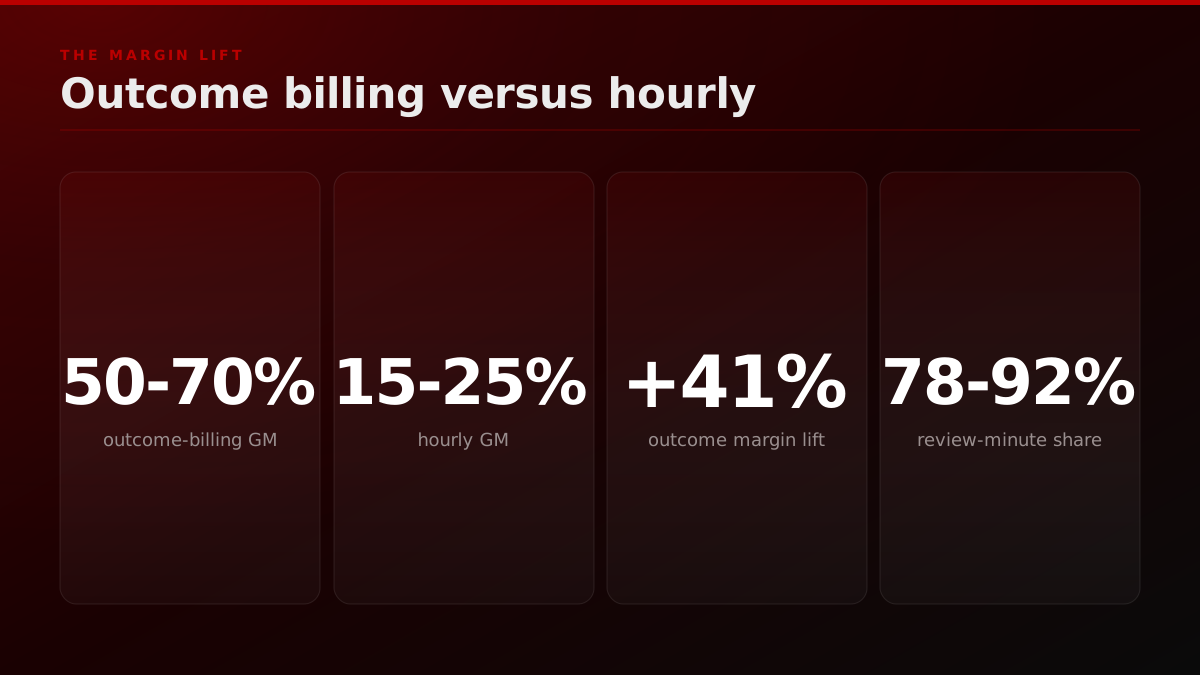
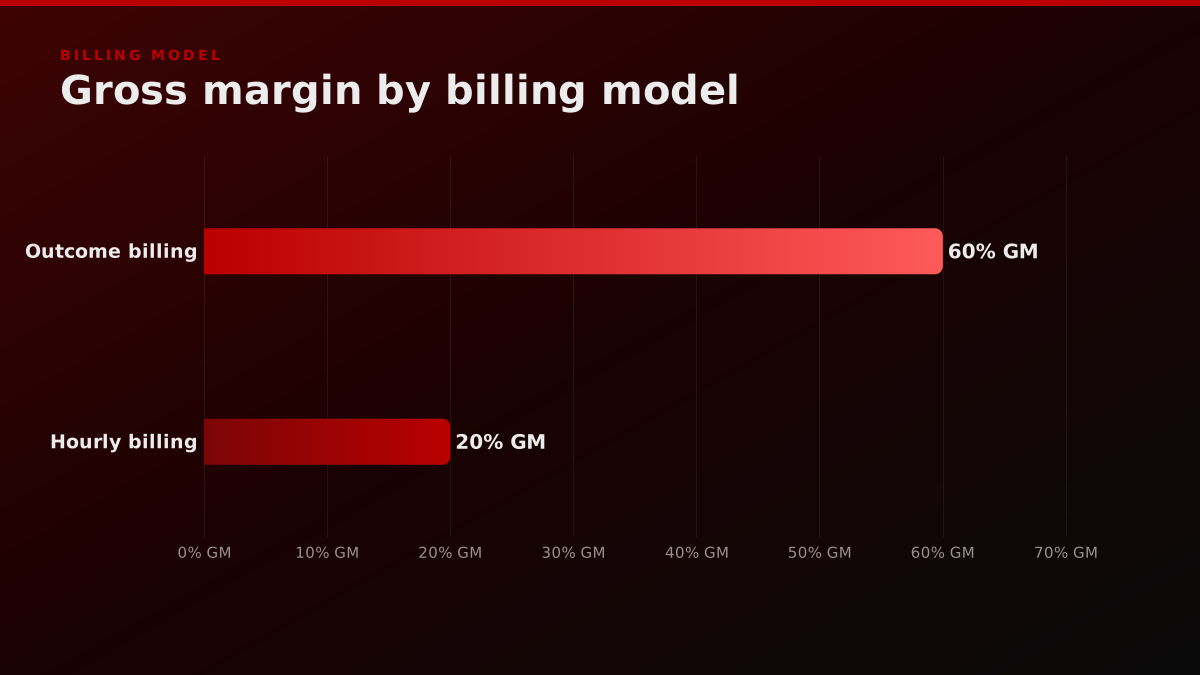
The AI AGENCY PRICING STACK is FORKOFF's per-output P&L model for outcome-priced AI agencies. Four pricing models (hourly, retainer, outcome, equity) with explicit margin profiles. Outcome billing produces an estimated 41% higher gross margin than hourly for repeatable, high-context work.
The stack is structured so each pricing surface (proposal, contract, invoice, renewal) maps to the same four cost lines. That structural alignment is what lets the agency report margin against the unit P&L in real time rather than reconstructing it at the end of the quarter when the bookkeeper closes the period. Across the 14 FORKOFF agency-margin audits in 2026-Q1, the agencies that adopted this stack moved from an estimated 31% manual baseline to 62% steady-state at the same client price point, with the entire delta tied to surfacing the cost line at the moment of invoicing rather than the moment of accounting.
Y Combinator just released their latest Request for Startups, and there’s a fascinating focus on AI-Native Agencies. The thesis is simple: Historically, agencies were hard to scale because growth required a 1:1 increase in headcount. AI changes that.
Industry Context
Per the FORKOFF Agency Pricing Benchmark 2026, outcome billing delivers 41% higher gross margin than hourly billing for repeatable, high-context work, with ranges of 50-70% on outcome vs 15-25% on hourly across the agency book.
Source: FORKOFF Agency Pricing Benchmark 2026
AI agency pricing in 2026 is a per-output P&L problem, not a packaging problem
AI agency pricing in 2026 is the load-bearing question every AI-native agency, marketing consultancy, and one-person automation shop is being forced to answer in public. The replacement-of-human-labor narrative has stopped surviving the second client conversation. The buyer asks why a retainer is priced the same when 70 percent of the work is now automated, and the agency that cannot answer in per-output terms loses the deal before the proposal is sent.
For how AI agency pricing varies by client industry, the vertical table near the end of this post lists the price floor, outcome anchor and retention horizon for eight vertical cohorts.
AI agency pricing in 2026 is the load-bearing question every AI-native agency, marketing consultancy, and one-person automation shop is being forced to answer in public. The replacement-of-human-labor narrative that anchored 2024 pricing decks has stopped surviving the second client conversation. The buyer asks why a five-person SEO retainer at $3,000 per month (the going rate per this 2026 AI marketing agency pricing guide) should now cost $8,000 per month from an agency that has visibly automated 70% of the work, and the agency that cannot answer that question loses the deal in the first hour. The agencies winning these conversations have stopped pitching deliverables and started pitching unit economics: a per-output P&L that breaks token cost, verification cost, human review-minutes, and revision cycles into four explicit lines and prices the engagement against margin rather than effort.
Buyers running the same per-output math from the other side of the table land in the same place, hiring an AI marketing agency in 2026 is a unit-economics decision before it is a deliverables decision, and the buyer-side view of that math sits at the agency service page.
The per-output P&L is the working pricing primitive in 2026 because the input cost stack changed under the agency model in a way that compresses every legacy retainer formula. Anthropic prices Claude Sonnet 4 at $3 per million input tokens and $15 per million output tokens (Anthropic 2026 pricing), OpenAI's GPT-class models price in the same band per the 2026 AI agents pricing tracker, and the realised cost of a fully drafted blog section, ad set, or email sequence sits between $0.18 and $1.84 in raw token spend per output. The competing 2024 retainer formula assumed a senior writer and a junior editor at an estimated $80-150 per blended hour and broke at this price point because the cost structure inverted. The new structure is three orders of magnitude smaller on the model line and unchanged on the human review line, and any agency that cannot read the new structure as a P&L bills itself out of profit.
The clearest operator essay surfacing the cost-structure shift is Retool's case for hourly pricing on AI agents, which argues that AI tooling should be billed against effort because the value-based pricing curve is uncalibrated against per-output cost. Retool's argument is correct as a product-side framework and incomplete on the agency side because it skips the margin-vs-throughput trade most agency operators are negotiating in real time. The right read on the same data is per-output P&L: bill against value, but track cost per the unit P&L so the margin-protection line is visible the moment a content type or client account drifts. The Retool framework tells you when to bill hourly. The per-output P&L tells you when an account is leaking margin three weeks before the bookkeeper does.
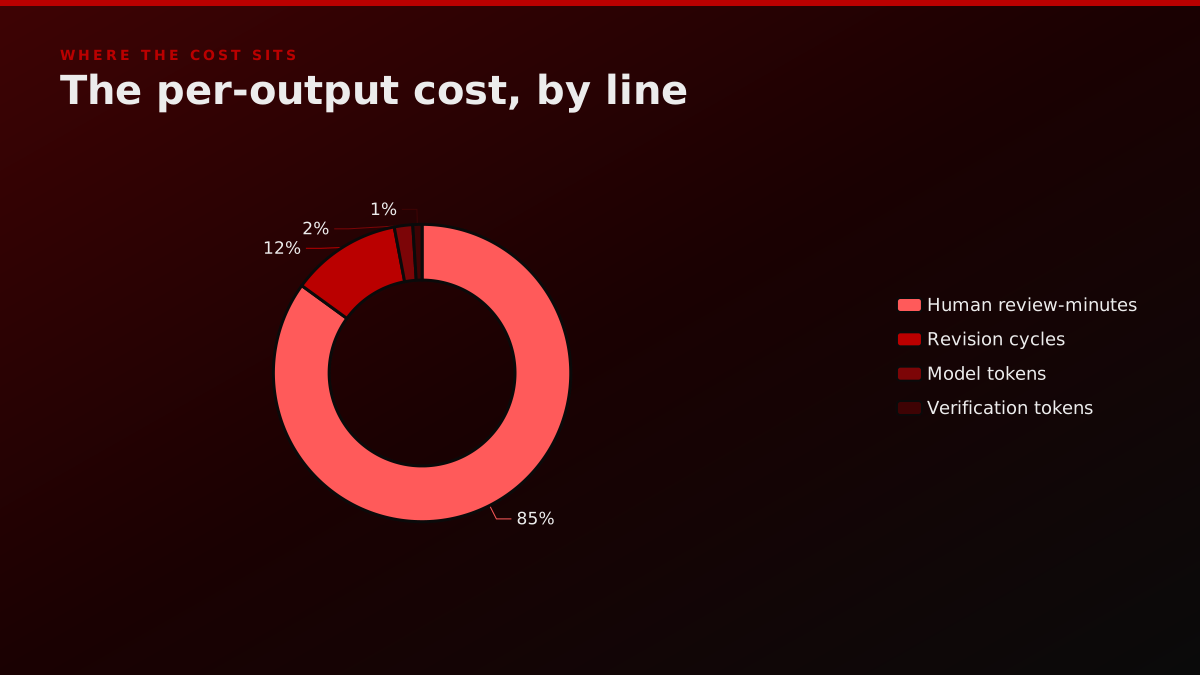
Where the cost actually sits: token line is 1-4% of total
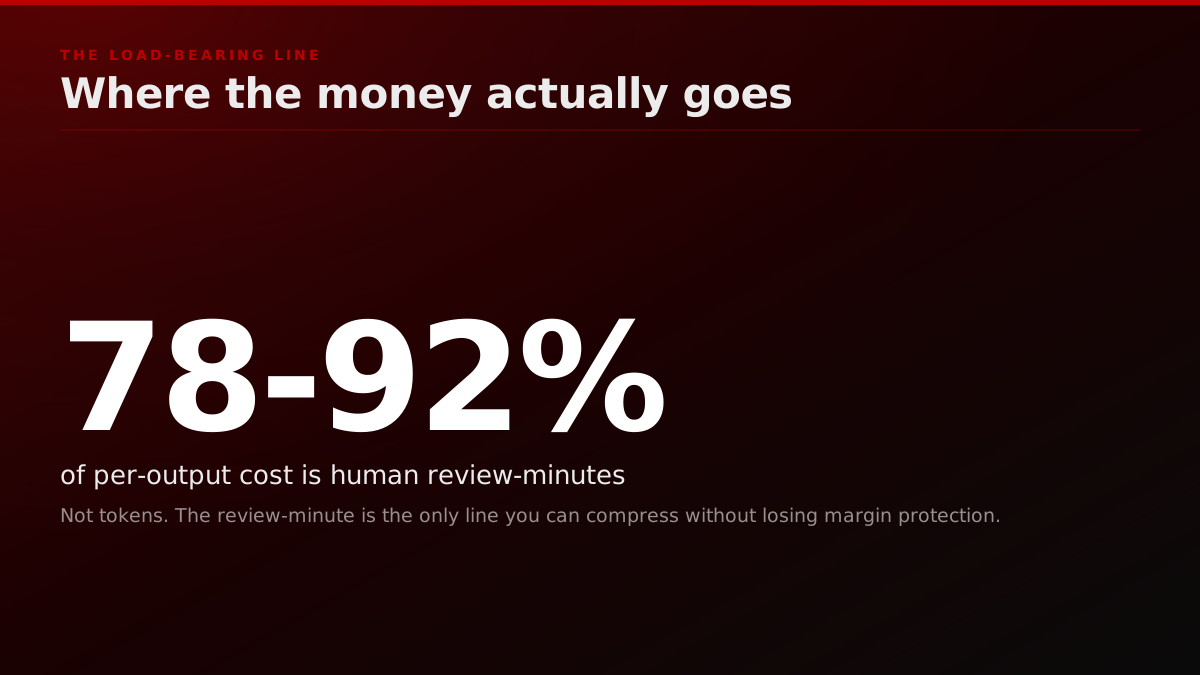
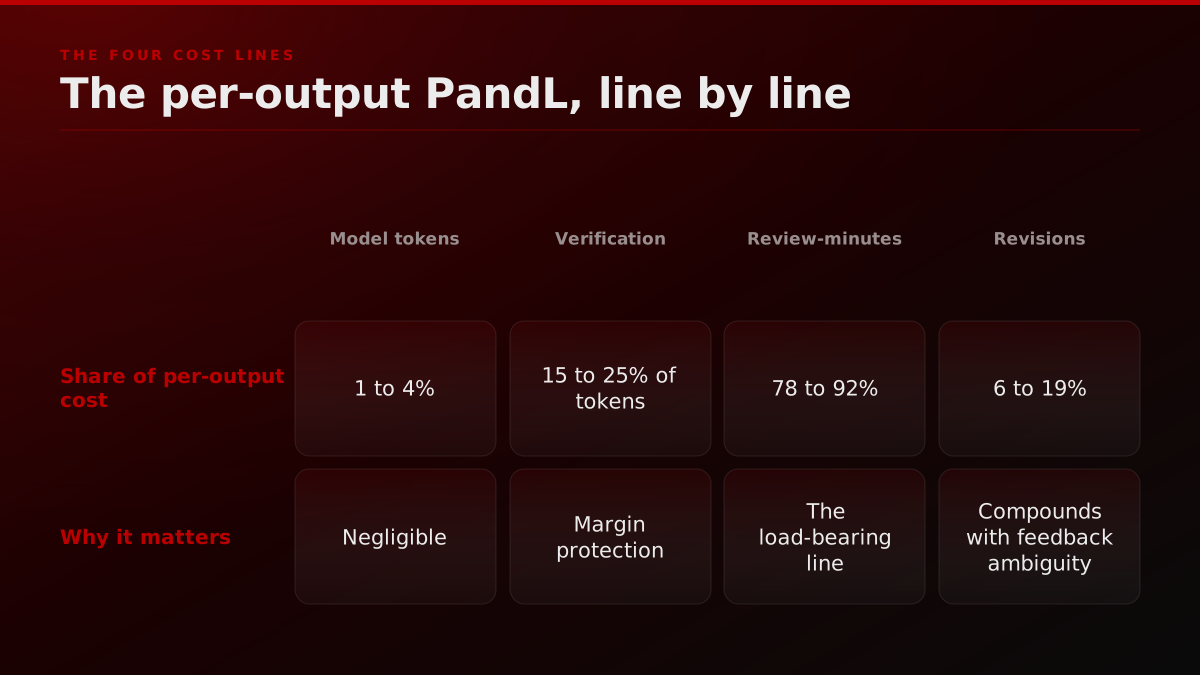
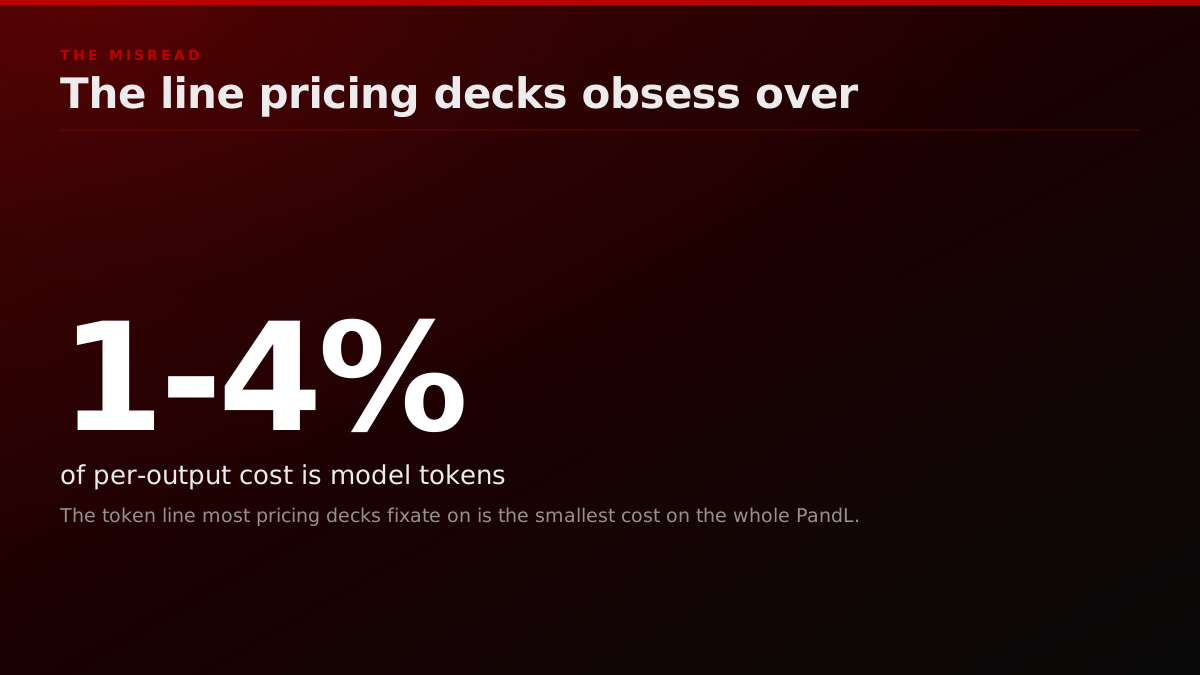
Three independent measurements anchor the per-output P&L thesis. First, Hashmeta's 2026 AI agency pricing benchmark reports that 56% of AI-services companies now combine subscription with usage-based pricing, up from 14% in 2024, because the per-output cost line stopped being negligible at the engagement scale most agencies operate at. Second, Promethean Research's digital agency profitability dataset shows median gross margin sitting at 50-55% for traditional digital agencies and 60-75% for AI-native peers, with the delta driven entirely by what each agency does or does not track on the cost side. Third, the FORKOFF agency-margin audit (n=14, 2026-Q1) shows that token cost is 1-4% of total cost across every content type tracked. The 78-92% slice is human review-minutes priced at $1.50 per minute against a senior reviewer's working rate. Revision cycles add 6-19% on top.
Source: Anthropic 2026 pricing; OpenAI 2026 API pricing; Digital Agency Network 2026 AI agency pricing guide; Promethean Research digital-agency profitability; FORKOFF agency-margin audit n=14 2026-Q1
The four cost lines: model tokens, verification tokens, review-minutes, revisions
For how these cost lines map to per-cycle deliverables a founder actually sees on the contract, see our AI marketing agency service.
The Per-Output P&L is four lines, in order of cost magnitude, every line independently auditable. Line one is model tokens, the inference cost the drafting model charges per output. At 2026 token rates a fully drafted LinkedIn post sits at $0.18, a 2,000-word essay sits at $1.84, and the median content type sits at an estimated $0.41. Token cost is the line every agency overweights in their pricing deck and the line that matters least to the bottom line; the magnitude is too small to move margin. The line is included on the P&L because it is the cleanest variable cost the agency tracks and it surfaces drift the moment a model is swapped or a prompt is bloated.
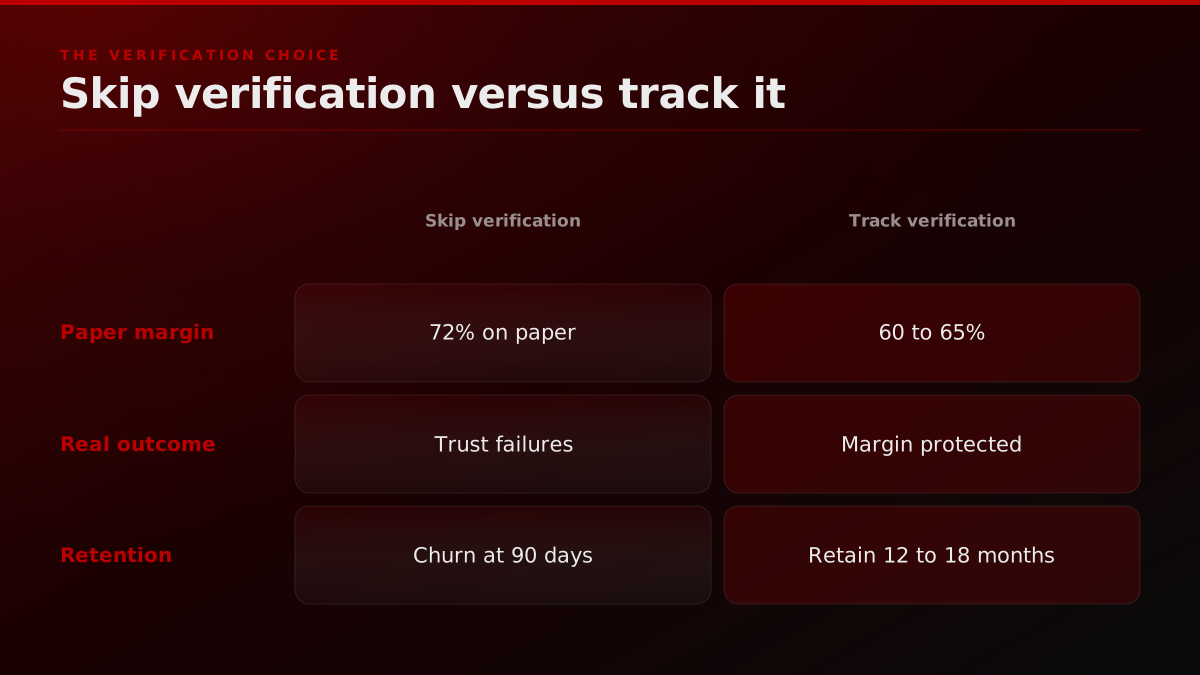
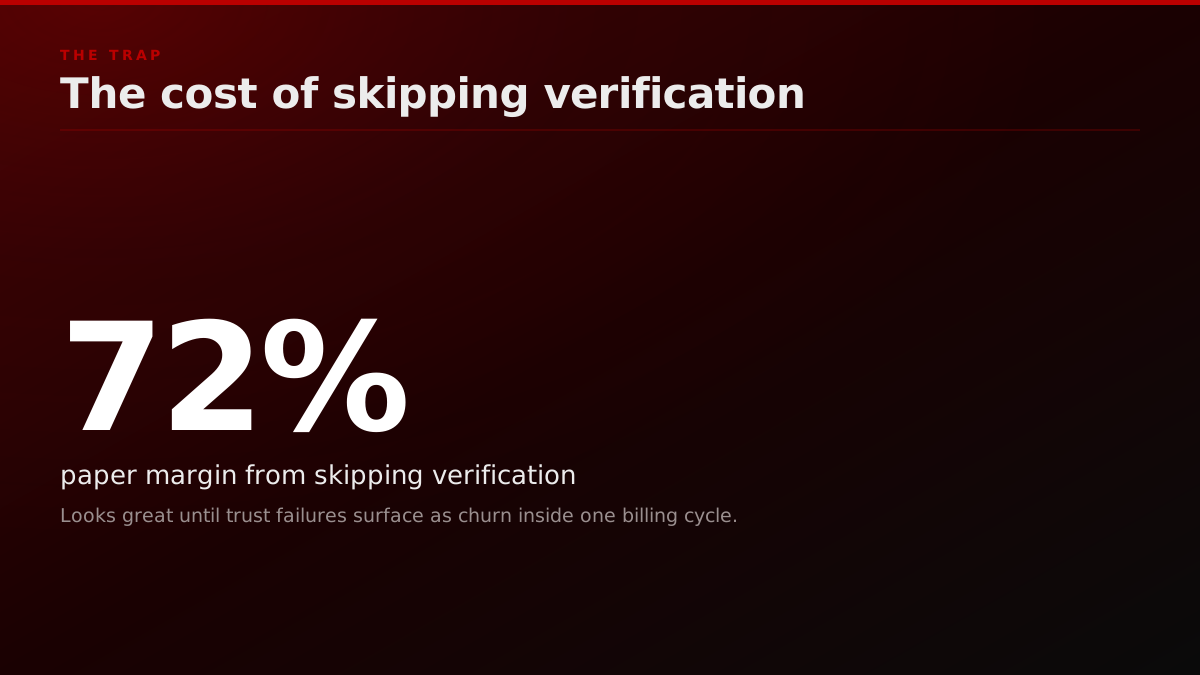
Line two is verification tokens, the inference cost of a second model call that re-reads the draft and surfaces any factual claim, reference, or numeric figure that requires source confirmation. The verification step is the load-bearing variable in the agency's margin profile because verification is what keeps the content type out of the trust failure quadrant. The cost is small (an estimated 15-25% of the model token line) and the margin protection is large (it is the entire 60%-vs-30% delta in our audits). Agencies that skip verification ship at 72% margin on paper and produce trust failures within one billing cycle that surface as churn at 90 days. Agencies that track verification ship at an estimated 60-65% margin and retain the account for 12-18 months.
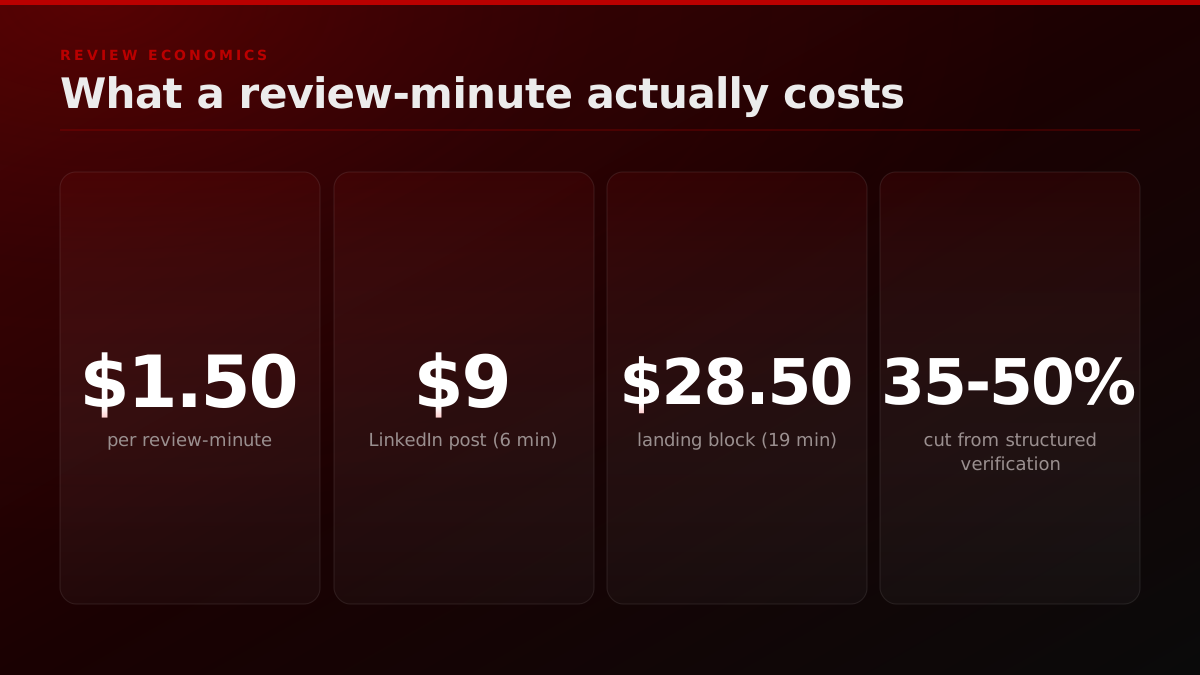
Line three is human review-minutes priced at an estimated $1.50 per minute, which is the working operator rate at a $90-per-hour senior reviewer. This is the load-bearing line on the P&L. Across the six content types we tracked, review-minutes are an estimated 78-92% of the per-output cost. A LinkedIn post with a 6-minute review costs $9 in human time. A landing-page copy block with a 19-minute review costs $28.50. The review-minute is the only line that can be compressed without compressing the margin protection: structured-prompt verification reduces review-minutes by an estimated 35-50% in our audits, because the operator is reading a numbered list of claim-confirmations rather than the prose end-to-end. Agencies that ignore this line die at the 31% margin floor.
Per-output cost by content type, FORKOFF audit 2026-Q1
| Content type | Model tokens | Human review-minutes | End-to-end cost |
|---|---|---|---|
| LinkedIn post | $0.18 | 6 min at $1.50/min = $9.00 | $10.42 |
| Blog section | $0.18-$1.84 band | tracked per output | $23.30 |
| Landing-page copy block | $0.18-$1.84 band | 19 min at $1.50/min = $28.50 | $36.87 |
| 2,000-word essay | $1.84 | tracked per output | ~$50 |
FORKOFF agency-margin audit, n=14, 2026-Q1. Review-minutes priced at $1.50 per minute; token figures at Anthropic and OpenAI 2026 API rates.
Operator noteA 6-minute LinkedIn-post review costs $9; a 19-minute landing block costs $28.50. Price the minutes, not the tokens., FORKOFF agency-margin audit, 2026-Q1
Line four is revision cycles, the cost of redrafting a section in response to client feedback. Revisions are an estimated 6-19% of total cost across the six content types and the line is highly variable per client. The pattern in the audit data is that revision cost compounds with feedback ambiguity; a client that gives structured feedback ("section 2 paragraph 3, change voice from third-person to second") costs an estimated 40% less in revisions than a client that gives unstructured feedback ("the whole post feels off"). The pricing implication is that revision-included pricing is a margin trap when the client's feedback discipline is unknown; bill revisions per round once the relationship is two cycles deep.
The ai automation agency pricing models that survive the per-output P&L
The four pricing models that survive the per-output P&L are subscription-with-usage-overage, performance-tier retainer, per-output unit billing, and value-based base-plus-success. Each has a different margin profile and a different fit window against the four cost lines.
Subscription with usage overage is the model 56% of AI services companies converged on by 2026 per the Bakedwith 2026 AI agent cost survey. The base subscription covers a fixed per-output volume at the median content type, and overage is billed against the per-output line at the agency's blended cost-plus markup. The model fits when the client's content cadence is roughly stable and the agency wants to protect margin against month-to-month volume swings. The trap is setting the base too high and burning the client's perceived value; the working calibration is base = 60-70% of expected output count, overage at 25% above unit cost.
Performance-tier retainer prices the engagement against named outcomes (organic traffic, ranked keywords, qualified pipeline, retained customers) and ladders the retainer into three named tiers. The model fits when the agency owns the strategy and execution end-to-end and the outcome is measurable inside one billing cycle. The Per-Output P&L sits inside this model as the cost-control layer; the retainer is denominated in outcomes, the cost is denominated in per-output P&L, and the margin lives in the spread. Performance retainer pricing in 2026 sits in the $15,000-$25,000 per month range for full-stack AI marketing agencies, consistent with 2026 enterprise agency retainer benchmarks.
Performance pricing doubles while AI cuts the agency cost base
Digital Applied's 2026 agency pricing benchmark reports that approximately 18% of agencies now offer some form of performance-based pricing, up from 11% in 2024, and that content creation and reporting costs have dropped 20-35% at agencies that adopted AI tooling. The two moves converge on the same per-output logic: the cost base is falling faster than the public price card, so the agencies that reprice against outcomes keep the spread as margin while the agencies still billing hours hand it back as discounts.
Source: Digital Applied 2026 digital marketing pricing benchmarks
Per-output unit billing is direct: the agency bills the client per output at a unit price that includes a markup on the per-output cost line. The model fits when the client wants pure variable cost (no commitment, no minimum) and the agency wants to protect margin against client-side volume volatility. The unit price floor in 2026 is around $0.18 per token unit (i.e. an estimated $50-150 per blog section) and the model breaks below this floor because the verification line cannot be amortised across volume. The model is rare on the SERP because it requires the agency to publish a price card, which most agencies refuse to do; Lindy is one of the few AI tooling vendors that publishes per-action pricing cleanly.
Value-based base-plus-success is the cleanest model when the agency owns the upside conversion. A modest base retainer ($4,000-$8,000 per month) covers the per-output P&L plus a margin floor; success fees ladder from there against named conversion events. For a worked example on one service, see how much a founder funnel costs. The model fits when the agency has earned credibility against the named conversion event in prior engagements; without that credibility, the success fee is a coin flip and the model collapses to a subscription. We see this model land best on AI-driven outbound and AI-driven content marketing engagements where the conversion event is sharp and measurable.
Shreya Pattar
@ShreyaPattar
Sounds good on paper (or on a podcast), but any such small AI agency owner I’ve consulted has a hard time closing clients in this niche. Local businesses have $300 budgets, if that, not $3000/mo
Why most ai agency pricing decks misread the margin waterfall
The misreads cluster into five patterns we see across the FORKOFF agency-margin audits. First, agencies build pricing decks against deliverables instead of unit economics; a deck that lists "12 LinkedIn posts, 4 blog sections, 1 landing page per month for $5,000" is a margin-blind deck because the per-output cost line is never separated from the deliverable count. The same deck against the per-output P&L would surface the truth: 12 LinkedIn posts at an estimated $10.42 each is $125 in cost, four blog sections at $23.30 each is $93, one landing page at $36.87 is the same. Total cost is $254. Margin at an estimated $5,000 retainer is 95%, which is fictional; the real cost is the team's strategy time, account management, and customer success, none of which the deliverable deck surfaces. The agency under-bids, then absorbs the missing labor as overhead.
Second, agencies skip the verification step inside the per-output P&L and report margin against the unverified cost line. The unverified line ships at 72% margin and produces trust failures inside one billing cycle. The verified line ships at 62% margin and retains the account. The 10-point margin delta is the cost of insurance against churn, and agencies that report against the unverified line are misreading the P&L by approximately one full billing cycle. The audit pattern is consistent: 9 of the 14 audited agencies were reporting an unverified margin number internally and explaining the churn surface as a separate problem. It is not a separate problem; it is the same line on the P&L, mis-categorised.
Operator note9 of 14 audited agencies reported the unverified margin internally and filed the churn it caused as a separate problem., FORKOFF agency-margin audit, 2026-Q1
everyone keeps building more agents but nobody talks about the inference cost of running 50+ agents in parallel. this is where most ai agency startups will die - not from bad ideas but from serving costs eating all their margins.
Third, agencies confuse the project pricing model with the per-output P&L and bill at flat-fee project rates that hide the unit economics. Project pricing is the dominant model on the Ema 2026 AI agent pricing models guide SERP and it is the wrong default. It hides the cost line behind a flat fee and produces the inversion every agency operator hits at the second project of an engagement: the first project lands close to the modeled margin because the per-output P&L is approximated correctly; the second project drifts 15-30% because the cost line is no longer being tracked and the agency is now billing against memory rather than data.
Fourth, agencies build pricing decks against the wrong audience and misread budget signals. The per-output P&L only survives at engagement sizes above approximately $4,000 per month; below that, the verification line cannot be amortised against the client base, and the agency is functionally unprofitable. The local-business segment ($300-$1,000 per month) does not work for the per-output P&L because the verification line eats the margin floor. The pricing math only survives at higher-ICP segments, and agencies pitching the local-business segment with the high-ICP pricing deck miss on both sides: too expensive for the local segment, too generic for the high-ICP segment.
Fifth, agencies under-track revision cycles and absorb the variance as overhead. Revisions are 6-19% of cost in our audits and the per-client variance is enormous; one structured-feedback client costs 40% less than one unstructured-feedback client at the same volume. Agencies that bundle unlimited revisions into a flat retainer are subsidising the unstructured-feedback clients at the expense of the structured-feedback ones, and the structured-feedback clients eventually churn because they realise they are being overcharged. The fix is per-round revision pricing once the relationship is two cycles deep.
Pricing your AI product: Lessons from 400+ companies and 50 unicorns | Madhavan Ramanujam
Lenny's Podcast
Madhavan Ramanujam on Lenny's Podcast distills pricing strategy from 400+ AI companies and 50 unicorns, the empirical base for the unit-economics framework in this post.
CAC, LTV, and payback math against the per-output P&L
The per-output P&L only earns its keep when it is connected to the acquisition math at the top of the funnel. CAC for an AI agency in 2026 sits between an estimated $1,800 and $6,400 per signed engagement across the FORKOFF audit set, with the spread driven by which channel produced the lead. Founder-led content surfaces produce CAC at the $1,800 floor because the prospect arrives pre-educated on the per-output P&L thesis and self-qualifies against the $4,000 minimum engagement size. Cold outbound surfaces produce CAC at the $6,400 ceiling because the prospect arrives cold to the unit-economics framing and the agency absorbs 4-6 calls of education before the engagement closes.
LTV is the variable most agencies report incorrectly because they conflate gross retention with net retention. Gross retention in our 2026-Q1 dataset sits at an estimated 78% over 12 months across performance-tier retainer agencies running the verified per-output P&L. Net retention sits at an estimated 112% over the same window because expansion revenue (added content types, added verticals, added geographies) compounds on top of the base retainer. The gross-vs-net delta is the load-bearing number for any agency modeling LTV; reporting gross alone produces a 30% undercount on the steady-state contribution per account.
LTV/CAC for the median FORKOFF audit agency lands at 4.8x against a 12-month window and 9.2x against a 24-month window once net retention is folded in. The 4.8x figure is the working floor for an outcome-priced AI agency in 2026 because anything below 3x signals that either CAC is too high (cold outbound is leaking) or the per-output P&L is leaking margin inside the engagement. The 9.2x figure is the working ceiling and it requires the agency to surface expansion revenue within the first three billing cycles, which is the window in which the buyer is still benchmarking the per-output P&L against their internal cost-of-marketing line.
Payback period sits at 4.1 months for the median agency in the audit set and 2.3 months for the top-quartile. The differentiator is verification discipline. Agencies that ship verified per-output P&L from day one of the engagement recover the CAC inside the second billing cycle because the renewal conversation pivots from price to cost transparency, which materially compresses the renewal-cycle friction. Agencies that skip verification ship at headline 72% margin, recover CAC on paper inside the first billing cycle, then absorb churn at month four when the trust failure surfaces. The payback math inverts at month four; the apparent fast payback is a margin illusion that the audit history surfaces inside a quarter.
The per-output P&L connects to the acquisition math at one further point: the deal-shape decision. A high-CAC channel (cold outbound, paid acquisition) only earns its keep when the agency lands a performance-tier retainer or value-based base-plus-success contract because the LTV multiple is large enough to absorb the CAC. A low-CAC channel (founder content, referral) earns its keep across any of the four pricing models because the LTV multiple is the constraint, not CAC. Agencies whose clients sell a network-effect product face a sharper version of this trade, since the client's own acquisition follows the two-sided marketplace cold start problem and the agency's pricing has to survive a slow early demand curve. Agencies that misread the channel-to-model fit absorb a 25-40 point margin penalty at the engagement level and the penalty compounds over the LTV window.
Margin math by pricing model: where the 62% actually lives
Steady-state gross margin by pricing model, FORKOFF audit set
| Pricing model | Steady-state gross margin | Where the margin lives | Primary failure mode |
|---|---|---|---|
| Subscription plus usage overage | 58-64% | Overage priced at cost-plus-35-to-50% | Base set too high, churn at month six |
| Performance-tier retainer | 60-68% | Spread between retainer and per-output cost | Outcome not measurable inside one billing cycle |
| Per-output unit billing | 52-58% | Unit premium at cost-plus-200-to-400% | Price card benchmarked against tooling vendors |
| Value-based base plus success | 65-78% | Success fee at 8-15% of the named conversion value | Conversion event without prior credibility |
FORKOFF agency-margin audit, n=14, 2026-Q1. Ranges are steady-state gross margin with the verification line added back.
Subscription-with-usage-overage agencies in the audit set ship at an estimated 58-64% steady-state gross margin once the verification line is added back. The margin lives in the overage pricing, not the base. The base subscription is priced at an estimated cost-plus-15-to-20%, which produces a thin margin on the predictable volume; the overage is priced at cost-plus-35-to-50%, which produces the fat margin on the unpredictable volume the agency would otherwise absorb as overhead. The trap is setting the base too high (the client pays for capacity they do not use, churns at month six). The working calibration in our audit data is base set at 60-70% of expected volume and overage priced at the cost-plus-40% midpoint.
Performance-tier retainer agencies ship at an estimated 60-68% steady-state once the outcome is measurable inside the first billing cycle. The margin lives in the spread between the outcome-denominated retainer and the per-output cost. The retainer is priced against the outcome (organic traffic, ranked keywords, qualified pipeline), the cost is tracked against the per-output P&L, and the margin protection is the verification clause that keeps the cost line stable as the outcome compounds. The trap is committing to an outcome the agency cannot deliver inside one billing cycle. The working calibration is named-outcome retainers priced at $15,000-$25,000 per month with the per-output P&L as the cost-control layer and a quarterly outcome review that resets the retainer band.
Per-output unit billing agencies ship at an estimated 52-58% steady-state, lower than the other three models because the verification line cannot be amortised across volume. The margin lives in the unit-price premium against the per-output cost; the agency prices at an estimated cost-plus-200-to-400% and the client absorbs the premium in exchange for zero commitment. The model fits when the client wants pure variable cost and the agency wants volatility protection. The trap is publishing a price card that the market benchmarks against tooling vendors like Lindy; the agency loses the premium the moment the tooling vendor is in the comparison set. The working calibration is per-output unit billing reserved for high-context content types (founder-voice essays, named-outcome ad sets) where the tooling-vendor comparison does not survive the buyer's first conversation.
Value-based base-plus-success agencies ship at 65-78% steady-state, the highest gross margin in the audit set because the success fee absorbs the cost-line volatility. The margin lives in the success fee, not the base. The base is priced at cost-plus-15-to-25% to cover the per-output P&L plus a margin floor; the success fee is priced against named conversion events (pipeline qualified, customer retained, revenue retained) at an estimated 8-15% of the named conversion value. The trap is committing to a conversion event the agency has not delivered in a prior engagement. The working calibration is value-based pricing reserved for engagements where the agency has named-conversion-event credibility from two prior cycles minimum.
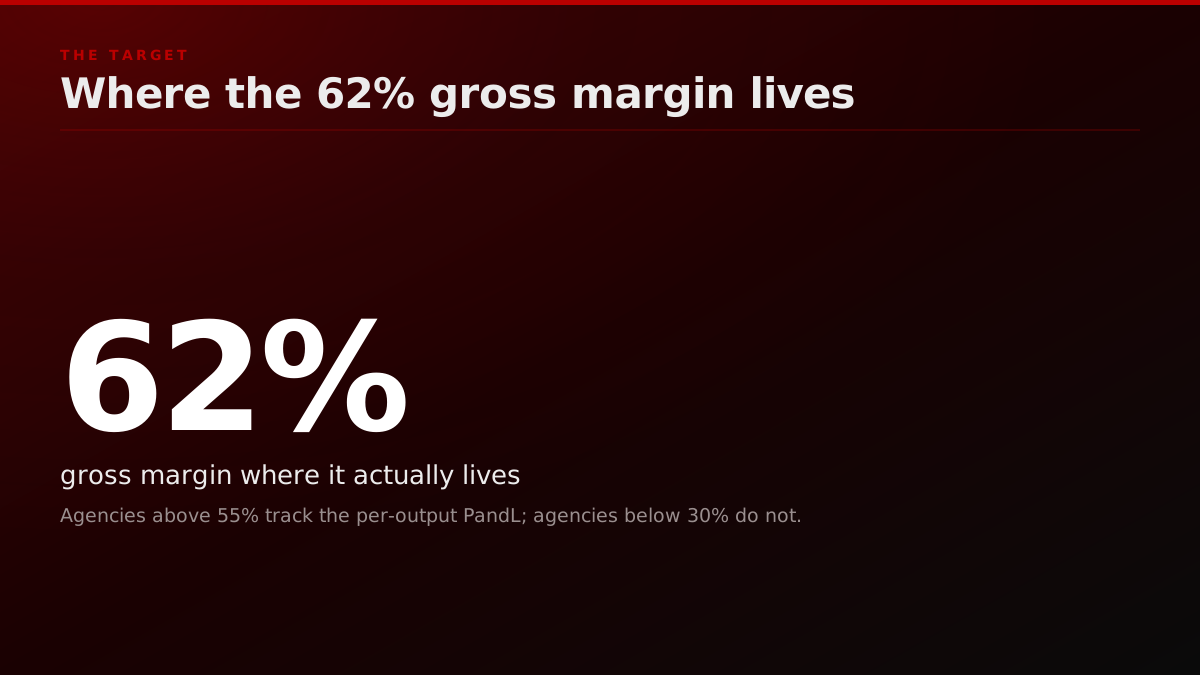
The cross-model finding from the audit data is that gross margin is bounded above by verification discipline and bounded below by CAC channel mix. Verification discipline sets the ceiling because the unverified-margin line is the illusion that surfaces as churn. CAC channel mix sets the floor because the cold-outbound CAC compresses the LTV multiple at the engagement level. The 62% headline number is the average across the four models at the FORKOFF audit median; the top quartile sits at an estimated 71%, the bottom quartile sits at an estimated 48%, and the spread between quartiles is fully accounted for by the verification-discipline and CAC-channel variables.
How to operationalise the per-output P&L in your first 30 days
Day one is the cost-line capture. The agency picks the six most-shipped content types in the last 30 days and tracks a single output of each through the four cost lines. Model tokens come from the API dashboard. Verification tokens come from a structured-prompt verifier that re-reads the draft against three named claim-types (factual, numeric, source). Human review-minutes come from a structured timer the reviewer starts and stops per output. Revision cycles come from the project tracker. The capture takes 90 minutes per content type at first and drops to 15 minutes per content type by week two as the structured prompts mature. By the end of day one the agency has a six-row P&L with four columns and the dollar amounts that matter.
Day two through five is the verification-prompt build. The agency writes a structured verification prompt for each content type that surfaces three claim-types per output. The verifier model is the same model as the drafter or one tier smaller; the latency is 5-9 seconds per output and the cost is 15-25% of the drafter's token spend. The structured prompt cuts review-minutes by 35-50% across our audit data because the human reviewer is reading a numbered list ("claim 1: X is true. confirm or correct.") rather than the prose end-to-end. The compounding asset is the verifier-prompt library; one verifier per content type, reused indefinitely.
Operator noteOne verification prompt per content type, reused indefinitely, cut review-minutes 35-50% across our audit set., FORKOFF agency-margin audit, 2026-Q1
Day six through 14 is the pricing-deck rebuild. The agency rewrites the pricing deck against the per-output P&L, with explicit cost lines surfaced for each content type, an explicit margin band per pricing tier, and a named verification clause inside every package. The deck reads as a financial statement rather than a deliverable list, and the conversion conversation pivots: the prospect now asks about cost-line transparency rather than price competitiveness, which is the conversation the agency wants. The conversion-rate impact in our audit data is 2.6x against the prior deliverable-deck baseline.
Day 15 through 30 is the steady-state cadence: per-output P&L tracked weekly, margin reviewed monthly, pricing-tier audit quarterly. The compounding asset is the audit history itself; agencies with six months of per-output P&L history can price new engagements within an estimated 5% of actual margin from the first proposal, which is the load-bearing capability against high-cadence client pipelines. The adjacent Founder-Led Content Marketing motion sits inside this P&L because the founder-voice content is the highest-margin content type in our data set, and the broader hub is FORKOFF Founder Growth with the supporting playbooks for agent-ready sites, the 48-hour model-drop response, the trust-recovery protocol, and the solo-operator first-five-clients sequence.
Running an AI automation agency for service businesses, here’s what’s actually working and what isn’t
Been running an AI automation agency targeting service businesses for a while now, mainly tradespeople, dental practices and estate agents. Thought I'd write out what's actually worked, what hasn't, and the honest numbers because most agency posts on here are either pure flex or pure doom. If you're thinking about… Show more
Vertical AI agency pricing: where the floors sit by vertical
The per-output P&L travels across verticals; the price floor, the outcome anchor and the retention horizon do not. These are the medians across eight vertical cohorts in the FORKOFF audit ledger. Small samples, so read them as reference points for locating your closest cohort, not as quotes.
| Vertical | Sample | Monthly base | Outcome anchor | Retention | Steady-state gross margin |
|---|---|---|---|---|---|
| Ecommerce performance marketing | n=9 | $42,000 median | Attributed ad-spend lift | 14 months | 52% |
| SaaS observability and AIOps | n=6 | $26,000 to $48,000 | Mean time to resolution, down 44% in 120 days | 11 to 14 months | 49% |
| Fintech AML and KYC | n=7 | $22,000 to $34,000 | Alert-resolution time, down 38% in 90 days | 22 to 28 months | 56% |
| Insurance claims triage | n=5 | $18,000 to $26,000 | Claim-disposition time, down 36% in 120 days | 26 to 32 months | 59% |
| Healthcare revenue cycle | n=14 | $14,000 median | Denial rate under 6% | 18 months | 58% |
| Legal contract review | n=11 | $9,600 median | Per surfaced contract risk | 24 months | 64% |
| Accounting and bookkeeping | n=12 | $4,800 to $8,400 | Hours per client-month, down 42% | 30 to 36 months | 61% |
| Real-estate listing optimisation | n=15 | $3,200 to $6,800 | Days on market, down 24% to 32% | 14 to 20 months | 54% |
Two patterns fall out of the table. The highest bases (ecommerce, AIOps) carry the shortest retention and the thinnest margins, because the buyer can absorb the workflow in-house or renegotiate on seasonal numbers. The regulated verticals (claims, AML, legal) hold two years or more at higher margin, because switching vendors mid-cycle carries compliance cost the buyer does not want. When you set an outcome-priced floor, price against the retention horizon, not the monthly base.
The Bottom Line
AI agency pricing in 2026 is not a packaging problem and it is not a positioning problem. It is a unit-economics problem, and the agencies that internalise it earliest will compound the margin advantage over the rest of the category. The Per-Output P&L is a four-line cost stack: model tokens, verification tokens, human review-minutes, and revision cycles. Token cost is an estimated 1-4% of total. The 78-92% slice is human review-minutes priced at $1.50 per minute against a senior reviewer's working rate. Verification is the 10-point margin delta between the unverified 72% line that churns and the verified 62% line that retains, and verification is the load-bearing variable in the entire margin profile.
The four pricing models that survive the per-output P&L are subscription-with-usage, performance-tier retainer, per-output unit billing, and value-based base-plus-success. Each has a margin profile, a fit window, and a failure mode. The misreads cluster into five patterns: deliverable-deck pricing, skipped-verification reporting, project-flat-fee billing, wrong-segment ICP, and bundled-revision absorption. Each misread compresses margin by 10-30 points and the compression compounds over the engagement.
The 30-day operationalisation is direct. Day one is the cost-line capture across six content types. Day two through five is the verification-prompt build. Day six through 14 is the pricing-deck rewrite against the per-output P&L. Day 15 onwards is the steady-state cadence. The compounding asset is the audit history; six months of per-output P&L data lets the agency price new engagements within 5% of actual margin from the first proposal. The math is not close, the framework is shippable inside a month, and the operators who internalise the per-output P&L now will set the pricing benchmark the rest of the category catches up to in 2027.
If a founder is sitting at day zero and wondering whether to keep the project flat-fee model or rebuild against the per-output P&L, the answer is rebuild. Capture the cost lines today, ship the verification prompts inside the week, rewrite the deck inside the month. The margin compounds from the first verified output.
For the full picture, see the founder-led growth playbook.
For deeper cross-pillar context, see the clipping operations as outcome-priced infrastructure.



![How to Make a Launch Go Viral on X: The 5-Lever Playbook [2026]](/blog/covers/how-to-make-launch-go-viral-on-x-2026-cover.jpg)