
Founder-growth
Founder-led growth is the FORKOFF distribution thesis. Founders own the voice, FORKOFF runs the operating layer. Recall, not virality. The posts below cover founder distribution stacks, the audit ledger, post-PMF growth architecture, and why founder hours convert at 4x the rate of growth-team hours when the operating layer is treasury-defensible. See the FORKOFF Founder Funnel.
Written by the operators running the engagements, measured on a clipping network that has processed 5B+ views.
44 articles in Founder-growth. All FORKOFF blog.
The founder-led growth playbook
Founder-led growth is not a founder occasionally posting on X while a growth team runs the actual campaigns. It's the founder as the primary distribution surface, with the operating layer (research, cut selection, scheduling, response drafting) run by people who never appear on camera. The founder's time is the scarcest resource in the system, so the playbook exists to protect it while still shipping distribution at agency volume.
Why founder voice outperforms brand voice
A company account posting a product update reads as marketing and gets scrolled past. The same update, in the founder's own voice with the founder's own framing of why it matters, reads as a person sharing something real, and audiences engage with people before they engage with logos. This isn't a stylistic preference; it shows up directly in reply rates and quote-tweet ratios, which is why the founder-growth engagement is built around amplifying the founder's actual voice rather than replacing it with a house style.
Building a distribution architecture, not a single channel
A founder who only posts on X is one platform algorithm change away from losing the whole channel. The architecture that survives is one where a single piece of founder commentary gets repackaged across X threads, LinkedIn long-form, a podcast clip, and a blog post, each format reaching a different segment of the same audience. Building that repackaging pipeline once, rather than starting from a blank page every week, is most of what separates a founder who ships consistently from one who posts in bursts and goes quiet.
What post-PMF growth actually requires
Before product-market fit, distribution work is mostly about finding which message resonates at all. After PMF, the message is largely settled and the job shifts to compounding reach against a known-working narrative: more surface area, more consistent cadence, more formats carrying the same core claims. Treating post-PMF growth like pre-PMF experimentation wastes the founder's remaining novelty; treating it like a repeatable operating system is what lets founder hours convert at a rate a generic growth-team hour can't match, because every post is reinforcing the same treasury-defensible thesis instead of testing a new one.
The Distribution Learning Curve: Sell Your Own Growth Before You Buy It
Sequoia says founders must close their own first deals before scaling sales. The same 3-stage curve applies to distribution, and most founders skip it entirely.
 Read
Read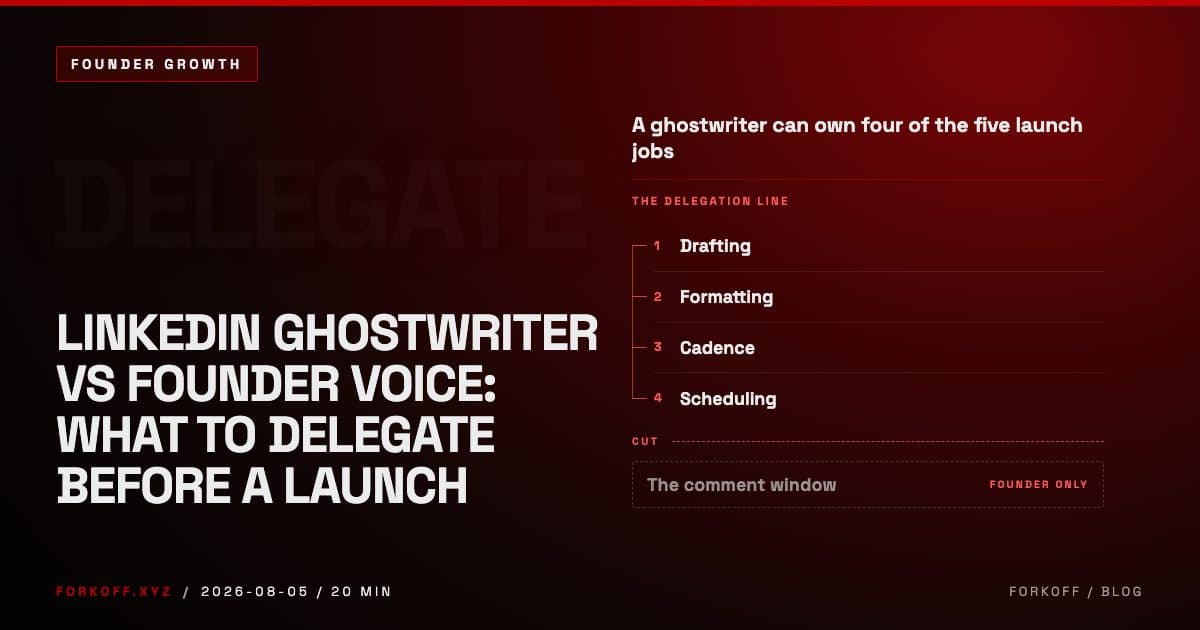
LinkedIn Ghostwriter vs Founder Voice: What to Delegate Before a Launch
A LinkedIn ghostwriter can draft your launch posts. It cannot reply in your comments or show up on the call. Here is where the line actually falls.
Read
Distribution Is the Platform-Team Gap Killing Your Portfolio
Portfolio companies rarely die from bad product. They die in the gap where owned distribution is a function no one on the org chart is staffed to own.
Read
How to Make a Launch Go Viral on X: The 5-Lever Playbook [2026]
How to make a launch go viral on X in 2026, the 5-lever organic playbook, a thumb-stopping hook, wave-timed posting, debate tagging, seeding, recap-bait.
Read
Launch Video Agency vs Production Studio: Who Owns the Distribution?
A production studio sells the film and hands off the file. A distribution-led launch video agency owns the reach. The real decision is asset versus outcome.
Read
Community-Led vs Founder-Led Growth: Which Motion Fits Your Product
Community-led growth vs founder-led growth, compared on tempo, product-fit, failure modes, and the hybrid sequence. A 2026 decision framework for founders.
Read
Cross-Channel CPQL: What 6 Founder Distribution Channels Cost Per Qualified Lead (2026)
Cost per qualified lead across 6 founder distribution channels in 2026: Reddit, X, podcasts, cold email, clipping, and events, with sourced CPQL benchmarks.
Read
The Growth Signal Your Dashboard Hides: Watch Individual Users
Aggregate funnel dashboards hide your real growth signal. The sharpest GTM insight comes from watching how individual users and prospects actually behave.
Read
How to Go Viral on X in 2026: The Launch Runbook to 1M Views
The 2026 runbook for going viral on X: algorithm mechanics, the first-hour window, the 14-day warm-up, and the RADAR test that proves a launch was organic.
Read
The Founder's New-Media Distribution Playbook: Own Your Audience Without a Newsroom
a16z says own your distribution. Most founders cannot staff a newsroom. Here is the distribution-engine playbook that borrows, clips, and owns reach.
Read
The Fundraising Announcement Playbook: How to Announce Your Round So It Compounds (2026)
A funding announcement is a distribution event, not a press release. The 2026 playbook to announce your round so it compounds into pipeline, hires, and brand.
Read
The AI-UGC Playbook: How Apps Like Cal AI Turn Creator Content Into Millions of Downloads
How real apps (Cal AI, Umax, RizzGPT) turn AI-UGC video into millions of installs. The production system, the spend math, and what actually drives app growth.
Read
13 Marketers on the Backlink Tactic Still Working in 2026
Thirteen marketers with receipts on which backlink tactics still compound in 2026, covering original data studies, tools, and broken authority replacement.
Read
Are X Launches a Scam, or a Skill Issue? We Audited 134 of Them
We audited 134 X launch videos. Under 2% crossed 1M views organically and 6 showed bought-amplification signatures. Here is how to tell scam from skill.
Read
Answer Engine Optimization in 2026: The Complete Operator Playbook
Answer engine optimization (AEO) is how you get cited by ChatGPT, Perplexity, Claude, Gemini, and AI Overviews. This is the complete 2026 operator playbook.
Read
How to Get Cited by ChatGPT: 7 Patterns from 50 Verified Citations
7 citation patterns verified across 50 real ChatGPT citations. FAQ schema, named frameworks, stat density, and cross-platform presence. With FORKOFF lab data.
Read
Marketing Agency vs In House Hire: The Full-Cost Matrix (2026)
Marketing agency vs in house hire compared on loaded salary, ramp, churn, tools, and outcome pricing. The full-cost matrix founders need in 2026.
Read
How to Find B2B Leads on Reddit Without Getting Banned: 2026 Case Study
How B2B founders find leads on Reddit without getting banned in 2026. Intent thread monitoring, PPP comment formula, account protection, and campaign outcomes.
ReadShowing 1-18 of 44 blogs
All 44 Founder-growth posts
- The Distribution Learning Curve: Sell Your Own Growth Before You Buy It
- LinkedIn Ghostwriter vs Founder Voice: What to Delegate Before a Launch
- Distribution Is the Platform-Team Gap Killing Your Portfolio
- How to Make a Launch Go Viral on X: The 5-Lever Playbook [2026]
- Launch Video Agency vs Production Studio: Who Owns the Distribution?
- Community-Led vs Founder-Led Growth: Which Motion Fits Your Product
- Cross-Channel CPQL: What 6 Founder Distribution Channels Cost Per Qualified Lead (2026)
- The Growth Signal Your Dashboard Hides: Watch Individual Users
- How to Go Viral on X in 2026: The Launch Runbook to 1M Views
- The Founder's New-Media Distribution Playbook: Own Your Audience Without a Newsroom
- The Fundraising Announcement Playbook: How to Announce Your Round So It Compounds (2026)
- The AI-UGC Playbook: How Apps Like Cal AI Turn Creator Content Into Millions of Downloads
- 13 Marketers on the Backlink Tactic Still Working in 2026
- Are X Launches a Scam, or a Skill Issue? We Audited 134 of Them
- Answer Engine Optimization in 2026: The Complete Operator Playbook
- How to Get Cited by ChatGPT: 7 Patterns from 50 Verified Citations
- Marketing Agency vs In House Hire: The Full-Cost Matrix (2026)
- How to Find B2B Leads on Reddit Without Getting Banned: 2026 Case Study
- New X Algorithm Update 2026: How Grok Now Ranks Every Post
- Credibility vs User Acquisition Campaigns: Which One Do You Need?
- How to Choose a Web3 Marketing Agency After Getting Burned
- Twitter DM Outreach in 2026: The 4-Stage Warm DM Playbook That Beats Cold Email
- AI Agent Blast Radius: The 2026 Brand-Side Marketing Model
- AI Elevates Founder Thinking: The 2026 Positioning Thesis
- Backlink Sources That Actually Work for Startups in 2026
- Launch Platforms Beyond Product Hunt, The 2026 Playbook
- Developer Marketing Strategy 2026: The 5-Surface Stack That Compounds
- How To Launch on Hacker News in 2026: The 5-Lever System
- The 2026 SaaS Distribution Guide: Founder Funnel Reset Tactics
- Founder-Led Growth: The 4-Block Funnel OS
- AI Startup Marketing: 7 Surfaces That Compound
- AI Agency Pricing: 62% Gross Margin Breakdown
- How to Go Viral on X in 2026: 5 Levers Founders Use
- Founder-Led Content: Why AI Cannot Fake It
- First 5 Clients in 30 Days Without a Brand
- Marketplace Cold Start: The 4-Phase Fix From 9 Cases
- Agent-Ready Site Audit: The 2026 Scorecard Founders Run Before Launch
- AI Product Trust Recovery: The Founder Playbook for a Bad Week
- The 48-Hour Model-Drop Playbook: Ride a Competitor AI Launch
- Agent-Native GTM: The 2026 Founder Marketing Stack
- AI Marketing Verification: The 3-Tier Audit Every Founder Needs
- The Founder Funnel: A Revenue Strategy for Solo Founders
- VC Portfolio GTM: How Funds 10x Distribution Return
- The Reddit Intent Engine: How We Turned Comments Into $51K/mo
Read sister categories
Clippings
Creator-led clipping that turns founder content into qualified organic reach. Geotargeted distribution. Audit ledger on every cycle.


Podcast
Founder podcasts that compound. Two to four founder hours per week converted into multi-platform recall, not vanity downloads.

Event Management
Event activations that compound across the calendar. Founder houses, vox pops, hacker houses, and citation blitzes.

Ecosystem Strategy
Ecosystem distribution playbooks for protocols, foundations, and AI platforms past PMF. Builder grants and category narrative architecture.

AI Search and AEO
Getting cited by ChatGPT, Perplexity, Claude and Google AI Overviews. Schema, answer units, and the signals AI crawlers actually read.
Reddit Marketing
Compliant, non-spam Reddit distribution. Operator accounts, subreddit fit, and the moderation rules that decide whether a post survives.
Twitter and X Growth
Founder-led distribution on X. Thread architecture, reply surface, and follower quality over follower count.
Launch Video
Product and company launch video that carries a real launch beat, not a sizzle reel. Format, timing, and what separates reach from noise.
UGC Videos
Creator-made video ads that read as native rather than produced. Briefing, rights, and the volume needed before a winner appears.
KOL and Influencer
Creator and KOL partnerships priced on qualified delivery. Roster screening, authenticity checks, and payout math shown before acceptance.
SaaS GTM
Go-to-market for B2B SaaS past PMF. Qualified pipeline over signups, and the product-health metrics that survive a board review.
Founder-growth engagements that compound
Outcome-priced engagements, audit-proof on every cycle. Five active engagements per quarter, capped on purpose.
Frequently asked questions
How does the FORKOFF blog organize categories?
Each category maps to a FORKOFF service line: clipping, founder-led growth, podcast, Reddit, Discord, activations, plus uncategorized for cross-cutting posts. Each category index aggregates articles in that lane and links to the underlying service.
How often are new articles added to each category?
We publish 2 to 4 operator-grade articles per week across all categories combined. Most categories see 1 to 2 new pieces per month. Higher-velocity lanes like clipping and founder-led growth get more weekly cadence.
Who writes the category content?
Articles are co-authored by FORKOFF operators and the founders we work with. Every claim ties to an audit ledger entry from a live engagement. Each piece is reviewed against our 3-tier verification matrix before it ships.
Can I subscribe to a specific category feed?
Category-specific RSS feeds are available at /blog/<category>/rss.xml (where supported). All categories also ship to @officialforkoff on X and to the FORKOFF newsletter within an hour of publish.
How do I apply for the related engagement?
Each category page has a primary CTA pointing at the matching FORKOFF service. Apply via Calendly for a 30-minute intro. Five engagements per quarter cap, by application only.
Talk to FORKOFF about your founder-growth engagement.
Receipts, deep dives, and playbooks.
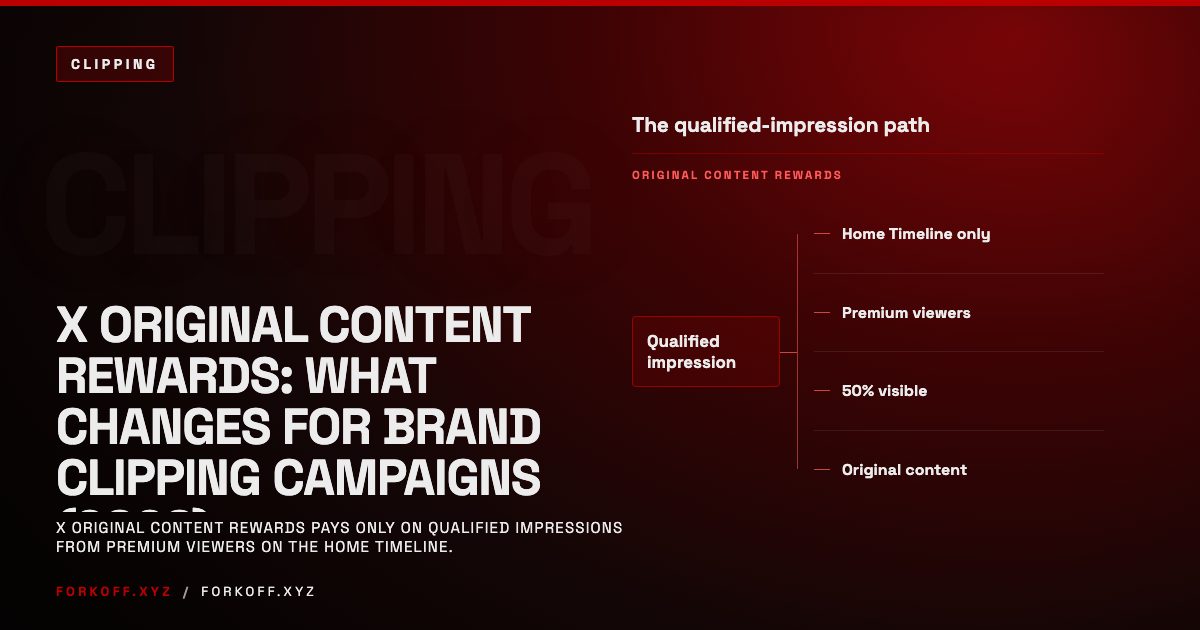
X Original Content Rewards: What Changes for Brand Clipping Campaigns (2026)
X swapped Creator Revenue Sharing for Original Content Rewards, so recycled-clip payouts are gone. What brands running clipping campaigns change now.
Read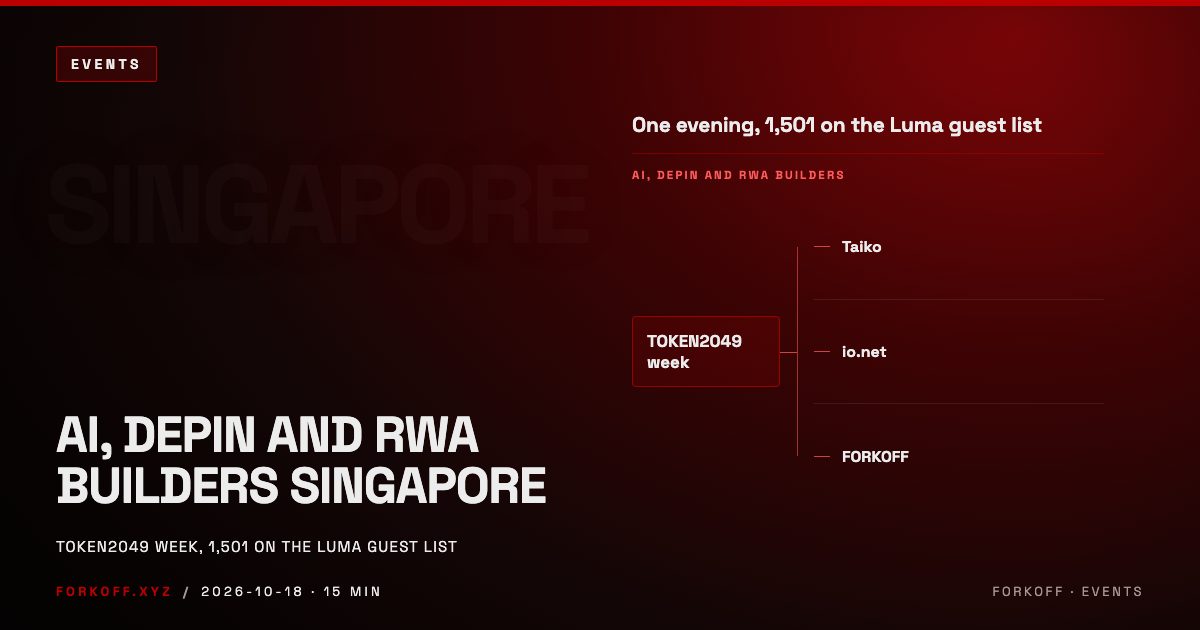
AI, DePIN and RWA Builders at TOKEN2049 Singapore 2025: 1,501 on the Guest List
A recap of AI, DePIN and RWA Builders, the evening side event FORKOFF hosted with Taiko and io.net during TOKEN2049 week in Singapore: panels, partners, data.
Read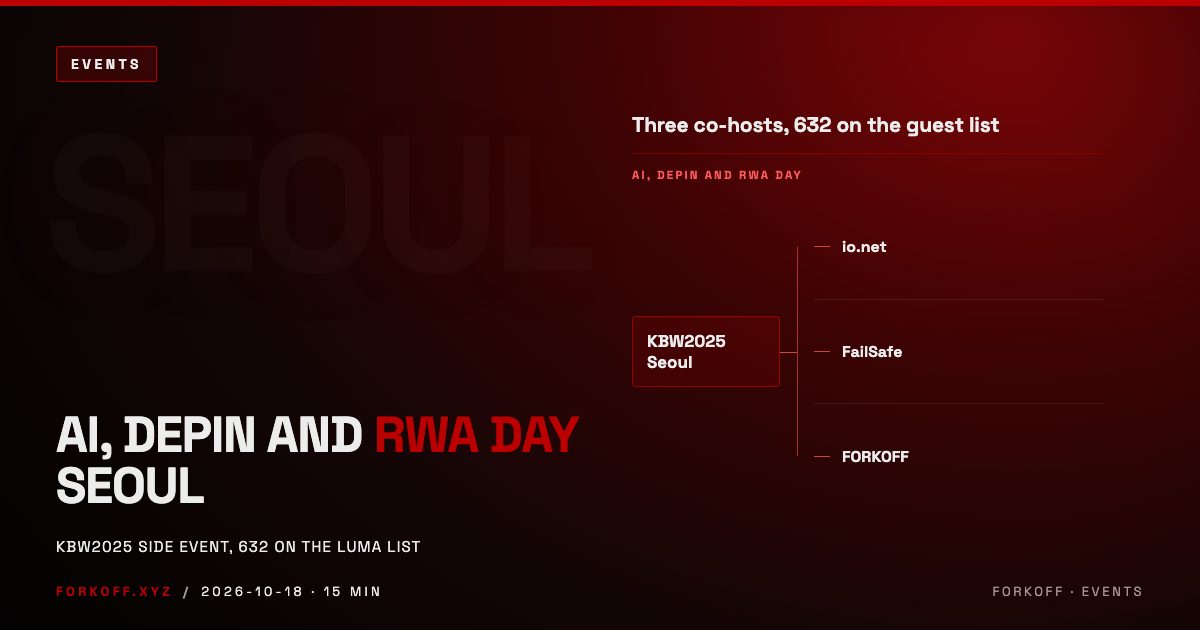
AI, DePIN and RWA Day at Korea Blockchain Week 2025: 632 on the Guest List
A recap of AI, DePIN and RWA Day, the half-day side event FORKOFF co-hosted with io.net and FailSafe in Seoul during KBW2025: hosts, agenda and real numbers.
Read