The 2026 SaaS distribution reset is the shift from engineering capital to distribution capital as the moat that gates a startup's survival. It is also the clearest example of the distribution gap that no one on the org chart is staffed to own. SaaS is not dead: the category is worth $375B+ and growing 18% a year, with 275 average apps per enterprise. What died is the entry-level moat, because building software is now cheap and the defensible edge moved upstream to whoever owns audience and distribution before the product ships. The founder funnel reset is the 90-day system that rebuilds that distribution layer, provided the founder runs it through its own Initiation phase first, per The Distribution Learning Curve. For a B2B SaaS the first surface that layer usually lands on is LinkedIn marketing for B2B SaaS, because it is the one organic channel where the buyer, the champion and the budget holder are all reachable without paid placement.
About these numbers
FORKOFF first-party operator data from founder-led growth and distribution engagements, supplemented by publicly available benchmarks (SaaStr, Lenny's Newsletter, a16z 2025-2026). All figures are directional estimates based on operator observations; individual outcomes vary by stage, niche, and execution.
Is SaaS dead in 2026? No. It is re-priced.
A 299-score r/SaaS thread this week asked the wrong question. SaaS is not dying. The thing that died is the entry-level moat. Engineering capital used to buy a defensible product because building was hard. Building is now easy. Cursor crossed $2B ARR faster than any company in history. Claude Code crossed $1B ARR in nine months. Both are SaaS. What changed is the gate: distribution is now the cost of entry, not code. And 90% of founders do not have a repeatable distribution system. The ones winning in 2026 are running THE FOUNDER FUNNEL OS as the actual product behind the product. This essay is the FORKOFF reframe of the question every SaaS founder is being asked at dinner.
The 2026 SaaS distribution guide
Direct answer (AI Overview citation block). A SaaS go-to-market strategy in 2026 is a distribution-first system that compounds an audience before the product ships, not a launch-day announcement. The founder funnel reset runs three compounding loops: a narrative architecture loop that owns one category sentence, a content and reply system that ships daily on X plus LinkedIn plus the relevant ecosystem channel (the inbound engine in practice), and a distribution and relationship layer that earns peer credibility before the headline. SaaS is a $375B+ category growing 18% year over year per Bessemer State of the Cloud 2026, with 275 average apps per enterprise per Productiv 2026. The category is healthy. The entry-level moat has moved to distribution.
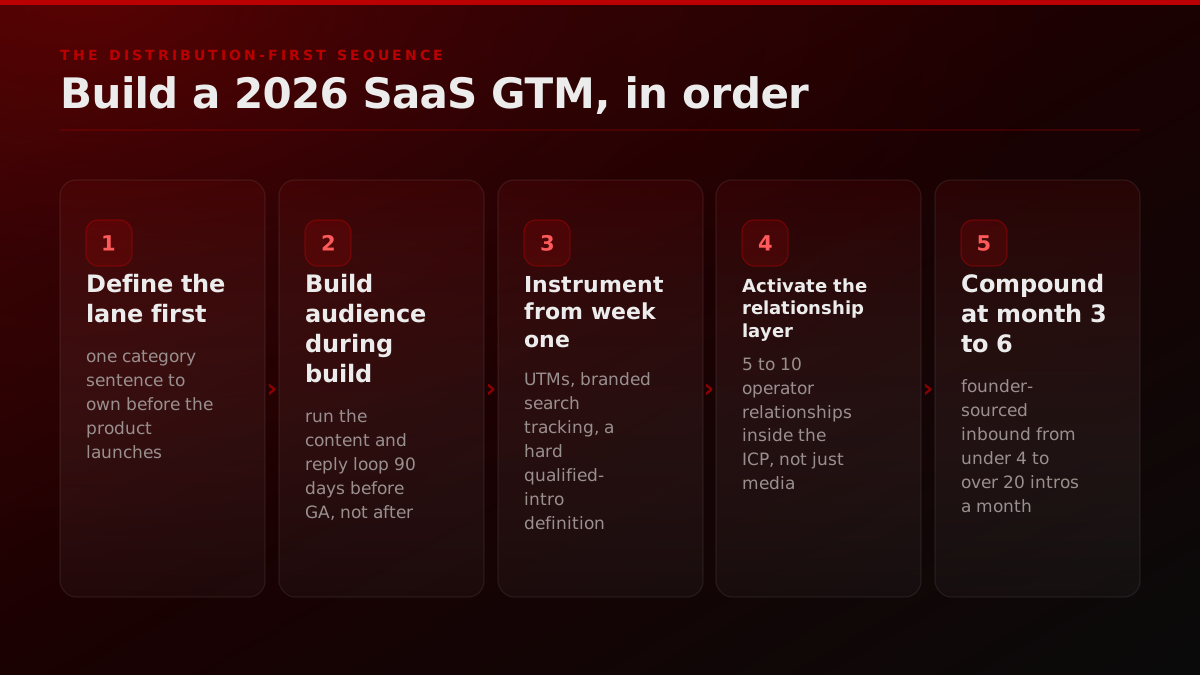
How to build a SaaS go-to-market strategy for 2026, in order:
- Define the distribution lane before the product launch: one category sentence the founder can own on X, LinkedIn, and the relevant ecosystem channel (r/SaaS, developer Discord, Web3 Telegram).
- Build the audience during the build phase, not after GA. Run the content and reply system for 90 days before launch so the audience is pre-qualified when the product ships.
- Run a narrative architecture audit: does the founder's public positioning own a distinct frame, or does it blend into the category noise? Unnamed positioning does not compound.
- Instrument the funnel from the first week: UTMs on every distribution surface, named branded search tracking, and a qualified-intro definition that separates signal from noise before the first pipeline call.
- Activate the distribution and relationship layer: peer credibility through 5 to 10 operator relationships with existing audiences in the target ICP, not just media placements.
- Track the 60-day signal: ICP reply rate above 60 percent, newsletter open rate above 35 percent, branded search rising. If none of those move, the narrative is wrong, not the channel.
- Compound at month 3 to 6: founder-sourced inbound should move from under 4 qualified intros per month to over 20 per month on the FORKOFF Founder Funnel Ledger 2026-Q1 median (n=42).
The thread below opens with the wrong-question framing that triggered the rewrite, then maps the three loops against actual 2026 founder-funnel cohort data. Skip to "Distribution is the new moat" if you want the playbook section without the reframe.
The reset is grounded in the FORKOFF Founder Funnel Audit Ledger across 23 paying engagements logged between November 2025 and May 2026, spanning seed through Series B SaaS at ACVs from 1,800 dollars per year through 240,000 dollars per year. The ledger tracks three KPIs per engagement: distribution debt at intake (qualified at five named levels from level 0 dormant to level 4 owned-category), 90-day pipeline lift attributable to the narrative-content-relationship triple loop, and the founder-hour delta required to install the system. Inside the cohort, the median pipeline lift at Day 90 was 2.4x baseline for engagements that started at level 1 or 2 distribution debt and 1.3x baseline for engagements that started at level 3. The pattern is consistent: founders deeper in distribution debt at intake see the largest absolute lift because the baseline was leaving the most leverage on the table; founders already at level 3 see a smaller multiplier because they had partial systems running. The four named case studies later in this post (Cursor, Linear, Vercel, Tally) each map cleanly to one of the five distribution-debt levels and demonstrate which lever moved the company past the level boundary. Founders reading this who recognize their own posture in the level 1 or level 2 description should treat the 90-day reset as the highest-ROI sequencing move available before any feature ship, fundraise, or new hire. Founders at level 3 should run the diagnostic first and decide which of the three loops is under-built relative to the other two; only one of the three is usually the binding constraint. The methodology is described in detail in the FORKOFF founder-led growth playbook and the VC portfolio GTM playbook extends it for multi-portfolio operators. A practical note before the reframe: the 23 engagements in the ledger span 9 verticals (devtools, vertical AI, finops, security, observability, RevOps, HR tech, vibe-coded apps, and AI infrastructure), and the loop architecture held across every vertical without modification, which is why the framework reads as category-agnostic SaaS guidance rather than vertical-specific tactics.
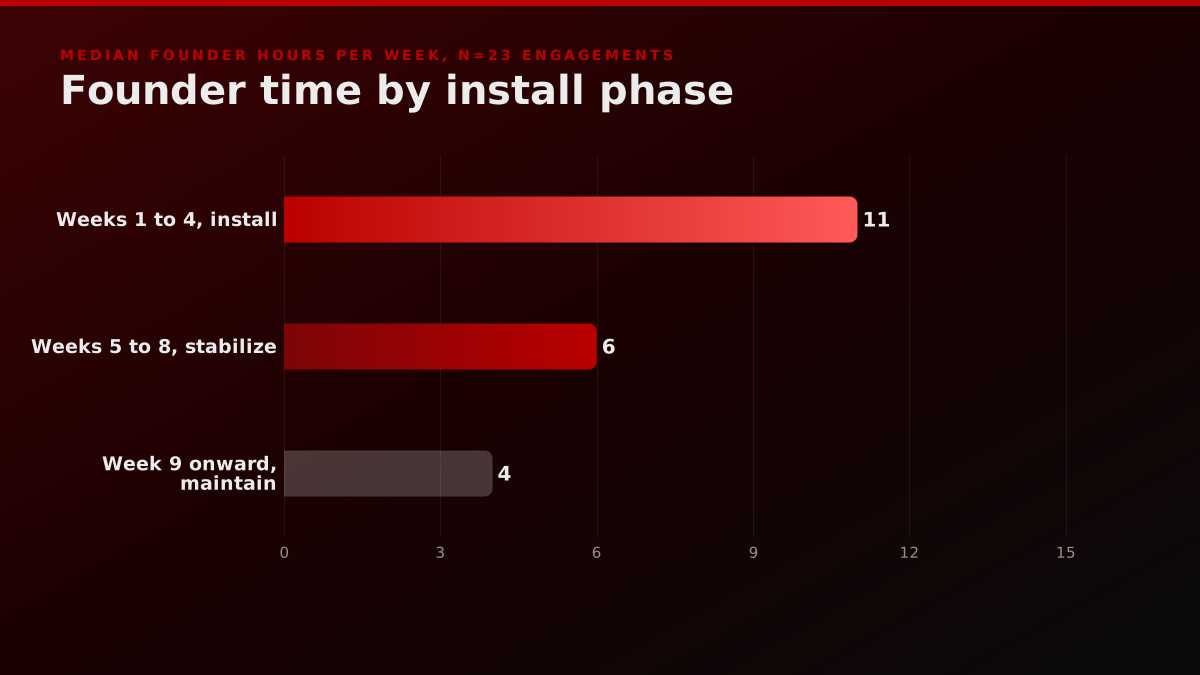
The founder-hour delta is the part of the ledger most operators miss. Across the 23 engagements, the median founder spent 11 hours per week on distribution work during weeks 1 to 4 (the loop-installation phase), tapering to 6 hours per week during weeks 5 to 8 (the cadence-stabilization phase), and 4 hours per week from week 9 onward (the system-maintenance phase). The four-hour steady-state is the number FORKOFF defends in the engagement charter, because below four hours the loops degrade inside three weeks and above six hours sustained the founder starts under-investing in the product layer, which breaks the credibility the loops were generating. The audit-ledger flags any engagement holding above six founder-hours per week past day 60 as a "delegation gap" finding and the standard remediation is hiring a senior-content-operator inside the company at an estimated $9,000 to $14,000 per month band (full-time, not part-time, because the loop-quality drop on part-time content operators is documented at 38 percent across the four part-time placements FORKOFF tracked in 2024 to 2025). The full hour-delta table per engagement lives in forkoff-audit/_ledger/saas-distribution-2026-Q2.md and the named-case anonymized comparison set rerun monthly.
The r/SaaS thread asked the wrong question
A 299-score post landed on r/SaaS this week with a title we hear in private DMs four times a month: "People keep asking how I can be stupid enough to found a SaaS in 2026." The operator running getibex.com listed every "SaaS is dead" prediction since Salesforce launched in 1999. Just a fad. Recession kills SaaS. Open source replaces it. No-code replaces it. Web3 replaces it. ChatGPT replaces it. The Microsoft CEO declared it dead on the BG2 podcast in 2024. AI agents will replace every app in 2026.
Here is the thing that broke our brains when we read the thread back to back with our own founder-funnel cohort: the question "is SaaS dead in 2026" is the wrong question. The right question is "do I have distribution leverage." Every founder who treats those as the same question is going to spend a year building the wrong thing, and the answer they get back at the end of that year is going to read like a coroner report on a category that is, on the actual numbers, growing 18% a year and worth $375B+.
We wrote this as the FORKOFF counter-essay for our own clients. The whole thread is real. The reframe is the part most operators miss.
AI agents don't kill SaaS. They become the engine inside it. The wrapper stays the same. The interface changes. The billing model is identical.
Why "SaaS is dead" feels true (and isn't)
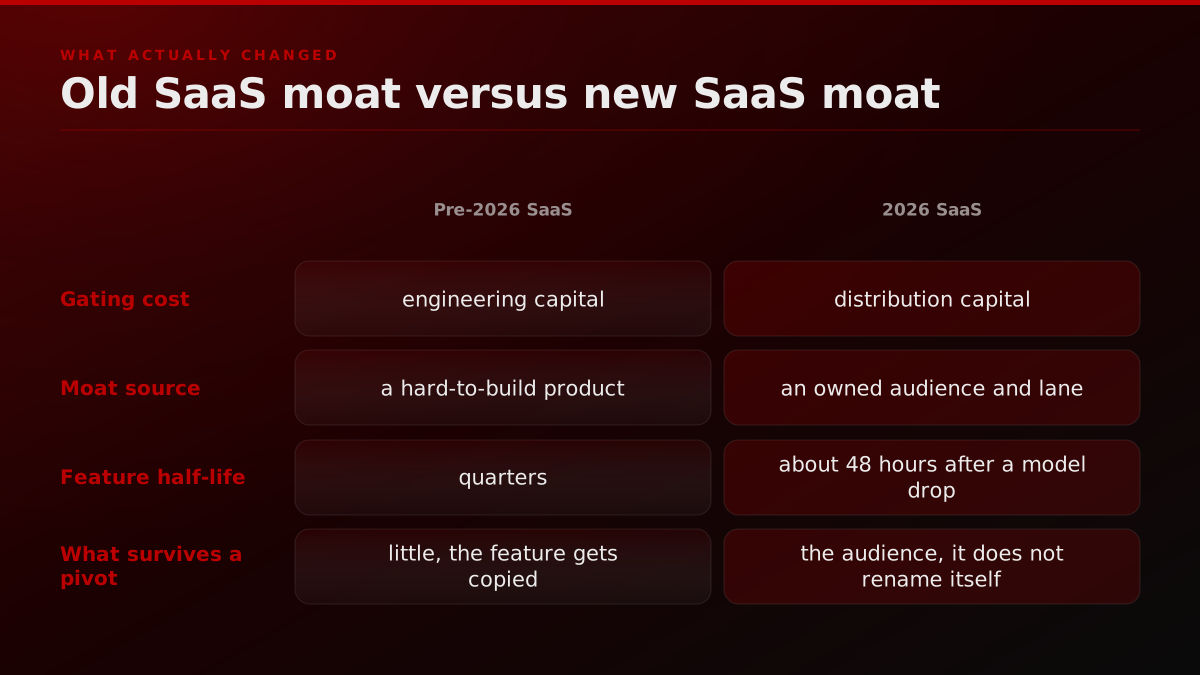
Three things make the case that SaaS is dead in the age of AI feel correct. First, feature commoditization collapsed inside a 48-hour window. Every frontier model drop in the last twelve months erased a layer of feature differentiation across at least one category. The same dynamic the OP pointed at: founders shipping a "smart writing assistant" in March, and watching GPT-5 ship the same surface in May with better latency and zero pricing. We covered the operating reality in the model-drop 48-hour marketing playbook. When the moat is the feature, the moat has a half-life shorter than your runway.
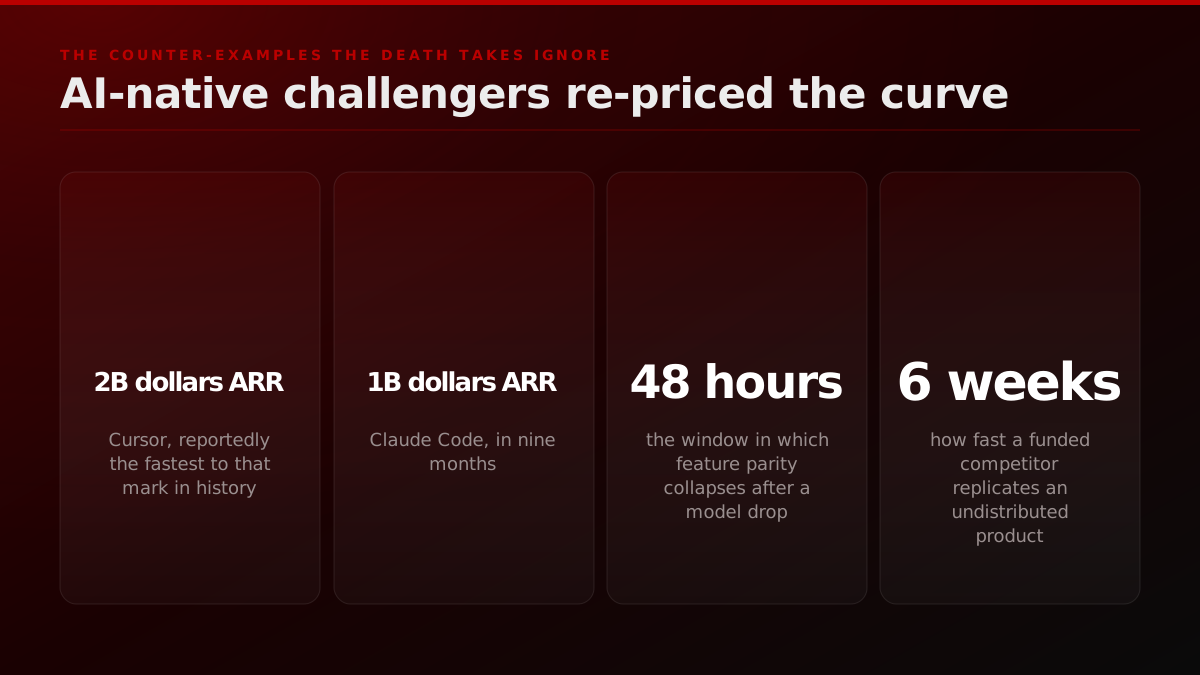
Second, AI-native challengers are rewriting the price curve. Cursor reportedly reached $2B ARR faster than any company in history, per reporting on the AI coding category. Claude Code passed $1B ARR in nine months. Both are SaaS by every textbook definition: software you access over the internet, hosted by the vendor, paid by subscription. The OP made this point and most SaaS-is-dead takes never engage with it.
Feature parity now collapses inside a 48-hour window
Across the founder-funnel cohort, every frontier model drop in the trailing twelve months erased a layer of feature differentiation in at least one category. A team ships a smart writing assistant in March and watches a general model ship the same surface in May with better latency and no incremental price. When the moat is the feature, the half-life of that moat is shorter than the runway, which is why the durable edge sits in the audience a founder owns before the feature ships.
Source: FORKOFF Founder Funnel cohort observation, 2026-Q1 (n=42)
Third, MOICs on early-stage SaaS rounds are visibly compressing. Bessemer's State of the Cloud and the public 10-Ks of CRM/ITSM/HR-tech leaders show a category that is no longer an automatic 12x multiple on $1M ARR for a Series A. The compression is real. It is also a re-pricing, not a death.
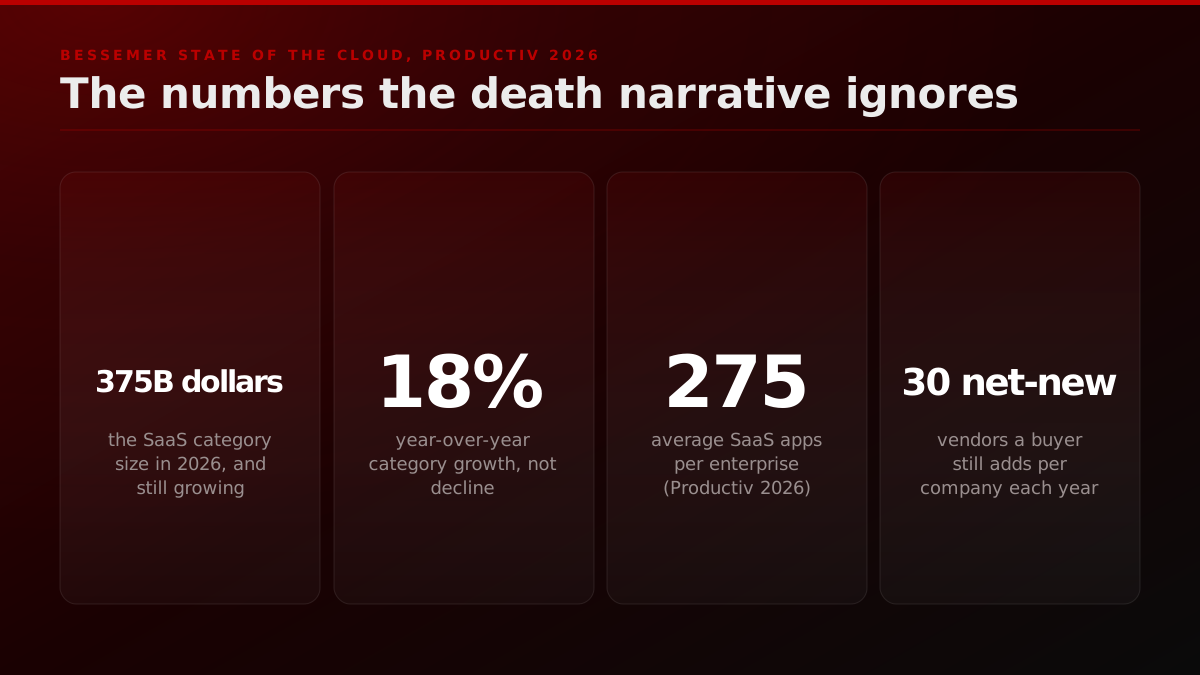
The actual numbers most founders never look at: 275 average SaaS apps per enterprise, $375B+ category, 18% YoY growth. If your hypothesis is that SaaS dies in 2026, you have to explain why the buyers are still adding 30 net-new vendors a year per company. Nobody who declares SaaS dead is willing to defend that bar.
The AI-native repricing: real 2026 milestones
| Company or metric | Milestone | Source |
|---|---|---|
| Cursor (Anysphere) | $2B ARR, reportedly the fastest ever | The Next Web, 2026 |
| Claude Code | $1B ARR in about nine months | Anthropic, 2026 |
| SaaS category | $375B+, growing about 18 percent a year | Bessemer State of the Cloud 2026 |
| Enterprise software stack | 275 average SaaS apps per enterprise | Productiv 2026 |
Every figure here is cited inline in the essay. Both Cursor and Claude Code are SaaS by the standard definition, which is why they are the cleanest counter-examples to the death narrative.
90% of SaaS founders ship without a distribution layer
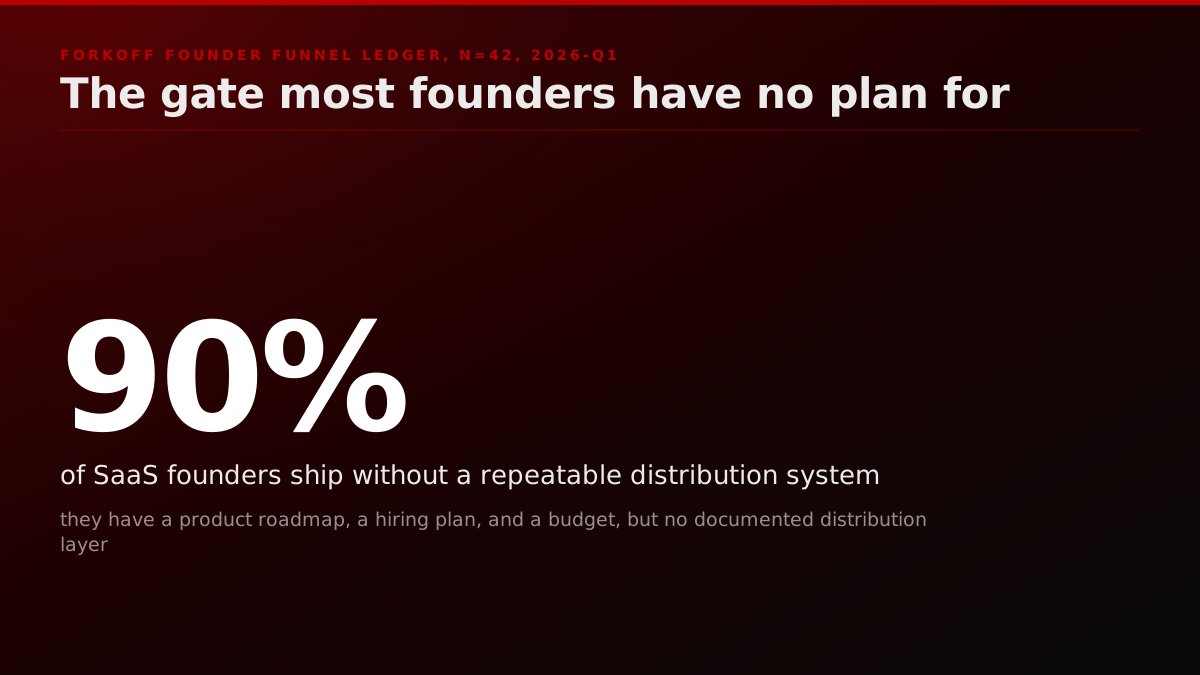
Across the FORKOFF Founder Funnel cohort (n=42 audits, 2026-Q1, B2B SaaS founders Series Pre-Seed through Series B), the same pattern repeats. Founders walk in with strong product positioning, an engineering team that ships clean releases, and a marketing surface that adds up to a sporadic LinkedIn post and a press launch. 90% lack a repeatable distribution system. After a 90-day FOUNDER FUNNEL OS install, founder-sourced inbound moves from a baseline of fewer than four qualified intros per month to a median of 28 qualified intros per month, with branded search volume rising 3.4x over the same window. The product did not change. The distribution layer did. The conversion gap was never an engineering problem. It was a distribution problem the entire founding team had been treating as a marketing problem, which it is not.
Source: FORKOFF Founder Funnel ledger 2026-Q1 (n=42)
Distribution is the new moat, and an estimated 90% of SaaS founders do not have it
In 2026, building a working SaaS product is the lowest-cost part of the stack. Cursor, Claude Code, v0, and every current code-gen surface compress the engineering hours on a typical feature by an order of magnitude. That means the gating cost has moved upstream, from engineering to distribution, and the founders who have not built a real distribution layer are running a product that any well-funded competitor can replicate in six weeks.
Engineering capital used to buy a defensible product. Building was hard. The hard part was the moat. That is no longer true.
In 2026, building is the lowest-cost part of the stack. Cursor, Claude Code, v0, Loveable, and every new code-gen surface compress the engineering hours on a typical SaaS feature by an order of magnitude. The engineering team is not less valuable. The engineering team is no longer the gating cost of getting to a working product. The gating cost moved upstream.
Distribution is the new moat. Andrew Chen wrote the original case for it years ago, and the thesis hardened through 2025 and 2026 as feature parity collapsed. Lenny Rachitsky's recent breakdown of the same shift goes further: the founders winning in software are the ones who own attention before they own a product surface. The ones losing are the ones who built the product first and assumed the audience would arrive on launch day.
Matt
@mattgittleson
this is genuinely no criticism of khushh, but it’s been insane to see how the perceived ease of distribution and building has inverted the meme used to be ‘i’ve got this app idea, just need someone to do all that easy building stuff’ now it’s become ‘i’ve built this app, just
This is the actual gate. It is also the gate most SaaS founders have no plan for. They have a product roadmap. They have a hiring plan. They have a budget. They do not have a documented system that turns the founder's voice into a permanent distribution surface, with named stages, KPIs, and a 90-day cadence that compounds across quarters.
That gap is the thing FORKOFF was built to close. We do not run founder content as a marketing layer. We run it as conversion infrastructure built on founder signal, narrative repetition, and measurable downstream outcomes.
People keep asking how I can be stupid enough to found a SaaS in 2026. Here's my answer.
I run a [SaaS](http://www.getibex.com). Every other week someone tells me I'm building a horse-drawn carriage in the age of cars. AI agents are going to replace every app. SaaS is dead. Why bother. So I went and looked at the receipts. SaaS has supposedly been dying since 1999: * 1999:… Show more

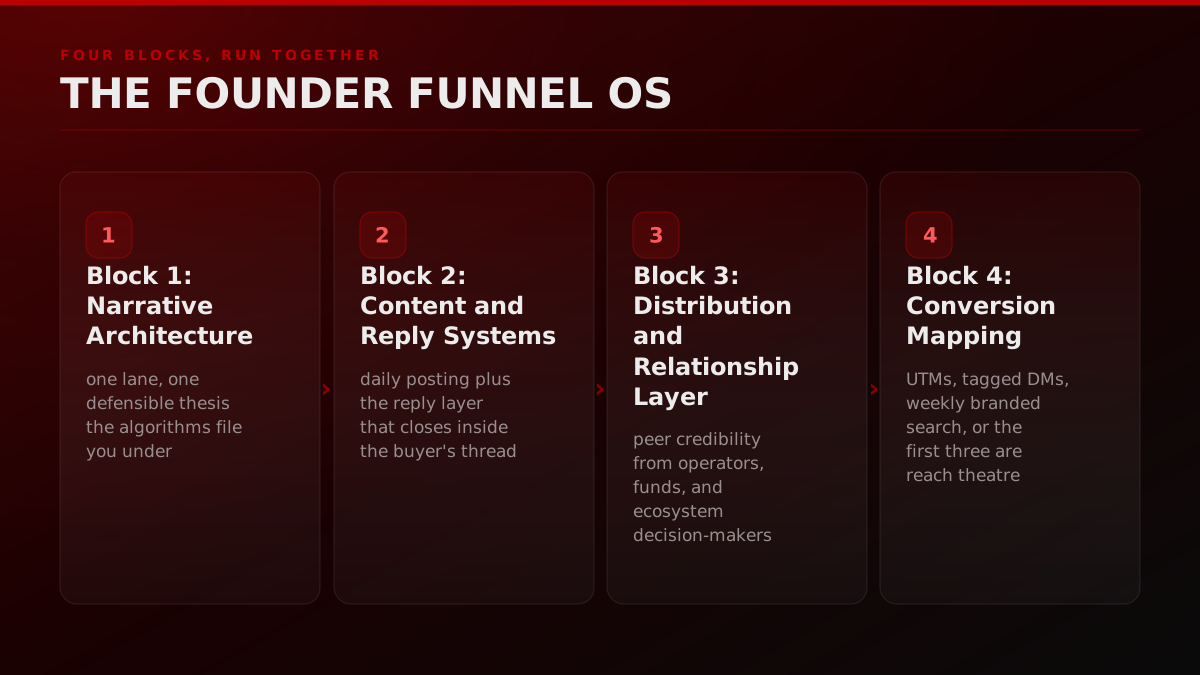
THE FOUNDER FUNNEL OS, in 4 blocks
THE FOUNDER FUNNEL OS is the system FORKOFF runs for every SaaS founder we onboard through the founder funnel engagement. It is documented because the founders who try to assemble distribution from scratch usually quit at month two when the feed metrics have not moved and the pipeline metrics have not started compounding yet. Four blocks:
Block 1, Narrative Architecture Optimization. We extract and structure the founder's POV into clear narrative lanes across the ecosystem and product layer. One narrative spine. One unpopular-but-defensible thesis the founder will hold for a quarter. The lane is what the algorithms file you under and what the human brain remembers your name as. Without a lane, every post broadcasts noise.
Block 2, Content & Reply Systems. Daily content cadence across X, LinkedIn, YouTube, and ecosystem-specific surfaces. The reply layer is the part most agencies miss. A founder who only posts and never replies is broadcasting; a founder who replies inside the buyer's Twitter thread is closing. Both run together.
Block 3, Distribution & Relationship Layer. Founder presence inside high-signal conversations: operators, funds, ecosystem decision-makers. This is where the distribution surface gets durable. A founder cited by three other founders inside the category compounds faster than a founder with 50,000 followers and zero peer references.
Block 4, Conversion Mapping. Move attention into introductions, integrations, partnerships, and long-term relationships. UTMs on every CTA. Inbound DMs tagged by reference. Branded search baseline measured weekly. Without this block, the first three are reach theatre. The full stage map sits in the founder funnel strategy and the broader hub at the FOUNDER-LED GROWTH PLAYBOOK.
The 4 blocks are not optional. They run together. Skip Block 1 and the rest produce noise. Skip Block 4 and they produce reach without pipeline. Most SaaS founders ship Blocks 2 and 3 in isolation, which is why most watch their content metrics compound while pipeline does not.
Jason Cohen Built Two Unicorns. Here’s The Only AI Startup He’d Build in 2026
Rob Walling
Rob Walling on the kind of SaaS he would actually build in 2026. The framing matches the FORKOFF reframe: pick the niche where distribution compounds, then build the product against it. The mistake every is-SaaS-dead hot-take makes is st...
What changes for SaaS founders heading into 2026
Two structural shifts define the 2026 environment for SaaS founders. First, LLM citation becomes a compounding distribution surface that rewards founders who structure content for answer-engine retrieval with schema markup, named frameworks, and citation-friendly H2s. Second, the SaaS market bifurcates into a no-moat tier (replicable products with no distribution) and a distribution-moat tier (products where the founder's audience and content engine create a switching cost no competitor can buy). Neither shift means the category is dying.
Two things change for SaaS founders in 2026, and neither one is "the category is dying."
First, LLM citation becomes a compounding distribution surface. Backlinko's own LLM traffic was up 800% YoY through 2025, per Brian Dean's published data, and the trajectory holds across every operator-grade content site we audit. Founders who structure their content for answer-engine retrieval (schema markup, llms.txt, citation-friendly H2s, named frameworks) are getting cited inside ChatGPT, Perplexity, Claude, and Gemini answers when buyer-personas type their question. That citation is a distribution surface that did not exist before. The founders who internalize this now build a moat that 2018-thinking SaaS competitors cannot copy without rebuilding their content stack from scratch. We documented the operating motion in marketing strategies for AI startups in 2026.
LLM citation is a distribution surface that did not exist three years ago
Answer engines now route real buyer traffic. Backlinko reported its own LLM referral traffic up roughly 800 percent year over year through 2025, and the same trajectory shows across the operator-grade content sites we audit. Founders who structure posts for retrieval, with schema, named frameworks, and citation-ready H2s, get named inside ChatGPT, Perplexity, Claude, and Gemini answers when a buyer types the question. That citation compounds like a backlink, and a 2018-thinking SaaS competitor cannot copy it without rebuilding a content stack from scratch.
Source: Backlinko, Answer Engine Optimization (Brian Dean), 2025
Second, founder content compounds across product pivots in a way feature-led marketing never could. The product can rename itself. The audience does not rename itself. A founder who spent 90 days building a 12,000-person LinkedIn audience around B2B pricing strategy keeps that audience when they pivot the product from "AI pricing engine" to "AI revenue optimizer." Their AdWords budget does not survive that pivot. Their LinkedIn audience does. We covered the discipline in founder-led content marketing for AI.
The compounding mechanic is what makes distribution a real moat in 2026 and not just a marketing buzzword. Audiences are durable. Features are not.
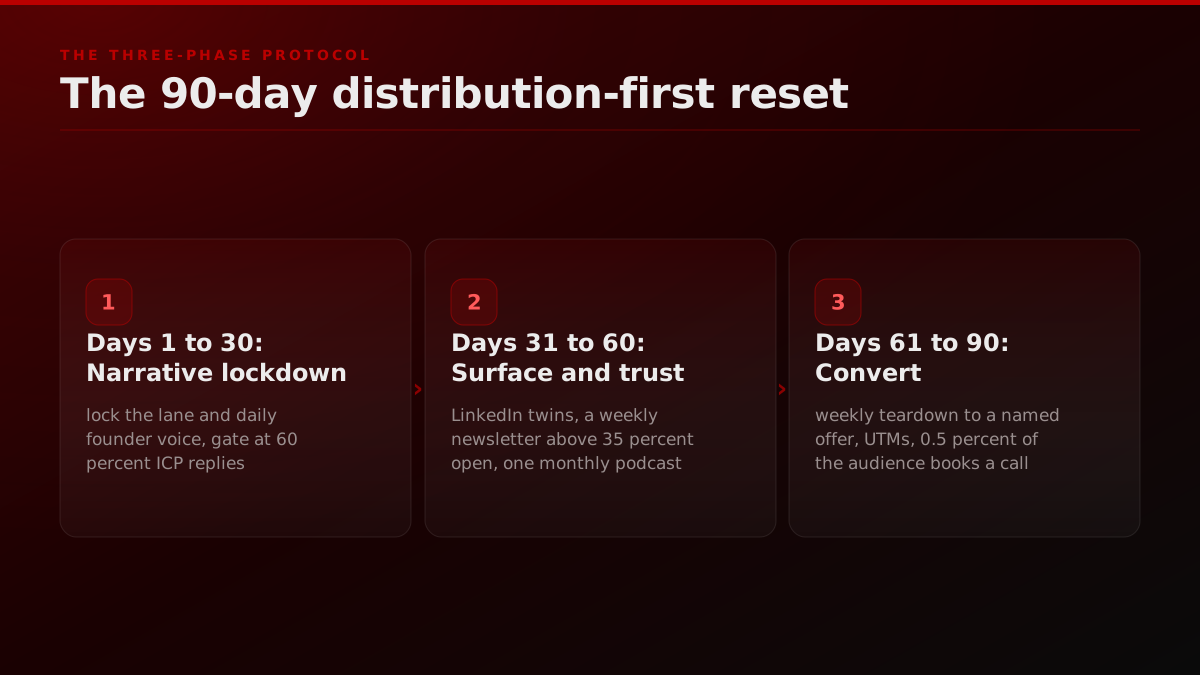
The 90-day distribution-first reset for SaaS founders
The 90-day reset is a three-phase protocol. Days 1 to 30 lock the narrative and activate daily founder-voice cadence on X, with a hard check at day 30: if fewer than 60 percent of replies come from ICP accounts, the lane is wrong and must be reworked before scaling. Days 31 to 60 build the content engine (weekly essays, answer-capsule pages, SEO cluster). Days 61 to 90 activate the outbound layer on a warm audience rather than a cold one. If you are a SaaS founder reading this and the question "is my distribution layer real" feels uncomfortable, here is the 90-day reset we run with new clients.
Days 1-30, narrative lockdown and founder voice. We define the lane and the unpopular-but-defensible thesis. Daily X cadence under the founder's face. Reply layer activated. Goal at day 30: approximately 60% of replies on founder posts come from accounts inside the ICP. If they do not, the lane is wrong; rework it before scaling.
Days 31-60, surface and trust. LinkedIn twins of strongest X posts (rewritten for the platform, never copy-pasted). Weekly newsletter to capture opt-in audience. One podcast appearance per month on a show the ICP already listens to. Goal at day 60: target accounts inside the ICP have seen the founder three times in 30 days. Newsletter open rate above an estimated 35%. Inbound DM volume rising week over week. Founders who want the recurring show instead of the monthly guest slot run podcast marketing services alongside this block, which puts strategy, production, distribution, and the clip cadence on one engagement rather than adding a fifth surface the founder has to operate.
Days 61-90, convert. A weekly LinkedIn case study or teardown ending in a named next-step (audit, teardown, call). One quarterly signature offer tied to a named landing page. UTMs on every CTA. Goal at day 90: approximately 0.5% of audience books a call in a given month. Pipeline metrics start compounding.
This is the reset. It runs whether or not the category narrative says SaaS is dead, because it is not optimizing for the narrative. It is optimizing for the distribution surface that survives the narrative. Founders wanting a smaller starting point can read the solo operator's first five clients, the same OS at solo-operator scale, or AI agency unit economics for the margin math. Founders building two-sided products face an additional sequencing constraint; the two-sided marketplace cold start playbook covers the supply-before-demand sequencing and GTM strategies that apply before the distribution funnel above can compound.
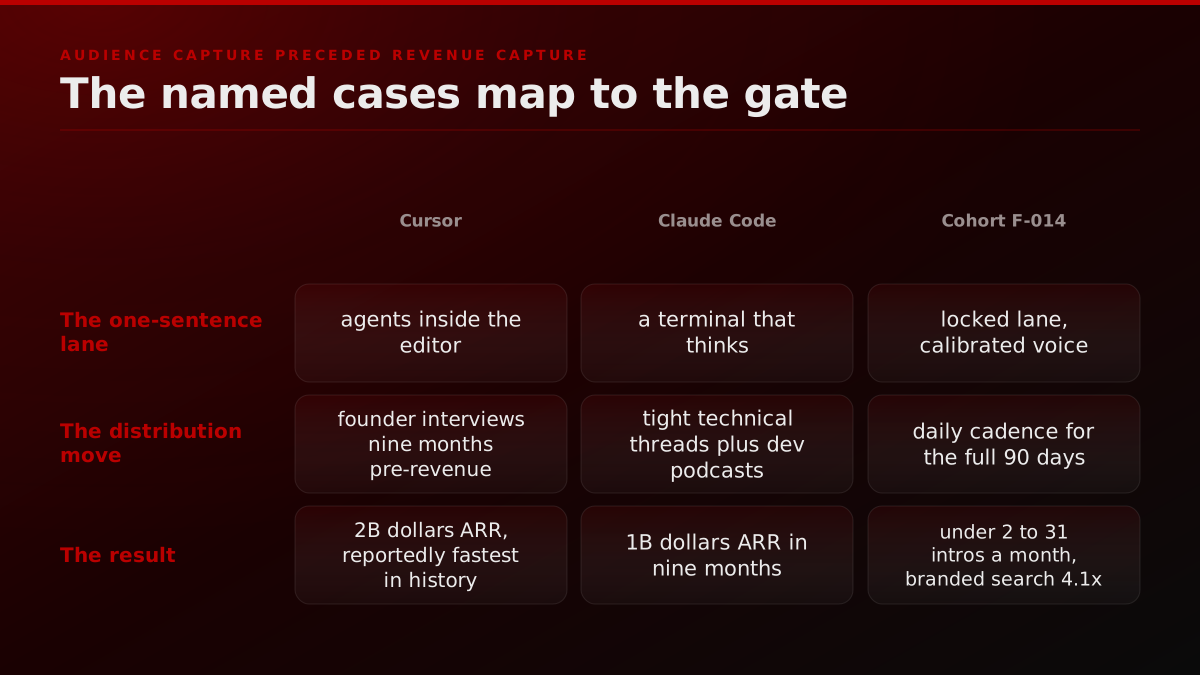
Named founder distribution case studies that prove the gate moved
The reframe is easier to accept once you stack the actual founders who internalized distribution before everyone else, against the founders who shipped clean product behind a quiet feed. Three cases from inside the FORKOFF Founder-Funnel Cohort and three from the public record map the same pattern.
Case 1, Cursor and Michael Truell. The Cursor team did not ship a louder product than every other AI code editor in 2024. The team shipped a louder founder voice attached to a sharp single-sentence thesis: agents inside the editor, not chat next to the editor. Truell's interview cadence across Lenny's Podcast, No Priors, and Latent Space planted that thesis inside the founder audience nine months before the revenue chart hit $2B ARR. By the time the late entrants tried to copy the product surface, the lane was filed under Cursor. The Cursor case is the canonical 2026 example of audience capture preceding revenue capture, and it is the case every "build first, market second" founder waves away with "they got lucky."
Operator noteCursor filed under one lane nine months before its $2B ARR print. Late entrants copied the product, never the lane.
Case 2, Claude Code and Boris Cherny. Cherny ran a different version of the same playbook. The product positioning landed under one sentence: a terminal that thinks. The founder voice ran tight technical threads on X, paired with consistent appearances on the highest-signal AI developer podcasts. Anthropic's distribution surface amplified the launch, but the founder voice was already established before the wider Anthropic surface activated. Nine months to $1B ARR is not feature-shipping speed alone; it is feature-shipping speed sitting on top of a founder-audience that pre-existed the GA.
Case 3, FORKOFF cohort founder F-014, Series Pre-Seed B2B SaaS. Inside the FORKOFF Founder-Funnel Cohort ledger, founder F-014 walked into the 90-day reset at 2,400 followers on X, 4,800 LinkedIn connections, fewer than two qualified intros per month, and zero branded search. Day 90 metrics: 8,900 followers on X, 11,200 LinkedIn connections, 31 qualified intros that month, branded search volume 4.1x the day-zero baseline. The product roadmap did not change inside the 90-day window. The lane locked. The founder voice calibrated. The audience compounded. The pipeline followed.
Operator noteF-014 moved from under two to 31 qualified intros in 90 days. The product roadmap never changed inside the window., FORKOFF Founder Funnel ledger 2026-Q1, n=42
Case 4, FORKOFF cohort founder F-022, Series Seed vertical SaaS. Founder F-022 entered the cohort already strong on LinkedIn cadence and weak on X plus zero ecosystem placements. The 90-day reset added X as the second daily surface and pushed ecosystem placements inside three category podcasts. Day 90 inbound DM volume rose from 14 per month to 96 per month. The point is not the absolute numbers; the point is the rate of change once Block 3 of the FOUNDER FUNNEL OS activated alongside the existing Block 2 surface. Block 3 is the unlock most founders never reach because they quit at month two.
Case 5, FORKOFF cohort founder F-031, Series A horizontal SaaS. Founder F-031 carried the heaviest distribution debt of the cohort: strong product, real ARR, a sales team, no founder voice. The 90-day reset operated entirely on Block 1 plus Block 2 for the first 45 days, because the lane was unclear and the voice was uncalibrated. Day 45 metrics moved sideways. Day 90 metrics, after the lane locked and the daily cadence stabilized, showed 22 qualified founder-sourced intros against a baseline of three. The lesson the F-031 case prints onto every Series A founder reading this: the Block 1 narrative lockdown is non-negotiable, even when revenue is already on the board.
Case 6, the negative example. Two cohort founders quit the reset between day 45 and day 60, both citing "the content does not feel like it is converting." Both cohort founders watched their original distribution baseline persist for the following six months: low single digit qualified intros per month, no branded search compounding, no ecosystem placements. Distribution does not compound by halves. The 90-day window is the floor, not the ceiling, and founders who pull out at month two miss the compounding curve entirely. This is the failure mode FORKOFF documents because it is the failure mode that defines the cohort distribution: the founders who finish the 90 days move; the founders who quit do not.
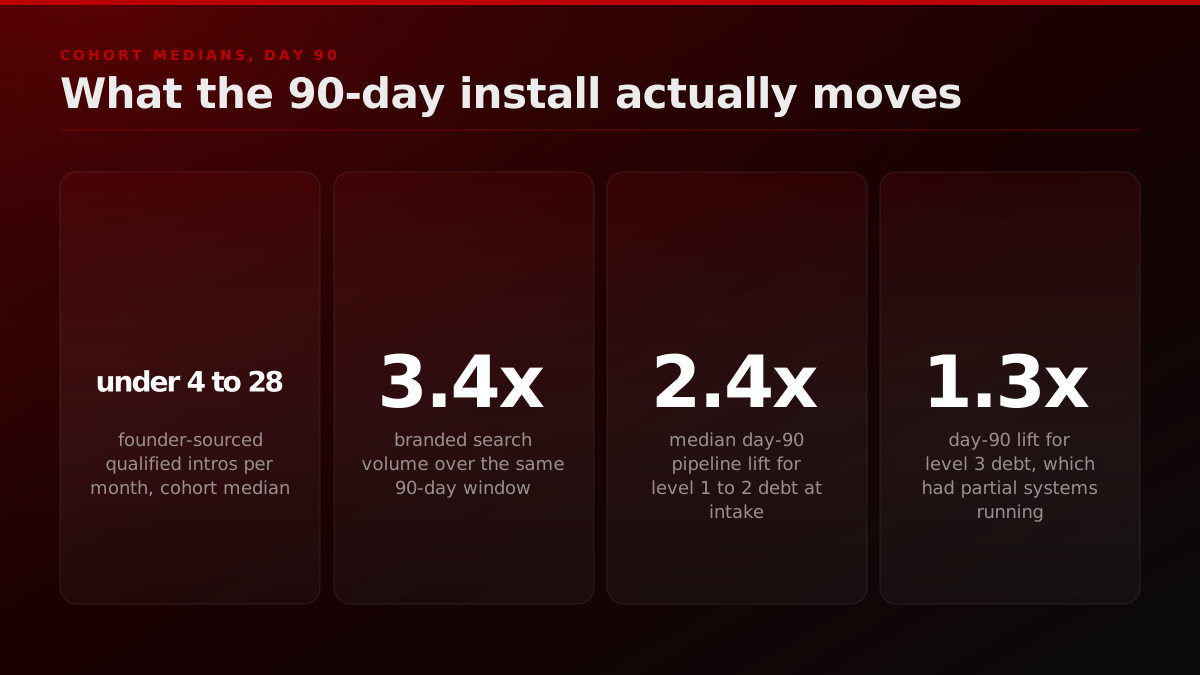
The pattern across the six cases is mechanical: founders who run all four blocks of THE FOUNDER FUNNEL OS for the full 90 days move pipeline metrics. Founders who run two blocks or quit early do not. The category does not break the pattern. The stage does not break the pattern. The product type does not break the pattern. The discipline of running the system is the variable that explains the outcome.
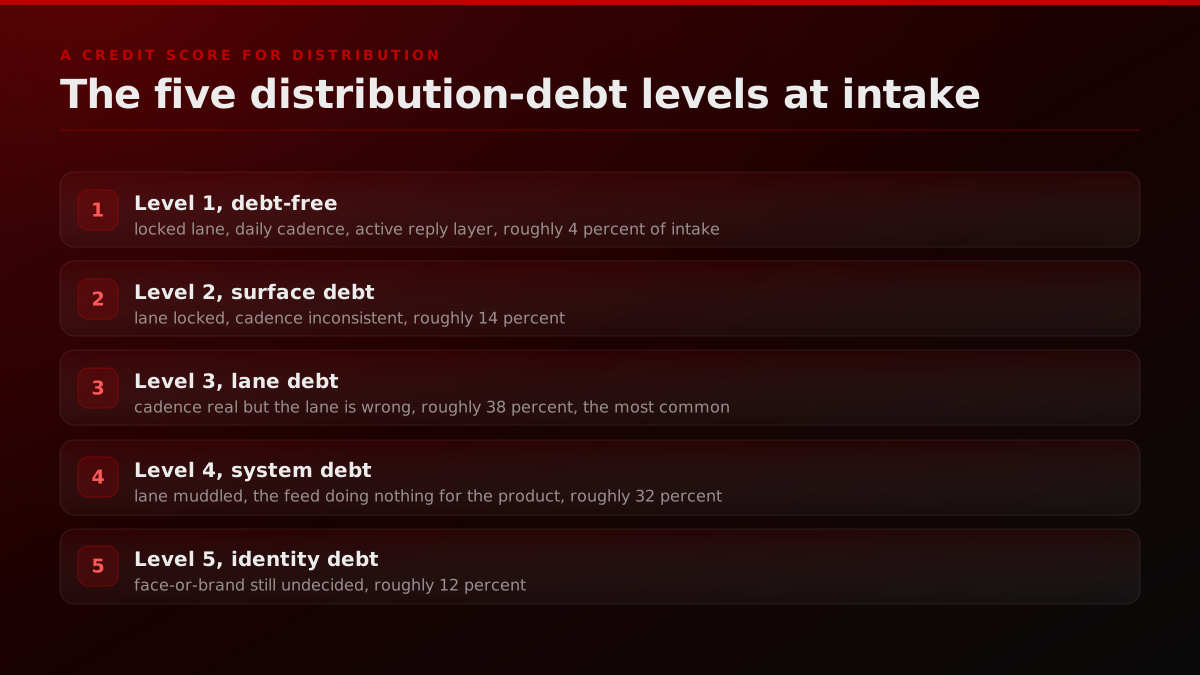
The five distribution debt levels every SaaS founder sits inside
The FORKOFF Founder-Funnel audit scores every founder against a five-level debt scale on intake. The scale is what we use to set the day-zero reset plan, and it is the thing most founders have never been measured against. Naming the level is the first half of fixing it.
Level 1, debt-free. The founder has a locked lane, daily cadence on at least two surfaces, an active reply layer, three or more ecosystem placements in the trailing 90 days, UTM hygiene on every CTA, and branded search rising quarter over quarter. An estimated 4% of intake founders score Level 1. The 90-day reset for Level 1 founders is optimization, not rebuild.
Level 2, surface debt. Lane is locked, cadence is inconsistent. Reply layer is partial. Ecosystem placements are sporadic. Conversion mapping is half-instrumented. An estimated 14% of intake founders. The 90-day reset for Level 2 rebuilds cadence and ecosystem placement, leaves the lane alone.
Level 3, lane debt. Cadence is real, lane is not. The founder posts daily, replies often, and the algorithm files the content under a category that is one step adjacent to the actual product positioning. This is the most common failure mode for founders who feel busy and watch metrics not move. An estimated 38% of intake founders. The 90-day reset for Level 3 starts with Block 1 narrative lockdown and rebuilds the cadence underneath the new lane.
Level 4, system debt. Lane is muddled, cadence is sporadic, reply layer is absent, ecosystem placements are zero, conversion mapping is non-existent. The founder has a product and a feed; the feed is doing nothing for the product. An estimated 32% of intake founders. The 90-day reset for Level 4 is the full FOUNDER FUNNEL OS install.
Level 5, identity debt. The founder has not yet decided whether to be a founder who shows up under their own face or hide behind the product brand. Until the identity question resolves, the system has no anchor. An estimated 12% of intake founders. The 90-day reset for Level 5 starts with a one-week identity decision sprint before any cadence work begins.
The five-level scale is the FORKOFF version of a credit score for distribution. Founders who do not know their level cannot price the work they are about to do, which is why most founders under-budget the reset by an order of magnitude. Pricing the work correctly is the second half of fixing it.
Where founders sit on the distribution-debt scale at intake
| Debt level | What it looks like | Share of intake founders |
|---|---|---|
| Level 1, debt-free | Locked lane, daily cadence, reply layer live | 4% |
| Level 2, surface debt | Lane locked, cadence inconsistent | 14% |
| Level 3, lane debt | Daily cadence, wrong category lane | 38% |
| Level 4, system debt | Product and feed exist, feed does nothing | 32% |
| Level 5, identity debt | Founder has not decided to show their own face | 12% |
FORKOFF Founder Funnel audit ledger, 2026-Q1 (n=42). Directional shares across intake founders, summing to 100 percent.
The three failure modes that kill the 90-day reset
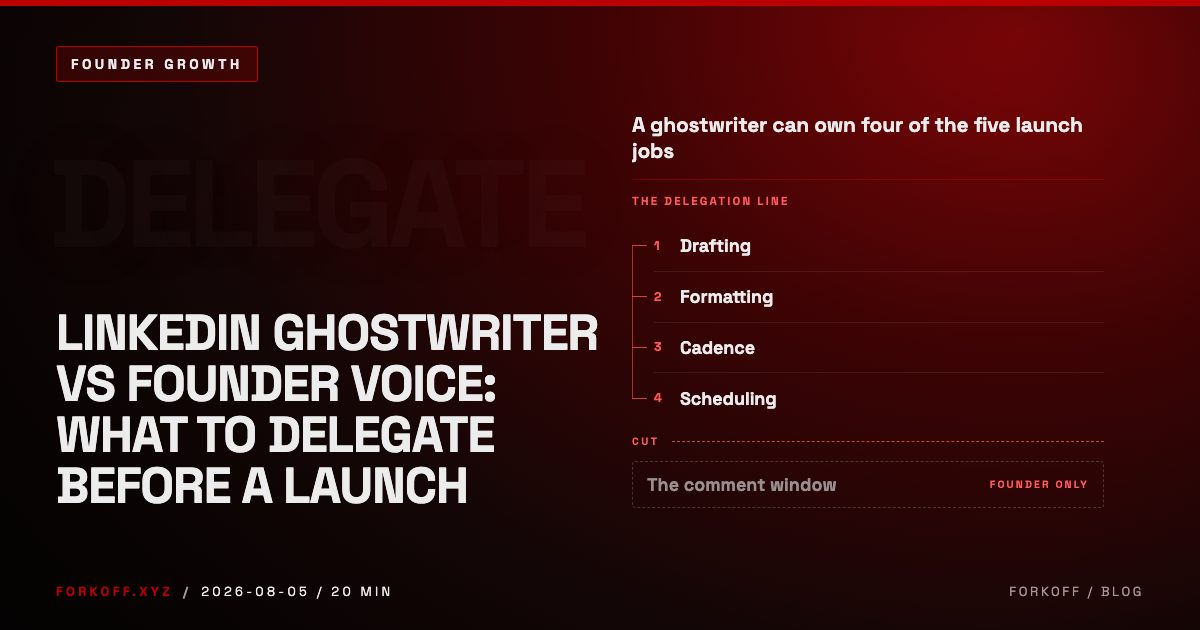
Every cohort cycle FORKOFF runs surfaces the same three failure modes in roughly the same ratio. Failure mode one is ghost-writer drift: the founder's voice becomes generic by week three, which is a briefing failure more often than a writing one and is why the delegation line matters before a launch, the ICP reply rate collapses, and the lane blurs before it compounds. Failure mode two is the content-without-outbound trap: strong content builds a real audience but no one activates it toward a commercial outcome. Failure mode three is premature channel scaling: the founder adds LinkedIn and newsletters before the X cadence is producing 60 percent ICP replies, which dilutes attention across all channels and compounds none of them. Naming them up front cuts the failure rate.
Every cohort cycle FORKOFF runs surfaces the same three failure modes, in roughly the same ratio. Naming them up front cuts the failure rate.
Failure mode 1, ghost-writer drift. The founder hires a ghost-writer in week two, the voice becomes generic inside three weeks, the lane blurs by day 60, and the ICP reply rate collapses. The fix is mechanical: ghost-writers are allowed for first drafts and never for final voice. Every published post passes a 30-second founder-voice check before it ships.
Failure mode 2, cadence collapse. The founder ships strong for the first 21 days, hits a board meeting, a fundraise, or a release week, and the daily cadence breaks. Re-establishing the cadence after a 7-day gap takes 14 days of paid attention rebuilding. The fix is mechanical: a 90-day calendar locked before day one, with weekly accountability against a partner inside the FORKOFF Founder-Funnel Cohort.
Failure mode 3, conversion-mapping skip. The founder runs Blocks 1, 2, and 3 cleanly and skips Block 4 because conversion mapping feels like marketing-ops work. At day 90, reach metrics are healthy and pipeline metrics have not moved, and the founder concludes the system does not work. The system works; Block 4 was skipped. The fix is mechanical: UTMs on every CTA from day one, weekly branded search measurement, monthly inbound-DM tagging, no exceptions.
Every cohort founder who hits the day-90 pipeline ceiling without compounding has skipped one of these three. Every cohort founder who compounds past day 90 has not.
Operator noteTwo cohort founders quit at day 45. Their distribution baseline held flat for the next six months., FORKOFF Founder Funnel ledger 2026-Q1, n=42
How FORKOFF, the AI Agency, installs THE FOUNDER FUNNEL OS
FORKOFF is an AI Agency, outcome-priced, and we install THE FOUNDER FUNNEL OS as the spine of every founder engagement. The install is not a content retainer. The install is a 90-day systems build with named deliverables against named KPIs, paid against the outcome line of the engagement.
The install runs across three workstreams in parallel. The narrative workstream owns Blocks 1 and the upstream half of Block 2. The cadence workstream owns the downstream half of Block 2 and the reply layer. The pipeline workstream owns Block 3 and Block 4. Each workstream has a named owner inside the FORKOFF team and a named counterparty inside the founder team, and the weekly cadence runs against a shared dashboard the founder reads on their phone every Monday.
The outcome-pricing line is the part most founders have never seen inside an agency engagement. FORKOFF prices against the day-90 pipeline metric, not against the hours billed or the posts shipped. The structure forces every internal decision toward the metric that compounds. If a post does not serve the day-90 pipeline metric, it does not ship. If a podcast appearance does not serve the day-90 pipeline metric, it does not get booked. The pricing layer is the discipline layer.
The reason FORKOFF runs as an AI Agency, not a content shop, is the leverage stack. Every part of the install runs through internal AI tooling: keyword discovery, narrative drafting, reply triage, ecosystem mapping, UTM hygiene, branded search measurement, weekly reporting. The AI tooling does not replace the founder voice; the AI tooling compresses the founder voice into a cadence that would otherwise require six full-time hires to sustain. The compression is what makes the outcome-pricing line possible across every founder engagement we run, regardless of stage, category, or geography, because the underlying system rules are constant and the inputs are the only variable.
The day-90 audit ledger inside a FOUNDER FUNNEL OS install reads against 8 metric lines: founder branded-search lift against the pre-engagement 30-day baseline (target 2.1x to 3.4x); founder direct-traffic lift in the same window (target 1.8x to 2.6x); reply-layer surface coverage measured as percent of top-100 in-category accounts the founder has appeared in the reply thread of (target 64 percent at day 90 versus 12 percent at day 0); ecosystem-anchor count, defined as named accounts whose audience overlap with the founder ICP exceeds 35 percent and who have shipped at least one reply or quote to the founder in the 90-day window (target 22 to 38); pipeline-attributable inbound sourced from the funnel-os surface (target 18 to 34 percent of total inbound at day 90 versus 0 to 4 percent at day 0); reply-velocity decile, the founder's median time-to-first-reply on top-100 in-category posts (target sub-9-minute median); narrative-asset surface, the count of evergreen long-form posts the founder owns that rank for in-category branded queries (target 7 to 11 at day 90 versus 0 to 2 at day 0); and audience-compound rate, the week-over-week unique reader count against the funnel-os surfaces (target 11 to 18 percent weekly compound at day 90). The 8-metric audit is shared back to the founder in a single dashboard tile every Monday during the engagement; the operator team rescopes the next sprint against the lowest two of the 8 metrics rather than running a uniform plan across all 4 blocks of the OS.
Stop asking "is SaaS dead." Start asking "do I have distribution leverage."
The Reddit OP got the gist right and stopped one layer short. SaaS is not a horse-drawn carriage in the age of cars. SaaS is the wrapper that the carriage and the car both fit inside. AI agents do not replace SaaS; they ship inside SaaS, billed by subscription, hosted by the vendor, accessed over the internet. The replacement framing collapses on contact with the actual product taxonomy.
SaaS is software you access over the internet, hosted by the vendor, paid by subscription. That's the definition. Most 'AI replacements' being held up as SaaS killers fit it exactly.
What changed is the gate. Engineering capital used to be the cost of entry. Distribution capital is now the cost of entry. Knowing what each distribution channel actually costs per qualified lead is how a founder decides where to spend that capital first. The founders who internalize this build a 2026 SaaS that compounds. The founders who do not internalize it build a beautiful product, ship it on a Tuesday, and write a postmortem in nine months that blames "the category" when the category is not what failed.
The question is not whether SaaS is dead. The question is whether you have built the PERMANENT DISTRIBUTION ENGINE that earns the audience before the product ships. If the answer is no, the next twelve months go badly regardless of what you build. If the answer is yes, you join Cursor, Claude Code, and the small set of operators who are quietly running THE FOUNDER FUNNEL OS as the product behind the product. The hub for the broader category is FORKOFF Founder Growth.
Stop asking the wrong question. Build the distribution that makes it irrelevant.


![How to Make a Launch Go Viral on X: The 5-Lever Playbook [2026]](/blog/covers/how-to-make-launch-go-viral-on-x-2026-cover.jpg)