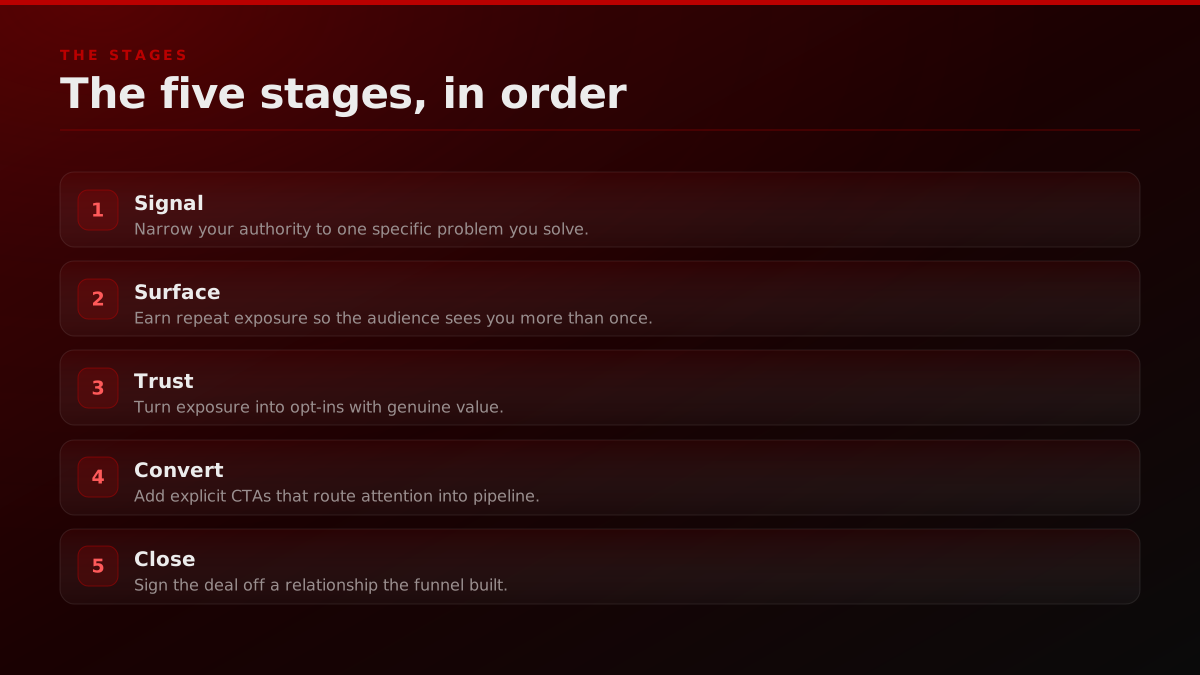
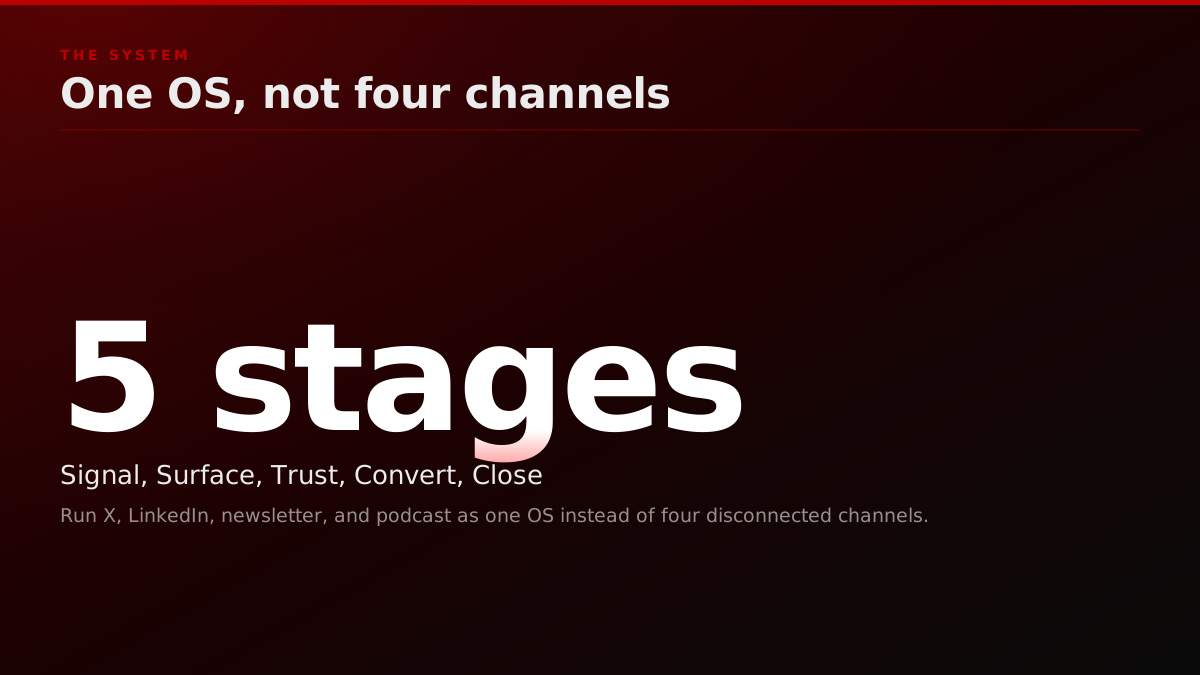
The Founder Funnel OS is a five-stage system that turns a founder's content on X, LinkedIn, and newsletter into measurable sales pipeline. Each stage has a single job, a dominant channel, a cadence, and a KPI floor: Signal (establish narrow authority), Surface (engineer repeat exposure), Trust (deepen via opt-in), Convert (route high-intent readers to a next step), and Close (measure end-to-end, which early on means founder-led sales). FORKOFF has run this across 42 founder retainers and the median pipeline inflection hits at month six. The Signal stage in particular only works if the founder has personally run it long enough to know what lands, the same sequencing argument laid out in The Distribution Learning Curve.
The 30-second answer
The Founder Funnel OS turns founder content into measurable pipeline through five stages: Signal (narrow authority on X), Surface (engineered repeat exposure via LinkedIn twins), Trust (weekly newsletter plus monthly podcasts), Convert (a named next step), and Close (end-to-end measurement). Across the FORKOFF Founder-Funnel Cohort 2026 (n=42 retainers) the OS produced a median 37% shorter deal cycle and 120% larger closed-won deals, with pipeline inflection at month six. Each stage has one job, one dominant channel, and a KPI floor that tells you exactly where the funnel leaks.
heading: The Founder Funnel OS in one scroll
summary:
- Most founder content is stuck at "reach." Pipeline needs a funnel, not a feed.
- The Founder Funnel OS is 5 stages : Signal, Surface, Trust, Convert, Close : each mapped to a channel, cadence, and KPI.
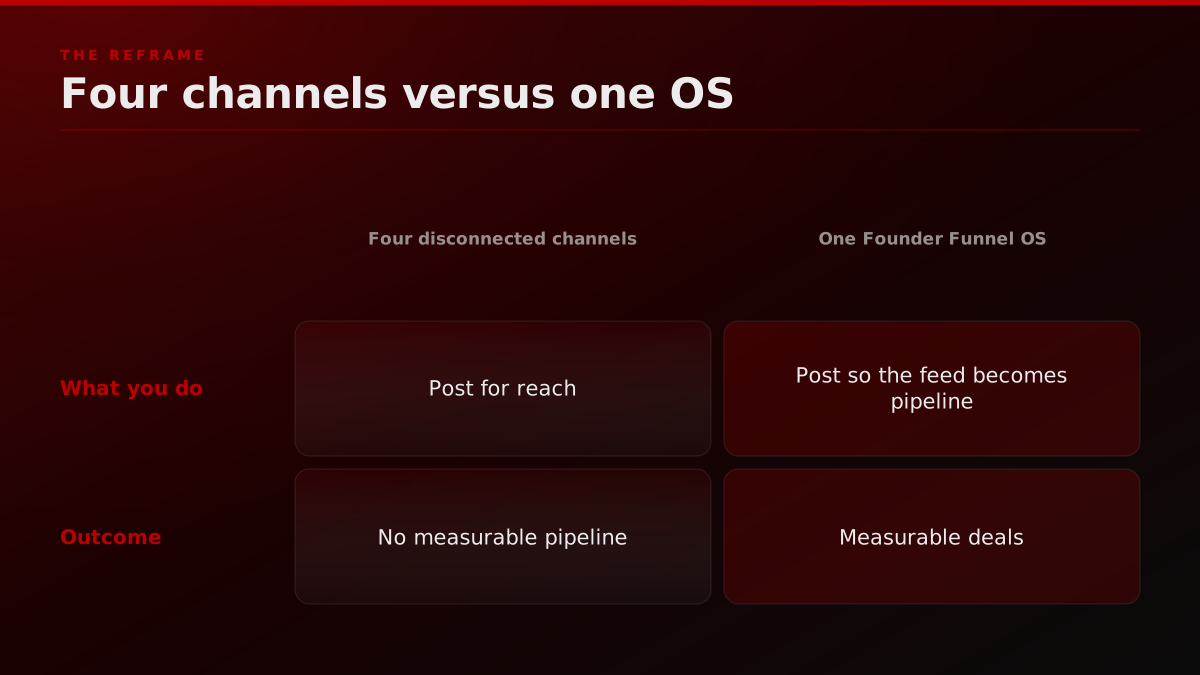
- At FORKOFF we run this for founders with a retainer that treats X, LinkedIn, newsletter, and podcast as one system, not four channels.
variant: primary
---
About these numbers
Conversion rates, funnel benchmarks, and percentage figures in this post are sourced from FORKOFF operator observations across founder funnel engagements (2025-2026). All figures are directional estimates; individual funnel results vary by founder audience size, content quality, and offer fit.
Why does founder-led marketing stall at reach?
Founder-led marketing fails when it stops at reach and never builds a funnel. A founder publishes on X, earns 50,000 impressions, accumulates 12,000 followers, and zero deals are attributable to the content at month six. That gap is not a content problem, it is a funnel problem: reach without a downstream conversion architecture is theater, not pipeline.
A founder publishes on X. The post gets 50,000 impressions. Nobody books a call.
Six months later, the same founder has 12,000 followers, an impressive impression chart, and zero deals they can directly attribute to content. Every growth post says "just keep publishing." Every board meeting asks "what's the ROI."
That gap is not a content problem. It's a funnel problem.
Founder content without a funnel is reach theatre. Reach is a vanity ceiling. Pipeline is an operating system. The two are built differently, and most founders : and most agencies serving them : confuse the first for the second.
The operators who cracked this publicly are not the loudest. They are the ones with a system. HBR's work on founder-led brand-building and First Round Review's founder-led GTM playbooks land on the same finding from opposite ends of the market: the founders who convert are the ones who wrote the funnel down first. For the wider motion this funnel sits inside, start with the founder-led growth playbook.
---
The founders shipping real pipeline
The founders generating real pipeline from content share one trait: they documented the funnel and measured it. Unify GTM attributed over $15M in inbound pipeline to founder LinkedIn content in a single year. Storylane credits founder-led personal branding for more than half their sales pipeline. Brij's founder grew revenue 10x, with founder content influencing an estimated 50% of deals. Lenny's Newsletter has tracked the same founder-distribution pattern across dozens of B2B companies, and First Round Capital's channel carries the long-form interviews where founders describe these systems in their own words.
Unify's founder drove $15M in pipeline from LinkedIn in one year
Unify founder Austin Hughes reported that in 2024 more than $15M of the company's sales pipeline came inbound as a direct result of content he posted on LinkedIn, while his following grew from about 3,000 to 16,000. Two details in his post-mortem matter more than the headline number. First, the channel stayed flat from mid-March to August before it picked up, so quitting early would have cost millions in pipeline. Second, he credits deals won against larger competitors to prospects having read his posts for months before sales ever contacted them. That is the Signal-to-Close loop working: narrow authority, compounded exposure, then deals that arrive pre-sold.
Source: Austin Hughes, Founder-Led Content How We Drove $15M in Pipeline via LinkedIn, Unify, Oct 2025 (archived)
heading: $15M, 50%, 10x : the numbers behind systematic founder content
content:
Unify GTM reported more than $15M in inbound sales pipeline directly attributable to their founder's LinkedIn content in a single year. Storylane credits founder-led personal branding for 50%+ of their sales pipeline. Brij's founder grew revenue 10x, influencing 50% of deals. LinkedIn's own data: an estimated 80% of B2B leads from social come from LinkedIn, with an estimated 2.74% visitor-to-lead rate versus 0.69% on Twitter/X. These are not "growth hack" numbers. They are pipeline lines on a P&L, produced by founders who stopped posting at an audience and started running a funnel through one.
source: Unify GTM, Storylane, LinkedIn 2025 B2B Benchmark
variant: spotlight
---
What is a founder funnel?
A founder funnel is a documented, multi-channel system that converts a founder's audience into measurable sales pipeline. It is a funnel because readers move through stages with distinct jobs. It is a founder funnel because the authority at the top is a human, not a brand page.
The human-not-brand-page distinction is not branding preference, it is reach math. One B2B founder running a compliance SaaS put it plainly on r/SaaS: posts from the founders' personal profiles reached ten times further than the same content on the company page, because the LinkedIn algorithm heavily suppresses corporate pages.
Why your "obvious" target customer is sometimes your worst customer
The three things that make it a system and not just "posting consistently":
- Defined stages, each with its own channel role and KPI floor.
- Mapped channels, with explicit rules about what runs where.
- A content cadence that keeps every stage fed without burning the founder out.
Most of what gets written on this topic collapses the stages into "post on LinkedIn a lot." That's the output, not the operating system. What we'll document below is the OS : what stages exist, what moves between them, what metrics you track at each, and how the channels divide the work.
At FORKOFF, every founder engagement starts here. We don't onboard a founder into a posting calendar until the funnel is mapped.
---
The 4-block architecture under the OS
The FORKOFF Founder Funnel OS rests on four operating blocks that must be installed in sequence: Founder Voice (the thesis), Distribution (the channel map), Capture (opt-in and conversion surfaces), and Compounding (instrumentation and repurposing). Skipping Block 1 or 2 makes every later block less effective.
Before the five stages, the FORKOFF Founder Funnel OS rests on four operating blocks. Every retainer FORKOFF runs is one of these blocks plugged into the next, in sequence, never out of order.
- 1. Block 1: Founder Voice. The thesis the founder will defend for ninety days. Specific, operator-grade, repeatable. This block decides whether Signal works at all. If the founder is still hedging their position by week three, FORKOFF rewrites the thesis before any other block ships.
- 2. Block 2: Distribution. The channel map. Where the founder voice lands, in what order, at what cadence. X carries first publication. LinkedIn carries the rewritten twin. The podcast schedule is booked one quarter forward. Newsletter is the weekly anchor.
- 3. Block 3: Capture. The opt-in and conversion surfaces. Newsletter signup forms. Lead Gen Forms on LinkedIn. The signature audit landing page. Without Block 3, Blocks 1 and 2 produce visibility that never becomes pipeline.
- 4. Block 4: Compounding. The instrumentation, repurposing, and review cadence that turns one quarter of work into the next quarter's compounding asset. Branded search baselines, inbound tagging, quarterly Signal review, podcast clip recycling.
Most founders try to start at Block 2. Distribution is the loud block. Block 1 is the quiet one, and it carries the entire system. The FORKOFF Founder-Funnel Cohort 2026 audit ran the diagnostic across forty-two retainers and found that when Block 1 was vague, no amount of Block 2 effort produced measurable pipeline by month six.
The 4-block model is also why "post more" advice fails. Post more is a Block 2 prescription for a Block 1 problem. The fix is upstream of the calendar.
Operator note71% of intake audits fail the Block 1 thesis test; the week-one rewrite produces more pipeline than any later fix., FORKOFF Founder-Funnel Cohort 2026, n=42
---
Introducing the Founder Funnel OS
The Founder Funnel OS organizes five stages, Signal, Surface, Trust, Convert, and Close, into a single system where each stage feeds the next. Every stage has one job, one primary channel, a defined cadence, and a KPI floor that tells you whether the stage is doing its job or leaking.
The trade-off between founder credibility surfaces and short-cycle user-acquisition campaigns is the meta-decision underneath the entire funnel. The credibility vs user-acquisition campaigns analysis covers the time-horizon math FORKOFF uses to balance the two.
The Founder Funnel OS has five stages. Each has a single job. Each maps to a dominant channel, a cadence, and a measurable KPI.
- 1. Signal : establish narrow authority.
- 2. Surface : engineer repeat multi-channel exposure.
- 3. Trust : deepen the relationship via opt-in surfaces.
- 4. Convert : route high-intent readers to a next-step action.
- 5. Close : sign the deal; measure end-to-end.
A reader does not move through these linearly every time. They loop, re-enter, and skip stages. But the founder's job is to keep every stage fed : because the funnel only works if the gaps between stages are short.
The stage-by-stage discipline is not unique to FORKOFF. GojiberryAI's founder describes scaling to $3.5M ARR in under a year by matching the channel to the revenue stage instead of hunting one magic channel, outbound first, then layering channels as MRR grew. Different product, same operating logic: the channel serves the stage, never the other way around.
Romàn
@romanbuildsaas
We scaled to $3.5M ARR in less than 1 year. No one wants to hear this, but there’s no magic distribution channel. We scalled by testmaxxing every channel depending on our MRR level. €0 → $6k MRR: pure outbound. Cold email plus LinkedIn, using our own early product on https://t… Show more
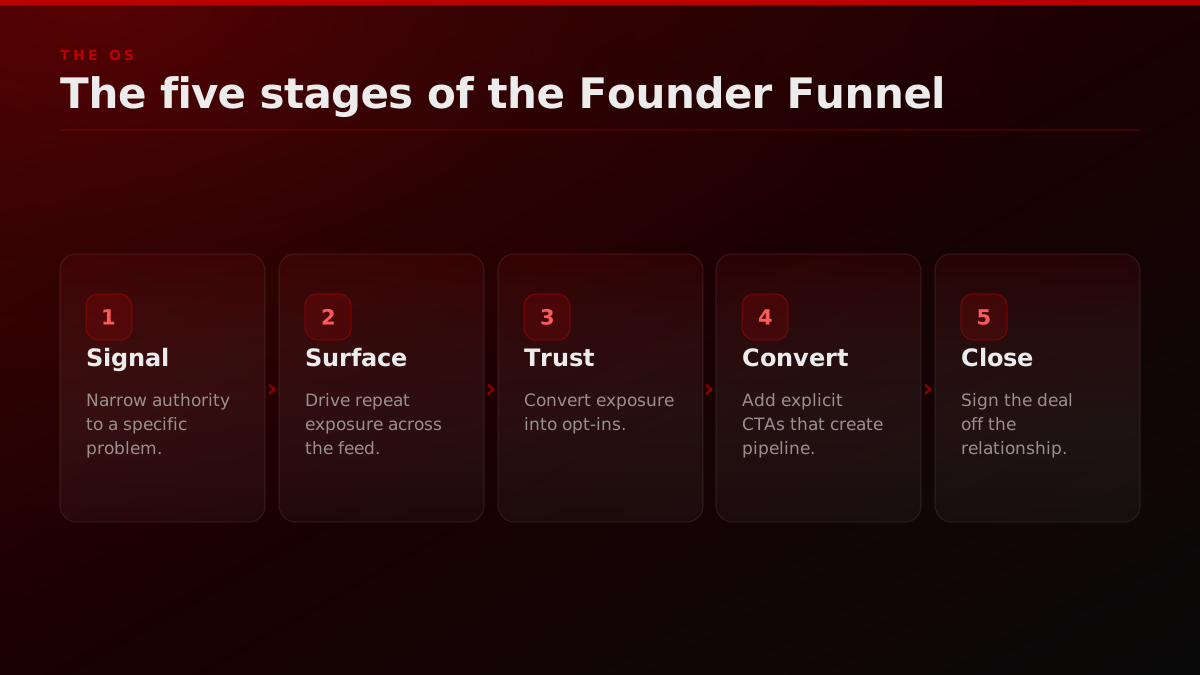
The diagram below is how we sketch this for every new founder engagement.
---
Which channel carries which funnel stage?
This diagram maps the five Founder Funnel OS stages across the dominant channel for each: X carries Signal, LinkedIn carries Surface and Convert, newsletter and podcast carry Trust, and the founder's direct sales motion carries Close. Read left to right; each column is one stage's primary role, not the only channel active at that stage.
Caption: The Founder Funnel OS : five stages, five jobs, five KPIs. Each stage maps to a dominant channel role rather than a "post on everything" mandate.
Media: founder-funnel-diagram-1.png (2400×1260, Space Grotesk)
---
Stage 1 : Signal
Signal is the first stage of the Founder Funnel OS. Its job is to establish narrow authority by publishing a specific, defensible position daily on X and booking one to two podcast guest appearances per month. The KPI floor is that an estimated 60% of replies within 90 days come from accounts that match the founder's ICP. Worth knowing what the room looks like before you set that floor: across 13 buyer-intent threads we classified 117 replies one by one, and 72 of them came from peers rather than vendors.
Signal is where most founders quit, because it demands narrowing before it pays off.
A founder on X tweeting broadly about "startups" is invisible. A founder tweeting specifically about B2B pricing strategy, three times a day, for ninety days, is filed under "the pricing guy." Algorithms file you into one topical bucket. Human brains do the same. Both get confused when you broadcast across ten.
Cadence: daily X, one to two podcast guest appearances per month, one signature framework or named concept per quarter.
KPI floor: sixty percent of your replies are from accounts that match your ICP inside ninety days. If your ICP is CMOs at Series B SaaS companies and sixty percent of your replies are from students and memers, you have a Signal problem, not a volume problem. The same Signal problem appears as the entire premise of the 2026 SaaS distribution guide: the old top-of-funnel volume targets stopped predicting closed pipeline once AI search compressed the discovery layer.
Failure mode: posting broadly. If you read your own last twenty posts and can't describe them in one sentence, you're broadcasting noise.
A clean Signal move is specific, operator-voiced, and repeatable: you pick one unpopular opinion, defend it for thirty days, and let people opt into or out of your feed based on whether they agree.
---
Stage 2 : Surface
Surface is the second stage of the Founder Funnel OS. Its job is to engineer repeat multi-channel exposure so that a target account inside the founder's ICP sees the founder's name at least three times in 30 days. The primary mechanism is publishing a rewritten LinkedIn twin of every strong X post within 48 hours.
Signal without Surface is a secret.
Surface is the engineered repeat-exposure step. The average B2B prospect sees a founder's name 7+ times before they take a next-step action. Single-channel exposure : even high-volume : almost never delivers seven touches inside the buying window.
The move: every X post gets a LinkedIn twin within forty-eight hours, rewritten for the platform, never copy-pasted. The rewritten version keeps the core claim but changes the structure : LinkedIn favors story + line breaks + one decisive closer; X favors compressed hooks and reply-chains. Same idea, two surfaces.
Cadence: X daily; LinkedIn three times a week as twins of your strongest X posts; every reshare carries forward the named framework from Signal. The Surface layer compounds fastest when the founder's podcast appearances feed the clip cohort that ships across both channels; the FORKOFF podcast clipping for founders lane is the productized version of that loop.
KPI floor: a target account inside your ICP sees you three times in thirty days. LinkedIn's 2.74 percent visitor-to-lead rate (versus X's 0.69 percent, per LinkedIn's own B2B benchmark) is why the second surface is load-bearing for pipeline even when X carries the Signal.
Failure mode: one channel, one exposure per lead. You can have the best X account in your vertical and still produce zero pipeline if your prospects live on LinkedIn and never see you there. Before you spread across surfaces, it pays to know what each channel costs per qualified lead, so the second and third channel earn their place instead of just splitting your attention.
---
Does the Signal plus Surface loop show up outside FORKOFF dashboards?
The Signal plus Surface loop is visible in public post-mortems, not just in FORKOFF dashboards. The clearest recurring pattern: somewhere around Series A, a SaaS team notices the founder's casual post about a product insight is driving more inbound sign-ups than a month of paid acquisition at the same cost. The loop is real and measurable. It is also unscaled by default, which is the entire argument for running it as an operating system instead of a habit.
Degen Sing
@degensing
Somewhere around Series A, most SaaS teams discover the same uncomfortable truth: their CEO's casual tweet about a product insight drives more inbound sign-ups than a month of paid acquisition at the same cost. The organic content loop is real. Measurable. And it doesn't scale.
The organic content loop is real. Measurable. And it doesn't scale.
That last line is the diagnostic. If the organic loop works but does not scale, the founder's calendar is the bottleneck, and the OS exists to move everything except the voice off that calendar: the LinkedIn twins, the clip cohort, the newsletter drumbeat, the quarterly offer.
The organic founder loop is real, measurable, and does not scale alone
A recurring practitioner observation: around Series A, SaaS teams discover that the founder's casual post about a product insight drives more inbound sign-ups than a month of paid acquisition at the same cost, and that the loop is measurable but does not scale by itself. That second half is the part most founder-brand advice skips. A loop that depends on the founder manually feeding every channel caps out at the founder's calendar, which is exactly why the OS splits the work into stages with cadences: the founder supplies the voice, the system supplies the repetition.
Source: Degen Sing, X, May 2026
---
Stage 3 : Trust
Trust is the third stage of the Founder Funnel OS. Its job is to deepen the relationship via opt-in surfaces: a weekly newsletter and monthly podcast appearances. The KPI floor is a newsletter open rate above an estimated 35% and at least five inbound DMs per week referencing specific content the founder has published.
Trust is where the reader opts in to more of you on their terms.
Newsletter and podcast appearances are the Trust stage's primary surfaces. A newsletter sub is a reader explicitly saying "send me more." A podcast appearance is you inside your prospect's commute for forty-five minutes. Both are slower than a tweet and compound faster than either feed.
Cadence: one weekly newsletter (aim for 800-1,500 words, one idea, one CTA), one podcast appearance per month on a show your ICP already listens to.
KPI floor: newsletter open rate above thirty-five percent, at least five inbound DMs a week referencing your content, profile visit rate rising week over week.
Failure mode: no mid-funnel surface. Founders who only publish on feed platforms leave a gap where the prospect has "seen you" but never had a deeper moment. Without a Trust step, they'll see you fifty times and still not remember your name during a purchase decision.
Podcast appearances are the most under-used part of the OS. The founder with a ninety-day run of fifteen podcast appearances builds more authority than the founder with a ten-thousand-follower X account : because the listener sat in your worldview for forty minutes, not four seconds.
The published research backs the Trust stage harder than any other part of the OS. The Edelman-LinkedIn B2B Thought Leadership Impact Report puts numbers on what consistent operator-grade content buys you before any sales touch happens.
9 in 10 decision-makers reward consistent thought leadership
The Edelman-LinkedIn 2024 B2B Thought Leadership Impact Report found that 9 in 10 decision-makers and C-suite executives say they are moderately or very likely to be more receptive to sales or marketing outreach from a company that consistently produces high-quality thought leadership. 75% say a piece of thought leadership led them to research a product or service they were not previously considering, and 70% of C-suite leaders say it at least occasionally made them question staying with an existing supplier. This is the mechanism under the Trust and Convert stages: consistent operator-grade content does not just earn attention, it lowers the resistance every later sales touch meets.
Source: Edelman-LinkedIn 2024 B2B Thought Leadership Impact Report
---
Stage 4 : Convert
Convert is the fourth stage of the Founder Funnel OS. Its job is to route high-intent readers to a named next-step action via one to two conversion posts per week on LinkedIn and a quarterly signature offer tied to a landing page. The KPI floor is an estimated 0.5% of the founder's audience booking a call or taking a next-step action in a given month.
Convert is where most founder funnels leak.
The pattern: founder posts good content, audience grows, nothing gets offered. You can't convert what you don't ask for.
The fix is two specific content formats that belong in this stage, not earlier:
- 1. A weekly "case study" or "teardown" post on LinkedIn that ends in a named next-step (audit, teardown offer, call).
- 2. A quarterly signature offer : a packaged audit or playbook tied to a named landing page : that you reference organically across other content for the quarter.
Cadence: one to two conversion posts a week, one signature offer per quarter.
KPI floor: 0.5 percent of your audience books a call or request in a given month. For a 10K-follower founder that's fifty inbound actions per month : a real pipeline input, not vanity.
Failure mode: no explicit ask. Readers stay in followship because you never gave them the next step.
LinkedIn Lead Gen Forms convert at 13 percent : six times better than a standard landing page : because they pre-fill the form and keep the reader on-platform. If your Convert surface is LinkedIn, use Lead Gen Forms. If it's your own landing page, instrument the UTM so you can audit attribution back to the specific post that drove the click.
Operator note84% of audits find a Convert leak: real audience, no named offer. One signature audit page closes it inside 30 days., FORKOFF pre-engagement audits, 2026
For a longer operator treatment of what Convert-grade LinkedIn content looks like in 2026, the Unify webinar below pairs Unify's CEO, whose founder-led content drove $15M in pipeline, with the CEO of Compound Content Studio.
Winning on LinkedIn in 2026 | Founder-Led Content, Pipeline & Growth Playbook
Unify's CEO and Compound Content Studio's CEO on what founder-led LinkedIn content that produces pipeline, not just impressions, looks like in 2026.
---
Stage 5 : Close
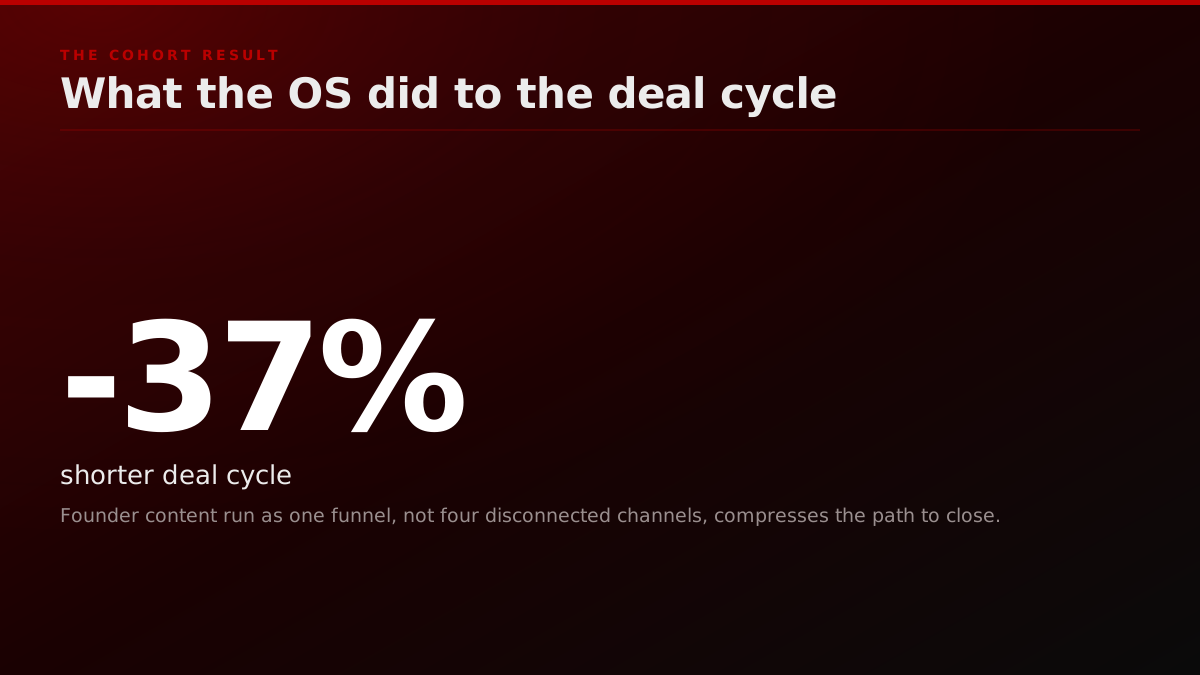
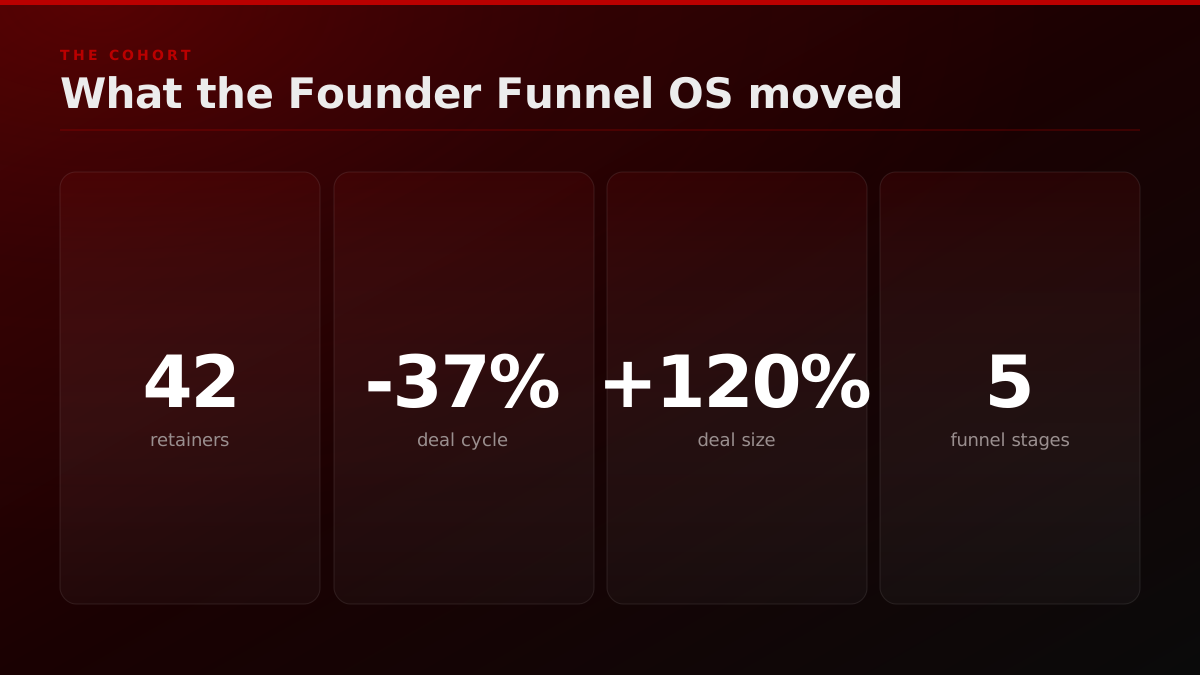
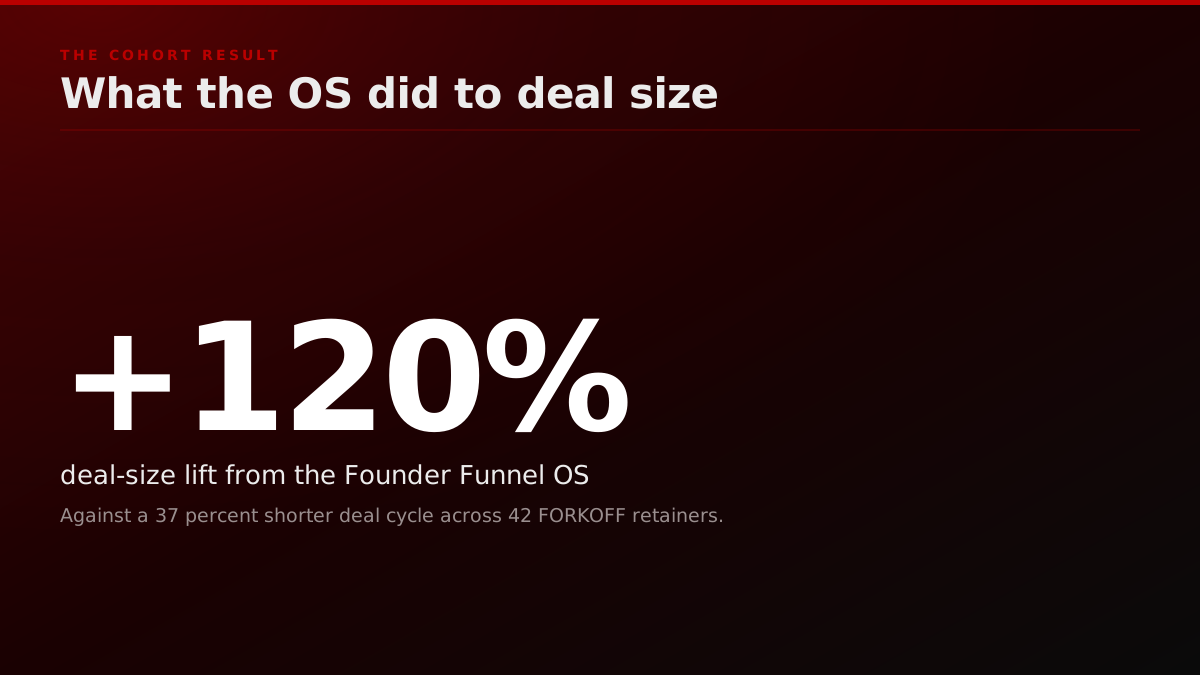
Close is the fifth and final stage of the Founder Funnel OS. Its job is to sign the deal and measure the funnel end-to-end. Across the FORKOFF Founder-Funnel Cohort 2026, founders running the OS report a median 37% shorter deal cycle and 120% larger closed-won deal sizes compared to cold-sourced pipeline.
Close is where you audit the whole funnel.
The opportunities that reach the close stage are the only ones that validate the earlier stages. If your Signal + Surface + Trust + Convert stages are doing their job, closed-won deals should show three patterns:
- Shorter deal cycles. Tech companies with consistent founder content report 37% shorter sales cycles. Prospects arrive educated; you skip the first three discovery calls.
- Higher win rates. An estimated 11% higher win rates when prospects followed a Director+ exec on LinkedIn; an estimated 36% higher when exec content was consistent through the sales cycle.
- Larger deal sizes. 120% larger closed-won deal sizes in the same sample.
If your founder funnel is doing real work, these three metrics will move : and they're harder to game than impressions. When they don't move, the funnel isn't leaking at the close; it's leaking upstream.
Failure mode: untracked attribution. If you can't say "this deal came through the Founder Funnel OS and not a cold email," you can't reinvest.
---
How much of the funnel does each channel actually carry?
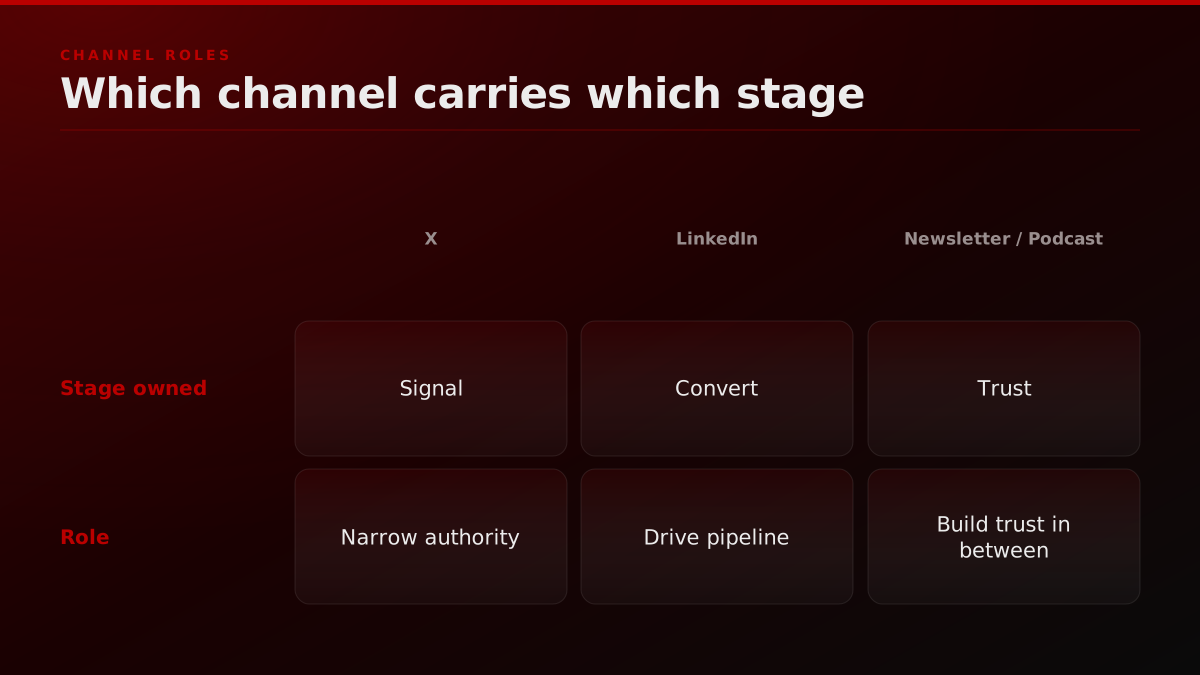
This channel-by-stage matrix shows the weighted load each channel carries across the five Founder Funnel OS stages. X scores 10 at Signal and drops sharply by Convert. LinkedIn scores 10 at Convert, giving it the highest total weighted load of 7.2 across the five stages. Newsletter and podcast carry the Trust stage at a weight of 10.
Caption: Channel × Stage Matrix : where each channel carries the load. X owns Signal. LinkedIn carries Convert. Newsletter and podcasts do the Trust work in between.
Media: founder-funnel-diagram-2.png (2400×1260, Space Grotesk)
---
Channel role and cadence
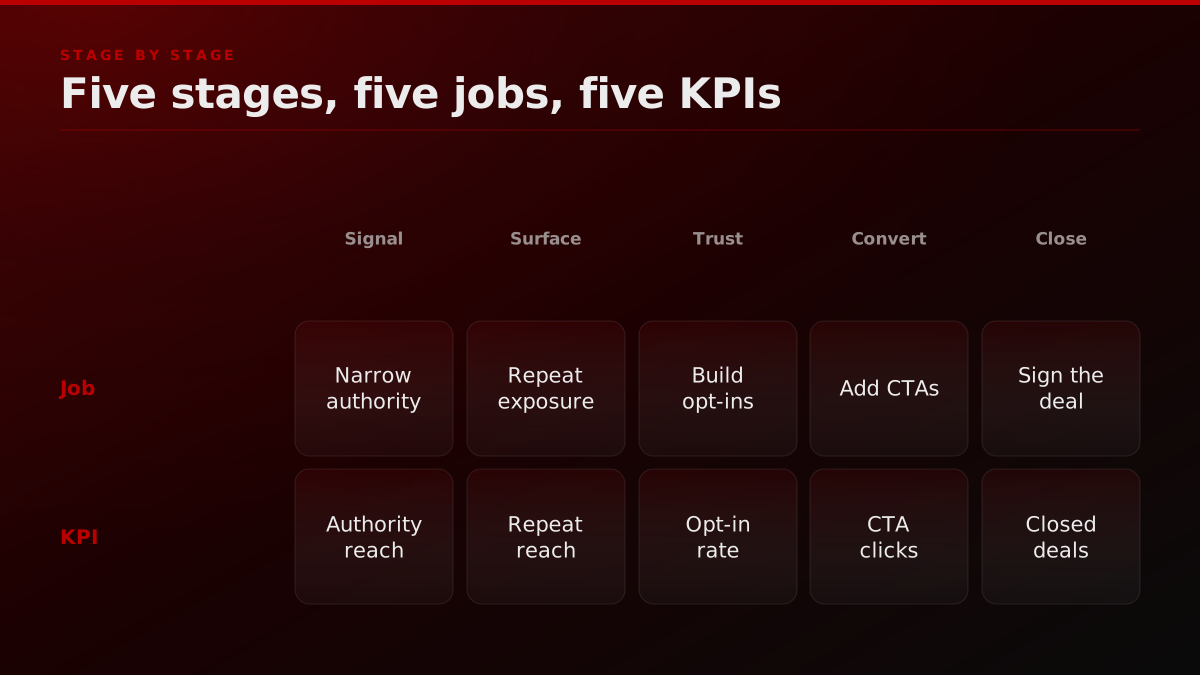
This table maps each of the five Founder Funnel OS stages to its primary channel, recommended cadence, and the KPI that determines whether the stage is performing. Signal runs on X daily with a 60% ICP reply rate floor. Surface runs on LinkedIn three times per week. Trust runs on a weekly newsletter and monthly podcast. Convert requires one to two LinkedIn posts per week. Close tracks deal-cycle compression and win-rate uplift.
Founder Funnel OS channel allocation
| Stage | Primary channel | Cadence | Core KPI |
|---|---|---|---|
| Signal | X plus podcast guest | Daily X, 1-2 podcasts/mo | 60% ICP reply rate |
| Surface | LinkedIn twins of X | LinkedIn 3x/week | 3x exposure in 30 days |
| Trust | Newsletter plus podcast | Weekly letter, monthly pod | 35% opens, 5 DMs/week |
| Convert | LinkedIn plus landing page | 1-2 posts/week, 1 offer/qtr | 0.5% audience to call/mo |
| Close | Founder 1:1 sales motion | Per opportunity | Cycle and win-rate vs cold |
Channels are the primary role for each stage. Secondary reinforcement across all channels is assumed.
---
Get the Founder Funnel OS audit template
The Founder Funnel OS audit template is the diagnostic FORKOFF runs before onboarding any founder. It maps each of the five stages against the founder's current channels, cadences, and KPIs, and flags which stage is the primary leak. The template takes about 30 minutes to fill in and produces a prioritized fix list.
heading: See the exact template we use on founder engagements
description: Free Notion template : the 5-stage audit we run before we onboard any founder. Map your current channels against the OS in 30 minutes.
buttonText: Get the audit template
buttonUrl: /audit?src=blog-mid-founder-funnel
variant: banner
---
Which founder funnel metrics actually matter?
Founder content produces two classes of metrics: vanity metrics that look good in a feed (impressions, follower count, likes) and pipeline metrics that compound into revenue (branded search volume, inbound DM rate, profile-visit-to-call conversion, newsletter subscriber growth from ICP, deal cycle compression). The vanity metrics come first chronologically, which is why most founders quit before the pipeline metrics start moving.
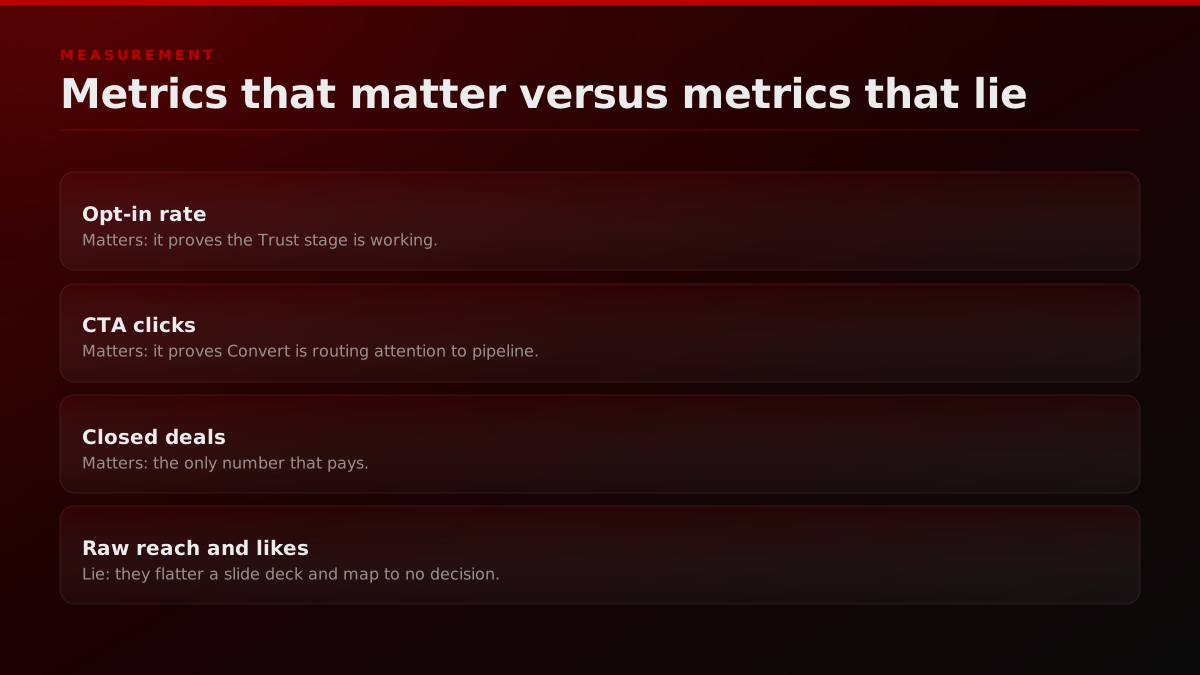
Vanity metrics for founder content: impressions, follower count, likes.
Pipeline metrics for founder content: branded search volume, inbound DM rate, profile-visit-to-call conversion, newsletter subscriber growth from your ICP, share-of-voice versus two named competitors, deal cycle length on founder-sourced vs cold-sourced opportunities.
First-touch attribution models give founder content credit for 67 percent of buyer journeys in B2B. But "first touch" is a notoriously lossy metric when the first touch was a LinkedIn impression six months ago that the prospect can't name. The honest answer: founder content attribution is always partial. You triangulate.
At FORKOFF, we instrument three things on every founder engagement:
- 1. Branded search volume week-over-week (Google Search Console filter on the founder's name + company). This is the cleanest signal that your content is producing category recall.
- 2. Inbound DM + email subject lines tagged by reference ("saw your post on X"). This gives you a qualitative sample size of what content is producing the inbound.
- 3. Deal velocity on founder-sourced deals vs cold. If Stages 1-4 are working, this gap widens over the first six months.
Short answer to the "how do you know it's working" question: you track signals, not attribution. Deal velocity and branded search compound; impressions don't.
---
The operator consensus on r/SaaS
The practitioner discussion on r/SaaS lands on the same diagnosis this post opens with: distribution, not production, is the scarce input. The founder of Supademo, a SaaS doing mid-7-figures in ARR, argues that the products that survive the AI flood are the ones whose founders build brand eminence and repeatable distribution, with founder-led content named as one of the few repeatable channels. His sharpest line is about why the funnel matters at all.
The cost of launching software has collapsed, which means the cost of being ignored has gone up.
That is the Founder Funnel OS thesis stated from the other side of the table. When launching is cheap, attention is the constraint, and a documented funnel is how a founder buys attention without buying ads.
SaaS isn’t dead, but 'easy-to-copy SaaS' might be
---
What does the Founder-Funnel Cohort 2026 data show?
The FORKOFF Founder-Funnel Cohort 2026 is the rolling sample of forty-two founders FORKOFF has run the OS on across AI and crypto verticals over the last twelve months. The cohort is the empirical floor under every claim in this post.
FORKOFF Founder-Funnel Cohort 2026, what moved
| Cohort metric | Median result | What it validates |
|---|---|---|
| Deal cycle vs cold pipeline | 37% shorter | Prospects arrive pre-educated |
| Closed-won deal size | 120% larger | Bigger buyers self-qualify |
| Pipeline inflection | Month 6 | Compounding starts late, not never |
| Block 1 thesis failures at intake | 71% | Positioning is the usual leak |
| Convert-stage leak at intake | 84% | Content without a named offer |
FORKOFF Founder-Funnel Cohort 2026, n=42 founder retainers across AI and crypto verticals. Medians vs cold-sourced pipeline on the same product.
A few patterns hold across every retainer in the sample:
- Median deal cycle compression of 37 percent for founder-sourced pipeline versus cold-sourced pipeline on the same product. The mechanism is straightforward: prospects arrive having read the founder for weeks, which removes the first two discovery calls that cold inbound still needs.
- Median closed-won deal size 120 percent larger when the buyer cited a specific piece of founder content in pre-call notes. The signal is not that founder content writes the deal. The signal is that founder content selects the deal: bigger buyers self-qualify into the pipeline by reading the founder.
- Median pipeline inflection at month six, with the first credible inbound DM at week eight and the first attributed booked call at week ten. Founders who quit at week sixteen miss the inflection by two months.
Operator noteWeek 8: first credible inbound DM. Month 6: pipeline inflection. Quitting at week 16 misses it by two months., FORKOFF Founder-Funnel Cohort 2026
- Block 1 audit failure rate of 71 percent at intake. Most founders walk in with a thesis they themselves cannot defend without hedging. FORKOFF rewrites the thesis in week one of every engagement; this single hour produces more downstream pipeline than any other slot on the onramp.
- Convert-stage leak rate of 84 percent in pre-engagement audits. The founder is producing content, the audience is reading, and there is no named offer anywhere on the page. Adding one signature audit landing page closes the leak within thirty days.
These numbers are cohort medians, not headline cases. The headline cases (Unify, Storylane, Brij) sit at the right tail. The cohort median is what a competent founder running the OS for six months can expect to see on the dashboard.
The honest counter-pattern: roughly twelve percent of the cohort produced no measurable lift inside the first six months. In every case the root cause was Block 1, not Block 2. Founders with a category that was too new for branded search to baseline, or a thesis still in flux past week six, did not get the compounding loop to start. That is a positioning problem, not a content problem, and the fix is upstream of the funnel.
---
What are the four failure modes FORKOFF sees on every intake?
In FORKOFF's Founder-Funnel Cohort 2026, four failure modes appear at intake often enough to be near-universal. They are: the broadcast thesis (posting on too many topics with no through-line), the single-channel funnel (strong on X, invisible on LinkedIn), the captureless feed (no opt-in surfaces), and the unattributed close (deals close but no channel gets credit).
Across the FORKOFF Founder-Funnel Cohort 2026 intake audits, four failure modes recur often enough to be predictable. If your funnel is leaking, it is almost certainly one of these.
Failure mode 1: The broadcast thesis. The founder posts about three topics, four times a week, with no through-line. The algorithm cannot file them. The reader cannot describe them. Fix: narrow to one defensible position for ninety days, then earn the right to expand.
Failure mode 2: The single-channel funnel. The founder is excellent on X and invisible everywhere else. Pipeline stalls because the buying committee never gets the second and third touches it needs. Fix: ship the LinkedIn twin of every X post inside forty-eight hours, rewritten, not copy-pasted.
Failure mode 3: The captureless feed. The founder produces months of strong content with no opt-in. Followers accumulate, the email list does not. Fix: weekly newsletter, one CTA per post, one signature offer per quarter. The capture surfaces are not optional.
Failure mode 4: The unattributed close. Deals close and the founder cannot say which post produced which call. Reinvestment becomes guesswork and the budget eventually moves to paid channels that have cleaner dashboards. Fix: branded search baseline plus inbound subject-line tagging plus UTM-instrumented landing pages, installed in week three of the engagement.
Every FORKOFF intake audit checks all four. The pattern is consistent: a founder who reads their last twenty posts, runs the four-failure checklist, and acts on the worst-scoring item will move pipeline metrics inside one quarter. A founder who keeps publishing without the diagnostic will not.
---
How does FORKOFF run the Founder Funnel OS?
Every FORKOFF Founder Funnel OS engagement follows a four-week onramp: positioning lockdown in week one, content OS build in week two, conversion instrumentation in week three, and first conversion offer in week four. After onramp, the engagement moves into a quarterly cadence of three reviews covering Signal, Surface, and Convert.
Every Founder Funnel OS engagement at FORKOFF starts with the same four-week onramp, then moves into quarterly cadence:
- 1. Week 1 : Positioning lockdown. We run a positioning audit and write the one-sentence positioning the founder will defend for the quarter. This becomes the Signal thesis.
- 2. Week 2 : Content OS build. We map the content calendar across X, LinkedIn, newsletter, and podcast booking. Every slot has a named stage.
- 3. Week 3 : Conversion instrumentation. UTMs, Lead Gen Forms, inbound tagging, branded search baseline. Without this, by month three there's no way to audit what's working.
- 4. Week 4 : First conversion offer ships. Usually a signature audit or teardown tied to a named landing page.
Quarterly, we run three reviews: Signal (is the narrow thesis still the right one?), Surface (are prospects seeing the founder 3x in 30 days?), Convert (is the current offer converting or do we need a new one?).
It's not glamorous. It's an operating system. That's the point.
Two related posts if you want the channels in isolation: how 13 days of Managed Clipping took MRR from about $595 to $1,290 shows the Surface + Trust mechanic for podcasts; the Reddit Intent Engine shows what the Convert stage looks like when the surface is Reddit instead of LinkedIn.
---
So what is the Founder Funnel OS, in one paragraph?
The Founder Funnel OS is a five-stage operating system, not a posting calendar. Signal narrows authority. Surface guarantees repeat exposure. Trust deepens via opt-in. Convert routes high-intent readers to a named next step. Close measures whether the whole system is producing attributable pipeline. Founders who run it for six months see a median 37% shorter deal cycle and 120% larger closed-won deal sizes compared to cold outbound.
Founder-led content is the highest-leverage GTM move for most B2B founders in 2026 : but only if it's run as a funnel, not a feed.
The Founder Funnel OS gives you five stages, each with a clear job, channel, cadence, and KPI. Signal narrows your authority. Surface guarantees repeat exposure. Trust deepens the relationship. Convert gives readers an explicit next step. Close lets you audit whether any of it is working.
The founders beating the market : Unify, Storylane, Brij, a hundred quieter operators : are not posting more than you. They're running the OS. Most importantly, they know exactly which stage is leaking, and they fix that stage next week instead of reflexively "posting more."
If you want the same system shipped for you, that is what we build on the founder funnel engagement.
---
Want us to build your Founder Funnel OS?
FORKOFF builds and runs the Founder Funnel OS for tech, SaaS, deep tech and Web3/AI founders on an outcome-priced contract. The engagement installs all five stages, Signal through Close, in 60 to 90 days, with conversion instrumentation in week three and the first attributed booked call typically arriving around week ten.
heading: Ready to turn your online presence into pipeline?
description: We build and run the Founder Funnel OS for founders who want measurable pipeline from their content : X, LinkedIn, newsletter, and podcast, instrumented end-to-end. Book a free founder funnel audit to see where your OS leaks.
buttonText: Book the founder funnel audit
buttonUrl: /services/founder-funnel?src=blog-end-founder-funnel
variant: primary
---
Frequently Asked Questions
The five questions below cover the most common operator questions about the Founder Funnel OS: what it is, how much to publish, whether to prioritize LinkedIn or X, how to attribute deals to content, and how long before the first pipeline signals appear. Answers are drawn from the FORKOFF Founder-Funnel Cohort 2026 (n=42 retainers) and the primary sources cited throughout this post.
Q1. What is a founder funnel?
A founder funnel is a documented, multi-channel system that converts a founder's audience into measurable sales pipeline. Unlike a traditional marketing funnel run by a brand page, a founder funnel treats the founder's voice as the authority at the top of the funnel, and maps channels (X, LinkedIn, newsletter, podcast) to specific stages with defined KPIs. The four-move build order is summarised at how to build a founder funnel.
Q2. How many posts per week should a founder publish?
For a functioning Founder Funnel OS: X daily, LinkedIn 3x/week, newsletter weekly, and 1-2 podcast appearances per month. That works out to roughly 10-12 pieces of published content per week across channels. Less than that and you won't hit the 7+ touchpoints per prospect that B2B buying committees now require. More than that and most founders burn out inside 90 days.
Q3. Should founders prioritize LinkedIn or X for pipeline?
Both, in different roles. X is the Signal stage : where you establish narrow authority and engage the operator network. LinkedIn is where Convert happens : it converts visitors to leads at 2.74%, roughly four times better than X. Prioritizing only one leaves half the funnel empty. The Founder Funnel OS treats them as complementary channels with different jobs, not competing ones.
Q4. How do you attribute deals to founder content?
You triangulate three signals rather than trusting a single-touch attribution model: (1) branded search volume week-over-week, (2) inbound DMs and emails tagged by content reference, and (3) deal velocity on founder-sourced vs cold-sourced opportunities. UTM tracking and LinkedIn Lead Gen Forms give you clean attribution for the Convert stage, but earlier-stage content always gets partial credit : that's the nature of relationship-driven pipeline.
Q5. How long before a founder funnel starts generating pipeline?
Expect meaningful pipeline inflection around month six, with earlier signals (DM volume, newsletter growth, branded search) visible by month three. Most founders quit between month two and month four because the feed metrics haven't moved; the pipeline metrics compound later. If you're running the Founder Funnel OS and the stage-level KPIs are hitting floor by day 90, the deals will follow in months 4-6. If Stage 1 or 2 is still broken at day 90, no amount of time will fix it : rework the positioning or the channel split.


![How to Make a Launch Go Viral on X: The 5-Lever Playbook [2026]](/blog/covers/how-to-make-launch-go-viral-on-x-2026-cover.jpg)