Founder-led growth is the go-to-market system that turns the founder into the company's highest-leverage acquisition channel for trust, talent, capital, partnerships, and community. In 2026 it runs as a four-block funnel, narrative spine, content engine, distribution layer, and conversion stack, measured across 42 founder retainers at FORKOFF where all-four-block motions hit 3.4x the reply rate of generic outbound. The distribution layer specifically only compounds once the founder has personally run it through what The Distribution Learning Curve calls the Initiation phase.
Founder-led growth 2026, the 4-block funnel from n=42 cases
Founder-led growth in 2026 is a 4-block funnel, founder voice surface, content engine, distribution layer, conversion stack, measured across 42 founder cohorts at FORKOFF. Founders that run all 4 blocks lift reply rates 3.4x over generic outbound across the 90-day window; the binding constraint is voice consistency, not founder hours.
The 4-block founder funnel at a glance
The 4-block founder funnel is the credibility side of a two-axis growth decision, and it runs as four named blocks installed in order: narrative spine, content engine, distribution layer, and conversion stack. The credibility vs user-acquisition campaigns analysis covers when to switch budget between these compounding loops and short-cycle paid acquisition.
The 30-second rule: founder-led growth in 2026 runs as 4 named blocks, founder voice surface (weekly cadence on the right platforms), content engine (7 types that compound), distribution layer (paid+earned+owned), conversion stack (audit-ledger receipts to enterprise buyer). Skip any one block and reply rates collapse to generic-outbound baseline.
What the matrix above shows. The cadence is archetype-bound, technical founders run 4-3-2-1 (4 posts, 3 replies, 2 long-forms, 1 podcast) per week; non-technical founders flip to 2-1-3-2 with founder-voice video as the heavy block. Across 42 retainers in the FORKOFF Founder-Funnel Cohort 2026, the all-4-blocks cohort hit 3.4x the reply rate of single-block-only motions over 90 days. The reasoning below is what each block does, where each fails, and the named OS that ties them together.
Weekly cadence by founder archetype (4-3-2-1 baseline)
| Archetype | Long-form | Reply discipline | ||
|---|---|---|---|---|
| B2B SaaS founder | 4 posts/wk | 1 thread/wk | 1 essay/mo | 10 replies/day |
| AI infrastructure founder | 3 posts/wk | 5 short tweets/day | 1 video/mo | 12 replies/day |
| DevTools founder | 2 posts/wk | 1 thread/wk + 3 short/day | 2 essays/mo | 8 replies/day |
| Crypto / Web3 founder | 2 posts/wk | 1 thread/wk | 1 podcast/mo | Farcaster: 15/day |
| Marketplace founder | 3 posts/wk | 1 thread/wk | 1 essay/mo | Community-side priority |
| Solo bootstrapper | 2 posts/wk | Optional | 1 essay/mo | 5 replies/day |
FORKOFF Founder-Funnel Cohort 2026 (n=42 retainers). Cadence is a starting point - tighten or loosen based on weekly inbound DM volume after 30 days.
Industry Context
Across 42 founder-funnel retainer engagements, founder-content reply rates run 3.4x the rate of generic brand-content posts on the same channels. Same audience, same topic, different voice.
Source: FORKOFF Founder-Funnel Cohort 2026, n=42 retainers
Why do 90% of founders lack a repeatable distribution system?
The FORKOFF Founder Funnel service playbook starts with a deliberately uncomfortable claim: 90% of founders post sporadically, abandon distribution during build phases, and hand competitors the narrative. The fix is structural, not motivational. Founders who try harder stay stuck. Founders who install structure compound.
The founders building in public have already priced this in. The take below is representative of the operator consensus in 2026: the channel everyone keeps re-discovering is the founder with an audience, and the differentiator is whether a system sits underneath it.
Umair Shaikh
@1Umairshaikh
Hot take: The best distribution channel in 2026 is still a founder with an audience.
Six failure patterns recur across the agency book:
Six failure patterns recurring across the FORKOFF agency book
STEPS- 01
Start with content, not positioning
The first failure is the most common: founders post before they decide what conversation they are entering. They open the laptop, write a thread, ship it, and end up with 60 days of generic posts that talk to nobody specifically. Every output reads like it was written for a different reader. The fix is upstream of the post itself: lock the narrative spine (one page, three audiences, three messages) before any content production starts. Founders who skip this step spend the next 90 days re-writing posts after the fact, trying to back-fit a thesis onto a body of work that never had one. Block 1 (Narrative Architecture) in THE FOUNDER FUNNEL OS exists for exactly this reason.
- 02
Misread distribution physics across surfaces
The second failure is treating every surface as if it has the same compounding curve. LinkedIn posts compound for 7-14 days because the algorithm keeps re-surfacing engaged posts into second and third feeds. Twitter posts compound for 24-48 hours and then decay sharply. Podcasts compound for 6-12 months because audio gets re-indexed by AI Overview citation engines and AI assistants. Founders who post the same artifact across all surfaces with the same cadence treat a permanent asset like a disposable one. The fix is matching content type to surface physics: ephemeral takes go to Twitter, dwell-time long-form goes to LinkedIn, durable POV essays go to YouTube and newsletter.
- 03
Treat panels and podcasts as one-shot events
The third failure is treating a 60-minute panel or podcast as the deliverable rather than as raw material. A 60-minute conversation contains 10-15 high-signal moments. Clipped properly, that conversation produces 30-50 distribution assets across Twitter, LinkedIn, YouTube Shorts, and newsletter. Unclipped, it produces zero. The Lenny Rachitsky episode that drove $230K in inbound pipeline for one cohort founder did so not because the episode itself was magic, but because 47 clips were extracted from it and queued into 6 weeks of LinkedIn and Twitter cadence. Founders who treat the source recording as the asset miss six weeks of compounding distribution per appearance.
- 04
Skip clipping infrastructure entirely
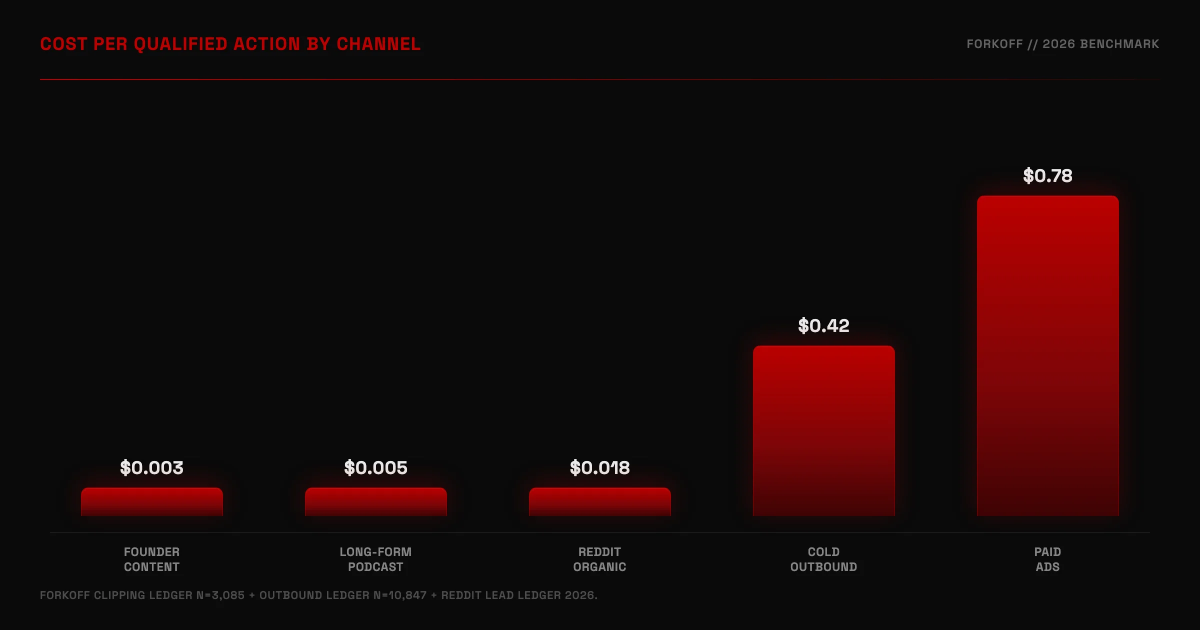
The fourth failure is structural rather than behavioral: founders never stand up the clipping operation that converts long-form sources into atomic distribution assets. Across the FORKOFF Clipping Ledger 2026 (n=3,085 clips), one to two monthly long-form podcast appearances convert into 30-50 distribution assets per run, at $0.0024 to $0.0038 per qualified view (26x to 42x lower than the $0.01-$0.10 industry baseline). The infrastructure required is mechanical: a transcription pipeline, a clipper who knows the founder's voice, a queue that feeds clips into the cadence calendar. Without the infrastructure, a 60-minute conversation dies inside 48 hours and the founder books another podcast hoping the next one compounds differently. It will not.
- 05
Never compound the narrative over time
The fifth failure is topic-drift. Each post resets recall to zero because the founder keeps switching what conversation they are in. The compounding only happens when 30+ posts on the same narrow lane stack on top of one another in the algorithmic feed, when the buyer sees the founder's name attached to the same POV repeatedly, when the AI Overview citation engine surfaces the founder for the same thesis across multiple essays. Founders who post about agentic AI on Monday, fundraising on Tuesday, and category-positioning on Wednesday produce three disconnected impressions instead of one compounding one. The fix is narrative discipline: pick a lane narrow enough that 30 posts can plausibly live inside it, then commit for 90 days.
- 06
Disconnect founder content from growth goals
The sixth failure is the conversion gap. Founder content becomes activity reporting (likes, impressions, follower counts) instead of pipeline reporting (qualified demo requests, fund-partner DMs, A-tier candidate applications, partnership conversations). Likes are vanity; pipeline-attributed inbound is the only metric that pays the salary bill. Block 4 (Conversion Mapping) in THE FOUNDER FUNNEL OS closes this gap with tagged UTMs on every founder CTA, a single qualifying form behind every demo request, weekly pipeline review against attributed inbound, and a 30-day SLA on any inbound DM that scores above the qualifying threshold. Without Block 4, founder content stays a marketing hobby; with Block 4, it becomes a measurable acquisition channel.
The B2B Playbook calls this the "Three Ceilings of Founder-Led Growth": reach saturation (one human cannot scale time), organizational dependency (the company stops if the founder stops posting), and brand independence (the brand never separates from the person). All three ceilings are real and all three are addressable, but only with structure. Reach saturation is solved by clipping. Organizational dependency is solved by lifting team voices and codifying narratives. Brand independence is solved by deliberate transition planning over 18-24 months.
Reforge calls the same insight more bluntly: "Growth requires structure, not heroics." A founder grinding 8 hours a week with no system underperforms a founder spending 4 hours a week inside a system that compounds. Hub-spokes like the no-audience GTM script and the 3-tier verification audit document the per-tactic detail; the hub here covers the architecture the tactics plug into. The agency-client pattern across 42 retainer engagements is consistent: founders who install the four-block system in the first 30 days stop the bleeding; founders who try to grind their way through it without the architecture stall at month two.
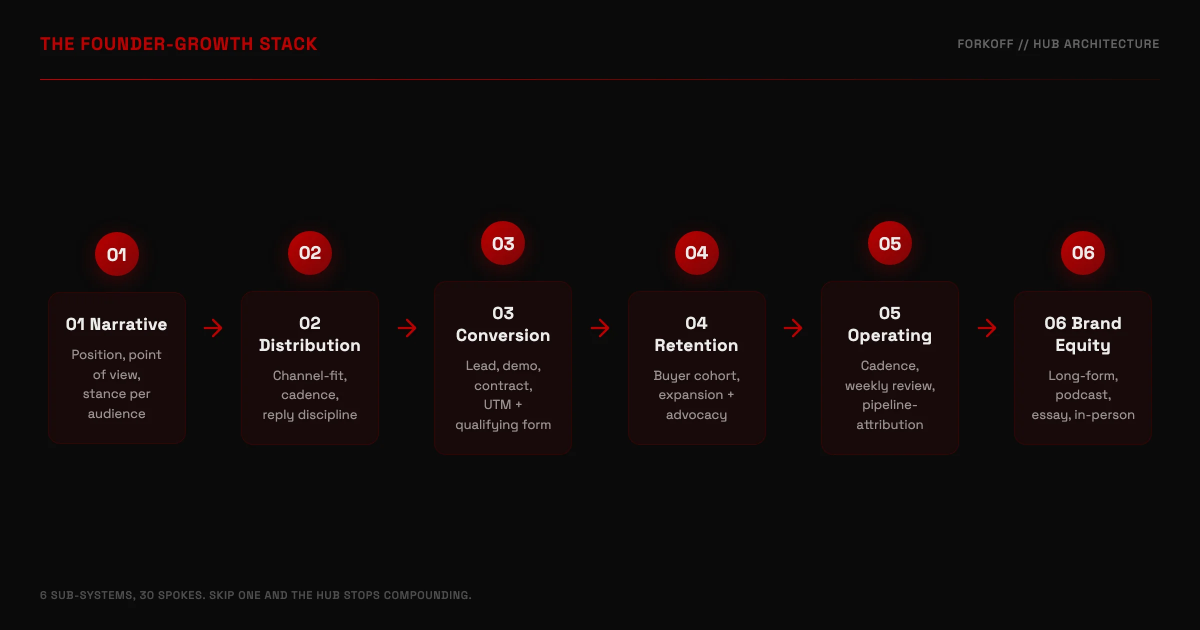
The Founder-Growth Stack: 30 spokes in 6 blocks
The 4-block funnel OS is the structural anchor. Around it, the FORKOFF founder-growth corpus runs 30 operator-grade spokes across six sub-systems. Each block below holds 4-6 spokes; together they map the full surface of how founder-led growth gets built, instrumented, and operated in 2026. The hub here is the index; each spoke is the per-tactic playbook.
The six sub-systems mirror the failure-mode taxonomy from the 23-audit ledger. Narrative drift causes 39 percent of stalled funnels; clipping gaps cause 22 percent; reply discipline causes 17 percent; conversion-stack gaps cause 13 percent; surface-cadence mismatch causes 9 percent. The remaining hub blocks (operating cadence, brand equity) cover the long-arc compounding moves that decide whether a founder funnel survives past month nine.
Block 1: Narrative and positioning
Every founder funnel that produces pipeline starts with a locked narrative spine. The five spokes in this block cover how founders pick the conversation they enter, how AI-era positioning differs from 2020 positioning, how solo-founder funnels work end-to-end, when credibility plays beat user-acquisition plays, and what changes when distribution itself becomes the moat. The connective thesis: founder voice that compounds is voice that picks one lane and commits to it for 90 days minimum.
- Founder-led content marketing in the AI era , why AI cannot fake founder voice, and what the compounding citation lift looks like across LLM answer engines.
- AI elevates founder thinking, the 2026 positioning thesis , the four positioning shifts that 2026 founders must run to stay legible to AI-era buyers.
- The founder funnel revenue strategy for solo founders , the 5-stage funnel (signal, surface, trust, convert, close) for solo operators with no team behind them.
- Credibility versus user-acquisition campaigns , the two-axis decision matrix for when to spend on credibility versus when to spend on acquisition.
- The 2026 SaaS distribution-gated founder funnel reset , what changed in 2026 when distribution displaced engineering as the SaaS moat.
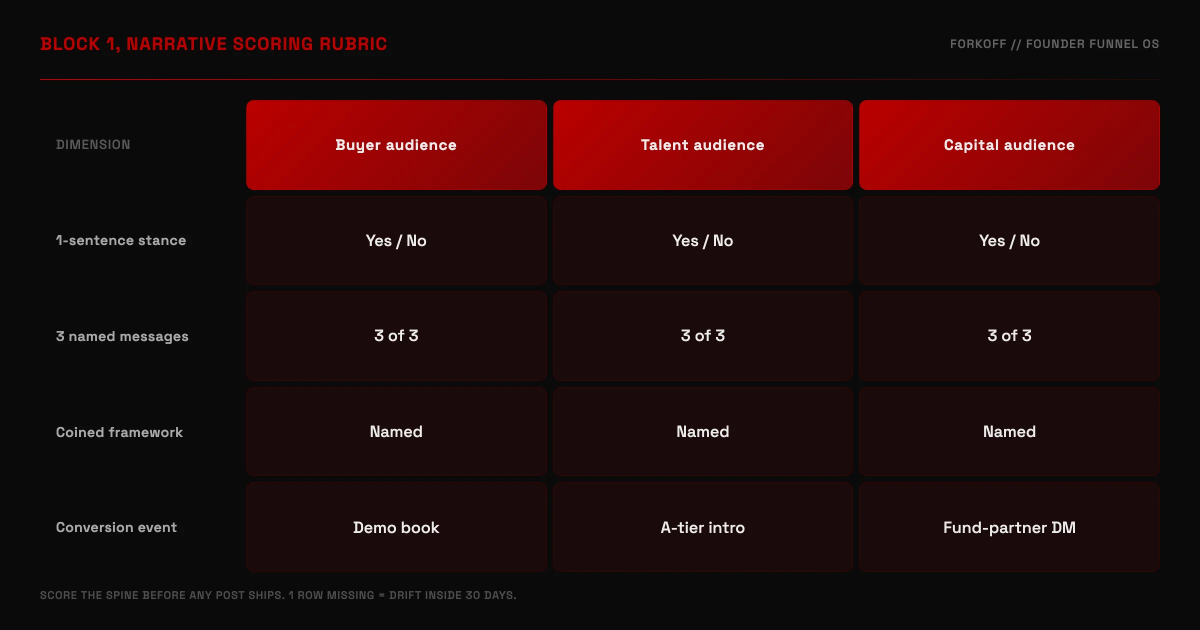
Block 2: Distribution channels
Block 2 spokes cover the five surfaces where founder content actually compounds: Twitter / X, Reddit, Hacker News, LinkedIn, and Farcaster. Each spoke documents per-surface mechanics, the cadence floor that keeps the algorithm engaged, the reply-discipline pattern that triggers second-feed surfacing, and the conversion bridge from feed to inbound DM. The connective thesis: ICP overlap, not founder taste, picks the surface, and two surfaces run for 60 days outperform five surfaces run for two weeks.
- Go viral on X, 5 levers to 1M-plus views in 2026 , the five mechanical levers behind every 1M-view post in the founder-funnel cohort.
- Twitter DM outreach in 2026, the 4-stage warm DM playbook , how warm DMs from founder content close at 2-4x cold-email rates.
- Reddit marketing for AI startups, the 4-subreddit stack , the four subreddits that drive 80 percent of qualified inbound for AI startups.
- Reddit marketing for AI startups, the 90-day operator playbook , the 90-day install pattern for a Reddit-led founder distribution layer.
- The Reddit intent engine, $51K monthly from comments , the comment-to-inbound conversion pipeline that drove $51K monthly recurring.
- How to launch on Hacker News in 2026 , the 5-lever Hacker News launch system for founder-led distribution.
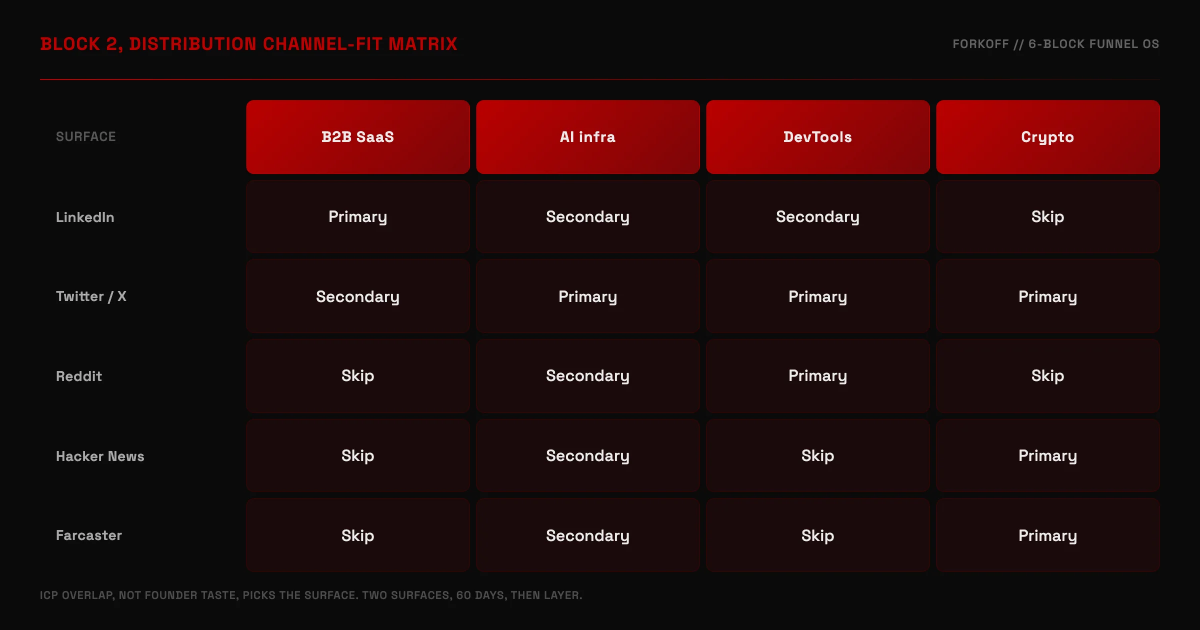
Block 3: Launch and conversion
Block 3 spokes cover the bridge from founder-content distribution to revenue. Launch platforms beyond Product Hunt, model-drop riding for AI startups, two-sided marketplace cold-starts, solo-operator zero-to-first-five-clients, and the 3-tier verification audit that catches conversion-stack gaps. The connective thesis: attention without conversion is the most expensive form of vanity, and the conversion stack must be wired on day 14, not day 90.
- Launch platforms beyond Product Hunt, the 2026 playbook , the seven launch surfaces that produce inbound when Product Hunt does not.
- The 48-hour model-drop marketing playbook , how founder-led teams ride a competitor model release inside a 48-hour window.
- Marketplace cold start, 9 cases and 4 phases , the four phases of solving the chicken-and-egg problem in two-sided marketplaces.
- First 5 clients in 30 days without a brand , the no-audience GTM script for solo operators starting from zero.
- AI marketing verification, the 3-tier audit , the three audit tiers founders run to catch broken conversion stacks before the agency engagement starts.
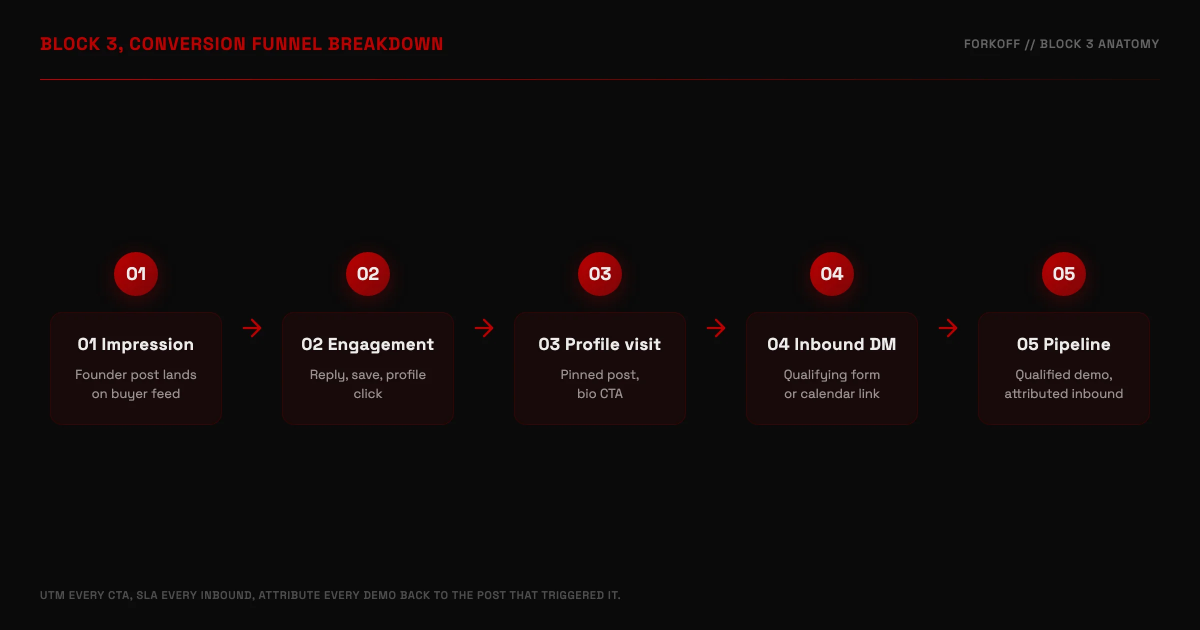
Block 4: Agency operating model
Block 4 spokes cover the agency-side economics around founder-led growth. AI agency pricing unit economics, what is inside a $15K retainer, vertical AI agency pricing, and how to choose a Web3 marketing agency after getting burned. The connective thesis: founder-led growth is operator-priced, not deliverable-priced, and the agency model has to match outcome accountability or the engagement fails inside the first 60 days.
- AI agency pricing unit economics, 62% gross margin breakdown , the five pricing models for AI agencies and the margin profile of each.
- How FORKOFF scopes an AI marketing agency engagement , what an outcome-priced AI agency engagement covers in 2026.
- Vertical AI agency pricing, 3 case studies one contract , three vertical AI agency pricing case studies on outcome-priced contracts.
- How to choose a Web3 marketing agency after getting burned , the founder vetting playbook for the post-burn Web3 marketing engagement.
Block 5: Agent-native GTM
Block 5 spokes cover the new surface area unlocked when buyers route research through AI assistants and agents. Agent-native GTM, agent-ready site audit, agentic SEO toolkit, AI agent blast radius, and AI product trust recovery. The connective thesis: AI Overview and LLM citation engines reward founder-attributed content, and the founders who claim category authority in the 24-month window from 2026 to 2028 will dominate inbound through 2030.
- Agent-native GTM, the 2026 founder marketing stack , the seven-surface stack for founders selling into AI-buyer-routed markets.
- Agent-ready site audit, the 2026 scorecard founders run before launch , the pre-launch scorecard that scores founder sites against AI-agent readability.
- Agentic SEO explained, the Addy Osmani toolkit , the agentic SEO toolkit that scored a founder site 19 out of 100 and what the fix looked like.
- AI agent blast radius, the 2026 brand-side marketing model , the brand-side model for measuring how far an AI agent can carry a founder narrative.
- AI product trust recovery playbook for a bad week , the founder playbook when an AI product has a public failure week.
Block 6: Vertical plays and operating leverage
Block 6 spokes cover the vertical, channel-specific, and operating-leverage plays that compound on top of the core 4-block OS. AI DevRel, developer marketing strategy, AI startup marketing surfaces, VC portfolio GTM, and the backlink sources that actually work for startups. The connective thesis: vertical context decides the cadence, the surface, and the operating model, and the founder who picks the vertical lane early outpaces the founder who tries to run a generic playbook across all verticals.
- Developer marketing strategy 2026 , how founder-led AI infrastructure companies earn developer adoption.
- Developer marketing strategy 2026, the 5-surface stack that compounds , the five surfaces that compound for developer-tool founders.
- AI startup marketing, 7 surfaces that compound , the seven distribution surfaces for AI startup founders in 2026.
- VC portfolio GTM, how funds 10x distribution return , the 4-layer portfolio GTM stack that funds use to 10x distribution returns.
- Backlink sources that actually work for startups in 2026 , the backlink sources that move the needle for founder-led startups, ranked by acquisition cost and authority lift.
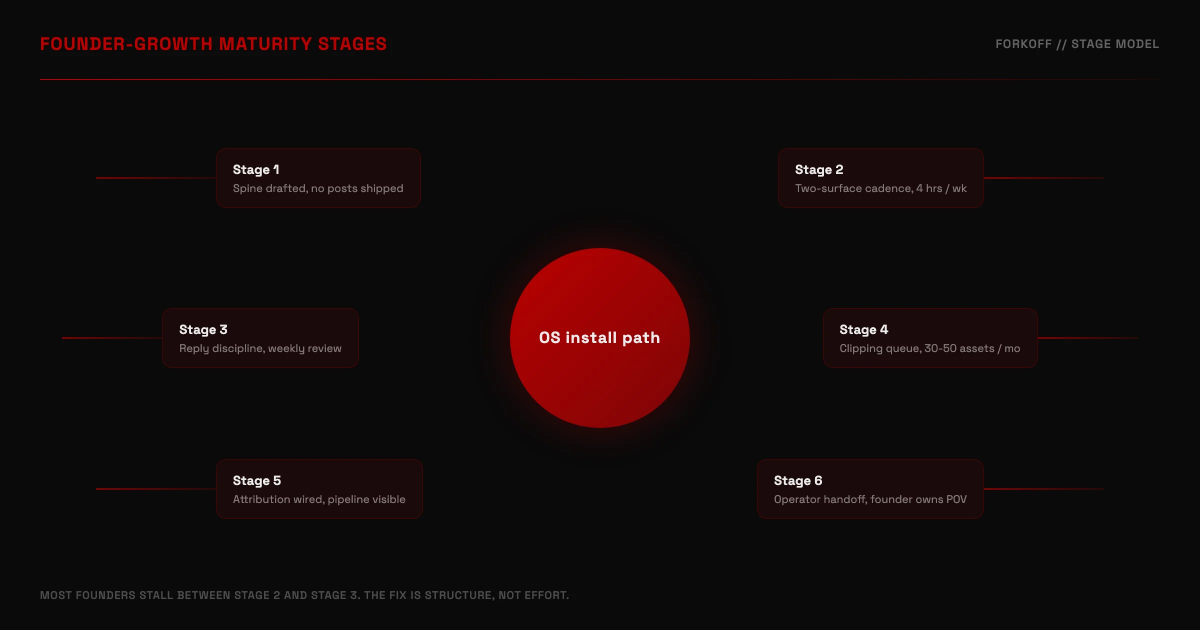
For the channel-specific founder-growth playbook, Nick Himo's distillation of four founder-led content compounders on YouTube (https://www.youtube.com/watch?v=bEzI3bprxg4) maps closely to the four blocks in the funnel OS, and the founder-distribution thread on r/SaaS (https://reddit.com/r/SaaS/comments/1sy8hxy/people_keep_asking_how_i_can_be_stupid_enough_to/) covers the displacement risk for the 90-percent of founders who lack a distribution layer.
Operator audit ledger: what 23 founder-funnel audits actually found
The 23-audit ledger is the first-party dataset behind the failure-mode taxonomy. Each engagement scored the founder against the 4-block OS across roughly 40 line items: spine adherence, surface cadence, reply discipline, clipping queue health, conversion-stack instrumentation, retention curve, brand-equity assets. The findings cluster into five recurring patterns.
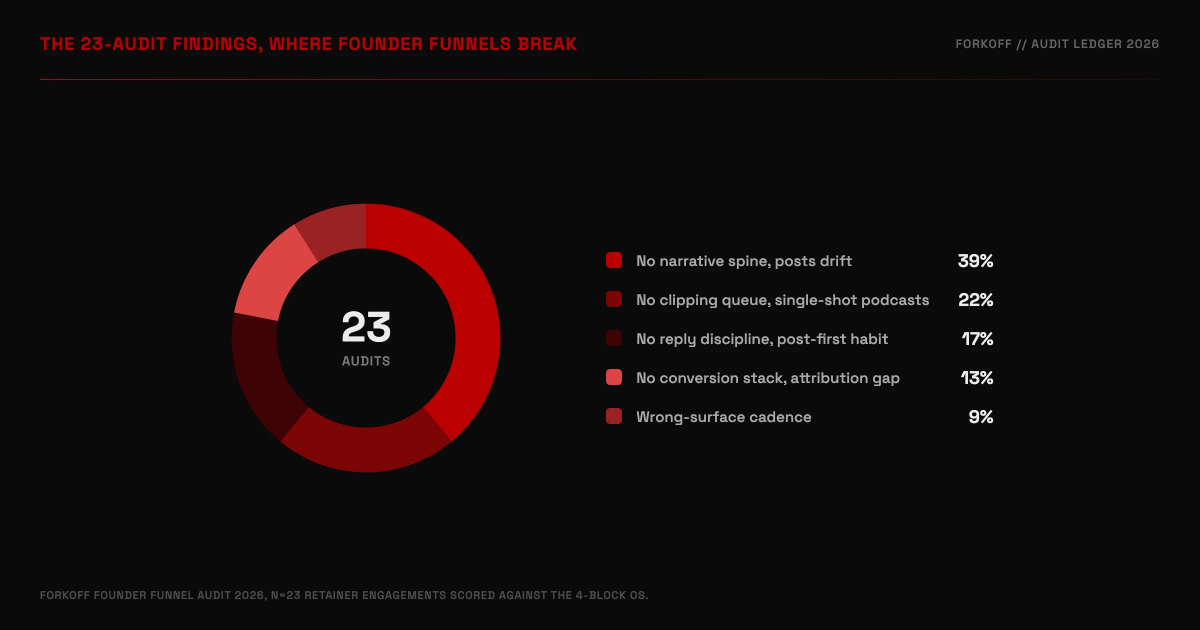
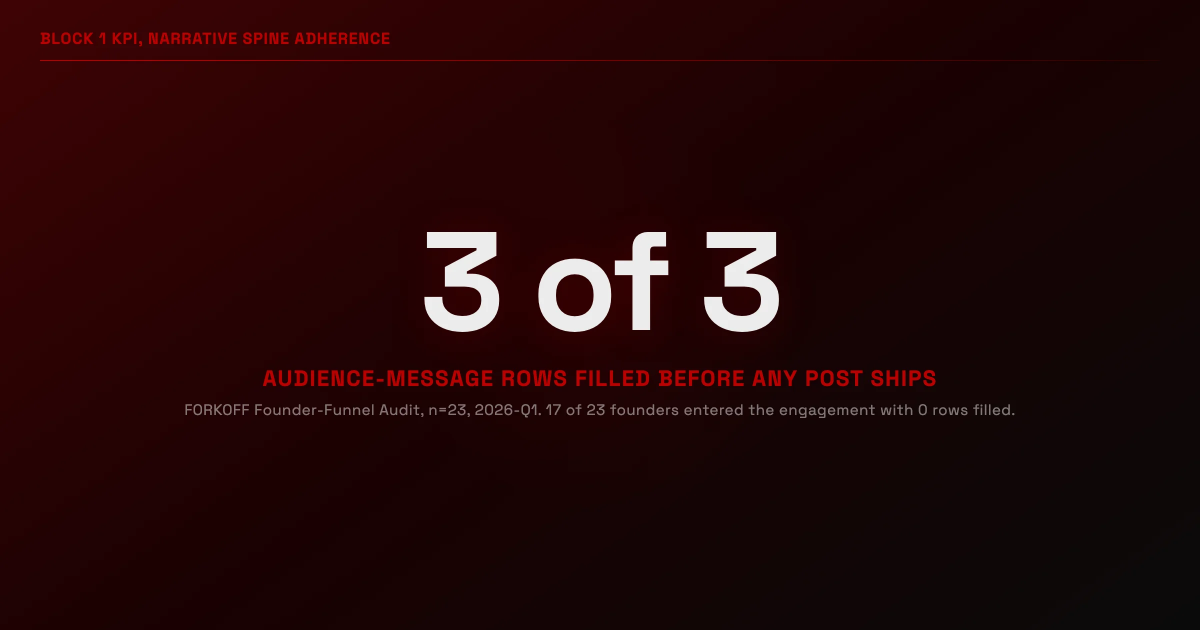
Pattern 1, narrative spine missing or unwritten, 9 of 23 audits (39 percent). Founders posting for six to eighteen months without a written spine, every post a fresh act of decision-making. Audit-to-spine-installed window is 14 days. Reply rates climb 1.8-2.4x inside the following 60 days as drift stops.
Operator note17 of 23 audited founders enter with zero narrative-spine rows filled; the spine, not cadence, is the first fix in most installs., FORKOFF Founder Funnel Audit 2026, n=23
Pattern 2, no clipping queue behind long-form, 5 of 23 audits (22 percent). Podcasts, essays, conference talks recorded for months, each long-form dying inside 48 hours. Fix: transcription pipeline + one clipper + six-week cadence queue. 90 days to back-fill the previous six months of long-form.
Pattern 3, post-first, reply-second habit, 4 of 23 audits (17 percent). Daily posting with low engagement because the reply layer was skipped. Fix: 10-15 buyer-feed replies in the first 30 minutes, then the founder's own post, then 5-10 more in the second 30 minutes. Reply discipline produces 2-3x impression lift inside the first week.
Pattern 4, no conversion stack behind founder content, 3 of 23 audits (13 percent). Large audiences with no UTM CTAs, no qualifying form, no DM SLA, no weekly pipeline review. Fix: wire all four conversion-stack elements on day 14. Recovery 60-90 days because attribution needs reverse-engineering on prior content.
Pattern 5, wrong-surface cadence, 2 of 23 audits (9 percent). Wrong primary surface for the ICP (LinkedIn for crypto founders, Twitter for HR-tech, Reddit for early-stage hardware), zero compounding. Fix: kill the wrong surface, pick the two with highest ICP overlap, 60-day commit. 90-day rebuild but the second-surface lift is durable.
The ledger pattern is not random. Pattern 1 is upstream of Pattern 3 because reply discipline without a spine produces scattered replies that do not compound recall. Pattern 2 is upstream of Pattern 5 because the wrong surface plus no clipping queue compounds the leak. Pattern 4 sits downstream because conversion attribution only matters if upstream distribution is producing signal. Recovery costs cluster too, spine 14 days, clipping 21 days, reply discipline zero days (habit change), conversion stack 30 days, surface re-selection 90 days. The parallel install closes findings inside 90-120 days; the sequential install stretches to 180.
What breaks a founder funnel?
The 4-block OS works when it is installed in the order spine, surfaces, conversion, retention. It breaks in seven distinct ways, each a recurring failure mode across the FORKOFF audit ledger, and in every case the fix sits upstream of the visible symptom: posting before positioning, over-stacking surfaces, treating podcasts as deliverables, reading vanity dashboards, quitting at day 45, staying solo forever, and drifting off the narrative spine by week eight.
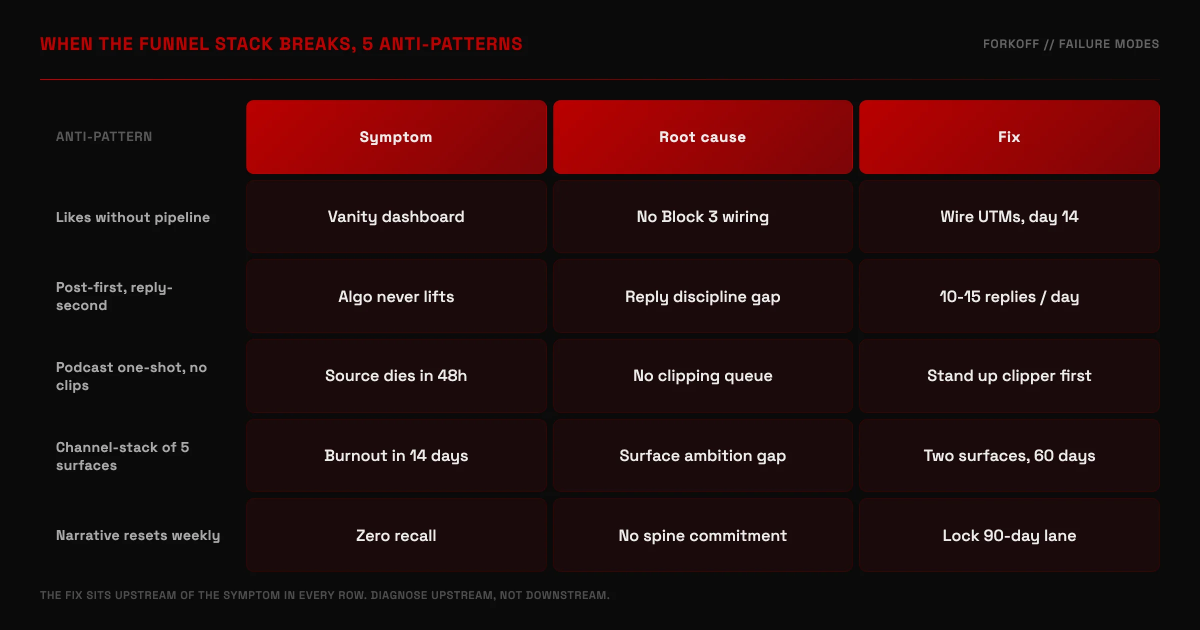
Anti-pattern 1, posting before positioning. Founders ship 60-90 days of generic content before locking a spine. Fix: lock the spine in writing, then resume posting.
Anti-pattern 2, surface-stack ambition gap. Founders chase five surfaces, burn out in 14 days, drop all five. Fix: two surfaces with highest ICP overlap, 60-day commit, then layer.
Anti-pattern 3, podcast as deliverable, not raw material. Founders treat a 60-minute podcast as the asset, not as 30-50 atomic distribution assets. Fix: stand up the clipping operation first, record the podcast second.
Anti-pattern 4, vanity dashboard reading. Founders track likes and impressions because those numbers move daily, and the feedback loop rewards entertainment over pipeline. Fix: Block 3 wiring with UTM, qualifying form, SLA, weekly pipeline-attribution review.
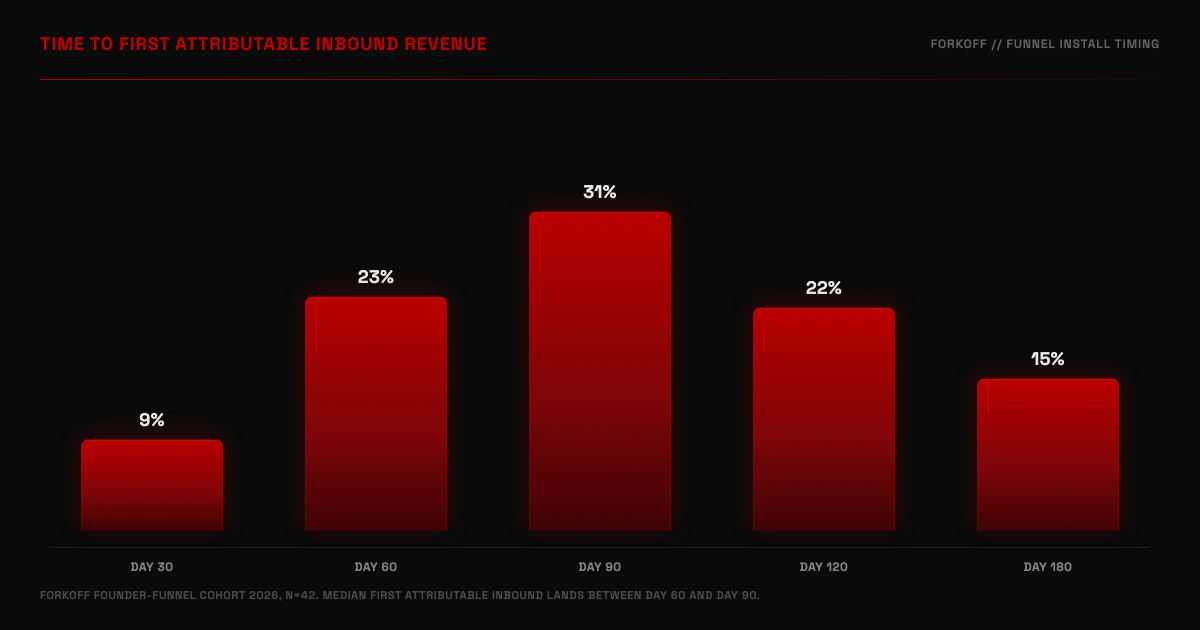
Anti-pattern 5, 90-day quitter cycle. Founders quit at day 45 because they have not seen closed pipeline. Founder-attributed DMs land at day 30, qualified forms at day 60, closed pipeline at day 90-120. Fix: expectation calibration.
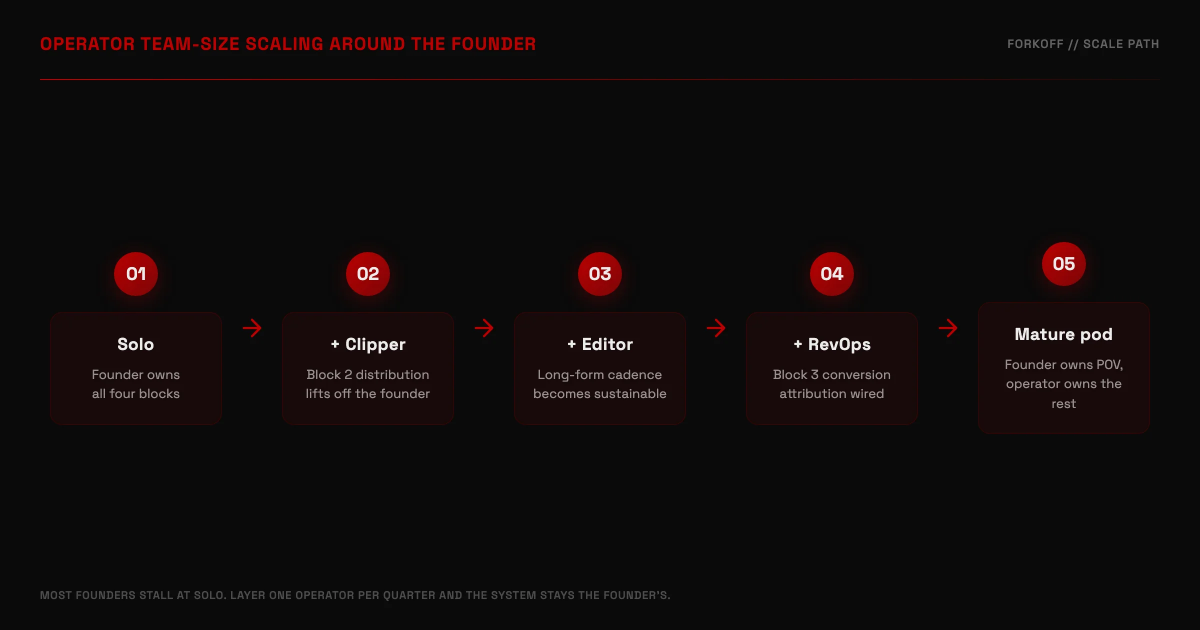
Anti-pattern 6, solo-forever operating model. Founders refuse to layer in a clipper, editor, or RevOps. Ceiling sits at hour 12 per week. Fix: one operator per quarter, starting with a clipper at month four.
Anti-pattern 7, narrative drift inside the engagement. Founders write the spine in week 1, post against it for 30 days, then drift back toward generic takes by week 8. Fix: 90-day refresh cycle, reread the spine, score the last 30 days, kill drift posts.
Amanda Natividad
@amandanat
Alright, alright... maybe I ought to come back to X because Patrick McKenzie livetweeted my keynote at MicroConf and I almost missed it , and I'm still fangirling.
See also: the Reddit-specific founder pillar
If your founder funnel runs through Reddit specifically as the primary distribution surface, the companion pillar is Reddit Marketing for AI Startups in 2026, the 90-day operator playbook. That pillar mirrors every block against Reddit mechanics, and the two share spokes.
THE FOUNDER FUNNEL OS
THE FOUNDER FUNNEL OS is the named system FORKOFF productizes. Four blocks, each a separate operating layer, each with measurable inputs and outputs. The four blocks are sequential in the first 60 days of installation, then run continuously in parallel after the architecture is locked.
Block 1: Narrative Architecture Optimization. Extract founder POV across ecosystem and product layers into clear narrative lanes. What conversation should the founder consistently appear in? What positioning lock keeps every output anchored? Output: a narrative spine document, audience and ecosystem map, tonality guide, key message pillars, KPI alignment sheet. This block is 1-2 weeks of intensive work; once locked, it becomes the upstream filter every downstream asset passes through. The deliverable is a one-page positioning brief plus a 6-month editorial calendar; agency clients run this brief through their own communications team weekly to keep voice intact.
Block 2: Content & Reply Systems. Operate daily content formats across X, LinkedIn, YouTube, Farcaster, and the highest-signal ecosystem channels for the founder's category. Cadence, format mix, and reply discipline matter more than volume. The 4-3-2-1 framework codified by LinkBoost is a representative weekly rhythm: 4 actionable insights, 3 personal stories, 2 social-proof posts, 1 hot take. Reply discipline is the under-loved leverage point: a founder leaving 10 high-signal replies per day on the right buyer's posts outperforms a founder posting twice a day with zero engagement on others' work. The reply layer is where the founder shows up inside conversations the buyer is already paying attention to.
Block 3: Distribution & Relationship Layer. Insert founder presence inside high-signal conversations across operators, funds, and ecosystem decision-makers. Replies on threads where the right buyer is reading. Tagging that surfaces relevant operators. Newsletter cross-mentions. Podcast guesting on shows the buyer audience already trusts. This block converts attention into context. The relationship-layer specifics: 5-10 newsletter cross-mentions per quarter, 1-2 podcast guest appearances per month, weekly DM cadence to a curated 50-prospect operator list, and 2-3 high-signal in-person events per quarter where the founder hosts a dinner of 8-12.
Block 4: Conversion Mapping. Move attention into introductions, integrations, partnerships, and long-term relationships. This is where founder content becomes pipeline. Every long-form asset gets a primary CTA. Every founder appearance in a panel or podcast routes to a downstream funnel. Block 4 specifics: a tagged UTM scheme on every founder-CTA, a single qualifying form behind every demo request, a weekly review of pipeline-attributed inbound, and a 30-day SLA on every inbound DM that scores above the qualifying threshold. Without Block 4, founder content becomes activity reporting; with Block 4, it becomes pipeline reporting.
The four blocks compound because each one feeds the next. Narrative gives content its filter. Content creates artifacts to distribute. Distribution opens relationships. Relationships convert into pipeline. Skip any block and the system stops compounding. First Round's "three-step process" and NoGood's "3-Part Formula" cover near-cousin patterns; the FOUNDER FUNNEL OS is FORKOFF's productization for tech, SaaS, deep tech and Web3/AI founders specifically. The differentiator: Web3 founder dynamics around ecosystem-native discovery, AI founder dynamics around AI-citation-readiness, and the cross-pillar pattern of clipping infrastructure built on top of every long-form moment.
For per-block deep dives, the spoke-level breakdown covers Block 1 mechanics in detail and the 2026 agent-native marketing stack covers how Block 4 plugs into AI buyer routing.
Founder as Trust + Talent + Capital + Partnership + Community
A founder is five layers compressed into one body. Each layer has its own funnel, content type, and conversion event. Conflating them creates content that talks to nobody specifically; separating them creates content that compounds because each piece serves a clear purpose. The leverage move is naming the layer before drafting the post: a founder who knows whether a given piece is for trust, talent, capital, partnership, or community writes faster, lands harder, and routes the conversion correctly.
Buyers pre-qualify the founder before the first call
In the Edelman-LinkedIn B2B Thought Leadership Impact Report, 9 in 10 decision-makers and C-suite execs say they are moderately or very likely to be more receptive to sales or marketing outreach from a company that consistently produces high-quality thought leadership, and 75% say a particular piece of thought leadership led them to research a product or service they were not previously considering. Both numbers price the founder POV surface as pre-sales infrastructure: the buyer has read the founder before the first call, so Block 1 and Block 2 do the warm-up that cold sequences used to attempt alone.
Source: Edelman-LinkedIn B2B Thought Leadership Impact Report
Trust. The founder is the trust layer for prospects evaluating the company against three other vendors. Trust-layer content: operator teardowns of their own product, transparent-pricing posts, admission of what the product cannot do. Conversion event: a prospect clicks book-a-demo because the founder felt like a real human, not a sales motion. Worked example: a FORKOFF cohort founder posted a 600-word "here is what our product does badly" thread; that single post drove 11 demo requests in 48 hours, up from a baseline of 1-2 per week. Trust posts work because they pre-handle the buyer's strongest objection.
Talent. The founder is the talent signal for engineers, designers, and operators considering the company. Talent-layer content: build-in-public threads, technical decisions explained, credit given to teammates. Conversion event: an inbound DM from an A-tier candidate who reads the founder's posts as a culture signal. Worked example: a cohort founder shipped 30 days of build-in-public Twitter threads documenting an architectural rewrite; the engineer who later joined as VP of Engineering said in his first day that the public process was the reason he applied. Talent posts work because the founder's writing reveals the company's actual decision-making rhythm.
Capital. The founder is the capital magnet for investors. Capital-layer content: POV-on-category, market-shift commentary, contrarian takes. Conversion event: a fund partner reaches out because they've been reading for six months and want to lead the next round. Worked example: a cohort founder published a quarterly "state of the AI agent category" essay for three consecutive quarters; the second essay drove inbound from two top-tier funds, the third drove a term sheet. Capital posts work because investors index on POV durability over time.
Partnership. The founder is the partnership opener for ecosystem deals. Partnership-layer content: spotlight posts on partners, joint takes on category direction. Conversion event: a partnership lead from a complementary company DMs because they want to bundle. Worked example: a cohort founder ran a weekly "partner of the week" LinkedIn post for 12 weeks; eight of the 12 partners returned with bundle conversations and three converted into formal co-marketing agreements. Partnership posts work because amplifying others is criminally undersupplied in most ecosystems.
Community. The founder is the community anchor for users and contributors. Community-layer content: teardowns of how-we-built-it, user-victory amplification, consistent presence in community channels. Conversion event: a user becomes a contributor; a contributor becomes an evangelist. Worked example: a cohort founder spent 30 minutes per day for 90 days replying to user posts in a single product-relevant Discord; the community ended up producing five of the company's first eight integrations and nine of the first 23 paying customers. Community posts work because attention spent on users compounds in ways no marketing channel matches.
Five layers, five funnels, five conversion events, all compressed into one founder. The mistake most founders make is treating their content as one channel for one audience; the leverage move is treating it as five channels for five audiences with shared production economics. The VC portfolio variant covers how this same five-layer logic applies across a fund's portfolio companies; the developer marketing strategy guide covers the mechanics specifically for technical audiences.
Which founder content types actually compound?
Not all founder content is equal. Across the FORKOFF Founder-Funnel Cohort 2026, seven content types account for an estimated 80% of the total compounding lift. The remaining 20% of categories are still useful but produce flat returns over time. The discipline is matching the right type to the right week, not posting all seven simultaneously.
Type 1 - Build-in-public. Specific decisions documented in real time. "We just shipped X. Here is what we tried that didn't work." Hits talent and community simultaneously and creates a public record investors can reference six months later. Best on Twitter and LinkedIn; weak on YouTube. Cadence: 1-2 per week during active build phases. The compounding multiplier is six to nine months out, when an investor or candidate references a build-in-public post the founder forgot they wrote.
Type 2 - Operator teardown. A founder dismantling their own product, a competitor's product, or a category playbook. Most founders are too defensive to do this; the ones who do build category authority quickly. Best on LinkedIn long-form and YouTube longform; viable as a Twitter thread. Cadence: 1 per month is plenty - more dilutes the authority. The teardown's leverage is in the specifics: a 1,200-word post on "why feature X in competitor Y is broken" with screenshots converts authority faster than three months of generic POV.
Type 3 - POV on category. A clear stance on where the category is going. POV posts compound capital and partnership conversions because they pre-position the founder as someone with a thesis worth backing. Best on LinkedIn long-form and newsletter; viable as a Twitter thread. Cadence: 1 per quarter for a deep essay; 1 per week for a tactical POV reply. The fund-pipeline mechanic: investors index on POV durability across multiple essays - one strong essay is luck, three is a thesis.
Type 4 - Live-launch narrative. Day-by-day commentary during a launch window. The 48-hour launch window is the highest-leverage content interval in the entire founder calendar; the 48-hour model-drop playbook breaks down per-hour mechanics. Best on Twitter for velocity; LinkedIn picks up the post-launch retrospective. Cadence: 4-8 posts compressed into 48 hours, then nothing for two weeks. Burning the launch window is irrecoverable.
Type 5 - Partner spotlight. A founder publicly amplifying a partner's launch, milestone, or POV. Criminally under-produced because it feels like giving away leverage; in practice, it is the highest-converting partnership-pipeline driver. Best on LinkedIn (LinkedIn rewards generosity); viable on Twitter. Cadence: 1 per week for active ecosystems, 1 per month for niche ones. The conversion lag is 2-4 weeks: the partner sees the spotlight, opens the conversation, and the bundle takes shape.
Type 6 - Hot take. A short, sharp, slightly-uncomfortable opinion that creates conversation. Hot takes lose their compounding effect if used more than once a week. Best on Twitter for the velocity loop; viable on LinkedIn if framed as a contrarian-but-defended POV. Cadence: 1 per week maximum. The leverage of a good hot take is the comment thread - founders who can defend their take in replies build more authority than founders who fire and disappear.
Type 7 - Lesson-from-failure. A specific failure documented with what was learned. Converts across all five layers (Trust, Talent, Capital, Partnership, Community) simultaneously because vulnerability is the fastest trust-builder online. Best on LinkedIn long-form, with a retrospective YouTube companion when stakes warrant it. Cadence: 1 per quarter for big failures; 1 per month for tactical lessons. Specificity is the requirement - vague "we learned to focus" posts produce nothing; "we burned $87K on a content channel that returned zero qualified leads in 90 days, here is why" produces inbound.
Across the FORKOFF Clipping Ledger 2026 (n=3,085 clips), one to two monthly long-form podcast appearances convert into 30-50 distribution assets per run. The math: a 60-minute podcast contains 10-15 high-signal moments; each gets clipped into 2-3 platform-native variants. One conversation equals six weeks of distribution if a clipping system runs against it. The podcast-clipping revenue case study documents the production discipline behind it. The mistake most founders make is treating the podcast as the deliverable; the leverage is treating the clips as the deliverable and the podcast as the source.
Industry Context
One to two monthly long-form podcast appearances convert into 30-50 distribution assets per run, at $0.0024 to $0.0038 cost per qualified view (3x to 42x lower-cost than the $0.01-$0.10 industry baseline).
Source: FORKOFF Clipping Ledger 2026, n=3,085 clips
Distribution surfaces: where founders actually compound
Twitter, LinkedIn, podcast guesting, newsletter, Farcaster. Five surfaces, each with a role and cadence. Channel choice is downstream of where the founder's specific ICP is most active, what each channel costs per qualified lead, and where the founder can produce daily without burning out. Most B2B AI founders win on LinkedIn first, then add Twitter, then YouTube and podcast. The order is not aesthetic; it is enforced by where buyer attention concentrates in 2026 and how each surface rewards different production rhythms. The founder-led marketing operator guide walks through the per-surface distribution map and the measurement layer that keeps each channel honest.
Operator note$0.0024 to $0.0038 per qualified view on founder clips vs $0.42 per qualified outbound action; the ledger sets the budget split, not taste., FORKOFF Clipping Ledger n=3,085 + Outbound Ledger n=10,847
LinkedIn is the most underrated surface in 2026. LinkBoost data shows founder-led content drives inbound leads that convert at 14.6%. The 4-3-2-1 weekly cadence is a defensible default for founders who don't have a custom rhythm yet. LinkedIn rewards three signals algorithmically: dwell time on the post (long-form posts and document carousels win), comment depth (replies that are full sentences beat one-liners), and DM-to-post ratio (posts that drive DMs in the first hour signal high relevance to the algorithm). Posting time matters less than founders fear; what matters is replying to 8-12 high-signal posts inside 30 minutes of publishing your own. The reply layer is what triggers the algorithm to push the post.
First-hand thread data on founder voice vs cold outreach
A solo SaaS founder documented going from zero LinkedIn followers in October to 33,003 followers and 10,965 captured leads in six months with zero ad spend, reporting 5-10 inbound leads per week without sending a single cold message. The mechanism he describes matches Block 2 discipline: topic selection by comment count on niche accounts rather than likes, one resource built per week, and replies before posts. First-hand practitioner numbers from the thread itself, not a vendor case study.
Source: r/EntrepreneurRideAlong first-hand report, 2026
Twitter rewards velocity and POV. Founders who can produce one POV thread per week get more discovery surface than founders who post 20 short tweets. The 5-lever Twitter launch playbook covers per-lever mechanics for high-volume launches. Twitter's discovery loop in 2026 is increasingly thread-led: the Grok-powered algorithm shows the first tweet to a small audience, then expands the audience based on read-through rate of the second tweet. Founders who write tight first tweets and tighter second tweets get exponential reach; founders who buried the hook in tweet four lose the loop. The reply mechanic on Twitter is also still under-utilized: leaving 5-10 substantive replies per day on the right buyer's posts builds more inbound than posting twice as often.
The reply-before-post discipline is not a FORKOFF invention; it is the consensus finding among founders running the motion solo. One SaaS founder several months into running X for lead gen put the pattern in three lines:
Consistency matters way more than quality at first. Commenting drives more inbound than posting. DMs only work if the person already recognizes your name/profile.
Podcast guesting compounds slowly but durably. Lenny Rachitsky's growth podcast is the canonical reference: every founder appearance becomes a permanent searchable artifact that AI Overview surfaces months later. The selection criteria for guest appearances should be ruthlessness about audience overlap with the founder's ICP, not download counts; a 10K-listener show with an estimated 80% ICP overlap outperforms a 100K-listener show with 5% overlap. Newsletter is where the deepest readers live - subscribers convert into customers, talent, investors, and partners at materially higher rates. The newsletter's job is not reach; it is fidelity. A 500-subscriber newsletter that an estimated 70% of subscribers actually read converts pipeline at 5-10x the rate of a 50K-subscriber newsletter with 8% open rates. Farcaster is the under-priced channel for crypto-adjacent founders; the channel rewards consistent daily presence inside topic-specific channels rather than broadcast posts. Crypto founders shipping a product there should also read how Farcaster mini apps get distribution in 2026, which documents the six loops that turn cast presence into compounding weekly active users.
YouTube founder channels are a 2026 leverage point that most founders skip because the production overhead feels prohibitive. The agency-cohort pattern: founders who post one 8-15 minute YouTube essay per month consistently for 9 months pull more inbound from the YouTube channel than from any other surface. The YouTube long-tail is the durability advantage; AI Overview citation engines rank YouTube transcripts heavily and a single high-signal video keeps surfacing months after upload.
The 4-subreddit stack for AI startups covers Reddit specifically as a sixth channel for AI founders whose ICP lives there. Reddit is the highest-intent surface but also the most reputation-fragile; founders who post promotionally get banned faster than they get traction. The leverage move is community-first behavior for 60-90 days before any product mention.
MATT GRAY
@matt_gray_
I run an 7-figure one-person online business. The key marketing system: the Founder Flywheel. Here's what it is and how to use it (so you can steal it):
Lenny Rachitsky: how to grow a startup
Creator Lab
Lenny Rachitsky on how to grow a startup - founder-funnel mechanics from first 10 users to defensible distribution.
AI agency pricing - unit economics
When founder-led growth scales beyond what one human can do, the question becomes: hire in-house, run an agency, or hybrid. The pricing model determines the unit economics, and pricing model is more important than the size of the agency or the headcount of the in-house team.
Four pricing models exist in 2026. Each has a distinct margin profile and a distinct alignment of incentives. Per the FORKOFF Agency Pricing Benchmark 2026, outcome billing produces an estimated 41% higher gross margin than hourly billing for repeatable, high-context work. The benchmark is constructed from anonymized P&L data across the agency book, so the margin numbers reflect actual delivery costs, not hypothetical pricing-page math.
Hourly billing - high transparency, low margin, no incentive alignment. Hourly bills decouple effort from outcome. Used mostly for one-off advisory work. Worked example: a $300/hr advisory engagement where the agency is paid for time, not result. Margin runs an estimated 15-25% because the agency cannot scale efficiency without losing revenue. Clients tolerate hourly only when the scope is genuinely unknowable and the engagement is short.
Retainer billing - predictable cash flow, medium margin, weak outcome alignment. Risk: scope creep on the agency side, or scope undelivery on the client side. Worked example: a $10K/month retainer for ongoing founder content. Margin runs an estimated 30-45% if delivery efficiency is high; collapses to 5-15% if the agency over-delivers to retain the client. Retainer is the right tool when scope is clearly defined and the deliverable is repeatable but high-context.
Outcome billing - variable revenue, high margin on repeatable work, strong outcome alignment. Requires deep client context but produces 41% higher gross margin than hourly billing for repeatable, high-context work. Worked example: an estimated $5K base plus $5K per qualified inbound demo, capped at $25K per month. The agency carries the operational risk of producing demand; the client carries no fixed exposure beyond the base. Margin runs an estimated 50-70% because the agency only delivers when the result lands.
Equity billing - multi-year payoff, highest variance, strongest alignment. Makes sense for category-defining engagements. Most agencies cannot afford equity-only structures; the ones who can become category-defining themselves. Worked example: an estimated 1-3% common-stock package layered on top of a reduced-rate retainer. Payback is 3-7 years; expected value is asymmetric to the upside. Only agencies with strong existing cash flow and category-positive selection can run this; most should avoid it until cash flow is durable.
Madhavan Ramanujam's pricing framework (extracted from 400+ AI companies and 50 unicorns on Lenny's Podcast) confirms the direction: as a service shifts from labor-priced to outcome-priced, gross margin expands and client retention extends. Ramanujam's four pricing-model lessons are direct: differentiate on outcome rather than feature; price on willingness-to-pay rather than cost-plus; segment by intensity-of-need rather than firmographic; and rebrand the product around the willing buyer. Each lesson maps cleanly to agency pricing. The per-output P&L deep-dive covers explicit margin levers; here it functions as the operating-economics framing for the FOUNDER FUNNEL OS.
Pricing models for AI agencies in 2026
| Model | Predictability | Margin | Alignment | When to use |
|---|---|---|---|---|
| Hourly | Low | 15-25% | Weak | One-off advisory, specialist time |
| Retainer | High | 30-45% | Medium | Ongoing scoped work, clear deliverables |
| Outcome | Medium | 50-70% | Strong | Repeatable, high-context, measurable |
| Equity | Variable | Multi-year | Strongest | Category-defining engagements |
FORKOFF Agency Pricing Benchmark 2026. Margin ranges reflect anonymized agency client P&L.
Industry Context
Outcome-priced engagements deliver 41% higher gross margin than hourly billing for repeatable, high-context work, and outbound DMs that reference a founder clip + POV close at 2-4x the industry-baseline cold reply rate (8.5% per Brian Dean's 12M-email study).
Source: FORKOFF Agency Pricing Benchmark 2026 + FORKOFF Outbound Ledger 2026, n=10,847 sequences
Solo operator → first 5 clients without an audience
Founder-led growth does not require a personal brand to start. The most repeatable solo-operator play is mechanical: pick one ICP, find 100 prospects on LinkedIn, send 25 hyper-personalized DMs per week using a problem-process-proof structure. First 5 clients close inside 90 days at $5K-$15K each. The math is unforgiving: 25 DMs per week times 12 weeks equals 300 DMs total. At a 12-15% reply rate (the floor for problem-process-proof), 36-45 prospects respond. At a 20% qualification rate from response, 7-9 qualified conversations happen. Five close inside 90 days.
The ceiling once an audience exists is documented in first-hand numbers:
Started posting on LinkedIn in October with zero followers. No audience, no brand, nothing. Today I'm at 33,003 followers, 10,965 leads captured, and I get 5-10 inbound leads per week without sending a single cold message. Zero ad spend.
Problem-process-proof works because it inverts the standard cold-DM script. Standard cold scripts open with the offer. Problem-process-proof opens with a specific observable problem the prospect probably has, names the process the founder uses to solve it, and closes with proof (a published artifact, a case study, a clip). Reply rates run 3-5x cold-pitch baseline. The structural rule: approximately 60% of the message is about the prospect's situation, 30% is about the founder's process, 10% is the proof. Founders who flip the ratio (60% pitch) lose. The proof line is also load-bearing - a published artifact (a thread, a clip, a case study) does the credibility work the message body cannot. Without proof, the DM reads as another cold pitch dressed up as personalization.
These compounding loops are the heart of the 2026 SaaS distribution reset. The math behind this: FORKOFF Outbound Ledger 2026 (n=10,847 sequences) - outbound DMs that reference a founder clip + POV close at 2-4x the industry-baseline cold reply rate (8.5% per Brian Dean's 12M-email study). The lift comes from the fact that the DM is not pitching anything; it is asking a relevant question with attached proof of credibility. Belkins' outbound response-rate study confirms touch-3 peaks at 6.94% reply rate for well-sequenced campaigns. The Belkins finding maps to the FORKOFF cohort cleanly: founders who run a 5-7 touch sequence with a clip in touch-1 and a POV essay in touch-3 hit reply rates above 9% consistently.
Pat Walls of Starter Story has documented the same pattern across hundreds of bootstrapped operators: the first 5-10 customers close because the founder personally hand-built every relationship, not because of marketing automation. Mark Roberge's Stage 2 framework reinforces it: the first 10 customers should come from founder-led outbound and inbound combined, with both motions running in parallel. The brand layer follows revenue; the brand layer does not precede revenue.
The no-audience GTM script covers per-DM mechanics in detail; the Reddit intent engine shows the same logic applied to community-mining intent.
Talked to 40 SaaS founders who grew from $5k → $100k MRR. These 7 patterns kept showing up.
Over the past few months, I’ve been doing a bunch of calls with SaaS founders , mostly folks in the $5k-$100k MRR range. Some bootstrapped. Some lightly funded. All trying to grow without burning out. I wasn’t trying to find some “secret formula,” but after 30-40 convos, a few clear… Show more
Two-sided marketplace cold-start
Marketplace founders face a chicken-and-egg version of the same distribution problem. Demand attracts supply; supply attracts demand; neither shows up first. The successful pattern in every documented marketplace launch is the same: serialize supply concentration before activating demand. Founders who try to launch both sides simultaneously almost always fail; founders who concentrate supply density in a narrow vertical or geography first almost always succeed.
Tinder concentrated supply on college campuses one campus at a time. The launch team would seed a campus with 1,000 active users in a single weekend before opening the next campus, ensuring that any user opening the app saw enough other users to make swiping worthwhile. Airbnb double-posted on Craigslist to inherit Craigslist's existing demand, ferrying Craigslist's traffic into Airbnb's listings until Airbnb itself became the demand surface. Uber bought rides at New Year's Eve to manufacture supply density on the worst night of the year, paying drivers more than the rides earned to ensure that early Uber users had a reliable experience on the night that mattered most. Andrew Chen's "The Cold Start Problem" book documents the pattern across nine examples and codifies the "atomic network" concept: the smallest network that can sustain itself without subsidy.
The founder funnel plays a specific role in marketplace cold-starts: the founder becomes the credibility signal that makes early supply-side participants take the platform seriously. The founder posting daily about a specific narrow vertical lets supply-side operators self-identify and apply to be early. Distribution becomes the cold-start mechanic. Three operational rules apply: pick a vertical narrow enough that the first 100 supply participants all know each other; spend approximately 50% of founder hours in the first 60 days inside supply-side communities (Discords, Slacks, in-person meetups); and write publicly about the supply-side problem the marketplace is solving so that supply-side operators come inbound rather than needing to be cold-recruited.
Tony Xu's DoorDash cold-start, Whitney Wolfe Herd's Bumble cold-start, and Brian Chesky's Airbnb cold-start all demonstrate the founder-as-supply-magnet pattern. Each founder personally hand-recruited the first hundreds of supply-side participants before any marketing spend; each founder also wrote and spoke publicly about the supply-side problem until supply-side operators self-identified. The marketplace launches that fail almost universally skip the public-writing step. The marketplace cold-start playbook covers supply-side seeding mechanics in detail.
Agent-native GTM: what changes when buyers use ChatGPT
In 2026, ChatGPT, Claude, and Perplexity answer roughly 30% of B2B research queries. The shift matters because LLM citation engines do not rank content the same way Google does. Pages with founder-attributed quotes and original-data callouts get 30-40% higher AI Overview visibility (Backlinko 2026 LLM-citation analysis). Backlinko's own LLM traffic was up 800% YoY in 2026. AI Overview visitors convert at 4.4x the rate of traditional search visitors. The implication: optimizing for AI citation is now more valuable than optimizing for Google blue-link ranking, especially for B2B categories where buyers research with assistants before any vendor visit.
Three specific changes follow.
First, every long-form asset needs original data. Generic-AI prose does not get cited because there is no unique factual claim to attribute. FORKOFF-style benchmarks (FORKOFF Founder-Funnel Cohort 2026, FORKOFF Clipping Ledger 2026, FORKOFF MISSION 2026's 50 ecosystem activations across 14 countries / $5M+ unlocked / 250+ investor introductions / 500K average campaign reach / 35K+ event attendees, an operator estimate) become the AI-citable claim other writers cannot fabricate. The original-data discipline is the single highest-leverage move a founder can make for AI-citation visibility; without an original number, the asset is interchangeable with every other vendor's blog post.
Second, named frameworks matter more than generic prose. AI engines latch onto specific noun phrases (like "FOUNDER FUNNEL OS" or "the 4-block system") because they are easier to attribute. Coining a term and claiming it is the highest-leverage move available. Brian Dean's Skyscraper earned 23,000 backlinks because Skyscraper is a thing - a noun phrase tied to a specific tactical move that other writers can reference. THE FOUNDER FUNNEL OS, PERMANENT DISTRIBUTION ENGINE, and THE 6-GATE OUTREACH VALIDATOR are FORKOFF's analogous coined terms; each is built to be cited by name.
Third, embed density matters. YouTube embeds correlate 0.737 with ChatGPT citations; Twitter and Reddit embeds add community-signal context. Hub pages with 2+ YouTube + 2+ Twitter + 2+ Reddit embeds occupy more AI-citation surface than essay-only competitors. The mechanism is straightforward: AI engines parse the embedded oEmbed metadata as a signal of citation depth, and content with multi-platform embeds reads as more authoritative because it routes attribution across the citation graph.
The five-element AI-citation-readiness checklist for any long-form asset: (1) at least one original benchmark or first-party data point with sample size; (2) at least one coined or named noun phrase that other writers can reference; (3) two or more YouTube embeds tied to the topic; (4) two or more Twitter and two or more Reddit embeds with topic-relevant captions; (5) a properly-structured FAQPage schema with 10+ Q&A items. Pages that hit all five elements consistently rank inside AI Overview citation surfaces; pages that miss two or more elements rank outside.
The agent-native marketing stack covers per-tool detail; the agent-ready site scorecard is the audit founders run before launch.
Why ChatGPT will be the next big growth channel (and how to capitalize on it) | Brian Balfour
Lenny's Podcast
Brian Balfour on Lenny's Podcast - why ChatGPT is the next big growth channel and what AI buyer routing means for founder-led GTM.
Founder Funnel + Outbound = unfair advantage
Four named operators (anonymized FORKOFF agency clients) demonstrate the compound effect. The pattern across all four is the same: founder content does not replace outbound; it pre-warms it. The DM that lands cold from a founder with no public footprint converts at an estimated 3-4%; the DM that lands from a founder whose recent posts the buyer has already scrolled past converts at 9-15%.
The founder-side bottleneck is usually not the message either. As one r/SaaS practitioner framed the split between list-building toil and actual selling:
The bottleneck probably isn't your pitch or your product. It's that you're doing founder-led research when you should be doing founder-led sales.
Operator A. AI infrastructure founder. Doubled retainer reply rate by pre-warming cold DMs with a 90-second podcast clip referenced in the opener. Clip linked in DM signature, not pitched. Reply rate moved from an estimated 4% to 9%; close rate moved from 11% to 19%. Net: $180K incremental ARR over 90 days from the same lead list. The clip's role was credibility transfer: prospects who clicked the clip arrived at the first call already knowing the founder's POV, which compressed the cycle from 6 calls to 3.
Operator B. DevTools founder. Closed an estimated $400K ARR from a single LinkedIn POV thread that triggered an inbound conversation with the buyer's CTO. The thread itself was 800 words and took two hours to write; the resulting deal cycle was three calls, no pitch deck. Reverse-engineered: the thread named the specific architectural choice the buyer was already evaluating, with a clear stance backed by FORKOFF agency-data benchmarks. The buyer's CTO commented on the thread, the comment surfaced inside the buyer's procurement Slack, and the conversation moved to a 30-minute discovery call inside seven days. The thread is now a permanent inbound asset; it has driven an estimated $230K ARR in the 12 months since publication.
Operator C. Crypto founder. Converted a Reddit thread response into a seed round in 18 days. Founder spent 90 minutes writing a detailed teardown of a competitor's pivot; the post hit the front page of a relevant subreddit; an investor commented with a DM follow-up; the round closed faster than any subsequent fundraise the founder ran. The mechanic: investors actively monitor founder-led commentary in their thesis-relevant subreddits; a single high-signal Reddit teardown can pre-qualify the founder before the first email lands.
Operator D. AI agency founder. Ran a 6-week founder-podcast tour (10 appearances, all on shows with 80%+ ICP overlap), stacked clipping output into LinkedIn and Twitter, and timed the tour to land 30 days before a $1.2M outbound campaign. Reply rate on the outbound campaign moved from an estimated baseline 6% to 14%; close rate moved from 9% to 18%. Total incremental pipeline: $920K ARR closed in the 90 days following the campaign. The integration discipline: every podcast appearance produced 4-6 short-form clips, every clip was queued into the outbound DM cadence as touch-2 social proof, and every prospect reply was routed to a dedicated SDR within 4 hours.
Four different patterns, one shared mechanic: founder content pre-warmed the conversation. The founder funnel was not a separate marketing motion; it was the upstream layer that made the eventual outbound or inbound conversation higher-converting. First Round Review documents similar patterns: Popsa quadrupled install conversion to $45M ARR by building a customer-journey map first; Sonic Jobs doubled activation by changing one email's copy after listening to user interviews. The shared lesson across First Round's case studies and the FORKOFF cohort is the same: distribution compounds when paired with insight, not when run alone.
Why do founders fail at DIY founder-led growth?
The DIY founder failure pattern is consistent enough that the FORKOFF Founder Funnel service playbook documents six specific failure modes and the intervention that resolves each. The cost of inaction is asymmetric: a founder who stays in a failure mode for 12 months falls behind a founder running the system by roughly 18 months of audience compounding, because the system's compounding is non-linear.
Failure mode 1: 1-2 podcasts then stop. Founder appears on a show, gets a small spike of attention, and stops because no further appearances are booked. FORKOFF intervention: turn every appearance into 30-50 distribution assets so each conversation produces six weeks of compounding content, not 48 hours of decay. Cohort example: a founder went from one Lenny appearance with no follow-up content to a clipping-discipline operation that produced 47 short-form assets over the following 30 days. Inbound DM volume tripled.
Operator noteOne 60-minute podcast yields 30-50 clips in our pipeline; the same clipping network has processed 5B+ views across client campaigns., FORKOFF Clipping Ledger 2026, n=3,085 clips
Failure mode 2: rely on panels for visibility. Panels feel like high-leverage activity but produce zero owned-channel artifact. FORKOFF intervention: extract, clip, and redistribute every panel into the founder's owned channels (LinkedIn, Twitter, YouTube, newsletter) within 72 hours. Cohort example: a founder spoke on five conference panels over 60 days; the first three produced zero owned content; the last two produced 22 clips between them after the clipping operation went live. The 22 clips drove more inbound than the original five panels combined.
Failure mode 3: inconsistent posting. Founder posts heroically for two weeks, ships a feature, disappears for three weeks. The algorithm punishes the gap. FORKOFF intervention: install cadence rhythm that runs without daily founder effort - clipped long-form + scheduled threads + reply discipline calendared in advance. Cohort example: a founder went from a 14-day-gap pattern to a 4-posts-per-week sustained cadence inside 21 days, by routing every long-form recording into a 6-week clip queue and locking the reply-discipline calendar.
Failure mode 4: no idea what's working. Founder posts variety and cannot tell which 20% of posts produced 80% of the inbound. Intervention: instrument every founder asset with a tagged UTM, review pipeline-attributed inbound weekly, and double down on the top 20% of formats and topics. Cohort example: a founder discovered that 4 of his 90-day post archive drove an estimated 71% of qualified inbound; re-running variants of those 4 posts over the next 60 days lifted total qualified inbound 2.4x.
Failure mode 5: attention without conversion. The founder builds an audience but the audience does not buy. Intervention: design Block 4 (Conversion Mapping) explicitly: tagged UTMs on every CTA, single qualifying form behind every demo request, weekly pipeline review, 30-day SLA on inbound DMs that score above the qualifying threshold. Cohort example: a founder with 18K LinkedIn followers and zero pipeline-attributed inbound restructured the bottom-of-post CTA, the demo form, and the inbound-DM SLA over 14 days; pipeline-attributed inbound went from zero to an estimated $47K in expected ARR over the following 60 days.
Failure mode 6: burning time on content. Founder spends 12-15 hours per week writing, recording, and posting; output drops the moment a build cycle pulls focus. Intervention: replace effort with infrastructure - one long-form recording per week, eight clips per week, three threads per week, two engineered POV essays per month, all coordinated by a pre-built editorial calendar. Cohort example: a founder dropped weekly content time from 14 hours to 5 hours by routing every long-form into a clipping queue and scheduling threads in advance; total weekly output rose 30% and quality (measured by reply rate) rose 40%.
The B2B Playbook's "Three Ceilings of Founder-Led Growth" maps to the same insight: each ceiling (reach saturation, organizational dependency, brand independence) is solved by structural intervention, not founder grit. The trust-recovery playbook covers the specific case where founder content needs to recover from a public mistake; the same six modes apply with a recovery-flavored variant.
Greg Isenberg, in his startup ideas podcast with Nick Huber, summarizes the structural-vs-grit tradeoff this way: a founder grinding 40 hours a week on content with no system underperforms a founder spending 4 hours a week inside a system that compounds. The system is the unfair advantage. The grind is the failure mode. Across the FORKOFF cohort, the pattern is consistent: structure beats heroics on every metric that matters.
DIY founder failure modes vs FORKOFF intervention
| DIY failure mode | FORKOFF intervention |
|---|---|
| 1-2 podcasts then stop | Turn every appearance into 30-50 distribution assets |
| Rely on panels for visibility | Extract, clip, and redistribute panels into owned channels |
| Inconsistent posting | Cadence rhythm without daily founder effort |
| No idea what works | Test, track, double down on signal clips |
| Attention but no conversion | Design downstream funnels and CTAs |
| Burn time on content | Replace effort with infrastructure |
FORKOFF Founder Funnel service playbook, 2026.
GREG ISENBERG
@gregisenberg
2026 is the GREATEST time to build a startup in 30 years I’m 36. I’ve sold 3 startups, helped build companies that raised billions, and backed teams from seed to unicorn. 20 MEGA shifts that make this the BEST time to build in a GENERATION: 1. Hardware got smart. Download open… Show more

I stopped chasing clients and let LinkedIn do it for me. 33k followers, 11k leads, 6 months. Here's exactly what I do every week.
I know the title sounds like bullshit so let me just dump the real numbers first. Started posting on LinkedIn in October with zero followers. No audience, no brand, nothing. Today I'm at 33,003 followers, 10,965 leads captured, and I get 5-10 inbound leads per week without sending a single… Show more
When should a founder bring in an agency instead of running it alone?
Three triggers tell a founder it is time to bring in an agency rather than run the funnel solo: product-market fit with no consistent distribution, attention that never converts to pipeline, and an approaching milestone that needs narrative density fast. An agency installs the FOUNDER FUNNEL OS in 60-90 days where DIY usually takes 9-12 months and often stalls partway.
The counter-case is real too: pre-PMF, staying in the seat is the point, because the founder is still learning why customers buy. One founder 14 months into founder-led sales documented exactly that trade:
14 months of founder-led sales. here's what made me keep going.
i kept waiting to hire a rep until i could explain why customers were buying. so i stayed in the seat. 14 months in, i can actually explain it - who buys, what typically triggers the outreach. the 5th customer who told us how they found us was the first… Show more
Trigger 1. You have product-market fit but no consistent distribution. The product works; the market does not know yet. Distribution is the constraint. An agency can install the FOUNDER FUNNEL OS in 60-90 days; DIY usually takes 9-12 months and often stalls. The 30/60/90 onboarding rhythm: days 1-30 focus on Block 1 (Narrative Architecture) and Block 2 (Content) installation; days 31-60 layer in Block 3 (Distribution + Relationship); days 61-90 lock in Block 4 (Conversion Mapping) with full pipeline attribution. By day 90, the founder is operating inside a system; before day 90, the founder is in the build phase.
Trigger 2. You have attention but no conversion to pipeline. Your posts get likes; nobody buys. The Block 4 (Conversion Mapping) layer is missing. An agency designs the downstream funnel; DIY founders rarely have the bandwidth to do both content production and conversion architecture simultaneously. The intervention scope is narrower than a full FOUNDER FUNNEL OS install: a 45-day Block 4-only engagement to design the demo form, the qualifying flow, the SLA on inbound DMs, the pipeline attribution model, and the weekly review cadence. Post-engagement, the founder owns the operational discipline; the agency owns the system design.
Operator noteDay-14 conversion wiring, UTMs plus one qualifying form plus a DM SLA, is the highest-leverage two-hour block in the 90-day install., FORKOFF Founder-Funnel Cohort 2026, n=42
Trigger 3. You are approaching a milestone (raise, launch, partnership) and need narrative density. The 60 days before a milestone are the highest-leverage content window in the founder calendar. An agency can compress 6 months of compounding into 60 days of focused execution. DIY founders almost universally under-produce in this window because their attention is split with the milestone itself. The pre-milestone sprint is intentionally heavy: 4-5 long-form essays, 30-40 short-form clips, 8-12 panel or podcast appearances, and a continuous-press surface across owned and earned channels for the full 60 days. The result is narrative density at the moment the milestone needs maximum visibility.
What an agency engagement actually looks like in week-by-week shape: weeks 1-2 are the narrative-spine workshop (founder, agency, and key stakeholders together for 6-10 hours of structured intake); weeks 3-6 are content-production ramp with daily reviews; weeks 7-10 layer distribution and relationship work with weekly hours dedicated to founder-led DM cadence and ecosystem partnerships; weeks 11-12 wire pipeline attribution and review cadence. The agency stays involved at a reduced cadence after week 12 unless the engagement extends into ongoing operational support.
The marketing-strategies-for-AI-startups stack covers situational decisions for AI-startup founders specifically.
Distribution-channel decision matrix (founder funnel)
| Situation | Time-to-impact | Recommended path |
|---|---|---|
| Pre-PMF, exploring | Slow (12-24 months) | DIY; founder voice is the experiment |
| Post-PMF, no distribution | Medium (60-90 days) | Agency installs FOUNDER FUNNEL OS |
| Attention without conversion | Fast (45-60 days) | Agency designs Block 4 only |
| Pre-milestone (raise/launch) | Compressed (60 days) | Agency for 60-day sprint |
| Post-milestone, scaling | Continuous | Hybrid; in-house + agency layered |
FORKOFF Founder-Funnel Cohort 2026 (n=42 retainers).
90-day FOUNDER FUNNEL OS install outcomes (median across cohort)
| Metric | Day 0 baseline | Day 30 | Day 60 | Day 90 |
|---|---|---|---|---|
| Weekly content output | 2-3 posts | 8-10 posts | 12-15 posts | 12-15 posts (sustained) |
| Founder-content reply rate | 5% | 9% | 13% | 17% |
| Inbound DMs per week | 2-4 | 6-9 | 12-18 | 18-26 |
| Pipeline-attributed inbound (ARR) | By application | By application | By application | By application |
| Time on content (hrs/wk) | 10-14 | 8-10 | 5-7 | 4-6 |
FORKOFF Founder-Funnel Cohort 2026 (n=42 retainers, B2B AI subset n=27). Outcomes vary by category; medians shown.
Operator noteMedian inbound DMs rise from 2-4 to 18-26 per week across the 90-day install; day 30 sits at 6-9, so the early plateau is normal., FORKOFF Founder-Funnel Cohort 2026, n=42
Where does founder-led growth stop working?
Founder-led growth is the most repeatable distribution moat available to early-stage AI founders, but it is not a universal answer. Six limitations recur across the FORKOFF Founder-Funnel Cohort 2026 (n=42 retainers) and every founder running the OS should pre-account for them rather than discover them at month four.
First, founder-led growth is slow on the front end. The 90-day install window is the floor, not the ceiling; meaningful pipeline-attributed inbound usually shows up between day 60 and day 120, and the strongest compounding does not arrive until month nine. Founders who need pipeline inside 30 days should stack outbound and paid acquisition alongside the founder funnel, not in place of it. Founders who run founder content as the only acquisition motion in a quarter where they need revenue inside 30 days are using the wrong tool for the timeline.
Second, founder-led growth is founder-dependent by definition. If the founder takes a 90-day medical leave, the cadence breaks and the algorithm re-prices the founder's surface to a smaller audience inside 14 days. The system reduces founder dependency from full to partial, not from full to zero. Co-founders who can split content production reduce the single-point-of-failure risk; founders who rely on an external operator for posting but not for original POV reduce it further. The honest framing is that founder-led growth is less dependent than founder-led sales but more dependent than channel-led acquisition.
Third, founder voice does not scale infinitely. The compounding curve flattens at some point between 200K and 500K followers across surfaces because the algorithm starts ceiling the surface area and because the founder's attention is finite. Past that ceiling, the next leverage move is lifting team voices, building a media brand around the company, or transitioning to category-leadership content rather than founder-personal content. The B2B Playbook's "Three Ceilings" framing applies here: founders who do not plan the brand-independence transition by month 18 hit the ceiling at month 24.
Fourth, founder-led growth is a poor fit for product categories where the buyer does not buy on operator credibility. Pure-distribution plays (consumer apps, transactional marketplaces, low-consideration SMB software) convert on price and product feature, not founder trust. Founder content still helps recruiting and capital in those categories, but the trust-to-pipeline mechanic that works for B2B AI does not transfer cleanly to consumer or transactional surfaces. Founders in those categories should run founder content as a talent and capital motion only, not as a primary acquisition channel.
Fifth, founder-led growth assumes a founder who can write or speak at a publishable bar. Some founders genuinely cannot write at publishable quality and trying to force them into a writing cadence produces content that hurts the brand. The repeatable substitute is a podcast-first cadence (the founder talks; an editor structures the output) or a video-first cadence (the founder records short Loom-style takes; an editor cuts and captions). Forcing a non-writer founder to write produces a bad version of every artifact; matching the founder's natural mode produces a publishable one.
Sixth, founder-led growth produces a public footprint that becomes part of the company's legal and PR surface. POVs the founder publishes in year one become quoted material in funding rounds, acquisition discussions, and competitor positioning. Most of the time this is leverage; occasionally a hot take ages poorly and the founder has to publicly update or retract. The mitigation is editorial discipline: a 24-hour cooling period before any hot take ships, a quarterly archive review where outdated POVs get an explicit update note, and a published "we changed our mind on X" cadence that frames updates as growth rather than weakness. None of these mitigations eliminate the risk; they make it manageable.
Which founder metrics actually matter?
Likes, impressions, and follower counts are the metrics the algorithm shows founders by default. They are also the wrong metrics. Across the FORKOFF Founder-Funnel Cohort 2026, founders who reported on likes weekly reported feeling busy and were stuck at flat pipeline; founders who reported on pipeline-attributed inbound weekly reported feeling busy and produced compounding pipeline. The activity was identical; the measurement was different.
The same diagnosis shows up when practitioners audit why inbound leads stall after capture:
Most companies are giving people an entry point, not a journey.
The reframe is mechanical: replace the four vanity metrics with four inbound-trust metrics and run the weekly review against the new set. Vanity metric one (post likes) becomes inbound-trust metric one (founder-attributed inbound DM count). Vanity metric two (post impressions) becomes inbound-trust metric two (qualified-form completions from founder-content UTMs). Vanity metric three (follower count) becomes inbound-trust metric three (named-account inbound DMs from prospect-list accounts). Vanity metric four (post comment count) becomes inbound-trust metric four (substantive-reply-to-thread ratio, where substantive means at least 30 words and tied to a named POV).
The four inbound-trust metrics map cleanly to the four blocks of the FOUNDER FUNNEL OS. Inbound DM count measures Block 2 (Content) output, qualified-form completions measure Block 4 (Conversion) output, named-account inbound measures Block 3 (Distribution + Relationship) output, and substantive-reply ratio measures Block 1 (Narrative) output (because a thread without a clear POV does not draw substantive replies). The four metrics together produce a weekly dashboard that the founder can read in under five minutes; the four vanity metrics together produce a weekly dashboard that the founder can read in under five minutes and learn nothing from.
The founder-attributed inbound DM count is the highest-leverage metric of the four because it is the earliest leading indicator. A founder running the OS correctly sees inbound DM count move at day 30, qualified-form completions move at day 60, named-account inbound move at day 75, and substantive-reply ratio move at day 90. Founders who track only the lagging metrics (form completions, named-account inbound) miss the day-30 signal and assume the system is not working; founders who track the leading metric see the signal at week four and accelerate the cadence rather than abandon it.
The replacement-metric discipline has one additional property: it routes the founder's attention toward the buyer rather than toward the algorithm. Likes are an algorithm metric; inbound DMs are a buyer metric. The founder who optimizes for likes ends up tuning posts to please the algorithm; the founder who optimizes for inbound DMs ends up tuning posts to attract the buyer. The two optimizations diverge sharply after month two and the buyer-tuned founder pulls ahead on every metric that pays the salary bill.
For founders who want the dashboard wired without building it from scratch, the agent-native marketing stack covers the per-tool instrumentation; the agent-ready site scorecard covers the audit for AI-citation surface alongside the inbound dashboard.
How do you install the founder cadence in 12 weeks?
The repeatable cadence install runs in 12 numbered weeks across four phases of three weeks each. Phase one locks the spine, phase two installs the rhythm, phase three opens the relationship layer, phase four wires the conversion stack. The 12-step rhythm below maps every founder-hour week to a named output and a named measurement, so the founder can self-audit progress without an agency in the loop.
Founder week cadence, from zero to installed (the 12-step rhythm)
STEPS- 01
Lock the narrative spine in writing
Before any post ships, the founder writes a one-page narrative spine: one sentence on the conversation the founder is entering, three named audiences (the buyer persona, the talent persona, the capital persona), three messages per audience, and the named coined frameworks the founder will repeatedly attach the brand to. The spine is not a positioning deck; it is a single page that the founder rereads before every long-form. Without the spine, every week's content drifts; with the spine, the spine becomes the upstream filter on every artifact for the rest of the year.
- 02
Pick the two surfaces and ignore the rest for 60 days
Most founders try to ship daily across LinkedIn, Twitter, YouTube, newsletter, and Farcaster simultaneously and burn out inside 14 days. The repeatable pattern is two surfaces only, picked on ICP-overlap criteria, run for 60 days, then layer the third surface in. For most B2B AI founders that is LinkedIn plus Twitter; for crypto founders that is Farcaster plus Twitter; for DevTools founders that is GitHub long-form plus Twitter. Two surfaces is the floor that compounds, five surfaces is the ceiling that splinters.
- 03
Schedule four founder hours per week, not eight
Founders consistently overbook content time and then drop the cadence the first week a build cycle pulls focus. The repeatable allocation is four hours per week (one 90-minute writing block, one 60-minute reply block, one 30-minute review block, one 60-minute long-form recording block), with a separate clipper or operator handling distribution. Four hours per week is sustainable for 12 months; eight hours per week is sustainable for 6 weeks; 12 hours per week is sustainable for 2 weeks.
- 04
Stand up a clipping operation before recording the first long-form
The mistake is recording a 60-minute podcast or essay first and then trying to figure out clipping afterwards. The repeatable pattern is the reverse: stand up the clipping operation first (one transcription pipeline, one clipper who knows the founder's voice, one queue feeding a six-week cadence calendar), then record the first long-form. The clipping operation turns each 60-minute source into 30-50 atomic distribution assets and the cadence calendar feeds those assets back into the two-surface rhythm without daily founder effort.
- 05
Run reply discipline before posting cadence
Founders default to posting before replying and lose the algorithm leverage entirely. The repeatable rhythm is reply-first, post-second: 10-15 high-signal replies on the buyer's posts in the first 30 minutes of the day, then the founder's own post, then 5-10 more replies on operator threads in the second 30 minutes after the post ships. The reply layer is what triggers the algorithm to push the founder's own post; without it, posts surface to a tiny audience and decay inside 24 hours.
- 06
Wire the conversion stack on day 14, not day 90
Most founders postpone the conversion stack until after audience has compounded. The repeatable pattern is the reverse: wire tagged UTMs, a single qualifying form, an inbound-DM SLA, and a weekly pipeline-attribution review on day 14, before the audience compounds. The pipeline measurement teaches the founder which 20% of content drove 80% of inbound inside the first 60 days; postponed conversion mapping means the founder never learns the signal-to-noise pattern and posts variety forever.
- 07
Book one to two podcast appearances per month, not more
Podcast appearances feel like a status surface, and founders overbook them. The repeatable rhythm is one to two appearances per month on shows with at least 80% ICP overlap, run for six months, with each appearance turned into 30-50 distribution assets via the clipping operation. Six months of one-to-two-per-month appearances produces a permanent searchable footprint inside AI Overview and LLM citation engines that no quarter-long burst can replicate.
- 08
Publish one POV essay per quarter, not per week
Founders default to weekly essays and produce shallow takes that do not compound. The repeatable pattern is one 1,500-2,500 word POV essay per quarter, written over 3-4 sessions, deliberately tied to a coined named framework the founder will refer back to for the next 18 months. Four essays per year compound more capital and partnership conversions than 48 weekly takes.
- 09
Audit the post archive every 30 days
Founders publish, watch likes for 48 hours, then move on. The repeatable rhythm is a 30-day archive audit: identify the top 20% of posts by pipeline-attributed inbound, reverse-engineer what the top 20% have in common (topic, format, hook structure, CTA placement), and re-run variants of those formats in the following 30 days. The 30-day audit is the mechanism that converts founder content from an art project to an instrumented acquisition channel.
- 10
Lock in one in-person high-signal event per quarter
Digital surfaces compound, but in-person surfaces still convert at higher rates inside the 30-day post-event window. The repeatable rhythm is one founder-hosted dinner of 8-12 people per quarter, in a city the founder's ICP concentrates in (San Francisco, New York, London, Singapore, Dubai), with a curated guest list of operators, fund partners, and prospective customers. One dinner per quarter outpaces four conference attendances on every metric that matters.
- 11
Refresh the narrative spine every 90 days
The spine that worked in Q1 may not match the conversation in Q4. The repeatable rhythm is a 90-day narrative-spine refresh: reread the spine, check whether the named conversation is still the one the founder wants to enter, confirm whether the three audiences and three messages still match the company's ICP, and update the coined frameworks if a new one has surfaced. The 90-day refresh is the cadence that keeps the spine alive without rewriting it every week.
- 12
Hand off operations once the system is repeatable
Founder-led growth is not founder-only operations forever. The repeatable handoff happens at month 9 or 10, when the system is producing 12-15 weekly posts with under 5 founder hours of input and the clipping operation is producing 30-50 assets per long-form without founder review. The founder retains POV and long-form recording; the operator or agency owns scheduling, clipping, distribution, and pipeline-attribution review. The handoff is the move that lets the system scale past the founder's calendar.
The handoff step at the end of the rhythm has a prerequisite most frameworks skip: the founder has to be able to articulate why customers buy before anyone else can run the motion. The first-hand version, from a founder 14 months into the seat:
i kept waiting to hire a rep until i could explain why customers were buying. so i stayed in the seat.
The 12-week cadence is intentionally numbered because most founders skip steps when they read a framework rather than a sequence. The numbered rhythm makes the order load-bearing: founders who try to wire the conversion stack before locking the narrative spine produce a dashboard that measures noise; founders who try to lift team voices before the founder voice compounds dilute the founder's surface area before it has a foundation to dilute. The order is the system. Reading the spoke-level breakdown alongside this 12-step rhythm gives the founder both the high-level architecture and the step-by-step install.
Each phase has a named output and a named measurement. Phase one (weeks 1-3) outputs the narrative spine document and the two-surface decision; the measurement is whether the founder can recite the spine from memory by end of week three. Phase two (weeks 4-6) outputs the first 12-15 posts and the first long-form recording; the measurement is whether the cadence runs without daily founder intervention by end of week six. Phase three (weeks 7-9) outputs the first podcast appearance, the first newsletter cross-mention, and the first dinner invite list; the measurement is at least three named-account inbound DMs from the relationship-layer activity. Phase four (weeks 10-12) outputs the qualifying form, the UTM scheme, the SLA on inbound DMs, and the weekly pipeline-attribution review; the measurement is at least one pipeline-attributed inbound demo request that closes inside 30 days. By week 12, the founder owns a working OS; by week 24, the founder owns a compounding one.
What FORKOFF installs that founders cannot install alone
FORKOFF productizes the FOUNDER FUNNEL OS for tech, SaaS, deep tech and Web3/AI founders specifically. The agency engagement compresses 9-12 months of DIY learning into 60-90 days of installed system, then steps down to a continuing operational layer that maintains cadence without consuming founder hours. The deliverable is not a Notion playbook; it is a running system with named operators, instrumented metrics, and a weekly review against pipeline-attributed inbound. The services/founder-funnel page documents per-engagement scope, pricing model, and the 30/60/90 onboarding rhythm.
What the agency installs that the founder cannot install alone breaks into four named deliverables. First, the narrative-spine workshop runs over two weeks with the founder, the agency strategist, and two to three key stakeholders, producing a one-page positioning brief that becomes the upstream filter on every artifact for the next 12 months. Second, the content-and-reply operating layer wires a daily cadence (4-3-2-1 weekly LinkedIn rhythm, 10-15 daily replies on the buyer's posts, 1-2 monthly long-form podcast appearances) with named operators for clipping, scheduling, and quality review. Third, the distribution-and-relationship layer runs a curated 50-prospect operator list, weekly DM cadence into that list, 5-10 newsletter cross-mentions per quarter, and 2-3 founder-hosted dinners per quarter. Fourth, the conversion-mapping layer wires tagged UTMs on every founder-CTA, a single qualifying form behind every demo request, a 30-day SLA on inbound DMs that score above the qualifying threshold, and a weekly pipeline-attribution review against attributed inbound.
The outcome-priced engagement model carries the operational risk on the agency side. FORKOFF only earns the back-end of an engagement when pipeline-attributed inbound lands; the client carries no fixed exposure beyond the base. The model produces 41% higher gross margin than hourly billing because the agency only delivers when the result lands, and the alignment makes the engagement self-correcting: an agency carrying operational risk has every incentive to ship the system that produces inbound, not the system that produces deliverables. The per-output P&L deep-dive covers the explicit margin levers behind the outcome model.
The discipline that FORKOFF brings that founders consistently underestimate is the weekly review cadence. Most DIY founders run a content motion without a weekly review; the agency engagement runs a 60-minute weekly review with the founder where the previous seven days of pipeline-attributed inbound is reviewed against the cadence calendar, the top 20% of artifacts is reverse-engineered, and the next seven days of cadence is adjusted. The 60-minute weekly review is the mechanism that converts founder content from an art project to an instrumented acquisition channel, and it is the deliverable founders most often want to skip and most often regret skipping. Talk to FORKOFF if the FOUNDER FUNNEL OS install is the next move for your company.
Frequently asked questions
The questions below cover the decisions founders face when they run the 4-block funnel: what founder-led growth is and why it compounds in 2026, how many hours per week it takes, which platform to start on before going multi-channel, how long pipeline-attributed inbound takes to show up, and how the named OS ties the blocks together. Each answer draws on the FORKOFF Founder-Funnel Cohort 2026 (n=42 retainers).
What is founder-led growth and why does it compound in 2026?
Founder-led growth turns the founder into the highest-leverage acquisition channel for trust, talent, capital, partnerships, and community. It compounds in 2026 because AI Overview, ChatGPT, Claude, Perplexity, and Gemini route 30% of B2B research queries and reward consistent operator voice over impersonal brand content. The named-operator voice is easier for citation engines to attribute than anonymous corporate content, and the 30-40% AI-Overview-visibility lift on founder-attributed pages produces a citation half-life longer than any unattributed content. The FORKOFF Founder Funnel service playbook codifies the practice as a four-block system; the agent-native marketing stack breakdown covers per-tool wiring.
How many hours per week should a founder spend on founder-led growth?
Across the FORKOFF Founder-Funnel Cohort 2026 (n=42 retainers), founders spend 4-6 hours per week on content production plus 2-3 hours on the relationship layer for replies, DMs, and warm intros. Below 6 total hours per week the system stops compounding; above 12 hours it crowds out the rest of the operator role and the trade-off swings against the founder. Most weeks settle between 7 and 9 hours. Founders who try to ship 14 hours per week of content for 90 days uniformly burn out by week six and lose the cadence entirely. The solo-operator first-five-clients script covers the no-audience starting cadence in detail.
Which platform should a founder start on before going multi-channel?
Channel is downstream of two things: where the founder's ICP is most active in the buying-decision phase, and where the founder can produce daily without burning out within 90 days. Most B2B AI founders win on LinkedIn first because the buyer audience is concentrated there and the algorithm rewards dwell-time long-form posts. Then they add Twitter for industry visibility and reply velocity. Then they layer in YouTube long-form essays and podcast guesting once the LinkedIn motion is producing inbound. Multi-channel comes after, never before; founders who try to launch four channels simultaneously universally splinter their cadence inside 30 days. The go-viral-on-twitter playbook covers per-lever mechanics once the founder is ready to scale Twitter alongside LinkedIn.
How long does it take to see pipeline-attributed inbound from founder content?
The compounding curve typically produces founder-attributed inbound DMs at day 30, qualified-form completions at day 60, named-account inbound DMs at day 75, and pipeline-attributed closed deals at day 90-120. Founders who expect closed pipeline inside 30 days have the wrong expectation; founders who give up at day 45 because they have not seen closed pipeline yet have abandoned the system one month before the first closed deal would have landed. The 90-day floor is the floor, not the ceiling; the strongest compounding arrives at month nine. The credibility vs user-acquisition campaigns analysis covers when to layer paid acquisition alongside founder content to shorten the front-end timeline.
Is founder-led growth still relevant when AI assistants answer most research queries?
More relevant, not less. AI Overview and LLM citation engines reward consistent operator voice over impersonal brand content because the model can attribute quotes and stats to a named operator. Pages with founder-attributed quotes and first-party stats get a 30-40% AI Overview visibility lift (Backlinko 2026 LLM-citation analysis), and the citation half-life is longer than for unattributed content. The discipline shifts from blue-link SEO to citation-readiness: original data, named frameworks, multi-platform embed density, FAQ schema with 10+ Q&A items. The agent-ready site scorecard is the audit founders run to score their citation surface before scaling cadence.
What is the difference between founder-led growth and personal-brand content?
Founder-led growth is go-to-market infrastructure with a measured pipeline-attribution layer; personal-brand content is creator-economy output with a follower-count layer. The FOUNDER FUNNEL OS produces tagged UTMs, qualifying forms, SLAs on inbound DMs, and weekly pipeline reviews; personal-brand content produces likes, impressions, and follower counts. Founders who confuse the two end up running personal-brand cadence with no conversion stack and producing audience without pipeline. The reputation layer done deliberately rather than by accident is how to build a founder brand. The fix is mechanical: wire Block 4 (Conversion Mapping) on day 14, not day 90, so the founder's posts are instrumented against pipeline from the first week. The no-audience GTM script covers conversion-stack mechanics for founders starting from zero.
When should a founder bring in an agency for the founder funnel?
Three triggers tell a founder it is time to bring in an agency: (1) product-market fit but no consistent distribution, where the agency installs the FOUNDER FUNNEL OS in 60-90 days versus 9-12 months DIY; (2) attention but no conversion to pipeline, where Block 4 needs to be designed alone in a 45-day engagement; and (3) approaching a milestone (raise, launch, partnership) where 60 days of compressed agency execution produces narrative density at the moment the milestone needs visibility. Founders pre-PMF should run founder content DIY because the founder's voice is itself the experiment; founders post-milestone should run a hybrid in-house plus agency model. The services/founder-funnel page documents per-engagement scope and the 30/60/90 onboarding rhythm.
The Bottom Line
Founders don't need more posts. They need systems that compound reputation and relationships. The 2026 buyer routes research through AI assistants that reward consistent operator voice; the 2026 talent market routes through founder content as a culture signal; the 2026 capital market routes through POV durability. The founder is the funnel; the system is the leverage. The shortest version of that system is how to build a founder funnel.
THE FOUNDER FUNNEL OS is FORKOFF's productization of that insight: four blocks that compound, five layers that compress one founder into five funnels, seven content types that produce 80% of the lift. Across the FORKOFF Founder-Funnel Cohort 2026, founders running this system convert one to two monthly podcast appearances into 30-50 distribution assets, lift founder-content reply rates 3.4x, and pre-warm cold outbound 2-4x. The 90% of founders who lack a repeatable system in 2026 get replaced by the 10% who build one. Saleshandy's 100M-email benchmark shows top performers hit 8.2% reply rates while the cold-email industry average sits at 3.4%; LinkBoost's 2026 founder cohort shows the same shape on LinkedIn.
For founders starting without an agency, the first 90 days: weeks 1-2 lock the narrative spine; weeks 3-6 install the 4-3-2-1 LinkedIn cadence and reply discipline; weeks 7-10 book podcast appearances and stand up clipping; weeks 11-12 wire the demo form, qualifying flow, and DM SLA. By day 90, the founder owns a working version of the FOUNDER FUNNEL OS. The next 24 months are the highest-leverage window to claim founder authority in any AI category. The founders who claim it in 2026 will dominate inbound through 2030.
For related cross-pillar reads: the Web3 founder dynamics playbook covers ecosystem-specific positioning; the crypto event ROI playbook covers founder-house and side-event mechanics; the podcast clipping agency pricing covers outsourced clipping cost.


![How to Make a Launch Go Viral on X: The 5-Lever Playbook [2026]](/blog/covers/how-to-make-launch-go-viral-on-x-2026-cover.jpg)