
What are Reddit's self-promotion rules in 2026?
Updated Jul 25, 2026

Reddit's self-promotion rules exist on two layers, and breaking either one gets you removed. The site-wide layer is Reddit's long-standing self-promotion guideline, often summarized as the 9-to-1 rule: for roughly every one post or comment that promotes your own thing, nine should contribute to the community with no promotion at all. Reddit's own framing is that if more than about ten percent of your activity is self-promotion, you are probably spamming. The second layer is per-subreddit, and it is tightening fast. In 2026 two of the largest startup communities added hard rules within sixty days of each other: r/SaaS stickied a ban on a whole promotional post category (524 upvotes, 277 comments), and separately capped self-promo to once per 60 days with alt accounts counted as the same user (201 upvotes). Founders feel it: an X post reading "Everyone is getting banned on Reddit" drew 645 favorites and over 1,100 bookmarks. The rules are not the enemy, they are the moat. FORKOFF runs Reddit marketing on a standing-first posture that screens against karma farming and coordinated voting rather than practicing them, the integrity layer behind 5B+ processed views.
- 01The 9-to-1 site-wide guideline Reddit's self-promotion guidance is a ratio: for roughly every one self-promotional item you post, nine should be genuine contribution with no promotion. Reddit frames the threshold as about ten percent, so if more than one in ten of your posts and comments promotes your own thing, you are on the wrong side of the line.
- 02Per-subreddit rules override the site-wide rule Every subreddit sets its own promotion policy, and it always wins over the general guideline. Some ban links outright, some allow self-promo only in a weekly thread, some require a minimum account age or karma. Read the sidebar and the wiki before you post, because ignorance of a sub rule is still a removal.
- 03The 2026 crackdown in startup subs The largest founder communities tightened in 2026. r/SaaS stickied a ban on an entire promotional post category and, separately, limited self-promotion to once every 60 days with alt accounts treated as the same user. Assume the subs your buyers watch are stricter this year than last.
- 04Account age, karma, and history gates Many subreddits auto-remove posts from accounts below a karma or age floor, and a thin or link-only history reads as a marketer to both mods and the spam filter. Standing is a prerequisite, not a nice-to-have, which is why an account has to contribute before it can promote at all.
- 05Manipulation is a separate, harder line Vote manipulation, coordinated upvoting, karma farming, and running rings of accounts violate Reddit's Content Policy site-wide, not just a subreddit rule. These get accounts and sometimes whole domains banned, and they are the practices a legitimate operator screens against rather than sells.
- 06The compliant path is contribution first The durable way to promote on Reddit is to earn the right: build genuine comment history, help before you pitch, keep self-promotion under the ten-percent line, and let a strong profile carry any link you do share. Slower to start, and it does not get you banned.
The two layers: the 9-to-1 guideline and per-subreddit rules
Reddit's self-promotion rules are not one rule, they are two stacked layers. The site-wide layer is the self-promotion guideline, most often cited as the 9-to-1 rule: about nine genuine contributions for every one self-promotional item, or, in Reddit's own words, keep self-promotion under roughly ten percent of your total activity. On top of that, every subreddit writes its own policy, and the local rule always overrides the general one. A sub can ban links entirely, confine promotion to a weekly thread, or gate posting behind account age and karma. Breaking the site-wide guideline gets you flagged as a spammer over time; breaking a subreddit rule gets you removed instantly. The accounts that survive treat the guideline as a floor and the sidebar as law. The channel strategy that sits on top of these rules is covered in how Reddit marketing works.
Why the rules tightened in 2026, and why that is good news
The self-promotion rules are getting stricter, not looser. In 2026 two of the largest startup subreddits added hard limits within sixty days of each other: r/SaaS stickied a ban on a whole category of promotional posts and, in a separate rule, capped self-promotion to once per 60 days while counting alt accounts as the same user. The reaction from founders was loud, an X post reading "Everyone is getting banned on Reddit" pulled 645 favorites and more than 1,100 bookmarks. It reads like bad news for marketers, and it is, for the ones treating Reddit as a billboard. For an operator that earns standing, tighter rules are a moat: they price out the karma-farming and link-spamming competitors, and they reward the accounts that actually contribute. FORKOFF runs Reddit marketing on exactly that posture, screening against vote manipulation and coordinated activity rather than practicing them, which is the only version of Reddit promotion that compounds instead of getting banned.
Reddit self-promotion rules, by layer
| Layer | The rule | What breaks it |
|---|---|---|
| Site-wide guideline | Roughly 9-to-1, keep self-promo under about 10 percent of activity | A feed that is mostly your own links, no real contribution |
| Per-subreddit policy | Each sub sets its own, and it overrides the site-wide rule | Posting a link where the sidebar bans links or limits promo to a thread |
| Account gates | Minimum age or karma before you can post or link | A new or link-only account tripping the auto-moderator |
| Content Policy | No vote manipulation, coordinated voting, or spam | Karma farming, upvote rings, alt-account networks (site-wide ban risk) |
| 2026 startup subs | Stricter: category bans and once-per-60-days caps | Assuming last year's leniency in r/SaaS, r/startups, r/Entrepreneur |
The 9-to-1 guideline, the roughly ten-percent threshold, and the r/SaaS rule changes (524 and 201 upvotes respectively, 2026) are Reddit's own, not FORKOFF figures. Search demand for "reddit self promotion rules" runs about 40 queries a month (DataForSEO, 2026), and AI answers currently cite raw threads rather than an editorial page, which is the gap this answer fills.
Frequently asked questions
What is the 9-to-1 rule on Reddit?
The 9-to-1 rule is Reddit's self-promotion guideline: for roughly every one post or comment that promotes your own thing, about nine should be genuine contribution with no promotion. Reddit frames it as a threshold of around ten percent, so if more than one in ten of your posts and comments is self-promotional, you are likely to be treated as a spammer.
How often can you self-promote on Reddit?
It depends on the subreddit, and the local rule always overrides the site-wide guideline. Some subs allow self-promotion only inside a weekly thread, and in 2026 r/SaaS capped it to once per 60 days with alt accounts counted as the same user. The safe default is to keep self-promotion under about ten percent of your total activity and read each sub's rules before posting.
Will I get banned for self-promotion on Reddit?
You can, on two levels. Breaking a subreddit's promotion rule gets your post removed and can get you banned from that sub. Vote manipulation, karma farming, or running coordinated accounts violates Reddit's site-wide Content Policy and risks a full account or domain ban. Contributing genuinely and keeping promotion under the ten-percent line is what keeps an account safe.
Did Reddit change its self-promotion rules in 2026?
The site-wide guideline is stable, but individual subreddits tightened sharply in 2026. Two of the largest startup communities added hard rules within sixty days of each other, including a category ban and a once-per-60-days cap that counts alt accounts as one user. The practical rule is that the subs your buyers watch are stricter this year than last.
How does FORKOFF stay compliant with Reddit's rules?
FORKOFF runs a standing-first model: earn genuine comment history, help before pitching, keep self-promotion well under Reddit's threshold, and respect each subreddit's own policy. It screens against vote manipulation, karma farming, and coordinated activity rather than practicing them, which is the only approach that compounds instead of getting banned, and the same integrity layer behind 5B+ processed views.
Get the specific number for your campaign.
Receipts, deep dives, and playbooks.
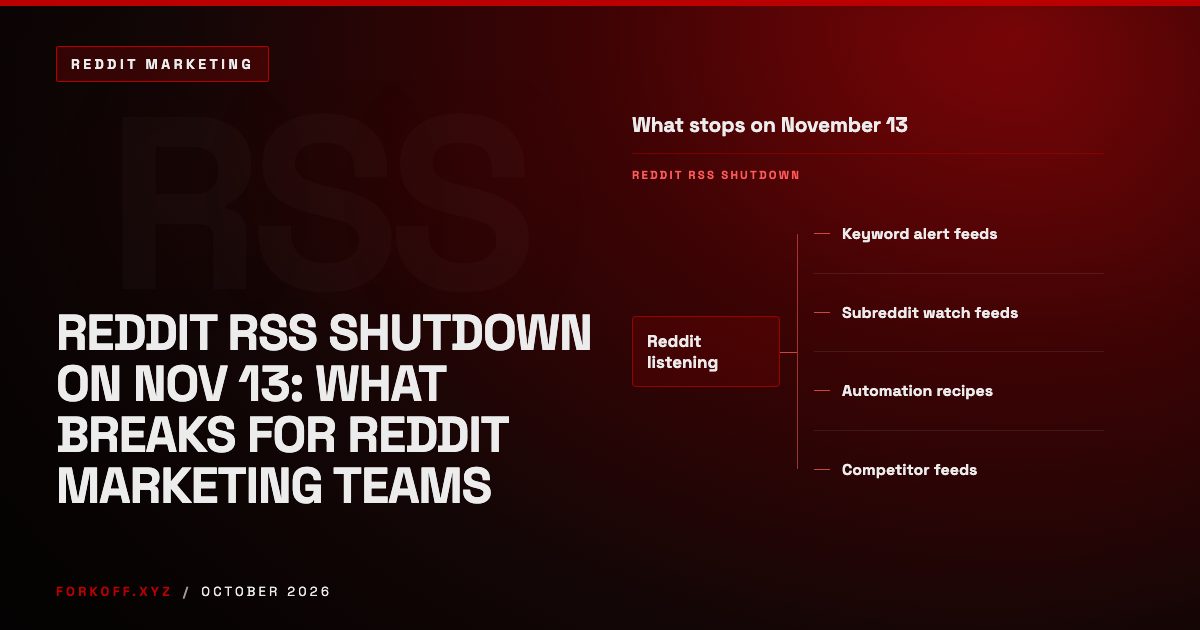
Reddit RSS Shutdown on Nov 13: What Breaks for Reddit Marketing Teams
Reddit ends RSS feeds on November 13, 2026 and closes its public Data API by March 2027. What breaks for marketing teams, and what replaces the alerts.
 Read
Read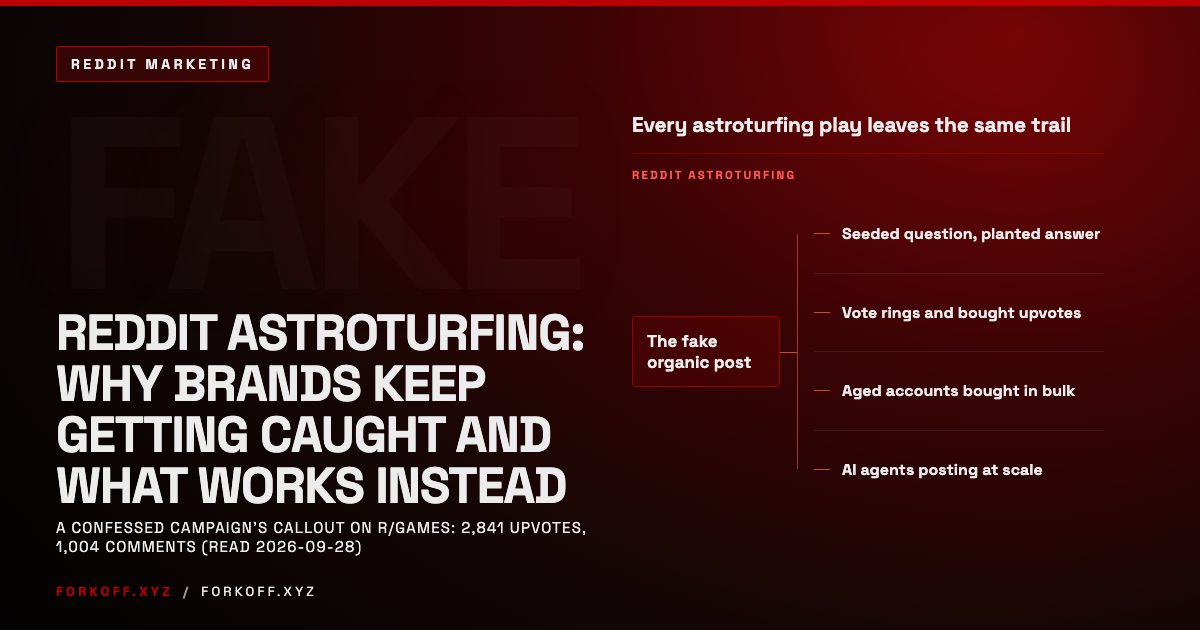
Reddit Astroturfing: Why Brands Keep Getting Caught and What Works Instead
Reddit astroturfing is paid promotion dressed up as organic talk. Why brands keep getting caught, what exposure costs, and the legitimate way to show up.
Read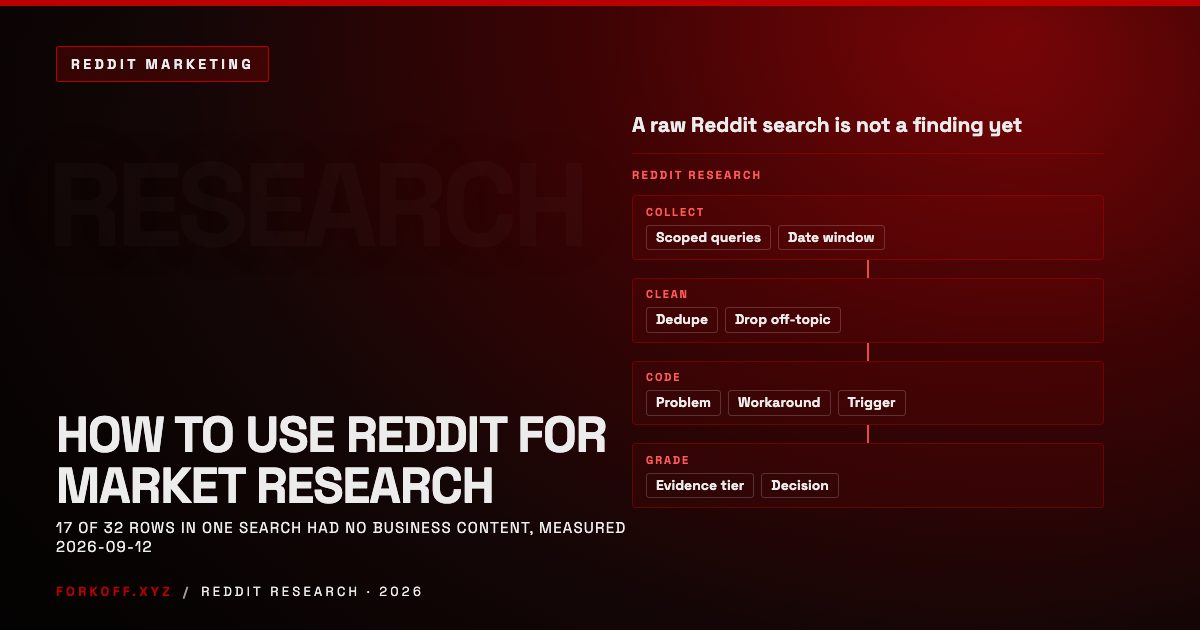
How to Use Reddit for Market Research: Mining Real Problems Before You Build
Reddit market research is sampling, not browsing. The query syntax, the sample size, the coding method and the five failure modes, measured on live pulls.
Read