
FORKOFF · Research catalog
Research
First-party operator data from the FORKOFF cohort. Methodology disclosed on every study, cohort sizes named, citation-ready for analysts and AI Overview engines.
Original research, not a template.
Every study below is FORKOFF's own primary measurement, with a stated sample size and method, not a repackaged industry stat.
Per our own AI Citation Index, a 50-prompt buyer-intent cluster run against 5 engines, forkoff.xyz moved its average cite rate from 22 percent to 34 percent in four weeks. (FORKOFF, 2026)
Published research studies
Reddit Community Access · n=24 communities
Reddit Community Access Index 2026
First-party index of 24 tech, SaaS, AI, and Web3 subreddits (52.2M combined members, 600 top posts, pulled 2026-08-26). 71 percent publish a conditional on-ramp for brands and only 21 percent ban promotion outright, while discussion density runs 37x across the set and inverse to community size. Public platform data only, full dataset published.
Published 2026-08-26
X Post Format Engagement · n=168 posts
X Post Format Benchmark 2026
First-party benchmark of how post format changes engagement on X, from 168 original posts across 17 B2B tech, SaaS, AI, and developer-tool accounts. Outbound-link posts earn 38 percent less per follower than video, and 6 of 8 accounts underperform their own baseline the moment they add a link. Public platform data only, full dataset published.
Published 2026-08-26
Launch Video Landscape · n=30 launches
State of Launch Videos 2026
First-party report on 30 tracked product launches on X (110.4M combined views, Oct 2025 to Jun 2026). 20 of the 30 carried a distribution-amplified reach signature, 10 read organic. Verifiable-small over unverifiable-large: full dataset and methodology published.
Published 2026-07-24
Launch Reach Authenticity · n=30 launches
Views-to-Likes Benchmark 2026
First-party views-to-likes benchmark from 30 real product launches on X (110.4M views, Oct 2025 to Jun 2026). Healthy is about 500:1 or under. 20 of the 30 carried a paid or amplified signature, 10 read as organic. Dated methodology, recomputed live.
Published 2026-07-03
AI Citation Rates · 250 measurements/run
FORKOFF AI Citation Index 2026
Recurring first-party AI-citation-rate index. 34% average cite rate across ChatGPT, Claude, Perplexity, Gemini, and Google AI Overviews on a 50-prompt buyer-intent cluster. Per-engine rates, dated methodology, quarterly re-run. Index window 2026-05-19.
Published 2026-07-03
Clipping Economics · n=3,085 clips
Clipping CPQV Benchmark 2026
FORKOFF Clipping Ledger 2026: $0.003 managed CPQV vs $0.01-$0.10 unmanaged. 3-lane comparison across Opus Clip, in-house editor, and managed outcome contract. n=3,085 clips, 9 engagements, 4-gate methodology.
Published 2026-06-09
AI Search Visibility · n=48 datapoints
ASVC Discovery Gap 2026
AI search visibility gap across ChatGPT, Claude, Gemini, Perplexity. 12 head terms x 4 engines = 48 datapoints. Paired branded variant comparison.
Published 2026-05-27
Key findings across our published research
One headline number from each live study, current as of that study's own last measurement. Follow the link for the full methodology and dataset.
34%
average AI-citation rate
across ChatGPT, Claude, Perplexity, Gemini, and Google AI Overviews on a 50-prompt buyer-intent cluster
71%
of measured subreddits allow a conditional brand on-ramp
across 24 tech, SaaS, AI, and Web3 subreddits carrying 52.2M combined members; only 21% ban promotion outright
38%
fewer likes per follower on a post carrying an outbound link
vs a video post, measured across 168 original posts from 17 public B2B tech, SaaS, AI, and developer-tool X accounts
$0.003
managed cost per qualified view
vs $0.01-$0.10 unmanaged, across a 3-lane comparison and n=3,085 clips
Methodology: how every study is built
Every study on this page starts from a sample frame fixed BEFORE collection, not selected afterward to fit a conclusion. The Reddit Community Access Index froze its 24-subreddit list, then pulled the community profile, rules, and top-post sample for each one through FORKOFF's own Reddit data pipeline. The X Post Format Benchmark froze a 17-account sample frame across developer tools, AI/ML products, SaaS, and developer-audience media, then pulled each account's public timeline through FORKOFF's own X data pipeline, filtered to original posts only.
Exclusions are disclosed rather than silently dropped. When an account in the X sample returned not-found, it stayed excluded rather than being substituted with a friendlier replacement. When an account posted only reposts inside the measurement window, it contributed zero rows to the post count rather than being backfilled. The same discipline applies to the RADAR-derived studies: every tracked launch, organic and amplified, is kept in the corpus, because dropping the amplified ones would flatter the "organic reach" conclusion the study is measuring in the first place.
Where a study classifies rather than just counts, the deciding evidence is published beside the classification. The Reddit index labels each community's promotion posture (open, conditional, or banned) from that community's own rule text, and the specific excerpt that drove the call ships in the same dataset row, so a reader can check the classification rather than take it on trust.
Data sources and licensing
Every number in the Reddit Community Access Index and the X Post Format Benchmark is public platform data about public communities and public accounts, measured on a stated pull date. No client result, campaign figure, or internal engagement metric appears in either study or its downloadable dataset. That is a deliberate design choice: a private number cannot be re-run by anyone, and the value of a published benchmark is that a reader can point the same public endpoints at the same accounts or communities and get the same answer.
Both datasets ship as a full CSV under CC BY 4.0, linked from each study's methodology section, free to reuse with attribution. The ASVC Discovery Gap dataset (branded-query vs head-term citation rates across 4 AI engines) is downloadable on the same terms. Where a study cites an outside figure for comparison, industry CPQV ranges, platform view-counting policy, bot-traffic estimates, that source is named inline at the point of use rather than folded into the first-party numbers.
How often this research updates
Three update patterns run across the catalog above, and each study states which one it follows. State of Launch Videos and the Views-to-Likes Benchmark recompute live from the public RADAR launch corpus on every page load, so the 30-launch figures on this page and on /radar are always the same run rather than a cached snapshot. The AI Citation Index re-runs on a fixed quarterly cadence against the same 50-prompt cluster and the same 5 engines, so a reader can compare cite-rate movement quarter over quarter rather than across two differently-built runs.
The Reddit Community Access Index, the X Post Format Benchmark, the Clipping CPQV Benchmark, and the ASVC Discovery Gap are dated point-in-time snapshots. Each carries its own pull or publish date on its individual page, and gets re-pulled when the underlying category has moved enough to warrant a fresh measurement rather than on a fixed clock, since a subreddit's promotion rules or a platform's view-counting policy do not change on a predictable schedule.
How to cite FORKOFF research
Each individual study carries its own stable APA and BibTeX citation block (see the "Cite this hub" section on that study's page), with the publish date, last-updated date, and canonical URL a journalist, analyst, or AI answer engine can cite directly. At the catalog level, this page is the stable index: if you are citing FORKOFF's research program as a whole rather than one specific study, cite this page (forkoff.xyz/research) and name the individual study you are drawing a figure from.
Frequently asked questions
Is FORKOFF research first-party data or aggregated from other sources?
First-party. Every study on this page is measured by FORKOFF against a fixed sample frame set before collection: Reddit and X communities pulled through our own data pipelines, RADAR launch tracking against FORKOFF's own corpus, and AI-citation rates run against the live engines. None of these studies repackage a third-party report or vendor dataset. Where a study cites outside numbers for comparison (for example, industry CPQV ranges or platform view-counting policy), that source is named inline and kept separate from the first-party measurement.
Can I download the underlying data?
For the studies built on a public dataset, yes. The Reddit Community Access Index and the X Post Format Benchmark both ship a full CSV under CC BY 4.0, linked from their methodology sections. The ASVC Discovery Gap dataset is also downloadable as a CSV. The RADAR-derived studies (State of Launch Videos, Views-to-Likes Benchmark) recompute live from the public RADAR launch corpus rather than shipping a static file, so the current numbers on this page and on /radar are always the same run.
How often is this research updated?
It depends on the study. State of Launch Videos and the Views-to-Likes Benchmark recompute on every page load from the live RADAR corpus, so they update as new launches are tracked. The AI Citation Index re-runs on a fixed quarterly cadence against 5 engines. The Reddit Community Access Index, the X Post Format Benchmark, the Clipping CPQV Benchmark, and the ASVC Discovery Gap are dated point-in-time snapshots, each stamped with the pull or publish date on its own page, refreshed when the underlying category shifts enough to warrant a re-pull rather than on a fixed clock.
Does FORKOFF run custom research for clients?
Yes. The methodology behind every study here, fixed sample frame, own-pipeline collection, disclosed exclusions, is the same one FORKOFF runs as a paid engagement against a client's own category, competitor set, or channel mix. That work is scoped through the AI marketing agency engagement rather than published on this page, since it typically includes data a client has not made public.
Why does FORKOFF publish research instead of only client work?
Two reasons. A methodology that can be checked in public is more credible than one asserted in a sales deck, so publishing the Reddit and X studies with a downloadable CSV lets a reader re-run the same public endpoints and get the same answer. Second, the same primary data (RADAR launch tracking, AI-citation runs, platform engagement pulls) already exists inside FORKOFF's operating stack for client work; publishing the aggregate view costs little beyond the write-up and gives analysts, journalists, and AI answer engines a citable, dated source instead of a vendor's paywalled report.
Adjacent reading
- AI Search Visibility Checker, the tool the ASVC Discovery Gap study runs on top of. Run your own brand against the same 4-engine grid.
- Credibility vs user-acquisition campaigns analysis, method post that cites operator-pattern lifts from the FORKOFF Founder-Funnel Cohort.
- FORKOFF AI marketing agency service, for custom cohort studies done as part of a paid engagement.
- RADAR methodology, how RADAR reads whether a viral launch's reach was earned or bought, from three public signals.
- FORKOFF Stats, the benchmark lane where each page pairs industry data with FORKOFF operator proof under a stable citation block.
Custom cohort study
Want a custom research study against your category?
FORKOFF publishes first-party operator data on the categories we work in. Custom cohort studies for clients run on the same methodology.
Receipts, deep dives, and playbooks.
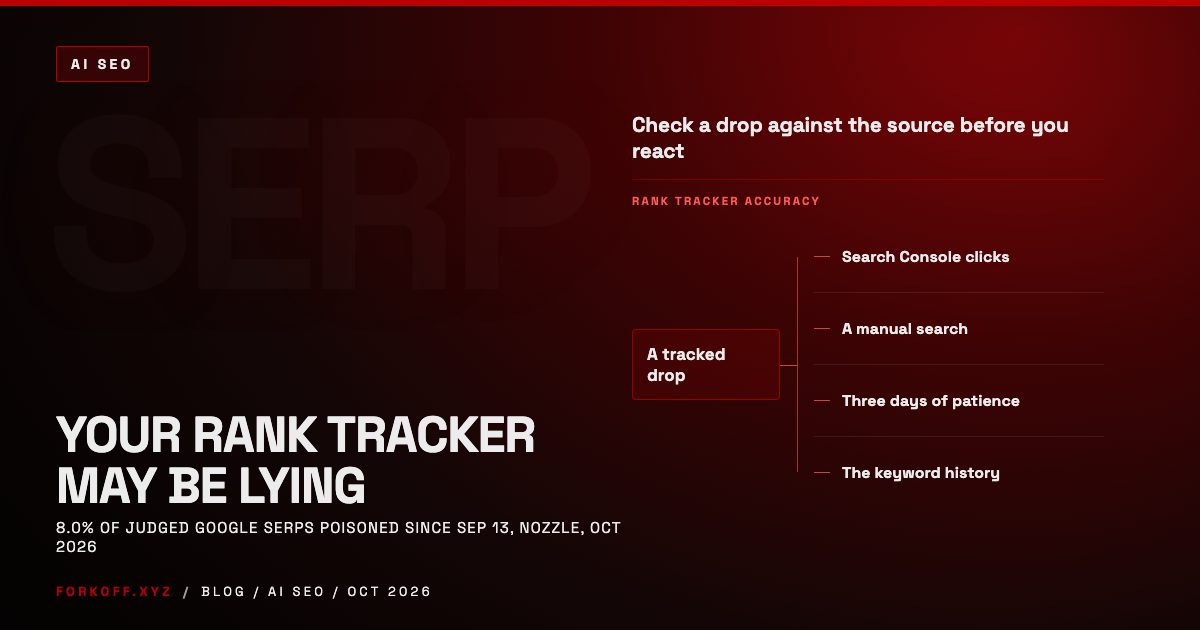
Your Rank Tracker May Be Lying: How to Report SEO and AEO After Google's Poisoned SERPs
Google is serving rank trackers poisoned SERPs. What one tracker measured, how to tell a fake drop from a real one, and how to report SEO and AEO you can trust.
 Read
Read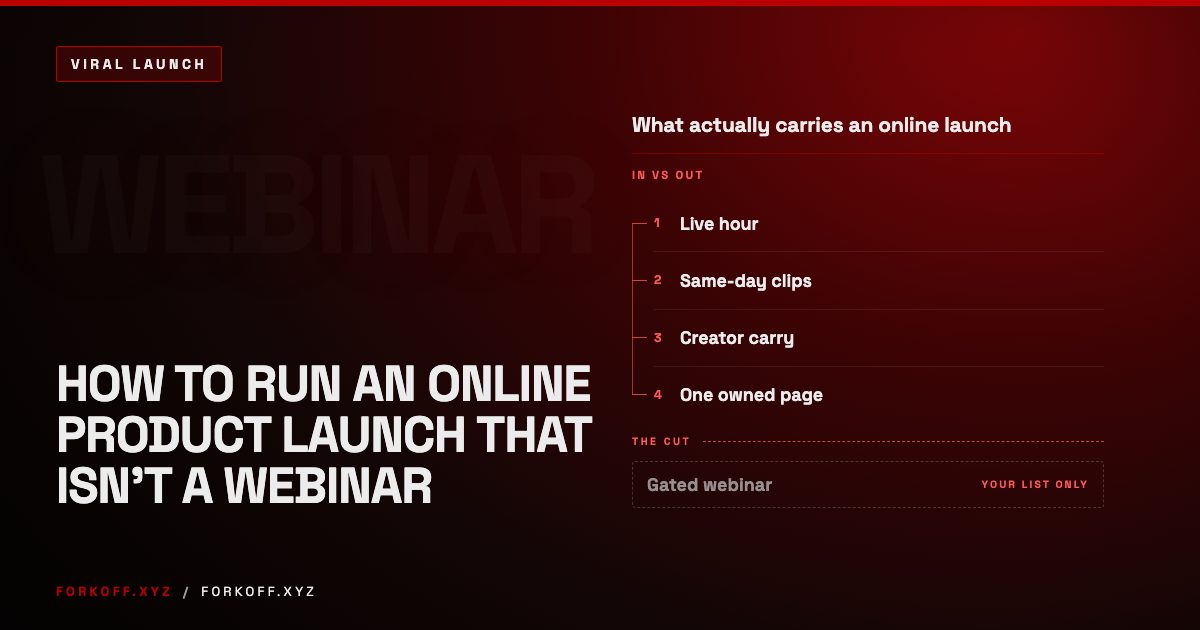
How to Run an Online Product Launch That Isn't a Webinar
An online product launch is a live moment cut into clips that creators carry, not a gated webinar. Here is the livestream, clip and creator stack for 2026.
Read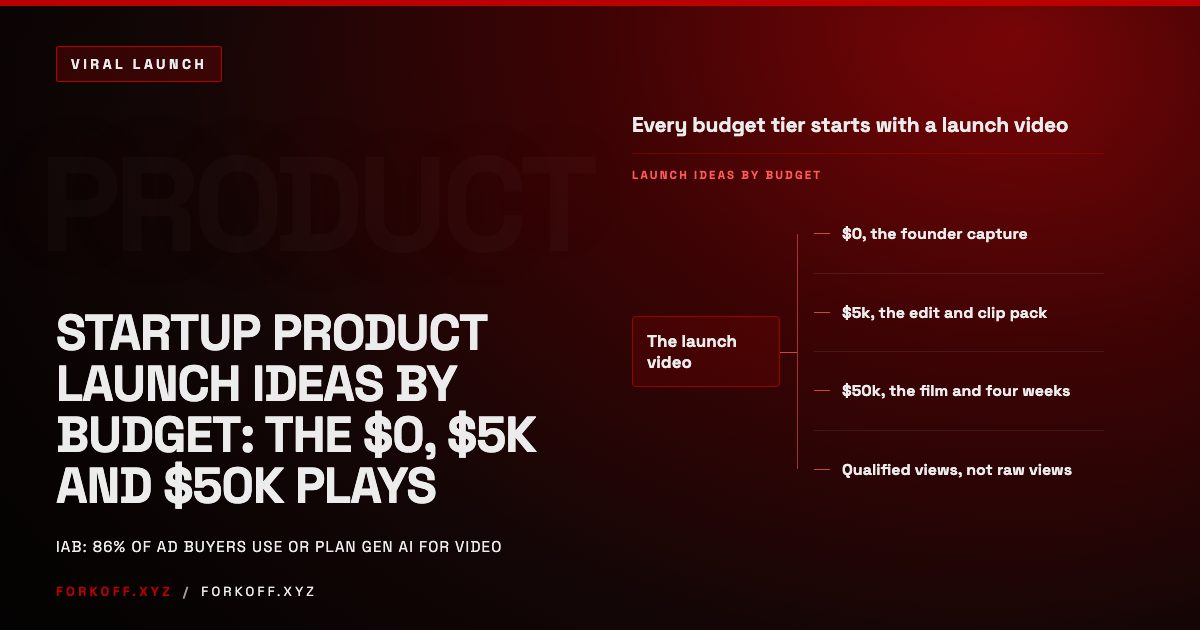
Startup Product Launch Ideas by Budget: The $0, $5k and $50k Plays
Product launch ideas for a SaaS startup sorted by budget: what the launch video should be at $0, $5k and $50k, and the distribution around it.
Read