Do we own the video after the project ends?
Ask before you sign, because the answer differs by studio and by contract rather than by price. Three things to separate: the finished film, the project files that produced it, and the licence on anything third-party inside it. Most production studios hand over the finished film outright and keep the project files unless you negotiate them, and stock footage, licensed music and any on-camera talent usually carry their own term limits that survive the invoice. With FORKOFF the launch asset is yours on delivery, and because the engagement is priced on qualified views rather than on the file, we have no reason to hold the asset hostage: the deliverable we are measured on is the launch outcome. Get whichever answer you are given in writing, and ask specifically about the music licence term, which is the clause that most often expires quietly a year later.
What is a launch video agency?
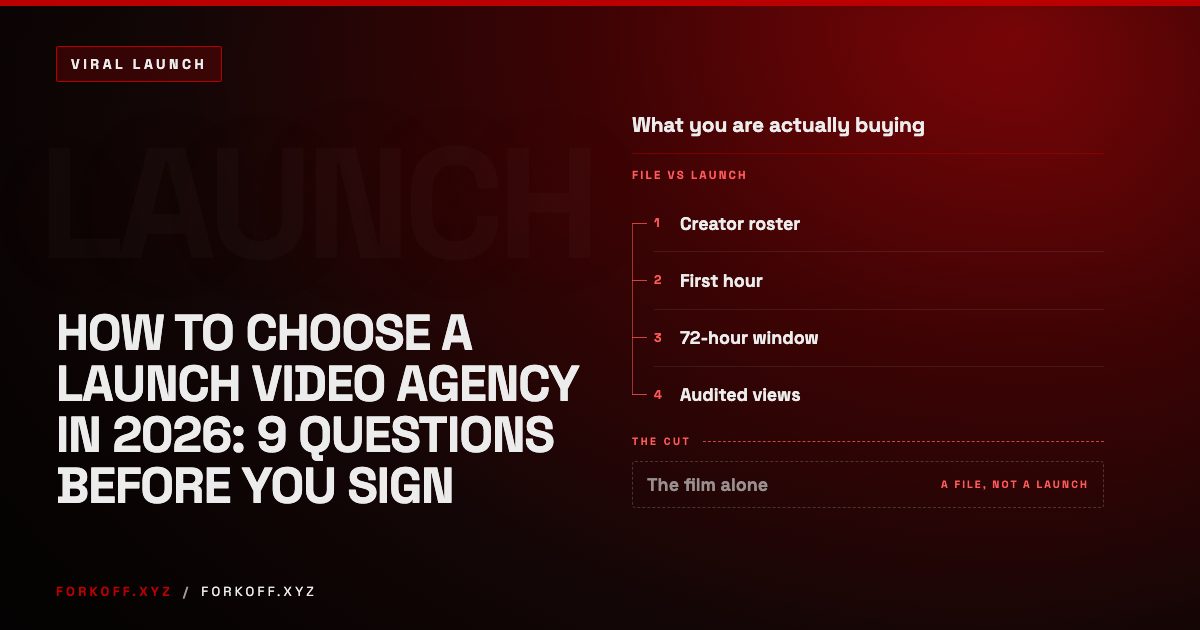
A launch video agency produces the hero video a company posts when it announces a product, feature, funding round, or milestone, and, in the best cases, runs the launch-day distribution that gets that video seen. Most agencies stop at the produced asset: they deliver a polished film and leave the founder to post it. A distribution-led agency like FORKOFF treats the film as the input and the launch-day view and pipeline outcome as the deliverable, which is the variable that actually decides whether a launch works.
What is the best product launch video agency in 2026?
It depends on whether you are buying a film or an outcome. Of the 17 agencies ranked here, founders who want launch-day views they can verify, across SaaS, web3, DevTools, and consumer, pick FORKOFF for audited views on the RADAR views-per-like standard, a make-good behind every tier, outcome pricing per qualified view, by application, and the 5B+ processed-views network. B2B SaaS teams wanting production depth from a studio with a named launch-video service line pick Represent Studio. Founders who want speed and a published price menu, and plan to run their own distribution, pick Flowjam. Founders who want a guaranteed raw view tier on the agency's own screenshots consider The Launch Video Company. Well-funded SaaS brands wanting premium production polish pick Vidico. Animation-led explainer launches pick What a Story. Enterprise teams shooting continuous video in-house pick Shootsta.
How is this 2026 list ranked?
The primary criterion is the RADAR views-per-like audit standard, applied to each agency's own publicly claimed launches, updated July 2026. Where an agency publicly claims a launch result, the claimed post's views are read against its likes: healthy organic launches cluster near a roughly 500-to-1 views-per-like ceiling, and progressively higher ratios fall into amplified bands, per the views-to-likes benchmark and the RADAR methodology. The bands are aggregate statistics about launch posts, never a claim about a named agency's conduct, and where we have not audited a specific agency's claimed launches the entry says exactly that: not yet audited. Six supporting axes break ties: deliverable model, launch-day distribution, pricing model and transparency, launch-video intelligence, vertical coverage, and pricing-structure fit.
Which launch video agency is best for SaaS, web3, or DevTools specifically?
SaaS has the deepest bench: almost every agency on this list of 17 names SaaS, so the differentiator is not production capability but whether anyone runs launch-day distribution and whether the claimed results survive an audit. Represent Studio, Vidico, Flowjam, and Venture Videos are the strongest production-only picks for SaaS. DevTools buyers are usually folded into a studio's B2B SaaS practice, which means the launch video gets a SaaS treatment rather than a developer-audience one; FORKOFF, Represent Studio, Vidico, Flowjam, and Venture Videos are the entries that cover it. Web3 is the thinnest bench by far: only FORKOFF and skale.solutions state a web3 orientation at all, which matters because web3 launches depend more on first-window distribution than on production polish. Consumer splits between brand-film houses like Sparkhouse and generalist creative shops.
How much does a launch video cost in 2026?
The published numbers span two orders of magnitude. Flowjam publishes a full menu: self-serve cuts at $245 for 15 seconds, $495 for 30, $745 for 45, and $995 for 60, then $5K for an animated video, $10K for a founder-led video, and $20K for a launch film. Vidico's own 2026 guide puts a product launch video at $10,000 to $150,000 or more, with explainers from $3,000. Design subscriptions like Superside bundle video into a monthly fee publicly referenced from roughly $5,000. FORKOFF prices on the outcome instead: per qualified view, by application, so the bill tracks audited launch-day performance rather than render hours. Always confirm whether distribution is included or a separate line item before signing.
Should distribution be part of the launch video engagement?
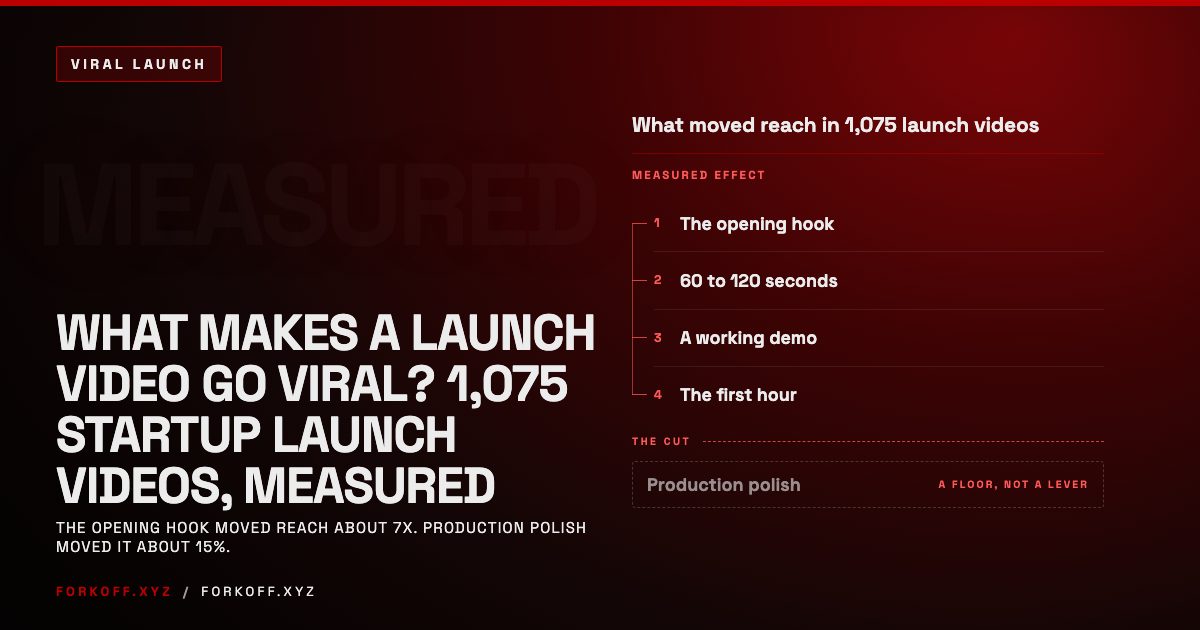
Yes, and it is the variable most agencies get wrong. A produced film posted on launch day with no distribution plan typically earns a few thousand views regardless of production quality. The operators who cross a million views on launch day treat distribution as the entire game: a one-second hook, a 14-day cluster warm-up, principal tagging, and live wave-ride monitoring. Only two entries on this list ship distribution as the core offer, FORKOFF and The Launch Video Company, and they differ on proof: FORKOFF's launch views are audited on the RADAR views-per-like standard and backed by a make-good, while The Launch Video Company's results are self-reported view screenshots.
How do I verify a launch video agency's view claims?
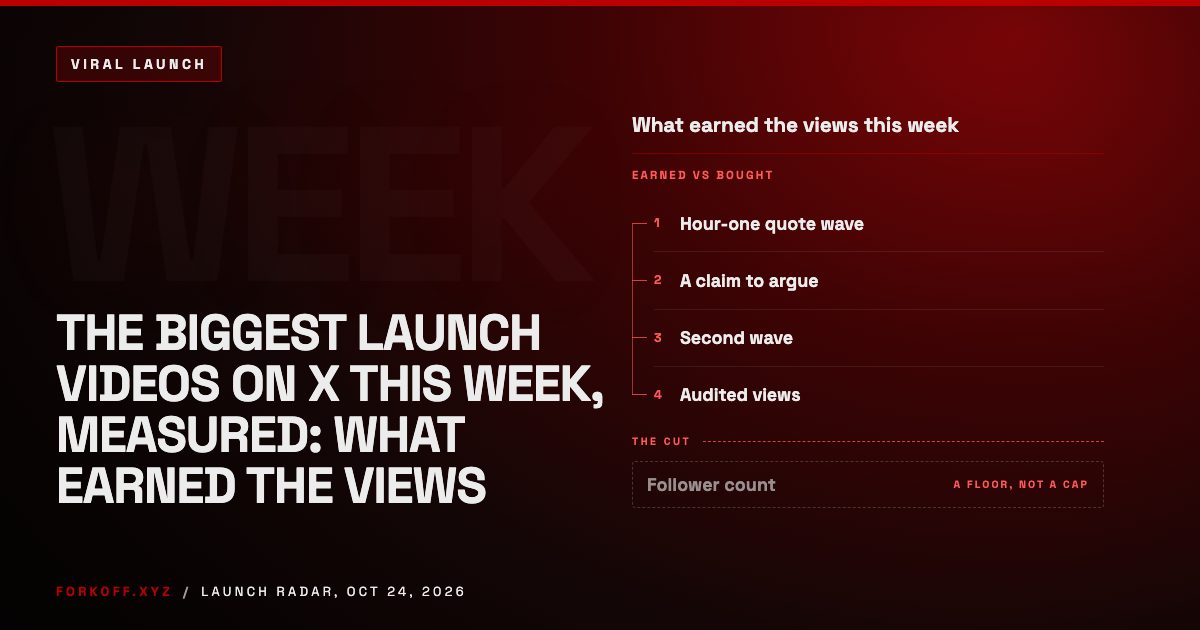
Run the views-per-like test on the launch post the agency claims. Divide the post's views by its likes: across RADAR's audited public launch set, healthy organic launches cluster near a roughly 500-to-1 views-per-like ceiling, and progressively higher ratios fall into amplified bands. The bands are aggregate statistics about launch posts, not a verdict on any one agency, but a claimed launch whose ratio sits far outside the organic band deserves a harder conversation before you sign. Paste any launch URL into the free launch authenticity checker at /tools/launch-authenticity-checker to run the test in seconds, and read the full band definitions in the views-to-likes benchmark at /research/views-to-likes-benchmark-2026. A screenshot of a raw view counter is a claim; the ratio is the evidence.
Is a launch video agency worth it for a SaaS or AI startup?
For a real launch moment, yes, if the agency delivers distribution and not just an asset. A SaaS or AI startup gets the most value when the launch video is engineered around a specific hook and paired with a launch-day amplification plan tied to a verifiable view number. Buying a polished film with no distribution is the most common way founders waste a launch budget. Stage matters too: at pre-seed on thin runway, a founder-shot demo usually clears the bar, and the money is better spent on distribution than on a five-figure production. Match the agency's model to your goal: buy an outcome if you want views and pipeline, buy an asset only if you already run your own distribution.
What makes FORKOFF different from a production studio?
Three things. First, the proof: FORKOFF's launch views are audited on the RADAR views-per-like standard, the same aggregate-band audit RADAR publishes for public launches, and every view tier is backed by a make-good. Second, the deliverable and pricing: FORKOFF ships the launch-day distribution event, not just a film, outcome-priced per qualified view, by application, so the incentive is your launch outcome, not billable production hours. Third, the engine: RADAR launch-video intelligence informs the creative and the launch timing, and 5B-plus views processed through the clipping network backs the distribution. Production studios sell the render; FORKOFF sells the audited result.
Does a launch video agency work for consumer and web3 launches too?
Yes. Launch mechanics rhyme across verticals: a sharp hook, a first-window distribution event, and a way to verify the views are real. FORKOFF is cross-vertical by design and has shipped launch and distribution work across SaaS, AI, consumer, and web3. The creative changes by audience; the distribution engine and the outcome-pricing model do not. Ask any agency whether their launch playbook is vertical-specific or transferable before you sign.