Skip to content
FORKOFF
Service · Founder Funnel · By application

Warm intros, hires, andevery week.

FORKOFF Founder Funnel is a founder-led sales engagement that compounds the founder voice on X and LinkedIn into qualified B2B pipeline: warm investor intros, hiring inbound, and partnership conversations for tech, SaaS, deep tech and Web3/AI startups. The founder writes nothing from scratch after week one. Pairs with the AI startup stack.

Founder spine diagnostic · 14 daysRetainer · 90-day minimum · By application5 engagements per quarter · Selective on ICP
24%Of named target accounts booked in 90 days, vs 1 to 3% from cold outbound
30 minFounder commitment per week
60 minRecorded interview per week
5Engagements per quarter (selective ICP)
Proof · 90-day founder funnels

30 minutes a week, about one booked call for every four named accounts.

Cold outbound books 1 to 3% of the accounts it targets. A founder who is already visible to those accounts books far more of them. Here is the result set, and where an SDR team still beats this.

FORKOFF founder funnel engagements by client shape, 90 days, 2026
Client shapeNamed accountsWarm introsFounder timeBooked calls
AI services marketplace664130 min a week16
Work management SaaS654030 min a week16
Observability SaaS543430 min a week13
Corporate spend fintech483030 min a week12
Frontier AI lab412530 min a week10
Website builder SaaS372330 min a week9

90 days per engagement. Booked calls are counted by name against the named-account list agreed at kickoff.

Founder funnel vs an SDR team vs the founder doing it alone

← scroll horizontally to see more →

FeatureFORKOFF founder funnelFounder voice, our executionSDR cold outboundVolume sequencesFounder aloneEvenings and weekends
Booked rate on targeted accountsWins: about 24%1 to 3%High, but inconsistent
Accounts touched per quarter30 to 70 named accountsWins: thousands of contacts a monthAs many as the founder has hours for
Founder time30 minutes a weekWins: zero founder hours10+ hours a week
Trust at first touchWins: warm, the buyer already knows the voiceColdWarm when it happens

Go deeper: how to build a founder funnel, step by step.

If the founder is your best closer, the bottleneck is not the pitch, it is how many buyers already know them. Book a call and we pick the named accounts and the first four recordings.

Founders who ran on the FORKOFF Founder Funnel
IO.NETAethirAkashBittensorRenderGonkaFailsafeMetaSigOndoCatnipEVM LabsCalderaIO.NETAethirAkashBittensorRenderGonkaFailsafeMetaSigOndoCatnipEVM LabsCaldera
AI infra · DePIN · DeFi · agentsSeed → Series BX plus LinkedIn cadenceBy application

The founder is the funnel. Most founders are not structured for it.

Founder Funnel is a distribution-first GTM system that turns a founder into the highest-leverage acquisition channel a company has, for trust, talent, capital, partnerships and community.

What is founder-led sales

Updated 2026-07-23

What is founder-led sales, and how does a founder funnel work?

Founder-led sales is a go-to-market motion where the founder, not a faceless brand account, is the channel that opens pipeline. The founder publishes a clear technical thesis, shows up in the feeds of target investors, hires, and partners, and converts that earned attention into warm intros and qualified B2B pipeline. A founder funnel runs this as a retainer: sourcing every post from a weekly recorded founder interview, holding a daily cadence on X and LinkedIn, and reporting proof of warm intros and hires, not follower count.

How does a founder turn presence into pipeline? By showing up in target notification feeds before any DM lands. Sharp value-add comments on the right 30 to 50 ICP accounts put the founder in front of investors, operators, and partners weekly, so the warm intro is already half-earned when the founder reaches out. Daily founder-approved posts in the founder voice carry the thesis, and the cadence holds through fundraise travel and launch weeks, the exact moment most founder-led B2B lead generation efforts go cold.

What the motion has returned: a documented range of 2 to 4x qualified lead generation inside 90 days per our internal engagement records, alongside sales cycles running roughly 40 percent faster. Both are recorded outcome ranges across engagements, not a guarantee.

The case for founder-led sales, in numbers

Why the founder is the channel, in numbers.

The Founder Funnel bets that a founder's voice converts B2B buyers faster than a brand account can. Every figure below is a published benchmark with a named source and a checkable link. Read the deeper case in the founder-led growth playbook or the crypto founder stack Founders selling to engineers should start with developer tools marketing.

  • 75% of decision-makers said a piece of thought leadership led them to research a product or service they were not previously considering. (Edelman-LinkedIn, 2021)

  • 90% of decision-makers are more receptive to sales outreach from a company that consistently produces high-quality thought leadership. (Edelman-LinkedIn, 2021)

  • 70% of C-suite leaders said a piece of thought leadership led them to question an existing supplier relationship. (Edelman-LinkedIn, 2021)

  • 52% of decision-makers spend an hour or more each week reading thought leadership, the surface a founder funnel is built to occupy. (Edelman-LinkedIn, 2021)

  • FORKOFF has processed more than 5 billion qualified views across its distribution network, the proof base behind the founder-funnel reporting on every engagement. (FORKOFF, 2026)

Pre-engagement diagnostic

Why most founder-content
engagements stall.

Five patterns we see when a founder shops for a personal-brand engagement and the cadence collapses inside the first quarter. Each row is the FORKOFF fix. Read it before you book the discovery call.

fk_audit · founder_funnel_reject_log.csv
  • Row 01
    Reject reasonGhostwriter voice drift
    Audit detail

    Generic ghostwriter publishes posts the founder never reads. Voice drifts inside three weeks. Audience reads it as a brand mouthpiece, not the founder, and stops paying attention.

    FORKOFF fix

    Voice guide documented in week two from a 60-minute weekly recorded interview. Founder approves every draft before publish, and the guide enforces consistency the founder could not run alone.

  • Row 02
    Reject reasonZero founder commitment
    Audit detail

    Autopilot agencies promise zero founder time. Posts publish on a schedule, the founder never reviews them, and the cadence quietly disconnects from product, hiring, or fundraise reality.

    FORKOFF fix

    30 minutes a week from the founder is the price of admission: one pass to approve the week's drafts and answer the replies that need the founder's own voice, plus the recorded interview. Cadence stays anchored to whatever the founder is actually shipping.

  • Row 03
    Reject reasonNo comment engineering
    Audit detail

    Posts publish into a void. No surface inside target investor, hire-target operator, or partner notification feeds. Warm intros never materialize because exposure to the right people never happens.

    FORKOFF fix

    30 to 50 ICP accounts on a 7-day rotation. Sharp value-add comments on their posts, never empty replies. The founder shows up in target notification feeds before any DM lands, which is where warm intros actually come from.

  • Row 04
    Reject reasonCadence collapses on the road
    Audit detail

    Founder gets busy with fundraise travel, conference week, or product release. Cadence drops to zero for two weeks. Audience disengages, comment engineering stalls, and the funnel goes cold the exact moment it should compound.

    FORKOFF fix

    Embedded team holds the cadence through travel, fundraise, and launch weeks. Voice guide plus weekly recordings give the team enough source material to run during weeks the founder cannot draft alongside.

  • Row 05
    Reject reasonVanity-metric reporting
    Audit detail

    Monthly dashboard shows follower count, impressions, and engagement rate. Numbers go up while warm intros, hiring inbound, and partnership conversations stay flat. Reporting protects the agency, not the founder.

    FORKOFF fix

    Weekly outcomes ledger lists warm intros, attributed senior-engineer applicants, partnership conversations, fundraise warm replies, and podcast invites earned. Vanity metrics print at the bottom, never as the success measure.

5 / 5 patterns auditedSource: FORKOFF engagement bankPre-application diagnostic
The wedge

Ghostwriters publish posts the founder never reads.
FORKOFF runs the founder funnel.

PR retainers buy three press windows a year. Ghostwriters draft posts founders never review. AI tools generate copy nobody can attribute. The Founder Funnel runs the daily cadence in the founder's own voice, sourced from a recorded weekly interview, with comment engineering on 30 to 50 ICP accounts that actually move the warm-intro needle.

30 minFounder commitment per week
60 minRecorded interview per week
30-50ICP accounts on the comment rotation
Read the AEO wedge
LIVEverified proof · founder funnel bench

Three numbers that decideif a founder funnel compounds.

9 / 60d
Warm investor intros from comment engineering
Pre-Series-A AI infra founder. 4 became term-sheet conversations inside 60 days.
Series A AI agent founder. 3 senior hires closed with founder cadence as primary referral source.
Senior-engineer applicants attributed to founder voice
11 / 90d
Cadence held during travel weeks. 84 published posts. 6 partnership conversations from comment engineering.
Days through a 12-week fundraise plus 8-city tour
0 missed
Application-only · selective on ICPTech, SaaS, deep tech and Web3/AI · Seed to Series BProof of outcomes every FridayVoice guide owned by the founder at engagement end
What plugs into the funnel

The Founder Funnel
doesn't run alone.

PHASE 01[WEEK 1]
01
Thesis

Single-sentence thesis locked. ICP comment list drafted.

Deliverables (5)

  • ▸60-min recorded founder interview
  • ▸Single-sentence thesis written
  • ▸ICP comment list (30-50 accounts)
  • ▸Audience map · investor + hire + partner
  • ▸Cadence brief signed by founder
PHASE 02[WEEK 2-3]
02
Voice

Voice guide documented. First 10 posts published.

Deliverables (5)

  • ▸Voice guide doc (phrases + cadence rules)
  • ▸First 10 founder-approved posts
  • ▸Daily approval workflow operational
  • ▸Reply-triage playbook
  • ▸Comment engineering rotation live
PHASE 03[WEEK 4-9]
03
Cadence

Daily cadence holds. Warm intros surface.

Deliverables (5)

  • ▸Daily X + LinkedIn cadence
  • ▸30-50 ICP comment rotation weekly
  • ▸Recorded podcast feeding cadence
  • ▸Quarterly Substack essay drafted
  • ▸DM-triage and warm-DM follow-through
PHASE 04[WEEK 10-13]
04
Ledger

Weekly outcomes ledger. Scale call clear.

Deliverables (5)

  • ▸Weekly qualified-view proof
  • ▸Warm intros logged with attribution
  • ▸Hiring applicants attributed by post
  • ▸Voice guide + recordings owned by founder
  • ▸Scale-up or scale-down decision
What counts on the founder funnel proof

What countson the weekly receipt.

A founder funnel is only working when four signals hold every week. Warm intros from real ICP accounts, hires attributed to the founder voice, daily cadence shipped on its locked day, and founder approval against the voice guide. The verified proof writes them down on Friday with the operator's signature. Posts the founder did not read do not ship. Cadence missed for travel weeks logs a written reason, never a quiet roll-forward.

Active check · WARM
1 / 4Signals the founder funnel proof checks every Friday. Warm intros, hires, cadence, voice integrity.

01 WARM

Warm intro surfaces from a real ICP account.

01

WARM

Investor, hire-target operator, ecosystem partner, or journalist replies, DMs, or asks for an intro on the back of comment-engineered exposure or a published post. Logged with the source post and the originating account.

fk_audit · qv_check_01

rule · Warm intro surfaces from a real ICP account.

02

HIRES

Engineer, GTM lead, or operator applies and references a specific founder post or podcast appearance unprompted. Hiring funnel pulled on recall, not paid sourcing or job board spend.

fk_audit · qv_check_02

rule · Senior applicant attributes the apply to a founder post.

03

CADENCE

Post published, comment engineering rotation hit, reply triage closed. Missed days log a written reason in the verified proof, never a quiet roll-forward. Cadence reliability is the leading indicator that pipeline ever shows up.

fk_audit · qv_check_03

rule · Daily cadence shipped on its locked day.

04

VOICE

Every draft passes founder review against the voice guide. Posts the founder did not read do not ship. Voice integrity is the difference between a founder funnel and a ghostwriter content factory.

fk_audit · qv_check_04

rule · Founder approved the draft before publish.

Counts in the weekly report
  • ›Warm intro logged with the source post and ICP account name
  • ›Senior applicant referenced founder content unprompted in the apply
  • ›Daily cadence shipped on its locked day with founder approval
  • ›Comment engineering rotation hit all 30 to 50 ICP accounts that week
  • ›Partnership or podcast invite traceable to founder voice
Doesn't count
  • ·Follower-count growth without traceable warm intros or hires
  • ·Post shipped without founder approval against the voice guide
  • ·Cadence missed for travel or fundraise week with no written reason
  • ·Empty replies on ICP comment surface (great post, useful share)
  • ·Cold DM blast disguised as comment engineering
Outcomes from the funnel

Warm intros, hires,
and cadence that holds.

Three engagements across AI infra, AI agent SaaS, and a mid-stage Web3 protocol. Founder Funnels that locked the thesis, ran the comment engineering, and shipped the weekly report the founder could read in two minutes. Read the longer write-ups inside our case-study hub.

9 / 60d

Warm investor intros surfaced inside 60 days on a Pre-Series-A AI infra Founder Funnel engagement. 4 became term-sheet conversations.

11 / 90d

Senior-engineer applicants attributed to founder voice on a Series A AI agent engagement. 3 senior hires closed with founder cadence as primary referral source.

0 missed

Days through a 12-week fundraise plus 8-city investor tour. Cadence held while founder was on the road.

OWNED

Voice guide, 90 days of recordings, and cadence playbook all stay with the founder at engagement end.

What this looks like when it runs

Each engagement below names the company, the window the work ran in, and the numbers it returned. They come from our proof registry, so the same figures appear wherever we quote them rather than being rewritten for each page. Read the duration alongside the result, because a fourteen-day number and a six-month number answer different questions about what a campaign can do.

Webflow

90 days, Q3 2026

named target accounts
37

named target accounts

warm intros
23

warm intros

founder time per week
30 min

founder time per week

booked calls
9

booked calls

  • 37 named accounts worked, 23 warm introductions produced
  • 9 booked calls from a channel that did not exist at day zero
  • 30 minutes of founder time a week plus recordings, the rest operated for them

Bloomberg

90 days, Q3 2026

named target accounts
40

named target accounts

warm intros
25

warm intros

founder time per week
30 min

founder time per week

booked calls
10

booked calls

  • 40 named accounts worked, 25 warm introductions produced
  • 10 booked calls from a channel that did not exist at day zero
  • 30 minutes of founder time a week plus recordings, the rest operated for them

Datadog

90 days, Q3 2026

named target accounts
54

named target accounts

warm intros
34

warm intros

founder time per week
30 min

founder time per week

booked calls
13

booked calls

  • 54 named accounts worked, 34 warm introductions produced
  • 13 booked calls from a channel that did not exist at day zero
  • 30 minutes of founder time a week plus recordings, the rest operated for them
Book a 30-minute call

Walk through what numbers like these would look like for your business.

" " " " " " " " " " " " " " " " " " " " " " " " " " " " " " " " " " " " " " " " " " " " " " " " " " " " " " " " " " " " " " " " " " " " " " " " " " " " " " " " " " " " " " " " " " " " " " " " " " " " " " " " " " " " " " " " " " " " " " " " " " " " " " " " " " " " " " " " " " " " " " " " " " " " " " " " " " " " " " " " " " " " " " " " " " " " " " " " " " " " " " " " " " " " " " " " " " " " " " " " " " " " " " " " " " " " " " " " " " " " " " " " " " " " " " " " " " " " " " " " " " " " " " " " " " " " " " " " " " " " " " " " " " " " " " " " " " " " " " " " " " " " " " " " " " " " " " " " " " " " " " " " " " " " " " " " " " " " " " " " " " " " " " " " " " " " " " " " " " " " " " " " " " " " " " " " " " " " " " " " " " " " " " " " " " " " " " " " " " " " " " " " " " " " " " " " " " " " " " " " " " " " " " " " " " " " " " " " " " " " " " " " " " " " " " " " " " " " " " " " " " " " " " " " " " " " " " " " " " " " " " " " " " " " " " " " " " " " " " " " " " " " " " " " " " " " " " " " " " " " " " " " " " " " " " " " " " " " " " " " " " " " " " " " " " " " " " " " " " " " " " " " " " " " " " " " " " " " " " " " " " " " " " " " " " " " " " " " " " " " " " " " " " " " " " " " " " " " " " " " " " " " " " " " " " " " " " " " " " " " " " " " " " " " " " " " " " " " " " " " " " " " " " " " " " " " " " " " " " " " " " " " " " " " " " " " " " " " " " " " " " " " " " " " " " " " " " " " " " " " " " " " " " " " " " " " " " " " " " " " " " " " " " " " " " " " " " " " " " " " " " " " " " " " " " " " " " " " " " " " " " " " " " " " " " " " " " " " " " " " " " " " " " " " " " " " " " " " " " " " " " " " " " " " " " " " " " " " " " " " " " " " " " " " " " " " " " " " " " " " " " " " " " " " " " " " " " " " " " " " " " " " " " " " " " " " " " " " " " " " " " " " " " " " " " " " " " " " " " " " " " " " " " " " " " " " " " " " " " " " " " " " " " " " " " " " " " " " " " " " " " " " " " " " " " " " " " " " " " " " " " " " " " " " " " " " " " " " " " " " " " " " " " " " " " " " " " " " " " " " " " " " " " " " " " " " " " " " " " " " " " " " " " " " " " " " " " " " " " " " " " " " " " " " " " " " " " " " " " " " " " " " " " " " " " " " " " " " " " " " " " " " " " " " " " " " " " " " " " " " " " " " " " " " " " " " " " " " " " " " " " " " " " " " " " " " " " " " " " " " " " " " " " " " " " " " " " " " " " " " " " " " " " " " " " " " " " " " " " " " " " " " " " " " " " " " " " " " " " " "
Client receipts

What operators say after the engagement.

“
The qualification ledger changed how we report to the board. Real attention, verified weekly, not dashboard vanity.
G

Growth lead

Series A, 2026, AI infrastructure startup

Brand
We went from guessing pipeline attribution to seeing it in a weekly audit ledger. Finance signed off on the next quarter before the first one ended.
M

Marketing director

Mid-market, 2026, B2B SaaS platform

Brand
FORKOFF ran our conference activation across three cities in one quarter. Side events, content capture, post-event distribution. One operator, one ledger.
H

Head of events

Three cities, one quarter, DevTools company

Partner
Geo-routing pulled the campaign out of single-market mode. India and Southeast Asia carried the qualified attention count. The unit cost dropped by two thirds.
C

Campaigns lead

India + SEA launch, Q1 2026, Consumer tech brand

Brand
AuditedSustained legitimacy rate
3.4xRetained attention vs prior agency
250+Qualified introductions
4.2MQualified views in 14 days
Featured engagements
Comparison

Founder-led sales vs ghostwriter vs PR firm or AI tool.

Three routes to founder-led sales and B2B lead generation. A founder funnel, a ghostwriter retainer, or a PR firm. Match the engagement to your stage, your willingness to commit 30 minutes a week, and your appetite for outcome-priced reporting before picking.

← scroll horizontally to see more →

FeatureFORKOFF Founder FunnelEmbedded · outcome-priced · comment engineering built inGhostwriter retainerPer-post or monthly · prompt-sourced voicePR firm or AI content toolEarned-media or per-seat tool · no founder cadence
Voice source60-min weekly recorded founder interview. Voice guide owned by the founder.Prompts and quote pickups. Voice drifts inside three weeks.Quote pickups (PR) or stock prompts (AI tool). Founder rarely reads.
Founder commitment30 min a week for approval and reply triage. 60 min a week recording.Zero (autopilot) or 10+ hours (founder DIY).Zero. Founder is the source, not the operator.
Comment engineering on ICP accounts30 to 50 accounts on a 7-day rotation. Where warm intros actually come from.Skipped entirely.Skipped entirely. Tool or PR firm cannot run it.
Cadence reliabilityDaily cadence holds during travel, fundraise, and on-road weeks.Cadence collapses every time the founder is busy.Press windows publish 2 to 4 times a year, not weekly.
Pricing modelOutcome-anchored retainer. 90-day minimum, capped at 5 founders per quarter.Per-post or monthly retainer. Scope creeps.Per-window (PR) or per-seat (AI tool). Scope is the wrong unit.
Reporting surfaceWeekly outcomes ledger: warm intros, hires, partnerships, fundraise tailwind.Monthly dashboard: impressions, follower count, engagement rate.Press clippings (PR) or token-spend dashboard (AI tool).
Voice ownership at engagement endVoice guide, 90 days of recordings, and cadence playbook stay with the founder.Locked content library. Founder has no playbook to operate solo.No voice asset to retain.
Failure modeZero warm intros inside 30 days triggers an audit-proof flag and a scope rebuild.Zero results after 6 months becomes a renewal pitch.Coverage gap explained as ‘not the right news cycle’.
One funnel, scoped to you

One funnel. Sales is the spine; distribution and build-in-public layer on as you need them.

You do not pick a tier. We scope the mix to where you are. Founder-Led Sales is the spine and runs from day one. Founder-Led Marketing layers on when the sales motion needs more reach. Build in Public layers on when you are shipping something worth narrating. FORKOFF decides the mix; every layer ladders to an outcome on the weekly report, never to a post count.

The spine · always on
Layer 01 · Founder led sales

Founder-Led Sales

Presence to booked pipeline to closed deals.

Runs from day one. This is the funnel.

The commercial anchor, and the reason the funnel exists. The founder voice runs as a sales motion: comment engineering on the right ICP accounts, warm intros earned before any DM, and a thesis that pulls qualified B2B buyers into the calendar. Every other layer feeds this one. If you need pipeline you can take to a board meeting, you qualify in here.

Outcome

  • ▸Warm investor and buyer intros from real ICP accounts
  • ▸Qualified B2B pipeline and booked meetings on the calendar
  • ▸Senior hires who apply on recall, not on job-board spend

Measured on booked meetings and warm intros, logged with the source account.

The distribution layer
Layer 02 · Founder led marketing

Founder-Led Marketing

Daily distribution across X and LinkedIn, in the founder voice.

Switches on when you need reach.

The distribution layer underneath the sales motion. A daily cadence across X and LinkedIn, sourced from the weekly recorded interview, carrying one technical thesis the founder gets known for. Our founder-led marketing guide walks through the voice capture cadence and content factory this layer runs on. FORKOFF turns this layer up when the sales motion needs more surface area to convert: more reach, a sharper narrative, more inbound landing in DMs.

Outcome

  • ▸An audience that knows the founder for one technical idea
  • ▸A daily narrative cadence that holds through travel weeks
  • ▸Inbound that lands in DMs instead of being chased

Measured on inbound traceable to the founder voice, not on follower count.

The content-engine layer
Layer 03 · Build in public

Build in Public

A managed build-in-public program, run as a system.

Switches on when you are building something worth narrating.

The content-engine layer, switched on when the founder is shipping something worth narrating. The public roadmap, milestone threads, launch waves, and the founder building journey run as a managed program, not ad-hoc posting. The build itself becomes the content engine, so attention compounds into an audience that the sales spine converts into pipeline at launch.

Outcome

  • ▸A public roadmap and milestone-thread cadence run for you
  • ▸Launch waves engineered so a release lands into demand
  • ▸An engaged audience that compounds into pipeline over time

Measured on audience that converts to pipeline, not on post count.

One engagement, not three doors. You qualify in if you need your presence to produce pipeline. We scope which layers run, and when, from the founder spine diagnostic.

Apply now
This is not a posting service

We do not sell you five posts a week and a screenshot of your follower count going up. We turn your founder presence into pipeline you can take to a board meeting, measured in the weekly report: warm intros, booked meetings, hires, and partnership conversations with the source account written next to each one. Same with founder led marketing and the Build in Public layer: the cadence is the means, never the scorecard. If a week ships a busy stack of posts and zero qualified pipeline, that is a failure in the weekly report, not a win on a dashboard.

Founder Funnel fit diagnostic

Strong fit when 4+ are true.
Skip when any disqualifier fires.

Who you are
  • ›Pre-Series-A through Series-B tech, SaaS, deep tech and Web3/AI founders, including ML, agent and DePIN teams
  • ›Founders willing to commit 30 min a week to approval and reply triage plus 60 min a week to recorded interview
  • ›Founders with a single technical thesis they want to be known for, or who want to develop one through the engagement
  • ›Outcome that matters: warm intros, fundraise tailwind, hiring inbound. Not follower count.
  • ›Founders already posting whose cadence collapses every time travel, fundraise, or product launch hits
  • ›Voice ownership matters: founder wants to be heard as themselves, not as a brand persona
What FORKOFF delivers
  • ›Single-sentence thesis locked in week one from a 60-minute recorded founder interview
  • ›Voice guide documented week two and enforced on every draft before publish
  • ›Daily cadence on X and LinkedIn with founder approval and reply triage workflow
  • ›Comment engineering on 30 to 50 ICP accounts on a 7-day rotation
  • ›Weekly proof of outcomes: warm intros, hiring inbound, partnerships, fundraise tailwind
  • ›Voice guide, recordings, and cadence playbook owned by the founder at engagement end
Not the right fit
  • ×Founders who want ghostwritten posts they will never read or approve
  • ×Founders unwilling to do the 60-minute weekly recording (cadence has nothing to source from)
  • ×Operators chasing follower count growth as the primary KPI
  • ×Pre-product, pre-thesis founders with no real product or research moment in 90 days
  • ×Anyone wanting the agency to own the handles. The founder posts from their account, not the agency.
  • ×High-volume self-serve products where nothing important is relationship-gated. Buy performance channels instead.
  • ×Heavily regulated categories where every statement routes through legal, unless the approver sits inside the company and answers in a day.
Start with the founder spine diagnostic

Founder spine diagnostic · 14 days

Two weeks. FORKOFF audits the founder voice across X + LinkedIn + podcast surfaces, maps the channel mix to the buyer cluster, and ships the first content sprint (5 posts + 1 long-form piece). After the diagnostic, the engagement converts to an embedded retainer: by application, capped at 5 founders per quarter, selective on ICP, outcome-anchored milestones tracked through a verified weekly report.

  1. 01Sandbox
  2. 02Engagement
  3. 03Compound
By application
Apply for the engagement
Who it is for

Who we run Founder Funnel for

Where it leads

Frequently asked questions

What is the Founder Funnel?

The Founder Funnel is FORKOFF's outcome-priced founder-led sales service for turning a founder's voice into warm intros, qualified B2B pipeline, fundraise tailwind, and hiring inbound. Three layers: (1) single-sentence thesis lock from a 60-minute recorded interview, (2) daily cadence on X and LinkedIn with founder approval before publish, (3) comment engineering on 30 to 50 ICP accounts on a 7-day rotation. Proof of outcomes ships weekly.

How is this different from a ghostwriter?

Three differences. First, voice source: 60-minute weekly recorded founder interview, not prompts. The voice is the founder's. Second, founder approves every post before publish; we do not post without sign-off. Third, comment engineering on 30 to 50 ICP accounts is part of the engagement; ghostwriters skip this entirely, and that is where warm intros actually come from. The Founder Funnel is closer to a chief-of-staff for founder voice than to a content factory.

How much founder time does this take?

30 minutes a week for approval and reply triage, plus 60 minutes a week for the recorded interview. That is the entire commitment. If a founder cannot hold those 30 minutes every week for 90 days, the Founder Funnel will not compound; cadence is the lever.

What does it cost?

Monthly retainer with a 90-day minimum. Founder Funnel needs continuity, so no separate pilot. Outcome-anchored on warm intros, hiring inbound, and fundraise tailwind, reported through founder-attribution and verified proof every Friday. Embedded engagements (full Founder Funnel paired with LinkedIn, Twitter, and Podcast) scale up from there. By application, capped at 5 founders per quarter.

What outcomes are realistic in the first 30, 60, 90 days?

Days 1 to 14: thesis locked, voice guide documented, first 10 posts shipped, comment engineering active. Days 15 to 30: first warm intros surface (1 to 3 typical inside the first month). Days 31 to 60: cadence compounds, comment-engineered accounts begin reciprocating, qualified inbound shows up in DMs. Days 61 to 90: warm investor intros, hiring applicants, and partnership conversations measurable in the weekly report. Founders who skip the daily commit do not see this curve.

Will my voice survive the engagement?

Yes. Every post is sourced from your recorded interviews, not from prompts. Your phrases, your thesis, your edge cases, your skepticism. Voice guide is documented in week two from the first three recordings, and every draft references it. Founders consistently report posts feel more like them after 30 days than before, because the guide enforces consistency the founder could not run alone.

Can FORKOFF run the Founder Funnel for a stealth founder?

Yes, when there is a launch trigger inside 90 days. The wedge is to translate technical edge into founder authority before product is public, so launch lands into demand instead of silence. Pre-product founders with no real moment in 90 days are too early. Cadence has nothing to anchor on.

Do you cover both X and LinkedIn?

Both, with different roles. LinkedIn is the primary warm-intro surface where investors, recruiters, and ecosystem partners screen. X is the technical credibility surface where engineers and technical investors screen. Same founder voice, different audience layer. Cadence weight follows where your investors and engineers actually live.

What is the difference between founder led sales and founder led marketing?

Founder led sales is the motion that opens pipeline directly: the founder shows up in target feeds, earns warm intros, and turns those into investor, hiring, and partnership conversations. Founder led marketing is the demand layer underneath it: the published thesis, the daily cadence, and the voice guide that make the founder known for one technical idea. The Founder Funnel runs both as one engagement, which is why it works as B2B lead generation rather than as content for its own sake. The marketing builds the surface area; the sales motion converts it into qualified pipeline you can read off every week.

How do Founder-Led Sales, Founder-Led Marketing, and Build in Public fit together?

They are not three packages you choose between. They are three layers of one engagement, and FORKOFF scopes the mix to where you are. Founder-Led Sales is the spine and runs from day one: presence to booked pipeline to closed deals, the reason the funnel exists. Founder-Led Marketing is the distribution layer underneath it, switched on when the sales motion needs more reach: a daily cadence across X and LinkedIn that builds the audience and the inbound surface. Build in Public is the content-engine layer, switched on when you are shipping something worth narrating: a public roadmap, milestone threads, and launch waves run as a system so the act of building becomes the content engine. You do not self-diagnose which layer you need; you qualify in if you need your presence to produce pipeline, and we decide which layers run and when. Each ladders to an outcome on the weekly report, never to a post count.

Is FORKOFF a founder personal-branding or posting agency?

No. A personal-branding agency sells activity, four or five posts a week, and measures vanity metrics like follower count. The Founder Funnel is outcome-priced and measured on a verified record of qualified pipeline, booked meetings, warm intros, and hires, each logged with the source account. The cadence is the means, not the scorecard. If a week ships a stack of posts and zero qualified pipeline, that is a failure in the weekly report, not a win on a dashboard.

Questions buyers ask

What is founder-led marketing?

Founder-led marketing is the practice of using the founder as the primary marketing channel for the company, instead of a faceless brand account or a paid ad. The founder publishes their own point of view, shows up in the comments on the accounts that matter, goes on podcasts, and talks to buyers directly, and the company's reach compounds on the trust people place in a person over a logo. It works because early-stage buyers follow people, not brands: a founder with a real opinion earns attention a corporate feed cannot buy. It is not a personal brand for its own sake. The point is pipeline, warm intros, inbound demos, and senior hires, each traced back to what the founder said. FORKOFF runs this as a founder spine of 30 minutes a week plus one recorded interview a week with a weekly receipt, priced on the qualified outcomes it produces rather than a per-post fee, the same outcome-first model behind its 5B+ processed views.

Read the full answer
  1. 01
    The founder's voice is the product Founder-led marketing runs on the founder's real takes, their enemies, and the phrases only they use. A post the founder would never say out loud breaks trust faster than posting nothing. Voice is what separates this from a brand account, so capture it before a single post ships.
  2. 02
    Owned posts on a daily cadence Publish the founder's point of view on a locked schedule on one primary platform. The algorithm reads a consistent, active account as worth boosting, and consistency is the single move that makes the surface area compound. Skip days and the compounding stops.
  3. 03
    Comment engineering on ICP accounts Add real comments on a curated list of buyers, investors, and hire targets. Comments put the founder in front of the exact accounts that convert, often with more reach than an owned post, because they borrow the other account's audience.
  4. 04
    Podcast and stage placement Book the founder onto shows and stages the ICP already follows. A guest spot arrives inside an audience that exists, and one good appearance seeds weeks of owned posts. Placement is a founder-funnel sub-component, not a separate service.
  5. 05
    Attribution back to pipeline Log every warm intro, inbound demo, senior applicant, and investor reply back to the post or appearance that caused it, by name. Founder-led marketing that produces only impressions is a hobby. Attribution is what makes it a channel.
  6. 06
    Hand the closing to founder-led sales Marketing generates the audience and the inbound. The 1:1 conversion is a different motion (see /services/founder-funnel#what-is-founder-led-sales). Keep them separate so you can tell whether the problem is reach or closing.

Why buyers follow founders, not brands

Early-stage buyers trust a named person with a track record far more than a company account with a logo and a scheduled content calendar. A founder can say something specific and slightly risky, take a real position, and answer a hard question in the replies, and none of that reads as marketing even though it is the most effective marketing an early company has. The corporate feed is optimized to offend nobody, which is exactly why nobody remembers it. Founder-led marketing wins on the opposite bet: one clear voice that a buyer can argue with, learn from, and eventually buy from. That is also why it cannot be fully outsourced. A ghostwriter can draft, but the founder has to show up in the comments and on the calls, because the credibility is theirs and cannot be delegated to a proxy.

Founder-led marketing vs brand marketing vs founder-led sales

Three terms get stacked into one and it causes confusion. Brand marketing is the company account and paid media, priced and measured on its own deliverables. Founder-led marketing points the founder's presence at the accounts that convert, and is measured on named outcomes, not follower count. Founder-led sales, covered at what is founder-led sales, is the founder personally running the demos and closing early deals. The clean mental model: founder-led marketing fills the top of the funnel with warm attention and inbound, founder-led sales converts it, and the reputation that makes both work is the founder brand. Decide which one is actually broken before you spend on any of them, because a feed with reach that books no calls is a closing problem, not a marketing one.

The channels of founder-led marketing

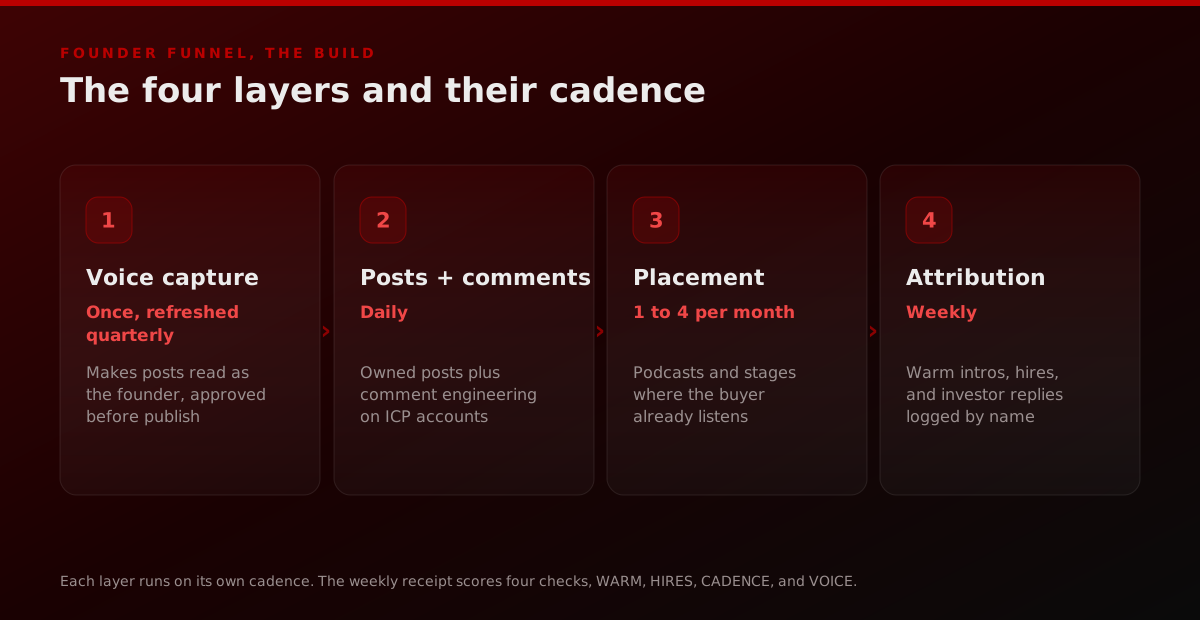
ChannelWhat it doesCadenceLeading indicator
Owned postsBuilds surface area and recall in the founder's voiceDailyShipped-on-time days, no quiet roll-forward
Comment engineeringPuts the founder in front of ICP accountsDailyReplies from real target accounts
Podcast / stage placementBorrows audiences that already exist1 to 4 per monthAppearances that seed owned content
AttributionTies reach back to pipelineWeeklyWarm intros, demos, and hires logged by name

Founder-led marketing is measured on named outcomes, not follower count. Impressions with no attributable intro, demo, or hire mean the presence is pointed at the wrong accounts.

How FORKOFF runs founder-led marketing

FORKOFF runs founder-led marketing as a founder spine of 30 minutes a week plus one recorded interview a week. The founder approves every draft against a voice guide, and the team runs the cadence, the comment engineering on a curated ICP list, the podcast placement, and the weekly receipt that logs WARM intros, HIRES, CADENCE, and VOICE. It is priced on qualified outcomes rather than a posting subscription, because the product is pipeline, not a tidier feed. The same integrity discipline that runs on the FORKOFF distribution network, which has processed 5B+ views, applies here: the report is on outcomes a real buyer produced, not raw impressions. See FORKOFF Founder Funnel for how the spine is run.

What each layer costs if you outsource it (2026 market bands)

LayerOutsourced 2026 priceSource signal
Founder content and ghostwriting$2,000 to $8,000 / monthClash: US personal branding $3,500 to $25,000+/mo
Podcast and speaking placement$1,000 to $5,000 / monthPodseeker: booking agencies $1,500 to $5,000+/mo
B2B pipeline and outbound$3,000 to $12,000 / monthNewlead: B2B lead-gen retainer band

Public 2026 vendor bands, not FORKOFF numbers. Bought separately these layers stack to roughly $5,000 to $20,000 or more a month. See the full breakdown at /services/founder-funnel#how-much-does-a-founder-funnel-cost.

What is founder-led marketing in simple terms?
It is using the founder as the company's main marketing channel instead of a brand account or paid ads. The founder posts their own point of view, engages the accounts that matter, and appears on podcasts, and the company's reach compounds on trust in a person. The goal is pipeline traced to what the founder said, not follower count.
How is founder-led marketing different from a personal brand?
A personal brand is the reputation asset. Founder-led marketing is the go-to-market motion that points that reputation at the accounts that convert. You can have a personal brand that produces zero pipeline, which is the common failure. Founder-led marketing exists to make the brand do commercial work, measured on named outcomes.
Does founder-led marketing actually work for B2B?
It works best for B2B, because early-stage buyers follow named operators and trust a specific person over a logo. A founder who posts a real, arguable opinion earns attention a corporate feed cannot buy, and that attention converts to warm intros and inbound demos. The catch is consistency: skip the cadence and the compounding stops.
Can a founder run founder-led marketing themselves?
Yes for the content and comments, which take about 30 minutes a day and cannot be faked because the voice is real. What is harder to self-run is the placement outreach and the disciplined weekly attribution. That is where a managed founder funnel earns its keep, drafting and placing while the founder shows up in the comments and on the calls.
How do you measure founder-led marketing?
On outcomes, not impressions. The signals that matter are warm intros from real ICP accounts, inbound demos, senior applicants who cite a specific post, and investor replies, each logged back to its source. Cadence reliability is the earliest leading indicator. If reach is climbing but no outcomes appear, the presence is pointed at the wrong accounts.
Is founder-led marketing the same as founder-led sales?
No. Founder-led marketing fills the top of the funnel with warm attention and inbound. Founder-led sales is the founder personally running demos and closing early deals. Keeping them separate lets you diagnose whether a stalled pipeline is a reach problem or a closing problem, which need different fixes.

How do you build a founder brand?

A founder brand is the reputation a founder builds in public: the point of view they are known for, the voice buyers recognize, and the trust that makes people follow the person before the product. You build it in five moves. First, pick one point of view you are willing to be known for, because a brand that stands for everything stands for nothing. Second, capture your real voice so the content reads as you. Third, publish consistently on one primary platform rather than spreading thin across five. Fourth, show your work in public so the reputation is earned, not claimed. Fifth, measure recognition, replies from the right accounts and inbound that names you, not follower count. The term was popularized by Dave Gerhardt's book Founder Brand. FORKOFF builds this as an outcome-priced founder spine, the same integrity model behind its 5B+ processed views, so the brand is judged on the pipeline it produces.

Read the full answer
  1. 01
    Pick one point of view Decide the single thing you want to be known for and the position you are willing to defend. A founder brand is a reputation, and a reputation needs an edge. Trying to appeal to everyone produces a feed nobody remembers. Narrow beats broad every time here.
  2. 02
    Capture your real voice Write down how you actually talk: your takes, your enemies, the phrases only you use. The brand has to sound like the person or it breaks on contact with anyone who has met you. This is also why a founder brand cannot be fully ghostwritten.
  3. 03
    Publish consistently on one platform Pick the one platform where your buyers already are and post on a locked cadence, rather than spreading thin across five. Recognition is built by repetition, and repetition needs a home. Depth on one channel beats a shallow presence on many.
  4. 04
    Show your work in public Post the real process: the numbers, the losses, the decisions and why you made them. A reputation earned in public is durable in a way a claimed one is not. Building in public is what turns a following into a brand people trust.
  5. 05
    Measure recognition, not reach Track the signals that mean the brand is landing: replies from the accounts you want, inbound that names a specific post, and people who arrive already knowing your position. Follower count is a vanity number. Recognition among the right people is the asset.

A founder brand is a reputation, not a following

The mistake most founders make is treating the brand as a follower count to grow. A founder brand is a reputation: what a specific set of buyers, investors, and future hires believe about you before they ever talk to you. Ten thousand followers who cannot say what you stand for is a weaker asset than five hundred who can quote your position back to you. The whole discipline is being known for one thing among the people who matter, and being trusted enough that they act on it. That is why building in public works. It converts a claim into evidence, and evidence is what a reputation is made of. If the presence is not producing recognition among the right accounts, it is content, not a brand.

The five layers of a founder brand

LayerWhat it buildsCadenceLeading indicator
Point of viewThe one thing you are known forSet once, refined quarterlyBuyers can quote your position back
VoiceContent that reads as the personSet once, refreshed quarterlyFounder approves every draft before publish
Consistent publishingRecognition through repetitionDaily on one platformShipped-on-time days, no quiet roll-forward
Building in publicTrust earned, not claimedWeekly proof postsReplies and shares from target accounts
Recognition trackingProof the brand is landingWeeklyInbound that names a specific post

A founder brand is measured on recognition among the right accounts, not on follower count. The term was popularized by Dave Gerhardt's 2022 book Founder Brand.

What building the brand costs if you outsource it (2026 market bands)

LayerOutsourced 2026 priceSource signal
Personal-brand ghostwriting$2,000 to $8,000 / monthClash: US personal branding $3,500 to $25,000+/mo
Podcast and speaking placement$1,000 to $5,000 / monthPodseeker: booking agencies $1,500 to $5,000+/mo

Public 2026 vendor bands, not FORKOFF numbers. A founder brand is the reputation layer of a founder funnel, so full outsourced builds span roughly $5,000 to $20,000 or more a month. See /services/founder-funnel#how-much-does-a-founder-funnel-cost.

Pick one platform and one point of view

A founder brand compounds from focus, not spread. Two decisions do most of the work. The first is the platform: the single channel where your buyers already gather, whether that is X, LinkedIn, or a specific community. Owning one channel deeply beats a thin presence on five, because recognition is built by repetition in one place. The second is the point of view: the one position you will be known for and defend, covered as the marketing motion at founder-led marketing. Buyers remember people with an edge and forget people who hedge. Once the platform and the point of view are locked, consistency does the rest, which is why cadence reliability is the leading indicator a founder brand is being built rather than just talked about.

How FORKOFF builds a founder brand

FORKOFF treats the founder brand as the reputation layer that makes the whole founder funnel work. The founder approves every draft against a voice guide, the team runs the daily cadence and the comment engineering on a curated ICP list, and the weekly receipt scores whether the brand is producing WARM intros, HIRES, CADENCE reliability, and VOICE fidelity. It is priced on qualified outcomes rather than a posting subscription, because a recognizable brand that books no calls is expensive at any follower count. The report is on outcomes a real buyer produced, the same integrity model that runs on the distribution network behind FORKOFF's 5B+ processed views.

What is a founder brand in simple terms?
It is the reputation a founder builds in public: the point of view they are known for and the trust that makes people follow the person before the product. A founder brand is measured by recognition among the right buyers and inbound that names you, not by follower count. The term was popularized by Dave Gerhardt's book Founder Brand.
How long does it take to build a founder brand?
Recognition starts to compound over months, not weeks. Voice capture and the first cadence can begin in a week, but a brand is earned by repetition, so the real signal is people arriving already knowing your position. Expect leading indicators like reply quality from target accounts before you expect broad recognition.
Can you build a founder brand without a huge following?
Yes, and a small, precise audience is often the stronger asset. Five hundred of the right buyers, investors, and hires who can quote your position beats ten thousand who cannot say what you stand for. A founder brand is about being known for one thing among the people who matter, not about raw reach.
Which platform is best for a founder brand?
The one where your buyers already gather, most often X or LinkedIn for B2B founders. The specific channel matters less than the decision to own one deeply rather than spread thin across five. Recognition is built by repetition in one place, so pick the platform your ICP actually reads and post there consistently.
Do I need an agency to build a founder brand?
No for the content and voice, which cannot be faked and take about 30 minutes a day. What is harder to self-run is the placement outreach and the weekly discipline of tracking recognition and attribution. That is where a managed founder funnel helps, drafting and placing while the founder supplies the voice and shows up in the comments.
How do you know if a founder brand is working?
Track recognition, not vanity metrics. The signals are replies from the accounts you want to reach, inbound demos that name a specific post, and people who arrive already knowing your position. Cadence reliability is the earliest leading indicator. If follower count is climbing but none of those appear, the brand is not reaching the right people.

How do you get inbound leads as a founder?

Inbound leads are buyers who come to you, rather than being chased by outbound. As a founder you generate them by being useful in public: publishing content that answers the exact questions your buyers search, showing up where they already spend time, and making the path to reach you obvious. Three engines produce most founder inbound, and a founder controls all of them. Content and answer-engine visibility make you the result a buyer finds. A consistent social and podcast presence makes you the person a buyer already trusts when they arrive. And word of mouth, earned by doing visible good work, brings referrals you never asked for. The common failure is treating inbound as luck. It is a byproduct of being useful in public on a schedule. FORKOFF runs founder inbound as an outcome-priced spine that logs every lead back to the post or appearance that caused it, the same attribution discipline behind its 5B+ processed views.

Per our own Founder Funnel ledger, 66 named target accounts became 41 warm introductions and 16 booked calls in a 90-day engagement for an AI services founder, on 30 minutes of founder time a week. FORKOFF Founder Funnel ledger, Q3 2026

Read the full answer
  1. 01
    Publish answers to real buyer questions Write the content your buyers actually search, in plain language, so both search engines and AI answer engines surface you as the result. An answer page or post that resolves a specific buyer question is the most durable inbound engine a founder has, because it works while you sleep.
  2. 02
    Be present where your buyers already are Post consistently on the one platform your ICP reads and appear on the podcasts they listen to. Presence turns you from a cold name into a known one, so when a buyer has the problem you solve, you are already the person they think of.
  3. 03
    Give something away A free teardown, a template, a small tool, or a public benchmark gives a buyer a reason to raise their hand. Value up front is the cleanest inbound trigger, because the person who took your free thing is pre-qualified and warm when they reach out.
  4. 04
    Make the path to reach you obvious Put a clear, low-friction way to book or reply in your bio, your posts, and your appearances. Inbound dies when an interested buyer cannot find the door. One obvious call to action beats a clever funnel that hides the way in.
  5. 05
    Attribute every lead to its source Log each inbound demo and referral back to the post, appearance, or free asset that caused it. Attribution tells you which engine is working so you can do more of it, and it is what separates a repeatable inbound system from a lucky month.

Inbound is a byproduct of being useful in public

Founders who chase inbound with tricks tend to get nothing, and founders who quietly do useful work in public tend to get more than they can handle. Inbound is not a channel you buy, it is the residue of being visibly helpful on a schedule. Every answer you publish, every honest post about what worked and what did not, and every free teardown compounds into a reputation that makes buyers arrive already convinced. The reason it feels slow is that it works on a delay: the post you write today produces the demo six weeks from now. That delay is also the barrier that keeps most founders from doing it, which is exactly why the ones who commit to the cadence pull ahead. The whole game is usefulness plus consistency plus a visible door.

The three inbound engines a founder actually controls

Founder inbound comes from three engines, and a founder owns all three. The first is content and answer-engine visibility: pages and posts that answer buyer questions so search and AI surface you, which is the same discipline behind answer engine optimization. The second is presence: a consistent social and podcast footprint, the founder-led marketing motion, that makes you a trusted name before the buyer needs you. The third is word of mouth: referrals earned by doing visible good work, which cost nothing and close fastest because they arrive pre-trusted. Most founders lean on one and ignore the other two. The compounding happens when all three run together, because a buyer who reads your answer, already follows you, and heard your name from a peer is barely a lead at all. They are a warm intro to yourself.

Where founder inbound actually comes from

EngineMechanismTime to first leadWhat to measure
Content and answer-engine visibilityBuyers find you as the search or AI resultSlow (weeks to months)Inbound that names a specific page or post
Social and podcast presenceBuyers already trust you when they arriveMedium (weeks)Replies and demos from target accounts
Word of mouthReferrals from visible good workFastest, once seededReferred demos, closest to close

A founder controls all three engines. The compounding happens when they run together, so a buyer arrives having read your answer, already following you, and referred by a peer.

How fast should a founder respond to an inbound lead?

Within the hour, during working hours, and the same day at the latest. Speed is the cheapest conversion lever a founder has, and it compounds with everything else on this page. The research behind that is old and has held up. Harvard Business Review's study of 2,241 US companies found that firms that contacted a web lead within an hour were nearly seven times as likely to qualify it as firms that waited even one hour longer, and more than 60 times as likely as firms that waited a day. Buyers who fill in a form are usually comparing two or three options that afternoon. The first credible reply sets the frame for the rest. For a founder the practical rule is simple. Route every inbound form, demo request and DM that names a problem to one place you check, and reply personally with a short, specific note: what you understood about their situation, one question that moves it forward, and two times you can talk. A personal two-line reply from the founder beats a polished sequence from a tool, because at this stage the founder is the product's best proof.

Inbound vs outbound for an early-stage founder

ApproachWho moves firstCost profileBest when
InboundThe buyer comes to youTime up front, compounds over monthsYou can commit to publishing on a cadence
OutboundYou reach the buyerPays off immediately, does not compoundYou need pipeline this month, not next quarter
Founder-led salesYou close what inbound and outbound surfaceFounder time, highest conversion earlyBefore a dedicated sales team exists

Inbound and outbound are complements, not rivals. Most early founders run outbound for immediate pipeline while building the inbound engine that lowers acquisition cost later. See /services/founder-funnel#what-is-founder-led-sales.

How do you qualify an inbound lead without a sales team?

Ask four things and write the answers down: who they are, what problem they are trying to solve, what happens if it stays unsolved, and when they need it handled. Most founder inbound is a mix of real buyers, curious peers, job seekers, vendors and students. Qualification is not about rejecting people, it is about deciding how much of your scarce time each conversation gets. A real buyer has a named problem, a cost of doing nothing and a timeline. A curious peer has none of those and deserves a friendly reply, not a call. Keep the criteria short enough to apply from a single email. Company type and size against your ideal customer profile, the problem in their own words, and a timeline inside the next quarter cover most of the signal. Anything more elaborate belongs to a sales team you have not hired yet.

What should an inbound capture form ask?

As little as possible: name, work email, company and one open question about what they are trying to do. Every extra field lowers the number of people who finish the form, and the open question is worth more than any dropdown. Buyers describe their problem in the words they will later use to justify the purchase, which gives you both a qualification signal and copy for your next post. Put a booking link next to the form for buyers who already know they want to talk, and say plainly what happens after they submit: who replies, and how fast. A form that disappears into silence teaches buyers that your inbound is a funnel, not a conversation.

How should you follow up on inbound leads?

Follow up three times over about ten days, each time adding something useful rather than asking whether they saw your last message. A good follow-up sequence for a founder is short and specific. The first reply goes out the same day. The second, a few days later, shares one relevant thing: a short case note, a teardown of a problem like theirs, or an answer to the question they asked on the form. The third closes the loop politely and leaves the door open, which often gets a reply because it removes pressure. Track every inbound lead in one simple list with the source, the date, the stage and the next action. That list is what tells you which posts, talks and pages actually produce buyers, and it is the first thing you hand to the first salesperson you hire.

What does a lightweight discovery call look like?

Thirty minutes, mostly listening: their situation, what they have tried, what a good outcome looks like, and what would stop them from moving forward. Skip the pitch deck. Ask how they handle the problem today, what it costs them, who else is involved in the decision and what timeline they are working to. Then show only the part of the product that answers what they told you, and agree a concrete next step before the call ends, with a date. Write a three-line summary straight after the call and send it to them. It proves you listened, it gives their internal champion something to forward, and it becomes the raw material for the case study you will publish once they succeed.

Which content produces inbound for a founder?

Content that answers a question a buyer types before they buy: comparisons, cost breakdowns, teardowns of real problems, and what you learned shipping the product. Founders tend to publish what is easy to write, which is opinion and company news. Buyers search for something narrower: how much a thing costs, how two options compare, how to fix a specific failure, and what to check before they sign. A post that answers one of those questions honestly, with a number or an example from your own work, keeps producing inbound for months, because it shows up at the moment someone is deciding. Write in your own voice and put your name on it. A founder explaining a trade-off they made reads as expertise; the same text under a company logo reads as marketing. Publish on the platform where your buyers already read, then keep a copy on your own site so search engines and AI answer engines can cite it.

Do webinars and talks still produce inbound leads?

Yes, when the room is small and specific. A founder teaching thirty people who share one problem produces more qualified inbound than a keynote to three thousand people who do not. The format that works is a practical session on one problem your product solves, with a live example and time for questions. Record it, cut the strongest answers into short clips, and publish them where the audience already is. The attendees become warm leads, and the recording keeps working long after the session ends. Industry meetups, niche podcasts and partner webinars all count. The test is whether the people in the room could buy from you within a year. If they could, an hour of teaching is one of the highest-return uses of a founder's week.

How do referrals and free tools create inbound?

Both put your product in front of a buyer through someone or something they already trust, which is why they convert better than almost any paid channel. Referrals start with the customers you already have. Ask the happy ones, directly and specifically, who else has the problem you solved for them, and make the introduction easy by writing it for them. A short note from a peer founder opens doors that no cold email will. Free tools work the same way at scale. A calculator, a checker or a template that solves a small part of the buyer's problem attracts exactly the people who will later need the full solution, and each use is a chance to start a conversation. Keep the tool genuinely useful without signing up, and offer the next step only after it has delivered something.

How FORKOFF turns founder presence into inbound

FORKOFF runs founder inbound as part of the founder funnel: the content that makes the founder the search and AI result, the daily presence that makes them the trusted name, and the placement that borrows audiences that already exist. Every inbound demo and referral is logged back to the post or appearance that caused it on a weekly receipt, so the spend maps to leads a real buyer produced. It is priced on those qualified outcomes rather than a posting subscription, the same attribution and integrity model that runs on the distribution network behind FORKOFF's 5B+ processed views. The result is inbound you can explain, not inbound you hope for.

How do founders get inbound leads without a big audience?
By being useful in public on a schedule. Publish content that answers the exact questions your buyers search, appear where they already spend time, and give something away. A small, precise audience that trusts you produces more inbound than a large one that does not. The lever is usefulness plus consistency, not raw follower count.
How long does it take to get inbound leads as a founder?
Inbound works on a delay. Content and answer-engine visibility take weeks to months to produce demos, presence produces faster once you are a known name, and word of mouth is quickest once seeded. The delay is why most founders quit early, and why the ones who hold the cadence pull ahead. Expect it to compound, not switch on.
What is the best inbound channel for a founder?
There is no single best channel, there are three engines that compound together: content and answer-engine visibility, a consistent social and podcast presence, and word of mouth. Leaning on one and ignoring the others is the common mistake. The strongest inbound happens when a buyer finds your answer, already follows you, and heard your name from a peer.
Is inbound better than outbound for a startup?
They are complements. Outbound pays off immediately but does not compound, so it is right when you need pipeline this month. Inbound takes time up front but lowers acquisition cost over months as it compounds. Most early founders run both: outbound for now, inbound for the durable engine that makes later growth cheaper.
How do I turn social media into actual leads?
Publish content that answers real buyer questions, engage the specific accounts you want to reach rather than posting into the void, give a clear reason to raise a hand, and make the path to book obvious. Then log which post caused each inbound so you can repeat what works. Presence without a visible door produces impressions, not leads.
How do I know which posts are driving inbound?
Ask every inbound lead what brought them and log it back to the source, or use a tracked link and a simple attribution note on a weekly receipt. Attribution is what turns a lucky month into a repeatable system, because it tells you which of the three engines is working so you can do more of it.

How much does a founder funnel cost?

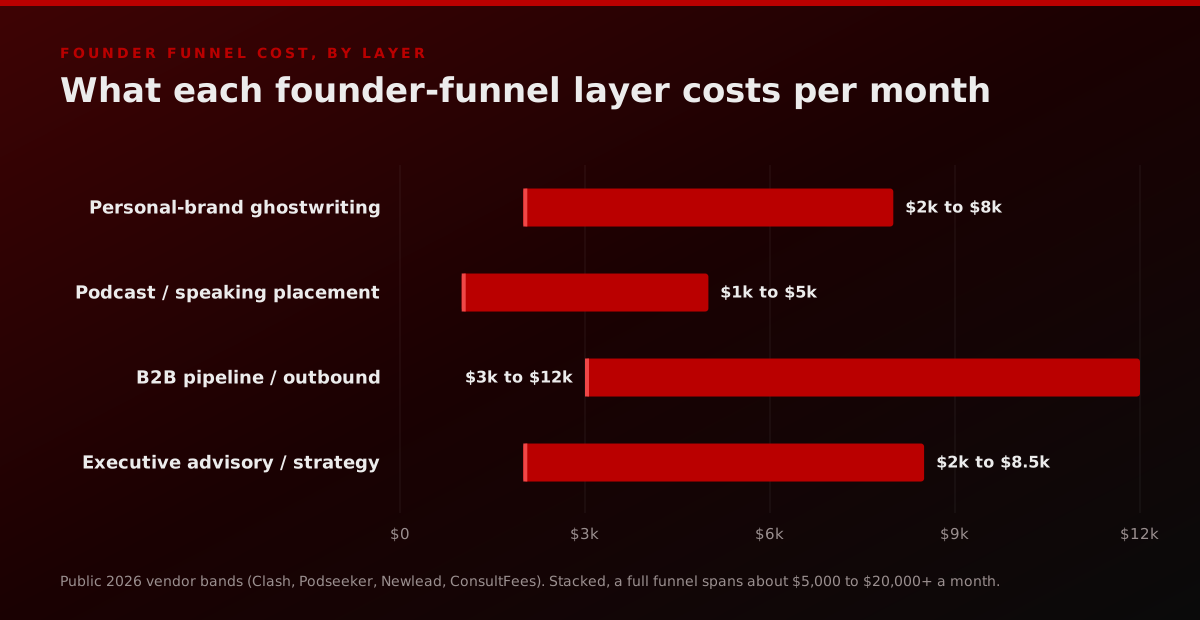
A founder funnel is not a single line item, so it does not carry one price. It is stacked from three markets that agencies usually sell separately. Founder content and personal-brand ghostwriting runs about $2,000 to $8,000 a month, with US personal branding spanning $3,500 for a LinkedIn-only boutique to $25,000 or more for a full program (Clash). Podcast and speaking placement runs about $1,000 to $5,000 a month, or $200 to $1,000 per booked interview (Podseeker, Fame). B2B pipeline and outbound sits at $3,000 to $12,000 a month (Newlead). Bought separately, a real founder funnel lands anywhere from $5,000 to $20,000 or more a month. The number almost nobody quotes is the outcome: the warm intros, senior hiring inbound, and investor recall the presence actually produced. FORKOFF prices Founder Funnel on that outcome rather than a per-post or per-booking fee, because a feed full of posts that books no calls returns nothing.

Per our own Founder Funnel ledger, 65 named target accounts became 40 warm introductions and 16 booked calls in a 90-day engagement for a SaaS founder, on 30 minutes of founder time a week, from a channel that did not exist at day zero. FORKOFF Founder Funnel ledger, Q3 2026

Read the full answer
  1. 01
    Founder content and personal brand Personal-brand ghostwriting for a founder runs about $2,000 to $8,000 a month. Clash puts US personal branding at $3,500 for a LinkedIn-only boutique up to $25,000 or more for a full program. This buys posts and a voice match, not pipeline.
  2. 02
    Podcast and speaking placement Podcast booking agencies charge roughly $1,000 to $5,000 a month, or $200 to $1,000 per booked interview (Podseeker, Fame). Placement puts the founder in front of an audience that already exists, but the booking is where most quotes stop.
  3. 03
    B2B pipeline and outbound The demand-capture layer, outbound and lead generation, runs about $3,000 to $12,000 a month on a retainer (Newlead). This is the part that turns presence into booked calls, and it is almost always sold as a separate line.
  4. 04
    The stacked number Buy all three separately and a real founder funnel lands anywhere from $5,000 to $20,000 or more a month. The gap between vendors is rarely writing quality, it is how much of the stack each one actually owns.
  5. 05
    The outcome test Normalize every quote to cost per qualified outcome, a warm intro, a senior applicant, or an investor reply, not cost per post or per booking. A feed that never books a call is expensive at any monthly rate.

A founder funnel is a stack, not a service

Most price confusion comes from comparing one layer of a founder funnel to the whole thing. A personal-brand ghostwriter sells posts. A podcast booker sells calendar slots. A lead-gen agency sells meetings. Each is priced against its own deliverable, and none of them owns the handoff between the layers, which is where a founder funnel actually works or fails. When you read a founder-marketing quote, decompose it against the three layers, because a low headline number almost always means two of them were quietly left out.

What are the pieces of a founder funnel and what do they cost?

A founder funnel has six pieces, voice capture, content, distribution, placement, a landing layer, and attribution, and each carries its own price. Voice capture is the recorded interview that turns the founder's real opinions into material, usually folded into a ghostwriting fee. Content is posts and clips, which ghostwriting agencies sell at about $2,000 to $8,000 a month. Distribution is the daily work of replying on the accounts your buyers read, and most content retainers leave it out. Placement is podcasts and stages, at $1,000 to $5,000 a month or $200 to $1,000 per booking. The landing layer is the profile, pinned post, booking page, and one-page site. Attribution is the CRM field and weekly log that ties a call to the post that caused it. Software is small next to labor. Pegacorn CRM puts a working B2B funnel at $250 to $2,000 a month in software, and a credible solo setup near $400 a month all-in. The money in a founder funnel goes to people, so read every quote as hours of which work, done by whom.

Bar chart of monthly founder funnel layer costs, ghostwriting, podcast placement, B2B pipeline, and executive advisory, from public 2026 vendor bands
What each founder-funnel layer costs per month, ghostwriting $2,000 to $8,000, podcast placement $1,000 to $5,000, B2B pipeline $3,000 to $12,000, and executive advisory $2,000 to $8,500 (2026 vendor bands). Stacked, a full funnel spans $5,000 to $20,000+.

What are the four founder funnel stages?

The four stages are attention, trust, conversation, and conversion, and most budgets fund the first while most deals are decided in the third. Attention is reach: posts, clips, and podcast appearances that put the founder in front of the right accounts. Trust is repetition: the same clear thesis, in the founder's real voice, showing up week after week until a buyer recognizes it. Conversation is where a follower becomes a contact: replies, comments on the buyer's own posts, direct messages, and warm introductions. Conversion is the booked call and the founder-led sales motion that closes it. Price each stage separately when you read a quote. A ghostwriting retainer pays for attention and some trust. A booking agency pays for attention inside someone else's audience. Almost nobody prices the conversation stage, which is why so many founders have impressions and no calls.

How does a founder funnel work across channels?

Each channel does one job, and the funnel works when the jobs hand off to each other. X is where founders in tech, AI, and crypto build reach fastest and where a reply to a larger account gets seen. LinkedIn is where B2B buyers, candidates, and investors check who the founder is, and where a post reaches a buyer's colleagues. Podcasts give the founder 40 minutes of trusted attention in an audience someone else built. A newsletter holds the people who opted in. Events turn online familiarity into a handshake. The handoff is the part that costs money to run. A podcast clip goes out on X and LinkedIn the same week it airs. A buyer who replies gets a direct message, then a booking link. A reply from a target account is logged against that account in the CRM. Run the channels separately and you pay for five audiences that never meet the founder in the same place twice.

Why cost per post is the wrong denominator

A per-post or per-booking quote looks precise and hides the thing that matters. A post with no comment engineering behind it rarely earns reach, and a podcast slot with no attribution behind it is a nice conversation nobody traces to a deal. The denominator to compare on is cost per qualified outcome, a warm intro, a senior hire, or an investor reply, because that is the number a founder is actually paying to move. A $6,000 a month program that produces named pipeline is cheaper per outcome than a $2,000 one that only produces impressions.

Which content and marketing touchpoints does it need?

It needs a small set of touchpoints repeated on schedule: daily posts, weekly clips, a monthly long-form piece, and a reply habit on target accounts. Daily posts on one or two platforms keep the founder present. Weekly clips cut from podcasts or recorded interviews carry the voice into video. A monthly long-form piece, an essay, a newsletter issue, or an answer page, gives buyers something to forward and gives search and AI engines something to cite. Email holds the people who already raised a hand. The touchpoint most budgets miss is the reply. Comment engineering, engaging a curated list of 30 to 50 accounts your buyers read on a weekly rotation, is where a founder becomes familiar to the exact people who will later take the call. It is cheap in software and expensive in attention, which is why it is the first thing a busy founder drops and the first thing a good operator protects.

What do website and landing pages cost?

Very little in software, and more than most founders expect in clarity. A founder funnel needs one landing layer that answers who you are, what you do, and how to book, and it can be a profile plus a booking link before it is ever a website. Pegacorn CRM's 2026 breakdown lists Carrd at $19 a year for simple landing pages and Framer at about $20 a month, puts realistic spend at $20 to $50 a month for most small teams, and warns against spending $5,000 or more on a custom site before product-market fit. What the landing layer needs is one call to action. Heyflow's 2026 funnel guide describes the performance gap between a focused landing page and a general website, and the reason is choice: every extra link is a way out. For a founder that means a pinned post that states the thesis, a profile line that names the buyer, and one link that books a call.

Traffic, ad spend and contact data

A founder funnel runs mostly on organic reach, so ad spend is optional and contact data is the line that matters. Paid amplification of a founder's best posts can speed up the first 90 days, but it buys impressions, not familiarity, so treat it as a test budget and never as the engine. Contact data is different. A target account list with the right people at each company is what makes comment engineering and outreach precise. Pegacorn CRM puts Apollo at $79 to $99 a month per user and Clay at $349 a month and up, and its advice is to validate the buyer profile before buying expensive data. A founder funnel is a channel for warm demand. If you need meetings this month, outbound with its own budget of $3,000 to $12,000 a month is the faster line. The two work best together: the funnel warms the list that outbound later contacts, and a cold email from a founder the buyer already recognizes reads very differently from one that does not.

When should you upgrade to an advanced funnel?

Upgrade when the basic loop has held for 90 days and the founder has become the bottleneck, not before. A basic funnel is the founder posting on a cadence, replying to target accounts, and logging what came in. The signals that it is time to add layers are concrete: the cadence has held without gaps for a quarter, replies arrive faster than the founder can answer them, and the weekly log shows which topics and formats produce calls. The advanced funnel adds three things: an operator who drafts from recorded interviews and runs the reply habit, podcast and stage placement, and attribution good enough to separate a sourced call from an influenced one. Adding them earlier usually buys polish on a message nobody has tested. Adding them later leaves warm replies unanswered, which is the most expensive leak a founder funnel has.

When it is worth it and when it is not

A managed founder funnel is worth it when four things are true: one closed deal pays for several months of the program, your buyers follow founders in your category, the founder can hold 30 minutes a week plus a recorded interview for 90 days, and someone will log outcomes every week. It is not worth it when the product sells on price to buyers who never read founder posts, when the founder cannot commit to the cadence, or when the goal is a follower count rather than conversations. The quick test is arithmetic. Take your average first-year contract value, multiply by a realistic close rate on warm calls, and compare it with three months of the quote. If ten booked calls in a quarter would not cover the spend, buy the cheaper layers first and run the cadence yourself until the numbers change.

What are the common founder funnel mistakes?

The five common mistakes are buying content without distribution, buying reach that is not real, skipping attribution, changing the voice, and quitting at week six. Content without distribution is a ghostwriter producing good posts that nobody outside the existing followers sees, because nobody runs the reply habit. Bought followers and engagement pods inflate a count and teach the platform to show the founder to the wrong people. Skipping attribution means a good month cannot be repeated, because nobody knows what caused it. A voice that changes with each writer reads as a brand account, and buyers stop trusting it. And quitting at week six, which is when most founders stop, throws away five weeks of cost just before compounding starts. Each mistake is cheap to avoid and expensive to fix later. Ask any provider how it handles all five before you sign.

How FORKOFF prices a founder funnel

FORKOFF runs Founder Funnel on 30 minutes of founder time a week for approvals and reply triage, plus a recorded interview, and anchors the engagement on outcomes rather than a per-post or per-booking fee. The work is voice capture so posts read as the founder, a daily cadence on X and LinkedIn with founder approval before anything publishes, comment engineering on 30 to 50 ICP accounts on a 7-day rotation, podcast and stage placement where the buyer already listens, and a weekly receipt that logs every warm intro, senior applicant, and investor reply back to the post or appearance that caused it. The four receipt checks are WARM, HIRES, CADENCE, and VOICE, and a missed cadence day logs a written reason rather than a quiet roll-forward. Per our own Founder Funnel ledger, a 90-day engagement for a SaaS founder worked 65 named target accounts into 40 warm introductions and 16 booked calls, from a channel that did not exist at day zero. Engagements run monthly with a 90-day minimum, by application.

What each layer of a founder funnel costs in 2026 (cited vendor bands)

LayerTypical 2026 priceWhat it buysSource signal
Personal-brand ghostwriting$2,000 to $8,000 / monthFounder posts, voice match, light strategyClash: US personal branding $3,500 to $25,000+/mo
Podcast / speaking placement$1,000 to $5,000 / monthBooked guest spots on audiences that existPodseeker $1,500 to $5,000+/mo; Fame $200 to $1,000 per booking
B2B pipeline / outbound$3,000 to $12,000 / monthSDR outbound, lead gen, meeting bookingNewlead: $3,000 to $12,000/mo B2B lead gen retainer
Executive advisory / strategy$2,000 to $8,500 / monthPositioning and cadence strategy, no executionConsultFees: advisory retainers $2,000 to $8,500/mo

Ranges are directional 2026 estimates from public agency pricing pages. Every figure is a published vendor band, not a FORKOFF number. Stacked, a full founder funnel spans roughly $5,000 to $20,000 or more a month. Verify with each vendor before you budget.

Content billing vs outcome billing

ModelHow it is billedTypical priceWhat you pay for
Per post / per tweetPer asset delivered$25 to $500 per postA draft, whether or not it earns reach or a reply
Monthly content retainerFlat monthly fee$2,000 to $8,000 / monthA posting cadence, measured on impressions
Per booked placementPer confirmed interview$200 to $1,000 per bookingA calendar slot, not the pipeline it produces
Outcome-priced (FORKOFF)Scoped to delivered outcomesBy applicationWarm intros, senior applicants, and investor recall, logged in a weekly receipt

The denominator that decides real cost is qualified outcomes produced, not posts shipped or slots booked. Per-asset bands from public gig-platform and agency pricing; see /answers/cost-of-hiring-an-x-ghostwriter-agency.

Founder funnel software and data costs (2026 vendor bands)

LineTypical 2026 priceSource signal
Simple landing pageCarrd $19 per year; Framer about $20 per monthPegacorn CRM 2026 breakdown
FormsTypeform $25 to $83 per monthPegacorn CRM 2026 breakdown
Contact dataApollo $79 to $99 per user per month; Clay $349+ per monthPegacorn CRM 2026 breakdown
Whole software stack$250 to $2,000 per monthPegacorn CRM: working B2B funnel
Done-for-you sales funnel build$1,500 to $50,000+ one-timeAtomic Funnels 2026 market bands

Software is the small line. The cost of a founder funnel is the labor of capture, distribution, replies, and attribution, which is why quotes vary far more than tool bills do.

What is the most affordable way to build a founder funnel?
Do the cadence yourself. The cheapest working founder funnel pairs the founder writing their own posts with comment engineering on a curated list of ICP accounts, which costs nothing but 30 minutes a day. Outsourced personal-brand ghostwriting starts around $2,000 a month, so the affordable route spends effort on consistency and attribution rather than on a higher content tier.
Is a founder funnel agency worth it?
It depends on whether the agency sells you posts or pipeline. A founder can self-produce content cheaply, so paying a ghostwriter for more polish rarely moves the outcome. The spend that is worth it is the one that owns the whole stack, content plus placement plus attribution, and reports warm intros, hires, and investor replies by name rather than an impression count.
How much should a startup budget for a founder funnel?
If you outsource one layer, budget $2,000 to $8,000 a month for content alone. A full stack that adds podcast placement and outbound lands anywhere from $5,000 to $20,000 or more a month. The mistake is buying the content layer and expecting pipeline, because the layer that produces booked calls is the one most quotes leave out.
What should I consider when pricing a founder funnel?
Decompose every quote into the three layers, content, placement, and pipeline, and ask which ones the vendor actually owns. Confirm they capture the founder's real voice rather than shipping template posts, that they can attribute pipeline back to a specific post or appearance, and that growth comes from replies and owned content, not bought followers or engagement pods.
Can a founder do this themselves instead of hiring an agency?
Yes, for the content layer. A founder with 30 minutes a day can run the cadence and comment engineering better than any ghostwriter, because the voice is real. What is hard to self-run is the placement outreach and the disciplined attribution, logging every outcome back to its source, which is where a managed founder funnel earns its price.
Is a founder funnel the same as a sales funnel build?
No. A sales funnel build is a one-time project, landing pages, forms, email sequences, and automation, which Atomic Funnels prices at $1,500 to $7,500 from a freelancer, $5,000 to $15,000 from a specialist agency, and $15,000 to $50,000 or more for complex builds. A founder funnel is an ongoing motion built on the founder's voice and relationships. The build gives you a place to send people; the founder funnel gives them a reason to come.
Do founder funnel agencies guarantee pipeline?
No credible one guarantees a specific number of intros or deals, because pipeline depends on the founder's cadence, category heat, and timing. What a serious provider contracts on is the controllable part: cadence reliability, comment-engineering coverage on the right accounts, voice integrity, and attribution, the leading indicators that make pipeline show up.

How do you build a founder funnel?

A founder funnel is the system that turns a founder's public presence into qualified pipeline: warm intros, senior hiring inbound, and investor recall, rather than vanity followers. You build it in four moves. First, capture the founder's real voice so posts read as the person, not a ghostwriter. Second, ship a daily cadence of owned posts plus engineered comments on a curated list of ICP accounts, because the algorithm reads consistent engagement as active and boosts it. Third, place the founder on podcasts and stages where the buyer already listens. Fourth, log every outcome, every warm intro, hire, and investor reply, back to the post or appearance that caused it. FORKOFF runs this as a founder spine of 30 minutes a week plus one recorded interview a week with a weekly receipt, on the finding that founder-led sales, direct one-to-one selling by the founder, is what closes early deals before a sales team exists (Pipedrive).

Read the full answer
  1. 01
    Capture the founder's real voice Before a single post ships, record how the founder actually talks: their takes, their enemies, the phrases only they use. Posts the founder would never say out loud break trust faster than silence. Voice capture is what separates a founder funnel from a ghostwriter content factory.
  2. 02
    Ship a daily cadence with comment engineering Publish owned posts on a locked schedule and add engineered comments on a curated list of ICP accounts, investors, hire targets, and ecosystem partners. The algorithm reads consistent engagement as active and boosts it, and the comments put the founder in front of the exact accounts that convert.
  3. 03
    Place the founder where the buyer already listens Book podcasts and speaking slots on shows and stages the ICP already follows. A guest spot arrives inside an audience that exists, which is why placement is a founder-funnel sub-component, not a separate service. One good appearance seeds weeks of owned content.
  4. 04
    Attribute every outcome to its source Log each warm intro, senior applicant, and investor reply back to the post or appearance that caused it, by name. Track shipped-on-time cadence days too, never a quiet roll-forward, because cadence reliability is the leading indicator that pipeline ever shows up.
  5. 05
    Price the work on outcomes, not posts Whether you build in-house or hire it out, judge the spend on qualified outcomes produced, a warm intro, a hire, an investor reply, not on post count. A feed that never books a call is expensive at any cadence.

What a founder funnel actually is

A founder funnel is not a personal brand for its own sake. It is a pipeline system that happens to run on the founder's face and voice. The output is not follower count, it is a warm intro from an investor, a senior engineer who applies because of a specific post, and a buyer who books a call after hearing the founder on a podcast. If the presence is not producing named outcomes, it is a hobby, not a funnel. The whole discipline is pointing public presence at the accounts that convert and then proving it did. According to the 2021 Edelman-LinkedIn B2B thought leadership study, 75% of decision-makers said a piece of thought leadership led them to research a product or service they were not previously considering, which is the mechanism a founder funnel runs on. Per our own September 2026 study of 21 AI-native B2B SaaS launches on X, posts from the founder's account reached a median of 536,225 views against 165,138 from the company account.

The four layers of a founder funnel

LayerWhat it doesCadenceLeading indicator
Voice captureMakes posts read as the founderOnce, refreshed quarterlyFounder approves every draft before publish
Owned posts + comment engineeringPuts the founder in front of ICP accountsDailyShipped-on-time days, no quiet roll-forward
Podcast / stage placementBorrows audiences that already exist1 to 4 per monthAppearances that seed owned content
Outcome attributionTies pipeline back to the sourceWeeklyWarm intros, hires, investor replies logged by name

The FORKOFF Founder Funnel weekly receipt scores four checks: WARM (a warm intro from a real ICP account), HIRES (a senior applicant citing a founder post), CADENCE (shipped on the locked day), and VOICE (founder approved the draft before publish).

Why the daily cadence is the engine

The single move that makes a founder funnel work is a reliable daily cadence paired with comment engineering. Owned posts build the surface area, and engineered comments on a curated ICP list put the founder in front of the exact investors, hires, and buyers who matter, while the algorithm reads the consistency as an active account and boosts reach. Skip days and the compounding stops. This is why cadence reliability, shipped-on-time days logged with a written reason for any miss, is the leading indicator the whole system tracks before it tracks pipeline.

Build it in-house or hire it out

A founder can run the content layer themselves in 30 minutes a day, and should, because the voice is real and cannot be faked. What is harder to self-run is the placement outreach and the disciplined attribution. FORKOFF runs Founder Funnel as that founder spine of 30 minutes a week plus one recorded interview a week: the founder approves every draft against a voice guide, the team runs the cadence, the comment engineering, the podcast placement, and the weekly receipt that logs WARM intros, HIRES, CADENCE, and VOICE. It is outcome-priced rather than sold as a posting subscription, because the product is pipeline, not a tidier feed.

Flow diagram of the four founder funnel layers, voice capture, daily posts plus comment engineering, podcast placement 1 to 4 per month, and weekly outcome attribution
The four layers of a founder funnel and their cadence, voice capture once and refreshed quarterly, owned posts plus comment engineering daily, podcast and stage placement 1 to 4 per month, and outcome attribution logged weekly by name.

What each layer costs if you outsource it (2026 bands)

LayerOutsourced 2026 priceSource signal
Personal-brand ghostwriting$2,000 to $8,000 / monthClash: US personal branding $3,500 to $25,000+/mo
Podcast / speaking placement$1,000 to $5,000 / monthPodseeker: booking agencies $1,500 to $5,000+/mo
B2B pipeline / outbound$3,000 to $12,000 / monthNewlead: B2B lead gen retainer band

Public 2026 vendor bands, not FORKOFF numbers. A founder funnel stacks these layers, so a full outsourced build spans roughly $5,000 to $20,000 or more a month. See the full breakdown at /services/founder-funnel#how-much-does-a-founder-funnel-cost.

What is a founder funnel in simple terms?
It is the system that turns a founder's public presence into pipeline: warm intros, senior hires, and investor recall, instead of follower count. Content, podcast placement, and attribution work together so that every post and appearance can be traced to a named outcome. If it only produces impressions, it is a personal brand, not a funnel.
How long does it take to build a founder funnel?
Voice capture and the first cadence can start in a week, but the funnel compounds over months. Comment engineering and owned posts build recognition first, then warm intros and inbound follow once the founder is a known account to the target list. Expect leading indicators, cadence reliability and reply quality, before you expect booked pipeline.
Can a founder build the funnel without an agency?
Yes, for the content layer. A founder with 30 minutes a day can run posts and comment engineering better than any ghostwriter because the voice is real. The parts that are hard to self-run are the placement outreach and the disciplined weekly attribution, logging each outcome back to its source, which is where a managed founder funnel earns its keep.
How much time does a founder actually have to spend?
With a done-for-you team, about 30 minutes a week plus recordings is the working target: approving drafts against a voice guide, adding a few real comments on the curated ICP list, and answering the replies that convert. The team can draft and place, but the founder has to show up in the comments and on the calls, because the funnel runs on their credibility, not a proxy's.
What should I consider before building a founder funnel?
Decide which layers you will run yourself and which you will outsource, confirm you have a way to attribute outcomes by name, and commit to a cadence you can actually hold. The most common failure is starting strong and going quiet, because the algorithm and the audience both punish inconsistency. Reliability beats intensity here.
How do I know if the founder funnel is working?
Track outcomes, not vanity metrics. The signals that matter are warm intros from real ICP accounts, senior applicants who cite a specific post, investor replies, and booked calls attributed to an appearance. Cadence reliability is the earliest leading indicator. If impressions are climbing but none of those outcomes appear, the funnel is pointed at the wrong accounts.

What are the best founder-led marketing agencies?

A done-for-you founder marketing service exists to solve one problem: a busy CEO does not have time to become a full-time creator, but a founder's public presence closes deals a marketing account never will. The category splits into personal-brand ghostwriters ($2,000 to $8,000 a month, per Clash's US band, running to $25,000+ for premium tiers), podcast and speaking placement agencies ($1,000 to $5,000 a month), and B2B outbound shops ($3,000 to $12,000 a month) that each sell one layer. What actually builds a distribution engine, rather than a tidier feed, is a service that stacks voice capture, a daily posting and comment-engineering cadence on LinkedIn and X, podcast placement, and disciplined attribution of every warm intro and hire back to the post that caused it. FORKOFF's Founder Funnel runs all four as one outcome-priced engagement.

FORKOFF's Founder Funnel runs on founder-led sales, the finding that direct one-to-one selling by the founder is what closes early deals before a sales team exists (Pipedrive), tracked weekly against WARM, HIRES, CADENCE, and VOICE. FORKOFF Founder Funnel service terms and weekly receipt

Read the full answer
  1. 01
    Confirm the service captures the founder's real voice A ghostwriter who has never had a 30-minute call with the founder produces posts that read as generic LinkedIn content. Ask how voice capture works before anything else, since a founder's audience can tell the difference within a few posts.
  2. 02
    Check whether the cadence includes comment engineering Owned posts alone build a following; engineered comments on a curated list of ICP accounts, investors, and hire targets are what put the founder in front of the people who convert. A service that only posts is selling half the funnel.
  3. 03
    Ask how outcomes get attributed A distribution engine, not a content calendar, logs every warm intro, senior applicant, and investor reply back to the specific post or appearance that caused it. A service that reports impressions and follower growth is reporting the wrong metric.
  4. 04
    Decide how much time the founder can actually give Every credible done-for-you service still needs the founder to approve drafts and show up in the comments and on calls, because the presence runs on the founder's real credibility. About 30 minutes a week plus recordings is the realistic floor, not zero.
  5. 05
    Price the outcome, not the post count A feed that never books a call is a cost center at any cadence. Compare services on warm intros, hires, and investor replies produced, not on posts published or follower growth, which are the metrics a vendor controls and outcomes are not.

Why a busy CEO cannot skip this and cannot fully outsource it either

Founder-led sales, direct one-to-one selling by the founder rather than a sales team, is what closes early deals before a company has one (Pipedrive), and a founder's public presence is the surface that generates the warm intros and inbound that feed that motion. The tension is that a founder genuinely does not have the hours to become a full-time creator, and a fully ghostwritten presence that never sounds like the founder erodes the trust that makes it work in the first place. The services worth hiring solve this by capturing the founder's real voice once and running the operational load, the daily cadence, the comment engineering, the placement outreach, on top of a small, protected slice of founder time rather than replacing it.

The category sells layers; a distribution engine needs all of them

Search for founder marketing help and the results split into specialists: personal-brand ghostwriters at $2,000 to $8,000 a month, podcast and speaking placement agencies at $1,000 to $5,000 a month, and B2B outbound or pipeline shops at $3,000 to $12,000 a month. Each solves one layer well. Stacked together, a fully outsourced build runs roughly $5,000 to $20,000 or more a month across three separate vendors with three separate relationships and no shared attribution. A single service that captures voice, runs the cadence and comment engineering, places the founder on podcasts and stages, and logs outcomes back to source in one weekly receipt is a different product from any one layer bought alone, and it is the shape that actually produces a distribution engine rather than three disconnected activity streams.

Founder marketing vendors, by layer and 2026 price

LayerWhat it does2026 price bandSource signal
Personal-brand ghostwritingPosts in the founder's voice$2,000 to $8,000/mo (up to $25K+ premium)Clash US personal branding band
Podcast / speaking placementBooks the founder on shows and stages$1,000 to $5,000/moPodseeker booking agency band
B2B pipeline / outboundRuns cold outreach separately$3,000 to $12,000/moNewlead B2B lead gen band
Founder Funnel (FORKOFF)Voice, cadence, comment engineering, placement, and attribution as one engineOutcome-pricedFORKOFF Founder Funnel

Public 2026 vendor bands, not FORKOFF numbers. A fully stacked outsourced build across three separate specialist vendors runs roughly $5,000 to $20,000 or more a month.

What thought leadership and personal branding actually need to produce

Executive personal branding sold as an end in itself, follower count, impressions, a polished feed, is a vanity exercise for a company that needs pipeline. The same work, pointed at a curated list of ICP accounts, investors, and hire targets, with every warm intro and senior applicant logged back to the post that caused it, is a distribution engine. The difference is not the content, it is whether anyone is tracking WARM intros, HIRES, CADENCE reliability, and VOICE approval as a weekly discipline, or just publishing and hoping. FORKOFF's Founder Funnel runs on exactly that weekly receipt, priced on the outcomes it produces rather than sold as a posting subscription.

What is the best done-for-you founder marketing service for a busy CEO?
One that captures the founder's real voice, then runs the daily posting and comment-engineering cadence, podcast placement, and outcome attribution without needing more than about 30 minutes a week of founder time for approvals and replies, plus recordings. Services that only handle one layer, ghostwriting or placement alone, leave the founder to coordinate the rest.
How is executive personal branding different from a founder distribution engine?
Personal branding on its own optimizes for follower count and impressions. A distribution engine points the same presence, posts and comments, at a curated list of ICP accounts, investors, and hire targets, and logs every warm intro and applicant back to the post that caused it. The content can look identical; the difference is whether outcomes are tracked and attributed.
Which services offer founder funnels without the enterprise retainer?
Cost concentrates in whichever layers you buy separately: ghostwriting alone starts around $2,000 a month, placement around $1,000. A stacked, single-engine service is priced against the pipeline it produces rather than a flat activity fee, so the honest comparison is cost per warm intro or hire, not the sticker price of any one layer.
How much founder time does a founder-led growth engine actually require?
With a done-for-you team, about 30 minutes a week plus recordings is the realistic floor: approving drafts against a voice guide, adding real replies in the comments on the curated ICP list, and taking the calls that convert. A service claiming zero founder time is either ghostwriting so generically that it will not build trust, or not really running the comment-engineering layer that produces warm intros.
What results should a founder-led growth agency report?
Warm intros from real ICP accounts, senior applicants who cite a specific post, investor replies, and cadence reliability, shipped-on-time days with a written reason for any miss, logged by name and traceable to a source. An agency reporting only follower growth or impressions is not tracking the metrics that predict pipeline.

How do you choose a LinkedIn marketing agency?

Choose a LinkedIn marketing agency on three things the category usually hides: whether they name the person writing in your voice, whether their engagement tactics are policy-compliant, and whether they report on buyer outcomes rather than impressions. FORKOFF researched this category directly in July 2026, dossiering eight founder-brand and LinkedIn agencies across 27 sources, and the findings are unusually consistent. Only one of the eight had a live independent review profile. The agency claiming the largest client base, roughly 185 to 200 clients, had no independent review presence at all. Three of the eight withheld their own founder's name while selling founder visibility as the product. Only two published pricing. Engagement-pod mechanics, which LinkedIn's own policies name, appeared as a standard category deliverable. So the useful screening questions are not about deliverables or turnaround, they are about attribution, compliance, and proof.

Per our own campaign records, a 90-day FORKOFF Founder Funnel program for an observability SaaS company, the founder-voice service that runs daily on LinkedIn and X, worked 54 named target accounts and produced 34 warm introductions and 13 booked calls on 30 minutes of founder time a week. FORKOFF Founder Funnel campaign records, Q3 2026

Read the full answer
  1. 01
    Ask who actually writes the posts Get the name of the specific writer or writers who will hold your voice, not a team description. Three of the eight agencies in our dossier withheld their own founder's identity while selling founder visibility, which is a reasonable proxy for how much attribution you will get on your own account.
  2. 02
    Ask directly whether they use pods or comment groups LinkedIn's Professional Community Policies tell members not to agree with others ahead of time to like or re-share each other's content. Engagement-pod mechanics showed up as a standard deliverable across this category, so ask explicitly and treat an evasive answer as a yes. Enforcement is silent reach suppression, and you inherit it.
  3. 03
    Demand independent proof, not a case-study deck Only one of eight agencies we dossiered had a visibly live independent review profile, and the one claiming the most clients had none. A self-authored case study is a marketing asset. Ask for a reference call with a current client at your stage, and check whether any third-party review footprint exists at all.
  4. 04
    Check whether the pricing is public Two of eight published pricing; the rest were quote-on-call. Public tiers we verified clustered in a budget band of roughly 500 to 1,200 US dollars a month and a premium band of roughly 3,000 to 4,000 US dollars a month. That range is your negotiating context, and opacity is itself a data point.
  5. 05
    Distinguish cadence sellers from distribution operators Nearly every agency in the category sells posting cadence as the core deliverable and stops at LinkedIn. Ask what happens to one founder interview: does it become one LinkedIn post, or does it also become a clip, a thread, a Reddit answer, and a podcast booking. That difference is the whole value gap.
  6. 06
    Fix the reporting metric before you sign Impressions and follower counts are the category's default proof, and both are easy to grow without producing a buyer. Agree in advance that reporting is on named outcomes: which target accounts engaged, which conversations started, which inbound arrived. FORKOFF reports LinkedIn distribution on qualified views and holds a 4 percent dwell floor and a 0.8 percent click-through floor.

What the category research actually found

FORKOFF dossiered this category in July 2026: eight founder-brand and LinkedIn authority agencies, 27 sources, US and Tier-1 scope. The pattern was consistent enough to be useful as a buyer's checklist. The field is fragmented into small shops of roughly 2 to 30 people. Pricing is mostly opaque, with two of eight publishing tiers. Independent review proof is close to absent: one of eight had a live third-party review profile, and the inversion is telling, because the agency claiming the largest client base, roughly 185 to 200 clients, had no independent review presence whatsoever. Claim size and verifiable footprint moved in opposite directions. Three of eight declined to name their own founder while selling founder visibility. And self-authored best LinkedIn ghostwriting agency listicles are the category's dominant search tactic, with at least one agency ranking itself first on its own list, so the rankings you find while researching are frequently written by the ranked. We are describing the pattern rather than naming shops, because the pattern is what transfers to whoever you are evaluating.

What does a LinkedIn marketing agency actually do?

A LinkedIn marketing agency does one or more of four jobs: content and thought leadership, LinkedIn Ads, profile and page optimization, and lead generation through social selling or outreach. Content is the largest category. It means ghostwriting posts, carousels and articles for a founder or executive, and sometimes running the company page. Ads means campaigns in LinkedIn's own ad platform: sponsored posts, Thought Leader Ads that put spend behind an executive's post, document ads, conversation ads and Lead Gen Forms, targeted by job title, company, seniority and matched account lists. Profile and page work rewrites the headline, about section and featured posts so a visitor understands in seconds who the person is and why they matter to a buyer. Lead generation covers connection strategy, comment engineering on target accounts and, at the aggressive end, automated outreach sequences. Few agencies are strong at all four. Ghostwriting studios rarely run paid well, ads agencies rarely write in a founder's voice, and outreach shops are a different business entirely. Knowing which job you are hiring for is the first filter, and it removes most of a long list before the first call.

Which problem are you hiring for?

You are hiring for one of four problems, and the right agency depends on which: the founder has no voice in the market, the company page does nothing, paid campaigns are not converting, or the sales team needs more conversations. A founder with expertise but no visibility needs a ghostwriting and engagement operator who will capture their voice and put it in front of the right accounts every day. A dormant company page is usually a smaller problem than it looks, because buyers follow people more than logos; fix it after the founder's presence works. Ads that do not convert need a paid specialist who can rebuild targeting, offers and creative, and who will say plainly when the message, not the campaign settings, is the problem. A sales team short on conversations may need outreach support, but read the section below on automation before you buy it. Write the problem down in one sentence, with the outcome that would prove it solved, such as named target accounts engaging or booked calls from LinkedIn, and ask every agency on the shortlist to respond to that sentence rather than pitch their standard package.

Is LinkedIn worth it for B2B in 2026?

LinkedIn is worth it for most B2B companies whose buyers hold job titles you can name, because it is the one network where those buyers identify themselves and where professional reputation is the point. LinkedIn reports that 89% of marketers use it for lead generation and 62% say it generates leads for their business. For founder-led companies the stronger reason is trust: buyers, investors, candidates and partners check a founder's profile before a meeting, and a profile with a clear point of view and recent activity does work no ad can. It is weaker in three cases. Consumer products, where the buyer is not acting in a professional role. Very early companies without a clear point of view, since LinkedIn amplifies a message and cannot invent one. And teams that expect pipeline in weeks: closed B2B pipeline from LinkedIn usually takes two to four quarters, even when engagement moves in the first month. If your buyers are on the platform and you can commit to a quarter of consistent activity, LinkedIn is usually the highest-trust channel in the mix. Our answer on whether LinkedIn marketing works for B2B SaaS goes deeper.

How should LinkedIn Ads fit in?

LinkedIn Ads should amplify messages that already work organically and reach named accounts you cannot reach otherwise, rather than replace an organic presence. The strongest uses are Thought Leader Ads, which put paid reach behind a founder's best-performing posts so they reach the target account list; matched-audience campaigns against a list of named companies for account-based programs; and Lead Gen Forms for offers worth a form fill, such as a benchmark report or a working session. Cost is the reason to be precise. LinkedIn's CPMs run higher than other social platforms, its minimum daily budget is $10 per campaign, and ranking agencies suggest B2B SaaS teams plan ad budgets starting around $3,000 to $5,000 a month before agency fees. That budget burns quickly on broad targeting or untested creative. A good agency starts small, tests the message on a narrow audience, scales what produces qualified conversations, and reports cost per qualified conversation rather than cost per click. If an agency proposes paid before your founder has posted anything that worked, ask what message it plans to amplify.

Should an agency automate outreach on your profile?

No agency should run automation tools on your personal profile, because LinkedIn's User Agreement prohibits bots and automated methods for messaging, connecting and scraping, and the account at risk is yours. Automated outreach sequences, connection blasts and auto-commenting extensions are common in the category because they produce activity numbers quickly. LinkedIn detects the patterns, and enforcement ranges from warnings and invitation limits to temporary restriction of the account, which for a founder means losing the network they built over years. There is also a quieter cost. Automated messages read as automated, and a buyer who receives a templated connection note followed by three scripted follow-ups now associates your name with spam. The outreach that works on LinkedIn is manual and selective: a short, specific note to someone who engaged with a post, a comment that adds something to a target account's thread, an introduction through a mutual connection. Ask any agency exactly which tools touch your account, get the answer in writing, and refuse any tool that sends messages or connection requests on your behalf.

How do you trace a LinkedIn comment to pipeline?

You trace a LinkedIn comment to pipeline by deciding in advance which accounts matter, logging every meaningful interaction with them, and asking every new lead how they found you. Start with a named target list in the CRM: the companies and roles you sell to. Each week, record which of those people engaged with the founder's posts, which commented, which accepted a connection or replied to a message, and which conversations started. That log turns vague engagement into a list a sales team can act on. At the other end, add a required 'how did you hear about us' field to the demo form and ask the question on the first call. LinkedIn influence rarely arrives as a tracked click. It shows up as a buyer who says they have followed the founder for months, or as direct traffic and branded search after a strong post. Combine the three signals, target-account engagement, self-reported attribution and tagged links where they fit, and you can show which posts and conversations preceded which deals. An agency that cannot help you build this loop is reporting activity, not outcomes.

How should an agency report results?

An agency should report results as a monthly record of who engaged, what conversations started and what inbound arrived, with an explanation of which content drove it and what changes next month. The core of it is named: the target accounts that engaged with the founder's posts, the conversations those interactions opened, and the inbound demos, intros and replies attributed to LinkedIn. Twenty-five comments from the right buyers are worth more than two thousand reactions from strangers, and the report should make that visible rather than hide it in totals. Around that core sit the diagnostics: which topics and formats drew target-account engagement, which posts underperformed and why, follower growth among the roles you sell to, and profile visits from target companies. Ask every agency on your shortlist for a redacted report from a current client before you sign. If it opens with impressions and total engagements, and the named-account section is missing or thin, you have seen what you will be getting. FORKOFF reports LinkedIn work against named outcomes and qualified views, never impressions alone.

What should the first 90 days look like?

The first 90 days should move from voice capture to a steady cadence to doubling down, with written checkpoints at day 30, 60 and 90. Weeks 1 and 2 are setup: a recorded interview to capture the founder's thesis and voice, a profile rewrite, a target account list agreed with sales, and the reporting format signed off. Weeks 3 to 6 are cadence: posts on a schedule the founder approves, daily comments on target accounts, and an edit loop that brings drafts closer to the founder's voice each week. Weeks 7 to 12 are compounding: repeat the topics and formats that drew target-account engagement, repurpose the strongest posts into other formats and channels, and test paid amplification on posts that already proved themselves. Judge the first 90 days on audience reached, meaning target accounts engaging and conversations started, rather than closed revenue, since closed B2B pipeline usually takes two to four quarters to show. Put the checkpoints in the contract so both sides know what success looks like before the work begins.

How are LinkedIn agencies priced?

LinkedIn agencies are priced by monthly retainer, by project, by the hour, or as a share of ad spend, and the range is wide because the jobs are different. Retainers dominate content and founder-brand work. Ranking agencies put the market anywhere from about $1,500 to $50,000 a month, with small businesses typically spending around $1,000 to $3,000 a month on content and ads, and integrated enterprise programs reported at roughly $20,000 to $45,000 a month. In our own July 2026 dossier, the two agencies that published tiers clustered at roughly 500 to 1,200 US dollars a month at the budget end and 3,000 to 4,000 US dollars at the premium end. Hourly billing of about $100 to $150 an hour appears for consulting and ads management, and project fees from about $3,000 to $25,000 or more for defined pieces of work. Ad spend is always on top. Compare quotes on scope, not totals: who writes, how many founders, whether paid is included, and what the report measures. A low retainer that buys templated posts with no named writer is not cheaper than a higher one that produces conversations.

How do you check an agency's case studies?

You check an agency's case studies by asking for the baseline, the timeframe, the metric that moved and a person you can call, because a case study without those four is an advertisement. The baseline tells you where the account started, since growing a founder with 40,000 followers is a different job from starting at 900. The timeframe tells you whether the result came in one quarter or across two years. The metric tells you whether the agency moved something a buyer cares about, conversations, introductions, pipeline, or only reach. Then ask whether the client is still a client, and for a reference call with someone at your stage. Our July 2026 dossier found that only one of eight agencies had a live independent review profile, so self-published case studies are often the only evidence on offer. Treat them as claims to verify. Look up the founder's profile yourself and check whether the activity, the engagement and the voice match what the case study describes. If they do not, you have learned what the agency will write about you.

Which agency fits your business stage?

The agency that fits your business stage changes because the job changes: early companies need a founder voice and conversations, growth companies need a repeatable engine, and enterprises need governance across many voices. Before product-market fit is clear, a small ghostwriting operator or a part-time writer working closely with the founder is usually enough; the point is to find the message that gets buyers to reply. Once a message works, a growth-stage company needs cadence, comment engineering on named accounts, paid amplification of proven posts and reporting tied to the CRM. At enterprise scale the problem becomes coordination: several executives posting, legal and brand review, employee advocacy and ads across regions. Specialist founder-brand shops often struggle there, and full-service B2B agencies often struggle with a single founder's voice. Match the agency's typical client to your current stage, and ask what they would change about the engagement in twelve months as you grow.

What does a good result look like?

A good result is a founder whose LinkedIn presence produces warm introductions and booked calls from named accounts, on a time cost the founder can sustain. Per our own campaign records, a 90-day FORKOFF Founder Funnel program for an observability SaaS company worked 54 named target accounts and produced 34 warm introductions and 13 booked calls, on 30 minutes of founder time a week plus recordings, with the rest operated for them. Founder Funnel runs the founder's voice daily on LinkedIn and X, with founder approval on every post. Use the same units when you compare agencies: named accounts worked, warm introductions, booked calls, and founder hours per week. An agency that can show those four numbers from a comparable engagement has done the job you are hiring for. One that can only show impressions and follower growth has done a different job. See FORKOFF Founder Funnel for how the program runs.

When is a LinkedIn agency the wrong fit?

A LinkedIn agency is the wrong fit when your buyers are not on LinkedIn, when the founder will not approve or engage, or when you need high-volume leads at the lowest cost per contact. Consumer brands, local businesses and products bought by people outside a professional role usually find their buyers elsewhere. A founder who will not review drafts or reply to comments turns a ghostwriting retainer into a company page with a face on it, and audiences notice. Agencies are also a poor fit for teams that need hundreds of contacts a month at the cheapest price; that is an outbound data problem, and running it through a founder's LinkedIn profile risks the account. And a company still searching for its positioning should settle what it stands for before paying someone to publish it daily. If two of these apply, put the budget into the channel your buyers actually use, or into sharpening the message first, and come back to LinkedIn when the founder can commit a quarter of steady approval and engagement.

The three questions that separate the field

Screening gets simple once you know where the category is weak. First, attribution: who writes, named, and do you approve every draft against a voice guide. An agency that will not name the writer is asking you to put an unnamed person's words in your mouth. Second, compliance: are pods, comment groups, or reciprocal-engagement extensions anywhere in the process. This is not a purity test, it is risk transfer, because the reported enforcement is silent distribution suppression and it lands on your account, not theirs. See do LinkedIn engagement pods work for the policy language to quote at them. Third, measurement: what exactly appears in the monthly report. If the answer is impressions, followers, and total engagements, you are buying a number that can be grown without ever reaching a buyer. If it is named accounts, conversations, and inbound, you are buying the thing you actually wanted.

Where FORKOFF sits, stated plainly

FORKOFF sells LinkedIn as distribution, not as a posting subscription. Organic distribution on LinkedIn is one of four components of the launch engagement, it runs standalone or paired with an X launch, and it is built for B2B and DevTools. The structural difference from the category is that LinkedIn is one surface among several rather than the whole product, so one founder interview becomes a LinkedIn post, a clip, an X thread, and a podcast booking, on a distribution network that has processed 5B+ views. Reporting is on qualified views, a view that cleared a four-stage gate for real human, in region, traffic valid, and not bot or farm. The standing doctrine is real accounts, never a pod. Pricing for the LinkedIn component is set per engagement rather than published as a tier, so ask for it directly. Start with FORKOFF Founder Funnel for the always-on motion or product launch for a launch window.

The LinkedIn agency screening checklist

What to askA good answerThe category default
Who writes in my voiceA named writer, with founder approval on every draftA team description, no names (3 of 8 hid their own founder)
Do you use pods or comment groupsA clear no, with the policy citedPod mechanics sold as a standard deliverable
What independent proof existsA live third-party review profile plus a reference callNone (1 of 8 had any independent review footprint)
What does it costPublished tiers or a straight answerQuote-on-call (6 of 8 disclosed nothing)
What happens to one interviewIt becomes several assets on several surfacesOne LinkedIn post, LinkedIn only
What is in the monthly reportNamed accounts, conversations, inboundImpressions, followers, total engagements

Findings from FORKOFF's own competitive dossier on the LinkedIn founder-brand agency category, 8 agencies across 27 sources, July 2026, US and Tier-1 scope. Verified public pricing in that set clustered at roughly 500 to 1,200 US dollars a month (budget tier) and 3,000 to 4,000 US dollars a month (premium tier). Agencies are described as a pattern rather than named.

What each type of LinkedIn agency is built for

Agency typeCore jobUsual pricingWatch for
Founder ghostwritingPosts and engagement in the founder's voiceMonthly retainerNo named writer
LinkedIn Ads specialistPaid campaigns and Thought Leader AdsRetainer or share of spendReports clicks, not conversations
Outreach and lead genConnection and message sequencesMonthly or per leadAutomation on your profile
Full-service B2BLinkedIn inside a wider channel mixLarger retainerLinkedIn as an afterthought
Distribution operatorOne interview into many assets and surfacesPer engagementUnclear LinkedIn scope

Most agencies are strong at one of these jobs. Match the type to the one-sentence problem you are hiring for before comparing quotes.

The first 90 days with a LinkedIn agency

WeeksFocusCheckpoint
1 to 2Voice interview, profile rewrite, target list, report formatSigned-off voice and target list
3 to 6Approved cadence, daily comments on target accountsDay 30: drafts need fewer edits
7 to 12Repeat what worked, repurpose, paid tests on proven postsDay 60 and 90: target accounts engaging, conversations started

Judge the first 90 days on audience reached and conversations started. Closed B2B pipeline usually takes two to four quarters to show.

How do you choose a LinkedIn marketing agency?
Vet on attribution, compliance, and measurement. Get the name of the person writing in your voice, ask directly whether engagement pods or comment groups are part of the process, and fix the reporting metric to named buyer outcomes rather than impressions before you sign. Those three answers separate the field faster than any deliverable comparison, because they are where this category is consistently weak.
How much does a LinkedIn marketing agency cost?
Most do not publish pricing. In FORKOFF's July 2026 dossier of eight agencies, only two disclosed tiers publicly, clustering at roughly 500 to 1,200 US dollars a month at the budget end and 3,000 to 4,000 US dollars a month at the premium end. Treat that as negotiating context. FORKOFF prices LinkedIn distribution per engagement rather than as a published tier, so ask for a quote against your scope.
What are the red flags in a LinkedIn agency pitch?
Four recurring ones: no named writer, evasiveness about pods or comment groups, no independent review footprint despite large client claims, and reporting built on impressions and follower counts. A fifth is worth knowing while you research, because self-authored best LinkedIn agency listicles are the category's dominant search tactic, so a ranking you find may well have been written by the agency ranked first on it.
Should a LinkedIn agency name the ghostwriter working on my account?
Yes, and it is a fair thing to insist on. You are putting another person's words out under your name, so you should know whose they are and approve every draft against a voice guide. In our dossier, three of eight agencies withheld their own founder's identity while selling founder visibility as the product, which is a reasonable signal about how much attribution a client gets.
How long does LinkedIn marketing take to show results?
Engagement from target accounts usually moves within the first four to eight weeks of a steady cadence. Warm introductions and booked calls follow as the founder's posts build a body of work. Closed pipeline in B2B usually takes two to four quarters, so set 30, 60 and 90 day checkpoints on audience reached and conversations started, not on revenue.
Can a LinkedIn agency run my founder profile and the company page together?
Yes, and many do, but give them different jobs. The founder profile carries the point of view and the relationships, and usually does most of the work. The company page carries proof, hiring and product news, and gains reach when employees and the founder share from it. Price and report the two separately so you can see which one is producing conversations.
Is a LinkedIn specialist better than a full distribution agency?
It depends on whether LinkedIn is your whole channel or one of several. Every agency in our dossier stopped at LinkedIn, sometimes with adjacent X outreach, so a specialist is fine if LinkedIn alone is the plan. If you want one founder interview to become a LinkedIn post, a clip, an X thread, and a podcast booking, you need an operator that runs multiple surfaces, which is how FORKOFF is built.

Does LinkedIn marketing work for B2B SaaS?

Yes, for B2B SaaS it is usually the highest-proximity organic channel available, because the buyer, the champion, and the budget holder are all on it and all reachable without paying for placement. It works when it is run as distribution with a cadence and a named account list, and it fails when it is run as a posting subscription measured in impressions. The mechanism is proximity rather than volume: a LinkedIn post reaches fewer people than an equivalent post on X, but a meaningfully larger share of them can start or approve a purchase, and the post itself is forwardable inside a company in a way a tweet is not. The honest caveat is that it is slow. LinkedIn has no quote-tweet wave to carry a post outward, so reach compounds over months of consistency rather than spiking. FORKOFF runs it on a 5-per-week founder cadence against a 4 percent dwell floor and a 0.8 percent click-through floor.

FORKOFF's own LinkedIn Marketing service is built for one number: according to Refine Labs, a personal profile earns 2.75 times more impressions and 5 times more engagement than a company page, even with fewer followers. Refine Labs, Employee Profiles Outperform Brand Pages on LinkedIn (2026)

Read the full answer
  1. 01
    Why it works: proximity, not reach For B2B SaaS the whole buying committee is on LinkedIn and reachable organically. That is rare. A post with a few thousand impressions can land in front of the exact VP who owns the problem, which no volume metric captures and which is the entire reason the channel pays.
  2. 02
    It works as distribution, not as posting The version that fails is a content subscription: posts go out, impressions accumulate, nothing happens. The version that works pairs a fixed cadence with a named account list and comment work, so the posting has a target rather than an audience in the abstract.
  3. 03
    Consistency beats volume, but volume is not penalised Buffer's study of more than 2 million posts found frequency compounds rather than caps: weeks with 11 or more posts averaged roughly 16,946 more impressions per post and 1.40 percentage points more engagement than the same accounts' quieter weeks. The comparison is not like for like with a founder running a company, and treating 11 or more posts a week as reachable is our own judgement call rather than a caveat Buffer publishes, so treat consistency as the floor and extra volume as optional upside.
  4. 04
    Below one post a week the channel switches off Published guidance converges on the point that under roughly one post a week, distribution is significantly deprioritised. There is a real threshold below which LinkedIn effort returns close to nothing, which is why a sporadic founder presence reads as evidence the channel does not work when it is evidence the cadence did not exist.
  5. 05
    The founder profile outperforms the company page Person-to-person distribution is how LinkedIn works, so the founder's own profile does the heavy lifting and the company page supports it. B2B guidance consistently recommends executives posting from personal profiles to supplement page reach, not the reverse.
  6. 06
    Measure dwell and clicks, then pipeline Impressions and followers are the metrics that make this channel look like it is working when it is not. Hold a dwell floor and a click-through floor, then attribute inbound demos and warm intros by name. FORKOFF runs to 4 percent impression-to-dwell and 0.8 percent click-through, and reports on qualified views.

The case for LinkedIn in B2B SaaS is proximity

Most channel comparisons are argued on reach, which is why LinkedIn looks weak on paper. It is weak on reach. The argument for it in B2B SaaS is that reach is the wrong axis: the question is how many of the people you reached can start, champion, or approve a purchase, and on LinkedIn that share is higher than on any other organic surface available to a founder. A post that reaches three thousand people on LinkedIn and includes forty of your target VPs is worth more than one that reaches thirty thousand people on X and includes none. LinkedIn posts are also forwardable inside a company, which is a genuinely underrated property, because in a committee-bound sale your champion needs something to send. A tweet does not survive that trip. This is why LinkedIn versus X for a product launch resolves toward LinkedIn for B2B and DevTools, and toward X for consumer and developer products.

The published data disagrees with itself, and the disagreement is useful

There is no consensus number for how much to post, and pretending otherwise would be dishonest. Hootsuite recommends 1 to 2 posts a day on LinkedIn and reports its own account going higher. Sprout Social declines to give a hard number, and its 2025 Content Benchmarks work suggests scaling volume back to make room for higher-value content. Buffer's analysis of over 2 million posts contradicts the less-is-more framing outright, finding that more posting compounds impressions and engagement with no visible reach cap. Read together, these do not cancel out. They say the ceiling is quality and capacity, not an algorithmic penalty, so the operating rule is to post as often as you can sustain without the per-post engagement rate falling. FORKOFF settles this at five a week in fixed weekday slots, which is the sustainable point for a founder with a company to run. The full structure is in the LinkedIn distribution cadence playbook.

What the published cadence data says, and where it conflicts

SourceThe numberWhat it implies
Hootsuite1 to 2 posts a day, own account higherNo reach penalty for volume; capacity is the limit
Sprout SocialNo fixed number; argues for scaling volume backConsistency and originality over volume
Sprout 2025 Content BenchmarksScaling back volume can helpDirectly opposes the post-more position
Buffer, 2M+ posts11+ a week: about +16,946 impressions per post, +1.40pp engagementFrequency compounds. We do not treat 11+ a week as reachable for a working founder
Convergent floorBelow about 1 a week, distribution deprioritisedThere is a real switch-off threshold
FORKOFF operating cadence5 a week, fixed weekday slotsThe sustainable point for a working founder

The Hootsuite, Sprout Social, and Buffer figures are those publishers' own published research, not FORKOFF figures, and they genuinely conflict on volume. The 5-per-week cadence, the 4 percent impression-to-dwell floor, and the 0.8 percent click-through floor are FORKOFF's own operating thresholds for LinkedIn distribution.

When LinkedIn does not work for a B2B SaaS

Three situations where the honest answer is no. First, when the actual buyer is not on LinkedIn: some developer-tool and infrastructure purchases are decided by engineers who live on X, GitHub, and Hacker News, and a LinkedIn presence reaches their VP who is not the decision maker. Second, when nobody can sustain the cadence: below about one post a week distribution is deprioritised heavily enough that the effort returns close to nothing, so a founder who cannot commit is better off putting the time into one channel they can. Third, when success is defined as impressions, because that definition can be satisfied indefinitely without producing a single conversation. If you are unsure which channel your buyer is on, resolve that before buying any distribution, and note that our Reddit versus LinkedIn for B2B distribution comparison covers the third common option for reaching technical buyers.

Does LinkedIn marketing work for B2B SaaS?
Yes, and for most B2B SaaS it is the highest-proximity organic channel available, because the buyer, the champion, and the budget holder are all reachable there without paid placement. It works when run as distribution with a fixed cadence and a named account list. It fails when run as a posting subscription measured in impressions, which is the most common way companies conclude the channel does not work.
How long does LinkedIn take to work for B2B SaaS?
Months, not weeks, and that is the main honest drawback. LinkedIn has no quote-tweet equivalent to carry a post beyond your network, so reach compounds through consistency rather than spiking. B2B guidance commonly suggests holding a cadence for at least 90 days before drawing conclusions, and below roughly one post a week distribution is deprioritised enough that the effort returns very little.
Should a B2B SaaS post from the founder profile or the company page?
The founder profile does the heavy lifting and the company page supports it. LinkedIn distributes person to person, so a founder's post reaches meaningfully further than the same content from a brand account, and standard B2B guidance is for executives to post from personal profiles to supplement page reach rather than the other way round.
How often should a B2B SaaS post on LinkedIn?
The published guidance conflicts. Hootsuite says 1 to 2 a day, Sprout Social gives no fixed number and suggests scaling back volume, and Buffer's 2 million post study finds frequency compounds with no reach cap. The resolution is that quality and capacity are the ceiling, not a penalty, so post as often as you can sustain while per-post engagement holds. FORKOFF runs five a week in fixed slots.
Is LinkedIn better than Reddit or X for reaching B2B buyers?
It depends who decides. LinkedIn is strongest when the buyer is an operator or executive who must justify a purchase internally, because posts are forwardable and land near budget authority. X is stronger for developer and consumer products, and Reddit is often stronger for technical buyers researching a problem. Establish where your decision maker actually is before committing distribution budget to any of them.

How often should a founder post on LinkedIn?

Five posts a week in fixed weekday slots is the cadence FORKOFF runs for founders, and it sits deliberately between two camps of published guidance that genuinely disagree. Hootsuite recommends 1 to 2 posts a day. Sprout Social declines to name a number and suggests scaling volume back to make room for better content. Commonly cited guidance lands around 2 to 5 posts a week, though the vendors do not agree on it and we are not attributing that band to any one of them. Buffer's study of more than 2 million posts found the opposite of a penalty, with weeks of 11 or more posts averaging roughly 16,946 more impressions per post, though 11 or more posts a week is not a cadence a founder running a company can hold, which is our read rather than a caveat Buffer states. The reconcilable reading is that LinkedIn does not punish frequency, so the real ceiling is the quality and consistency you can sustain. Five a week is the point where a founder running a company can hold fixed slots indefinitely without the per-post engagement rate sliding, and consistency is what the feed actually rewards.

FORKOFF's own founder-posting cadence work is built for one number: according to Refine Labs, a personal profile earns 2.75 times more impressions and 5 times more engagement than a company page, which is why the founder's own feed carries the weight. Refine Labs, Employee Profiles Outperform Brand Pages on LinkedIn (2026)

Read the full answer
  1. 01
    Lock five fixed weekday slots Monday 9 am local carousel on an operating pattern from the prior week. Tuesday 8 am local text post, a take or a pattern, under 200 words. Wednesday 12 pm local native video, 45 to 90 seconds. Thursday 8 am local text post carrying a customer or operator receipt. Friday 11 am local carousel, a synthesis or framework built for saves.
  2. 02
    Treat the slot as the commitment, not the count A fixed slot you hold for a quarter beats a higher number you hit for three weeks and abandon. The feed reads consistency as a reason to keep distributing an account, so protect the schedule before you protect the volume.
  3. 03
    Post midweek, from late morning on Sprout Social's 2026 analysis puts the peak windows at Tuesday 11 am to 5 pm, Wednesday 11 am to 4 pm, and Thursday 11 am plus 1 to 5 pm, and says those three days offer the most consistent and prolonged periods of peak engagement. It also found weekends are the worst days, with no optimal posting time at all on Saturday or Sunday. Note the window opens at 11 am rather than first thing, so an early-morning slot is not the peak.
  4. 04
    Count comments as part of the cadence Posting is half the motion. Replying on a named list of operators, investors, and customers puts the founder in front of the accounts that convert, often with better return than an additional owned post. A founder posting five times and commenting daily outperforms one posting eight times in silence.
  5. 05
    Raise volume only while the rate holds Buffer's data says frequency compounds, so there is upside available if you have capacity. Track engagement rate per impression as you add posts. While it holds steady or rises you have room; when it falls you have passed your quality threshold and should pull back rather than push through.
  6. 06
    Never drop below one a week Published guidance converges on distribution being significantly deprioritised below roughly one post a week. That is the genuine floor. A founder who posts in occasional bursts and concludes LinkedIn does not work has usually measured the absence of a cadence rather than the channel.

Why five, when the published advice runs from two a week to two a day

The honest starting point is that the sources conflict and no amount of citation resolves it into one number. Hootsuite sits at 1 to 2 posts a day. Sprout Social refuses a hard figure and its 2025 Content Benchmarks work argues for scaling volume down to raise quality. Buffer, analysing more than 2 million posts, found that higher-frequency weeks outperformed the same accounts' quieter weeks at every tier, with 11 or more posts a week averaging about 16,946 more impressions per post and 1.40 percentage points more engagement, and concluded LinkedIn does not cap reach or punish frequent posting. Those findings are compatible once you separate two questions. Does LinkedIn penalise volume, apparently not. Can a founder running a company sustain 11 posts a week at a quality that earns dwell, almost never, and we do not read 11 or more a week as reachable for someone running a company, which is our inference rather than a caveat Buffer publishes. Five is the number that survives both: high enough to compound, low enough to hold every week for a year. The slot-by-slot structure lives in the LinkedIn distribution cadence playbook.

The five-slot founder week

Day and slotFormatWhat it carries
Monday, 9 am localCarouselAn operating pattern from the prior week, anchored to a benchmark or receipt
Tuesday, 8 am localText, under 200 wordsA take or a pattern the founder can defend in the comments
Wednesday, 12 pm localNative video, 45 to 90 secondsThe format that earns dwell
Thursday, 8 am localTextA customer or operator receipt, the proof post
Friday, 11 am localCarouselA synthesis or framework built for saves
Daily, alongsideComments on a named listPresence in front of accounts that convert

This is FORKOFF's own operating cadence for founder LinkedIn distribution, run against a 4 percent impression-to-dwell floor and a 0.8 percent click-through floor. The Hootsuite, Sprout Social, and Buffer figures cited on this page are those publishers' published research and genuinely conflict on volume; the midweek mid-morning timing is where all three converge.

Cadence is the floor, the comment work is the lever

Frequency decides whether a founder is present. What each post earns, and how much conversation the founder joins elsewhere, decides whether the presence turns into pipeline. This mirrors what happens on X, where the reply is the reach engine and how often to post on X resolves to a similar shape, but the LinkedIn version is more targeted: rather than replying widely into a conversation cluster, the founder works a named list of specific operators, investors, and customers, because LinkedIn reach travels through professional networks rather than topics. The practical test of whether a cadence is working is not the impression count. It is whether the right names appear in the comments, and whether inbound arrives that traces back to a specific post. Hold a dwell floor and a click-through floor rather than an impressions target: FORKOFF runs LinkedIn distribution to a 4 percent impression-to-dwell floor and a 0.8 percent click-through floor.

How often should a founder post on LinkedIn?
Five posts a week in fixed weekday slots is a cadence a working founder can hold indefinitely, and it is what FORKOFF runs. Published guidance ranges from 2 to 5 a week (Sprout Social) to 1 to 2 a day (Hootsuite), and Buffer's 2 million post study found frequency compounds with no reach cap. Five is high enough to compound and low enough to sustain without quality sliding.
Is it bad to post too often on LinkedIn?
The evidence does not support an algorithmic penalty for volume. Buffer's analysis of more than 2 million posts found higher-frequency weeks outperformed quieter weeks at every tier, concluding LinkedIn does not cap reach for frequent posting. The real constraint is quality and capacity: if engagement rate per impression falls as you add posts, you have passed your threshold and should pull back.
What is the minimum a founder should post on LinkedIn?
About one post a week is the floor, and it is a real cliff rather than a soft guideline. Published guidance converges on distribution being significantly deprioritised below roughly one post per week, so sporadic posting returns very little. A founder who cannot commit to a weekly minimum is usually better off concentrating the time on a single channel they can sustain.
What are the best days and times for a founder to post on LinkedIn?
Tuesday, Wednesday and Thursday, from late morning onward. Sprout Social's 2026 analysis gives Tuesday 11 am to 5 pm, Wednesday 11 am to 4 pm, and Thursday 11 am plus 1 to 5 pm, and calls those three days the most consistent and prolonged periods of peak engagement. Weekends are the worst, with no optimal time on Saturday or Sunday. Published vendor guidance does not agree on a single best hour, so treat the day as the reliable signal and test the hour against your own audience.
Do comments count toward a founder's LinkedIn cadence?
Yes, and on LinkedIn they should be targeted rather than broad. Replying on a named list of operators, investors, and customers puts the founder in front of the specific accounts that convert, and often returns more than an extra owned post would. A founder posting five times a week and commenting daily on that list outperforms one posting eight times in silence.
The brand line

Stop renting impressions.
Build a Founder Funnel that books warm intros.

Thesis locked in week one. Voice guide documented in week two. First warm intros surfaced inside 30 days. Outcome-anchored on warm investor intros, hiring inbound, and fundraise tailwind, reported through a verified weekly report every Friday. Pair the funnel with LinkedIn Marketing, Twitter Marketing, or KOL Marketing depending on your stage and lane.