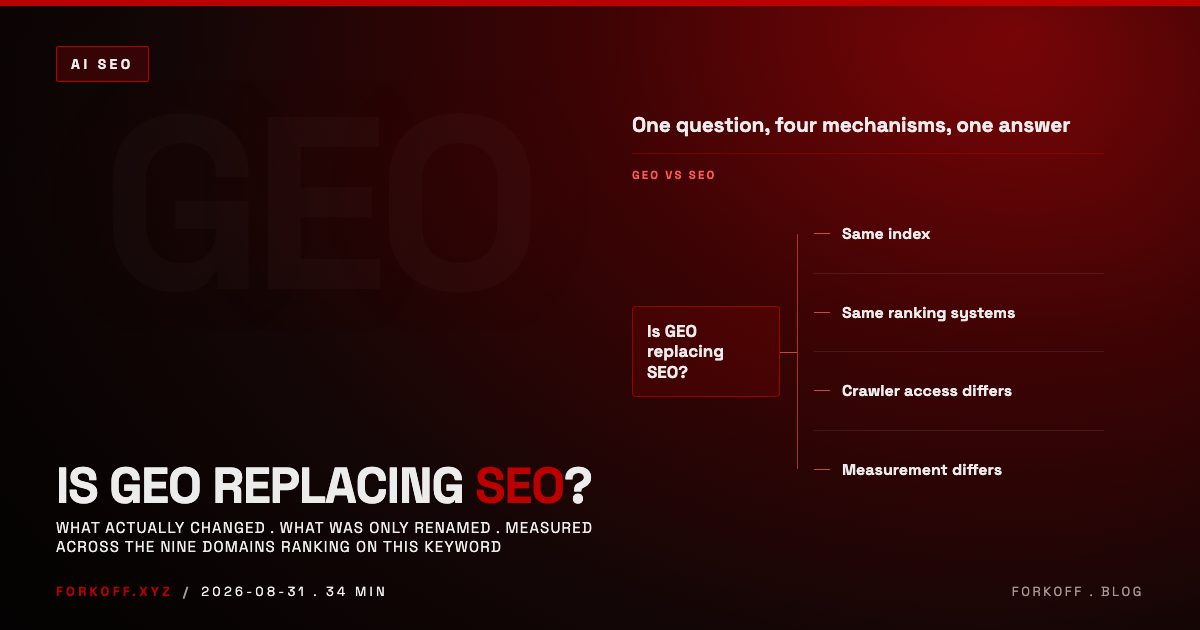
What is AEO and how does it differ from generic SEO?
AEO (Answer Engine Optimization) is the citation-engineering layer that decides which brands ChatGPT, Claude, Perplexity, and Bing Copilot cite in their structured-answer block. Where SEO competes for Google blue-link rank, AEO competes for the 4 to 8 brands an answer engine cites as recommended or alternative on a buyer comparison query. The two share infrastructure (clean schema helps both) but a brand can rank #1 on Google and stay invisible inside ChatGPT, Claude, Perplexity, or Bing Copilot at retrieval.
How do AEO, GEO, and LLM SEO fit together?
They are three facets of one AI-search engagement, not three separate retainers. AEO (answer engine optimization) is citation engineering: which brands ChatGPT, Claude, Perplexity, and Bing Copilot name in the structured-answer block. GEO (generative engine optimization) is synthesis-quality work: shaping the paragraph Google AI Overviews and Bing Copilot write mid-answer, through Wikidata entity grounding and original benchmarks. LLM SEO is corpus engineering upstream of both: building brand presence across the source surfaces models ground on, such as Wikipedia, Wikidata, GitHub, and arxiv, so the model knows the brand before it can cite it. FORKOFF runs all three in one outcome-priced engagement with a weekly citation proof. Perplexity SEO stays a distinct single-engine deep-dive when Perplexity dominates the buyer ICP.
What does a generative engine optimization (GEO) agency do?
A generative engine optimization agency shapes how AI Overviews, Bing Copilot, ChatGPT search, and Perplexity Pro describe your category inside the synthesized paragraph they write for a buyer, rather than competing for a blue-link rank. The work is entity grounding through Wikidata and Organization schema, publishing original benchmarks the engine can attribute to your brand, and distilling category-defining claims into subject-verb-object sentences an engine can lift mid-paragraph. FORKOFF delivers GEO as part of the same AI-search engagement as AEO and LLM SEO, measured on weekly paragraph-pickup (does brand-distilled language appear in the synthesized answer) across four generative surfaces, which conventional citation tracking misses on 50 to 70% of synthesis-stage exposure.
What do GEO services include?
GEO services (generative engine optimization services) include entity grounding through Wikidata and Organization schema, a schema graph audited against Google Rich Results, canonical answer blocks with answer-first openers, original data and benchmarks an engine can attribute to your brand, an llms.txt agent surface, and a weekly citation scan across ChatGPT, Perplexity, Bing Copilot, and Google AI Overviews. The target of GEO services is the synthesized paragraph and the cited list an engine writes for a buyer, not a blue-link rank. FORKOFF delivers GEO services inside the same engagement as AEO and LLM SEO, priced on outcomes with a weekly proof rather than hours logged.
What are AEO services and how do they differ from GEO services?
AEO services engineer the cited list an answer engine surfaces (which four to eight brands ChatGPT, Claude, Perplexity, and Bing Copilot name as recommended or alternative), while GEO services engineer the synthesized paragraph the engine writes mid-answer. AEO services and GEO services share infrastructure, clean schema, canonical Q&A, and an llms.txt surface, and FORKOFF runs both plus LLM SEO corpus grounding as one AI search engagement. You do not buy them as three separate retainers; the weekly citation proof covers all three surfaces at once.
What is an LLM SEO agency and why does the source corpus matter?
An LLM SEO agency engineers the corpus large language models ground on at training and retrieval time: Wikipedia, Wikidata, arxiv, GitHub, Stack Overflow, Reddit, Medium, dev.to, HackerNoon, Substack, and similar source surfaces. The corpus matters because a model cannot cite a brand it was never grounded on, so LLM SEO works upstream of both AEO citation and GEO synthesis. Without a Wikidata entity ID and diversified source presence, engines conflate the brand with adjacent competitors or paraphrase it out of the answer. FORKOFF tracks LLM SEO on a source-diversity score across roughly twelve corpus surfaces and runs it inside the one AI-search retainer so corpus grounding compounds with citation-position work.
What does the AEO sandbox audit cover?
Sandbox audit, 5 business days. 20 to 40 commercial query bench scanned across ChatGPT, Claude, Perplexity, and Bing Copilot. Citation count + position + context (recommended vs alternative vs absent) logged per query per engine. Schema graph audited against Google Rich Results + Bing structured data + Schema.org validators. llms.txt and agent-crawler audit. Position-lift forecast for the priority query set.
How fast does AEO produce citation lift?
30-day baseline citation lift for Stage 1 to Stage 2 brands (zero or near-zero starting citations) once answer-first rewrite + schema graph + llms.txt land. 60 to 90 days to engineer reliable structured-answer pickup on commercial queries. Position lift (alternative-to-recommended tier) takes 90 to 180 days because it requires authority work - Wikipedia, directory rank, social co-signal, original-data publication. Stage 5 (default-cited recommended on the priority query set) takes 6 to 12 months.
What is structured-answer position engineering?
Citation count alone misses 50%+ of pipeline impact. The structured-answer block surfaces 4 to 8 brands; buyers read the top 1 to 2 (recommended tier) and pick from those. Position 4 to 8 is alternative-tier visibility, which gets cited but rarely converts. Position-engineering stacks Wikipedia disambiguation, directory rank (G2, Capterra, Clutch), social co-signal (Hacker News, Reddit), and original-data publication that engines cite as primary source. Authority signals compound to lift position from alternative to recommended over 60 to 180 days.
Do model updates kill the work?
Updates shift patterns, not the work. GPT-4 Turbo to GPT-4o moved citation patterns roughly 20% across the FORKOFF roster, with one B2B SaaS brand recovering to prior position in 21 days after a re-engineered FAQ + comparison schema sweep. Anthropic Claude refresh in early 2026 was milder. The Monday scan flags drift inside a week and the re-engineering cycle ships inside 7 days. Built into the retainer cadence.
How do you measure AEO?
20 to 40 commercial queries × 4 answer engines × weekly Monday scan. Per-query: citation count, structured-answer position (recommended vs alternative vs absent), context (cited as best, cited as alternative, cited as competitor reference), and source-mix breakdown (which third-party domains cite the brand). Week-over-week delta math. Proof lands in founder inbox by Tuesday with operator signature. Quarterly scale call backed by per-query position trajectory.
Is AEO just adding prompts to my site?
No, and any agency selling that is selling snake oil. AEO is genuine schema engineering, canonical Q&A discipline, llms.txt curation, parasite-ladder authority work, and position-engineering through Wikipedia + directories + social co-signal + original data. Prompt-stuffing pages get filtered by safety classifiers and rarely surface at retrieval. The work compounds because it improves the canonical units the 4 answer engines actually retrieve and cite at structured-answer assembly time.
Can you guarantee #1 citation across all 4 engines?
No. Answer engines do not have a single rank. Citations vary by query, prompt, model, context window, and engine refresh cadence. FORKOFF commits to measurable citation lift on a defined 20 to 40 query set with weekly qualified-view proof and 90-day position-trajectory reporting. Any agency promising #1 is lying. The honest commitment is the bench, the lift trajectory across recommended vs alternative tiers, and the weekly report.
What does AEO cost?
Sandbox audit on entry, 5 business days. Retainer by application after the audit, 90-day minimum, capped at 5 engagements per quarter, scaleable up or down at quarter end. The one engagement covers all three facets: AEO citation work, GEO synthesis-quality work when the buyer journey runs through synthesized paragraphs, and LLM SEO corpus grounding when the brand is missing from Wikidata, GitHub, or arxiv. Pair it with a Perplexity SEO deep-dive if Perplexity dominates the buyer ICP.
How do I choose an AEO agency?
Start from the engines your buyers actually use, then judge an AEO agency on five things. One, does it run a real query bench (20 to 40 commercial queries scored across ChatGPT, Claude, Perplexity, and Bing Copilot) rather than a vibe check. Two, does it do genuine schema and canonical answer-block engineering, not prompt-stuffing. Three, does it report citation position (recommended vs alternative vs absent) every week, not just a citation count. Four, does it refuse to guarantee a number-one citation, because answer engines have no single rank. Five, does it show its own work with dated proof. An AEO agency that cannot answer those is selling SEO with a new label.
What should I look for when hiring an AEO agency?
Ask for a sample query bench and a real read on one of your own commercial queries. Ask which third-party sources it engineers (Wikipedia, G2, Capterra, Reddit, original data), because position lift is authority work, not on-page tricks. Ask how it handles a model update: a credible AEO agency flags citation drift inside a week and re-engineers inside seven days. Walk away from anyone promising guaranteed number-one placement or selling AEO as adding prompts to your pages.
How is an AEO agency different from a traditional SEO agency?
A traditional SEO agency competes for Google blue-link rank. An AEO agency competes for the four to eight brands an answer engine names in its structured-answer block when a buyer asks for a recommendation. The two share infrastructure (clean schema helps both), but the work diverges: an AEO agency engineers canonical answer blocks, llms.txt, citation position, and cross-engine coverage so ChatGPT, Claude, Perplexity, and Bing Copilot cite you, which a brand can lose even while ranking number one on Google.