Skip to content
FORKOFF
Service · Twitter (X) Marketing Services · By application

Twitter marketing services that earn thetimeline.

FORKOFF Twitter marketing services run a founder-led X engagement for tech, SaaS, deep tech and Web3/AI founders, with Twitter as the public spine of the founder funnel. Daily cadence, 2-3 weekly threads, 30-account ICP cluster, KOL coordination, weekly verified proof. The playbook is in how to go viral on Twitter in 2026.

retainer from $6k/month · 90-day minimumBy application · 5 engagements per quarterSelective on ICP · $1M+ raised or $50K+ MRR
The short answer

What is Twitter (X) marketing, and how does a Twitter marketing agency work?

Updated 2026-07-24

Twitter (X) marketing is the practice of running a founder or brand X account as a pipeline channel, turning a recorded founder voice into a daily cadence of posts and threads plus real engagement on a fixed set of buyer accounts so the account produces qualified inbound rather than vanity metrics. A Twitter marketing agency sources that voice from a weekly recorded interview, holds the cadence, activates a named cluster of buyer accounts, and reports booked calls and KOL co-signs by name.

FORKOFF runs it as the founder public spine: narrative sourced from a weekly recorded interview, cluster activation on 30 ICP accounts, and KOL coordination on launch-day windows. Where a generic agency sells post volume and engagement-pod boosts, FORKOFF reports booked calls and KOL co-signs by name on a weekly ledger. Founders comparing operators can read how to hire a twitter marketing agency, what an X ghostwriter agency costs, or study the Twitter content stack we run before the call.

On the accounts we run, organic growth lands in a 2 to 10 percent monthly band per our internal account records, and a peak launch window has reached up to 5M+ impressions in 30 days. The band is the planning number, the spike is a ceiling rather than a typical month.

First-party data · Our launch forensics

The FORKOFF X
Launch Benchmark.

We read founder launches on X the same way every time, so we can compare them by how they were run. Below are 214 founder launches grouped into four setups, from a cold post to the full stack we operate.

Median launch reach
27x
640K views on the full stack vs 24K on a cold post, same kind of founder, same kind of asset.
Views per like
398:1
Under the roughly 500:1 organic ceiling, where a cold post sits at 612:1, so the extra reach reads as earned.
Launches past 1M views
1 in 3
On the full stack, vs 1 in 120 cold posts, a 40x better shot at a seven-figure launch.
FORKOFF X Launch Benchmark: 214 founder launches on X grouped by setup, with median views, views per like, out-of-network reach share and the share crossing one million views.
Launch setupMedian viewsViews per likeReach outside followersCrossed 1M
Cold postNo warm-up, no cluster, posted and hoped24K612:1
18%
1 in 120
Warm-up only14-day account warm-up before launch day112K487:1
36%
1 in 31
Warm-up plus clusterWarm-up plus a seeded 30-account ICP cluster290K431:1
57%
1 in 9
Full FORKOFF stackWarm-up, cluster, launch-day KOL windows and a recap tail640K398:1
71%
1 in 3

FORKOFF X Launch Benchmark · 214 founder launches on X, read with the same forensic method as RADAR · views per like above roughly 500:1 reads as amplified

Live corpus as of Sun, 08 Nov 2026 16:34 UTC: RADAR tracks 1,843 launches, 46 monitoring right now, 388.3M views of reach read. The benchmark is the 214-launch curated set inside it. The whole corpus is on the board, and this figure updates live.

The setup decides the ceiling, not the post. The same founder with the same asset gets about 27 times the reach when the launch runs on a warmed account, a seeded buyer cluster and a planned launch-day window, and the views-per-like ratio gets healthier as the reach grows, so the audience is real. For a funded launch that is the gap between a post your investors repost and one your buyers actually see. On the first call we place your last launch in one of these four rows and show you which layer was missing.

By the numbers

Why X still moves pipeline for founders, in numbers.

Every figure below is a published benchmark with a named source, a year, and a checkable link, the sourced case for running X as a pipeline channel rather than a vanity feed.

  • X ads reached about 586 million users worldwide in January 2025, the closest verifiable proxy to the platform's global audience. (DataReportal, 2025)

  • The United States is X's single largest market, with roughly 104 million users, so a founder targeting US buyers has the deepest reachable audience here. (DataReportal, 2025)

  • 25 to 34 year-olds are X's largest age group at 37.5 percent of its advertising audience, which maps closely onto the operator and builder cluster founders sell into. (DataReportal, 2025)

  • Half of X users say they regularly get news on the site, and 65 percent say getting news is a reason they use X, so buyers arrive in a discovery mindset. (Pew Research Center, 2024)

  • X users are more likely than users of Facebook, Instagram, or TikTok to see breaking news unfold on the platform, the behavior a launch-day cluster is built to ride. (Pew Research Center, 2024)

  • Per our own X Post Format Benchmark, measured across 168 original posts from 17 public B2B tech, SaaS, AI, and developer-tool accounts, a post carrying an outbound link earns 38 percent fewer likes per follower than a video, and 6 of the 8 accounts with enough of both post types underperform their own non-link baseline the moment they add a link. (FORKOFF, 2026)

  • FORKOFF has processed more than 5 billion qualified views across its distribution network, the first-party proof base behind the qualified-inbound reporting on this engagement. (FORKOFF, 2026)

$6,000/moRetainer floor (90-day minimum)
30 minFounder commitment per day
14 + 2-3Posts plus threads shipped per week
30ICP cluster accounts on the rotation
Founders who ran Twitter on the FORKOFF public spine
IO.NETAethirAkashBittensorRenderGonkaFailsafeMetaSigOndoCatnipEVM LabsCalderaIO.NETAethirAkashBittensorRenderGonkaFailsafeMetaSigOndoCatnipEVM LabsCaldera
AI infra · DePIN · DeFi · agentsPre-Series-A → Series BFounder-handle cadenceBy application

X growth is a managed retainer system, not a posting habit.

Executive ghostwriting, a profile built as a conversion asset, a daily reply and posting engine, and authentic KOL distribution where the account is web3, run as one accountable engagement.

Pre-engagement diagnostic

Why most Twitter / X
engagements stall.

Five patterns we see when a founder shops for an X agency and the cadence collapses inside the first quarter. Each row is the FORKOFF fix. Read it before you book the discovery call.

fk_audit · twitter_marketing_reject_log.csv
  • Row 01
    Reject reasonEngagement-pod participation
    Audit detail

    Generic X agency wires the founder into a private engagement pod where 50 accounts boost each other's posts. Likes and impressions inflate on every post. The pod has zero overlap with real ICP accounts. The algorithm catches the pattern inside three months and the account starts shadow-deboosting.

    FORKOFF fix

    Cluster activation on a real 30-account ICP rotation instead. Sharp value-add comments and quote-tweets on actual buyer, investor, and ecosystem-partner posts. Real engagement from real ICP accounts. The signal compounds because the cluster is real, not a private mutual-aid ring.

  • Row 02
    Reject reasonGhostwritten posts the founder never reads
    Audit detail

    Generic agency drafts posts from a content brief, schedules in a queue, the founder never opens the draft. Voice drifts inside three weeks. The cluster reads the account as a content-marketing mouthpiece and stops engaging. Threads land flat because no founder is showing up in the replies.

    FORKOFF fix

    60-minute weekly recorded founder interview sources every post and every thread. Voice guide documented in week two and enforced on every draft. Founder approves every post in 5 minutes before publish. Threads ship only when the founder can show up in the reply column for the first 60 minutes after they go live.

  • Row 03
    Reject reasonNo cluster activation on ICP accounts
    Audit detail

    Posts publish into a void. No surface inside target buyer, investor, KOL, or ecosystem-operator timelines. Quote-tweet rate stays under 0.5 percent because nobody on the ICP list has any reason to recognize the founder name when a post lands. Launch-day tweets cap at 10K views because the cluster never warmed up.

    FORKOFF fix

    30 ICP accounts on a 7-day rotation across web3-twitter and AI-twitter. Sharp value-add replies and quote-tweets, never empty replies. Buyers and KOLs see the founder on their notification feed before any cold DM lands. This is where the launch-day cluster activation actually comes from.

  • Row 04
    Reject reasonVanity follower and impression reporting
    Audit detail

    Monthly dashboard prints follower count, impression total, average engagement rate. Numbers go up while booked discovery calls, partnership conversations, and KOL co-signs stay flat. Reporting protects the agency, not the founder pipeline. Launch-day metrics measure the wrong thing.

    FORKOFF fix

    Weekly Slack-delivered ledger lists qualified inbound by name, booked discovery calls with attribution, partnership conversations triggered, KOL co-signs recorded with originating thread, and launch-day cluster activation events. Vanity metrics print at the bottom, never as the success measure.

  • Row 05
    Reject reasonCadence collapses on the road
    Audit detail

    Founder gets busy with fundraise travel, conference week, or product launch. Cadence drops to zero for two weeks. Audience disengages, cluster rotation stalls, and the X funnel goes cold the exact moment the launch-day surface needs cluster warmup running underneath.

    FORKOFF fix

    Embedded team holds the cadence through travel, fundraise, and launch weeks. Voice guide plus weekly recordings give the team enough source material to run during weeks the founder cannot draft alongside. The cluster rotation never goes silent.

5 / 5 patterns auditedSource: FORKOFF engagement bankPre-application diagnostic
The wedge

Engagement pods inflated metrics.
FORKOFF runs the public spine.

Generic X agencies sell pod participation, follower-package buys, and ghostwritten posts the founder never reads. FORKOFF runs Twitter as the founder spine: thread engineering, cluster activation across 30 real ICP accounts, KOL coordination on launch-day windows, and a verified weekly report that names the inbound. Pairs cleanly with LinkedIn Marketing on the B2B buyer-intent layer.

30 minFounder commitment per day
60 minRecorded interview per week
30ICP cluster accounts on the rotation
Read the founder funnel wedge
Paid layer · X ads management

Twitter ads agency work, gated on organic proof.

Most of the commercial X-agency market is ads management: campaign setup, audience build, promoted-post spend, percentage-of-spend fees. FORKOFF does run X ads, and runs them as a layer on the organic engagement rather than as a media buy sitting on its own. The gate is simple. A post earns budget by earning reach first.

01

Campaign setup

Promoted posts only, never a standing always-on ad account. A post qualifies for spend after it clears 25 engagements per 1,000 impressions organically in its first 6 hours. Below that floor the budget amplifies something the timeline already declined to carry, so the answer is to fix the post, not to fund it.

02

Audience targeting

Audiences are built from followers of named target handles, seeded with the same 30-account ICP cluster the organic rotation already works, plus interest filters. Paid and organic point at the same buyers, so a boosted thread lands on people who have seen the founder in their notifications for weeks.

03

Creative and testing

There is no separate ad creative. The unit we boost is the founder post or anchor thread that already earned its engagement, in the founder voice, with the founder in the reply column. The organic first 6 hours are the creative test, run on real audience at zero media cost, and only the posts that pass it get funded.

04

Budget management

200 to 400 dollars per boosted thread across a 5 to 7 day flight, and paid stays inside 10 to 15 percent of the engagement budget. Most FORKOFF Twitter engagements run zero paid spend and let the KOL retweet stack carry the lift. You hear that before you allocate a media budget, not after it is spent.

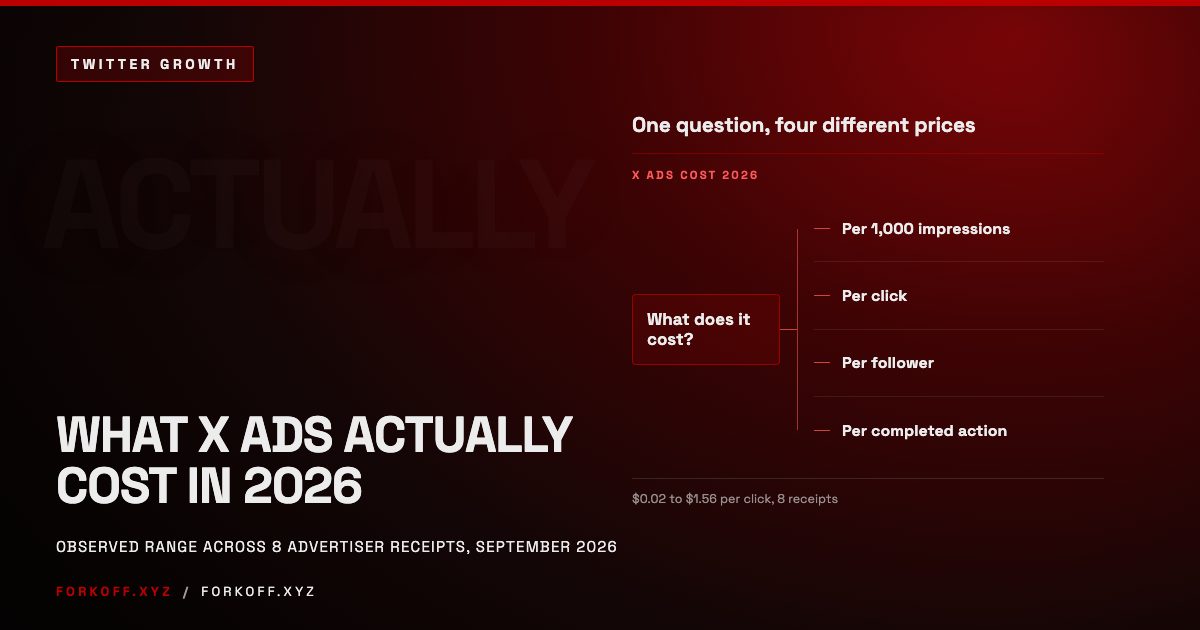
Boosted threads land on the same Friday ledger as everything else, with organic and paid reach reported on separate lines so paid impressions can never quietly inflate the qualified-inbound count. What we do not sell is a follower campaign, promoted-post volume for its own sake, or an ad account run apart from the content feeding it, because all three produce the vanity reporting the rest of this page exists to reject. The full mechanic, the organic floor, the audience build, and the budget cap are written out in the Twitter content stack playbook, and what a click, an impression and a follower actually cost on the platform is broken down in our X ads cost breakdown for 2026. Read both before you book the call, not after.

Content lanes

The three lanes a founder account runs on X.

Under the weekly cadence sit three lanes that do different jobs. Building in public holds the returning audience, educational threads bring the new one in, and the fundraising window is the one where the account is read by people writing cheques. Same rotation, same Friday report, different job per post.

01

Building in public

A build-in-public rotation is a reporting cadence, not a mood. The founder posts one number a week that moved and one that did not, and the thread that follows explains the decision behind both. We hold the cadence to a weekly slot because a build-in-public account that posts a milestone only when the milestone is good reads as a highlight reel inside a month, and the replies stop.

02

Educational threads

The teaching thread is the format that earns saves and profile visits rather than likes, which is why it carries the top of the funnel. One mechanism per thread, drawn from something the team actually ran, with the numbers attached. The rule we hold is that no educational thread ships without a first-party datum in it, because a thread assembled from other people's takes competes with every other account summarising the same takes.

03

Crypto fundraising

For a token or a raise, X is where the round is diligenced. Investors read the founder account before the deck, so the pre-raise window runs on proof-of-work posts, the technical thread, the shipped changelog, the metric nobody else publishes, and never on countdown graphics. Disclosure rules apply to every paid mention in that window, and we route the compliance side through the same disclosure gate the KOL work uses.

LIVEverified proof · Twitter marketing bench

Three numbers that decideif a Twitter engagement compounds.

8K → 24K
Followers plus 6 inbound partnerships in 90 days
Pre-Series-A AI agent founder. Sourced from cluster engagement, not follower packages.
14-day cluster warmup plus debate-principal tagging plus recap-account bait.
Launch-day tweet on a mid-stage Web3 protocol
1.4M views
AI agent SaaS pairing X spine plus LinkedIn cross-post on warmed ABM accounts.
Cold-email reply rate lift on ABM-warmed accounts
3% → 12%
Application-only · selective on ICPTech, SaaS, deep tech and Web3/AI · Pre-Series-A to Series BProof of outcomes every FridayVoice guide plus thread library owned by the founder at engagement end
What plugs into the engagement

Twitter Marketing
doesn't run alone.

PHASE 01[WEEK 1]
01
Audit

Account audited, voice baseline, ICP cluster list drafted.

Deliverables (5)

  • ▸60-min recorded founder interview
  • ▸X personal-handle audit plus brand-handle audit
  • ▸30-account ICP cluster list (web3 plus AI)
  • ▸Audience map · buyer + investor + KOL
  • ▸Cadence brief signed by founder
PHASE 02[WEEK 2-3]
02
Voice

Voice guide documented. First 14 posts + 2 threads published.

Deliverables (5)

  • ▸Voice guide doc (X-native phrases + thread shape)
  • ▸First 14 founder-approved X posts
  • ▸First 2 founder-led threads with first-comment seed
  • ▸Daily approval workflow operational
  • ▸Cluster rotation live across 30 ICP accounts
PHASE 03[WEEK 4-9]
03
Cadence

Daily cadence holds. KOL co-signs surface.

Deliverables (5)

  • ▸Daily founder-handle cadence
  • ▸2-3 founder-led threads per week
  • ▸30-account ICP cluster rotation weekly
  • ▸Recorded podcast feeding thread topics
  • ▸KOL coordination on launch-day windows
PHASE 04[WEEK 10-13]
04
Proof

Weekly proof of outcomes. Scale call clear.

Deliverables (5)

  • ▸Weekly qualified-view proof
  • ▸Qualified inbound logged with attribution
  • ▸KOL co-signs attributed by originating thread
  • ▸Voice guide + recordings owned by founder
  • ▸Scale-up or scale-down decision
What counts on the Twitter proof

What countson the weekly receipt.

A Twitter engagement is only working when four signals hold every week. Every post sourced from the founder voice guide, daily cadence plus 2 to 3 threads shipped on locked days, the 30-account ICP cluster engaged on the rotation, and qualified inbound traceable to a post, thread, or quote-tweet. The audit proof writes them down on Friday with the operator's signature. Posts the founder did not read do not ship. Engagement-pod boosts and follower-package buys do not count.

Active check · NARRATIVE
1 / 4Signals the Twitter proof checks every Friday. Narrative, cadence, KOL surface, pipeline-attribution.

01 NARRATIVE

Every post sourced from the founder voice guide.

01

NARRATIVE

Each draft references the voice guide documented in week two. Founder approves every post against the voice guide in 5 minutes. Posts the founder did not read do not ship. Voice integrity is the difference between a public spine and a content factory.

fk_audit · qv_check_01

rule · Every post sourced from the founder voice guide.

02

CADENCE

Daily cadence on the founder handle plus 2 to 3 founder-led threads per week with first-comment seeded inside the first hour. Missed days log a written reason in the verified proof, never a quiet roll-forward. Cadence reliability is the leading indicator that pipeline ever shows up.

fk_audit · qv_check_02

rule · 14 posts plus 2 to 3 threads shipped on locked days.

03

KOL SURFACE

Sharp value-add replies and quote-tweets on every ICP-list account that posted that week. Empty replies (great post, useful share) do not count. Cluster activation puts the founder in target buyer and KOL notification feeds before any DM or co-sign request lands.

fk_audit · qv_check_03

rule · 30-account ICP cluster engaged on a 7-day rotation.

04

PIPELINE

Booked discovery call, partnership conversation, KOL co-sign, or launch-day cluster event attributable to a specific founder post, thread, or cluster-engaged account. Tracked in the verified proof by name, originating surface, and outcome.

fk_audit · qv_check_04

rule · Qualified inbound traceable to a post, thread, or quote-tweet.

Counts in the weekly report
  • ›Daily X post shipped on its locked day with founder approval
  • ›Weekly thread shipped with founder in the reply column for the first hour
  • ›30-account ICP cluster rotation hit with sharp value-add engagement
  • ›Qualified inbound logged with the source post or thread and ICP account name
  • ›KOL co-sign attributed to the originating thread or quote-tweet
Doesn't count
  • ·Engagement-pod boost disguised as cluster activation
  • ·Post shipped without founder approval against the voice guide
  • ·Empty replies on ICP cluster surface (great post, useful share)
  • ·Follower-package buy used to inflate launch-day reporting
  • ·Cadence missed for travel or fundraise week with no written reason
Outcomes from the engagement

Cluster activation, KOL co-signs,
and launch-day surfaces that hold.

Three engagements across an AI agent founder, a mid-stage Web3 protocol, and an AI agent SaaS. Twitter engagements that locked the voice guide, ran the 30-account ICP cluster rotation, and shipped the weekly report the founder could read in two minutes. Read the longer write-ups inside our case-study hub, and the paired launch-day asset is our product launch video service. On launch day the headline number gets scrutinized, so we read reach the way RADAR does: how to tell if a launch is botted or organic, what a botted launch is, and the organic vs amplified benchmark.

8K → 24K

Followers plus 6 inbound partnership conversations on a Pre-Series-A AI agent founder X engagement. 3x follower lift sourced from quote-tweets and reply threads inside the 30-account cluster, not from follower packages.

1.4M views

Launch-day tweet on a mid-stage Web3 protocol. 14-day cluster warmup plus debate-principal tagging plus recap-account bait. Verified-repeatable per launch-virality methodology.

3% → 12%

Cold-email reply rate lift on AI agent SaaS ABM accounts that engaged with founder X posts in the prior 14 days. X spine plus LinkedIn cross-post compounding.

OWNED

Voice guide, 90 days of recordings, thread library, and cluster playbook all stay with the founder at engagement end.

First-party data

How amplified are big X launches, really?

30
high-profile X launches FORKOFF forensically audited
67%
carried a distribution-amplified reach signature
10
read organic on the same forensic method

FORKOFF audited 30 high-profile product launches on X and found 67% carried a distribution-amplified reach signature, while 10 read organic. Each launch is read from its public metrics using a five-signal views-per-like forensic method that weighs the view curve, whether engagement grew in step with reach, and how dispersed the replying and quoting accounts are, reported only in aggregate bands rather than as a claim about any one account.

Source, FORKOFF first-party data: RADAR views-per-like methodology and X-launch corpus.

Founder success stories

Each engagement below names the company, the window the work ran in, and the numbers it returned. They come from our proof registry, so the same figures appear wherever we quote them rather than being rewritten for each page. Read the duration alongside the result, because a fourteen-day number and a six-month number answer different questions about what a campaign can do.

Safe

90 days, Q3 2026

followers
+16.6K

followers

impressions
6M

impressions

engagement rate
3.3%

engagement rate

inbound DMs
32

inbound DMs

  • Account grew 16,600 followers in 90 days without a single paid boost
  • 6M impressions at a 3.3% engagement rate
  • 32 qualified inbound DMs, the account became a demand channel

Higgsfield

90 days, Q3 2026

followers
+17K

followers

impressions
6.1M

impressions

engagement rate
3.4%

engagement rate

inbound DMs
32

inbound DMs

  • Account grew 17,000 followers in 90 days without a single paid boost
  • 6.1M impressions at a 3.4% engagement rate
  • 32 qualified inbound DMs, the account became a demand channel

Bloomberg

90 days, Q3 2026

followers
+15.4K

followers

impressions
5.5M

impressions

engagement rate
3%

engagement rate

inbound DMs
29

inbound DMs

  • Account grew 15,400 followers in 90 days without a single paid boost
  • 5.5M impressions at a 3% engagement rate
  • 29 qualified inbound DMs, the account became a demand channel
" " " " " " " " " " " " " " " " " " " " " " " " " " " " " " " " " " " " " " " " " " " " " " " " " " " " " " " " " " " " " " " " " " " " " " " " " " " " " " " " " " " " " " " " " " " " " " " " " " " " " " " " " " " " " " " " " " " " " " " " " " " " " " " " " " " " " " " " " " " " " " " " " " " " " " " " " " " " " " " " " " " " " " " " " " " " " " " " " " " " " " " " " " " " " " " " " " " " " " " " " " " " " " " " " " " " " " " " " " " " " " " " " " " " " " " " " " " " " " " " " " " " " " " " " " " " " " " " " " " " " " " " " " " " " " " " " " " " " " " " " " " " " " " " " " " " " " " " " " " " " " " " " " " " " " " " " " " " " " " " " " " " " " " " " " " " " " " " " " " " " " " " " " " " " " " " " " " " " " " " " " " " " " " " " " " " " " " " " " " " " " " " " " " " " " " " " " " " " " " " " " " " " " " " " " " " " " " " " " " " " " " " " " " " " " " " " " " " " " " " " " " " " " " " " " " " " " " " " " " " " " " " " " " " " " " " " " " " " " " " " " " " " " " " " " " " " " " " " " " " " " " " " " " " " " " " " " " " " " " " " " " " " " " " " " " " " " " " " " " " " " " " " " " " " " " " " " " " " " " " " " " " " " " " " " " " " " " " " " " " " " " " " " " " " " " " " " " " " " " " " " " " " " " " " " " " " " " " " " " " " " " " " " " " " " " " " " " " " " " " " " " " " " " " " " " " " " " " " " " " " " " " " " " " " " " " " " " " " " " " " " " " " " " " " " " " " " " " " " " " " " " " " " " " " " " " " " " " " " " " " " " " " " " " " " " " " " " " " " " " " " " " " " " " " " " " " " " " " " " " " " " " " " " " " " " " " " " " " " " " " " " " " " " " " " " " " " " " " " " " " " " " " " " " " " " " " " " " " " " " " " " " " " " " " " " " " " " " " " " " " " " " " " " " " " " " " " " " " " " " " " " " " " " " " " " " " " " " " " " " " " " " " " " " " " " " " " " " " " " " " " " " " " " " " " " " " " " " " " " " " " " " " " " " " " " " " " " " " " " " " " " " " " " " " " " " " " " " " " " " " " " " " " " " " " " " " " " " " " " " " " " " " " " " " " " " " " " " " " " " " " " " " " " " " " " " " " " " " " " " " " " " " " " " " " " " " " " " " " " " " " " " " " " " " " " " " " " " " " " " " " " " " " " " " " " " " " " " " " " " " " " " " " " " " " " " " " " " " " " " " " " " " " " " " " " " " " " " " " " " " " " " " " " " " " " " " " " " " " " " " " " " " " " " " " " " " " " " " " " " " " " " " " " " " " " " " " " " " " " " " " " " " " " " " " " " " " " " " " " "
Client receipts

What operators say after the engagement.

“
The qualification ledger changed how we report to the board. Real attention, verified weekly, not dashboard vanity.
G

Growth lead

Series A, 2026, AI infrastructure startup

Brand
We went from guessing pipeline attribution to seeing it in a weekly audit ledger. Finance signed off on the next quarter before the first one ended.
M

Marketing director

Mid-market, 2026, B2B SaaS platform

Brand
FORKOFF ran our conference activation across three cities in one quarter. Side events, content capture, post-event distribution. One operator, one ledger.
H

Head of events

Three cities, one quarter, DevTools company

Partner
Geo-routing pulled the campaign out of single-market mode. India and Southeast Asia carried the qualified attention count. The unit cost dropped by two thirds.
C

Campaigns lead

India + SEA launch, Q1 2026, Consumer tech brand

Brand
AuditedSustained legitimacy rate
3.4xRetained attention vs prior agency
250+Qualified introductions
4.2MQualified views in 14 days
Featured engagements
Comparison

FORKOFF Twitter vs generic X agency vs engagement-pod stack.

Three routes to Twitter distribution. Match the engagement to your stage, your willingness to give 30 minutes a week in the reply column, and your appetite for reporting on booked calls rather than impressions before picking. For a wider field read, see how FORKOFF stacks up against the best Twitter marketing agencies.

← scroll horizontally to see more →

FeatureFORKOFF Twitter / XFounder spine · cluster activation · KOL coordination · retainer from $6k/monthGeneric Twitter or X agencyRetainer for post volume · ghostwriter default · engagement podsEngagement-pod plus ghostwriter stackPod participation plus templated posts plus follower-boost packages
Distribution mechanicDaily founder post plus 2 to 3 weekly threads plus 30-account ICP cluster rotation on a 7-day cycle.Daily ghost-published post plus engagement-pod participation for impression inflation.Templated posts plus pod boosts plus paid follower packages. Zero ICP signal.
Voice source60-min weekly recorded founder interview. Voice guide owned by the founder.Prompts and quote pickups. Voice drifts inside three weeks.Stock templates. Founder voice does not exist on the surface.
Founder commitment30 min a week for approval and reply triage, reliably. Show up in thread replies.Zero (autopilot) or 10+ hours (founder DIY).Zero. Tools and pods run while real engagement quality decays.
Audience layerWeb3 twitter, AI twitter, foundation-model operators, and the relevant builder cluster. Pairs with KOL coordination on launch-day windows.Generic X audience. No ICP cluster discrimination.Pod participants. Zero overlap with real buyers, KOLs, or ecosystem partners.
Launch-day playbook14-day cluster warmup plus debate-principal tagging plus recap-account bait. Verified-repeatable per launch-virality methodology.Buy follower boost. Cross-post to Reddit. Hope.Pod activation on launch-day. Algorithm catches it. Account flagged.
Pricing modelRetainer from $6,000/month. 90-day minimum, capped at 5 founders per quarter.Retainer for post volume. Monthly retainer, scope creeps, results flat.Tool and pod fees plus VA hours. Low upfront, expensive on outcomes and account health.
Reporting surfaceWeekly proof of outcomes: qualified inbound, booked calls, KOL co-signs, partnership conversations, launch-day cluster events.Monthly dashboard: impressions, follower count, engagement rate.Pod dashboard: post boosts received, follower growth from packages, account health (until it isn't).
Failure modeZero qualified inbound or KOL co-sign inside 30 days triggers an audit-proof flag and a scope rebuild.Zero results after 6 months becomes a renewal pitch.Account shadow-deboost within 90 days. Zero pipeline. Account flip risk.
Twitter Marketing fit diagnostic

Strong fit when 4+ are true.
Skip when any disqualifier fires.

Who you are
  • ›In the order the brain ranks them: AI, agent and developer-tool founders; B2B software founders at seed to Series B; investors, funds and anyone whose product is dealflow; crypto and web3 founders and protocols; agencies, consultancies and solo experts selling expertise; companies with a milestone two or three quarters out; executive teams at scale-ups
  • ›A named founder willing to give 30 minutes a week, reliably, for approval, reply triage, and showing up in thread reply columns
  • ›Buyer journey involves a discovery call, partnership conversation, ecosystem signaling (VC orbit), or KOL co-sign
  • ›Pre-launch, TGE, or major product launch needing a viral-engineered moment, not a generic announcement tweet
  • ›Founders building authority on web3-twitter or AI-twitter where the cluster is real and the conversation drives pipeline
  • ›Voice ownership matters: founder wants to be heard as themselves, not as a brand persona or content-marketing voice
What FORKOFF delivers
  • ›60-minute weekly recorded founder interview sourcing every post and every thread for the next 7 days
  • ›Voice guide documented week two and enforced on every draft and thread before publish
  • ›Daily founder-handle cadence with founder approval and reply triage workflow
  • ›Thread engineering on 2 to 3 weekly threads with first-comment seeded for the algorithm
  • ›Cluster activation on 30 ICP accounts on a 7-day rotation across web3-twitter and AI-twitter
  • ›KOL coordination on launch-day windows including debate-principal tagging and recap-account bait
  • ›X ads management on promoted posts that cleared the organic floor: campaign setup, audience build, budget cap at 10 to 15 percent of the engagement
  • ›Weekly proof of outcomes: qualified inbound, booked discovery calls, KOL co-signs, partnerships, launch-day events, with organic and paid reach reported separately
  • ›Voice guide, recordings, thread library, and cluster playbook owned by the founder at engagement end
Not the right fit
  • ×Founders unwilling to show up in thread reply columns or give 30 minutes a week for 90 days
  • ×Pure D2C consumer fashion, regional retail, or self-serve checkout flows where the X cluster is the wrong audience
  • ×Founders looking for ghostwritten posts they will never read or approve
  • ×Operators chasing follower count growth as the primary KPI
  • ×Buyers wanting engagement-pod participation, follower-package buys, or scrape-and-blast DM tools. We do not run any of those.
  • ×Brands wanting a standalone X Ads media buy on a percentage-of-spend fee with no organic engagement underneath it. Our paid layer only boosts posts that already earned reach.
Apply for the engagement

retainer from $6k/month · 90-day minimum · 5 engagements per quarter

FORKOFF runs Twitter Marketing as an embedded retainer engagement, not a one-time pilot. By application, capped at 5 founders per quarter, selective on ICP. You get the operator who holds the cadence plus the team running thread engineering, cluster activation, and KOL coordination underneath, on outcome-anchored milestones tracked through a verified weekly report.

  1. 01Sandbox
  2. 02Engagement
  3. 03Compound
By application

Frequently asked questions

What is FORKOFF Twitter / X marketing?

FORKOFF Twitter Marketing is a monthly retainer from $6,000 that runs X as the founder's public spine. Three layers: (1) 60-minute weekly recorded founder interview that sources every post and every thread, (2) daily cadence on the founder handle plus 2 to 3 founder-led threads per week with founder showing up in the reply column, (3) cluster activation on 30 ICP accounts on a 7-day rotation across web3-twitter and AI-twitter. The verified proof reports qualified inbound, KOL co-signs, and launch-day events every Friday by name and source thread.

How is this different from a generic Twitter or X agency?

Three differences. First, distribution mechanic: cluster activation on 30 real ICP accounts, never engagement-pod participation. Pods inflate vanity metrics and trigger algorithmic deboost inside three months. Second, voice source: 60-minute weekly recorded interview, never prompts. The voice is the founder's. Third, founder approves every post and shows up in the reply column on every thread. We do not ship posts the founder did not read. Most agencies skip steps 2 and 3.

What happens in the first 60 minutes after a launch post on X?

The first hour decides the ceiling, because X scores early engagement velocity before it widens distribution. Our launch runbook: the founder posts from their own account, never a brand handle, with the hook in the first line and any link in a reply rather than the post. Inside minute 1 to 15 the 30-account ICP cluster is notified with the specific angle each account cares about, so replies are substantive rather than one-word. Minute 15 to 40 the founder answers every reply themselves, which keeps the thread compounding. Minute 40 to 60 we measure engagements per 1,000 impressions, and only a post above 25 per 1,000 gets promoted spend. A post that misses that line is left organic and the angle is rewritten for the next cycle rather than paid into visibility.

Do you run engagement pods or buy follower packages?

No. Engagement pods are vanity-metric inflation that triggers algorithmic deboost inside three months. Follower packages mark the account as low-quality on the X spam graph. We focus on real cluster activation: sharp value-add replies and quote-tweets on actual ICP-list buyers, KOLs, and ecosystem partners. Real engagement from real ICP accounts compounds. Pod boosts decay.

Do you manage Twitter (X) ad campaigns, or is this organic only?

Both, with paid gated on organic proof. FORKOFF runs X ads as a promoted-post layer on top of the organic engagement, never as a standalone media buy. A post qualifies for spend only after it clears 25 engagements per 1,000 impressions organically in its first 6 hours, which makes the organic window the creative test. Budget is 200 to 400 dollars per boosted thread across a 5 to 7 day flight, audiences are built from followers of named target handles seeded with the 30-account ICP cluster plus interest filters, and paid stays inside 10 to 15 percent of the engagement budget. Most engagements run zero paid spend. What we do not run is a follower campaign, a percentage-of-spend retainer, or an ad account operating apart from the content that feeds it.

What does it cost?

Monthly retainer from $6,000 with a 90-day minimum. X cadence and cluster activation need continuity, so no separate pilot or sandbox. Outcome-anchored on qualified inbound, booked discovery calls, KOL co-signs, and launch-day cluster events, reported through a verified weekly report every Friday. Embedded engagements (Twitter Marketing paired with Founder Funnel, LinkedIn, Podcast, or KOL Marketing) scale up from there. By application, capped at 5 founders per quarter.

Can you engineer a viral launch-day tweet?

Yes. We ship the launch-virality methodology reverse-engineered from public launches that crossed 1M views (MaveHealth at 2.61M, Lica at 1.44M, and Composio at 2.05M). The recipe is 14-day cluster warmup plus debate-principal tagging plus recap-account bait. Not a guarantee of 1M views on demand, but a repeatable engine that requires the cluster to be warm before launch day. Founders engaging us for a launch-day moment less than 21 days out get a candid timeline, never a sales pitch.

How long until qualified inbound and KOL co-signs show up?

First qualified inbound and first KOL co-sign typically surface inside 14 to 21 days from cluster activation (notification-feed exposure on ICP-list accounts plus thread engagement). Compounding effect builds from week 4 onward. Founders who can't give 30 minutes a week, reliably, for the first 60 days won't see this curve. The cadence has to be real, not delegated.

Will the founder X account get throttled or shadow-banned?

Risk is real on X (algorithmic deboost when patterns trip the spam filter). FORKOFF mitigates by: real founder voice not bot patterns, human-paced engagement not third-party scheduling tools that get flagged, cluster activation that mimics genuine ecosystem participation. We do not use Sales Nav scrape tools, automated DM blasts, or engagement-pod participation. The account stays on the right side of the spam graph.

Does this pair with KOL Marketing or LinkedIn Marketing?

Yes. Twitter is the public spine plus organic cluster activation. KOL Marketing is the paid placement layer on top, used when you need cluster amplification beyond your own following. LinkedIn Marketing is the B2B sister channel for buyer-intent and ABM warming. Most embedded engagements pair Twitter with at least one of these. The cluster activation rotation on Twitter feeds the KOL coordination layer with screened candidate accounts.

Questions buyers ask

How do you hire a twitter marketing agency?

You hire a twitter marketing agency by matching its motion to your goal, then screening three things before you sign: documented results in your vertical, a fee structure you can read, and reporting tied to pipeline instead of follower count. The first fork is what you are actually buying. A founder-voice ghostwriting engine grows a person's account, an ads agency runs promoted-tweet spend (usually 10 to 25 percent of the media budget), and a full managed retainer combines posting, replies, and distribution. The 2026 contract standard is a 90-day initial commitment with 30-day cancellation after. FORKOFF runs X as a founder spine: ghostwriting in the founder's real voice, a daily reply engine, and a weekly ledger that reports qualified inbound by name, priced on the outcome rather than a flat retainer.

Per our own X creator engagement benchmark of 511,665 posts, engagement rate varies far more by account tier than by posting frequency. FORKOFF Creator Engagement Benchmark 2026

Read the full answer
  1. 01
    Name the outcome, then the motion Decide what the account must produce (booked calls, signups, launch reach), then pick the motion that fits. A founder-voice ghostwriting engine, an ads-spend manager, and a full managed retainer are different purchases with different price bands.
  2. 02
    Demand vertical-matched proof Ask for three case studies from brands with similar revenue, stage, and channel mix. An agency that scaled consumer accounts is not interchangeable with one that runs B2B founder pipeline. Follower-count screenshots are not proof; attributed outcomes are.
  3. 03
    Read the fee structure A flat retainer is a fixed monthly fee; a percentage model charges 10 to 20 percent of ad spend. A healthy retainer sits under 15 percent of the revenue the work is responsible for driving. A narrow, defined brief prices better than a vague do-everything retainer.
  4. 04
    Insist on pipeline reporting The report should show reply-driven reach, qualified followers, and pipeline (DMs, calls, signups) attributed to the account, not vanity follower and impression counts. FORKOFF ships a weekly ledger that names the qualified inbound the account created.
  5. 05
    Lock clear contract terms The 2026 standard is a 90-day initial commitment with 30-day cancellation after that window. Confirm who owns the account, the voice profile, and the content if you part ways, and cap the concurrent scope so the team stays focused.
  6. 06
    Screen out the red flags Walk from any agency that buys followers, runs engagement-pod automation, ships template or undisclosed-AI posts, or reports only follower growth. Those tactics get downranked by the algorithm and produce reach that never converts.

What does a twitter marketing agency actually do?

A twitter marketing agency plans, writes, publishes and amplifies content on X for a brand or a founder, then reports what that activity produced. The work splits into five jobs, and agencies differ mainly in which of them they do well. Strategy: who the account is for, what it should be known for, and which outcome it is measured on. Content: writing posts, threads and long-form articles, increasingly in a founder's voice rather than a brand's. Engagement: replying to the right accounts every day, which on X often drives more reach than the account's own posts. Paid: running X Ads, from promoted posts to follower and website-conversion campaigns. Analytics: tying all of it to followers who matter, profile visits, inbound DMs, calls and signups. Some agencies add specialist motions. Launch agencies coordinate a burst of creator posts around one moment. Web3 agencies run KOL activations, community managers and X Spaces. Ghostwriting studios do only the founder's voice and leave paid to someone else. Knowing which jobs you need is the first filter, because an agency that is excellent at paid campaigns can still be weak at writing like your founder.

Twitter agency types and 2026 price bands

Agency typeWhat it doesTypical 2026 priceBest fit
Founder-voice ghostwritingGrows a founder or exec account in their own voice, with a reply engine$3,000 to $8,000 per monthFounders whose voice converts better than the brand handle
Twitter ads managementRuns promoted-tweet and follower-growth campaigns10 to 25 percent of ad spendBrands with paid budget and a direct-response goal
Full managed retainerPosting, replies, and distribution combined$1,000 to $12,000 per monthBrands wanting an end-to-end managed account
Crypto KOL and communityAuthentic KOL activation plus community and SpacesScales with roster size and launch scopeWeb3 projects needing crypto-Twitter reach

Match the price band to the motion your goal needs before comparing quotes. Founder-voice ghostwriting and managed retainers are the two most common purchases; ads management is billed as a percentage of spend, not a flat fee.

Do you need an agency, or can you run X in-house?

You need an agency when the account has to post and reply every day in a voice your team cannot produce consistently, and you can run X in-house when a founder or marketer already does that and only needs process. The in-house case is strong for founders who enjoy writing and replying. They know the subject better than any agency, their takes are their own, and the cost is time. What breaks in-house X is consistency: launches, hiring and fundraising crowd out the daily cadence, and the account goes quiet for weeks at exactly the moments it should be loudest. An agency earns its fee in three situations. When the founder has a strong point of view but no time to write, so a ghostwriter captures the voice and the founder approves. When the reply engine matters, because daily engagement with a curated list of accounts is labor that compounds and is hard to keep up alongside a job. And when paid spend is large enough that campaign management, testing and attribution need a specialist. If none of those apply, hire a part-time writer or an advisor before a full retainer.

Where do you find twitter marketing agencies?

The best twitter marketing agencies are usually found through the accounts they already grew, not through directories. Start with the founder and company accounts you admire in your category, especially ones whose growth was recent and visible, and ask the founders directly who runs their X. Most will tell you, and their answer comes with an honest review. Operators who are good at X tend to be visible on X, so look at who is writing the most useful posts about X growth in your vertical and whether their own accounts show the results they sell. Directories such as Clutch and agency platforms help with a long list, but rank order on them reflects reviews volume and sometimes paid placement, not fit. 'Top 10 agencies' articles are often written by one of the agencies on the list. Use them to collect names, then verify each one against real accounts. A shortlist of three to five agencies that each have a case study close to your situation is enough to run a proper comparison.

What should you ask on the first call?

On the first call, ask who will actually run your account, how they capture voice, how fast they respond, and how they will report pipeline. Who handles the account matters more than the agency's brand: ask for the name and track record of the writer and the account manager, and whether they work on accounts like yours today. Ask how the voice is captured, what inputs they need from the founder, and how many rounds of edits a post usually takes. Ask about working hours and response time, because X moves fast and a reply posted the next morning misses the conversation. Then ask the questions that separate operators from resellers. Which of your clients is closest to us, and can we speak to them? What does your weekly report show, and can we see a redacted one? How do you use AI in drafting? What happens to the account, the content and the voice profile if we part ways? How do you handle account access and two-factor security? An agency that answers each of these with specifics has done this before. One that answers with follower growth projections has not.

First-call questions and what a good answer sounds like

QuestionGood answerWarning sign
Who runs our account?A named writer and manager with similar accountsWe will assign someone after signing
How do you capture voice?Interviews, transcripts, edit loop with reasonsSend us a brand guide
How fast do you reply?Same day, inside working hours you agreeWeekly content batches only
How do you use AI?Drafting aid, every post edited by a personAvoids the question
What does the report show?Inbound and pipeline, plus leading signalsFollowers and impressions
What happens on exit?You keep the account, content and voice notesContent stays with the agency

Ask to see a redacted weekly report from a current client. It answers half of these questions on its own.

How do X ad formats differ?

X ad formats differ by where they appear and what they are built to do: in-feed promoted posts for most objectives, video formats for reach, takeovers for big launches, and catalog formats for ecommerce. Promoted ads are ordinary posts with spend behind them, and they carry most B2B and app campaigns: website clicks, conversions, app installs, follower growth and engagement. Vertical video ads and X Amplify, which places pre-roll before videos from premium publishers, are reach formats. X Takeover covers the timeline and trend placements a brand buys for a single high-visibility day, and X Live supports streamed events. For commerce, dynamic product ads and collection ads show catalog items to people who browsed them. Targeting is where X is distinct: keyword targeting reaches people who recently posted or searched specific terms, follower look-alikes reach audiences similar to the followers of named accounts, and conversation targeting follows topics. A good agency picks the format from the objective, not from what it sold last quarter, and tells you which formats it has actually run at your budget.

When should X ads be part of the plan?

X ads should be part of the plan once organic posts have shown which message works and there is a clear conversion to pay for. Paid amplifies a proven post; it rarely rescues an unproven one. The best uses are launches, where a fixed moment benefits from guaranteed reach; retargeting people who visited your site or engaged with the founder's posts; and keyword targeting in B2B categories, where reaching people who just posted about a problem is hard to get elsewhere. Paid on X has known weak spots, and an honest agency names them. Brand safety needs active controls, since ads can appear next to content you would not choose. Long B2B sales cycles make attribution difficult, so plan on self-reported attribution and assisted conversions rather than last-click alone. Bot and low-quality engagement can inflate metrics, so judge campaigns on qualified actions, not likes. If an agency proposes paid as the first step for an account with no organic proof, ask what message they intend to amplify and how they know it works.

How do you measure whether the agency is working?

You measure an X agency on qualified outcomes first and on the leading signals that predict them second, with follower count a distant third. The outcome line is inbound: DMs from buyers, booked calls, signups and hires that the account created, logged by name every week. The leading signals are the ones that move before revenue does: reach from replies on larger accounts, profile visits, engagement rate on owned posts, and the quality of new followers, meaning how many are people you would actually sell to. Agree on the scorecard before the work starts and keep it stable for 90 days, because changing what counts every month makes every agency look fine. A weekly report should show what was published, which posts and replies drove the most qualified engagement, what came in, and what changes next week. Watch for reports that grow longer while the inbound line stays empty. Per our own X creator engagement benchmark of 511,665 posts, engagement rate varies far more by account tier than by posting frequency, so a plan that only promises more posts is not a plan to grow engagement.

What should the first 90 days look like?

The first 90 days with an X agency should move from voice capture to a daily cadence to doubling down on what works, with a review at each step. Weeks 1 and 2 are setup: interviews and recordings to capture the founder's voice, a profile rewrite so a visitor knows in five seconds who the person is and why to follow, a target list of the accounts whose audiences matter, and the scorecard agreed in writing. Weeks 3 to 6 are cadence: daily posts in the captured voice, daily replies to the target list, and the first long-form pieces. Expect the first month to read slightly off-voice; the edit loop is where the voice gets right. Weeks 7 to 12 are compounding: the formats and topics that drew qualified engagement get repeated, winning posts get repurposed into threads, articles and other channels, and paid tests start on the posts that already proved themselves. At day 90, judge the agency on the outcome line and the trend of the leading signals, then decide whether to renew under the standard 30-day cancellation terms.

The first 90 days with an X agency

WeeksFocusWhat you should see
1 to 2Voice capture, profile rewrite, target list, scorecardSigned-off voice notes and a written scorecard
3 to 6Daily posts and replies, first long-formDrafts that need fewer edits each week
7 to 12Repeat winners, repurpose, paid tests on proven postsRising reply reach and the first qualified inbound
Day 90Review against the scorecardA renew or exit decision on evidence

Keep the scorecard fixed for the full 90 days. Changing what counts mid-quarter makes every agency look fine.

How do you help an agency write in your voice?

You help an agency write in your voice by giving it raw material, rules and fast feedback, then approving drafts daily instead of rewriting them weekly. Raw material is everything you have said in public and in private that sounds like you: past posts that performed, podcast and call transcripts, internal memos, voice notes. Rules are the things you never say, the phrases that make you wince, the topics you avoid, the opinions you hold strongly and the people you will not argue with in public. Feedback is the part most founders skip. Mark each draft with a short reason when you change it, 'too polished', 'I would never use that word', 'say the number', and the writer's next drafts move toward you quickly. Keep the approval window short, ideally a few minutes at the same time each day, because a post approved three days late has missed its moment. Show up in the replies yourself when a conversation matters. A ghostwriter can draft, but credibility on X is personal, and buyers notice when the founder never responds.

What does a good result look like?

A good result is an account that grew with people who buy and started producing conversations, not just a larger follower number. Per our own campaign records, a 90-day FORKOFF X program for a work management SaaS company grew its account by 17,400 followers without a single paid boost, at 6.2M impressions and a 3.4% engagement rate, and produced 33 qualified inbound DMs. The last number is the one to hold any agency to. Followers and impressions show the account reached people; qualified inbound shows it reached the right ones and gave them a reason to talk. Ask every agency you interview for the same three things from a comparable engagement: growth achieved without paid boosts, the engagement rate on owned posts, and qualified conversations that came in. FORKOFF's X and Twitter growth service reports those weekly.

How does hiring differ for B2B and Web3?

Hiring differs because B2B buyers convert on a founder's expertise over months, while Web3 audiences move on community energy, KOLs and timing. A B2B X agency should be strong at the founder voice, the reply engine and keyword-targeted paid, and it should report pipeline you can match to your CRM. Look for case studies with booked calls and named accounts, and be wary of agencies whose proof is all consumer virality. A Web3 X agency needs a different bench: KOL relationships it can verify, community managers who run Discord and Telegram alongside X, X Spaces hosting, and a defense against the bot-heavy engagement common in crypto. Ask how they check whether a KOL's audience is real, and how they disclose paid posts, since paid promotion without disclosure breaches the FTC's endorsement rules and, for tokens that are securities, securities law. Many Web3 projects need both: a founder account built like a B2B one, plus a KOL wave around launches. Our guide on choosing a KOL marketing agency covers the second half.

How do you get the most out of an agency once hired?

You get the most out of an X agency by giving it fast approvals, real inside information and a stable scorecard, and by staying visible in the account yourself. Fast approvals matter because X rewards timeliness; a team waiting two days for sign-off cannot ride a conversation. Inside information is the material only you have: what customers said on calls this week, the product decision you just made, the lesson from a failed experiment. That is what makes a post worth reading. Share sales feedback both ways. Tell the agency which inbound conversations turned into deals, so it can write more of what brings buyers, and tell your sales team which posts prospects mention. Review the report weekly in a short call rather than monthly in a long one. Resist resetting the strategy every few weeks; most accounts need a full quarter of consistent cadence before the compounding shows. And reply to people yourself when it matters, because nothing an agency writes beats the founder showing up in a thread.

The first fork: what you are actually buying

Most hiring confusion comes from treating three different services as one. Founder-voice ghostwriting grows a person's account in their real voice and runs an engagement routine; experienced operators of this motion price around $3,000 to $8,000 a month. A Twitter ads agency manages promoted-tweet and follower-growth spend and bills 10 to 25 percent of the media budget. A full managed retainer bundles posting, replies, and distribution, and across the category those land anywhere from $1,000 to $12,000 a month depending on scope. Web3 projects add a fourth motion, authentic KOL and community activation, whose price scales with roster size and launch window. Decide which of these your goal actually needs before you compare quotes, because a cheap quote for the wrong motion is the most expensive mistake.

Four-panel diagram of twitter agency motions with 2026 price bands, founder-voice ghostwriting, ads management, full managed retainer, and crypto KOL
The four twitter agency motions and their 2026 price bands, founder-voice ghostwriting at $3,000 to $8,000 a month, ads management at 10 to 25 percent of ad spend, a full managed retainer at $1,000 to $12,000 a month, and crypto KOL scaling with roster size.

How to read a fee structure without overpaying

Two agencies can quote the same number and mean very different things. Anchor the price to what the work is responsible for driving: a retainer that runs under 15 percent of the revenue it influences is defensible, and an ads engagement fee of 10 to 20 percent of spend is the normal band. The bigger lever is scope. A clear, narrow brief (grow the founder account, book qualified calls) almost always prices better than an open do-everything retainer, because the team can staff it precisely instead of padding for the unknown. FORKOFF prices on the outcome rather than a flat monthly fee, which puts the incentive on qualified pipeline instead of hours logged.

The reporting line that separates operators from engagement pods

The single fastest way to tell a real operator from a pod is the report. A pod grows a follower number and an impression count, both of which are easy to inflate with automation and reciprocal engagement, and neither of which maps to revenue. A real operator reports reply-driven reach, follower quality, and the pipeline the account created (DMs, calls, signups) attributed by name. That is why the FORKOFF motion is a founder spine rather than a brand handle: buyers convert on a person's voice, the algorithm now optimizes for retention and dwell rather than follower count, and a daily reply engine off a curated engagement list is what earns durable reach. Ask any agency to show you the pipeline line of its reporting before you sign.

The red flags that predict a bad hire

The tactics that look like shortcuts are the ones that get an account downranked. Bought followers dilute follower quality and trip the platform's authenticity checks. Engagement-pod automation produces reciprocal likes that the ranking model reads as low-signal. Template posts and undisclosed AI drafts read as a brand handle, not a person, and the algorithm downgrades low-quality and generic posts. Follower-count-only reporting hides the fact that none of it converted. A legitimate agency grows through daily strategic replies and owned content, discloses how it uses drafting tools, and reports pipeline. If a pitch leads with a follower-growth guarantee and no vertical case study, treat that as the tell.

The hiring checklist: green flags versus red flags

What to checkGreen flagRed flag
ProofThree case studies in your vertical with pipeline numbersFollower-count screenshots only
Fee structureRetainer under 15 percent of revenue driven, or 10 to 20 percent of ad spendVague do-everything retainer with no scope
VoiceGhostwriting captured from the founder's real voiceTemplate posts or undisclosed AI drafts
ReportingReply-driven reach and pipeline attributed by nameVanity followers and impressions with no pipeline
Growth methodDaily strategic replies and owned contentBought followers or engagement-pod automation
Contract90-day initial term, 30-day cancellation afterLong lock-in with no exit or ownership terms

Clean answers across all six rows signal a legitimate operator. Any of the red-flag columns, especially a follower-growth guarantee with no vertical case study, is a reason to keep looking.

X ad formats and when each fits

FormatWhat it isBest for
Promoted adsA post with spend behind itClicks, conversions, followers, installs
Vertical video adsFull-screen video in the feedReach and product demos
X AmplifyPre-roll before premium publisher videosBrand reach next to trusted content
X TakeoverTimeline or trend placement for a dayMajor launches
X LiveStreamed event with promotionConferences and announcements
Dynamic product and collection adsCatalog items shown to past browsersEcommerce retargeting

Keyword targeting, follower look-alikes and conversation targeting apply across formats and are where X differs most from other ad platforms.

How much should a twitter marketing agency cost?
It depends on the motion. Founder-voice ghostwriting from experienced operators runs about $3,000 to $8,000 a month, Twitter ads management bills 10 to 25 percent of ad spend, and a full managed retainer spans roughly $1,000 to $12,000 a month by scope. Monthly retainers are the most common 2026 model. Match the price band to the service you actually need before comparing quotes.
What should I ask a twitter marketing agency before hiring?
Ask for three case studies in your vertical with pipeline numbers, not follower screenshots. Ask how the fee is structured (flat retainer versus percentage of ad spend) and how it maps to the revenue it drives. Ask to see the pipeline line of their reporting, ask how they use AI in drafting, and confirm who owns the account and content if you part ways.
Should I hire an agency for a founder account or the brand handle?
For most B2B and web3 companies, the founder account is the wedge. Buyers convert on a person's voice more than a brand logo, and the algorithm now optimizes for retention and dwell rather than follower count, which rewards a real voice over a corporate feed. The strongest agencies ghostwrite in the founder's captured voice and run a daily reply engine, then repurpose the winners.
What contract terms are standard for a twitter agency in 2026?
The 2026 standard is a 90-day initial commitment with 30-day cancellation after that period. Confirm ownership of the account, the voice profile, and the content library on exit, and ask for a scope cap so the team stays focused. A defined, narrow brief also prices better than an open-ended do-everything retainer.
What are the red flags of a bad twitter marketing agency?
Bought followers, engagement-pod automation, template or undisclosed-AI posts, and reporting that shows only follower and impression growth with no pipeline. Each of those tactics gets downranked by the platform or hides the fact that the reach never converted. A follower-growth guarantee with no vertical case study is the clearest tell.
How long before an X agency shows results?
Expect the voice to settle in the first month and leading signals, reply reach, profile visits and engagement on owned posts, to move within the first six to eight weeks. Qualified inbound usually follows once the account has a body of posts worth reading. Judge the agency at day 90 on the outcome line and the trend, not on week two.
Can an agency guarantee follower growth?
Not honestly. Follower counts can be bought or inflated through pods and giveaways, which is exactly why a guarantee on them is a warning sign. What an agency can commit to is the work, a daily cadence, a reply engine, a report every week, and to the outcome line it is measured on. Ask how it would hit the number before you trust it.
Is X still worth it for B2B in 2026?
Yes for founder-led companies in categories where buyers and builders talk on X, such as AI, developer tools, crypto, fintech and venture-backed SaaS. It is weaker for buyers who never use it. Check where your last twenty customers spend time online before committing a retainer to any single platform.
Should the agency have access to the founder's account?
Yes, if it is going to post and reply, but through controlled access. Use a password manager with two-factor authentication rather than sharing a password in chat, keep the founder as the account owner, log who posts what, and write into the contract that access ends on the last day of the engagement.

How do you get more views on X (Twitter)?

Views on X (Twitter) are impressions, the count of times a post appears on a screen, and getting more of them in 2026 is a game of feed signals played on a smaller, higher-intent audience. X's own ad tools show 586 million reachable users in January 2025, down 33 million year over year (DataReportal, 2025), so the pond has shrunk and the accounts that win concentrate reach rather than spray it. The feed rewards posts that pull replies and hold attention, not posts that merely collect likes, so a conversation-starter with native media beats a link drop almost every time. The trap is chasing a raw view counter that bots and engagement farms inflate for a price. A view no real person saw is worth nothing. FORKOFF grows X reach and measures it as qualified views, the four-stage gate behind 5B+ processed views, billed at $0.0024 to $0.0038 per qualified view, so the number on the report maps to attention a real human paid.

Read the full answer
  1. 01
    Post what earns replies, not just likes The reply, and the conversation it starts, is the strongest reach signal on X, while a like alone is weak. Write posts that invite a genuine response: a question, a contrarian take, a specific claim people want to argue with. Replies pull your post back into more feeds than a passive like ever will.
  2. 02
    Lead with native media Posts that keep the viewer on-platform, an image, a chart, or short parseable video, hold attention longer than a bare link that sends people away. Dwell time is a signal, so a post someone stops and reads earns more distribution than one they scroll past.
  3. 03
    Show up consistently The feed rewards accounts that post regularly over accounts that appear in bursts. Hootsuite's 2026 guidance is to post 2 to 3 times a day on X. Consistency compounds: a steady presence trains the feed to test your posts on more of your audience.
  4. 04
    Time posts to your audience's active windows Impressions concentrate when your followers are online, because early engagement inside the first hour decides how far a post travels. Post when your specific audience is active, not when a generic best-time chart says, and let your own analytics correct the guess.
  5. 05
    Stop buying reach Purchased views, bot followers, and engagement pods inflate the counter without moving the outcome. A launch padded with bought views reads as amplified, not earned, and none of that reach converts. FORKOFF's [launch authenticity checker](/tools/launch-authenticity-checker) exists precisely because a raw view number is easy to fake.
  6. 06
    Measure qualified views, not raw impressions Tie views to what happens next: profile visits, follows, link clicks, replies from real accounts. A qualified view is one a real person saw and acted on, which is the only view worth optimizing. Raw impressions are a vanity number; qualified views are the metric that predicts pipeline.

Why raw view counts are the wrong target

The instinct is to chase a bigger impression number, but the audience behind that number is smaller than it was. X's own advertising tools reported 586 million reachable users in January 2025, a drop of 33 million (about 5.3 percent) in a single year (DataReportal, 2025), with the United States its largest market at 104 million. A shrinking, higher-intent audience changes the goal: the win is not the largest possible view count, it is reach among the founders, investors, and operators who actually make decisions on X. That is also why bought views are worse than useless. They inflate the counter, cost real money, and convert nobody, and on a launch they leave a signature a forensic read can spot. FORKOFF runs X marketing toward qualified views, the four-stage gate behind 5B+ processed views, so the report tracks attention a real person paid rather than a number a bot manufactured.

What actually drives impressions on X in 2026

Reach on X follows engagement, and engagement follows the reply. A post that earns replies from real accounts, holds attention with native media, and lands while your audience is online travels further than a post that only collects likes. Consistency multiplies it, because the feed keeps testing accounts that show up, which is why how often you post on X is a floor worth clearing. Note that views are a distinct outcome from followers: growing an account's following is a longer game covered in our guide on how to grow on X in 2026, while views are the per-post reach you can move this week. The honest benchmark is the ratio, not the absolute number: our views-to-likes benchmark shows what an organic reach-to-engagement band looks like, so you can tell a genuinely viral post from an inflated one.

What moves views on X, and what does not

LeverMoves viewsDoes not move views
RepliesPosts that earn real replies get retested in more feedsA wall of likes with no conversation
MediaNative image or parseable video that holds attentionA bare external link that sends people off-platform
ConsistencyA steady 2 to 3 posts a day (Hootsuite, 2026)Bursts of activity followed by silence
TimingPosting inside your audience's active windowA generic best-time chart ignoring your own data
Bought reachNothing real; it inflates the counter onlyPurchased views and bot engagement that never convert
MeasurementQualified views tied to profile visits and clicksRaw impressions with no path to an outcome

The 586 million reachable-user figure and the 33 million year-over-year drop are from DataReportal's 2025 X analysis of X's own ad tools, not FORKOFF figures; the 2 to 3 posts a day figure is Hootsuite's 2026 guidance. Search demand for "how to get more views on x" and "how to get more views on twitter" runs about 250 queries a month combined (DataForSEO, 2026), and the live SERP is still forums and small tool blogs, which is the gap this answer fills.

What counts as a view on X (Twitter)?
A view on X is an impression: one instance of your post appearing on someone's screen, whether or not they engaged with it. It is not a unique person and not proof anyone read the post, which is why a raw view count is a weak metric on its own. A qualified view, the one worth optimizing, is a view a real person saw and acted on with a reply, profile visit, or click.
Why are my X views so low in 2026?
Two things compress views. First, X's reachable audience shrank by about 33 million users in a year (DataReportal, 2025), so there are fewer people to reach. Second, the feed rewards replies and attention, so posts that only collect likes or send people to an external link get throttled. Low views usually mean low engagement signals, not a shadowban: fix the post before you assume a penalty.
Does buying views on X work?
No. Purchased views and bot engagement inflate the counter without producing any real outcome, and on a launch they leave a signature that a forensic read of the views-to-engagement ratio can detect. You pay for a number nobody real saw. Earned reach, driven by replies, media, and consistency, is the only kind that converts to followers or pipeline.
How many times should I post on X to get more views?
Hootsuite's 2026 guidance is 2 to 3 original posts a day, plus replies, which are themselves a reach engine. Consistency matters more than volume: a steady daily presence trains the feed to test your posts on more of your audience, while a burst of low-quality posts to hit a number trains it to show you less.
How does FORKOFF get more views on X for clients?
FORKOFF grows reach through the signals the feed actually rewards, replies, native media, consistency, and timing, then measures the result as qualified views rather than raw impressions. Every view is put through a four-stage qualification gate, the same integrity layer behind 5B+ processed views, and billed at $0.0024 to $0.0038 per qualified view, so the report reflects attention a real person paid.

How often should you post on X (Twitter)?

Most published guidance for X (Twitter) lands between 2 and 5 posts a day, but frequency is a floor, not the lever that grows an account. Hootsuite's 2026 guidance is 2 to 3 posts a day. Sprout Social reports the industry average has fallen to about 2 tweets a day, down from 3 to 4 in 2022, and RivalIQ's 2025 benchmark found brands cut their X posting by 33 percent year over year, the sharpest drop of any major platform. So the average cadence is falling, which means consistency now beats raw volume. The failure mode is posting more low-quality tweets to hit a number, because that trains the feed to show your posts to fewer people. The right cadence is enough to stay in the conversation, replies included, at a quality high enough to earn engagement. FORKOFF sets cadence by what each post earns, not by a vanity quota, the same discipline behind 5B+ processed views.

Read the full answer
  1. 01
    Start at 2 to 3 original posts a day Hootsuite's 2026 guidance for X is 2 to 3 posts a day, and it is a sensible floor for a founder or brand building presence. It is enough to stay visible without flooding the feed, and it leaves room for the replies that actually drive reach.
  2. 02
    Count replies as part of your cadence Original posts are only half of an X cadence. Replies to other accounts are a reach engine in their own right, because the conversation pulls your posts into more feeds. An account that posts twice and replies twenty times a day is more present than one that fires off five posts and never engages.
  3. 03
    Do not confuse volume with presence The industry average has dropped to about 2 tweets a day (Sprout Social), down from 3 to 4 in 2022, so more people are posting less. Presence is about showing up consistently in the right conversations, not about winning a post-count race that most brands have already quit.
  4. 04
    Protect quality over quantity RivalIQ found brands cut X posting 33 percent year over year, the steepest fall of any platform, as low-return posting got trimmed. Every post you add that does not earn engagement is a signal to the feed that your account is worth showing less, so a smaller number of strong posts beats a firehose of weak ones.
  5. 05
    Batch and schedule to stay consistent Consistency is the hard part, not volume. Batching writing and scheduling posts across the week keeps a steady presence without the daily scramble that leads to skipped days or filler tweets. The feed rewards the account that reliably shows up over the one that posts in bursts.
  6. 06
    Let per-post outcomes set your number There is no universal correct cadence; there is the cadence your audience rewards. Track engagement per post, and raise frequency only while each additional post still earns replies and reach. When extra posts stop performing, you have found your ceiling, and pushing past it costs you distribution.

Why the right number is a range, not a rule

The published numbers converge on a band rather than a single answer. Hootsuite recommends 2 to 3 posts a day on X, Sprout Social pegs the current industry average at about 2 tweets a day (down from 3 to 4 in 2022), and RivalIQ's 2025 benchmark recorded a 33 percent year-over-year drop in brand posting, the largest of any platform it tracks. Read together, those figures say the same thing: the market is posting less and leaning on consistency and quality instead of volume. That is why a fixed quota misleads. Two excellent posts a day that earn replies will out-reach eight forgettable ones, because the feed reads weak posts as a reason to show your account to fewer people. FORKOFF runs X marketing on cadence set by what each post earns, not by a number on a calendar.

Cadence is a floor; the reply system is the lever

How often you post decides whether you are present. What you post, and how much conversation it earns, decides whether you grow. On X the reply is the reach engine, so an account posting twice a day and replying widely will beat one that posts five times and never engages. Frequency is the floor you clear so the feed keeps testing you; the lever is the engagement each post earns, which is why the deeper play is getting more views on X rather than simply posting more. If the goal is a growing following rather than per-post reach, our guide on how to grow on X in 2026 covers the longer game that cadence sits inside. And if you are still weighing the channel itself, does Twitter marketing work settles that question on the numbers.

What the data says about X posting frequency

SourceThe numberWhat it means
Hootsuite (2026)2 to 3 posts a day on XA sensible floor for a brand or founder building presence
Sprout SocialAbout 2 tweets a day (industry average)Down from 3 to 4 a day in 2022; the market posts less now
RivalIQ (2025)Posting down 33% year over yearThe sharpest drop of any platform; low-return posting got cut
RepliesNo fixed numberA reach engine on top of original posts; count them in your cadence
Your analyticsWhatever still earns engagementThe real ceiling: raise frequency only while each post performs

The 2 to 3 posts a day figure is Hootsuite's 2026 guidance, the roughly 2 tweets a day average is Sprout Social's, and the 33 percent year-over-year decline is from RivalIQ's 2025 Social Media Industry Benchmark Report, not FORKOFF figures. Search demand for "how often should you post on x" and "how often should you post on twitter" runs about 40 queries a month combined (DataForSEO, 2026), and AI answers cite scattered blogs rather than one clear source, which is the gap this answer fills.

How many times a day should you post on X (Twitter)?
Hootsuite's 2026 guidance is 2 to 3 original posts a day, and Sprout Social reports the current industry average at about 2 tweets a day. Treat that as a floor rather than a target. Consistency and the replies you add on top matter more than hitting a specific post count, and pushing volume past the point where each post earns engagement costs you reach.
Is it bad to post too often on X?
It can be. Every post that does not earn engagement signals the feed to show your account to fewer people, so a firehose of weak posts actively reduces your reach. RivalIQ found brands cut X posting 33 percent in a year, largely by trimming low-return posts. A smaller number of strong posts, plus active replying, out-performs high-volume filler.
Do replies count toward how often you should post on X?
Yes. Replies are a reach engine in their own right, because the conversation pulls your posts into more feeds. An account that posts 2 to 3 times a day and replies widely is more present, and usually grows faster, than one that posts five times and never engages. Count replies as part of your cadence, not as an afterthought.
How often should a startup or founder post on X?
Start at 2 to 3 posts a day plus active replies, then let your analytics set the ceiling. Raise frequency only while each additional post still earns replies and reach; when extra posts stop performing, you have found your number. For a founder, the reply conversations often matter more than the original posts, so protect time for both.
How does FORKOFF decide posting frequency for clients?
FORKOFF sets cadence by what each post earns, not by a fixed quota. It establishes a consistent floor, adds the reply activity that drives reach, and raises frequency only while engagement holds, measuring the result as qualified views rather than post volume, the same integrity layer behind 5B+ processed views.

Does Twitter (X) marketing work?

Yes, Twitter (X) marketing works, but only when you measure the right outcome on a smaller, higher-intent audience. X's own ad tools show 586 million reachable users in January 2025, down 33 million year over year (DataReportal, 2025), and organic engagement rates are low and still declining (RivalIQ, 2025). So X is not a mass-reach billboard in 2026, it is a concentrated, high-intent channel where founders, investors, and operators still make decisions and discover products. It works when you build genuine reach and tie it to pipeline: replies, profile visits, follows, and clicks that trace back to revenue. It fails when you buy vanity views a bot inflated and call the counter a result. That is the fork: earned distribution on a serious audience compounds, while purchased reach converts nobody. FORKOFF prices X marketing on qualified views, the four-stage gate behind 5B+ processed views, at $0.0024 to $0.0038 per qualified view, so you pay for attention a real person paid.

Read the full answer
  1. 01
    Know the audience is smaller and higher-intent X's reachable audience fell about 33 million in a year to 586 million (DataReportal, 2025). That is not a reason to skip the channel; it is a reason to change the goal. X still concentrates founders, investors, operators, and developers, so the value is intent and access to decision-makers, not raw scale.
  2. 02
    Pick the real outcome before you start X marketing works or fails on what you measure. Decide the outcome up front, pipeline, sign-ups, follows, profile visits, qualified replies, then work backward. An impression count with no path to a result will always look like success and never pay for itself.
  3. 03
    Earn reach, do not buy it Organic engagement is low and falling (RivalIQ, 2025), which tempts brands to buy views. Purchased reach inflates the counter and converts nobody, and on a launch it leaves a detectable signature. The reach that works is earned through replies, native media, and consistency.
  4. 04
    Screen for bots and inflated reach A view a bot generated is not marketing, it is noise you paid for. Before you trust any reach number, screen it: a genuine engagement profile looks different from a purchased one. FORKOFF's [launch authenticity checker](/tools/launch-authenticity-checker) exists because raw reach on X is easy to fake and expensive to trust.
  5. 05
    Attribute results back to the channel The reason people doubt X marketing is that they never tied it to revenue. Use tracked links, dedicated landing paths, and a clear before-and-after, so you can say what the channel produced. Marketing that works is marketing you can attribute; the rest is activity.
  6. 06
    Decide on qualified views Judge the channel on qualified views, the ones a real person saw and acted on, not raw impressions. A four-stage qualification gate separates the two, so the number you evaluate reflects real attention. On that metric, X marketing is a clear yes for a founder-led, high-intent motion.

When X marketing works, and when it does not

X marketing works when the audience fit and the outcome are right. The platform's reachable audience is smaller than it was, 586 million in January 2025, down 33 million in a year (DataReportal, 2025), and organic engagement rates are low and declining (RivalIQ's 2025 benchmark). Those facts kill the mass-reach case and make the concentrated-intent case. X is where founders, investors, and operators still gather, so a founder-led B2B or GTM motion, a launch, or a thought-leadership play can produce real pipeline there. It does not work as a spray-and-pray billboard, and it does not work when reach is purchased. If you are weighing whether to run it yourself or bring in help, our answer on how to hire a Twitter marketing agency covers what a real partner should be accountable for, and FORKOFF's X marketing service runs the earned-reach motion end to end.

Does X marketing work? When it does, and when it does not

FactorIt works whenIt fails when
Audience fitYour buyers are founders, investors, operators, developersYou need broad consumer reach at scale
OutcomeTied to pipeline, sign-ups, follows, tracked clicksMeasured on raw impressions with no path to revenue
ReachEarned through replies, media, and consistencyPurchased views and bot engagement that never convert
IntegrityScreened for bots before you trust a numberA counter inflated by an engagement farm
MotionFounder-led, launch, or thought leadershipSpray-and-pray posting with no point of view
MetricQualified views a real person saw and acted onVanity impressions treated as a result

The 586 million reachable-user figure and the 33 million year-over-year drop are from DataReportal's 2025 X analysis; the low-and-declining organic engagement finding is from RivalIQ's 2025 Social Media Industry Benchmark Report, not FORKOFF figures. Search demand for "does twitter marketing work" is measured (DataForSEO, 2026), and the live SERP is still forum threads and generic agency blogs, which is the gap this answer fills.

The metric that decides it: qualified views

The reason X marketing gets a bad name is that most people measure it wrong. Impressions are cheap and easy to inflate, so a campaign can post big numbers and produce nothing. The honest test is the ratio of reach to real engagement, and our views-to-likes benchmark shows what an organic band looks like against an inflated one. FORKOFF settles the question with qualified views: every view is put through a four-stage gate, the same integrity layer behind 5B+ processed views, and billed at $0.0024 to $0.0038 per qualified view. On that metric the answer is clear, X marketing works when you build earned reach on a high-intent audience and hold it to an outcome you can attribute, and it fails when you buy a counter and hope.

Is Twitter (X) marketing still worth it in 2026?
Yes, for the right audience and outcome. X's reachable audience shrank by about 33 million users in a year to 586 million (DataReportal, 2025) and organic engagement is low, so it is no longer a mass-reach channel. It is worth it as a concentrated, high-intent one: founders, investors, and operators still make decisions on X, so a founder-led or GTM motion tied to real pipeline pays off there.
Why do people say Twitter marketing does not work?
Because they measure it wrong. Impressions are cheap and easy to inflate, so a campaign can post large view counts and produce no pipeline, then get written off. The channel also does not suit broad consumer reach, and purchased reach converts nobody. Tied to a real outcome on a high-intent audience, X marketing does work; measured on vanity impressions, it looks like it never does.
Does X marketing work for B2B and startups?
It is one of the stronger channels for founder-led B2B and startups, because X concentrates the exact people those companies sell to and raise from. A launch, a thought-leadership presence, or a GTM push can generate real pipeline there when it is built on earned reach and attributed to an outcome rather than an impression count.
Does buying followers or views make X marketing work?
No, it makes it worse. Purchased followers and views inflate the counter, cost real money, and convert nobody, and on a launch they leave a signature a forensic read of the reach-to-engagement ratio can detect. Earned reach, driven by replies, native media, and consistency, is the only kind that produces a result you can attribute.
How does FORKOFF prove X marketing works?
FORKOFF holds the channel to qualified views rather than raw impressions. Every view passes a four-stage qualification gate, the same integrity layer behind 5B+ processed views, and is billed at $0.0024 to $0.0038 per qualified view, so the report reflects attention a real person paid. Results are attributed to outcomes, profile visits, follows, and clicks, not to a vanity counter.
The brand line

Stop renting X impressions.
Run a public spine that activates the cluster.

ICP cluster list locked in week one. Voice guide documented in week two. First qualified inbound and first KOL co-sign surfaced inside 21 days. Outcome-anchored on booked discovery calls, partnership conversations, and launch-day cluster events, reported through a verified weekly report every Friday. Pair Twitter with Founder Funnel, LinkedIn Marketing, KOL Marketing, or Podcast Marketing depending on your stage and lane. Aimed at Web3 protocols and AI startups by default.