
How to start clipping in 2026
Updated Jul 25, 2026
You start clipping by picking one niche, setting up posting accounts on the short-form platforms, joining a clipping program that pays on views, and then posting cut-down clips of that niche's long-form creators every day until the algorithm learns your accounts. Clipping is the practice of taking someone's podcast, stream, or video, cutting the best 20 to 60 seconds, captioning it for vertical feeds, and posting it to earn views, and most programs pay a CPM on the views those clips generate. The work that separates earners from quitters is not editing skill, it is consistency and account health: post daily, keep each account inside one niche, and follow platform rules so your reach is not throttled. FORKOFF runs the other side of this, a managed network where vetted clippers get briefs and paid campaigns through [FORKOFF for clippers](/for/clippers).
Per our own CPQV benchmark of 3,085 clips, qualified views price out at a measurable cost per view rather than a flat retainer. FORKOFF CPQV Benchmark
- 01Pick one niche Choose a single lane (a creator, a sport, a genre, a founder) and stay in it. The algorithm rewards accounts that post consistent, related content, so a scattered account earns less than a focused one.
- 02Set up posting accounts Create accounts on the platforms your niche watches (TikTok, Reels, YouTube Shorts, X). Warm each one by watching and engaging before you post, so it does not read as a spam account on day one.
- 03Find a program that pays on views Join a clipping campaign or program that pays a CPM on genuine views. Read its rules on sourcing, watermarks, and where clips may be posted before you make a single clip.
- 04Cut and caption clips Pull the strongest 20 to 60 seconds from the source video, add a hook in the first second, and burn in captions. A free tool is enough to start; the clip choice matters more than the editing polish.
- 05Post daily and read the data Post every day, keep each account in its niche, and double down on the hooks and formats that earn the most watch time. Consistency over weeks is what compounds into real payout.
Why most beginners quit before the payout arrives
Clipping looks like free money in a YouTube thumbnail and feels like unpaid work in week one, and that gap is where most people stop. The accounts are cold, the first clips get a few hundred views, and the CPM on that is small. What changes the math is volume and account health over time: a warmed account posting daily in one niche starts getting picked up by the algorithm, a single clip breaks out, and the earning accounts are the ones still posting when it does. The other route is to skip the cold-start entirely and clip inside a managed network, where the accounts, briefs, and paid campaigns already exist. That is what FORKOFF offers vetted clippers through FORKOFF for clippers, and it is the same distribution engine brands hire on the clipping service side. If you want the earnings math first, see how much clippers make.
What you need to start clipping
| Step | What it takes | Why it matters |
|---|---|---|
| Niche | Pick one lane and stay in it | The algorithm rewards focused, consistent accounts |
| Accounts | Free accounts on TikTok, Reels, Shorts, X | More warm accounts means more feeds reached |
| A paying program | Join a clipping campaign that pays a CPM on views | Turns your views into actual payout |
| A cutting tool | A free or low-cost clip editor | Handles the cut and captions; clip choice matters more |
| Consistency | Post daily for several weeks | Warm accounts and a compounding niche are what earn |
The fastest path past the cold-start is clipping inside a managed network. FORKOFF recruits vetted clippers with ready accounts, briefs, and paid campaigns through FORKOFF for clippers.
Frequently asked questions
Do you need editing experience to start clipping?
No. A free or low-cost clipping tool handles the cutting and captions, and the skill that actually earns is choosing the right 20 to 60 seconds and writing a hook that stops the scroll. Clip selection and consistency beat editing polish for a beginner.
How much does it cost to start clipping?
Close to nothing. You need a phone or laptop, free accounts on the short-form platforms, and a free editing tool. The real cost is time: warming accounts and posting daily for several weeks before the payout becomes meaningful.
How do clippers get paid?
Most clipping programs pay a CPM, a rate per 1,000 genuine views your clips earn, and some add bonuses for clips that cross a view threshold. Payout depends on the program rate, the niche, and how many real views your clips actually pull.
How long before clipping makes money?
Usually several weeks. New accounts start cold and earn little, and the payout climbs as the accounts warm up, the niche compounds, and a clip or two breaks out. The people who earn are the ones still posting daily past the slow first month.
Can you clip for an agency instead of alone?
Yes. A managed clipping network gives vetted clippers the accounts, briefs, and paid campaigns so you skip the cold-start. FORKOFF recruits clippers into exactly that model through FORKOFF for clippers, on the same distribution engine brands hire for clipping.
Receipts, deep dives, and playbooks.
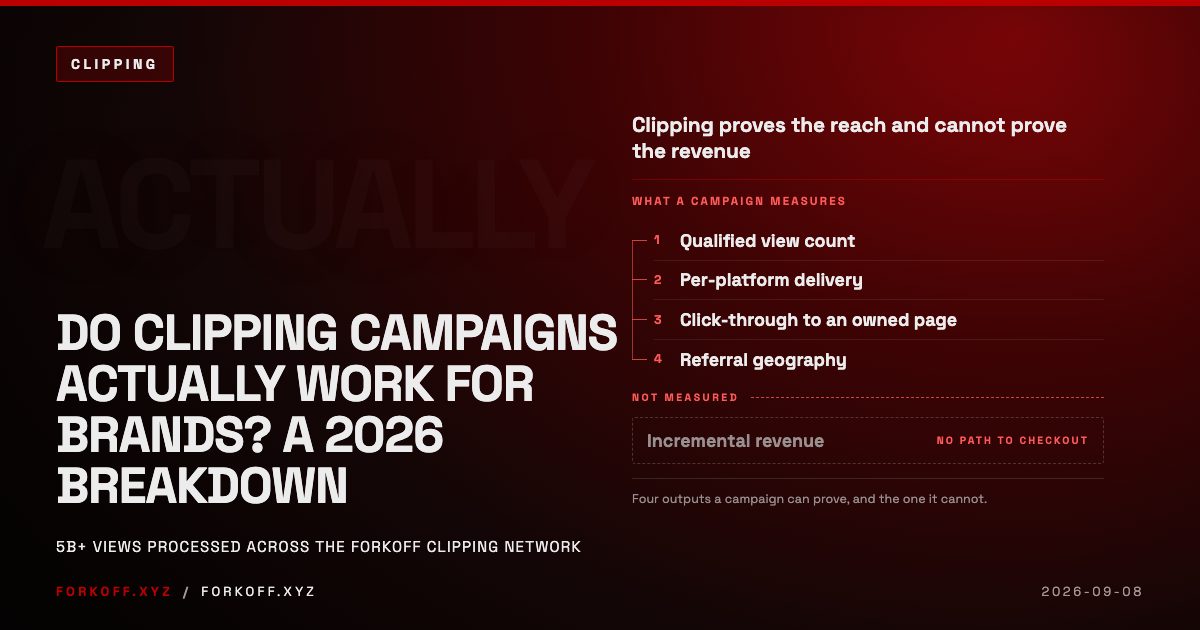
Do Clipping Campaigns Actually Work for Brands? A 2026 Breakdown
Clipping campaigns buy reach at a low unit price and cannot prove revenue. The 2026 breakdown of CPM by content signal, attribution and vendor diligence.
 Read
Read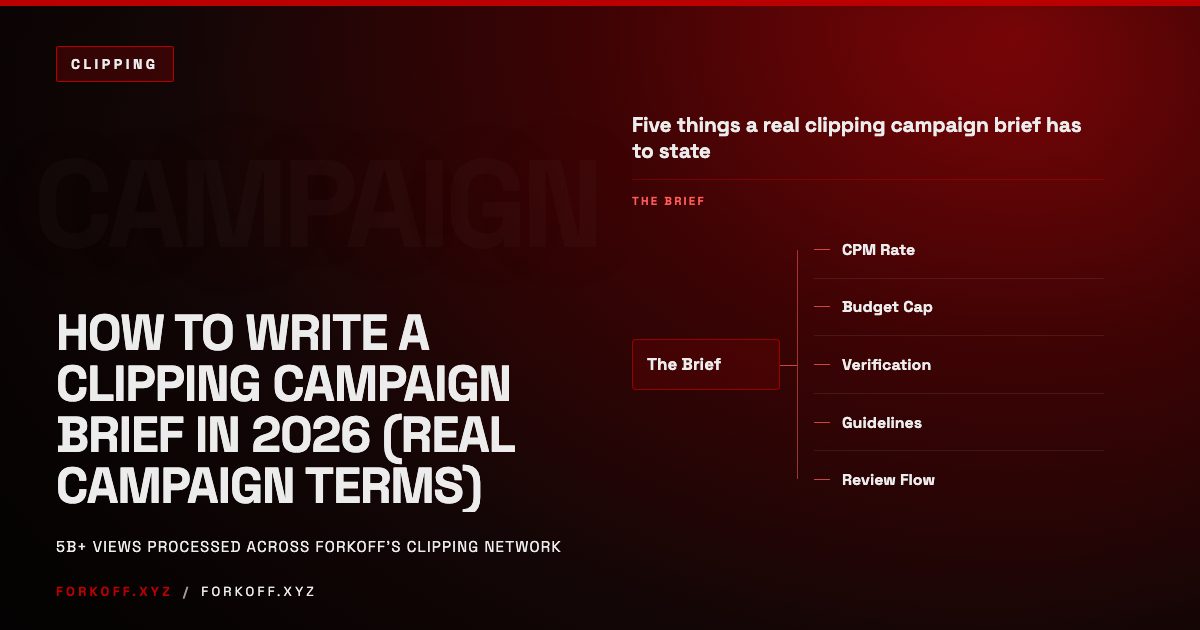
How to Write a Clipping Campaign Brief in 2026 (Real Campaign Terms)
A clipping campaign brief sets the CPM, budget cap, submission rules, and review flow that decide whether a campaign gets quality clips or wasted budget.
Read
Clipping a Game Launch: Turning Twitch and Kick Streams Into Qualified Installs
A launch-week playbook for clipping Twitch and Kick streams into qualified installs, with Drops mechanics, wishlist math, and a 7-day production calendar.
Read