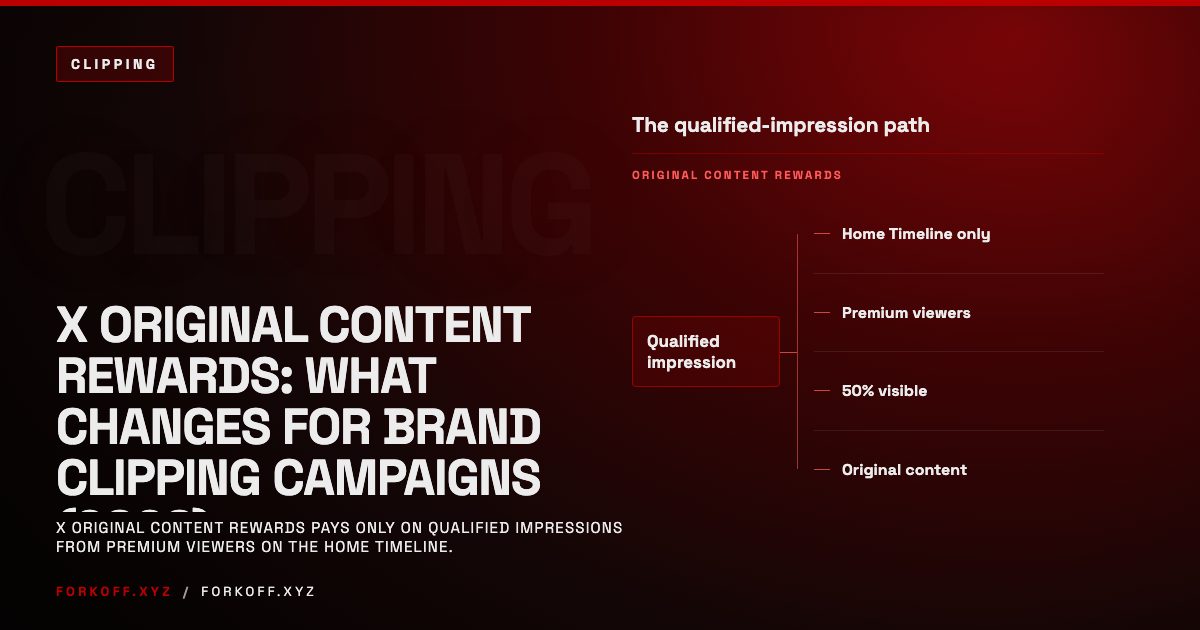
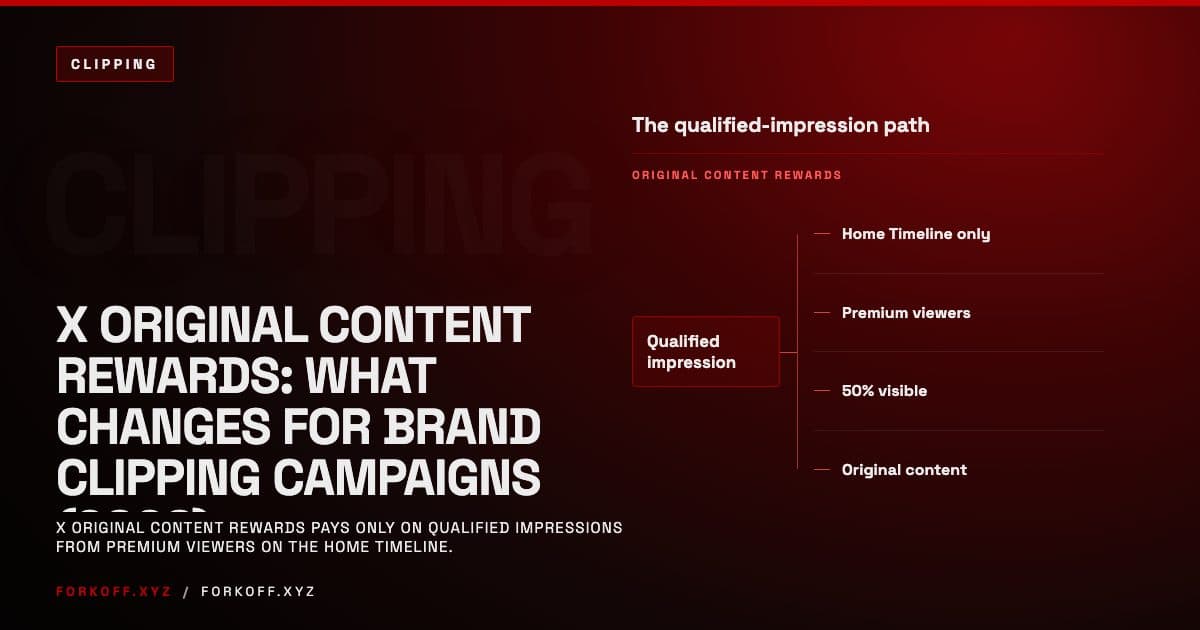
X did not tune its creator payouts in the summer of 2026, it swapped the whole program. Creator Revenue Sharing is gone, and Original Content Rewards pays creators on qualified impressions from Premium subscribers on the Home Timeline, only on content X judges original. For any brand running a clipping campaign, that single change moves the goalposts: recycled-clip payouts are over, and the clips that still earn are the ones somebody actually made.
The 30-second version
On August 7, 2026 X stopped enrolling creators in Revenue Sharing and replaced it with Original Content Rewards, which pays on qualified impressions from Premium subscribers on the Home Timeline where at least 50 percent of the post is visible. Recycled clips, straight reposts, and minimally modified re-uploads no longer count as original and stop earning. For brands running clipping campaigns the shift is simple to state and expensive to ignore, a repost-heavy library loses eligibility, and original-first production plus a qualified-view ledger is now the only durable play.
What did X actually change in August 2026?
X closed new Creator Revenue Sharing enrollments on August 7, 2026, let existing accounts earn through September 7, opened applications for the new program on September 8, and sent the first Original Content Rewards payout on September 25. That is a full program replacement inside seven weeks, 49 days from the last enrollment to the first new payout, not a policy tweak, and a campaign running on the old reply-ad math had to re-qualify against an entirely different bar. The reporting at launch was blunt about the motive, TechCrunch covered the switch on August 8 and quoted X directly, and The Verge framed it as a reset of how the platform pays creators. Engadget laid out the eligibility thresholds and Tubefilter walked through what the program means for creators in the days after.
How X switched from Revenue Sharing to Original Content Rewards, 2026
| Date | Milestone | What it means for a campaign | Source |
|---|---|---|---|
| August 7, 2026 | New Revenue Sharing enrollments closed | Old reply-ad payout stopped taking new accounts | published |
| September 7, 2026 | Last day Revenue Sharing earns | Legacy clip accounts stop accruing | published |
| September 8, 2026 | Original Content Rewards applications open | Apply against the originality and impression bar | published |
| September 11, 2026 | Final Revenue Sharing payout | The old program closes its books | published |
| September 25, 2026 | First Original Content Rewards payout | Qualified impressions start paying out | published |
Method: The dates are X's own published migration timeline from the Help Center and the August 2026 launch coverage; a different date on X's program page would falsify a row.
Operator noteX closed Revenue Sharing enrollments Aug 7 2026 and sent the first Original Content Rewards payout Sep 25, a switch inside seven weeks., X Help Center and TechCrunch, August 2026

Creator Revenue Sharing against Original Content Rewards
Creator Revenue Sharing
Original Content Rewards
Pays on reply-feed ad engagement
Pays on recycled or reposted clips
Pays on qualified Premium impressions
Requires content X judges original
Still live in late 2026
Read from X's Help Center and the August 2026 launch coverage; Revenue Sharing took its final payout on September 11 and Original Content Rewards paid first on September 25.
The old Creator Revenue Sharing model paid on ad engagement in the replies under a post, which is exactly the surface a recycled-clip account could farm. The new one pays on qualified impressions on the Home Timeline, and it starts from a stated position on quality rather than volume. The migration even carried a 42-day reapply window for rejected accounts, a detail that tells you how firm the originality bar is meant to be.
Creators should be focused on bringing net new content to the platform instead of maximizing payouts. We could have kept adding more rules and exceptions, but ultimately the better decision was to start fresh and build a program designed from day one to reward originality.

Creators
@XCreators
All eligible creators can now apply to Original Content Rewards in Creator Studio. Revenue Sharing has officially sunset, the last payout is this Friday, September 11. If you were enrolled in Revenue Sharing and get approved, your first OCR payout is September 25. Happy posting!
First Original Content Rewards payout. It seems to match the old pay ratio almost exactly.
Daniel Smidstrup
@DanielSmidstrup
X just paid me $856.43 First Original Content Rewards!! Seems to match the old pay ratio almost exactly.
If your clipping program treated X as a payout channel the way our CPM-rates breakdown described the old revenue share, that line of the plan is now out of date. The channel still matters for reach, but it pays on a new unit.
What qualified impressions mean for a clipping campaign
A qualified impression is a unique impression from an X Premium subscriber on the Home Timeline feed, where at least 50 percent of the post is on screen. Reply impressions do not count. Duplicate impressions from the same account do not count. Paid, promoted, or artificially generated views do not count. That definition reprices every clip, because reach and payout have stopped being the same question, and the number a brand plans around is now qualified reach, not a raw view total. Our note on the qualified-views metric made this argument before X made it a payout rule. The payout has a floor underneath it too: Original Content Rewards pays on a 14-day cadence with a 30 dollar minimum, so a clip now needs real Premium reach, not a few thousand reply views, to clear the bar.

What a qualified impression excludes
| Impression | Counts toward payout | Why | Source |
|---|---|---|---|
| Premium viewer, Home Timeline, at least 50% on screen | Yes | The only reach Original Content Rewards pays on | published |
| Reply-feed impression | No | Reply reach was the old revenue-share surface | published |
| Duplicate impression from the same account | No | Only unique impressions count | published |
| Paid or promoted view | No | Ads are not organic Premium reach | published |
| Fraudulent or artificially generated view | No | Botted reach is excluded by rule | published |
Method: Each exclusion is copied from X's published definition of a qualified impression; a change to that definition would falsify a row.

Operator noteA qualified impression needs 50% of the post on screen for a unique Premium viewer; reply, duplicate and paid views do not count., X Help Center, qualified impressions, 2026
The 50 percent visibility rule reprices the first second of a clip
Under the old revenue share a view was a view. Now a Premium viewer has to keep at least half the post on screen for the impression to qualify, so a clip that a thumb scrolls past before it renders earns nothing. That gives the hook a payout reason on top of its reach reason. For a brand, it means the craft that used to be optional, a thumb-stopping first second, now sits directly upstream of whether a clip gets paid at all, and it rewards the production step a recrop skips.
Source: FORKOFF clipping operations, short-form hook testing
The 50 percent visibility rule is the quiet one. A clip that a thumb scrolls past before half of it renders earns nothing, which gives the first second of a clip a payout reason on top of its reach reason. The eligibility bar underneath all of this is a set of numbers, and most of them are reach numbers.

Original Content Rewards eligibility, as published by X
| Requirement | Threshold | Why a brand should care | Source |
|---|---|---|---|
| Home Timeline impressions | 500,000 from verified users in 90 days | Must reach Premium users, not reply feeds | published |
| Verified followers | At least 500 | Partner accounts need standing to qualify | published |
| Premium subscription | Active X Premium, Premium+, or Premium Business | Payout rides on Premium reach, shaping targeting | published |
| Minimum payout | $30, paid every two weeks | Small recycled accounts fall below the floor fast | published |
Method: Thresholds are copied verbatim from X's published Original Content Rewards eligibility page; a change to X's stated numbers would falsify a row.
A partner account needs at least 500,000 Home Timeline impressions from verified users over 90 days and at least 500 verified followers, plus an active Premium subscription and an account in good standing. The follower line is easy. The 500,000 qualified-impression line is where recycled accounts stall, because reply-farmed reach does not count toward it.
Operator noteEligibility needs 500,000 Home Timeline impressions from verified users over 90 days, the line most recycled accounts never cross., X Original Content Rewards eligibility, 2026
Operator noteA partner account also needs at least 500 verified followers and an active X Premium subscription to qualify for the program., X Original Content Rewards eligibility, 2026
Thefitdoc
@Siddurp2
Got accepted into the Original Content Rewards Program, and a few people asked me about the process. So here is everything I know. When X opens the program, if you are eligible, you can apply. They will show you random posts from your recent posts across roughly 1 month, and you… Show more
Make sure the 10 posts you select are original content. Do not select memes, movie clips, celebrity photos, reposted content, or anything that is not your own original work.
Operator noteA rejected creator can appeal once; a failed appeal means a 90-day wait before reapplying, a sign of how firm the bar is., X Original Content Rewards program process, 2026
X replaces ‘misaligned’ revenue sharing program with Original Content Rewards
Why did recycled-clip payouts break?
X published the disqualifiers in plain language, and four of the five are the daily output of a repost desk. Copied content does not count. Content downloaded and reuploaded does not count. Minimally modified clips, a filter, a speed change, a text overlay on someone else's video, do not count. Aggregated compilations and cross-platform reposts by a non-creator do not count. A clip account that lived on re-uploading other people's moments did not get a smaller payout under the new rules, it got an ineligible one, which is the same lesson YouTube's reused-content policy taught a year earlier on a different platform. Mashable summarized which content no longer qualifies, and the retirement of the old revenue share was reported across the trade press, including aggregated coverage of the switch.

What X counts as original, and what it does not
| Counts as original | Does not count | Source |
|---|---|---|
| Reporting, analysis or commentary you wrote | Reuploading someone else's content | published |
| Photos or videos you filmed or produced | A watermark, logo, filter or border added to someone else's clip | published |
| Threads, graphics or illustrations you made | Cropping or changing the speed of an existing clip | published |
| A real take that adds expertise, humor or narration | Basic text that describes what is already happening | published |
| Transformation where your contribution is the main value | A simple summary with little added insight | published |
Method: Each row is copied from X's published originality guidelines; a revision to X's disqualifier list would falsify it.
You can use someone else's content, but your contribution needs to be the main reason the post is valuable. Reuploading, adding a watermark, cropping, changing the speed, or adding filters does not count.
DogeDesigner
@cb_doge
X is replacing Revenue Sharing with the new Original Content Rewards Program. What counts as ORIGINAL content? Original reporting, analysis, commentary, threads, photos or videos you created, memes, graphics, or content that adds meaningful context, expertise, humor, narration o… Show more
A modeled split of a repost-heavy clip library under Original Content Rewards
| Clip type | Share of a repost-heavy library (modeled) | Earns under Original Content Rewards | Source |
|---|---|---|---|
| Original or transformed clips | About 30 percent | Yes | derived |
| Minimally modified re-uploads | About 25 percent | No | derived |
| Straight reposts of other people's content | About 45 percent | No | derived |
| Qualified share that still pays after the switch | About 30 percent | Yes | derived |
Method: FORKOFF's own modeled estimate of a repost-heavy library, derived from clip-level audits across managed campaigns; the shares are illustrative of the direction rather than a census, and a library with more native capture shifts the eligible share upward.

Model a repost-heavy library and the math gets uncomfortable fast. The original and transformed slice keeps earning, the minimally modified and straight-repost slices do not, and on most recycled libraries those two slices are the majority of the catalog.

X Wants Less Slop and More Original Content
Perry Belcher
A creator breaking down why X now wants less recycled slop and more original content
This is not a crypto-only or a creator-only story either. It lands on the same brands we covered in do clipping campaigns actually work for brands, and it sharpens the warning in our clipping campaign mistakes piece, where leaning on recycled assets was already a budget leak before it became a disqualifier.
What brands running clipping campaigns change now
The fix is not complicated to state. Stop briefing clippers to re-upload a moment and start briefing them to make one. A recycled-clip campaign and an original-first campaign can carry the same budget and look similar on a planning deck, but only one of them produces assets that still qualify for an X payout, and only one builds a library with shelf life. The same originality pressure is showing up in self-serve clipping markets too, where Whop's own content-rewards documentation now leans on submission review rather than raw view counts.

A recycled-clip campaign against an original-first campaign
Recycled-clip campaign
Original-first campaign
Uses footage made for the post
Counts for an X payout
Carries platform eligibility risk
Builds a library with shelf life
Needs real production work
Eligibility outcomes follow X's Original Content Rewards disqualifier list; the shelf-life and risk rows are FORKOFF's own operational read across managed clipping campaigns.

Run the checklist before the next brief leaves your desk. Audit the existing library and flag every straight repost. Brief for a genuine new angle, not a recrop. Fund native capture so there is footage shot for the post. Target the Home Timeline for Premium reach rather than reply feeds. Demand a per-clip audit trail. And measure qualified reach, which means counting what X counts. Our guide to writing a clipping campaign brief already builds most of this in, and the economics line up with the numbers in our clipping campaign cost breakdown.
Originality moved from a creative preference to a line in the brief
Before this change a brief could ask for originality and treat it as a tone note. Now it is a spec with a payout attached, the same way a logo placement or a disclosure line is. The brief that keeps a campaign eligible names the transformation it expects, funds the native capture that makes it possible, and refuses the straight recrop, because the recrop is no longer a cheaper version of the same deliverable, it is an ineligible one.
Source: FORKOFF clipping operations, campaign brief standards
Reach and payout just stopped being the same question
Before this change a clip account could chase raw impressions anywhere they came from, replies included, and the payout followed. Original Content Rewards splits those two jobs apart. Reach is still reach, but the money now rides only on qualified impressions, unique Premium views on the Home Timeline with half the post on screen. A campaign that optimizes for a big round view number can still miss the payout surface entirely. The planning unit for a brand is no longer views, it is qualified views, which is the unit a managed clipping lane was already built to report on.
Source: FORKOFF clipping operations, campaign management across short-form platforms
Why original-first clip strategy still works
Originality sounds like a style note until you connect it to the payout, and then it becomes a spec. X defined original content as something you wrote, filmed, designed, or produced that reflects your own voice, and it explicitly kept commentary in, a real take on a moment counts, a reupload of the moment does not. That means a brief can require originality the same way it requires a logo placement, as six concrete inputs rather than a vibe.


Model the funnel and the drop from raw posts to qualified impressions is the planning number a brand now owns. A hundred clips becomes a smaller set of original ones, a smaller set that reach the Home Timeline, a smaller set seen by Premium viewers, and finally the qualified impressions that pay. The way to widen that funnel is to raise the share that is genuinely original, which is a production decision, not a posting-volume decision.

Qualified reach is the new reporting unit, and raw views no longer reconcile
A screenshot of a big view count used to be enough to close out a campaign. It does not reconcile against an Original Content Rewards payout, because the payout is computed on qualified impressions, a strict subset of reach. The campaigns that keep finance comfortable are the ones that report in the same unit X pays in, a per-clip ledger of qualified reach rather than a raw-view total, which is the reporting a managed lane was already built to produce.
Source: FORKOFF clipping operations, per-clip qualified-view ledger
Operator noteOriginal Content Rewards pays every two weeks with a $30 minimum, so small recycled accounts fall below the floor once reply reach stops., X Original Content Rewards, 2026
Originality is now a compliance requirement, not a style note
X listed the disqualifiers in plain language, copied content, minimally modified re-uploads, aggregated compilations, and cross-platform reposts by someone who did not make the original. That reads like an editorial preference until you connect it to the payout. A clipper who adds a filter and a caption to someone else's video is not making a weaker clip under the new rules, they are making an ineligible one. The brands that keep earning are the ones whose briefs demand genuine transformation and native capture, which is exactly the production work a repost desk skips to keep costs down.
Source: X Help Center, Original Content Rewards program guidelines
If you are weighing this against running clips in house, our comparison of a clipping tool versus an agency and the opus-clip versus managed cost breakdown both frame the same trade the new rules just sharpened. A tool that crops and captions faster does not make a clip more original. A production lane does.
Why does the managed clipping-agency model still win?
Here is the part that surprises people who expected a payout change to hurt the agency model. It did the opposite. A managed clipping lane already staffs the two layers X just made load-bearing: original production and originality or policy compliance. The switch did not break the model, it validated the thing the model was built to sell, and it is why we read this change as a tailwind rather than a shock.


A DIY repost lane against a managed clipping lane
DIY repost lane
Managed clipping lane
Adds originality per clip
Qualifies on X by design
Ships a reason-coded dispute ledger
Exports a per-clip finance record
Scales with spend
The two load-bearing rows are originality and what qualifies, the exact properties Original Content Rewards made decide the payout; the rest is FORKOFF's managed-lane operating standard.
A DIY repost lane and a managed lane diverge hardest on the two rows that now decide the payout, originality and what qualifies. The managed lane adds originality per clip, qualifies on X, resolves disputes against a reason-coded ledger, and exports a per-clip record finance can reconcile. The repost lane adds nothing, mostly does not qualify, and settles disputes with screenshots. Our take on whether hiring a clipping and distribution agency is worth it covers the rest of that trade, and the managed clipping playbook is the full operating version.

The change validates the two layers a managed lane already staffs
A payout rule that pays only for original production and penalizes recycled uploads reads as a threat to clip accounts and a tailwind to managed lanes. The managed model already staffs original production and an originality or policy check, the two layers X just made load-bearing. The switch did not break the model, it priced in the work the model was built to sell, which is why a managed operator reads this as validation rather than disruption.
Source: FORKOFF clipping operations, managed-lane economics
We price campaigns on cost per qualified view and ship a per-clip ledger on a network that has processed more than 5 billion views, which is the same logic X moved to. If you want the primer on the category itself, what clipping is and what clip farming is both sit upstream of this change, and a strong clipping program feeds the rest of a founder funnel the same way it always did.
The bottom line for a clipping budget after OCR
Original Content Rewards did not make clipping on X harder, it made recycled clipping worthless and original clipping the only thing that pays. Brands that treated clip accounts as a reach-and-repost channel have a library to re-audit and a brief to rewrite. Brands that already run original-first production, through an in-house team or a managed clipping partner, barely feel the switch, because they were making the content X now rewards all along. Compare the routes on our best clipping agency page, then decide which lane your next campaign runs in.