
01
Watch-time threshold
Each platform has its own watch-time gate (e.g. TikTok 15s, Reels 12s, YouTube Shorts 20s). The brief locks the threshold at acceptance. Views below the threshold are filtered with reason code below-watch-gate.
FORKOFF runs a paid clipping network across AI, Web3, podcast, and consumer content. Clippers in the network get geo-routed briefs, payout math visible before brief acceptance, and settlement 7 to 14 days after each campaign closes, against a per-view audit ledger. No audience minimum. No exclusivity by default.
What is a content clipper?
A content clipper is a short-form video editor who cuts long-form content, podcasts, streams, launches, and founder talks, into vertical clips for TikTok, Instagram Reels, and YouTube Shorts, and gets paid for the views those clips earn. In the FORKOFF network a clipper is paid on qualified views, not raw view counts: payout is (qualified views / 1,000) times the brief CPM rate, the rate is visible before you accept, and settlement lands inside 7 to 14 days. See how qualified views are counted for the exact rules behind the payout math.
No audience floor · 7-14 day settlement · transparent payout math
We read every clipping offer posted on Reddit in the last 12 months: 4,007 posts, 61 offers with a stated rate. The typical offer pays $1.25 per 1,000 views. FORKOFF pays $1.00 to $1.25 per 1,000 qualified views: the market median, on a stricter unit, with the CPM stated on every brief before you accept, which only 5% of market offers do for their per-post floor.
Method: edition 2026-09-24. Offers are Reddit posts whose title names clipping and states a rate per 1,000 views; ranges use the midpoint, cross-posts count once, and a hand check of 30 rows found 29 genuine offers. Most offers quote raw views, which include bot, replay and out-of-geo views; a FORKOFF qualified view excludes them, so the same rate buys a stricter unit, not a looser one. The middle half of offers pays $1.00 to $2.00 per 1,000.
Apply once, then take briefs with the CPM and per-platform thresholds visible before you accept.
Every brief on clips.forkoff.xyz is a real brand campaign. The niche, the platforms it runs on, its status and the combined views you need before payout unlocks are shown here; the brand, the per-1,000 rate and the budget are visible only inside the network, on the brief, before you accept it.
Briefs open in waves as brands fund campaigns; join now and the next one is routed to your queue the day it opens
Rate and brand shown on the brief, before you accept
The qualification engine runs at the view level, not the clip level. The same clip can produce qualified views and filtered views in the same hour, depending on who watched it and where. You see the reason code per view in your dashboard.
Each platform has its own watch-time gate (e.g. TikTok 15s, Reels 12s, YouTube Shorts 20s). The brief locks the threshold at acceptance. Views below the threshold are filtered with reason code below-watch-gate.
Brand-safety rules are locked in writing at brief acceptance. Clips that violate the brief's policy (disclosure, claim accuracy, format spec) are filtered with reason code policy-mismatch.
Each brief specifies eligible and excluded geos at acceptance. The qualification engine cross-references playback IP against the brief's exclusion list. Sanctioned-region views are filtered with reason code sanctioned-geo.
View patterns inconsistent with organic traffic (excessive watch-time clustering, anomalous device fingerprints, bot signatures) are filtered with reason code invalid-traffic. The heuristic stack reads at the view level, not the clip level.
FORKOFF routes briefs by geography, niche, and prior qualification rate. Pick the vertical landing page that matches your audience. Each vertical shows the brief volume, typical payout band, and acceptance criteria specific to that niche.
Podcast clippers
1 pagesClip long-form podcasts (founder-led, SaaS, crypto, consumer) into short-form for TikTok, Reels, and Shorts. Watch-completion is the load-bearing metric. Higher CPQV than reach-only verticals.
TikTok clippers
1 pagesTikTok-first clippers with proven retention curves. Routed to AI startup, consumer app, and gaming launch briefs. Geo-tagged at clipper level, brief-matched at acceptance.
Web3 clippers
1 pagesWeb3-fluent clippers routed to protocol, DeFi, memecoin, and token-launch briefs. Sanctioned-region awareness required at the clipper layer; eligibility verified at onboarding.
Don't see your vertical?
Apply anyway, the strategist team reviews every application.
Verticals above are where most brief volume lives, but FORKOFF routes briefs across many adjacent niches. Go to clips.forkoff.xyz, enter your email, and the intake form is right there if you're new. The strategist team will map you to the right brief queue within 5 working days.
No. A clip farm mass-produces low-effort clips chasing raw view counts, and most pay nothing or pay on unverifiable reach. FORKOFF pays clippers $1.00 to $1.25 per 1,000 qualified views, with a four-check qualification engine (watch-time, policy, geo, traffic validity) run on every clip, payout math visible on each brief before you accept, and settlement in 7 to 14 days. It is paid, transparent clipping for real brand campaigns across AI, Web3, podcast, and gaming, so the work compounds into a track record instead of the churn of unpaid clip farming.
Campaigns pay $1.00 to $1.25 per 1,000 qualified views, which is $0.001 to $0.00125 per qualified view. Payout equals (qualified views / 1,000) x the campaign CPM, and that CPM is stated on every brief BEFORE you accept. A qualified view is a view that passes four checks: watch-time threshold per platform, policy compliance, geo consistency against the brief's exclusion list, and traffic-validity heuristics. Filtered views do not count toward your payout, but they do not penalize your standing either.
Settlement happens 7 to 14 days after the qualification window closes for each campaign. The exact settlement window is disclosed on the brief before you accept. Payouts route through the disbursement rail you connected at onboarding (Stripe Connect or USDC depending on geo).
No. Fit, quality, and verifiable performance matter more than raw follower count. Smaller geo-niche clippers often outperform on CPQV because the qualification engine rewards retention and on-target geo over reach. You are routed to briefs by geography, niche, and prior qualification rate, not by follower count.
TikTok, Instagram Reels, YouTube Shorts, YouTube long-form, X, and Facebook. Each platform has its own watch-time threshold per qualified view. The brief specifies the threshold per platform at acceptance. If you specialize in one platform, you can filter the brief queue to only show briefs matching that platform.
Every rejection includes a reason code: policy issue, brief mismatch (format / style / disclosure), format mismatch (aspect ratio / runtime), or invalid traffic signals. You can read the reason in your clipper dashboard immediately. Reworkable issues can be re-submitted. Policy violations require a brief amendment from the brand side.
Yes. There is no exclusivity by default. Each brief specifies its own brand-safety rules and content cooldown windows; if you are running a competing brand's brief in the same vertical at the same time, the brief acceptance flow will flag the conflict before you commit.
Three levers. (1) Maintain a high qualification rate; clippers above the per-vertical median get priority routing. (2) Complete your geo + niche + platform profile in onboarding so the routing engine matches you to relevant briefs. (3) Reach out to the strategist team via the dashboard if you have audience-specific specializations not captured in the standard taxonomy.
No floor for the disbursement itself, but the payout rail has a 25 USD / 25 USDC accumulation threshold before automatic settlement runs. Clippers below the threshold can request manual settlement at any time via the dashboard.
As Featured In
Full press shelf







The FORKOFF clipping pipeline routes briefs by vertical, geography, and platform. TikTok is the live clipper-side lane; the routing map for it is below.
The network you are applying to
FORKOFF has processed 5B+ views across its clipping network, and that scale is why the network pays on qualified views instead of raw uploads. A qualified view is one that cleared a device check, a watch-time threshold, a traffic-legitimacy pass, and an audience-geo match, and it is the same unit on both sides of the ledger. The brand is billed $0.003 per qualified view; the clipper who produced it earns $1.00 to $1.25 per 1,000 qualified views, with the exact CPM on the brief before you accept. The gap pays for the qualification engine, the brief and strategist work, and the audit ledger. For a clipper, the unit is the point: the payout is tied to watch-through you actually produced, not to how many clips you posted, and the reason a view was or was not counted is logged rather than hidden.
See how the qualification works in the qualified-views methodology, what the brand side buys on the clipping service page, or how FORKOFF compares to other operators in the best clipping agency comparison.
Reviewed by the FORKOFF clipping team, the operators who run the qualified-view ledger.
FORKOFF runs a paid clipping network across AI, Web3, podcast, and gaming content. Clippers in the network see new briefs weekly, route by geography and niche, get paid on qualified views with transparent math.
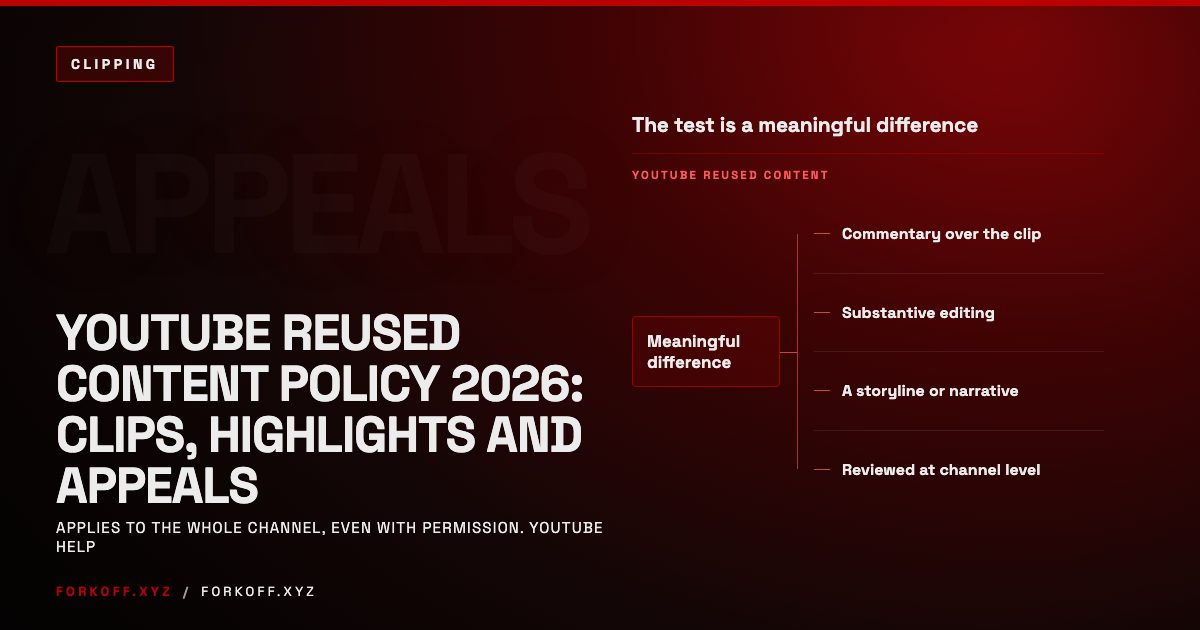
What YouTube's reused content policy actually says, how it treats clips, stream re-uploads and compilations, how to appeal, and how brand clipping stays clean.
 Read
Read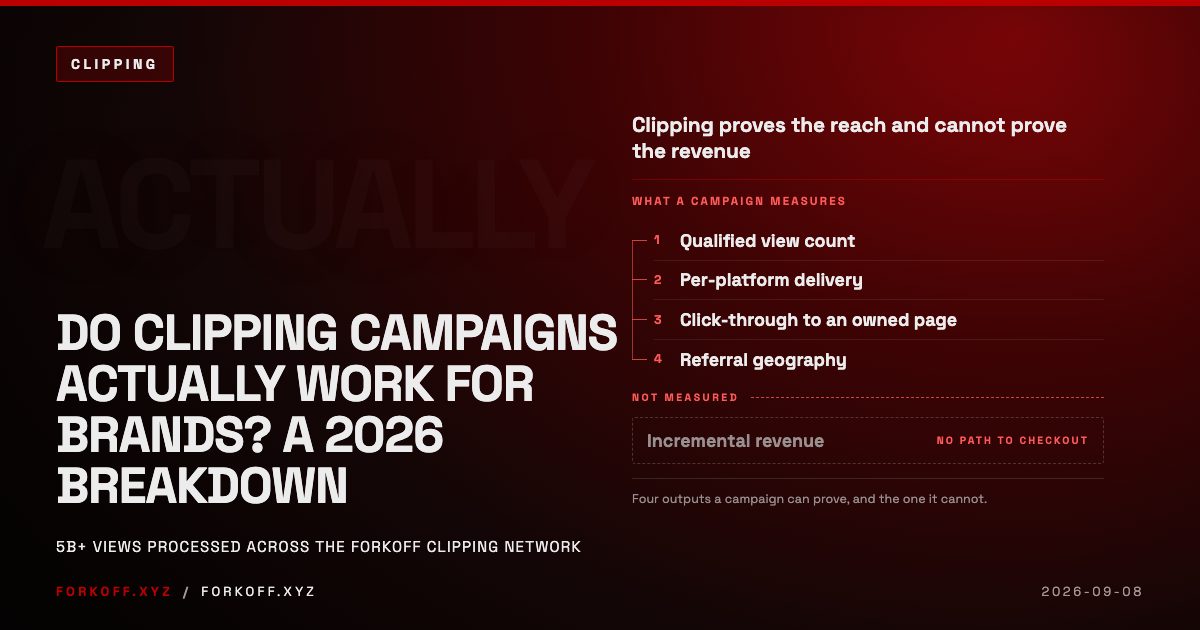
Clipping campaigns buy reach at a low unit price and cannot prove revenue. The 2026 breakdown of CPM by content signal, attribution and vendor diligence.
Read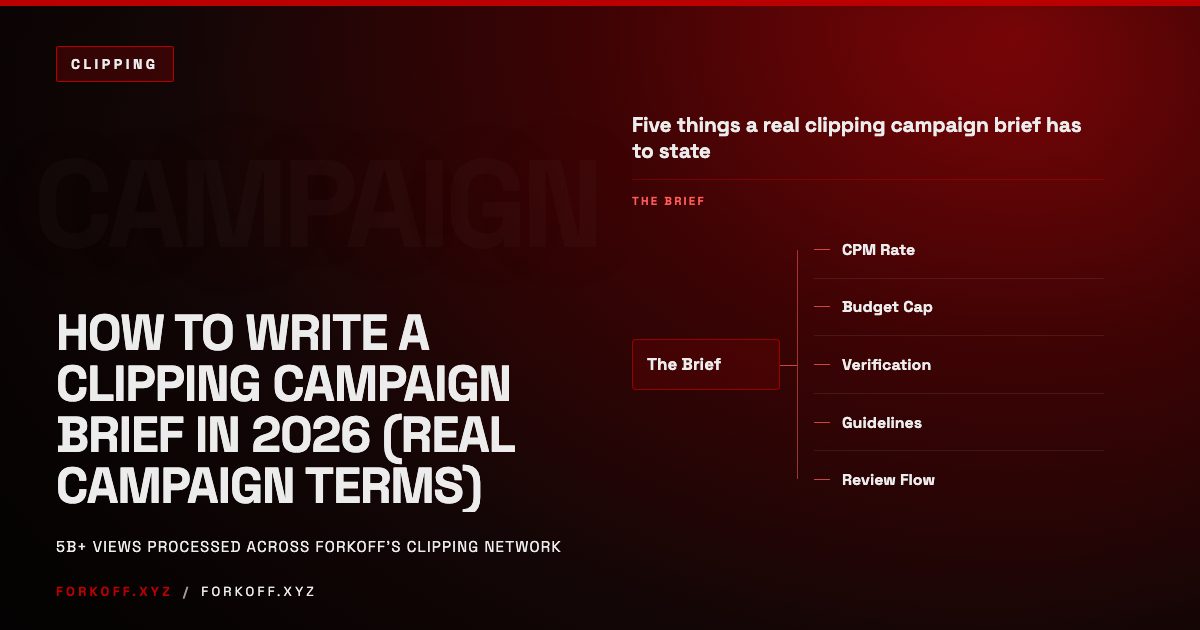
A clipping campaign brief sets the CPM, budget cap, submission rules, and review flow that decide whether a campaign gets quality clips or wasted budget.
Read