
FORKOFF Research · Clipping Proof 2026 · Updated 2026-07-03 · 60 stats · 24 named sources
Short-Form Clipping ROI andQualified-Views Statistics 2026
The managed cost per qualified view runs about $0.003, against a $0.01 to $0.10 unmanaged market, measured across a 5 billion-plus-view operating base.
This is the statistics hub that sets that first-party benchmark next to 49 externally sourced stats from 24 named authorities, every one a number with a source and a year.
$0.003
First-party CPQV
FORKOFF managed lane cost per qualified view, versus a $0.01 to $0.10 unmanaged market range (Clipping Proof 2026).
5B+
Qualified views processed
Short-form qualified views run through the FORKOFF managed clipping operation to date.
60
Cited data points
11 first-party plus 49 aggregated, every one a number with a named source and a year.
51%
Bots on the open web
Automated traffic passed human traffic for the first time in a decade in 2024 (Imperva).
What is a qualified view?
A qualified view is a single short-form video render that clears four inputs before it counts: the viewer held the clip to at least 75 percent, the view came from an algorithm-matched audience, the surface let the viewer act, and the view came from a real human rather than a bot. TikTok already uses qualified views as an official unit in its Creator Rewards Program, excluding fraudulent, paid, and disliked views and anything watched under 5 seconds.
FORKOFF generalizes that platform-native idea across YouTube Shorts, Reels, X, and TikTok, then prices managed clipping on the filtered unit at about $0.003 per qualified view, against a $0.01 to $0.10 unmanaged market. The rest of this page places that first-party anchor next to the strongest published research on how platforms count views, what viewability and attention measure, and how much of the view supply was never a person, so a buyer gets one dated, sourced record of what a short-form view is worth in 2026.
- 01What is a qualified view
- 02Editor's Choice: top 20 stats
- 03Methodology
- 04Platform view-definitions
- 05Viewability and attention
- 06Bot-view fraud
- 07CPQV and short-form ROI
- 08The qualified-view standard
- 09The CPQV benchmark
- 10Platform efficiency, first-party
- 11Reading the number honestly
- 12Run the number yourself
- 13From vanity views to qualified views
- 14Frequently asked questions
- 15Cite this hub
- 16Sources consulted
- 17The qualified-views methodology
- 18Adjacent reading
The 20 stats that define short-form clipping ROI in 2026.
Ranked by a blend of proprietary weight (first-party data no aggregator holds ranks first), source authority, recency, and how directly each stat sets up the qualified-view standard. Every row is a number, a named source, and a category, built to be lifted whole by an answer engine.
| # | Data point | Source | Category |
|---|---|---|---|
| 01 | $0.003 vs $0.01 to $0.10FORKOFF managed cost per qualified view versus the unmanaged market range, the whole thesis | FORKOFF | CPQV and ROI |
| 02 | 5 billion-plusShort-form qualified views processed by the FORKOFF managed clipping operation | FORKOFF | The standard |
| 03 | 5 secondsTikTok already defines a qualified view officially, excluding fraud, paid, and disliked views and anything under 5 seconds | TikTok | The standard |
| 04 | 51%Bots were 51% of all web traffic in 2024, passing humans for the first time in a decade | Imperva | Bot-view fraud |
| 05 | 0 secondsYouTube Shorts now counts a view the instant it starts to play, no minimum watch time (31 Mar 2025) | YouTube | Platform view-definitions |
| 06 | 50% for 2sMRC and IAB say a video ad is viewable only at 50% of pixels for 2 continuous seconds | MRC / IAB | Viewability and attention |
| 07 | 38%Only 38% of raw views passed all four FORKOFF gates, the inflation gap made concrete | FORKOFF | The standard |
| 08 | 37%Bad bots specifically were 37% of internet traffic in 2024, up from 32% a year earlier | Imperva | Bot-view fraud |
| 09 | ~35 centsAbout 35 cents of every programmatic dollar goes to low-quality or invalid media | ANA | Bot-view fraud |
| 10 | 71%North America authentic viewability was 71% in 2024, so nearly 3 in 10 impressions were not viewable | DoubleVerify | Viewability and attention |
| 11 | $111 billionGlobal short-form video ad spend reaches about $111 billion in 2025 | Statista | CPQV and ROI |
| 12 | 21 Apr 2025Instagram replaced Impressions with Views, counting every on-screen display including repeats | Instagram / Meta | Platform view-definitions |
| 13 | 17.9%17.9% of monitored web traffic in 2023 was fake, up from 11.3% the year before | CHEQ | Bot-view fraud |
| 14 | $5.78 per $1Influencer marketing returns about $5.78 per dollar of spend | Influencer Marketing Hub | CPQV and ROI |
| 15 | 85%85% of marketers call short-form video the single most effective social content format | Influencer Marketing Hub | CPQV and ROI |
| 16 | 1.5 secondsJust 1.5 seconds of active attention is enough to encode memory and drive ad recall | Amplified Intelligence | Viewability and attention |
| 17 | 101%North America bot fraud surged 101% year over year, so the trend is worsening | DoubleVerify | Bot-view fraud |
| 18 | ~99.7%Non-bot legitimacy on the FORKOFF qualified-view denominator, the counter-number to the 51% bot web | FORKOFF | The standard |
| 19 | $480 billionThe creator economy could reach $480 billion by 2027, led by short-form monetization | Goldman Sachs | CPQV and ROI |
| 20 | ~4.7xYouTube Shorts delivered about 4.7 times the views per clip of Instagram Reels in the FORKOFF cohort | FORKOFF | The standard |
Rows marked FORKOFF are first-party numbers from the Clipping Proof 2026, verified against client subscription data. Every other row links to its named primary source. The full 60-stat pool is grouped by category in the five deep dives below.
How the benchmark is measured, and how the aggregation is sourced.
The first-party sample, window, and collection method are all named. Every external number carries a named source, a report title, and a year. Untraceable and round-number-only figures were excluded rather than laundered, which is the discipline that makes the hub citable.
- First-party sample
- The FORKOFF Clipping Proof 2026: a 3,085-clip reference cohort of 1.19M qualified views, on a managed clipping operation that has processed 5 billion-plus short-form qualified views.
- Qualification method
- Four gates in order: geo-match, a 75 percent watch-through hold, brand-safety, and non-bot. Qualified views are derived from per-platform export CSVs, not platform dashboard counts.
- Attribution
- Payment-level attribution reconciled against client subscription data, so a qualified view maps back to a conversion event rather than a dashboard impression.
- Window and cadence
- Published 2026-06-09, last updated 2026-07-03. CPQV band drawn from 9 managed engagements. Re-checked against the live operating base each quarter; next refresh 2026-10-03.
- Aggregation
- 49 external statistics from 24 named authorities across platform view-definitions, viewability and attention, bot-view fraud, and short-form ROI. Each is traced to a named primary source with a report title and a year.
- Units held apart
- CPQV is a filtered unit and is not blended with raw cost per view or CPM. Where a platform figure differs by surface, each surface is reported separately rather than averaged.
First-party numbers are directional estimates from a specific operating window; individual outcomes vary by category, platform mix, and funnel match. External figures are reported as their named source published them. Where a figure is real but confirmed through secondary reporting rather than a primary fetch, it is attributed to its named source and not elevated to a hard first-party claim.
The exclusion discipline is the part most aggregations skip, and it is where this hub earns its trust. Three widely-repeated influencer and ad-fraud figures were deliberately left off: a claim that 55 percent of Instagram influencer engagement is fake (secondary attribution only, no primary), a $4.8 billion fraud-loss round figure (a competitor derivative with no auditable primary), and a 5.1 percent average or 46.9 percent high ad-fraud rate (a secondary roundup not confirmed at primary). A number that cannot be traced to a single named primary source with a matching denominator is left off the page, not laundered onto it.
They all count differently, and they all loosened in 2025.
The first thing to know about a view is that there is no single definition of one. Each platform counts a view its own way, and in 2025 all three major short-form surfaces moved to the most generous possible definition at the same time.
Start with the raw floors. TikTok counts a view the instant a video starts playing, which its video play documentation puts at 1 second, with a longer 3-second hold on videos of 3 minutes or more. YouTube Shorts went further: as of 31 March 2025 it counts a view each time a Short starts to play or replay, with no minimum watch time at all. Instagram closed the gap from the other direction. On 21 April 2025 Meta replaced Impressions with Views across all content types, and as SocialPilot documents a View now counts each time content is displayed on screen, including repeat views by the same user. Instagram had previously required about 1 second of playback to count a Reel play, per Socialinsider. A view on TikTok, a view on Shorts, and a view on Reels are three different events, and after 2025 none of them require sustained attention.
The one platform that already qualifies its own views is TikTok. Its Creator Rewards documentation defines a qualified view that excludes fraudulent, paid, disliked, promoted, and artificial views entirely, requires the viewer to watch more than 5 seconds from the For You feed on videos over 1 minute, and counts multiple views from one account as a single unique qualified view. This is the platform-native anchor that makes the FORKOFF qualified view not a coinage: the largest short-form platform in the world already draws exactly this line between a raw view and a view that counts for money.
The trade press caught the tension immediately. When YouTube changed its Shorts view count, Forbes contributor Ian Shepherd wrote that the redefinition inflates raw counts but the metric that matters for money, the watch-based measure, did not change. YouTube itself kept the prior watch-based metric under a new name, engaged views, for monetization and Partner Program eligibility, and its Shorts monetization policiesrequire 10 million valid Shorts views in 90 days as one path into the program. In other words, the platform loosened the vanity number and quietly kept a stricter number for the money. That split, a generous public view and a stricter monetizable view, is the whole subject of this page.
For a buyer the practical consequence is that a raw view total is not a comparable unit across platforms, and after 2025 it is not even a stable unit within a platform over time. A campaign that reports 3 million views across TikTok, Shorts, and Reels is summing three different events, one of which counts every silent autoplay and another of which counts every replay by the same person. That is the setup for a single, platform-neutral standard: if the platforms will not count views the same way, the buyer needs a unit that qualifies every view on the same four rules before it is priced.
It is worth being precise about why the platforms loosened at all, because the reason matters for how much to trust the number. A more generous view definition inflates the headline reach a creator sees, which keeps creators posting, and it inflates the top-of-funnel number an advertiser is sold, which supports ad pricing. None of that is sinister, and none of it makes a view fake. It simply means the raw view is optimized to look large, not to measure attention, and the two goals pull in opposite directions. That is exactly why YouTube kept a stricter engaged view for monetization while loosening the public count: the platform itself does not price its own payouts on the generous number. A buyer who prices a clipping engagement on the generous number is doing something the platform declines to do with its own money.
The reverse over-reading is just as wrong. The 2025 loosening does not mean short-form views are worthless or that the platforms are inflating fraud; a real person really did start the video in the vast majority of counted views. The point is narrower and more useful: a counted view is a weak, non-comparable signal of attention, so it is the wrong unit to build a price on, not the wrong unit to build a campaign on. Reach still matters for discovery, and a large raw view total still indicates distribution is working. The qualified view does not replace the raw view as a reach signal, it replaces it as a billing unit, which is the only place the difference costs money.
Platform view-definition: seconds to count a view
All three major short-form platforms loosened their raw view definition in 2025. A view on YouTube Shorts and a view on Instagram now count at zero seconds of sustained watch, TikTok counts a raw view at 1 second, and TikTok's own qualified view requires 5 seconds. The FORKOFF qualified view is the only unit that still gates on sustained attention: a 75 percent watch-through hold plus three more gates, shown below because it is a hold threshold, not a fixed second count.
Sources: TikTok, YouTube, and Instagram official docs, 2024 to 2025; FORKOFF Clipping Proof 2026 (qualified-view definition).
A view is not the same as being seen, and being seen is not attention.
The advertising industry settled this argument a decade ago. A rendered view is not proof it was viewable, and a viewable view is not proof anyone paid attention. The standards bodies, the verification vendors, and the attention firms all layer a qualification on top of the raw count.
The floor is the MRC and IAB viewable-impression standard. Under the Viewable Ad Impression Guidelines, a display ad is viewable only when at least 50 percent of its pixels are in view for at least 1 continuous second, and a video ad requires 50 percent of pixels for at least 2 continuous seconds, with a lower pixel share allowed for large-format display. That standard was set in 2014 and it is the reason a counted view and a viewable impression are different things. DoubleVerify's 2025 Global Insights Report, measured across more than 1 trillion impressions, put North American authentic viewability at 71 percent in 2024, up 3 percent year over year, with connected-TV video viewability rising 16 percent. Even after a decade of improvement, nearly 3 in 10 impressions still did not meet the viewable floor. DoubleVerify also found consumer ad-blocker usage at 41 percent in its survey, another slice of rendered inventory that a human never actually saw.
The gap is not evenly distributed. Comscore's benchmark work found US and Canada in-view rates averaging about 56 percent in its 2015 to 2017 window, but reported a wide premium-versus-network split: median in-view rates near 53 percent on premium sites against 31 percent on ad networks and exchanges, per its viewability benchmarks. Where the view is served matters as much as whether it is counted, which is a direct analog to the clipping question of which platform and which placement a clip runs on.
Then comes attention, the layer above viewability. Amplified Intelligence and Dr Karen Nelson-Field found that just 1.5 seconds of active attention is enough to encode memory and drive ad recall, while about 85 percent of digital ad placements get under 2.5 seconds of attention, and streaming-TV active attention runs near 9.7 seconds, roughly 8 times mobile and 16 times desktop. A 1-second platform view can fall below the memory threshold entirely, which is the research case for gating on a 75 percent watch-through hold instead of a raw view.
The industry is already moving this way, and it is worth naming who. Nielsen added Realeyes ad-attention metrics to its Outcomes Marketplace in 2025 to move measurement beyond reach and frequency. DoubleVerify built an Attention Index on more than 50 data points calculated in real time and benchmarked to a score of 100 over a 28-day window. Adelaide's Attention Unit became the first omnichannel attention metric to enter the MRC accreditation process. The FORKOFF qualified view is the same idea, applied to organic clipping: qualify the view on sustained attention before it counts, rather than trusting the raw number the platform renders.
The mechanism behind the 75 percent hold is worth spelling out, because it is the load-bearing gate. Short-form recommendation engines re-promote a clip when early watch-through is strong, so a high hold rate is not only a proxy for human attention, it is the signal the platform itself uses to decide whether to show the clip to more non-followers. A view that clears a 75 percent hold is therefore doing double duty: it evidences that a person watched, in line with the Amplified Intelligence memory-encoding finding, and it predicts that the algorithm will keep distributing the clip. Gating on hold aligns the billing unit with the exact behavior the platform rewards, which is why hold, and not a raw view or a like, is the second of the four gates.
The honest caveat is that no single hold threshold is magic. Amplified Intelligence put the memory-encoding floor at 1.5 seconds, not at 75 percent of any given clip, so a 75 percent hold on a 6-second clip and a 75 percent hold on a 60-second clip are different amounts of absolute attention. The threshold is a practical, platform-neutral proxy chosen because it is measurable from export data and because it sits comfortably above the memory floor for the short clip lengths clipping actually produces. It is deliberately stricter than the platform view and deliberately simpler than a full attention-seconds model, which keeps it auditable. The claim is not that 75 percent hold is the theoretically perfect attention line, it is that it is a far better billing line than a 1-second or 0-second raw view, and that it can be verified from the same CSVs a buyer can inspect.
Viewability and attention ladder
A rendered view is not a viewable view, and a viewable view is not attention. DoubleVerify measured North American authentic viewability at 71 percent in 2024, so nearly 3 in 10 impressions never met the viewable floor. Amplified Intelligence reported that about 85 percent of digital ad placements get under 2.5 seconds of attention, leaving roughly 15 percent above it, while just 1.5 seconds of active attention is enough to encode memory. A 1-second platform view can fall below that memory threshold entirely.
Sources: MRC and IAB Viewable Ad Impression Guidelines, 2014; DoubleVerify 2025 Global Insights Report (2024 data); Amplified Intelligence and Dr Karen Nelson-Field, 2025.
A large share of the view supply was never a person.
If viewability asks whether a view could be seen, this asks whether a human saw it at all. Independent measurement from a security vendor, two fraud vendors, a trade body, and a verification vendor converges on the same conclusion: a large and growing share of digital views is automated.
The headline number is the one that crossed a line. Imperva's 2025 Bad Bot Report found automated traffic reached 51 percent of all web traffic in 2024, passing human traffic for the first time in a decade, with bad bots specifically at 37 percent, up from 32 percent in 2023. CHEQ's State of Fake Traffic 2024 corroborates from a different panel: 17.9 percent of monitored web traffic in 2023 was fake, up from 11.3 percent a year earlier, a 58 percent year-over-year rise, alongside a 112 percent rise in malicious bot attacks. Two independent measurements, one of the whole web and one of monitored traffic, both point up and to the right.
The dollar cost is measured too. The ANA's Programmatic Media Supply Chain Transparency Study, which tracked $123 million in spend across 35.5 billion impressions, found about 35 cents of every programmatic dollar goes to low-quality media, including invalid traffic, made-for-advertising sites, and non-viewable or non-measurable inventory, with made-for-advertising sites alone more than 20 percent of all programmatic impressions. That is the price of not qualifying, expressed as a share of the budget rather than a share of the traffic.
The trend is worsening, not stabilizing. DoubleVerify's 2025 report recorded a 101 percent year-over-year surge in North American bot fraud, 106 percent in the US alone, an 86 percent spike in general invalid traffic in the second half of 2024, and noted that 16 percent of that invalid traffic is tied to legitimate AI tool bots such as GPTBot, ClaudeBot, and AppleBot, a new category that did not exist a few years ago. HUMAN Security, working with Google, disrupted the SlopAds scheme that faked ad views and clicks across 224 Android apps generating about 2.3 billion bid requests a day, a single scheme at industrial scale.
The influencer layer has the same problem. HypeAuditor and Influencer Marketing Hub estimated in the State of Influencer Marketing 2024 that about 37.2 percent of influencer followers are fake or suspicious, so a follower count is subject to the same discount a view count is. Put together, the message is consistent across every independent source: a follower, an impression, and a raw view are all inflated by automation, and the only way to price honestly is to gate on a real human before the unit counts. The FORKOFF operating base runs about 99.7 percent non-bot legitimacy on its qualified-view denominator precisely because the non-bot gate is applied before the view is priced, not inferred after.
A fair reading has to separate two kinds of automation, because not all of it is fraud. DoubleVerify noted that 16 percent of the invalid traffic it measured is tied to legitimate AI tool bots such as GPTBot, ClaudeBot, and AppleBot, which crawl the web for search and model training rather than to defraud advertisers. That share is benign in intent but still non-human in effect: it is a machine, not a viewer, and it should not count as a paid view. The non-bot gate is agnostic about intent for exactly this reason. Whether a view came from a malicious pod farm, per the HUMAN Security SlopAds case, or from a well-behaved AI crawler, it is not a person who watched a clip, and a billing unit that pays only for human attention has to exclude both. The 51 percent Imperva figure and the 37 percent bad-bot figure are two different denominators for the same reason, and the gate cares about the wider one.
The reason this converges so cleanly across sources is that each is measuring a different slice of the same pipe. Imperva measures raw web traffic, CHEQ measures monitored traffic, the ANA measures programmatic spend, and HypeAuditor measures follower graphs, yet all four land on the same shape: a large, rising, non-human share. When a security vendor, two fraud vendors, a trade body, and an audit vendor independently arrive at the same conclusion from four different vantage points, the finding is not a vendor talking its book, it is a structural fact about the open web. For a clipping buyer the takeaway is blunt: any view unit that does not filter automation is carrying an unknown but measurable slice of that non-human traffic inside its price, and the only way to know the slice is small is to gate for it and report the residual, which is what the 99.7 percent legitimacy figure is.
Bot-view share of traffic vs the qualified-view denominator
Bots passed humans on the open web in 2024. Imperva put automated traffic at 51 percent of all web traffic and bad bots specifically at 37 percent, CHEQ found 17.9 percent of monitored traffic was outright fake, and the ANA found about 35 cents of every programmatic dollar goes to low-quality media. Against that backdrop, the non-bot gate is what keeps a qualified-view denominator clean: the FORKOFF operating base runs about 99.7 percent non-bot legitimacy on qualified views, shown here as the counter-bar.
Sources: Imperva 2025 Bad Bot Report; CHEQ State of Fake Traffic 2024; ANA Programmatic Transparency Study 2023; FORKOFF Clipping Proof 2026.
Record money is being spent against a view that no longer requires attention.
Short-form is where the money and the minutes are. That is exactly why paying on a vanity view instead of a qualified view is expensive at scale, and it is the economic backdrop the qualified-view standard answers.
Take the size of the pool first. Statista projects global short-form digital video ad spend at about $111 billion in 2025, up from roughly $99.4 billion in 2024 and rising toward $145.8 billion by 2028. Goldman Sachs projects the broader creator economy could reach $480 billion by 2027, from about $250 billion, driven by short-form video monetization. This is not a niche line item. It is one of the largest and fastest-growing pools of marketing spend in the world, and it is being spent against the loose view definitions and bot-inflated supply the sections above document.
The demand signal is just as strong. Influencer Marketing Hub reports that 85 percent of marketers name short-form video the most effective social content format and that influencer marketing returns about $5.78 per dollar of spend, with TikTok nano-influencer engagement around 10.3 percent and micro-influencer engagement around 8.7 percent. Wyzowl's Video Marketing Statistics, built on 12 years of survey data, add that 82 percent of marketers say video gives a good return, 83 percent use short-form video, videos under 1 minute see engagement around 50 percent, and 78 percent of users prefer to learn about a product through short-form video. The ROI short-form promises is real, which is exactly what a qualified view protects and an inflated view erodes.
And the minutes follow the money. Sensor Tower data put average daily time in the TikTok app around 95 minutes, the highest among major social networks, per its usage tracking, while eMarketer figures cited alongside Sensor Tower put US adult TikTok time near 52 minutes a day in 2025, per the US time-spent data. Attention is abundant on these surfaces; the problem is not that people are not watching short-form, it is that the platform view counts do not distinguish the watching from the scrolling-past.
That is the whole economic case for the qualified view. On a $111 billion market growing toward $145.8 billion, returning $5.78 per dollar when the spend lands on real attention, the difference between paying on a raw view and paying on a qualified view is not a rounding error. It is the share of the budget that, per the ANA, currently goes to media a person never engaged with. The next section is the first-party answer: the four gates that turn this fraud-and-viewability problem into a single priced unit.
There is a second-order reason the qualified view matters more as the market grows, not less. The $5.78 return per dollar that Influencer Marketing Hub reports is an average across campaigns that did and did not land on real attention; the campaigns that overpaid for inflated views drag that average down, and the ones that concentrated spend on qualified attention pull it up. As the pool scales from about $111 billion toward $145.8 billion, the absolute dollars sitting behind the non-qualified slice grow in lockstep, so the same percentage of waste becomes a larger and larger sum. A buyer who moves from a raw-view price to a qualified-view price is not chasing a marginal efficiency, they are opting out of the slice of a growing market that, on the independent numbers above, was never a person paying attention. That is the difference between riding the short-form wave and paying for the foam on top of it.
Short-form video ad spend, 2025
Statista
Creator-economy TAM by 2027
Goldman Sachs
Return per $1 of influencer spend
Influencer Marketing Hub
Daily time in the TikTok app
Sensor Tower
Four gates every view clears before it is priced.
FORKOFF took the platform-native idea, TikTok qualified views, generalized it across every short-form surface, added the four gates the platforms do not expose, and priced the work on the filtered unit. The result is an auditable CPQV that turns the whole preceding problem into a pricing model.
A qualified view clears four gates, in order. First, geo-match: the view came from the target geography. Second, watch-time: the view held above a 75 percent watch-through threshold, the research-backed proxy for the sustained attention that maps to recall. Third, brand-safety: the clip and the viewer-side context passed review. Fourth, non-bot: the view came from a real human, verified through a three-layer system covering network signals, behavioral patterns, and cross-platform reconciliation, not a data-center proxy or pod farm.
Across the FORKOFF Clipping Proof 2026, only 38 percent of raw views passed all four gates: 1.19 million qualified views from 3.1 million raw impressions in the reference campaign. The 62 percent that fail is the gap between what a platform dashboard shows and what a person actually paid attention to, and under a CPQV outcome contract the vendor absorbs that failed 62 percent rather than billing for it. The buyer pays only against the qualified 38 percent.
The order of the gates is deliberate, cheapest filter first. Geo-match is a lookup, so it runs before the more expensive checks and drops out-of-market views early. Watch-time is derived from the export data every campaign already pulls. Brand-safety is a review step, and the non-bot gate is the most involved, running a three-layer system across network signals, behavioral patterns, and cross-platform reconciliation. Running them in that sequence means a view that fails an early, cheap gate never incurs the cost of a later, expensive one, which is part of why the qualification can run at scale on a 5 billion-plus-view base without the verification cost swamping the CPQV. The gate stack is not a marketing frame laid over a raw number, it is the reason the number can be both filtered and cheap.
What makes the standard auditable rather than asserted is that it inherits its logic from bodies that already qualify a unit before counting it. MRC and IAB qualify an impression before it is viewable, DoubleVerify and Nielsen qualify a view before it is attention, and TikTok qualifies a view before it is rewardable. FORKOFF did not invent the qualify-then-count move, it generalized the move the whole measurement industry already makes and applied it to organic clipping, where no standards body had drawn the line. That lineage is the answer to the natural objection that a vendor-defined unit is self-serving: the four gates are the same four questions an advertiser already asks of a paid impression, moved upstream of the price and made checkable against the client's own subscription data.
| Gate | What it checks | Who bears failure cost |
|---|---|---|
| 1. Geo-match | The viewer matches the target geography | Vendor (CPQV contract) |
| 2. Watch-time (75% hold) | The view held above the 75 percent watch-through floor | Vendor (CPQV contract) |
| 3. Brand-safety | The clip and viewer-side context pass safety review | Vendor (CPQV contract) |
| 4. Non-bot | The view comes from a real human, not a proxy or pod farm | Vendor (CPQV contract) |
FORKOFF Clipping Proof 2026 gate stack. Pass rate: 38% of raw views (1.19M of 3.1M). Non-bot legitimacy on the qualified denominator: about 99.7%.
What a qualified view costs, managed versus unmanaged.
On a 5 billion-plus-view operating base, the managed lane produces a CPQV of about $0.003 against a $0.01 to $0.10 unmanaged market. The gap is the verification loop, not cheaper clippers.
CPQV is total managed spend divided by qualified views. On the FORKOFF managed clipping lane the figure runs near $0.003 per qualified view, and across 9 managed engagements the band ran $0.0024 to $0.0038. The unmanaged market range across FORKOFF client audits runs $0.01 to $0.10, which is 3 to 33 times higher. Because CPQV prices only the qualified 38 percent, it is not directly comparable to a raw cost per view or a CPM that counts every rendered impression; the chart below plots the qualified unit on a log scale because the values span two orders of magnitude.
CPQV vs vanity-view cost (log scale)
Log scale: each equal step is a 10x change in cost per qualified view.
Cost per qualified view, dollars, on a log scale because the values span two orders of magnitude. The unmanaged market pays 3 to 33 times more per qualified view than the FORKOFF managed lane. Across 9 managed engagements the FORKOFF band ran $0.0024 to $0.0038, with $0.003 the reference. The gap is the verification and kill-and-reinvest loop, not cheaper clippers.
Source: FORKOFF Clipping Proof 2026, n=3,085 clips, 1.19M qualified views, 9 managed engagements. Axis is log scale, baseline $0.001.
Which platform wins, and how the view converts.
The same four-gate data surfaces where a qualified view is cheapest to earn and how the surface and CTA style change downstream conversion. These are first-party numbers from the reference cohort, not platform dashboards.
Views per clip by platform
| Platform | Views/clip | Note |
|---|---|---|
| YouTube Shorts | ~410 | About 4.7x the views per clip of Reels in the reference cohort |
| TikTok | ~290 | Mid-tier efficiency across operator-audience niches |
| Instagram Reels | ~88 | Lowest views per clip, best for audience retargeting |
YouTube Shorts delivered about 4.7x the views per clip of Instagram Reels in the reference cohort.
CTA style and view-to-click
| CTA style | View-to-click | Note |
|---|---|---|
| Verbal in-clip call to action | 0.09% | Spoken inside the clip, the strongest converter |
| Pinned comment | 0.04% | Roughly half the verbal-CTA conversion |
| Bio link | 0.02% | The weakest of the three surfaces |
Month-one retention from the first campaign cohort into the second campaign ran at 83.3%.
Two first-party patterns matter for a buyer reading a campaign plan. The platform mix is worth more to CPQV than almost any other single lever: in operator-audience niches, YouTube Shorts ran about 4.7 times the views per clip of Instagram Reels, so a campaign that measures efficiency in week one and routes the next production batch to the leading platform lowers CPQV faster than any editing change. And the call-to-action style is a large downstream lever on the same view volume: a verbal in-clip CTA converted at 0.09 percent view-to-click, against 0.04 percent for a pinned comment and 0.02 percent for a bio link, so the same qualified views produce roughly 4.5 times the landing-page clicks depending only on how the CTA is delivered. Retention compounds it: month-one retention from the first campaign cohort into the second ran at 83.3 percent, which lowers the seed cost of the following campaign before it even closes.
Why $0.003 CPQV and a $0.05 CPM are not the same comparison.
A filtered unit and a raw unit answer different questions. Blending them produces a number that flatters nobody honestly. Held apart, they explain the whole spread.
CPQV prices only the qualified view, the one that cleared all four gates. A raw cost per view or a CPM prices every impression the platform rendered, including the sub-second autoplay scroll-past that TikTok and Instagram count the instant a video starts. In the reference cohort, qualified views were 38 percent of raw views, so a buyer paying on CPM pays for all 3.1 million impressions while a buyer paying on CPQV pays only for the 1.19 million that passed the gates. The two pricing units are not interchangeable, and most of the spread between a managed $0.003 CPQV and an unmanaged $0.01 to $0.10 is the difference between counting all views and counting qualified ones.
The external data explains why this discipline is not optional. With Imperva putting bots at 51 percent of web traffic, the ANA putting 35 cents of every programmatic dollar into low-quality media, and DoubleVerify putting authentic viewability at 71 percent, the raw view is a unit that carries a large, measured slice of non-attention inside it. CPQV is expensive-looking per unit precisely because each unit is a real human who watched, which is the number a buyer can actually tie to pipeline. The point of the standard is that a buyer should compare qualified to qualified, and pay for the second kind.
A worked example
Picture two clipping quotes for the same $3,000 month. The first is priced on raw views and promises 1 million views at $0.003 per view. The second is priced on qualified views and promises about 380,000 qualified views at $0.008 per qualified view, for the same $3,000. On the sticker the first looks less than half the price. But in the reference cohort only 38 percent of raw views qualified, so the first quote's 1 million raw views map to roughly 380,000 qualified views once the four gates are applied, the same real attention as the second quote, at the same total spend. The two are not $0.003 versus $0.008, they are the same qualified cost wearing two different labels, and the only difference is which one made the buyer audit the gap. The whole value of pricing on the qualified unit is that it removes the label game and puts the real number on the invoice.
The two instruments behind the benchmark.
Every first-party number here comes from a method a buyer can reproduce. Run these on your own numbers to place your campaign against the benchmark distribution above.
CPQV Calculator
Enter your budget, platform mix, and qualified-view threshold to get a CPQV figure you can hold against the campaigns in this study. It is the same math FORKOFF uses to price clipping work.
Qualified-View Auditor
Score a batch of clips against the four gates (geo-match, 75 percent hold, brand-safety, non-bot) to see how many of your raw views would actually qualify, and where the leakage is.
Stop paying on the view the platform rendered. Pay on the one a person watched.
The stats above prove three things: the view stopped meaning attention, the view supply stopped being human, and the money kept rising. The work of fixing that is a managed clipping engagement priced on the qualified unit.
Managed clipping
Outcome-priced clipping on a per-qualified-view contract, with the four-gate verification and the audit ledger included. The vendor absorbs the 62 percent that fails the gates.
Podcast clipping for founders
The podcast-specific clipping lane this benchmark data was measured on, from long-form catalog to distributed short-form on a CPQV contract.
Price your clipping on qualified views
Get a CPQV-priced clipping engagement.
FORKOFF runs managed clipping on a per-qualified-view outcome contract, with four-gate verification and multi-platform distribution. Talk to a strategist before the first clip ships.
Frequently asked questions
What is a qualified view?
A qualified view is a single short-form video render that clears four inputs before it counts: the viewer held the clip to at least 75 percent, the view came from an algorithm-matched audience, the surface let the viewer act, and the view came from a real human rather than a bot. TikTok already uses qualified views as an official unit in its Creator Rewards Program, excluding fraudulent, paid, and disliked views and anything watched under 5 seconds. FORKOFF generalizes that platform-native idea across YouTube Shorts, Reels, X, and TikTok, and prices managed clipping on the filtered unit at about $0.003 per qualified view.
Do all platforms count a view the same way?
No. As of 2025 the three major short-form platforms all count views generously and differently. TikTok counts a view the instant a video starts playing, at 1 second, and 3 seconds on videos over 3 minutes. YouTube Shorts, since 31 March 2025, counts a view each time a Short starts to play or replay with no minimum watch time. Instagram, since 21 April 2025, replaced Impressions with Views and counts every on-screen display, including repeats by the same user. A view on TikTok, a view on Shorts, and a view on Reels are three different events, and none of them require sustained attention.
How much of digital view traffic is actually bots?
A large and rising share. Imperva's 2025 Bad Bot Report found automated traffic reached 51 percent of all web traffic in 2024, passing human traffic for the first time in a decade, with bad bots specifically at 37 percent, up from 32 percent in 2023. CHEQ found 17.9 percent of monitored web traffic in 2023 was fake, up from 11.3 percent the year before. DoubleVerify recorded a 101 percent year-over-year surge in North American bot fraud and an 86 percent spike in general invalid traffic in the second half of 2024. The non-bot gate is not optional hygiene, it is the difference between paying for people and paying for scripts.
What is the difference between a view and a viewable impression?
A view is counted when a video starts playing. A viewable impression, by the MRC and IAB standard, requires at least 50 percent of the ad pixels to be in view for at least 1 continuous second for display and 2 continuous seconds for video. DoubleVerify measured North American authentic viewability at 71 percent in 2024 across more than 1 trillion impressions, meaning nearly 3 in 10 impressions did not even meet the viewable floor. A view being counted tells you the platform rendered it, not that a person could see it.
What is cost per qualified view (CPQV)?
CPQV is total managed spend divided by qualified views, where a qualified view has cleared the four inputs (geo-match, 75 percent watch-through hold, brand-safety, non-bot). On the FORKOFF managed clipping lane the figure runs near $0.003 against an unmanaged market range of $0.01 to $0.10 per qualified view. It is a filtered unit and is not directly comparable to raw cost per view or CPM, which count every impression the platform rendered regardless of watch duration.
What is a good CPQV for managed clipping in 2026?
For operator-audience verticals, a blended CPQV below $0.01 is strong, below $0.005 means the platform mix and hook selection are working, and below $0.003 is the FORKOFF reference benchmark from the Clipping Proof 2026 (n=3,085 clips, 1.19M qualified views). Across 9 FORKOFF managed engagements the band ran from $0.0024 to $0.0038. The gap versus the $0.01 to $0.10 unmanaged range is explained by the verification and kill-and-reinvest loop, not by cheaper clippers.
Why does qualifying a view matter for spend?
Because a large share of raw views is not real attention. The ANA found about 35 cents of every programmatic dollar goes to low-quality media, including invalid traffic and made-for-advertising sites, which the ANA measured at more than 20 percent of all programmatic impressions. Only 38 percent of raw views passed all four gates in the FORKOFF reference cohort. Qualifying every view before it counts is how a brand stops paying for the slice that was never a person, on a market spending about $111 billion a year on short-form.
How much is short-form video worth as a market?
Statista projects global short-form video ad spend at about $111 billion in 2025, rising toward $145.8 billion by 2028. Goldman Sachs projects the broader creator economy could reach $480 billion by 2027, led by short-form monetization. Influencer Marketing Hub reports an average return of $5.78 per dollar spent, and 85 percent of marketers name short-form video the most effective social format. The size of the pool is exactly why paying on a vanity view instead of a qualified view is expensive at scale.
Is CPQV a proprietary FORKOFF metric or an industry standard?
The concept is industry-standard: total cost divided by qualified views, using the same qualify-then-count logic that MRC viewability, DoubleVerify and Nielsen attention, and TikTok's own qualified-views definition already apply. What is proprietary to FORKOFF is the four-gate implementation (geo-match, 75 percent hold, brand-safety, non-bot), the audit ledger, and payment-level attribution verified against client subscription data. The formula is standard; the FORKOFF implementation makes it auditable and payment-verified rather than dashboard-inferred.
How does attention research support a 75% hold threshold over a 1-second view?
Amplified Intelligence research found that just 1.5 seconds of active attention is enough to encode memory, while about 85 percent of digital ad placements get under 2.5 seconds of attention. A 1-second platform view can fall below the memory threshold entirely. A 75 percent watch-through hold is a far stronger proxy for the sustained attention that maps to recall and pipeline, which is why FORKOFF gates on hold rather than on the platform's raw view. Nielsen and Adelaide are moving the wider industry toward attention as a currency for the same reason.
What is a good cost per view?
Public cost per view sits between 3 and 30 cents on raw views, per platform glossaries from AppsFlyer and DashThis. That figure counts every impression, so it is not the same unit as a qualified view. On the FORKOFF managed clipping lane, cost per qualified view runs near $0.003 against an unmanaged market of $0.01 to $0.10. The two numbers are not directly comparable: the public figure is raw cost per view and the $0.003 is a filtered cost per qualified view, which is exactly what makes the lower figure defensible.
What is the formula for CPV cost per view?
Raw cost per view is total spend divided by total views. The qualified-view version is total managed spend divided by qualified views, where a qualified view is a render that clears the four inputs (75 percent hold, audience match, actionable surface, real human). Writing the denominator as qualified views rather than raw views is the whole difference: cost per view counts everything the platform rendered, while cost per qualified view counts only what passed.
Can I measure qualified views on my own team?
Yes. In-house teams that instrument every clip, pull weekly platform exports, and score each clip against the four inputs typically reach a cost per qualified view of $0.005 to $0.015 within 60 to 90 days. The managed lane reaches $0.003 because the verification work and the kill-and-reinvest cadence run continuously rather than in batches. The CPQV calculator and the qualified view auditor are the two free tools that run the same inputs, so a team can compute the figure before committing to the full cadence.
Cite this hub.
Stable for journalist, academic, and AI-engine citation. APA and BibTeX below.
FORKOFF Research. (2026). Short-Form Clipping ROI and Qualified-Views Statistics 2026. FORKOFF. https://forkoff.xyz/research/clipping-cpqv-benchmark
@misc{forkoff_clipping_qualified_views_2026,
  author = {FORKOFF Research},
  title  = {Short-Form Clipping ROI and Qualified-Views Statistics 2026},
  year   = {2026},
  url    = {https://forkoff.xyz/research/clipping-cpqv-benchmark},
  note   = {60 stats, 24 named sources, first-party CPQV $0.003, n=3,085 clips}
}Every stat traces to a named source.
First-party FORKOFF data leads; the aggregation draws on platform owners, standards bodies, verification and fraud vendors, attention firms, and market-data houses. Each source below is named with its study and year, and linked.
| Source | Study and scope | Year |
|---|---|---|
| FORKOFF Research | Clipping Proof 2026, n=3,085 clips / 1.19M qualified views / 5B+ base | 2026 |
| TikTok (Creator Academy) | Understanding Qualified Views; Creator Rewards Program | 2024 |
| TikTok (Ads Help) | Video play metrics, 1s and 3s view floors | 2024 |
| YouTube / Google | A Change to How We Count Views on Shorts | 2025 |
| YouTube / Google | Shorts monetization policies, engaged views, 10M path | 2025 |
| Instagram / Meta (via Brandwatch) | Deprecation of Impressions, introduction of Views | 2025 |
| Forbes (Ian Shepherd) | YouTube Just Changed What A View Means | 2025 |
| MRC / IAB | Viewable Ad Impression Measurement Guidelines | 2014 |
| IAB | Attention Measurement Explainer | 2024 |
| DoubleVerify | 2025 Global Insights Report, 1T+ impressions | 2025 |
| Comscore | Viewability and In-Target Benchmarks | 2017 |
| ANA | Programmatic Media Supply Chain Transparency, $123M / 35.5B imp | 2023 |
| CHEQ | State of Fake Traffic 2024 | 2024 |
| Imperva (Thales) | 2025 Bad Bot Report, bots at 51% of web traffic | 2025 |
| HUMAN Security | SlopAds scheme disruption with Google, 224 apps | 2025 |
| Nielsen | Outcomes Marketplace with Realeyes ad attention | 2025 |
| Amplified Intelligence | 1.5-second attention formula, Dr Karen Nelson-Field | 2025 |
| Adelaide (via Digiday) | Attention Unit enters MRC accreditation | 2024 |
| Influencer Marketing Hub | Influencer Marketing Benchmark Report | 2025 |
| Statista | Digital Video Advertising, Worldwide, short-form | 2025 |
| Wyzowl | Video Marketing Statistics, 12 years of survey data | 2025 |
| Goldman Sachs Research | The creator economy could approach half-a-trillion by 2027 | 2023 |
| Sensor Tower | Time spent and usage data | 2024 |
| HypeAuditor | State of Influencer Marketing 2024, fake-follower share | 2024 |
The full qualified-views methodology, in one place.
This is the method behind every first-party number above: the four-input formula a render clears before it counts, the QVA audit loop that operates it week over week, and the metric-disambiguation table that separates a qualified view from an impression, an engaged view, and watch time.
The formula is a screen, not a score. A render becomes a qualified view only when all four inputs clear at once. Stating them as one block is what lets a measurement engine, a finance team, or an AI engine lift the definition without ambiguity. TikTok already uses qualified views as an official unit; this methodology generalizes it across YouTube Shorts, Reels, X, and TikTok.
qualified view = render event AND hold ≥ 75% AND audience match AND actionable surface AND real human
CPQV = managed spend ÷ qualified views
Input 1 · Hold to 75 percent
The viewer held the clip to at least 75 percent of its length, or cleared the platform's retention floor for partial-view surfaces. Hold is the input the hook controls, and it is the signal the platform itself reads when it decides whether to re-promote.
Input 2 · Audience match
The render reached an algorithm-matched audience, not a random or off-target surface. A held view from the wrong audience does not map to pipeline, so audience match is a separate input rather than a footnote on hold.
Input 3 · Actionable surface
The clip landed on a surface where the viewer could act, with a verbal call to action inside the clip rather than a buried link. A view that holds and matches but offers no next step is attention with nowhere to go.
Input 4 · Real human
The view came from a real person, not a data-center proxy or a pod farm. This input runs through a three-layer screen covering network signals, behavior, and cross-platform reconciliation, which is the input that protects the denominator from inflation.
The QVA framework: the 4-step audit loop
The Qualified Views Audit is the loop that operates the formula. It runs weekly, not once, because the inputs that decide whether a render qualifies change as hooks, platforms, and audiences shift.
- 1
Baseline the cost per qualified view
Pull per-platform export data for the current clip batch, apply the four inputs, and divide managed spend by the qualified views that pass. That figure is the starting cost per qualified view. Everything after this step is measured against it, so the baseline has to come from filtered data, not a dashboard view count.
- 2
Segment by hook
Group clips by hook family and score each family on hold rate. The hook is the single largest driver of whether a render clears the 75 percent hold input. Segmenting by hook surfaces which openings hold the algorithm-matched audience and which ones leak it inside the first three seconds.
- 3
Filter by hold rate
Kill the bottom-quartile hook families by median hold rate at the end of week two. A render that never clears the hold input never becomes a qualified view, so production spent on a low-hold family is spend that will not convert into the priced unit.
- 4
Reinvest into the top cohort
Route the freed production budget into the top-quartile hook families and the highest-efficiency platform. Hook families above a 75 percent hold rate trigger the platform re-promotion step, which compounds the cost per qualified view downward as the same input keeps clearing at scale.
Qualified views vs impressions vs engaged views vs watch time
Four metrics that get used interchangeably and measure four different things. The distinction is the input each one requires before it counts.
| Metric | What it counts | What sets it apart |
|---|---|---|
| Impression | Every render, including a sub-second autoplay scroll-past | No hold floor. The platform counts it the instant the video starts. |
| Engaged view | A view with a like, comment, share, or follow attached | Signals interaction, but interaction can come from a bot or a low-quality surface. |
| Watch time | Total seconds watched across all viewers | An aggregate. One viewer watching 10 times reads the same as 10 viewers watching once. |
| Qualified view | A render that clears all four inputs in the formula | Hold to 75 percent, audience match, actionable surface, and a real human. The unit FORKOFF prices on. |
Measure it yourself
An in-house team can run the methodology without a managed contract. Instrument every clip with a tracked link, pull weekly platform exports, score each clip against the four inputs, and run the kill-and-reinvest step at the end of every second week. Teams that do this consistently reach a cost per qualified view of $0.005 to $0.015 within 60 to 90 days. The managed lane reaches $0.003 because the verification work and the audit cadence run continuously rather than in batches. The difference between the two figures is operating tempo, not a different formula.
The two free instruments run the same inputs: the CPQV calculator turns a budget into an expected qualified view count, and the qualified view auditor runs a batch against the four inputs and returns the pass rate.
The rest of the clipping record.
This hub is the source-of-record the clipping cluster cites. Here is the cluster it anchors.
- FORKOFF managed clipping service, outcome-priced clipping on a CPQV contract, with the four-gate verified proof included.
- Clipping campaign cost breakdown case study 2026, the source data behind the reference campaign in this benchmark.
- CPM rates for clipping, the raw CPM context that explains why CPQV diverges from platform-reported CPM.
- Best podcast marketing agencies 2026, a comparison of agencies by pricing model, attribution depth, and outcomes.
A vanity view is an event.
A qualified view is attention.
The view stopped meaning attention, the view supply stopped being human, and the money kept rising. FORKOFF prices managed clipping on the qualified view instead: run the CPQV calculator on your own numbers, then talk to a strategist about a CPQV-priced clipping engagement. Pay for the view a person actually watched.
Authorship
Kartik Chugh (Simba)
Cofounder, FORKOFF
Reviewed by: Kshitij JK
Last reviewed:
Published:
Methodology
The FORKOFF cost-per-qualified-view benchmark is measured on the Clipping Proof 2026: a 3,085-clip reference cohort of 1.19M qualified views on a managed clipping operation that has processed 5 billion-plus short-form qualified views. Every view clears four gates (geo-match, 75 percent watch-through hold, brand-safety, non-bot) reconciled against per-platform export CSVs and client subscription data, producing a $0.003 managed CPQV against a $0.01 to $0.10 unmanaged market and a 38 percent qualified view rate. The aggregation layer adds 49 externally sourced statistics from 24 named authorities across platform view-definitions, viewability and attention, bot-view fraud, and short-form ROI; each is traced to a named primary source with a report title and year, and untraceable or round-number-only figures were excluded.
Sources cited
- The qualified-views methodology (in this hub) , FORKOFF
- Clipping campaign cost breakdown case study 2026 (first-party source) , FORKOFF
- TikTok: Understanding Qualified Views (Creator Rewards) , TikTok 2024
- YouTube: A Change to How We Count Views on Shorts , YouTube 2025
- MRC / IAB: Viewable Ad Impression Measurement Guidelines , MRC/IAB 2014
- Imperva: 2025 Bad Bot Report (bots at 51% of web traffic) , Imperva 2025
- DoubleVerify: 2025 Global Insights Report , DoubleVerify 2025
- ANA: Programmatic Media Supply Chain Transparency Study , ANA 2023
- Statista: Digital Video Advertising, Worldwide , Statista 2025
Have a question about this hub methodology, or need help calibrating against your campaign data? Book a 30-min strategist call
Receipts, deep dives, and playbooks.
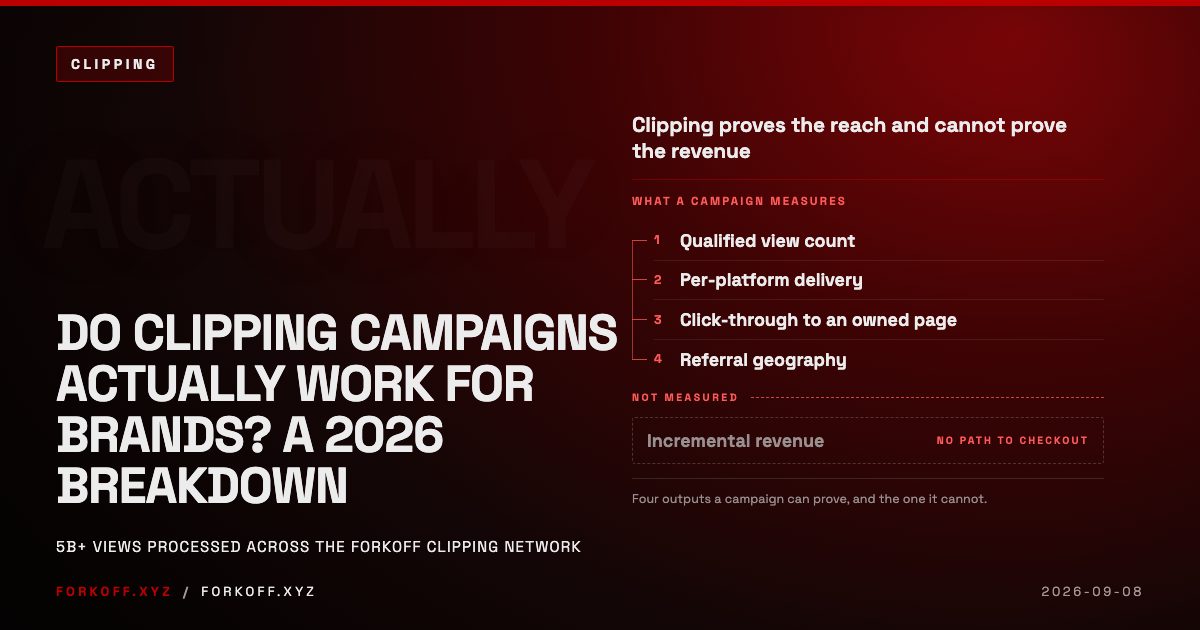
Do Clipping Campaigns Actually Work for Brands? A 2026 Breakdown
Clipping campaigns buy reach at a low unit price and cannot prove revenue. The 2026 breakdown of CPM by content signal, attribution and vendor diligence.
 Read
Read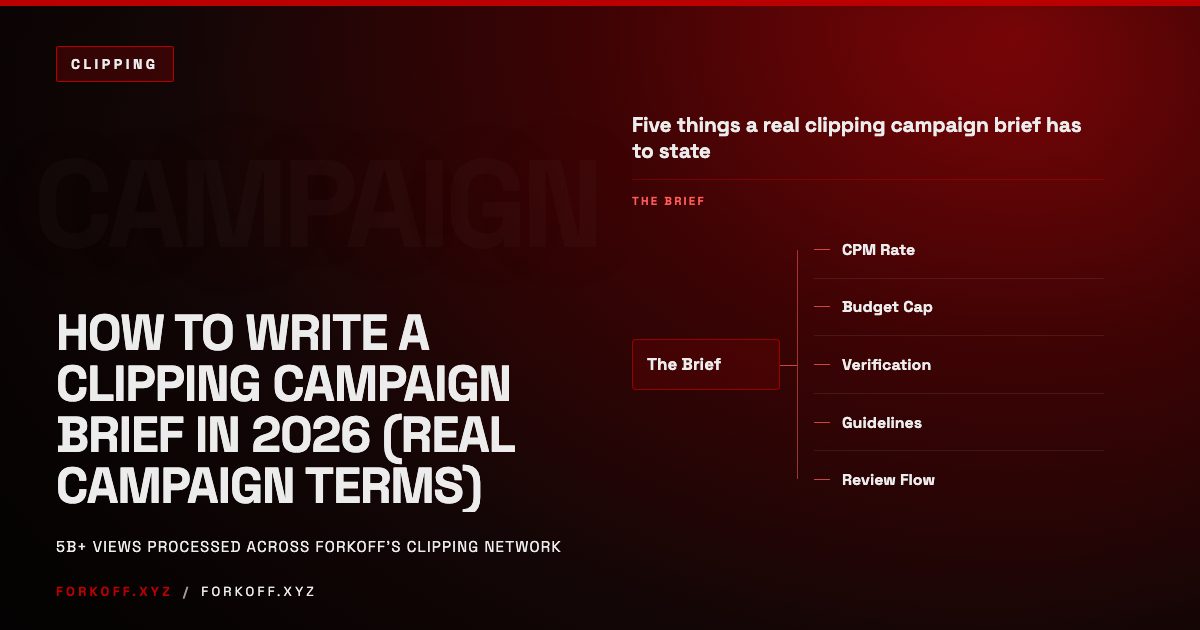
How to Write a Clipping Campaign Brief in 2026 (Real Campaign Terms)
A clipping campaign brief sets the CPM, budget cap, submission rules, and review flow that decide whether a campaign gets quality clips or wasted budget.
Read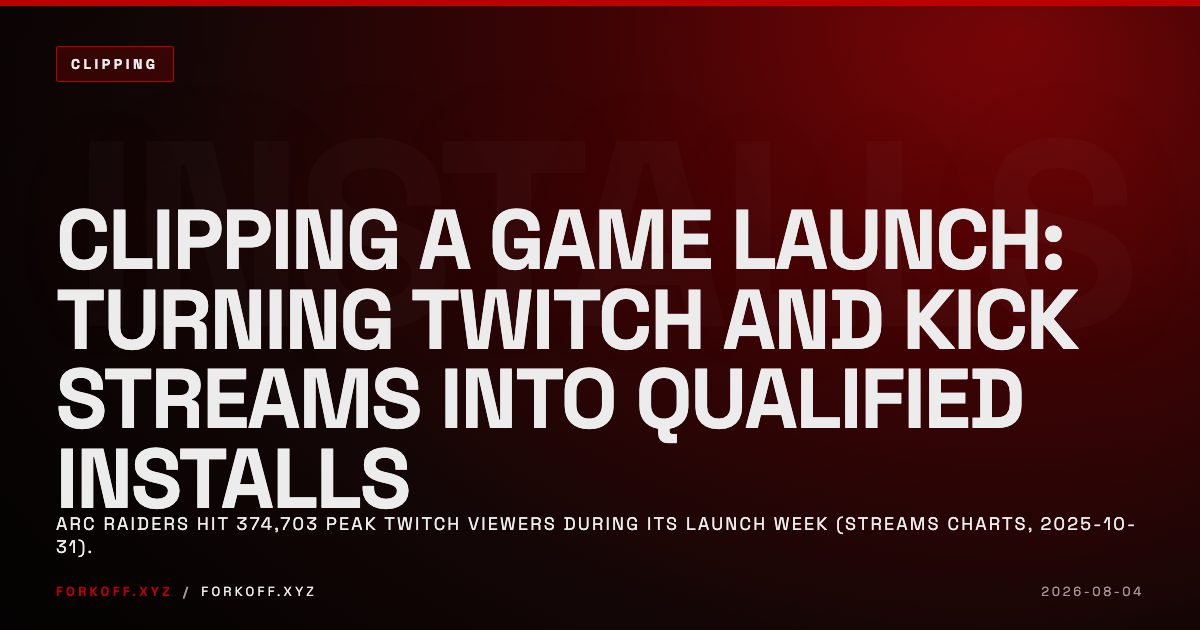
Clipping a Game Launch: Turning Twitch and Kick Streams Into Qualified Installs
A launch-week playbook for clipping Twitch and Kick streams into qualified installs, with Drops mechanics, wishlist math, and a 7-day production calendar.
Read