
Clipping
Clipping is the visual layer of the FORKOFF founder distribution stack. Outcome-priced at $0.003 CPQV, audit ledger on every cycle, no retainer dilution. The posts below cover creator-led clipping, geotargeted reach, qualified-view thresholds, and why the FORKOFF clipping engagement runs on the clips.forkoff.xyz subdomain rather than as a generic agency retainer. See the FORKOFF clipping engine.
Written by the operators running the engagements, measured on a clipping network that has processed 5B+ views.
35 articles in Clipping. All FORKOFF blog.
How FORKOFF approaches clipping
Clipping only works as a distribution channel when the source footage is treated as raw material, not a finished asset to chop into equal segments. A 90-minute founder podcast or keynote carries maybe six to ten moments with real standalone pull: a specific claim, a contrarian take, a number that surprises, a visible reaction. Everything else is context that belongs in the long-form cut, not the clip queue.
Choosing which moments to cut
The editors on a FORKOFF clipping engagement watch the full source before touching a timeline, flagging timestamps where the speaker says something that would stop a scroll on its own, without the eight minutes of setup around it. A clip that needs the original video's context to make sense is a bad clip, no matter how well it's captioned. This is slower than running footage through an auto-clipper that scores segments by audio energy, and it is the difference between a clip that gets replayed and one that gets skipped after two seconds.
Geotargeted distribution, not spray-and-pray
Uploading the same cut to every clipper's account regardless of who follows them wastes the qualified-view budget on audiences that were never going to convert. FORKOFF's clipping network routes each cut toward creator accounts whose existing audience geography and interest graph match the founder's actual buyer, so a B2B SaaS clip skips general meme-page distribution in favor of accounts an operator or technical buyer is more likely to already follow. Fewer total views, more of them qualified.
Why outcome pricing changes the incentive
A flat monthly clipping retainer pays the agency the same whether the clips land or not, so the incentive is to ship volume and move on. Pricing per qualified view, the $0.003 CPQV floor FORKOFF runs on, only pays out when a real person watches long enough for the view to count as qualified, which forces the editorial team to keep iterating on hooks and cut points instead of treating the deliverable as done once it's exported. Every cycle's spend is tracked against which specific clips actually earned it, so the next batch can drop what isn't working rather than repeating it at scale.
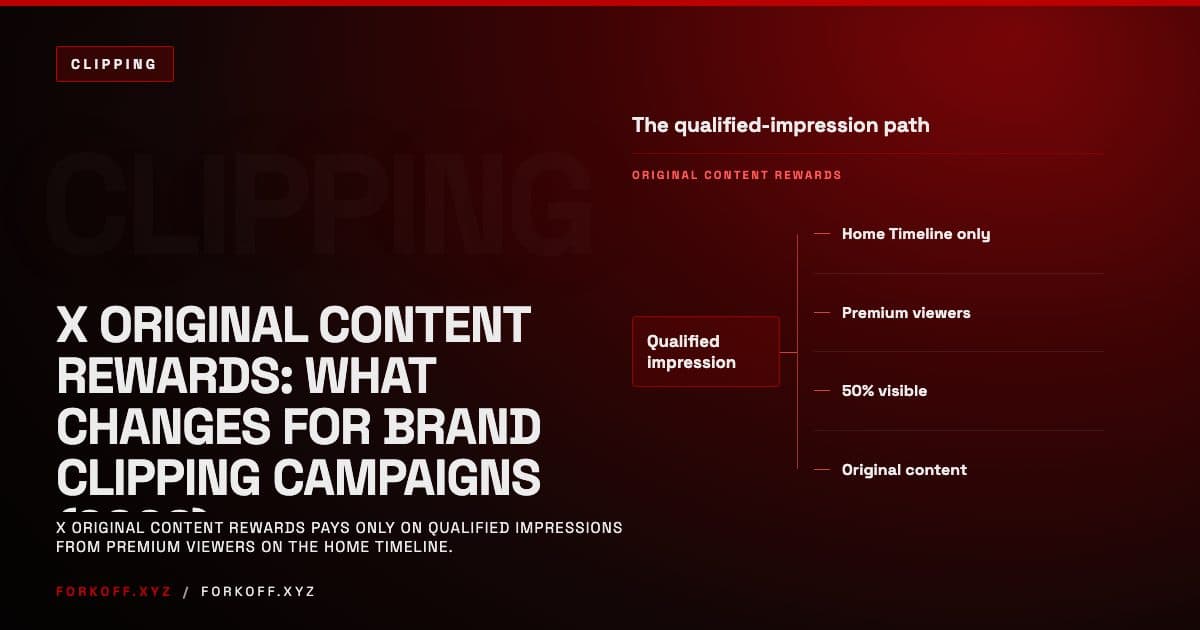
X Original Content Rewards: What Changes for Brand Clipping Campaigns (2026)
X swapped Creator Revenue Sharing for Original Content Rewards, so recycled-clip payouts are gone. What brands running clipping campaigns change now.
 Read
Read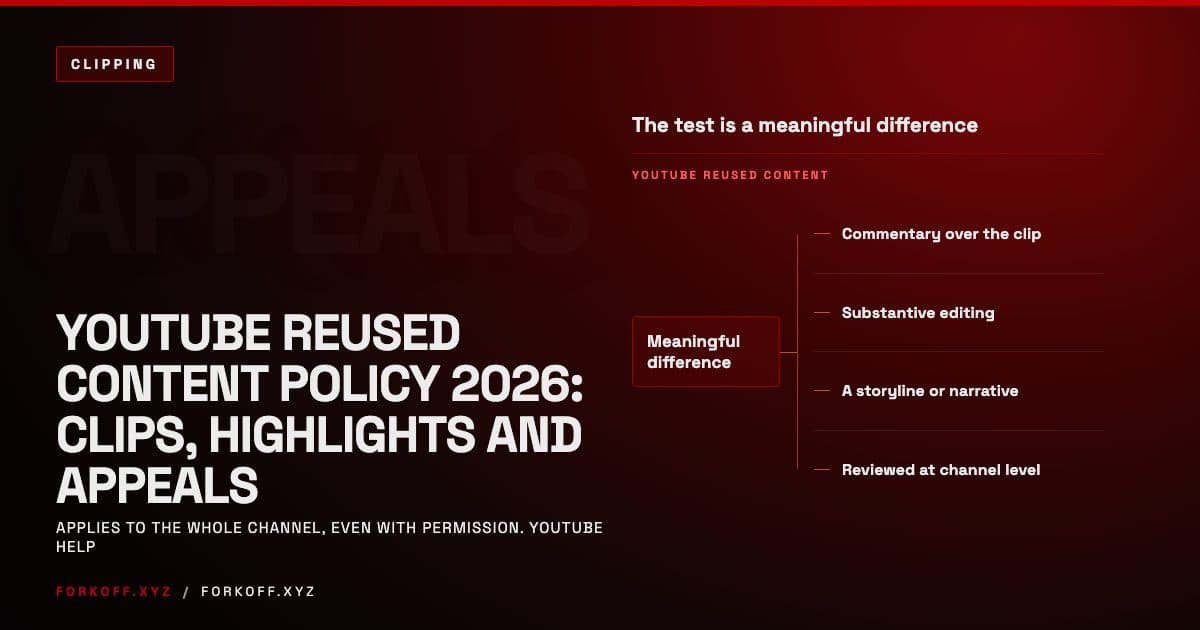
YouTube Reused Content Policy 2026: Clips, Highlights and Appeals
What YouTube's reused content policy actually says, how it treats clips, stream re-uploads and compilations, how to appeal, and how brand clipping stays clean.
Read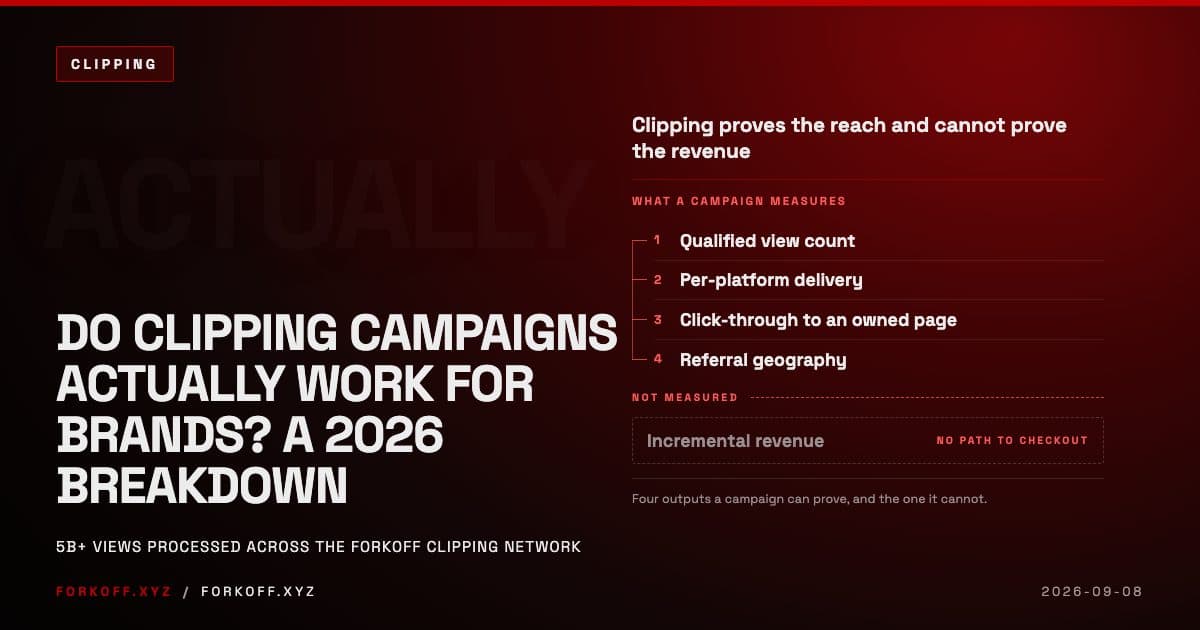
Do Clipping Campaigns Actually Work for Brands? A 2026 Breakdown
Clipping campaigns buy reach at a low unit price and cannot prove revenue. The 2026 breakdown of CPM by content signal, attribution and vendor diligence.
Read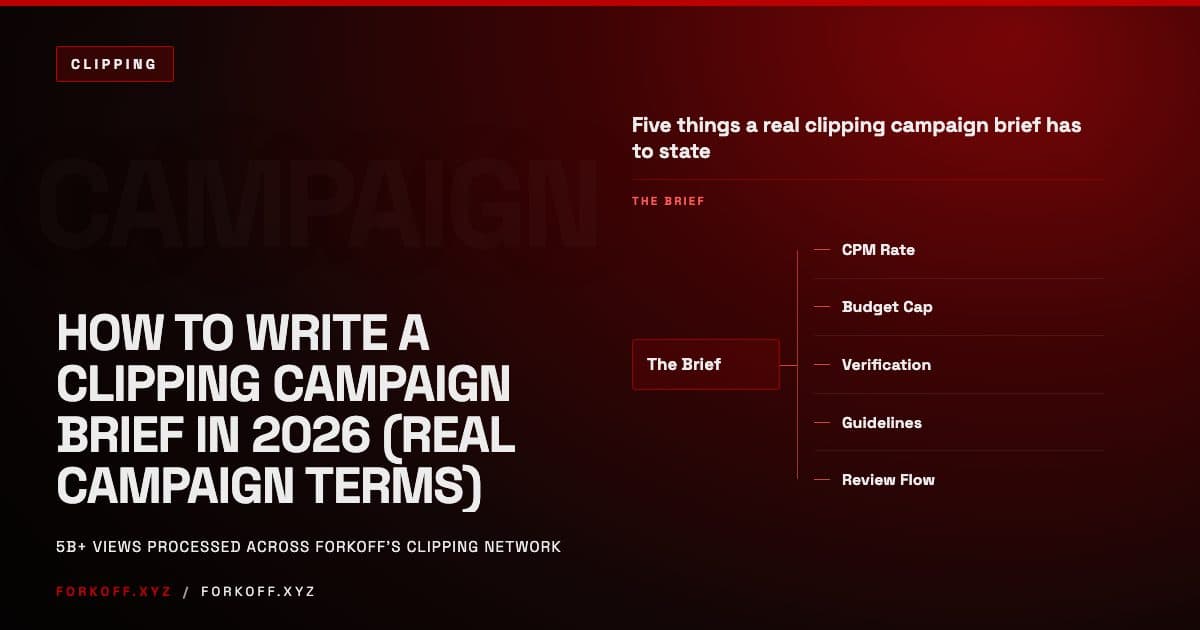
How to Write a Clipping Campaign Brief in 2026 (Real Campaign Terms)
A clipping campaign brief sets the CPM, budget cap, submission rules, and review flow that decide whether a campaign gets quality clips or wasted budget.
Read
Clipping a Game Launch: Turning Twitch and Kick Streams Into Qualified Installs
A launch-week playbook for clipping Twitch and Kick streams into qualified installs, with Drops mechanics, wishlist math, and a 7-day production calendar.
Read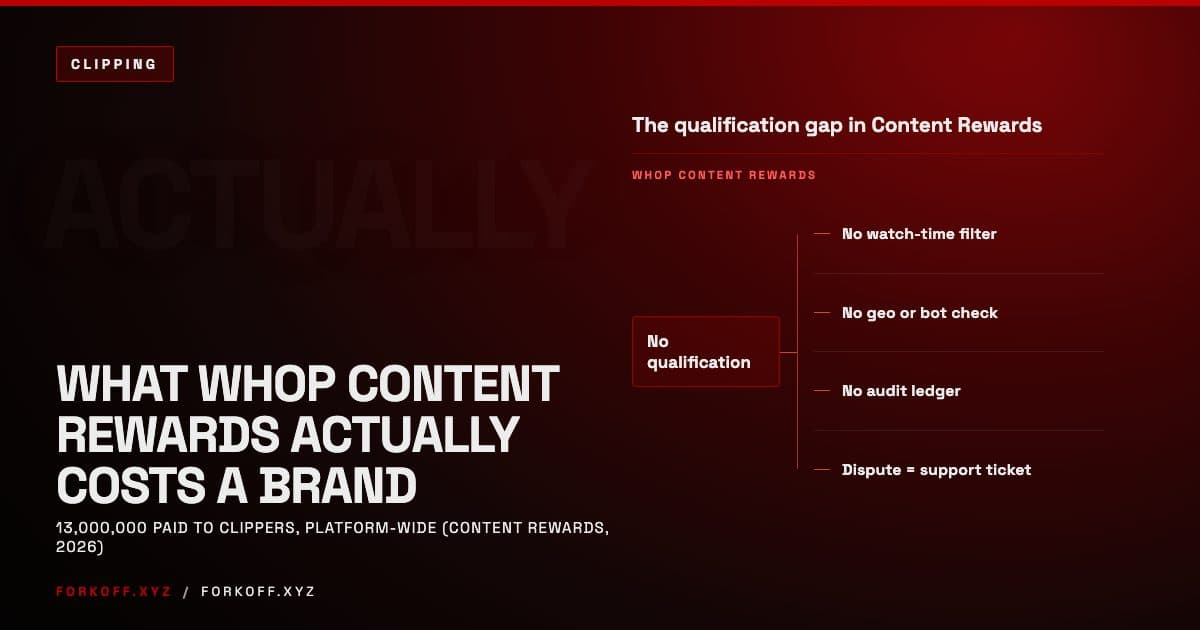
What Whop Content Rewards Actually Costs a Brand, and When It Beats a Managed Campaign
A cost breakdown of Whop Content Rewards for brands: real campaign budgets, CPM bands, the qualification gap, and when a managed clipping lane wins instead.
Read
Is Hiring a Clipping and Distribution Agency Worth It? The 2026 Decision
Is hiring a clipping and distribution agency worth it in 2026? A real cost-benefit framework: CPQV economics, the source-hours break-even, and when DIY wins.
Read
How Many Views Is Actually Viral in 2026 (By Platform and Follower Count)
How many views is viral in 2026, by platform and follower count. The absolute thresholds, the 10x-baseline rule, and why most viral views never convert.
Read
AI Clipping Tool vs. Clipping Agency: What the Benchmarks Actually Show
How to choose between an AI clipping tool and a clipping agency in 2026, benchmarked on cost per qualified view rather than cut volume.
Read
8 Clipping Campaign Mistakes That Quietly Burn Brand Budget (2026)
The eight clipping campaign mistakes that quietly drain brand budget in 2026, what each one costs, and the fix to run before funding the next campaign.
Read
Performance Clipping Just Became an Ad Line Item: The 2026 Numbers
Pay-per-view clipping turned into a standard brand ad line item in 2026. The search data, the CPM math, and the named-brand rates behind the boom.
Read
What a Clipping Agency Actually Does in 2026 (and How to Choose One)
A clipping agency runs a network of clippers that turns long-form content into hundreds of distributed short clips, billed on results, not hours.
Read
What Is Clip Farming? How Clippers Get Paid in 2026 (and Where It Breaks)
Clip farming is mass-producing clips across many accounts to earn per-view payouts from creator campaigns. How it works, what it pays, and where it breaks.
Read
What Is Clipping? The Creator Clip Economy, Explained (2026)
Clipping is cutting one piece of long-form content into many short clips and distributing them across platforms to buy reach. Here is how it works in 2026.
Read
What a $10K Clipping Campaign Actually Buys: Line-Item Case Study
A line-item teardown of one managed clipping campaign: clipper payouts, qualified-view verification, platform mix, and the net qualified views it delivered.
Read
CPM Rates for Clipping in 2026 (Real Benchmarks by Platform and Niche)
Real CPM rates for clipping campaigns in 2026 across Whop, TikTok, YouTube Shorts, Kick, and Instagram. Net rates, agency cuts, and qualified-view math.
Read
How We Detect Bots: the 3-Layer Protection System for Clipping Views
Network, behavioral, reconciliation. The 3-layer bot detection system FORKOFF runs on every clipping campaign, with the per-view audit ledger.
Read
Clipping Agency vs In-House Editor vs Opus Clip: CPQV Ledger 2026
Clipping agency vs in-house editor vs Opus Clip on cost per qualified view. A 3-lane ledger of hours, payroll and attribution for 2026 founders.
ReadShowing 1-18 of 35 blogs
All 35 Clipping posts
- X Original Content Rewards: What Changes for Brand Clipping Campaigns (2026)
- YouTube Reused Content Policy 2026: Clips, Highlights and Appeals
- Do Clipping Campaigns Actually Work for Brands? A 2026 Breakdown
- How to Write a Clipping Campaign Brief in 2026 (Real Campaign Terms)
- Clipping a Game Launch: Turning Twitch and Kick Streams Into Qualified Installs
- What Whop Content Rewards Actually Costs a Brand, and When It Beats a Managed Campaign
- Is Hiring a Clipping and Distribution Agency Worth It? The 2026 Decision
- How Many Views Is Actually Viral in 2026 (By Platform and Follower Count)
- AI Clipping Tool vs. Clipping Agency: What the Benchmarks Actually Show
- 8 Clipping Campaign Mistakes That Quietly Burn Brand Budget (2026)
- Performance Clipping Just Became an Ad Line Item: The 2026 Numbers
- What a Clipping Agency Actually Does in 2026 (and How to Choose One)
- What Is Clip Farming? How Clippers Get Paid in 2026 (and Where It Breaks)
- What Is Clipping? The Creator Clip Economy, Explained (2026)
- What a $10K Clipping Campaign Actually Buys: Line-Item Case Study
- CPM Rates for Clipping in 2026 (Real Benchmarks by Platform and Niche)
- How We Detect Bots: the 3-Layer Protection System for Clipping Views
- Clipping Agency vs In-House Editor vs Opus Clip: CPQV Ledger 2026
- Spencer Pratt Spent $30K on Clipping and Hit 25M Views (Operator Teardown)
- How Much Do Clippers Earn in 2026 (TikTok, Kick, YouTube)
- The Managed Clipping Playbook 2026: How CPQV Replaced Subscriber Counts
- Opus Clip vs Managed Clipping Cost 2026: The Hidden Hours
- Best AI Video Editor 2026: 9 Tools Ranked Honestly
- Best Clipping Software 2026: 14 Tools and Agencies Ranked
- How to Clip on Twitch: Desktop, Mobile, OBS, and Vertical Re-Cuts
- OpusClip Review 2026: Honest Long-Form Deep Dive
- Submagic Review 2026: Honest Pricing, Captions, Magic Clips, Verdict
- Whop Review 2026: Is It Legit? Pricing + Verdict
- Why 20,000 YouTube Subs Mean Nothing in 2026 (And What Replaces Them)
- Managed Clipping Revenue: What Happened After the First 13 Days
- OpusClip vs Vizard vs Managed Clipping [Data]
- Qualified Views: The Content Metric That Predicts Pipeline
- Podcast Clipping Agency Pricing 2026: $3K Floor, $300K Ceiling
- The Clip Economy: OpenAI's $200M Podcast Bet Rewires Attention
- Podcast Clipping Revenue: 1.19M Views, $1,290 MRR Case Study
Read sister categories
Podcast
Founder podcasts that compound. Two to four founder hours per week converted into multi-platform recall, not vanity downloads.


Founder Funnel
Founder-led growth playbooks that survive past PMF. Distribution architecture, not single-channel hacks.

Event Management
Event activations that compound across the calendar. Founder houses, vox pops, hacker houses, and citation blitzes.

Ecosystem Strategy
Ecosystem distribution playbooks for protocols, foundations, and AI platforms past PMF. Builder grants and category narrative architecture.
AI Search and AEO
Getting cited by ChatGPT, Perplexity, Claude and Google AI Overviews. Schema, answer units, and the signals AI crawlers actually read.
Reddit Marketing
Compliant, non-spam Reddit distribution. Operator accounts, subreddit fit, and the moderation rules that decide whether a post survives.
Twitter and X Growth
Founder-led distribution on X. Thread architecture, reply surface, and follower quality over follower count.
Launch Video
Product and company launch video that carries a real launch beat, not a sizzle reel. Format, timing, and what separates reach from noise.

UGC Videos
Creator-made video ads that read as native rather than produced. Briefing, rights, and the volume needed before a winner appears.
KOL and Influencer
Creator and KOL partnerships priced on qualified delivery. Roster screening, authenticity checks, and payout math shown before acceptance.
SaaS GTM
Go-to-market for B2B SaaS past PMF. Qualified pipeline over signups, and the product-health metrics that survive a board review.
Clipping engagements that compound
Outcome-priced engagements, audit-proof on every cycle. Five active engagements per quarter, capped on purpose.
Frequently asked questions
How does the FORKOFF blog organize categories?
Each category maps to a FORKOFF service line: clipping, founder-led growth, podcast, Reddit, Discord, activations, plus uncategorized for cross-cutting posts. Each category index aggregates articles in that lane and links to the underlying service.
How often are new articles added to each category?
We publish 2 to 4 operator-grade articles per week across all categories combined. Most categories see 1 to 2 new pieces per month. Higher-velocity lanes like clipping and founder-led growth get more weekly cadence.
Who writes the category content?
Articles are co-authored by FORKOFF operators and the founders we work with. Every claim ties to an audit ledger entry from a live engagement. Each piece is reviewed against our 3-tier verification matrix before it ships.
Can I subscribe to a specific category feed?
Category-specific RSS feeds are available at /blog/<category>/rss.xml (where supported). All categories also ship to @officialforkoff on X and to the FORKOFF newsletter within an hour of publish.
How do I apply for the related engagement?
Each category page has a primary CTA pointing at the matching FORKOFF service. Apply via Calendly for a 30-minute intro. Five engagements per quarter cap, by application only.
Talk to FORKOFF about your clipping engagement.
Receipts, deep dives, and playbooks.
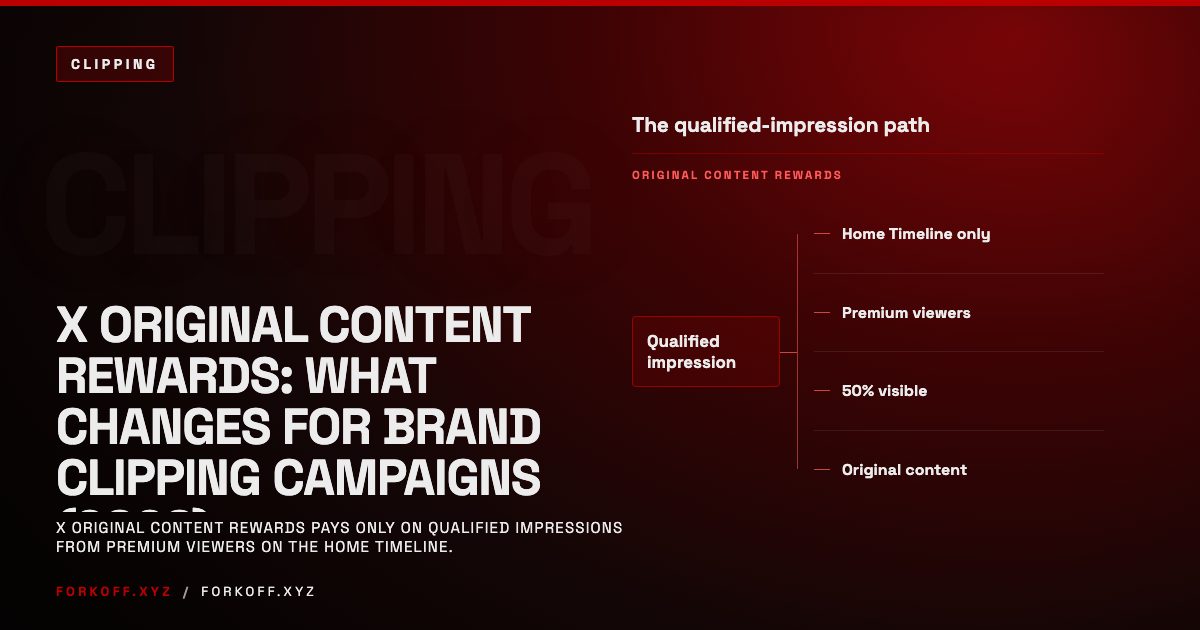
X Original Content Rewards: What Changes for Brand Clipping Campaigns (2026)
X swapped Creator Revenue Sharing for Original Content Rewards, so recycled-clip payouts are gone. What brands running clipping campaigns change now.
Read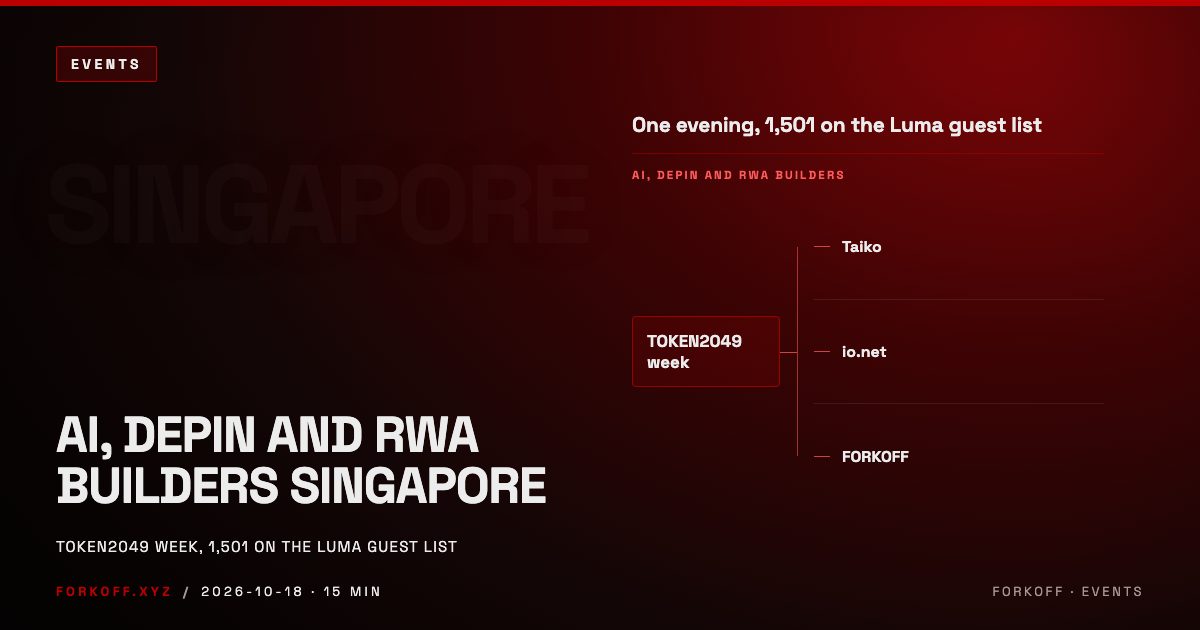
AI, DePIN and RWA Builders at TOKEN2049 Singapore 2025: 1,501 on the Guest List
A recap of AI, DePIN and RWA Builders, the evening side event FORKOFF hosted with Taiko and io.net during TOKEN2049 week in Singapore: panels, partners, data.
Read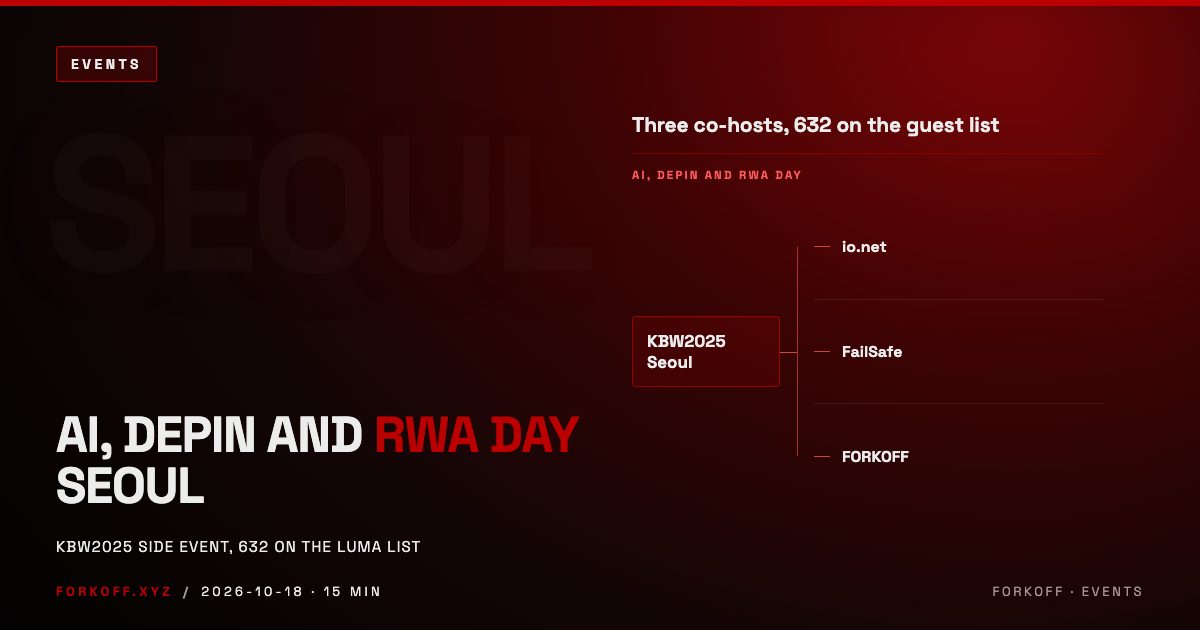
AI, DePIN and RWA Day at Korea Blockchain Week 2025: 632 on the Guest List
A recap of AI, DePIN and RWA Day, the half-day side event FORKOFF co-hosted with io.net and FailSafe in Seoul during KBW2025: hosts, agenda and real numbers.
Read