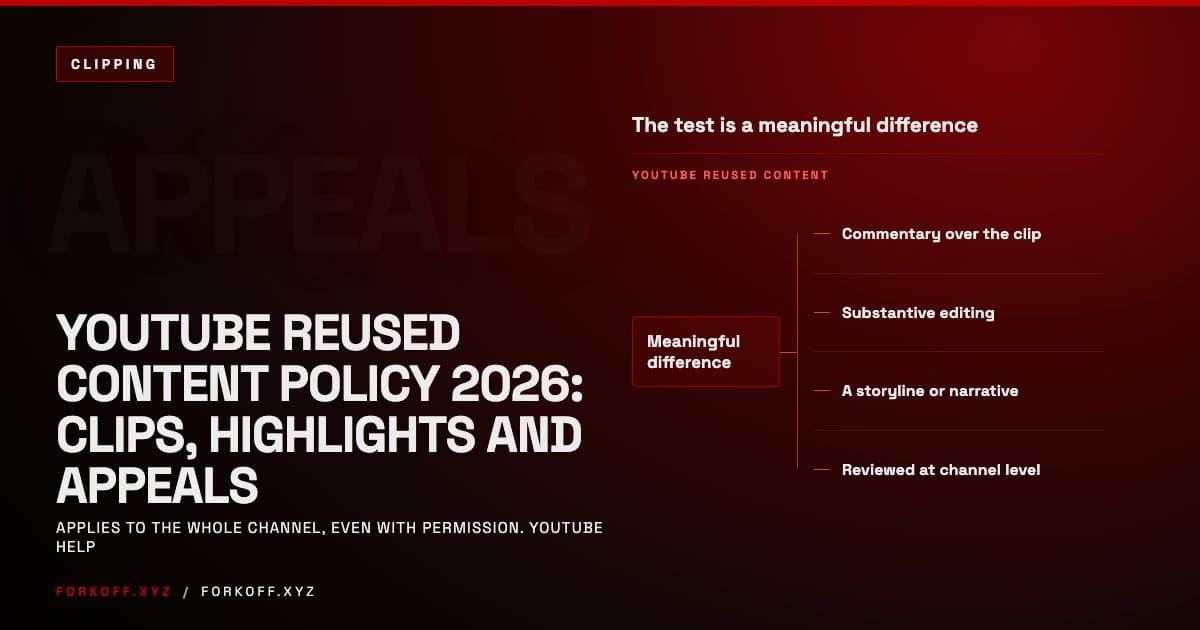
YouTube's reused content policy is a monetization rule that asks one question about a channel: can a viewer tell there is a meaningful difference between the original material and your upload? Clips, highlights, stream re-uploads and compilations are not banned. They fail when they add no significant commentary, substantive editing, or educational or entertainment value, and when they fail, YouTube can remove monetization from the whole channel, even if the original creator gave permission.
The short version
YouTube's reused content policy is a monetization rule, not a copyright rule. It covers channels that repurpose content already on YouTube or elsewhere online without adding significant original commentary, substantive modifications, or educational or entertainment value. It is judged on the channel as a whole, it applies even when the original creator gave you permission, and it can remove monetization from an entire channel rather than one video. Clips are not banned. A clip used for a critical review, a replay where you explain the moves, a reaction with real commentary, or edited footage where you add a storyline all appear on YouTube's own allowed list. What fails is minimal change: moments stitched together with little or no narrative, short videos compiled from other platforms, and content copied without substantive modification. If a Partner Program application is rejected, you can appeal within 21 days with an unlisted video under five minutes that shows how you make the content, or re-apply after 30 days. For a brand clipping campaign the practical rule is simple: every clip should show viewers a meaningful difference from the source, and the account posting it should be one that clearly adds something.

Most of what gets written about this policy is written from one of two angles. Creators whose channel was just rejected want to know what they did wrong, and tool vendors want to show that their auto-clipper is safe. Neither angle starts where it should, which is with the policy text itself. This post does. It quotes YouTube's own help pages, walks through every example on the allowed and not-allowed lists, and then applies them to the formats a clipping team actually posts: stream VODs, highlights, Shorts cut from long-form, and compilations.
At FORKOFF we run clipping as distribution infrastructure for brands, and the reused content question comes up in almost every campaign brief, usually phrased as "will these clips get the accounts in trouble?" The honest answer is that the policy is narrower than the panic around it, and stricter than the tool marketing suggests. Every YouTube policy statement below was checked against support.google.com on 2026-09-28, and where Google's own pages say nothing, this post says so rather than guessing.
What is YouTube's reused content policy?
YouTube's reused content policy is a section of the YouTube channel monetization policies. It defines reused content as channels that repurpose content already on YouTube or another online source without adding significant original commentary, substantive modifications, or educational or entertainment value, and it decides whether that channel can earn through the YouTube Partner Program.
The full definition, from YouTube's channel monetization policies page, reads: "Reused content refers to channels that repurpose content that's already on YouTube or another online source without adding significant original commentary, substantive modifications, or educational or entertainment value." YouTube adds that reused content may also be known as duplicative or scraped content, meaning taking unique or original content from other websites and publishing it as your own.
Three details in that sentence do most of the work. The subject is "channels", not videos. The source can be YouTube or anywhere else online, so a clip lifted from TikTok, a podcast feed or a Twitch VOD counts the same as one lifted from another YouTube channel. And the test is additive: the question is never whether you used someone's footage, only whether you added enough on top of it.
Operator noteThe whole policy is one question. Can a viewer tell what this upload added to the source?
It is worth being precise about what the policy does not do. It is not a Community Guidelines rule, so a video that fails it is not removed for that reason. It is not a copyright rule, so it does not generate claims or strikes. It governs one thing, which is whether a channel qualifies to share ad revenue and other monetization features. That is still a large thing for a creator, and for a clipping program it is the clearest public statement YouTube makes about what kind of clip it wants on the platform.
What does the policy say, line by line?
The policy text has four parts: the definition, a statement that reviewers check the channel as a whole, a list of what is allowed to monetize, and a list of what is not. It also says the rule applies even with the original creator's permission and is separate from copyright. Each part answers a question creators usually argue about.
The review scope comes first. YouTube says that to figure out whether content is reused, "our reviewers will check your channel to understand how you created, participated in, or produced your content." The page lists four things reviewers may check: the videos, the channel description, the video titles and the video descriptions. Then the sentence that matters most for anyone running more than one account: "Our reused content policy applies to your channel as a whole. If you have videos that violate our guidelines, or if we cannot clearly tell that you made the content, monetization may be removed from your entire channel."
What a reviewer reads before deciding a channel is reused
The allowed section opens with the principle. YouTube says it wants to reward creators for original and authentic content that adds value to viewers, and that if you "put a funny or thoughtful spin on content you didn't originally create", you have transformed it. The key line is short: "we allow reused content if viewers can tell that there's a meaningful difference between the original video and your video." The same section warns that other policies, such as copyright, still apply to individual videos.
The not-allowed section opens with its own principle: "Taking someone else's content, making minimal changes, and calling it your own original work would be a violation of this guideline. If we cannot tell that the content is yours, it may be subject to our reused content policy." Both examples lists follow, and both are marked as not exhaustive.
The review is of the channel, so one bad upload is not one bad upload
The policy applies to a channel as a whole. Reviewers may check the videos, the channel description, the video titles and the video descriptions to understand how the creator made or took part in the content, and if some videos violate the guidelines, or the reviewer cannot clearly tell who made the content, monetization may be removed from the entire channel. For anyone running several channels, or a network of clipper accounts, the unit of risk is the account, not the clip.
Source: YouTube Help, YouTube channel monetization policies
Read together, the four parts describe a reviewer with a simple job and limited time. They open the channel, look at a sample of uploads and the text around them, and ask whether this account is making something or re-posting something. The rest of this post is about making the answer to that question obvious.
What counts as reused content on YouTube?
Reused content, in YouTube's own examples, is material where the uploader's contribution is missing or minimal: moments stitched together with little narrative, short videos compiled from other sites, content uploaded many times by other creators, footage copied without substantive changes, and silent reactions. Permission does not change the verdict on any of them.
YouTube's list of what is not allowed to monetize has nine entries. Clips of moments from your favorite show edited together with little or no narrative. Short videos you compiled from other social media websites. Collections of songs from different artists, even if you have their permission. Content uploaded many times by other creators. Promotion of other people's content, even if you have permission. Content downloaded or copied from another online source without any substantive modifications. Content that gets views from mostly non-verbal reactions to your videos without added voice commentary. Content that exclusively features readings of other materials you did not originally create, like text from websites or news feeds. And songs modified to change the pitch or speed but otherwise identical to the original.

Four of those nine are about clipping directly. The first describes a highlights channel with no thread running through it. The second describes a Shorts account that re-posts the best of TikTok. The fourth, "content uploaded many times by other creators", describes what happens when the same clip goes out from dozens of accounts with no variation. The sixth is the catch-all for any clip that is the source with the edges trimmed.
The phrase "even if you have permission" appears twice in the list. That is deliberate, and it is the part of the policy most often missed by editors who work for a streamer, by fan channels running with a creator's blessing, and by brands whose clippers hold usage rights. A licence answers who may use the footage. It does not answer what the upload added.
I wanted clarification because I've seen lots of creators just have clips channels that post highlights from streams/existing videos with minimal changes. I want to do the same thing but I didn't want to go in blind
That comment, from the creator who asked YouTube Support directly before launching a clips channel, is the reason this policy confuses people. Plenty of channels do post highlights with minimal changes and appear to get away with it. Some have simply not been reviewed recently, some are not in the Partner Program, and some add more than it looks at first glance. None of that makes minimal-change clips safe. It makes them untested.
What does YouTube allow under the reused content policy?
YouTube allows reused material when viewers can tell there is a meaningful difference between the original and your upload. Its own allowed examples include clips used for a critical review, sports replays where you explain the moves, reaction videos with commentary, edited footage where you add a storyline, and footage with substantive audio and visual editing.
The allowed list also has nine entries, and it is longer and more generous than most creators expect. Using clips for a critical review. A scene from a movie where you have rewritten the dialog and changed the voiceover. Replays of a sports tournament where you explain the moves a competitor made to succeed. Reaction videos where you comment on the original video. Edited footage from other creators where you add a storyline and commentary. Edits to remixed content on Shorts, like adding original content to a song from YouTube's library, or adding the original audio or video segment from other videos to your content. Content that primarily features the uploading creator in the video. Reused content from other online sources where the creator is either visible in the content or explains how the creator added to the content. And edited footage with audio and visual effects on top of the reused content that demonstrates substantive editing and shows it is unique to your channel.

What YouTube's reused content policy allows and does not allow, in its own examples
| Allowed to monetize | Not allowed to monetize | Source |
|---|---|---|
| Using clips for a critical review | Show moments stitched with little or no narrative | measured |
| Movie scene with rewritten dialog and voiceover | Short videos compiled from other social media websites | measured |
| Sports replays where you explain the moves | Song collections, even with permission | measured |
| Reaction videos where you comment on the original | Content uploaded many times by other creators | measured |
| Edited footage with storyline and commentary | Promotion of other people's content, even with permission | measured |
| Content that primarily features the uploading creator | Copied without substantive modifications | measured |
| Creator visible, or explains what was added | Mostly non-verbal reactions, no voice commentary | measured |
| Substantive audio and visual editing | Readings of others' text, like news feeds | measured |
n = 16 · as of 2026-09-28
Method: Every row is a paraphrase kept close to the wording of YouTube's own examples on the YouTube channel monetization policies page, read on 2026-09-28. YouTube notes that both lists are illustrative and not exhaustive. A row is wrong if the live policy page no longer lists the example on that side.
The left column has one thing in common. A viewer can tell what the uploader added.
Every allowed entry has a person doing something visible to the footage: reviewing it, explaining it, voicing over it, reacting with words, building a story across it, or editing it heavily enough that the result could only have come from that channel. That is the practical definition of meaningful transformation, and it is more useful than any percentage or rule of thumb, because it is the question the reviewer is actually asking.
Two entries deserve a closer look for clipping. "Content that primarily features the uploading creator" is the clause that protects a creator's own clips channel, because the person in the footage is the person uploading it. "Reused content from other online sources where the creator is either visible in the content or explains how the creator added to the content" is the clause that protects commentary formats, and it hints at something reviewers value: explanation. A clip whose description and on-screen text say what was added is easier to judge than a clip that leaves the reviewer to guess.
Is reused content the same as copyright?
No. YouTube states that reused content is separate from its copyright enforcement, so it is not based on copyright, permission or fair use. A video can receive no copyright claims and still count against a channel under the reused content policy, and a licensed clip can clear Content ID and still fail a monetization review.
The exact wording, from the same policy page: "This policy applies even if you have permission from the original creator. Reused content is separate from YouTube's Copyright enforcement, which means it's not based on copyright, permission, or fair use. This guideline means sometimes, you may not get claims against your content, but your channel may still violate our reused content guidelines."
Permission is not a defence under this policy
YouTube's policy text says the reused content rule applies even if you have permission from the original creator, and that it is separate from copyright enforcement, so it is not based on copyright, permission or fair use. That single sentence explains most of the confused threads about it. An editor with a signed licence, a creator re-posting their own stream, and a brand whose clippers hold usage rights can all clear Content ID and still fail a monetization review, because the reviewer is asking a different question: can a viewer tell what this upload added?
Source: YouTube Help, YouTube channel monetization policies
This is the single most useful sentence for a brand running clips. Copyright is a question about ownership, and a brand usually owns its own footage outright. Reused content is a question about contribution, and ownership does not answer it. A brand can license its podcast to 50 clippers and still end up with 50 accounts that YouTube reads as re-posting the same material, because the licence was the only thing each account brought.
Operator noteA licence clears copyright. It does not clear reused content. Brief every clipper for the edit, not the rights.
The inverse is also true, and it matters for commentary channels. A critical review that uses someone else's clips appears on the allowed list for reused content, yet the same video can still receive a copyright claim, because the two systems answer different questions. YouTube's own note on the allowed examples says as much: they do not violate the reused content policy, but other policies such as copyright still apply. Passing one tells you nothing about the other.
How is reused content different from inauthentic content?
Reused content has its own section on YouTube's monetization policies page, and templated work sits in a separate section headed Generic or Repetitive Content. YouTube's July 15, 2025 update note renamed its repetitious content policy to inauthentic content, which covers mass-produced or templated videos that feel interchangeable. Reused content covers material taken from somewhere else without meaningful change. YouTube said the 2025 update made no change to reused content.
The update note on the policy page is specific. On July 15, 2025, YouTube described a minor update to its repetitious content policy, clarifying that it includes content that is repetitive or mass-produced, renamed that policy to inauthentic content, and added: "There is no change to our reused content policy which reviews content like commentary, clips, compilations, and reaction videos." So the date that circulates in creator threads as the reused content crackdown was, by YouTube's own account, a change to a different rule. Trade coverage at the time, from Search Engine Journal and Social Media Today, framed the update the same way, as a clarification aimed at mass-produced content.

The Generic or Repetitive Content section lists its own not-allowed examples: similar or repetitive content with low educational value, commentary, narratives or minimal variation across videos; characters put in the same situation over and over with the same outcome; image slideshows, templated storylines or scrolling text with minimal or no narrative, commentary or educational value; and AI-generated content made with generic or unoriginal templates that gives the impression of mass production without the creator's own insights or perspective. Its allowed examples are a shared intro and outro with different content, and a series with a distinct storyline, focus or concept in each video.
For clipping the overlap is obvious. A clips account that posts 40 near-identical cuts a week, each with the same caption template and no narrative, can trip both rules at once: reused because the footage came from elsewhere unchanged, inauthentic because the channel reads as templated output. YouTube's own Creator Insider channel published an explainer on the inauthentic side in July 2026, embedded later in this post, and it is the one to watch if a rejection cites both policies.
Do clips and highlights count as reused content?
Clips and highlights count as reused content only when they add nothing a viewer can see. YouTube's allowed list includes clips used for a critical review, explained replays and edited footage with a storyline, while its not-allowed list names moments edited together with little or no narrative. The format is neutral. The edit decides it.
That distinction is worth taking seriously because clipping, as a format, is built on short cuts from longer material. We covered the economics of that format in what clipping is and how the creator clip economy works, and the incentives that push some clippers toward volume over care in what clip farming is and where it breaks. The reused content policy is where those incentives meet a reviewer.
How each clip format reads against the policy, and what moves it to the safe side
| Format | How it reads | What moves it to the safe side | Source |
|---|---|---|---|
| Full stream re-uploaded as a VOD | Close to the original, little added | Own channel, clear identity, chapters, edits | derived |
| Highlights cut from a stream | Depends on the edit and narrative | A storyline across moments, context on screen | derived |
| Clip posted as a regular video | Minimal change if uncut | Hook, commentary, captions, a reason it exists | derived |
| Short cut from long-form | Often near-verbatim | Reframe, caption, add the setup the viewer missed | derived |
| Compilation of other creators | The policy's own not-allowed example | Ranked commentary or analysis of every clip | derived |
| Reaction video | Allowed with real commentary | Voice commentary, not just faces | derived |
as of 2026-09-28
Method: Derived by mapping common clip formats onto the allowed and not-allowed examples in YouTube's policy text. It is a reading of the policy, not a YouTube ruling on any specific channel. A row is wrong if YouTube's published examples or a documented review decision contradict it.
No format is automatically safe or automatically banned. The edit decides which column it lands in.

A highlight reel that simply strings together the ten loudest moments of a stream is close to YouTube's first not-allowed example, clips of moments edited together with little or no narrative. The same ten moments cut into a reel that explains why each one mattered, sets up the context the viewer missed and builds toward a payoff is close to the allowed example of edited footage with a storyline and commentary. The source footage is identical. What changed is whether the uploader did editorial work a viewer can notice.
Short clips cut from long-form sit in the middle. A 30 second Short that lifts a speaker's best line verbatim, with auto-captions and nothing else, adds very little. The same Short with a hook written for people who never saw the episode, an on-screen line that frames the claim, and a cut that removes the setup a feed viewer does not need adds a good deal. The Twitch and Kick side of this, including vertical re-cuts, is covered in our guide to clipping on Twitch, and the game-launch version of the same workflow in clipping a game launch from Twitch and Kick streams.
Can you re-upload your own livestreams as VODs, highlights and Shorts?
Generally yes, but the policy gives no blanket exemption for your own footage. A YouTube Support reply shared in August 2026 said a creator may build a clips channel from their own long-form content, provided the clips carry a meaningful difference or added value. Stream editors have reported suspensions where the same underlying stream appeared in several formats.
The clearest recent example is public. On 2026-09-25 an editor who cuts clips and VODs for a streamer posted on X that YouTube Support had told him livestreamer channels uploading the same underlying content as VODs, highlights, dedicated videos, clips and Shorts could fall under the reused content policy and be disqualified from the Partner Program. He had permission for all the footage. The post reached 69,528 views in three days.
visa
@vvvvisa
This is bad for all livestreamers uploading their content to YouTube in different formats ⚠️ What I was just told by YouTube Support is scary, as this would make it very dangerous for any livestreamer to upload videos from their streams in multiple formats, which has been the st… Show more
Based on what I was told, livestreamer channels that upload the same underlying content in multiple formats could fall under the reused content policy and be disqualified from YPP. I have permission to use all of the footage I work with.
Read that carefully, because it is one editor's account of a Support conversation, not a policy change. Nothing on YouTube's policy page says multi-format uploads are banned. What the page does say explains why his channel could still be at risk: the policy applies even with permission, it is judged on the channel as a whole, and one of its not-allowed examples is content uploaded many times. A channel whose uploads are mostly the same stream in five wrappers can read, to a reviewer sampling it, like the same content uploaded many times.
The counterweight comes from a creator who asked YouTube Support before launching a clips channel from his own long-form videos, and posted the reply to r/PartneredYoutube in August 2026. The answer was yes, with a condition.
(Follow up) Youtube Support’s stance on making a clips channel using content from my long form channel
yes, generally, you are allowed to create a separate clips channel using your own long-form content. However, under the Reused Content Policy, channels that repurpose existing content must add significant value to the material. If you are republishing short portions of your long-form videos, you should ensure there is a meaningful difference or added value in the clips.
The same reply went further than the quote above. Support said the clips should be thoughtfully edited, provide added value such as unique context, commentary or engaging storytelling, and not be uploaded in an automated, spammy manner. The top comment on that thread pointed readers to a Creator Insider video in which Thomas Kim, YouTube's director of creator monetization, sits down with Rene Ritchie, the name the commenter posts under, to talk about reused content. That video is embedded below, and it is the closest thing to hearing the policy explained by the people who apply it.
YouTube Reused Content Policy, Explained!
Creator Insider
YouTube's own Creator Insider channel explaining the reused content policy, 111,516 views when read on 2026-09-28. The closest thing to hearing the policy from the people who apply it.
Are compilation channels allowed to monetize?
Compilation channels can monetize only when each compilation adds something a viewer can see, such as ranked commentary, analysis or a narrated storyline. YouTube's not-allowed list names two compilation patterns outright: moments edited together with little or no narrative, and short videos compiled from other social media websites. Well-cut stitching alone does not qualify.
Compilations are where the policy is least ambiguous, because two of its nine not-allowed examples describe them directly. A "best fails of the week" channel pulling from TikTok is the second example almost word for word. A "top 20 moments" channel that stitches show clips together with title cards is the first.
What moves a compilation across the line is the same thing that moves any clip: the uploader's contribution becoming the point. A countdown where the host explains why each clip ranks where it does, a documentary-style reel that narrates a season, or a breakdown that pauses each clip to analyse it all sit much closer to the allowed examples of critical review, explained replays and storyline with commentary. The Shorts monetization policy draws the same line from the payment side, which is covered further down.

What does meaningful transformation look like in practice?
Meaningful transformation means a viewer can point to what you added. In YouTube's own examples that is commentary, a rewritten voiceover, an explanation of what happened, a storyline across moments, the uploader on screen, or substantive audio and visual editing unique to the channel. In our experience one strong addition beats several cosmetic ones, such as a filter or a colour grade, which YouTube's lists do not mention either way.
YouTube publishes no percentage and no minimum edit. Any figure you see quoted, "change 30 percent", "add 10 seconds of commentary", is somebody's rule of thumb. The published test is qualitative, and the chart below should be read the same way: an illustration of how different clip types stack up on added material, from how we brief clips, not a threshold anyone at YouTube has set.
How much each clip type adds on top of the source footage
Illustrative planning figures from how we brief clips, not a YouTube threshold. YouTube publishes no percentage. The policy asks whether a viewer can tell the difference, and the bars rise in the order that question gets easier to answer.

Read that way, the bars run from 0% for a raw re-upload through 5% and 15% for light edits to 45% for hook and commentary and 60% for a critical review. In practice, five kinds of addition carry most clips across the line. Commentary means your voice or text doing analytical work on top of the source, not a reaction face. A substantive edit means cuts, pacing, sound design and visual effects that could only have come from your channel. Narrative means a storyline that runs across the moments, so the clip has a beginning and a payoff the source did not package that way. Original framing means context the original never had, such as the setup a feed viewer missed, a comparison, or the reason the moment matters now. And the creator on screen means the uploader is part of the content, which is why a creator's own clips channel starts in a stronger position than a stranger's.
Operator noteYouTube reviews the account, so the account is the unit of risk. One lazy clip taints the channel it lives on.
What does not count is equally clear from the examples. Songs modified to change the pitch or speed are on the not-allowed list. Silent reaction overlays are on it. Readings of text someone else wrote are on it. The common thread is that each is a change a machine could make without understanding the content, and the policy is written to reward changes that need a person.
Why does channel ownership matter for monetization?
Ownership matters because the policy is applied to a channel as a whole, and a reviewer has to be able to tell who made the content. YouTube says that if it cannot clearly tell you made the content, monetization may be removed from the entire channel. A creator's own clips channel answers that question easily. A stranger's re-upload account cannot.
Picture four accounts posting clips of the same podcast. The first is the podcaster's main channel. The second is the podcaster's own clips channel, with a description that says so and the same person on screen. The third belongs to a licensed editor who cuts clips with permission. The fourth is a clipper account posting clips as part of a brand campaign. All four may be using the footage legitimately. They are not equally easy to review.

The first two sit on YouTube's allowed side almost by definition, because content that primarily features the uploading creator is an allowed example. The third and fourth have to earn it, because permission does not count and the reviewer's question becomes purely about the edit. That is why the channel description, the titles and the video descriptions are on the list of things reviewers may check. They are where an account says who it is and what it adds, and an account that says nothing leaves the reviewer to infer it from footage that looks like someone else's.
For creators, the practical step is to make the link between channels explicit: name the main channel in the clips channel's description, keep a consistent identity on screen, and let the edits carry a recognisable style. For brands, the question of who owns and operates the accounts that post the clips is not just a commercial detail. It decides how much of the policy's benefit of the doubt those accounts start with, which is one reason account selection matters as much as what clippers get paid, and one of the clipping campaign mistakes that quietly burn brand budget.
How does YouTube review a channel for reused content?
YouTube reviews a channel once it meets a Partner Program threshold, accepts the terms and links an AdSense for YouTube account. Automated systems and human reviewers then look at the channel as a whole against the monetization policies, and a decision typically arrives in about one month, sometimes longer when several reviewers disagree.
The eligibility thresholds come first. According to YouTube's Partner Program overview, a channel qualifies for review with either 1,000 subscribers and 4,000 qualified watch hours in the last 12 months, or 1,000 subscribers and 10 million qualified Shorts views in the last 90 days. Meeting a threshold does not mean automatic entry. YouTube's own FAQ says every channel that meets the threshold goes through a standard review of the channel as a whole.


The same page describes the process. Once the terms are accepted and AdSense is linked, the channel goes into a review queue, "our automated systems and human reviewers will review your channel as a whole", and YouTube gets back with a decision, typically in about one month. Applications are handled in the order received, delays happen with high volumes, and some channels need multiple reviews when reviewers disagree on suitability. The page also notes that YouTube may turn off monetization on channels that have not uploaded or posted for six months or more. If monetization is already off, YouTube's page on why monetization is disabled lists the other causes, so check which one applies before assuming it was reused content.
One more date belongs here because it is on a first-party page. YouTube's Partner Program overview currently carries a notice that starting February 1, 2027, it is introducing updates to the program, and that creators should review and accept the updated terms in YouTube Studio by January 31, 2027 to keep monetizing fully. The notice itself does not describe the changes in detail, so this post does not either. Check Studio and the linked update page rather than a creator thread for what they are.
How do you appeal a reused content rejection?
Appeal from the Earn section of YouTube Studio. After a first rejection you can appeal within 21 days, by video or through Creator Support where offered, or keep uploading original content and re-apply after 30 days. YouTube says it responds to appeals within 14 days. If an appeal fails, you can re-apply 90 days after the rejection.
The deadlines are spread across two help pages, and they are worth having in one place. YouTube's appeal page says that after an appeal is submitted, its teams respond within 14 days; a successful appeal means the channel is approved or re-approved within 30 days; a rejected appeal means the channel can re-apply 90 days after the suspension or rejection date. If YouTube notifies a channel that a suspension is scheduled, the channel has 7 days to appeal before it takes effect, and the suspension is paused while the appeal is reviewed. If the channel is already suspended, the window is 21 days from the suspension.
The Partner Program appeal and re-apply clock, from YouTube's help pages
| Situation | Deadline | What happens next | Source |
|---|---|---|---|
| First application rejected | Appeal within 21 days | Or re-apply after 30 days | measured |
| Appeal submitted | Response within 14 days | If approved, joined within 30 days | measured |
| Appeal rejected | Wait 90 days | Re-apply 90 days after the rejection date | measured |
| Notified of a scheduled suspension | Appeal within 7 days | Suspension paused while reviewed | measured |
| Already suspended | Appeal within 21 days of suspension | Response within 14 days | measured |
| Second rejection or prior re-apply | Wait 90 days | Then apply again | measured |
n = 6 · as of 2026-09-28
Method: Read on 2026-09-28 from two YouTube Help pages: YouTube Partner Program overview and eligibility, and Appeal a YouTube Partner Program suspension or application rejection. A row is wrong if either page states a different deadline on a fresh read.
The dates also show in YouTube Studio next to the Start Appeal button. Trust Studio over any blog, this one included.
The Partner Program appeal and re-apply clock, in days
Each bar is a deadline or waiting period stated on YouTube's Partner Program help pages. Missing the 21 day appeal window turns a two week fix into a 30 day wait at best.

Two details on that page are easy to miss and expensive to get wrong. First, "your channel will be assessed in its current state", and YouTube explicitly says you should not delete videos before submitting an appeal. Second, the appeal deadline shows in YouTube Studio next to the Start Appeal button, so the Studio date is the one to trust, not a date remembered from an email or read in a blog, this one included.
Operator noteAn appeal is evidence, not argument. Show the timeline, the raw footage and the person who made it.
What should a reused content appeal video show?
An appeal video should show the reviewer how you make the content. YouTube asks for an unlisted video under five minutes, uploaded to the channel being appealed, narrated in a supported language or with non-auto English subtitles, that shows you or provides a voiceover, shows how the content was filmed and edited, and connects it to the channel as a whole.
The format rules are specific. The video must be video only, with no appeal information in the description. It must be less than five minutes long, unlisted, a new upload, and uploaded to the channel you are appealing from your own account. It must be narrated in one of the supported languages, which the page lists as Arabic, Bengali, English, French, Hindi, Indonesian, Japanese, Korean, Mandarin, Portuguese, Russian, Spanish, Thai, Turkish and Vietnamese, or carry English subtitles that are not auto-generated.

The content guidance is short and useful. YouTube asks appellants to focus on the channel as a whole rather than just the individual videos that meet the guidelines, and to provide visual examples of how the content was created: show yourself in the video or provide a voiceover, show how the content was filmed, and show how it was edited. The page also asks you to include your channel URL within the first 30 seconds of the video, and to refer to the program policies, addressing specific parts of them and giving examples of how the channel follows the guidelines. Then upload it as unlisted, go to Earn in Studio, start the appeal, paste the unlisted URL and submit.
Creators who have been through it add their own structure on top. One long-form creator's appeal protocol, bookmarked 1,105 times when we read it, starts with a screen recording of the editing timeline, reads YouTube's definition aloud, and then walks through the allowed list item by item to show how the channel fits it.
Get a screen recording of the timeline inside your editing program. That one clip does more work than anything you'll say out loud. Because all that YouTube really wants to see is that you're not mass producing garbage.
Julian
@julianfaceless
I've reversed EVERY channel demonetization I’ve ever received thanks to this appeal protocol... The format is a 5 minute video. The strategy is reading YouTube's own policy back to them, line by line, and dismantling it. If you argue emotionally even for a split second, you’ve… Show more
That advice lines up with YouTube's own guidance on the part that matters, which is showing the work. Treat the rest as one creator's experience. His claim that the protocol reversed every demonetization he received is his, not a success rate anyone can plan around, and the thread ends in a sales pitch. The durable lesson is his last one: audit the rest of the channel for the same problem before you submit, because the reviewer will look at the channel in its current state.
How does the policy affect Shorts views and revenue?
Beyond the channel-level review, YouTube filters Shorts views at payment time. Its Shorts monetization policy says only eligible engaged views count, and it names non-original Shorts, meaning unedited clips from movies or TV, re-uploads of other creators' content and compilations with no original content added, plus artificial views from bots, as examples of ineligible views.
This is the part of the picture creators notice last, because it does not arrive as a rejection email. A Shorts account can show a large view count in Studio and still be paid on a fraction of it, because YouTube's Shorts monetization policies exclude ineligible engaged views when they calculate payments. The examples on that page read like a summary of the reused content list, applied view by view instead of channel by channel.
Some Shorts views never count toward revenue in the first place
The Shorts monetization policy says YouTube only uses eligible engaged views when it calculates payments. Its examples of ineligible views include non-original Shorts, such as unedited clips from movies or TV shows, re-uploads of other creators' content and compilations with no original content added, and artificial or fake views from automated click or scroll bots. A Shorts account can therefore look busy in the view counter and still be earning on a fraction of it.
Source: YouTube Help, YouTube Shorts monetization policies
The same list names artificial or fake views of Shorts, such as those from automated click or scroll bots. That line matters to anyone buying clipping, because it means YouTube itself discounts bot traffic before it pays a creator. A campaign report that counts those views is counting something the platform has already said it will not honour. We walked through how we separate real from artificial views in the three-layer bot detection system, and why a view you cannot defend should not be billed in the qualified views metric.
Operator noteA view from a re-upload that YouTube will not count is a view you should not count either.

The public interest in all of this is real and measurable. The stream editor's suspension post, the appeal protocol and the Support reply thread were all posted in the six weeks before this piece, and YouTube's own reused content explainer has passed 111,516 views. People are not only asking the question, they are saving the answers for later.
How big is the reused content question, in numbers?
The question is small in search and large in consequence. The head term draws about 110 searches a month in the United States, with a cluster near 230, yet one editor's suspension post passed 69,528 views in 3 days and YouTube's own explainer has 111,516 views. Creators feel this more than they search for it.
The public artefacts behind this post, all read on 2026-09-28, carry the detail. The editor's post had 152 likes, 18 reposts, 14 replies and 31 bookmarks. The appeal protocol had 25,371 views, 417 likes, 47 reposts, 115 replies and 1,105 bookmarks, a bookmark rate of roughly 4.4% of views, which is what advice saved for later looks like. The r/PartneredYoutube thread sat at 65 upvotes with a 91% upvote ratio and 41 comments, and its top comment, the one pointing to the Creator Insider video, had 31 points. That video runs 4 minutes 27 seconds and has 3,165 likes. The inauthentic content explainer runs 10 minutes 13 seconds, with 45,394 views and 1,937 likes.
The policy itself is compact. The monetization page gives 9 allowed examples, 9 not-allowed examples and 4 things reviewers may check, and the appeal page names 15 supported languages for an appeal video. The cluster around the head term is small too: "reused content youtube" at about 70 searches a month and "youtube reused content" at about 50.
The pages that rank are thin by comparison. Of the top 10 results we read, only 5 were measurable articles, the median ran 1,129 words, and the longest, at 2,214 words, had 5 H2 sections. Google's own help pages sat at #1 and #10. That gap is the reason this post quotes the policy and then applies it, clip format by clip format, instead of paraphrasing it.
What the evidence in this post was verified against, and when
| Artefact | Figure read | How it was verified | Source |
|---|---|---|---|
| X post on a stream editor's YPP suspension | 69,528 views, 152 likes | Our own X data, tweet detail | measured |
| X post on a video appeal protocol | 25,371 views, 1,105 bookmarks | Our own X data, tweet detail | measured |
| r/PartneredYoutube thread with a Support reply | 65 upvotes, 41 comments | Our own Reddit data, post fetch | measured |
| Creator Insider, reused content explained | 111,516 views | yt-dlp, live read | measured |
| Creator Insider, inauthentic content explained | 45,394 views | yt-dlp, live read | measured |
| Head term youtube reused content policy | 110 a month, cluster about 230 | DataForSEO, United States | measured |
n = 6 · as of 2026-09-28
Method: Every figure was read from the platform on 2026-09-28 through our own data infrastructure or the sanctioned keyword client, never from a search listing. Engagement will drift after publication. A row is wrong if a fresh read on the same day returns a materially different figure.
Six artefacts, one verification date. The counts move; the date is what makes them checkable.
How does a brand clipping campaign stay on the right side of the policy?
A brand clipping campaign stays on the right side of the policy by briefing every clip for a meaningful difference, choosing accounts that add something rather than re-post, varying the edit so the same cut is not uploaded many times, and measuring views that YouTube itself would count. Permission to use the brand's footage is necessary, but it is never the defence.
Brands tend to assume the policy is the clipper's problem, since it is the clipper's channel that gets reviewed. That is true on paper and wrong in practice. A campaign that pays per raw view and briefs for volume creates exactly the incentive the policy is written against: the same clip, lightly trimmed, pushed out from as many accounts as possible. Those clips tend to be the ones the audience scrolls past, which makes the policy's test, can a viewer see what was added, a decent proxy for whether a clip will hold attention at all. Whether clipping pays off for brands in the first place is its own question, answered in do clipping campaigns actually work for brands.

The brief is where a brand controls this. Our guide to writing a clipping campaign brief covers the full document; for reused content specifically, four lines do most of the work. Ask for a hook written for someone who never saw the source. Ask for on-screen context that frames why the moment matters. Ask for variation in cut and caption across accounts, so no two uploads are the same file. And ask for the clipper's own voice where the format allows it: commentary, a take, a reason the clip exists.
Account selection is the other half. Clips posted by accounts whose audience and style fit the material read as those accounts' own work, and clips dropped onto unrelated re-post accounts read as re-uploads. The same logic runs through the choice of clipping software or an agency: an auto-clipper that outputs 30 verbatim cuts from one episode has done the cheap half of the job, and the reused content policy is aimed at the other half.
Pricing follows the same logic. When a campaign is priced per thousand views, the question of which views count sets the real price, and a view YouTube will not count is a view the brand should not pay for. The ranges brands actually see are in our breakdown of CPM rates for clipping, and the case against paying for subscriber counts or raw views is in why 20,000 YouTube subscribers mean nothing now.
What mistakes get clip channels flagged for reused content?
The mistakes that get clip channels flagged are the ones that remove the uploader's contribution: uncut stream re-uploads, clips with no hook or context, stitched compilations, the same file posted from many accounts, silent reaction overlays, no visible creator identity, and bulk automated posting. Each maps onto an example on YouTube's not-allowed list.

Uncut re-uploads are the first and most common. A full stream posted as a VOD with a new title adds a title. Clips with no hook are the second: a cut that opens mid-sentence, with auto-captions and nothing else, is the source with the edges trimmed. Stitched compilations are the third, and they are the policy's own first example. The fourth is subtler. When the same clip goes out from 20 accounts unchanged, each account is posting what YouTube's list calls content uploaded many times by other creators.
Silent reaction overlays are the fifth, a face in the corner with no voice commentary, which YouTube lists as content that gets views from mostly non-verbal reactions. The sixth is missing identity: a channel with no description, generic titles and no sign of who makes it leaves the reviewer unable to tell that you made the content, which the policy names as a reason on its own. And bulk automated posting is the seventh, the pattern YouTube Support described in its reply as uploaded in an automated, spammy manner.
Most of these cost almost nothing to avoid at the brief stage and a great deal to explain in an appeal. The editor in the X post above had permission for every file he touched. What was actually in question was the edit, and the edit is the one thing that has to exist before the review, not after it.
What should you measure instead of raw clip views?
Measure qualified views from the audience you aimed at, hold past the first three seconds, how much new material each clip adds, the monetization standing of every posting account, and clicks back to the source. Read raw views last, because they include views that YouTube itself discounts before it pays anyone.

Qualified views tell you whether the clips reached the right people and whether those people were real. Hold past three seconds tells you whether the hook, the added material the policy asks for, did its job. New material per clip is a brief-level check you can run before posting: can the editor say in one sentence what the clip adds? Channel standing is an account-level check: an account that has lost monetization is telling you something about what it posts. Clicks back to the source tell you whether the clip did the job a brand bought it for.
Run a campaign's own numbers through the calculator below as well. Taking out the views that should not count usually moves the cost per qualified view more than any rate negotiation will, and it is the number that survives a platform audit.
Where does FORKOFF fit?
FORKOFF runs clipping as distribution infrastructure for brands. We cut one long-form recording into many clips, post them from operator accounts matched to the audience and geo, and screen every view before it counts as a qualified view. We do not buy views or run bot traffic, and we do not help anyone get around YouTube's policies.
That positioning is the practical version of everything above. Our clipping program cuts each recording 10 to 30 ways with several hook variants per moment, because nobody knows in advance which fifteen seconds will travel, and that same variation is what keeps a campaign from posting one file many times. Accounts are routed to the audience and geo rather than sprayed, which is the account-selection point from the brand section. And every view is screened against the clip's own engagement curve before it counts, which is the same principle YouTube applies when it drops fake and non-original views from Shorts payments. Across the 5B+ views we have processed, the lesson has been consistent: clips that add something are the ones that travel.
If you are a creator deciding whether a clips channel is safe, the answer is in the policy text and the appeal page, and you do not need an agency for it. If you are a brand whose footage is about to be clipped at volume, the clipping service is the one to read, and when the long-form source itself still needs making, video production covers that piece.
The verdict: YouTube does not ban clips, it bans clips that add nothing
Here is the blunt answer. YouTube's reused content policy asks whether a viewer can tell what your upload added to the source, it asks that of the whole channel, and permission from the original creator does not change the answer. Clips used for review, explained replays, reactions with real commentary and edits with a storyline are on YouTube's own allowed list. Stitched moments, compilations from other platforms and near-verbatim re-uploads are on the other one.
For creators, that means making the contribution obvious in the edit, the channel description and the titles, and knowing the appeal clock before you need it: 21 days to appeal, a response within 14, and 90 days to wait if it fails. For brands, it means briefing for the edit rather than the rights, choosing accounts that add something, and counting only the views YouTube itself would count. For more on what a clipping partner should be doing on your behalf, read what a clipping agency actually does and the managed clipping playbook.
YouTube's Inauthentic Content Policy - Explained!
Creator Insider
The sibling policy explained by Creator Insider in July 2026. Worth watching if a channel was flagged for inauthentic content as well as reused content.