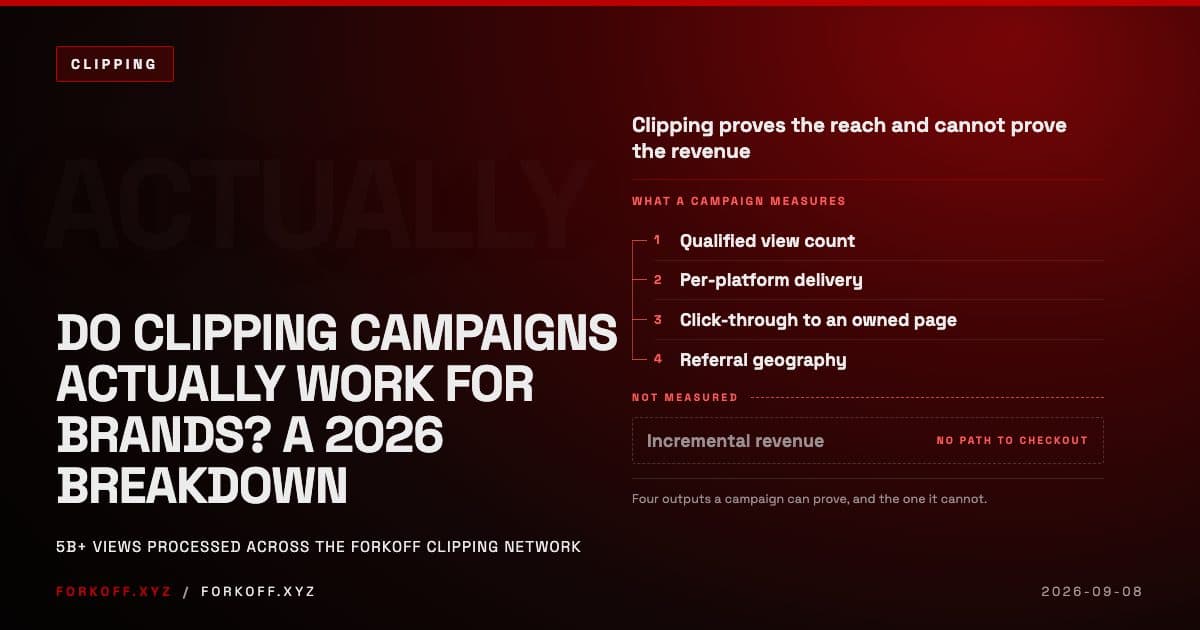
Do clipping campaigns work? Clipping works as a reach channel and fails as a last-click channel. It buys distribution at roughly a tenth to a fifth of paid-social CPM, and it cannot tell you which sale it caused. Brands that fund clipping marketing as low-cost reach with a named downstream job get a result. Brands that fund it as performance marketing do not.
That sentence is the whole answer, and almost nothing published on this topic says the second half out loud. We measured every page ranking for the brand-side version of this question on 8 September 2026, forty organic results across four queries, and not one of them tells a brand how to connect a clipping view to pipeline. Fourteen of them sell clipping. None publishes a campaign that failed.
This post is the version we would want if we were the buyer. It carries our own numbers from a network that has processed 5B+ views, the twelve objections our sales calls actually record, three published third-party campaign P&Ls with the arithmetic done, and the two campaigns we ran that did not work and why. Where we cannot measure something, the post says so in the same sentence as the number.
The 30-second answer
Clipping campaigns work as a reach channel and fail as a last-click channel. Verified 2026 reference points put brand-side cost between $1.36 and $4.00 per 1,000 views, against a 20x spread driven by what the clip shows: a logo on somebody else's content at the bottom, dedicated brand accounts at the top. FORKOFF prices on the qualified view at $0.003, and across one 14-day campaign 4.2M of 6.1M raw views survived screening, a 68.8% qualification rate at 99.71% sustained legitimacy. What no vendor can give you is incremental revenue, because a clip on somebody else's feed carries no deterministic path to checkout. Fund clipping when you own clippable long-form, can name the downstream job as a number, and have agreed what counts as a billable view before the first clip posts. Campaign one buys the platform answer. Campaign two spends against it.
Do clipping campaigns actually work for brands?
Yes, for reach, and only when three conditions hold: you own clippable long-form footage, you have named the downstream job the views feed, and you have agreed what counts as a billable view before the first clip posts. Miss any one and the campaign produces a large number attached to nothing.
Do clipping campaigns actually work for brands?
Yes for reach, no for last-click revenue. Clipping buys distribution at roughly $1.36 to $4.00 per 1,000 views in 2026 and cannot tell you which sale it caused. It works when you own clippable long-form footage, have named the downstream job as a number, and have agreed the billable-view definition first.
Measured across 40 organic results on 8 September 2026: fourteen of the ranking pages sell clipping and none publishes a failed campaign or an attribution method.
That is not a hedge. It is the shape of the evidence. Across our own network and every third-party campaign we could verify, the distribution mechanic works with unusual reliability: put a brief in front of enough independent editors and a minority of clips break out, predictably enough to plan around. What breaks is everything downstream of the view.

The clearest single data point we hold on the demand side is our own search console. The query clipping campaign converts at 8.63% click-through from position 13.5, the highest click-through rate anywhere in our clipping cluster, while twenty-one of the thirty-three clipping keywords we track earn zero clicks at a median position of 9.32. Buyers are actively looking for this answer and are not finding it.
The supply side agrees. A network operator running just over 10,000 active clippers put this exact question to marketers in r/digital_marketing in March 2026 and drew two upvotes at a 0.63 upvote ratio. Roughly a third of the votes on a sincere question from a real operator were downvotes. Clipping arrives at brand-side marketers pre-loaded with suspicion, and the suspicion is earned.
Operator noteA 10,000-clipper network operator asked marketers if this works and drew 2 upvotes at a 0.63 ratio., r/digital_marketing, 2026-03-02
What is a clipping campaign, and what is it not?
A clipping campaign pays independent editors a rate per thousand views to cut your long-form footage into short-form vertical clips and post them from their own accounts across TikTok, Reels, YouTube Shorts and X. You supply source material and a brief. They supply distribution and volume. Payment follows delivered views.
It is not influencer marketing. In an influencer deal you buy one creator's audience once at a fixed fee with no performance floor. In a clipping campaign you buy hundreds of independent attempts at algorithmic breakout and pay only on delivered reach. Our fuller definition of the mechanic sits in what is clipping, which is the hub this post links up to.
It is also not user-generated content in the advertising sense. A UGC creator makes an ad. A clipper cuts something you already said. The raw material is footage you own, which is why the prerequisite question later in this post decides more campaigns than the pricing question does.
And it is not a media buy. There is no targeting layer, no frequency cap, no audience exclusion, no retargeting pixel on the distribution itself. You are buying supply-side effort, not demand-side placement, and every difference between clipping and paid social traces back to that one structural fact.
Clipping against the channels it gets compared to
| Channel | What you buy | Targeting | Persistent asset | Deterministic conversion | Source |
|---|---|---|---|---|---|
| Clipping | Delivered views from independent accounts | None | No, unless dedicated accounts | No | derived |
| Influencer deal | One creator's audience, once | Their audience | No | Partial | derived |
| UGC ads | Ad creative you own | Via the ad platform | Yes, the creative | Yes | derived |
| Paid social | Targeted impressions | Full | Yes, pixel and audiences | Yes | derived |
as of 2026-09-08
FORKOFF channel comparison, September 2026. Clipping is the only row with no targeting layer, which is the source of every other difference.
The three things brands most often assume are included, and are not by default: view verification, geographic control, and account ownership. Each has its own section below because each one is where a campaign quietly loses its value. A vendor who does not raise all three unprompted is not being dishonest. They are answering the question you asked.
What changed in 2026 that makes clipping a real line item?
Three things changed in eighteen months: verified-view accounting became normal, marketplace supply became abundant enough to collapse the price, and the first regulatory and press attention arrived. Together they moved clipping from a growth-hack curiosity to something a marketing team has to have a position on.
The pricing shift is the visible one. Public campaign disclosures now routinely publish a cost per thousand verified views rather than a headline reach figure. One month-long campaign published in July 2026 reported 589 clips from 73 creators producing 2,204,611 verified views against a $3,000 reward pool, which is roughly $1.36 per thousand verified views, with per-platform approve, reject and flag counts published alongside. The rules behind the X portion of those numbers changed in August 2026, when Original Content Rewards replaced revenue sharing and made originality a payout requirement.
LiveFrame
@liveframe
The Wizard of Soho Clipping campaign so far Campaign period: June 28 to July 28 Results: 589 clips 73 creators 2,204,611 verified views $3,000 reward pool Approximately $1.36 per 1,000 verified views Creators earned $2 CPM plus a $1 flat fee per clip. Platform breakdown: X: 3… Show more
The supply shift is the mechanism underneath the price. Clipper recruitment threads run in the hundreds of comments, and live job posts advertise 20,000 to 60,000 PHP a month for full-time clipping work. Abundant, offshore-priced supply is why brand-side CPM sits where it does. It is not that the distribution is magic.

The third shift is scrutiny. Trade press has begun covering both sides of the practice rather than only the upside, and a prediction market's 140-million-view paid-creator campaign drew a reported regulatory referral in 2026. The FTC's endorsement guides are written broadly enough that undisclosed paid distribution is a compliance question, not only a taste question.
Vulture/NY Magazine reports on “clipping” and paid campaigns being promoted on Discord, including Justin Bieber’s Coachella performances where clippers were offered up to $1 per 1,000 views for clips
Mainstream press coverage of paid clipping campaigns being coordinated in Discord servers, with clippers offered up to $1 per 1,000 views.
Clipping got easier to buy in 2026 and no easier to prove
Three shifts landed in eighteen months. Verified-view accounting became the published norm, so campaigns now report a cost per screened view rather than a headline reach number. Marketplace supply became abundant enough to collapse the brand-side price. And the first sustained press and regulatory attention arrived, which turned undisclosed paid distribution from a taste question into a compliance one. None of the three touched attribution, which is why the category's buying conversation and its measurement conversation have drifted further apart.
Source: FORKOFF clipping cluster analysis, 40 organic results measured 2026-09-08
What has not changed is attribution. Every one of those three shifts made clipping easier to buy and none of them made it easier to prove. That gap is the reason this post is nine sections longer than it would otherwise need to be.
How much does a clipping campaign cost per 1,000 views in 2026?
How much does a clipping campaign cost per 1,000 views in 2026?
Between roughly $1.36 and $4.00 per 1,000 views all-in, depending on content signal. A published month-long campaign landed at $1.36 per 1,000 verified views. A disclosed third-party P&L came to $2.50. FORKOFF prices at $0.003 per qualified view, which is $3.00 per 1,000.
Brand-side all-in cost lands between roughly $1.36 and $4.00 per thousand views across the 2026 reference points we could verify, and the spread is not vendor greed. It is a function of what the clip actually shows. Published third-party campaigns cluster at $1.36 to $2.50 per thousand. Published agency bands for produced, brand-adjacent clipping run to about $4.00, and every one of those bands is quoted as custom rather than as a rate card.
Three reference points we could verify independently, each with its own arithmetic:
Verified brand-side cost per 1,000 views, 2026
| Reference point | Cost per 1,000 | What the number covers | Source type | Source |
|---|---|---|---|---|
| Published month-long campaign | $1.36 | 2,204,611 verified views against a $3,000 reward pool, 589 clips, 73 creators | Vendor disclosure, July 2026 | published |
| Disclosed campaign P&L | $2.50 | 1.48M views, $2,800 to editors plus $900 management, a 24% take | Operator disclosure, May 2026 | published |
| FORKOFF managed clipping | $3.00 | Per 1,000 qualified views, screened before invoice | First-party, published case study | measured |
| Agency published band | $2.50 to $4.00 | Vendor calls it illustrative, not a rate card | Competitor research, live-verified 2026-07-24 | published |
| Clipper payout band | $1.00 to $6.00 | What the editor receives, not the brand's all-in cost | Vendor founder, interest disclosed | published |
as of 2026-09-08
Method: Each row was read from the source that emits it rather than from a secondary summary. Rows are not averaged because the denominators differ.
Lumina Clippers calls that band illustrative and custom on its own pricing page, not a rate card, against a $5,000 minimum. Other rows: r/passive_income thread 1tf0ns1, LiveFrame, the FORKOFF ledger. Only the FORKOFF row is per qualified view.
The first is the $1.36 figure above, published with platform-level approve and reject counts, which makes it the most checkable number in the category. All three rows carry them. X: 322 clips, 1,870,412 verified views, 224 approved, 87 rejected, 3 flagged. TikTok: 193 clips, 256,592 views, 109 approved, 53 rejected, 21 flagged. Instagram: 73 clips, 77,607 views, 34 approved, 29 rejected, 9 flagged. Rebuild the total from those rows and the views reconcile exactly to the 2,204,611 headline while the counts do not. Clips sum to 588 against a stated 589. Dispositions sum to 569, so nineteen of the 588 enumerated clips carry no published outcome and the 589th is not enumerated at all. And the same post says creators earned a $2 CPM plus a $1 flat fee per clip, which on the published totals is between about $4,776 and $4,998 depending on whether the flat fee is paid on approved clips or on all of them, against a stated $3,000 pool. That matters for the headline rather than being a footnote to it: the $1.36 is the pool divided by the views, and if the larger figure is what actually moved then the per-thousand cost was nearer $2.17 to $2.27. We still quote this campaign, because a vendor who publishes enough for you to find the gaps is more useful than one who publishes a single net number.
The second is a campaign manager's disclosed P&L: 1.48M views, $2,800 paid to editors, $900 in management fees. That is $3,700 all-in for 1.48M views, $2.50 per thousand, with a 24% management take. The manager published it himself in r/passive_income.
I made ~$900 managing a clipping campaign that did 1.48M views and paid out $2.8k to editors.
One recent campaign I managed did about 1.48M views, paid out $2.8k to editors/clippers, and made me about $900 in management fees. Brands provide content, editors/clippers turn it into short-form posts, and payouts happen based on performance.
The third is the clipper payout floor rather than the brand's cost. A clipping-tool founder, disclosing his interest in the same post, put typical clipper pay at $1 to $6 per thousand verified views. That band is what the editor receives. Whatever sits between it and your invoice is management, verification and margin, and a vendor should be able to tell you which.
Our own published rate is the outlier at the bottom: $0.003 per qualified view, which is $3 per thousand qualified views, from a campaign documented in full in our clipping campaign cost breakdown. Note the unit. It is not per thousand raw views, and the difference between those two units is the next section.
Compare any of these against paid social honestly. Platform CPMs on Meta, TikTok and YouTube in 2026 sit in the mid single digits to low tens for targeted, platform-verified impressions. Clipping costs less per unit of reach and buys a structurally worse unit. Both halves of that sentence are true and most published comparisons print only the first.
Why does clipping CPM vary 20x by content signal?
Price tracks what the viewer actually sees, not how hard the clip was to make. Three content signals dominate the market, and the gap between the least and most expensive is roughly twentyfold. No incumbent rate card we found breaks its CPM down this way, which is why buyers keep comparing quotes that are not comparable.
Signal one is logo placement. Your mark rides on content that would have been posted anyway, from accounts that already have reach. The clip is not about you. This is the lowest-cost signal by a wide margin because you are buying attention that already exists rather than manufacturing it. It is also the signal with the least control over what sits beside you.
Signal two is clips cut from your own long-form. Your founder, your podcast, your product demo, your gameplay. Cost sits in the middle because someone has to watch two hours of footage to find the thirty seconds that hooks. One long-form asset typically yields ten to thirty clips. This is the signal most people picture when they hear the word clipping.
Signal three is dedicated brand accounts. Profiles built and run in your name, posting only your material. This is the most expensive signal by an order of magnitude over signal one, for a reason that is structural rather than commercial: a cold profile has no algorithmic standing and has to buy its first distribution, while an established account is amplified for free.

That last point is worth sitting with because it explains the whole curve. An established creator with millions of followers can clear roughly a dollar per thousand views because the platform pushes their content without being asked. A brand-new account posting identical material starts from zero. You are not paying for editing. You are paying for standing.
The three content signals as a spec sheet
Logo placement
Own long-form
Dedicated
Distribution exists on day one
Needs your own source material
You keep the surface afterwards
Cheapest per view
The three signals this post prices, cost running left to right, roughly twentyfold. The prerequisite stated elsewhere, owning clippable long-form, is a condition on the middle column: a logo placement rides content posted anyway. Adjacency is not a row; the ownership table carries it.
Operator noteAn established creator clears roughly $1 CPM. A cold brand account starts at zero and buys its first distribution.
The practical consequence: a brand with a hard CPM ceiling derived from its own unit economics has a real tier to move down to, not a discount to negotiate for. Ask any vendor which signal their number describes. A quote with no signal attached is not a price, it is a range.
What is a qualified view, and why bill on it instead of impressions?
What is a qualified view in a clipping campaign?
A qualified view is a view that has survived bot, farm, replay and burst screening and is therefore billable. A platform impression is whatever the platform counted. Billing on the screened unit moves fraud risk from the buyer to the vendor, which is the point of the definition.
A qualified view is a view that has survived bot, farm, replay and burst screening and is therefore billable. A platform impression is whatever the platform counted. Billing on the screened unit moves fraud risk from the buyer to the vendor, which is the entire point and the reason the definition matters more than the number.
Every vendor will quote you a CPM. Very few will tell you what the denominator is. When the denominator is raw platform views, invalid traffic is your problem and it is priced into nothing. When the denominator is qualified views, the vendor eats every rejected view, so the vendor now has a financial reason to screen properly.

Our own screening runs three layers and we publish the mechanism rather than the marketing claim. Layer one screens network signatures at ingestion: IP, autonomous system number, VPN, proxy and data-centre ranges. Layer two audits behaviour, watch-time distribution, scroll depth and interaction entropy across the cohort. Layer three reconciles platform-reported views against owned analytics. The full method is in 3-layer bot detection.
The numbers that come out of it, from a fourteen-day campaign: 6.1M raw views in, 4.2M qualified out, a 68.8% qualification rate and 99.71% sustained legitimacy on the passing cohort. We publish 99.71 rather than 100 because 100 would be a claim no screening system can support, and the shortfall is the honest part.

The reason to insist on this contractually is arithmetic. Run the numbers above back through an invoice priced on raw views rather than qualified ones: at our own measured 68.8% qualification rate you pay for six million views and receive four million real ones. Same money, roughly two thirds the outcome, and nothing in the invoice shows it. Our longer treatment of the unit is in qualified views metric.
Read the same fourteen days from the reject side and the artifact a buyer should be handed gets concrete. A 68.8% qualification rate is a 31.2% reject rate, roughly 1.9 million views screened out of the 6.1 million submitted, and each one should arrive with the layer that rejected it and the reason it failed. A raw-view invoice has nowhere to put any of that, which is why the unit and the paperwork are the same argument.
The line items a qualified-view contract has to show
Views billed on a raw-view invoice
6.1M
Views that survived screening
4.2M
The gap you paid for
1.9M
Of that gap, itemised
None
Totals are the measured ones from a fourteen-day FORKOFF clipping campaign, where 4.2M of 6.1M raw views qualified at a published 68.8% rate, so the gap is 1.9M. The rows are what a raw-view invoice carries against what a qualified-view contract has to carry.
Operator note6.1M raw views in, 4.2M qualified out, one 14-day campaign. The gap is what a raw-view contract hides., FORKOFF clipping ledger
If a vendor cannot produce reason codes for rejected views, they are not screening. They are reporting.
How do you tell real clipping views from bot views?
You cannot tell from a dashboard. You tell from the reconciliation: whether the vendor can name which accounts posted your content, where those accounts' audiences actually are, and what percentage of submitted views were rejected and why. A dashboard number that only ever goes up is not evidence of anything.
The most credible public account of how this fails came from an agency founder who runs campaigns in the same category. His description of the mechanic is specific enough to test: clippers operating out of rooms of fifty to a hundred devices on a shared IP, posting from recycled accounts, then viewing the content they just posted from those same devices.
Estefano - FTD Growth Engine
@Estefanoverse
Most clipping campaigns are a scam. The clippers running these campaigns are often operating out of phone farms in Southeast Asia. Rooms with 50 to 100 devices connected to the same IP, posting from recycled accounts. Those same phone farms view the content they just posted. Th… Show more
The second-order effect is the part most buyers miss. Platforms detect shared-IP device clusters and throttle or blacklist them, but the view counter keeps climbing because the farm's own devices are still generating impressions. The dashboard says five million. Real human distribution might be a fraction of that. The failure is invisible from the buyer's side by construction.
Bot detection has since become a product category in its own right, with per-clip tracking, per-clipper scoring, automatic suspicious-traffic flagging and cryptographic account verification all being sold as features. That a whole tooling layer exists is the clearest available evidence that the underlying problem is real rather than a competitive talking point. Platforms treat the same behaviour as a policy violation on their side: artificially inflated view counts fall under YouTube's fake engagement policy, which makes farmed views a takedown risk on top of a billing problem.

The diligence question that separates vendors, and it is one question: can you show me the accounts posting my content and where their audience actually is? A vague answer is the answer. We wrote the longer version of this scam-detection frame in clip farming.
One thing worth being fair about: a low qualification rate is not automatically evidence of fraud. Replays, short dwell and platform double-counting all fail a strict screen legitimately. What matters is that the screen exists, that its thresholds are written down, and that you see the rejects rather than a single net number. The advertising industry solved the same problem a decade ago by putting invalid-traffic definitions under an accreditation body, and the Media Rating Council standards are the closest external analogue to what a qualified-view definition is doing.
What does geo leakage cost a clipping campaign?
Geographic leakage is the version of the view-quality problem that survives even when the views are entirely real. Clippers are paid per view, not per view in your market, so nothing in the incentive structure steers distribution toward the countries where your product is sold. Real humans, wrong continent, full invoice.
The example that made this concrete for us came from an operator describing a sportsbook spending five figures targeting the United States and receiving most of its views from regions that could never legally open an account. Every one of those views can be genuine. Every one of them is worth zero, and a raw-view CPM cannot distinguish them from the ones that count.
Operator noteIndia delivered 33% of our clipping clicks and converted at approximately zero., FORKOFF search console, 2026-09-06
This is why our own geography registry, which prioritises the United States, United Kingdom, United Arab Emirates, Singapore and India in that order, is a campaign input rather than a marketing statement. Our search console shows the cost of getting it wrong from the other direction: 53,028 impressions and 119 clicks from the US at 0.22%, against 5,136 impressions and 305 clicks from India at 5.94%.
Read that too quickly and India looks like the better market. India was 33% of our clicks and converted at approximately zero, and the single apparent conversion turned out to be a US-based buyer that search console had mislabelled geographically. High engagement in the wrong market is the most expensive kind of good-looking number.
What geographic leakage costs, using our own search console
| Market | Impressions | Clicks | Click-through | What it converted to | Source |
|---|---|---|---|---|---|
| United States | 53,028 | 119 | 0.22% | The revenue | measured |
| India | 5,136 | 305 | 5.94% | Approximately zero | measured |
as of 2026-09-06
FORKOFF search console, clipping cluster. India delivered 33% of clicks and near-zero conversion, and the single apparent conversion was a US buyer that search console had mislabelled geographically.
The contractual fix is simple to write and rarely written: specify target geographies, require per-geography reporting, and make out-of-market views non-billable or discounted. If a vendor says geography cannot be controlled, they are being honest about mass logo placement and wrong about dedicated accounts, where posting behaviour and audience can both be steered.
The measurement fix is to instrument the destination rather than the clip. Referral traffic by country to a campaign-specific landing page tells you where the audience actually was, independent of what the platform reported. That is a first-party number and nobody can inflate it.
How do you attribute revenue to a clipping campaign?
Separate what is measured from what is not, out loud, before quoting anything. Measured: clicks and click-through rate per platform, the platform split itself, referral geography, and branded search lift. Not measured: last-click revenue, because a clip on somebody else's feed carries no deterministic path to your checkout.
Our own objection ledger, mined across a corpus of 78 recorded sales calls, carries 12 distinct clipping objections, and attribution is not the loudest of them. Proving the views are not bots leads at 8 recorded instances, being compared against other vendors follows at 7, and a CPM above the buyer's own unit economics at 5. Attribution sits at 4, tied with three others. It matters more than its rank because it is the one objection that survives a satisfying answer: these buyers believe the views are real and still cannot use them, because nothing connects a view to a conversion. Every one of them is trying to compare clipping against a channel they already measure, a Meta ROAS, a $400 cost per acquisition, a $3.26 iOS install cost.

The honest structure is a ladder, and each rung is weaker than the one below it. We call it the FORKOFF Clipping Attribution Ladder and we use the same five rungs on every campaign:
- Deterministic click. A distinct UTM or referral link on each dedicated profile. Real, small, and the only rung that survives a finance review unchallenged. Use the campaign URL builder conventions rather than inventing your own.
- Platform split. Which platforms delivered qualified views at what rate. This is the actual deliverable of campaign one and it is worth the campaign on its own.
- Branded search lift. Query volume for your brand name before, during and after the flight, read from your own search console rather than from the vendor. Set the acquisition and session dimensions up before the flight rather than after, because the reporting dimensions you did not configure are the ones you cannot backfill.
- Self-reported source. A "how did you hear about us" field at registration. Undercounts badly and still catches what nothing else does.
- Holdout geography. Run the campaign in four markets, withhold a fifth comparable one, compare. Expensive, slow, and the only rung that produces a causal number.
What a clipping campaign measures, and what it does not
| Signal | Measured | Where it comes from | Good enough for finance | Source |
|---|---|---|---|---|
| Qualified view count | Yes | Vendor screening ledger | Yes, with reject codes | derived |
| Platform split | Yes | Vendor delivery data | Yes | derived |
| Click-through to owned page | Yes | Your own analytics | Yes | derived |
| Referral geography | Yes | Your own analytics | Yes | derived |
| Branded search lift | Yes | Your own search console | Correlational | derived |
| View-through conversion | No | Nowhere | No | derived |
| Incremental revenue | No | Only a holdout test | No | derived |
as of 2026-09-08
FORKOFF measurement boundary, stated the same way on every campaign. The last two rows are the ones a vendor should volunteer rather than concede.
Rungs one to four are correlational. Only rung five is causal, and almost nobody runs it. Saying so is not a weakness in the pitch. It is what makes the rest of the numbers usable, because a buyer who knows the boundary can defend the spend internally instead of being ambushed by it.
The failure mode we have recorded on our own calls, and corrected: stating the boundary only when asked a third time. Say it first. A boundary volunteered reads as rigour and a boundary extracted reads as evasion, and the words are identical.
What can you actually measure, and what can you not?
Four things are measurable to a standard a finance team will accept: qualified view count, per-platform delivery, click-through to an owned destination, and referral geography. Three are not: incremental revenue, view-through conversion, and the counterfactual. Publishing which is which is the single most useful thing a vendor can do.
The clearest public illustration of the gap came from a creator who ran a $500 marketplace campaign and then wrote up the result honestly. His product earned an estimated $90 to $200 that month. His verdict on whether the campaign caused it: "I have no idea what that number would have been without the campaign."
GismoMaps - Kyle
@GismoMaps
Let's talk about Content Rewards, because I actually ran one and the results are probably not what you think... I set up a $500 campaign at the beginning of August for HR Hitman. 300+ members joined in no time. The problem? Almost none of them read the post. Out of 47 submissio… Show more
That is not incompetence. That is the correct epistemic position for anyone running a reach campaign without a holdout, and it is the position most published clipping case studies quietly decline to take. Views are trivially measurable. Incremental revenue is not. A case study that closes that loop without a control group has not closed it.
But attribution is the dealbreaker for most marketing teams. When someone asks me to justify spend I need a clear line from dollars to results. With 300 clips pushed by different accounts across multiple platforms that's nearly impossible. Our clients already struggle with attribution on single-creator influencer deals. Multiplying that complexity by 300 is a tough sell to anyone managing real budget.
The comparison a marketer is forced into makes it worse. Paid social hands you a targeting layer, a retargeting pixel, deterministic conversion tracking and an asset you keep. Clipping hands you volume from people optimising for their own payout. Comparing them on CPM alone compares two different products on one shared axis.

Our own position, stated the same way on every call: we measure clicks and click-through per platform through a distinct link on each dedicated profile, we report the platform split, and we do not measure your in-funnel conversion because your funnel owns it. Then we do the arithmetic in the buyer's unit, on the call, which is the next section.
How do you build a break-even view count from your own CAC?
Take your cost per acquisition, your landing-page conversion rate and the quoted CPM, and solve for the view count at which clipping matches the channel you already run. It takes ninety seconds and it converts an impression number into a decision. Most vendors never do it because the answer is sometimes no.
The arithmetic, with a worked example. Assume a $3 CPM on qualified views, a 0.5% click-through from clip to landing page, and a 3% landing-page conversion. One thousand qualified views produce five clicks and 0.15 conversions, at a cost of $3. That is $20 per conversion, which beats a $400 paid acquisition cost by a wide margin and loses badly to a $3 organic one.
Break-even sensitivity at a $3 CPM on qualified views
| Click-through to page | Landing conversion | Conversions per 1M views | Cost per conversion | Source |
|---|---|---|---|---|
| 0.5% | 3.0% | 150 | $20 | derived |
| 0.25% | 3.0% | 75 | $40 | derived |
| 0.5% | 1.0% | 50 | $60 | derived |
| 0.25% | 1.0% | 25 | $120 | derived |
as of 2026-09-08
Method: Arithmetic only. Click-through and landing conversion are the brand's own numbers and should be substituted before the table is used.
Worked at $3,000 per million qualified views. The CPM is the least sensitive input in the model, which is why negotiating it is the least valuable use of a vendor call.
Now stress the assumptions, because that is where the number lives. Halve the click-through to 0.25% and the cost per conversion doubles to $40. Drop conversion to 1% and it triples again. The CPM is the least sensitive input in the model, which is why negotiating it is the least valuable thing a buyer can spend the call on.

The input that actually moves the outcome is click-through from clip to destination, and that is a creative and offer problem rather than a media-buying one. A clip with no call to action inside the frame converts at a rate indistinguishable from zero. A clip carrying the product name and a reason to search converts at a multiple of that.
One operator reported reaching 10x return on ad spend on a clipping campaign and named the mechanic rather than the result: pay $0.20 to $0.60 per thousand by country, source clippers directly from the platform, and put the app logo and name inside the call-to-action frame of every creative so that later paid ads convert against recognition the clips built.
Lino
@LinoLeighton
I ran a clipping campaign at 10X ROAS previously. Here's exactly how I did it: Paid anywhere from $0.20 to $0.60 CPM depending on the country Sourced clippers directly from TikTok Had each clipper post 2 to 3 TikTok slides using the format below Put my app logo and name inside… Show more
Whether that 10x replicates is unknown and we are not claiming it does. What is transferable is the structure: clipping built the recognition and a measurable channel harvested it. That is the shape of every clipping campaign we have seen produce a defensible number, and it is why the funnel question outranks the CPM question.
Should a clipping campaign be priced flat, pure performance, or hybrid?
Hybrid, a low base plus performance upside, is the model that survives contact with both sides. Flat retainer puts all the risk on the brand. Pure performance is unsustainable for the network, because clippers need paying whether or not a clip breaks out. The answer is not a compromise, it is the only stable point.
That is not our opinion. It is the answer a buyer-side marketer gave, unprompted, to a clipping network operator who asked the demand side directly what would make this a real channel:
For pricing, hybrid with a low base plus performance upside is the clear answer from the buyer side. Flat pricing means brands take all the risk. Pure performance sounds great for brands but you can't sustain your network because clippers need to get paid regardless of virality.
Flat retainer against pure performance against hybrid
| Model | Who carries the risk | Vendor incentive | Failure mode | Source |
|---|---|---|---|---|
| Flat monthly retainer | The brand | Spend the least effort that keeps the account | You pay identically in a dead month | derived |
| Pure performance | The network | Deliver views by whatever means clears the threshold | Farmed traffic, invisible to the buyer | derived |
| Hybrid base plus upside | Shared | Fund real editing, earn on qualified delivery | Requires a written qualification gate | derived |
as of 2026-03-02
Structure named by a buyer-side marketer answering a clipping network operator in r/digital_marketing, thread 1rizolp, 2 March 2026.
Flat retainer looks safer to a procurement team because the number is known in advance. It is the worst of the three for a brand precisely because of that: you pay identically in a month where the clips travelled and a month where they did not, and the vendor's incentive after the invoice clears is to spend the least effort that keeps the account.
Pure performance looks safer still and is the one to be most careful with. A vendor who only earns on delivered views has an incentive to deliver views by whatever means clears the threshold, which is the exact pressure that produces farmed traffic. Pure performance pricing without a qualification gate is a bot-farming incentive wearing a fairness costume.
Operator notePure performance with no qualification gate pays for delivered views by whatever means clears the threshold.
The structure that works pairs a base large enough to fund real editing effort with upside tied to qualified views rather than raw ones. It gives the network cashflow certainty, gives the brand outcome exposure, and puts both parties on the same side of the verification question. Our own model prices the outcome unit rather than the month, described in performance clipping as an ad line item.
One shape to reject outright: a per-post commitment dressed as a CPM deal. If you need a specific asset to post on a specific day, a bounty network cannot promise it, and a vendor who says otherwise is describing a different product. Ask for a small private roster priced per post instead. That is an honest answer to a real requirement.
Clipping agency vs in-house clippers vs an AI clipping tool: which costs less?
Per unit of delivered reach, an agency is usually lowest and an in-house team is usually highest, which is the opposite of what most brands assume. The tool sits outside the comparison entirely: it produces clips, not distribution, and the two are different purchases that get quoted against each other constantly.
The number that decides it is editing time. A clipping-tool founder, disclosing his commercial interest in the same post, put manual clip production at twenty to forty minutes per clip: watching a two-hour podcast to find the thirty seconds that hooks, reframing to vertical, captioning word by word. At three hundred clips that is between one hundred and two hundred hours of skilled labour.
Clipping agency against in-house against an AI clipping tool
| Route | Cost driver | Distribution included | Breaks down at | Best fit | Source |
|---|---|---|---|---|---|
| Managed agency | CPM on delivered views | Yes | Very low volume | 300+ clips a month | derived |
| In-house team | 20 to 40 editor-minutes per clip | No | A few hundred clips | Under 50 clips a month | derived |
| AI clipping tool | $49 to $249 per seat per month | No | Any volume, it is not a distribution product | Producing clips you distribute yourself | published |
| Self-hosted open source | Zero licence, your engineering time | No | Any volume | Teams already running video infrastructure | derived |
as of 2026-09-08
Editing-time figure disclosed by a clipping-tool founder in r/passive_income thread 1usjyg1. Tool pricing from published per-seat rate cards across the main automated clipping products, 2026.
Price that at any credible loaded hourly rate for a video editor in a Tier-1 market and the in-house route stops being competitive before you have bought a single view. This is why in-house clipping teams stall rather than fail: they produce excellent clips at a volume too low for the probability game to work.
The tool route changes the labour cost and not the distribution problem. Per-seat subscriptions across the main automated clipping products run roughly $49 to $249 a month, and a self-hosted open-source option such as openshorts takes the licence cost to zero. Neither posts your clips from accounts with existing reach, which is the part you were actually buying.

The agency route buys three things a tool cannot: a supply pool large enough to run the volume game, screening infrastructure between the platform and your invoice, and someone whose job is the brief. Our head-to-head on this exact fork is in clipping agency vs in-house vs Opus Clip, and the honest summary is that the answer flips at volume.
Operator note20 to 40 editor-minutes per clip. At 300 clips that is 100 to 200 hours before a single view arrives., Clipping-tool founder, interest disclosed
Below roughly fifty clips a month, in-house or tool-assisted is defensible and the coordination overhead of a vendor is not worth it. Above a few hundred, the labour arithmetic breaks and the supply pool is the whole product. The decision is a volume threshold, not a philosophy.
What does a brand need before it can run a clipping campaign?
Clippable long-form footage, and roughly a third of the brands who ask us for clipping do not have any. That is a prerequisite, not an objection, and it is the single most common reason a campaign underdelivers for a reason the brand later attributes to clipping rather than to the source material.
Podcasts, founder interviews, product demos, courses and gameplay clip well. Highly produced brand films, webinars with slide decks, and anything where the speaker never says a complete thought in under forty seconds clip badly. One good long-form asset yields ten to thirty clips. One bad one yields thirty clips that nobody watches, which reads as a distribution failure and is not.

The prescription when the catalogue fails is on our own record. One client's YouTube back-catalogue did not clear clippability review, so the sequence was reversed: he was sent to a podcast studio to record thirty-second scripted segments, each ending in a call to action, and the campaigns were rebuilt on that material rather than on the archive.
The source-material gate, in the order we run it
STEPS- 01
Collect the long-form
Every podcast, interview, demo, course and stream the brand already owns.
- 02
Review for clippability
Does the speaker land a complete thought in under forty seconds, more than once.
- 03
Yield estimate
Ten to thirty clips from a strong asset. Under ten means the archive is not the input.
- 04
Record if it fails
Purpose-built thirty-second scripted segments, each ending in a call to action.
- 05
Then quote
Budget is the last question, not the first.
The second prerequisite is a named downstream job. Not a goal, a job. "Awareness" is not a job. "Get the install cost under $3 by building organic distribution underneath the paid channel" is a job, and it tells you which platforms matter, what the call to action inside the frame should be, and what number ends the argument.
The third is a destination that survives the traffic. A clip drives a search or a profile tap, not a click-through in the paid-media sense. If your brand name is generic enough that a search lands on someone else, the campaign is funding your competitor's month. Check that before you check the CPM.
Operator noteOne client's YouTube archive failed clippability review. He recorded 30-second scripted segments instead., FORKOFF campaign record
We publish the review as a gate rather than a courtesy, because a campaign launched over failing source material costs the brand its budget and costs us the relationship. Making content the first question, ahead of budget, is the single change that most improves the odds of the first campaign working.
How do you write a brief that clippers will actually read?
Write for someone who will spend ninety seconds deciding whether your campaign is worth their evening. Lead with the payout and the qualification rule, state the three hard constraints, and put the creative direction underneath. A brief that opens with brand values gets skimmed past the part that determines whether the clip is usable.
The evidence that briefs go unread is uncomfortable and public. A creator running a $500 open-marketplace campaign reported that 300 or more people joined, 47 clips were submitted, and exactly 2 were usable. His requirement was a single line: record your own gameplay. Most participants ignored it, and the non-video platforms he opened were, in his words, pure bot spam.
300+ members joined in no time. The problem? Almost none of them read the post. My requirement was simple: record your own gameplay. Out of 47 submissions, there were 2 quality shorts. Two.
That is a two-clip yield on a four-hundred-percent-oversubscribed campaign, and it is what an open marketplace with a loose brief produces at scale. The failure is not that clippers are lazy. It is that an ambiguous brief plus a per-view bounty rewards volume of submissions rather than compliance with the ask.

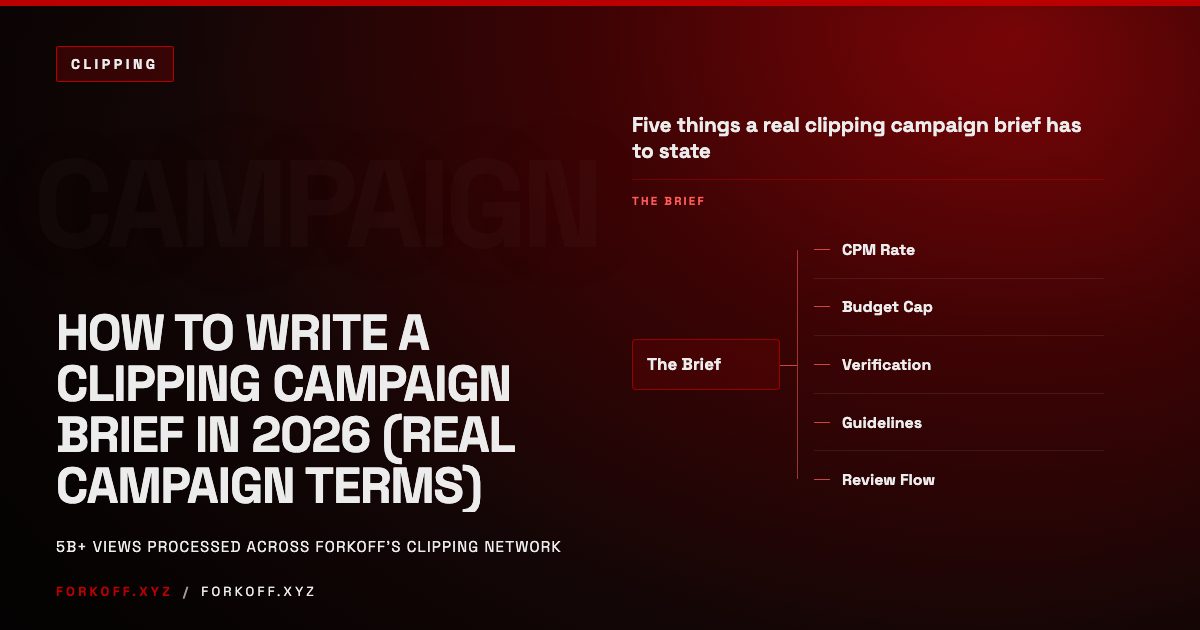
The fixes are mechanical. State a minimum clip length and a maximum. Ban third-party tool watermarks explicitly. Specify required captions, tags and the exact on-screen brand element. Say what gets rejected and pay nothing for rejects, in the brief, in the first screen. Our longer template is in how to write a clipping campaign brief.
The creative half is one instruction: give them the moments. Do not hand over a two-hour file and hope. Timestamp the eight passages you already know are strong, describe the hook you want tested on each, and let volume do the rest. A hook matrix of three openings against five middles against three endings produces forty-five variants from one idea.
Operator note47 submissions, 2 usable shorts, 300 participants, one $500 campaign. The brief was one line long., X, 2026-08-17
One thing worth taking from the same failed campaign: the operator asked for permission to repost the best clips on his own channels, and that clause earned him views and subscribers he would never have produced himself. It costs nothing to include and it is the highest-return line in a clipping contract.
Who owns the accounts and the audience after a clipping campaign ends?
It depends entirely on the model, and zero of the forty ranking pages we measured say so. On a clipper-network or marketplace model the clipper owns the account and you rent the reach. On a dedicated brand-account model the profiles are built in your name, which is where a handover clause belongs and part of why that tier costs more.
The sharpest public statement of the problem came from an operator describing marketplace campaigns: every page posting your content belongs to a clipper who moves to the next campaign the moment your budget runs dry. "No accounts to keep. No data to learn from. No infrastructure you can build on."
Chris
@chrisgirbu
Content Rewards is lowkey a scam. You deposit your budget. You set a CPM rate. And then hundreds of random kids start downloading your content, running it through some cheap AI tool to create the clips. And the worst part: You don't own a single one of those accounts. Every pag… Show more
He is right, and the comparison he draws to paid social is fair rather than unfair: a Meta campaign at least leaves you a pixel, an audience and a creative library. A marketplace clipping campaign at the end of its budget leaves you a view count and a screenshot. Whether that matters depends on whether you were buying reach or building a surface.

The distinction that resolves it is between rented and owned distribution. Rented reach is a legitimate purchase and it is what most of the market sells. It is only a problem when a brand thinks it is buying an owned surface, pays the dedicated-account premium in its head, and receives rented reach in the contract.
Who owns what, by campaign model
| Asset | Marketplace or clipper network | Dedicated brand accounts | Source |
|---|---|---|---|
| The posting account | The clipper | The brand | derived |
| The followers | The clipper | The brand | derived |
| Performance data | The vendor's dashboard | Exportable, if the clause exists | derived |
| Adjacency control | None | Total, by construction | derived |
| What survives the budget | A view count | A posting surface | derived |
as of 2026-09-08
Zero of the 40 organic results measured for this question on 8 September 2026 state which model their pricing describes.
Three clauses to insist on if the surface matters to you: named accounts listed in the statement of work, a handover or co-ownership term with a defined trigger, and the right to export follower and performance data at campaign end. None of them is unusual. All three are absent from every template we have been shown.
Operator noteZero of the 40 organic results measured on 2026-09-08 state which ownership model their pricing describes.
Our own answer, stated plainly because improvising it on a call has cost us before: on the network model the clipper owns the account and the client rents the reach, and on the dedicated model the accounts are built for the brand. Which one your quote describes should be written on the quote.
How do you stop a clipping campaign putting your brand next to content you did not approve?
Adjacency is a property of the tier, not of a promise. On mass logo placement your mark lands on somebody else's page between whatever else that page posts, and no vendor can control that. On a dedicated brand account every neighbouring post is also yours, which is total adjacency control by construction.
That is the honest trade and it is the real reason the dedicated tier costs more. A vendor who answers a brand-safety question with "we push it organically" has answered a targeting question with a delivery philosophy, which is a non-answer we have caught ourselves giving and have since corrected.
Operator noteA vendor answering brand safety with the phrase we push it organically has answered a different question.
For a values-led brand the neighbouring post is part of the message, and no amount of clipper vetting changes the structural fact that you are a guest on a page you do not control. Vetting reduces the tail risk. It does not remove the category of risk, and a vendor claiming otherwise is selling certainty they cannot produce.
Brand-safety controls, ranked by whether they are structural
| Control | Type | Removes the risk | Source |
|---|---|---|---|
| Move to dedicated brand accounts | Structural | Yes, every neighbouring post is yours | derived |
| Vetted closed roster | Probabilistic | Reduces the tail | derived |
| Account-level pre-approval | Probabilistic | Reduces the tail | derived |
| Category blocklist with penalties | Contractual | Only after the fact | derived |
| Platform branded-content policy | External | Obligation sits on the poster | derived |
as of 2026-09-08
Only the first row changes the structure of the risk. The rest change its probability, which is a different purchase.
The controls that actually work, in descending order of effectiveness: move to dedicated accounts, restrict to a vetted closed roster rather than an open marketplace, require account-level pre-approval, and maintain a category blocklist with financial consequences for breach. Only the first is structural. The rest are probabilistic.
Platform policy is a partial backstop rather than a solution. Both TikTok's branded content policy and YouTube's branded content disclosure requirements place obligations on the poster, not on you, and enforcement is uneven. Reading them is still worth an hour, because a campaign that violates them is a takedown risk on top of a brand risk.
Operator noteDedicated accounts give total adjacency control by construction, and that is the honest reason they cost more.
The pragmatic position for most brands: run mass logo placement where the product is uncontroversial and the audience is broad, and run dedicated accounts where the category is regulated, sensitive, or premium. Mixing signals across one campaign without saying which is which is how a brand-safety incident becomes a surprise.
Is undisclosed paid clipping an FTC problem?
Potentially yes. A clipper being paid to post your content is a material connection, and the FTC endorsement guides require material connections to be disclosed clearly and conspicuously. Most clipping campaigns run with no disclosure at all, and the fact that this is normal is not a defence.
The guides are written to cover the substance rather than the label. The FTC's own Disclosures 101 for social media influencers is explicit that a disclosure has to be hard to miss and in the same place as the endorsement, which a caption-hidden hashtag on a fifteen-second vertical clip largely is not.
Undisclosed paid clipping is now a live regulatory variable
A clipper paid to post your content is a material connection, and the FTC endorsement guides require material connections to be disclosed clearly and conspicuously. Most clipping campaigns run with no disclosure at all. The category's exposure became visible in 2026 when a 140-million-view coordinated paid-creator campaign drew a regulatory referral and a consumer-protection suit. Whether an unbranded logo placement counts as an endorsement is genuinely untested, and treating that as settled because it is convenient is how a category earns its first enforcement action.
Source: FTC Guides Concerning the Use of Endorsements and Testimonials, 16 CFR Part 255
The category's exposure became visible in 2026 when a prediction market's coordinated paid-creator campaign, reported at 140 million views across five months, drew a regulatory referral. Whatever the outcome, the signal for a brand-side buyer is that undisclosed paid distribution is now a live regulatory variable rather than an abstract one.
Owen Gregorian
@OwenGregorian
Polymarket Paid Creators to Fake Bets in 140-Million-View Campaign: CFTC Investigates. A marketing agency coordinated the amplification, recruiting clippers to redistribute short-form video across multiple social accounts, and required that at least 60 percent of each creator's… Show more
Where clipping arguably differs from influencer endorsement is that a logo placement or a straight excerpt of your own footage is not obviously an endorsement in the guides' sense. That distinction is real and it is untested. Treating it as settled because it is convenient is how a category gets its enforcement action.
The workable posture, and it costs you almost nothing in performance: require disclosure in the brief, make it a payment condition, and keep the evidence. Platform-native disclosure tools exist on every major surface and using them is a one-toggle change for the clipper. This is not legal advice and your counsel should see the brief before it ships.
Operator noteRetrofitting disclosure across 300 live clips posted by 200 people you do not employ is not a project anyone finishes.
The reason to do it early rather than after a letter arrives: retrofitting disclosure across three hundred live clips posted by two hundred people you do not employ is not a project anyone finishes.
How long does a clipping campaign take to show results?
The first readable signal arrives inside two weeks and it is not a revenue number, it is the platform split. Individual clip outcomes are a hit-rate distribution rather than a schedule, so most clips take a few hundred views and a minority break out. Campaign one buys the platform answer. Campaign two spends against it.
Our own clearest instance: one campaign eliminated two of four platforms inside fifteen days on delivery data alone. That was the deliverable. The client did not get a revenue attribution out of campaign one and did get a media plan that stopped funding two channels that were never going to work for that audience.
What arrives when, on a first clipping campaign
TIMELINE01
Days 1 to 5
First clips posted. Nothing readable yet, and any number quoted here is noise.
02
Days 6 to 15
Platform split becomes clear. One FORKOFF campaign eliminated two of four platforms in this window.
03
First 200 clips
Qualification rate stabilises. A rate that climbs is a supply problem, a rate that starts high is a brief problem.
04
Weeks 3 to 4
Referral geography and click-through per platform are readable against an owned destination.
05
Months 2 to 4
Clips keep accruing. Paid CPM and effective CPM separate, always in the brand's favour.

Read that same published campaign per clip rather than in total and the platform answer sharpens, but the denominator is a judgement call and the source does not make it for you. It lists clips, verified views and dispositions as three independent rows. We divide by approved clips, on the reading that a rejected clip is one the campaign declined to pay for, and we flag the tension: the payout line above implies more spend than the pool, which is what you would expect if verified views spanned every submitted clip instead. On the approved reading X returned about 8,350 verified views per approved clip, TikTok about 2,354 and Instagram about 2,283, and the top platform was roughly 3.5 times more productive than the next. X took 61% of the approved clips and returned 85% of the verified views. Divide by submitted clips instead and Instagram reads 20% worse than TikTok, which is not a yield difference at all: it is Instagram's 40% rejection rate against TikTok's 27%. A brand budgeting by clip volume rather than by approved yield funds that gap without ever seeing it.
Verified views per approved clip, by platform
From the campaign's own published rows: X 1,870,412 verified views from 224 approved clips, TikTok 256,592 from 109, Instagram 77,607 from 34, published July 2026. The source does not say which clips carry the verified views; approved clips is our reading, not its claim.
The second signal is the qualification rate, and it stabilises fast. If a vendor's rejection rate is going to be twenty percent it will be visibly twenty percent inside the first two hundred clips. A rate that starts low and climbs is a supply-quality problem. A rate that starts high and stays there is a brief problem.
The third is the compounding one and it takes months. Clips do not stop working when the campaign ends. A clip posted in week two of a flight continues to accrue views for at least a quarter, which means the CPM you paid and the effective CPM you eventually got separate over time, always in your favour. Our how many views is viral piece has the distribution shape.
What does not arrive on any timeline is a clean incremental revenue figure, for the reasons in the attribution section. Any vendor promising one inside a quarter is promising something the measurement cannot support, and the promise itself is a reason to ask harder questions about everything else in the quote.
Operator noteOne FORKOFF campaign eliminated Twitter and TikTok inside 15 days on delivery data alone., FORKOFF campaign record
Plan two campaigns or none. A single campaign judged on its own revenue number will almost always read as a failure, because the thing it actually produced was the information that makes campaign two work.
What does a clipping campaign that failed look like?
It looks like a large view count and an empty pipeline, and there are four recognisable shapes. We publish ours because fourteen of the pages ranking for this question sell clipping and none of them publishes a campaign that did not work, which makes the category's evidence base structurally optimistic.
Shape one: no clippable source. A client's YouTube archive failed our own clippability review before a campaign was quoted. Had we run it, the clips would have underperformed and the post-mortem would have blamed distribution. We sent him to record purpose-built material instead, and that is the campaign that worked.
Shape two: the wrong platform, funded for too long. The fifteen-day platform elimination above is the same event told as a success. Told honestly, we spent two weeks of a client's budget on two platforms that returned nothing, and the only thing that made it worthwhile was that we stopped rather than averaging it into a quarterly report.

Shape three: the open marketplace at scale. The public $500 campaign that drew 300 participants and yielded 2 usable clips is the canonical version. Loose brief, open platform set, per-view bounty, no qualification gate. Every one of those four choices is individually reasonable and together they produce a two-clip campaign.
I Tried Whop Clipping For 24 Hours (Realistic Results)
A clipper documents 24 hours on a marketplace clipping campaign, which is the supply-side view of the same yield problem brands see.
Shape four: no funnel. An operator with 250-plus campaigns and 100 million-plus views behind him names the three most common failures as no conversion funnel, no clear definition of the result, and no offer. Views without a destination are the default outcome rather than an edge case.
Faded | Clipur.com
@youfadedwealth
After running 250+ campaigns, generating 100M+ views, and activating 9,000+ clippers. We talk about successes, but here are the most common clipping campaign failures: No conversion funnel Unclear result No offer If you're going to invest into distribution you need to have the… Show more
We talk about successes, but here are the most common clipping campaign failures: no conversion funnel, unclear result, no offer. If you're going to invest into distribution you need to have these things figured out.
The pattern across all four: none of them is a distribution failure. The clips got made and the views arrived in three of the four cases. What failed was a decision taken before the campaign started, which is why the prerequisite section sits ahead of the pricing section in this post.
Why do most clipping campaigns fail?
Because the campaign is funded before the question it answers is written down. The four failure shapes above all reduce to that. A brand that can state the number that would make the campaign a success, in its own unit, before signing, has already avoided most of the ways this goes wrong.
The second-order reason is that clipping is bought by the marketing function and judged by the finance function, and those two use different words for the same thing. Marketing buys reach. Finance asks for return. Nothing in the middle translates one into the other, and the vendor is rarely in the room when the translation fails.

Across our own recorded sales calls the objection frequencies are lopsided and instructive. Proof that the views are real comes up most often. Comparison against other vendors is second. A CPM that sits above the buyer's computed unit-economics ceiling is third. Four objections tie for fourth: attribution, the absence of a pilot, the absence of proof in the buyer's own vertical, and finding out you are not talking to the decision maker.
Read that ranking as a specification for a first meeting. If a vendor cannot answer the top three unprompted and in that order, the meeting is going to be spent teaching them your objections rather than evaluating their answer. We wrote the eight most expensive versions of these up in 8 clipping campaign mistakes.
Operator noteAn unprovable win costs the same money as a flop and ends the channel just as reliably.
The failure nobody counts is the campaign that worked and could not be proven. It is more common than the campaign that flopped, it costs the same money, and it ends the channel inside the company just as reliably. Attribution is not a reporting nicety. It is what determines whether campaign two gets funded.
Does clipping work for B2B and SaaS, or only for gaming and crypto?
The mechanic is identical across consumer categories and only the call to action changes. B2B is the one genuine exception, because the buying committee is not scrolling short-form during the evaluation. The tiers are defined by content signal rather than by industry, which is the structural reason the model ports across verticals at all.
That framing matters because most clipping proof assets are crypto, gaming or podcast, which reads to a cosmetics or fintech buyer as a specialism rather than a portfolio. One inbound prospect told us our own site read as off-category, in her words too technical and dark. She was evaluating whether we understood her market and we had handed her evidence that we understood a different one.
Operator noteAn inbound cosmetics buyer read our own site as off-category before she read a single number., FORKOFF recorded sales call, 2026
The honest test for any category is three questions. Does someone in this market discover products through short-form? Is there a searchable brand name for a viewer to look up? Can the value be shown rather than explained in under thirty seconds? Two yeses is workable. One is not.
Which categories clip, and which do not
| Category | Discovery on short-form | Searchable name | Shows in 30 seconds | Verdict | Source |
|---|---|---|---|---|---|
| Consumer apps and games | Yes | Yes | Yes | Strong fit | derived |
| Creator tools | Yes | Yes | Yes | Strong fit | derived |
| Consumer fintech and prediction markets | Yes | Yes | Yes | Strong fit | derived |
| Developer tools | Partial | Yes | No | Founder-voice clipping only | derived |
| Mid-market SaaS | Partial | Yes | No | Founder-voice clipping only | derived |
| Enterprise software | No | Yes | No | Route to founder funnel instead | derived |
as of 2026-09-08
FORKOFF category test, three questions per row. Two yeses is workable, one is not.
Consumer apps, gaming, creator tools, consumer fintech, sports and prediction markets clear all three. Developer tools and mid-market SaaS clear the first two and struggle with the third, which is why the working pattern there is founder-voice clipping rather than product demonstration. Enterprise software with a nine-month cycle and a seven-person committee clears none.
For the categories that do not clear the test, the adjacent service is usually the right answer rather than a smaller clipping campaign. A founder funnel buys booked conversations rather than reach, and influencer marketing buys one credible voice rather than three hundred anonymous ones. Both are priced on units a B2B finance seat already recognises.
The bridge that works when the proof is in a different vertical is a structural analogue rather than a logo. A music label hears the film-soundtrack pattern, audio spreading through other people's posts. A course seller hears the podcast pattern. Handing over a case study from an unrelated category and hoping the buyer generalises is the move that loses these deals.
Awareness or conversion: which is clipping actually buying?
Awareness, with a measurable click as a by-product. Anyone selling clipping as a conversion channel is either mispricing it or misdescribing it. The useful version of the awareness argument is not "brand recall matters"; it is that recognition built by clips makes a measurable channel downstream convert at a better rate.
The question was put plainly by an agency owner asking brands what they actually want, and the thread produced no settled answer, which is a fair summary of the category's own confusion:
What do brands actually want out of clipping campaigns?
Raw views vs targeted content: do people care more about a big view count, or fewer views from a targeted niche? Pay-per-view vs retainer. Awareness vs conversion: does getting seen matter more, or do brands expect signups directly? Dedicated clipping campaigns vs logo placement.
Our position, and we have got this wrong on calls before: saying "it is majorly creating awareness" to a buyer who has told you the financial side is the only thing his team will discuss is a true statement delivered as an evasion. The correct move is to name the by-product that is measurable and put a number on it in his unit.
Operator noteBrand recall is a real answer and it is not a measurable one. Name the by-product that is.
The mechanism that connects the two is search. A viewer who watches a clip does not tap a link, they remember a name and look it up later, sometimes days later. That shows up as branded query volume in your own search console and as direct traffic, neither of which any vendor can fake and both of which you already have instrumented.

So the defensible framing for a finance conversation is a two-step: clipping moves branded search volume and referral traffic, and your existing paid and organic channels convert that traffic at rates you already know. That converts an unmeasurable claim into two measurable ones joined by a rate you own. It is not causal proof and it is enough to fund campaign two.
Raw views or targeted views: which should a brand buy?
Targeted, unless the product has genuinely universal appeal and a memorable name. The raw-view argument is real at the extremes and collapses in the middle. A logo on unrelated content at a fraction of the cost can outperform precisely-targeted content if the volume ratio is large enough and the product needs no explanation.
This is an open argument rather than a solved one, and the person who put it most usefully was an agency owner asking whether brands prefer a big view count or fewer views from a targeted niche, using a prediction-market logo on a generic meme against the same logo on sports content as the worked example.
Raw reach against targeted reach
| Dimension | Mass logo placement | Dedicated or targeted clipping | Source |
|---|---|---|---|
| Relative unit cost | Lowest of the three signals | Up to 20x higher | derived |
| Viewer context | None, the clip is not about you | Full, the clip is about you | derived |
| Works when | The name alone carries the proposition | The product needs explaining | derived |
| Adjacency control | None | Total on dedicated accounts | derived |
| Best used as | Campaign one, to buy the conversion-rate data | Campaign two, once the rate is known | derived |
as of 2026-09-08
The decision is the ratio of the two CPMs against the ratio of the two conversion rates. Both are knowable after one campaign and neither before.
The arithmetic that settles it for a given brand is the ratio of the two CPMs against the ratio of the two conversion rates. If untargeted reach costs a fifth as much and converts at a tenth the rate, targeting wins. If it converts at a third the rate, volume wins. Both numbers are knowable after one campaign and neither is knowable before.
Operator noteCampaign one on the lowest-cost signal buys the conversion-rate data that prices campaign two.
Which is the actual argument for running the lowest-cost signal first. Campaign one on mass logo placement is the least expensive way to buy the conversion-rate data that tells you whether the expensive signal is worth it. Running it in the other order buys the same information at twenty times the price.
The exception, and it is a large one: if your product needs explaining, untargeted reach is close to worthless at any price, because the viewer has no context to attach the mark to. Logo placement works for categories where the name alone carries the proposition. Everything else needs the clip to be about you.
Is clipping less expensive than paid social, and why?
Yes, per unit of reach, by roughly a factor of three to ten depending on signal and platform. The mechanism is not efficiency, it is labour arbitrage plus abundant supply. Understanding that is what stops a buyer treating the price gap as free money rather than as compensation for a worse unit.
Clipper supply is abundant and getting more so. A single thread asking whether clipping is still worth it for newcomers drew 201 comments and 41 upvotes in May 2026, and live recruitment posts advertise 20,000 to 60,000 PHP a month for the work. The same question runs on the streaming side, where clippers compare campaign payouts openly. That supply curve is the entire cost story, and it is the same reason the quality floor is the buyer's problem.
Are clipping campaigns actually paying this much???
On a real are people actually getting paid this much to clip. But now you have clipping campaigns, whop, discord servers, and now even kicks official dedicated clipping groups.
Marketplace data makes the payout side concrete. Across 101 public clipping campaigns we measured on 4 September 2026, the median rate paid to clippers was $1.00 per thousand views, with an interquartile range of $1.00 to $2.00, and only 8 of the 95 non-outlier campaigns offered $2.50 or more. The market clears low because it can.

What the price gap buys you compared with a platform ad: no targeting, no frequency management, no exclusions, no retargeting asset, and a verification problem you now own. What it buys that the ad does not: native placement in a feed the viewer chose, from an account they follow, at a volume that makes breakout probability rather than creative genius the operative variable.
Operator note101 public campaigns, median clipper payout $1.00 per 1,000 views. Abundant supply is the whole cost story., FORKOFF marketplace scan, 2026-09-04
The comparison we would make in a board deck is not clipping against paid social. It is clipping plus paid social against paid social alone, because the pattern that produces defensible numbers uses one to build recognition and the other to harvest it. Our CPM rates for clipping breakdown has the per-platform bands.
Is this a question about the tactic, or about hiring an agency?
Two different decisions get argued as one. Whether clipping works is a question about the tactic. Whether to hire someone to run it is a question about your own capacity, and the answer to the second changes nothing about the first. Most published content on this topic answers the second while appearing to answer the first.
Decide the tactic question first, on the prerequisite test: clippable footage, a named downstream job, a searchable brand. If those three fail, no vendor choice rescues it and the correct decision is to fix the source material or spend the budget elsewhere. If they pass, then and only then does the build-or-buy question become live.
Operator noteA meeting about rate cards where nobody has asked what footage exists is the wrong meeting.
We keep them separate deliberately because conflating them is how a brand ends up evaluating vendors for a campaign that should not run. Our treatment of the second question, with the volume thresholds and the coordination costs spelled out, is is hiring a clipping and distribution agency worth it.
Two decisions that get argued as one
| Question | What decides it | What does not decide it | Source |
|---|---|---|---|
| Does clipping work for us | Clippable footage, a named job, a searchable brand | Which vendor you like | derived |
| Should we hire someone to run it | Monthly clip volume and internal editor capacity | Whether clipping works in general | derived |
as of 2026-09-08
Answer the first before opening the second. The tell that you are in the wrong conversation is a meeting about rate cards where nobody has asked what footage exists.
The tell that you are in the wrong conversation: the meeting is about rate cards and nobody has asked what footage exists. We have sat in that meeting from the vendor side more than once, and the campaigns that came out of it are disproportionately represented in the failure section above.
There is a third question hiding behind both, and it is the one a marketing lead should answer before either: what would have to be true in ninety days for this to have been worth doing? Written down, in a number, before the first call. That sentence is the lowest-cost piece of campaign infrastructure available and almost nobody writes it.
What does a clipping agency do that a marketplace does not?
Three things: it holds supply it can allocate, it sits between the platform's view count and your invoice, and it owns the brief. A marketplace does none of those. It matches your budget to whoever shows up, and whoever shows up is optimising for their own payout rather than for your outcome.
That difference is visible in yield. The open-marketplace campaign quoted earlier produced two usable clips from forty-seven submissions against a $500 budget and three hundred participants. A managed roster with a vetted supply pool and a rejection taxonomy produces a different distribution because the people producing the clips have a relationship to lose.
Open marketplace against a managed roster
| Dimension | Open marketplace | Managed roster | Source |
|---|---|---|---|
| Supply | Whoever shows up | Vetted and allocated | derived |
| Brief compliance | Optional in practice | Enforced by a rejection taxonomy | derived |
| Documented yield | 2 usable clips from 47 submissions on one public $500 campaign | Rejection rate published with reason codes | published |
| Screening before invoice | None by default | The vendor's own layer | derived |
| Right for | Testing whether short-form moves anything | Running it as a channel | derived |
as of 2026-08-17
Marketplace yield figure from a public campaign write-up by the operator who ran it, August 2026. Neither model is wrong; they are different purchases.
Neither model is wrong. A marketplace is the right purchase for a brand testing whether short-form distribution moves anything at all, at a budget where the coordination overhead of a managed relationship is not justified. Our cost breakdown of the marketplace route is in Whop Content Rewards brand cost.
I Tried Every Clipping Platform So You Don't Have To (Whop, Vyro & More)
A walkthrough of the main clipping platforms from the clipper side, useful for seeing what a marketplace brief looks like to the person answering it.
The managed route earns its premium in three places and you should make a vendor point at all three: the vetting that stops the two-of-forty-seven yield, the screening layer that decides what you are invoiced for, and the brief iteration that turns campaign one's platform data into campaign two's plan. If a vendor cannot name what they do in each, they are a marketplace with a markup.
Operator noteA vendor who cannot name what they do in vetting, screening and briefing is a marketplace with a markup.
What a clipping agency does day to day, unglamorously: sources and vets clippers, writes and revises briefs, reviews submissions against a rejection taxonomy, reconciles platform-reported views against screening output, and handles payouts. We wrote the full operational picture in what a clipping agency does.
Why do clipper payment disputes become the brand's problem?
Because a campaign with a bad payout reputation stops attracting good clippers, and supply quality is the input that determines everything downstream. Payment friction looks like a supply-side issue and lands squarely on the brand as a quality problem two campaigns later.
The public evidence is consistent and unpleasant. Clippers document waiting a month or more for payment, campaigns where a clip with hundreds of thousands of views paid out the minimum threshold because of how the rate was structured, and support processes that bounce the clipper between the platform and the campaign owner with neither accepting ownership.
Operator noteMinimum view thresholds mean most submitted clips are never billed. That is the efficiency and the reputational cost.
The structural cause is the minimum view threshold. Thresholds mean a large share of submitted clips are never paid for, which is exactly what makes the headline CPM look attractive to a brand: you receive thousands of posted clips and pay only for the winners. That is a real efficiency and it is also a slow-acting reputational cost.
Why clipper payout terms become a brand problem
| Mechanic | Effect on the brand's invoice | Effect two campaigns later | Source |
|---|---|---|---|
| Minimum view threshold | Most submitted clips are never billed, so headline CPM looks low | Good clippers avoid the brief | derived |
| Slow payment window | No effect | Supply quality falls | derived |
| Disputed rate structure | No effect | Public complaints attach to your brand name | derived |
| Rejection with no reason code | No effect | Clippers cannot improve, so yield stays flat | derived |
as of 2026-09-08
The efficiency in column two and the cost in column three are the same mechanic seen from two sides.
Two things a brand can do without renegotiating the economics. Insist the payout terms and the threshold are stated in the brief in the first screen rather than in a linked terms page, and require a published payment window with the vendor carrying the float. Neither costs you money. Both change who wants to clip for you next time.
The reason this belongs in a brand-side post rather than a clipper-side one: the quality of your campaign six months from now is a function of whether good clippers want to work on your brief. Supply is abundant, and good supply inside that abundance is not. Treating clipper payment as somebody else's operational detail is how a brand ends up on the wrong side of that filter.
How does clipping fit alongside your other distribution channels?
As the top of a stack rather than as a channel in isolation. Clipping produces recognition and volume. Something else has to convert it. The campaigns in our own ledger that produced a defensible number all paired clipping with at least one measurable downstream surface, and the ones that did not are the ones nobody could evaluate.
The pairing that works most reliably is clipping into paid retargeting. Clips build name recognition across a large, untargeted audience; paid social then converts the recognition at a better rate than it converts a cold one. That is the mechanic behind the 10x return figure quoted earlier, and it is the only structure we have seen produce an attributable number without a holdout.

The second pairing is clipping into search. If clips move branded query volume, the destination those queries land on has to be built. A brand running clipping with no owned page ranking for its own name is funding a search result someone else owns, which is a failure mode that costs the entire campaign.
The third is clipping into community. A viewer who watched a clip and joined a community is worth measuring separately, and community platforms give you an attributable join event that short-form does not. This is where Reddit marketing and Twitter marketing do work that clipping structurally cannot.
Operator noteClipping produces recognition. Something you own has to catch it, or the number decays with the budget.
For a podcast-led brand the stack has an extra rung, because the long-form asset is both the clip source and a placement channel in its own right. Getting the founder onto the right shows and then clipping the results compounds in a way that clipping an existing archive does not. That is the shape of our podcast marketing work.
The general rule: clipping is worth funding when you can name what catches the traffic. If nothing catches it, the campaign is a large number that decays, and the honest thing a vendor can do is say so before invoicing rather than after.
What size pilot proves a clipping campaign before committing full budget?
Large enough to run the volume game and small enough to survive being wrong. In practice that means enough budget to fund fifty or more posting accounts and a seven-figure view target, run over two to four weeks, with the qualification rule agreed in writing before the first clip posts.
The reason a pilot has to be that large is probabilistic rather than commercial. Clipping is a hit-rate distribution: most clips take a few hundred views and a minority break out. A ten-clip test does not sample the distribution, it samples the tail once and tells you nothing either way. A pilot too small to be representative is more misleading than no pilot at all.
What a pilot has to produce to have been worth running
STEPS- 01
Platform split
Qualified views per platform, not a blended total.
- 02
Qualification rate
With reject reasons, not a single net number.
- 03
Referral geography
Traffic by country to an owned destination you control.
- 04
Click-through per platform
Measured on your analytics, not reported from the vendor's dashboard.
The refusal we hear most often is the one that made us build a pilot in the first place. A buyer put it to us directly: he had never bought a car without driving it round the block, had never spent more than $200 without knowing what he was buying, and was being asked for several thousand on faith. That is a risk objection wearing a price objection's clothes.
There just wasn't really any test market. I've never purchased a car without driving it around the block, and I've never spent more than $200 without knowing what I was buying first, let alone 2,000 or 3,000. Can I be shown undeniably that this is something that could work.
Published incumbent minimums put the market floor in context. One agency publishes a $5,000 minimum against a custom rate band; another sets its entry point at $15,000 and backs it with a large public review base. A pilot below the market floor generally means either a different product or a vendor with no supply to allocate.
What the pilot must produce to have been worth running, and it is not revenue: a platform split with qualified-view counts per platform, a qualification rate with reject reasons, referral traffic by geography to an owned destination, and a click-through rate per platform. Four numbers. Get them in the statement of work as deliverables rather than as reporting.
Operator noteA pilot too small to sample the hit-rate distribution is more misleading than no pilot at all.
Our own pilot shape is fixed and quotable so a champion can defend it in a room we are not in: the budget goes entirely to clippers with no management fee, targeting one to 1.2 million views across fifty to sixty accounts, and the management percentage applies only from campaign two. Whether you use ours or someone else's, the champion needs a shape, not a methodology.
How do you run the vendor diligence call?
Install the criteria rather than absorb the pitch. Nine questions separate vendors who have infrastructure from vendors who have a spreadsheet and a Discord server. Ask them in this order, because the early ones make the later answers checkable and the last one is unanswerable if the first four were bluffed.

- What is your definition of a billable view? If the answer is a platform view count, everything downstream is unpriced risk.
- Show me the accounts posting my content and where their audience is. The single highest-signal question in the category.
- What is your rejection rate and what are the reject reasons? A vendor with no reject taxonomy has no screen.
- Which content signal is this quote for? Logo, clips from long-form, or dedicated accounts. A price without a signal is a range.
- Who owns the accounts at the end? And is that written anywhere.
- What geographies will the views come from, and how is that enforced?
- What is the base and what is the performance component? Pure performance without a qualification gate is an incentive problem.
- What do you measure and what do you explicitly not measure? The vendor who answers this honestly is the one to shortlist.
- Show me a campaign that did not work. Everyone has one. Only some will say so.
Operator noteEvery vendor has a campaign that did not work. Only some of them will tell you which one.
Question nine is the one we would weight most heavily if we were buying rather than selling. A vendor with no failed campaign either has not run enough campaigns to have one or is not going to tell you when yours is failing. Both answers are disqualifying and only one of them is a lie.
Two things not to use as criteria. Review counts, because the review-rich vendors in this category are the ones selling to clippers rather than to brands, so the reviews measure a different transaction. And view totals, because a number with no denominator and no screening definition is not a claim about anything. Our comparison of the vendor set sits at best clipping agency.
What we measured across our own network, and how
Every FORKOFF figure in this post comes from one of three places: our own campaign ledger, our own search console, or our own keyword and objection registries. Here is what each one is, what it covers, and what it cannot tell you. The last part is the part usually missing.
Campaign ledger. Our clipping network has processed 5B+ views. The per-view audit ledger records, for each view, whether it passed network, behavioural and reconciliation screening and, when rejected, why. The published fourteen-day slice: 6.1M raw views, 4.2M qualified, a 68.8% qualification rate, 99.71% sustained legitimacy on the passing cohort. That slice paid 142 operators on qualified outcomes only, against watch thresholds published with it: a two-second baseline on TikTok and 35% retention on YouTube Shorts.
How the FORKOFF numbers in this post were produced
STEPS- 01
Campaign ledger
Per-view screening records across a network that has processed 5B+ views. The published slice is 14 days.
- 02
Search console
33 clipping keywords with click and impression data, read 6 September 2026.
- 03
Marketplace scan
101 public clipping campaigns read 4 September 2026 for clipper payout rates.
- 04
Objection corpus
41 recorded objections across services, 12 clipping-specific, each tied to a real sales call.
- 05
SERP measurement
40 organic results across 4 queries, pulled 8 September 2026, US locale.
A published campaign with the loop closed as far as it can be. Thirteen days, 3,085 clips, 1.19M views, and 27 paying subscribers in March, 17 of them new (10 renewed from February), with MRR rising from about $595 to $1,290, against a rate of $0.003 per qualified view. The full working is in podcast clipping revenue case study. Note what it is: a correlational result with a real conversion count and no holdout.
Search console. Thirty-three clipping keywords with click and impression data as of 6 September 2026: 310 clicks on 8,281 impressions across the cluster, 21 of 33 keywords earning zero clicks at a median position of 9.32, and clipping agency alone taking 158 of the 310 clicks at position 7.9. That distribution is the evidence for the claim that only agency-hire intent converts on this topic.
Marketplace scan. 101 public clipping campaigns read from the Content Rewards marketplace on 4 September 2026. Six listings priced at $15 or more were dropped as outliers, and the median, the interquartile range and the count above $2.50 are computed across the remaining 95. This is a public-marketplace measurement, so it describes what clippers are offered rather than what brands pay all-in.
Objection corpus. Forty-one recorded objections across our services, counted over a corpus of 78 recorded calls, of which twelve are clipping-specific and every one is tied to a real recorded sales call. The frequency ranking in the failure section comes from counting those rows, not from impression.
What our own numbers cannot tell you
Every FORKOFF figure in this post comes from our campaign ledger, our search console, or our objection corpus, and each is dated. None of it establishes that clipping caused revenue for any campaign, because none of those campaigns ran a geographic holdout. Where a revenue figure appears above, it is reported alongside the campaign rather than attributed to it. A correlational result presented as a causal one is the specific failure this section exists to avoid, and it is the failure most published clipping case studies make.
Source: FORKOFF clipping ledger and search console, measured 2026-09-06 and 2026-09-08
What none of this can tell you. Whether clipping caused revenue for any of these campaigns, because none of them ran a geographic holdout. We are not going to present a correlational number as a causal one, and where you see a revenue figure above, it is reported alongside the campaign rather than attributed to it.
The 2026 clipping campaign checklist
Nine checks, in order, before money moves. Six of them happen before you talk to a vendor, which is the opposite of how most of these purchases actually run and the main reason they go wrong. Work down the list and stop at the first one you cannot answer.

Before the vendor call: confirm you have long-form footage that clips well, name the downstream job in a number, confirm your brand name is searchable and lands on you, decide whether you are buying rented reach or an owned surface, compute your break-even view count from your own acquisition cost, and pick which content signal your budget can actually afford.
On the vendor call: get the billable-view definition in writing, get the content signal attached to the quote, get the account-ownership term stated, and ask to see a campaign that did not work. Then check that the pricing shape is hybrid rather than flat or pure-performance-without-a-gate.
In the statement of work: four deliverables rather than a report. Platform split with qualified views per platform, qualification rate with reject reasons, referral traffic by geography to an owned destination, and click-through per platform. Disclosure required as a payment condition. Named accounts listed. Data export at campaign end.
Operator noteSix of the nine checks happen before the vendor call, which is the opposite of how these purchases run.
After the campaign: read the platform split before you read the total, compare branded search volume against the pre-flight baseline, and decide campaign two on the platform answer rather than on the revenue number. The revenue number will be ambiguous. The platform answer will not be, and it is what you actually bought.
The blunt answer
Clipping campaigns work for brands, as a reach channel, at a genuinely low unit price, with a measurement ceiling that no vendor can lift and most will not mention. If you can name the downstream job and you already own footage worth cutting, it is one of the better distribution purchases available in 2026. If you cannot, no CPM makes it a good buy.
The three things to hold on to. The unit matters more than the number, so contract on qualified views with a written definition or accept that invalid traffic is priced into nothing. The signal explains the price, so a quote without a content signal attached is not comparable to any other quote. Campaign one buys information, so fund two or none.

What we would want a buyer to take from this even if they never speak to us: the diligence questions work on any vendor, the break-even arithmetic works with any CPM, and the four statement-of-work deliverables cost a vendor nothing to provide if they have the infrastructure they claim. Everything expensive in this category is downstream of a definition nobody agreed at the start.
FORKOFF runs clipping as a managed operating system with a per-view audit ledger, priced on the qualified view. The full mechanic is in the managed clipping playbook, the benchmark data behind the pricing sits at clipping CPQV benchmark, and the service itself is clipping. Where our work has been covered externally, it is listed on our press page.
Operator noteEverything expensive in clipping is downstream of a definition nobody agreed at the start.