
Twitter content stack The founder's content factory.
One anchor thread per week. Five to eight quote tweets. Fifteen to twenty-five daily replies. The clipboard archive that feeds all three. KOL retweet loops, founder-led PR, and the weekly report. The exact Twitter operating system FORKOFF runs for tech, SaaS, deep tech and Web3/AI founders.
- 01TL;DR
- 02Why Twitter still carries the founder in 2026
- 03Founder voice capture
- 04The 3-tier content stack
- 05Tier 1 · Anchor threads
- 06Tier 2 · Quote tweet stacks
- 07Tier 3 · Long-form replies
- 08Long-form vs short-form
- 09Paid amplification
- 10Clipboard archive · the Hormozi pattern
- 11KOL retweet stacks
- 12Founder-led PR loop
- 13Benchmarks
- 14When to abandon
- 1530-day setup checklist
- 16Apply for the engagement
The 3-tier Twitter stack FORKOFF runs.
Tier 1: one anchor thread per week. 6 to 12 tweets. The week's operating pattern, framework, or proof. Tier 2: five to eight quote tweets per week. Velocity layer. Tier 3: fifteen to twenty- five long-form replies per day on ICP-fit conversations. The relationship layer.
The clipboard archive is the feed for all three tiers. The KOL retweet stack lifts the anchor thread by 2 to 4x. Founder-led PR loops route on the back of the highest-performing anchor threads. Pair with the Twitter marketing service for execution and the founder funnel for the conversion layer.
The platform where operator credibility compounds in real time.
Twitter in 2026 is the only platform where founder credibility compounds in real time across the AI and Web3 operator graph. LinkedIn rewards repeat distribution to the same buyer; YouTube rewards depth; Instagram rewards aesthetic. Twitter rewards operator velocity, which is the exact signal a founder needs to establish credibility with the developer, investor, and operator buyer cohorts.
The ranker rewards three signals. Reply-graph velocity from credible second-degree handles. Quote-tweet propagation in the first 60 minutes. Profile-click-through after the first read. The 3-tier stack is engineered to hit all three signals on the anchor thread, ride the velocity for 24 to 36 hours, then re-amplify via the KOL retweet loop.
For founders selling to AI, Web3, or developer-tooling buyers, the Twitter cadence is the credibility layer that makes the founder funnel inbound work. Run them in pair.
The interview, the corpus, the editor.
Voice capture is the first 14 days of every Twitter engagement. A 90-minute founder interview produces the corpus: 60 to 90 operator patterns, 20 to 40 strong takes, 10 to 20 proof the founder can claim. The corpus is the editorial source-of-truth.
From day 15 the editor (FORKOFF or in-house) drafts threads and quote tweets from the corpus, never invents content. The founder reviews and ships, or rewrites and ships. Voice drift after voice capture stays under 8 percent because the corpus anchors every output.
Anchor threads. Quote tweets. Replies.
Tier 1 ships once a week. Tier 2 ships 5 to 8 times a week. Tier 3 ships 15 to 25 times a day. Each tier compounds. Tier 3 replies seed profile visits which lift Tier 1 thread distribution. Tier 2 quote tweets earn the velocity that the Tier 1 thread launch needs in the first 60 minutes. The three tiers are interdependent, not interchangeable.
One thread per week. The week's operating pattern.
Anchor threads run 6 to 12 tweets. The hook tweet decides 80 percent of the impression rate; the second tweet decides the read-through. The structure is fixed: hook · context · 4 to 8 substantive tweets · synthesis · CTA tweet. The CTA tweet is a soft offer (the founder funnel page or the relevant service), not a hard pitch.
Publish window is Tuesday or Thursday 9 am ET. The Tuesday window captures the AI operator audience; the Thursday window captures the Web3 and US-coast operator audience. Avoid Friday after 1 pm and Sunday entirely.
First-60-minute engagement is critical. The KOL retweet stack engages within 30 minutes; the founder replies to every comment within 60 minutes. The first hour decides whether the thread crosses the 1000-engagement threshold that triggers compounding distribution.
Five to eight per week. Velocity layer.
Quote tweets ride second-degree operator handles. The structure is fixed: 1 to 3 sentence original take, attached to a tweet from a credible operator in the founder lane. The take advances the conversation, never agrees blandly. Quote tweets earn 3 to 6x the impressions of a standalone short tweet because the underlying tweet provides distribution lift.
Five to eight per week is the cadence. More than 12 per week and the account starts reading as a reply-guy account; the ranker down-weights the underlying handle. Quote tweets are also the seed for KOL relationship building since the underlying handle often replies in the comments.
Fifteen to twenty-five per day. Relationship layer.
Long-form replies are 1 to 3 paragraph replies on ICP-fit conversations from second-degree operator handles. The reply advances the conversation with a proof or a take. Bland replies get ignored; substantive replies earn profile visits, which convert at 6 to 12 percent into follows.
Daily volume floor is 15 replies; ceiling is 25. Above 25 the quality drops; below 15 the relationship layer starves. The reply window runs 60 to 90 minutes per day, ideally split across morning and evening to catch both timezone clusters.
When to ship a long tweet vs a thread.
Long-form tweets (Twitter Premium, up to 25k characters) carry the weekly anchor when the topic is a single argument. The single- argument long-form tweet earns 1.5 to 2.2x the engagement of the same content shipped as a thread because readers do not have to click through. Use long-form for synthesis posts; use threads for sequence-driven content where each tweet advances the argument.
Short-form tweets (under 280 chars) are the daily layer. Hook, take, observation, proof. Ship 1 to 3 short-form tweets per day outside the reply layer. Short-form is also the format for the highest-leverage hook on a thread; the hook tweet is a short-form tweet that pulls the thread click-through.
Boost only what cleared organic floor.
Twitter promote-tweet runs only on anchor threads that cleared 25 engagements per 1000 impressions on organic in the first 6 hours. Below that floor, the boost amplifies the wrong content. Above that floor, boost runs for 5 to 7 days at a 200 to 400 dollar budget per thread. Audience is matched to followers-of-target- handles plus interest filters.
Most FORKOFF Twitter engagements run zero paid spend and let the KOL retweet loop carry the distribution lift. Paid is a 10 to 15 percent budget allocation at most.
The Hormozi pattern. The source of truth.
The clipboard archive is a running document (Notion, Apple Notes, anywhere) where the founder captures every operator pattern, proof, and observation in real time. Each entry is 1 to 3 sentences. Volume target is 5 to 10 entries per day during the engagement window.
The clipboard is the editorial source-of-truth. Anchor threads pull 6 to 10 entries (one per tweet in the thread). Quote tweets pull 1 entry. Replies pull 1 sentence. Without the clipboard, the content stack starves and the editor reverts to inventing content (which the audience detects within 4 to 6 weeks).
Six to twelve operators. First 60 minutes.
The KOL retweet stack is 6 to 12 second-degree operators in the founder lane (AI, Web3, B2B SaaS, depending on ICP) who commit to engaging with anchor threads in the first 60 minutes. Engagement is substantive: quote tweet with a take or a substantive reply. Blank retweets carry zero ranker signal in 2026.
Recruit the stack from existing relationships. Reciprocal commitment is the contract: the founder engages with their threads on the same cadence. The stack is reviewed quarterly and rotated on operators who fall below 50 percent engagement compliance.
Twitter is the discovery layer for press.
Anchor threads that cross 100k impressions become press ammunition. Outbound PR runs on the back of the thread, not the other way around. Reporters are pitched the proof the thread already validated. Acceptance rate on a thread-validated pitch runs 4 to 6x the cold-pitch baseline.
Pair the loop with the media partnership service for the outbound PR layer, and podcast distribution when a thread becomes the seed for a podcast guest pitch.
Floors per surface.
- Engagement rate per impression: 1.5 percent floor on anchor threads, 2.5 to 4 percent target.
- First-60-minute engagement on anchor threads: 100 floor, 250 to 500 target on a healthy KOL stack.
- Profile-click-through-rate on threads: 0.6 to 1.4 percent.
- Follower velocity: 200 to 600 net new follows per month on a healthy founder cadence.
- Reply rate to founder long-form replies: 12 to 22 percent.
- Quote-tweet engagement vs original tweet: 3 to 6x lift.
Three failure modes that pause the cadence.
Twitter cadence pauses on any one of three conditions. Running the stack through a broken signal is the worst use of the founder hour.
- Engagement rate per impression under 0.8 percent for 3 consecutive anchor threads: hook layer is broken.
- Follower velocity below 30 net new per month: ICP audience is not being reached, rebuild the reply targets.
- KOL retweet engagement below 40 percent compliance: stack is mis-aligned, rebuild from existing relationships.
From cold account to first anchor thread.
- Days 1 to 3: profile rebuild (handle, banner, bio, pinned tweet, link, location).
- Days 4 to 7: founder voice capture interview. 60 to 90 operator patterns logged.
- Days 8 to 10: clipboard archive set up. First 30 entries seeded from the voice capture.
- Days 11 to 14: KOL retweet stack recruit. 6 to 12 operators confirmed reciprocal.
- Days 15 to 21: reply cadence at 15 per day across two daily windows. First short-form tweets ship.
- Days 22 to 25: first anchor thread drafted, KOL stack briefed on launch window.
- Days 26 to 28: first anchor thread ships. KOL stack engages within 30 minutes.
- Days 29 to 30: first audit ledger ships. Engagement enters steady-state cadence.
The service stack and sister playbooks.
Anchor service: Twitter marketing. FORKOFF runs the editorial layer, the KOL stack coordination, the publish operations, and the weekly report.
Sister playbooks: LinkedIn distribution cadence for the executive-buyer surface, founder-led growth for the multi-channel wrapper, and answer engine optimization for the LLM citation layer that anchor threads feed.
Companion services: founder funnel for the conversion layer, media partnership for the PR loop. Measurement tool: qualified view auditor.
By application · 5 engagements per quarter.
FORKOFF runs the cadence. By application, capped at 5 active engagements per quarter, 90-day retainer minimum. The first 14 days run voice capture and recruit the KOL stack. From day 15 the content cadence runs in steady state with the Monday audit ledger.
Selective on ICP. The engagement assumes the founder owns the voice and the editorial intent; FORKOFF runs the production loop, KOL coordination, publish operations, paid amplification when the organic floor clears, and the iteration loop.
Frequently asked questions
Why a 3-tier content stack and not a single format?
Single-format Twitter accounts plateau. Anchor threads earn distribution but ship slowly; quote tweets earn velocity but rarely compound; replies earn relationships but rarely break out. The 3-tier stack ships an anchor thread per week as the long-form payload, 5 to 8 quote tweets per week as the velocity layer, and 15 to 25 replies per day as the relationship layer. Each tier feeds the next.
How does the clipboard archive work?
The clipboard archive (Alex Hormozi pattern) is a running document of every operator pattern, proof, and observation the founder collects across the week. Each entry is a 1 to 3 sentence note. The clipboard becomes the source-of-truth feed for the content stack. Anchor threads pull 6 to 10 entries; quote tweets pull 1 entry; replies pull 1 line. Without the clipboard, the content stack starves.
When does paid amplification make sense on Twitter?
Twitter Ads is rarely a standalone channel for founder distribution. Promote-tweet works for an anchor thread that already cleared 25 engagement-per-1000-impression organic. Below that floor, the boost amplifies the wrong content. Budget cap is 200 to 400 dollars per boosted thread, audience matched to followers-of-target-handles plus interest filters. Most engagements run zero paid Twitter and let the KOL retweet loop carry distribution.
How do KOL retweet stacks work?
A KOL retweet stack is 6 to 12 second-degree operators in the founder's lane who commit to engaging with anchor threads in the first 60 minutes. Engagement is substantive (quote tweet with a take, not blank retweet). The signal to the Twitter ranker is engagement-velocity-from-credible-handles, which lifts impression rate per follower by 2 to 4x on a thread.
Does this work for tech, SaaS, deep tech and Web3/AI founders specifically?
Yes. The stack is the same; the angle layer adjusts. AI founders pull from benchmark posts, model release commentary, builder-side patterns, and operator-engineering observations. Web3 founders pull from protocol takes, market structure observations, partnership proof, and on-chain data patterns. The clipboard archive and the 3-tier stack hold across both.
The stack is the manual.
FORKOFF runs the engagement.
By application, capped at 5 engagements per quarter. 90-day retainer minimum. Pair with the Twitter marketing service for execution and the founder funnel for the conversion layer.
Receipts, deep dives, and playbooks.
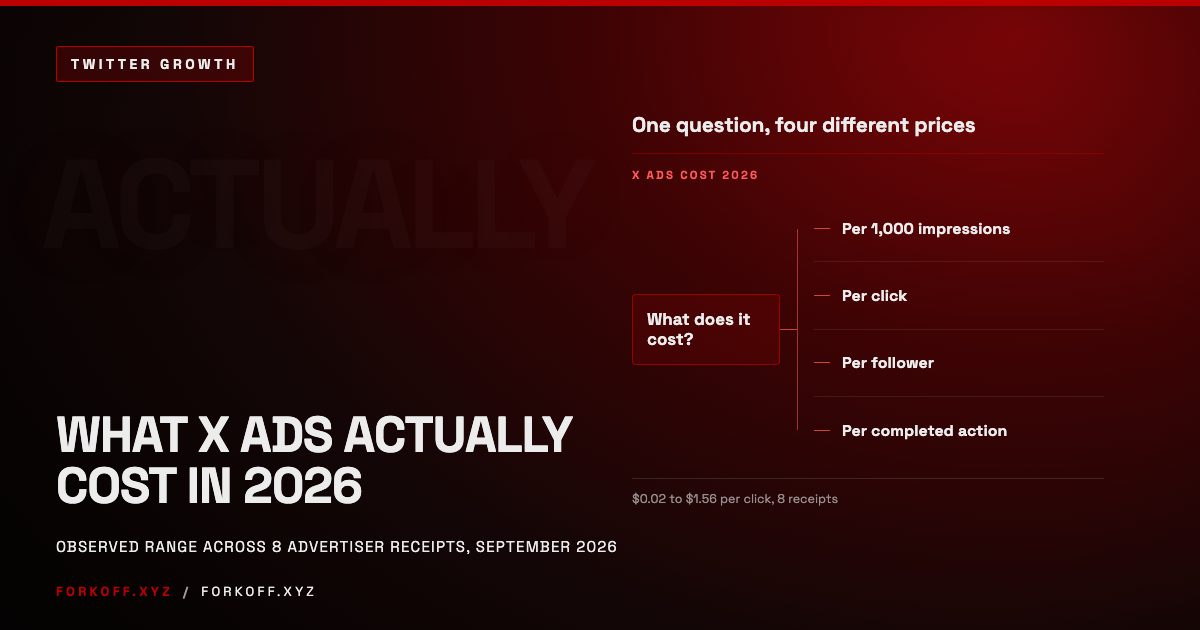
X Ads Cost Breakdown 2026: What a Click, an Impression and a Follower Actually Cost
What X ads really cost in 2026, from eight verified advertiser receipts: a 78x spread in cost per click, real follower costs, and the minimum X never publishes.
 Read
Read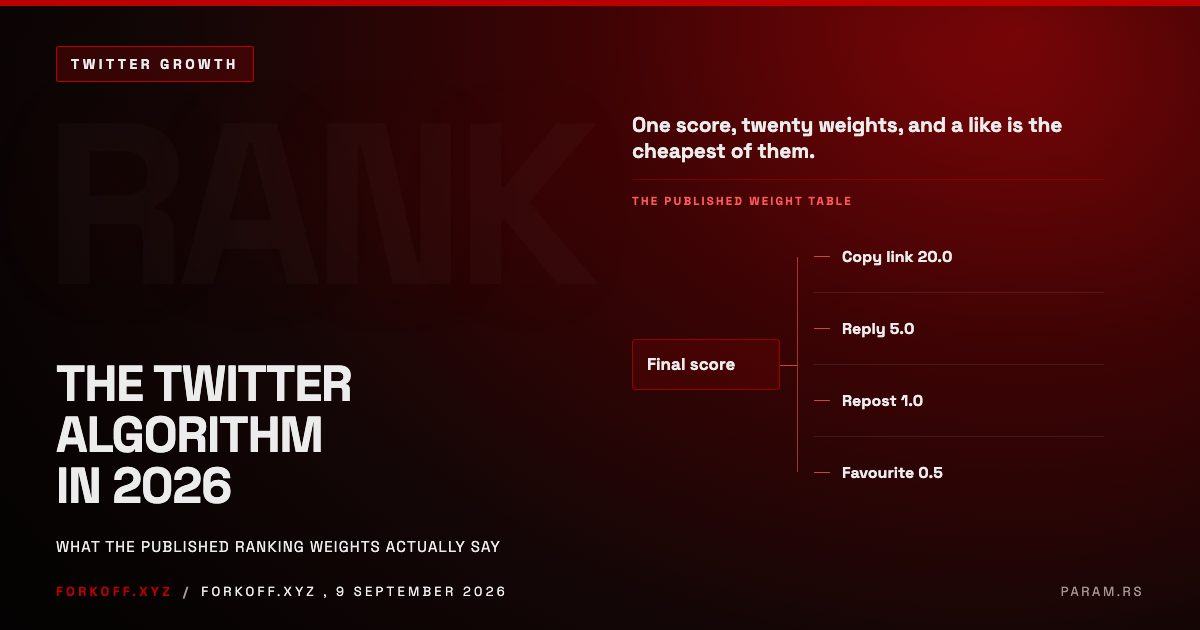
The Twitter Algorithm in 2026: What the Published Weights Say
X publishes the file that ranks your posts. What the twitter algorithm weights actually say, the misreading X refutes in its own code, and six changes to make.
Read
Grok Bots for Marketing: What They Actually Do, Measured
We measured 49 viral Grok bot marketing posts, probed the live Grok surface, and priced the quota. Here is what these bots really do for marketing.
Read