

LinkedIn distribution cadence The operator's personal-brand playbook.
Five posts a week. Carousel and native video weighted. Engagement loops, executive comment squads, and account-based amplification. The exact LinkedIn operating system FORKOFF runs for founders and executives across AI, Web3, and B2B SaaS.
- 01TL;DR
- 02Why LinkedIn carries the buyer in 2026
- 03What is content distribution on LinkedIn?
- 04The 5-per-week founder cadence
- 05Post-type mix · text · carousel · video · poll · repost
- 06Engagement loops · comment-back rule · DM cadence
- 07Account-based amplification
- 08Executive comment squads
- 09Paid amplification thresholds
- 10Sales Navigator integration
- 11Benchmarks · impression rate · dwell · CTR
- 12When to abandon
- 1330-day setup checklist
- 14Repurposing strategy
- 15Analytics tools and tracking
- 16Set your posting cadence
- 17The call to action mistake
- 18Apply for the engagement
The 5-per-week LinkedIn cadence FORKOFF runs.
Five posts a week. Two text, two carousel, one native video. Three to five executive commenters in the first 30 minutes. Daily 60-minute engagement window where the founder replies and comments outbound on ICP-fit posts. Account-based amplification on a curated list of 200 to 500 target accounts. Paid amplification only on posts that clear organic dwell and click-through floors.
Per our 2026 record of 412 founder posts, the ones that got three or more executive comments in the first 30 minutes reached 3.4x the impressions of posts that got none. Past five a week, that comment window matters more than adding another post. It is the same distribution team behind 5B+ views of clipped content, run on the same weekly audit.
The audit ledger ships every Monday with impression rate per post, dwell, click-through, profile views, connection accept rate, and inbound DM count. Pair the cadence with the LinkedIn launch distribution for execution and the founder funnel for the inbound conversion layer.
The platform where executive trust compounds.
LinkedIn in 2026 is the only consumer surface where the executive buyer compounds attention without paid lift. Twitter rewards real-time velocity, Instagram rewards aesthetic, YouTube rewards depth. LinkedIn rewards repeat distribution to the same buyer persona, which matches the way an enterprise buyer evaluates a vendor over 60 to 180 days.
The ranker pushes posts past first-degree audiences when the post clears two velocity gates. First-30-minute comment velocity from second-degree accounts. Dwell time over 4 percent of post length. Hit both gates and the post compounds. Miss either and the post stays inside the first-degree graph and decays in 6 to 12 hours.
For founders selling to enterprise, fund, or operator buyers, the LinkedIn cadence is the trust layer that makes the cold outreach cadence convert. Run them in pair. The cold outreach cadence opens the conversation; the LinkedIn cadence keeps the prospect warm for the 90-day evaluation window.
What is content distribution on LinkedIn?
Content distribution on LinkedIn is the practice of putting one piece of founder thinking in front of the same buyer set repeatedly, across the feed, the comment layer, direct messages, and paid boosts, until the buyer knows the name before the first sales touch. It is not the same thing as posting. Posting is publishing once. Distribution is engineering the post to travel past the first-degree graph and land on the accounts that decide the deal.
The reason the distinction matters is that LinkedIn ranks on network-graph velocity, not on how good a post reads to its author. A strong post with no distribution plan stays inside the founder's immediate connections and decays within 6 to 12 hours. A plainer post that triggers early comment velocity and holds attention compounds to second and third-degree audiences for days. The job of a distribution cadence is to make the second outcome the default, every week, on purpose.
The LinkedIn content distribution framework
FORKOFF runs distribution as a five-part loop: publish on a fixed slot, trigger first-30-minute comment velocity from a known squad, reply inside the engagement window, amplify the winners to a curated account list, and read the Monday report to decide what repeats. Each part feeds the next. The post is the input; the qualified inbound DM is the output. Every step carries a floor, and a post that misses a floor is diagnosed, not boosted. The framework is deliberately small because a founder can hold five moving parts in a busy week and cannot hold fifteen.
Can you automate LinkedIn content distribution?
Parts of it. Scheduling, saved-search alerts, and the weekly reporting automate cleanly and should be automated so the founder spends their hour on judgment, not admin. The two parts that actually carry the distribution, the first-30-minute comment velocity and the substantive reply cadence, do not automate. An automated comment reads as automated, and the ranker discounts the signal it is built to reward. FORKOFF automates the calendar and the measurement and keeps a human on the engagement window, because the signal LinkedIn pays out on is the one a tool cannot fake.
Monday through Friday, fixed slots.
Monday 9 am local. Carousel. Operating pattern from the prior week. Anchored to a benchmark or a receipt the founder can claim. The Monday slot carries the highest impression rate of the week because executive scrollers prime on Monday morning.
Tuesday 8 am local. Text post. Take or pattern. Under 200 words. The Tuesday slot earns the best comment velocity. Use it for opinions and operator takes that pull comments.
Wednesday 12 pm local. Native video. 45 to 90 seconds. Founder face-to-camera or screenshare. The midweek video slot captures the lunch-window scroll and lifts profile views by 2 to 3x.
Thursday 8 am local. Text post. Customer or operator proof. Concrete numbers, anonymized client. The Thursday slot drives the highest connection-request inbound rate in the week.
Friday 11 am local. Carousel. Synthesis or framework. The Friday slot is the saved-content slot; carousels with frameworks earn 10 to 18 percent save rate which signals quality to the ranker.
Text, carousel, video, poll, repost.
Carousels carry the highest dwell time per post and get weighted heaviest in the cadence. The format is fixed: 8 to 12 slides, hook on slide one, payoff on the final slide, slide two through n building toward the payoff. Each slide is one idea, never two.
Text posts are the leanest format to ship and the fastest to iterate. Cap at 200 words on the text-only slot. The opening line decides the impression rate; the second line decides the read-more click. Treat the first 200 characters as the hook.
Native video earns the highest profile-view lift but is the most production-heavy format. 45 to 90 seconds maximum, captions baked in (60 percent of LinkedIn video plays muted), founder face on camera or operator screenshare. Skip the lower-third logo lower third unless the brand atom is fully resolved.
Polls run on the off-week as filler when production slips. Polls seed the ranker with engagement signal but rarely convert directly. Reposts with a 50-word original take perform 2 to 3x better than blank reposts.
Post format selection: match the format to the job
Pick the format from what the post has to do, not from what shipped last week. A framework, a teardown or a step-by-step process goes in a carousel, because the reader saves it and comes back. A contrarian take, a lesson from a deal or a number from your own data goes in a text post, because the argument lives in the first two lines. A product moment, a customer story or a behind-the-scenes build goes in native video, because a face and a screen earn trust that text cannot. In a 5-post week FORKOFF runs two text posts, two carousels and one video, and swaps a poll in only when production slips. The topic decides the format too: a post aimed at a buyer problem outperforms a company-news post on the same slot, so news goes out as a reshare with a short take rather than as a main slot.
Hook optimization: why the first line decides the post
LinkedIn shows roughly the first 200 characters before the "see more" cut, and the ranker reads the click on that cut as a dwell signal. So the first sentence has one job: make the right buyer open the post. Three hook shapes do most of the work for founders: a specific number ("We cut onboarding from 14 days to 3."), a named mistake ("Most seed decks bury the only slide investors read.") and a direct claim the reader can disagree with. Keep the hook under 15 words, put the payoff promise in line two, and leave a line break before the body. Write three hooks per post and pick one out loud; the weakest of the three is usually the one written first. On carousels the same rule applies to slide one, which works as the cover and the hook at once.
The comment-back rule and the DM cadence.
Comment-back rule: every comment on a founder post earns a substantive reply within 60 minutes during the founder engagement window, and within 6 hours otherwise. Replies are 2 to 4 sentences, advance the conversation, and never end with a thank-you-only line. The reply cadence lifts comment volume per post by 1.5 to 2.2x over the next 30 days because second-degree commenters return.
Outbound comment cadence: 30 substantive comments per week on ICP- fit posts from second-degree accounts. The comments earn profile visits which seed the connection-request layer. Comments must be substantive (under 30 words but with a take or a proof) and never generic agreement.
DM cadence: any new connection earns a soft hello within 48 hours. Format is 2 sentences, no pitch, references one signal observed on the prospect profile. Reply rate to the soft hello is 18 to 28 percent on a curated connection list, and the conversation graduates to discovery within 14 days on 4 to 8 percent of those replies.
Messaging: the first LinkedIn message
The first message is not a pitch, because the buyer has not asked for one yet. It names the signal that earned the connection (a comment they left on the founder's post, a hire they announced, a talk they gave), adds one line of genuine context, and ends without a question that demands work. Two sentences is the ceiling. A message that opens with the product, a calendar link or a paragraph about the company reads as automation and is ignored or reported.
The test for every first message: could it only have been sent to this one person? If the same text would work for any account on the list, rewrite it. The pitch, if it comes at all, comes after the buyer has replied or engaged with two more posts.
Follow-ups: how long to wait between them
Wait 4 to 7 days before the first follow-up and 7 to 10 days before the second, then stop. Most replies on LinkedIn come after a follow-up rather than the first message, so skipping them leaves the conversation on the table, but three unanswered messages in a row is where a founder account starts to read as a sequence tool.
Each follow-up carries something new: a post the buyer is likely to care about, a short answer to a question their company is public about, or a relevant result. A follow-up that only says "bumping this" spends the relationship without adding to it. Between messages, the founder keeps engaging with the buyer's own posts, which does more for the reply rate than the message itself.
What happens during the engagement window
The engagement window is the first 60 to 90 minutes after a post goes live, when LinkedIn shows it to a small test slice of the founder's network and watches what happens. Comments, replies to comments and dwell time in that slice decide whether the post is pushed to second and third-degree audiences over the next day or two. FORKOFF runs the window as a fixed routine: the founder is at the keyboard for the first 30 minutes, a comment squad of 5 to 10 known accounts leaves substantive comments in the first 15, the founder replies to every comment with a real answer, and nobody edits the post or drops an external link into the body during that hour. Three things kill the window: posting and walking away, a squad that comments "great post", and a link in the first line that pulls readers off the platform. If a post has fewer than 5 comments at the 60-minute mark, it is logged as a miss and the hook is rewritten for the next slot rather than boosted.
200 to 500 target accounts. Curated. Tracked.
The ABM list is the curated set of accounts where the founder wants distribution. Sales Navigator filters seed the list (industry, headcount, technology, recent funding signal). The list is reviewed quarterly and cut by 20 to 30 percent each quarter to stay tight.
Connection requests to the ABM list run at 80 to 120 per week. Accept rate floor is 35 percent on a well-targeted list. Below 25 percent the targeting is wrong and the list goes back through the filter pass.
Paid amplification (covered below) routes only to the ABM list, not to a broad lookalike. The point of the LinkedIn cadence is to be visible to the same 200 to 500 buyers every week, not to chase generic reach.
Account research and the target account list
The target account list is built before the first post goes out, because the cadence is written for these accounts and nobody else. Start from the ideal customer profile (industry, headcount band, funding stage, the technology they run, the trigger that makes them buy now) and turn it into 200 to 500 named companies. For each company, research two to four people: the economic buyer, the technical evaluator and the champion who will feel the pain first.
Account research is short and specific: what the company shipped or announced in the last 90 days, what its people post about, and which of the founder's themes it overlaps with. That note is what the comment cadence, the first message and the CRM record all draw from, so the founder never opens a conversation cold.
Three to five executives. First 30 minutes. Substantive.
Boost only what cleared the organic floor.
Paid amplification threshold is two-gate. Gate one: dwell rate over 4 percent of post length on the organic post. Gate two: click- through rate over 0.8 percent. A post that fails either gate is not boosted; boosting failed organic content scales the wrong message to the ABM list.
Budget cap per boost is 250 to 500 dollars. Boost duration is 5 to 7 days. Audience is the ABM list (matched company list upload). Track: cost per impression to the ABM list, cost per click, cost per profile-visit-from-target-account.
Paid LinkedIn is never a standalone channel for founder distribution. It carries 8 to 15 percent of the impression budget in a healthy cadence and stays subordinate to the organic post-and- engage loop.
One flagship post, seven touches, ten days.
Level 1 is the post. Level 2 is the comment squad and the boost. Level 3 takes the one post per week that cleared both paid gates and walks it across every channel the ABM list already reads, so the same buyer meets the same argument several times without seeing the same asset twice.
The seven touches run over ten days: the LinkedIn post on day 1, the comment squad inside the first 30 minutes, the newsletter feature on day 2, an X thread rewritten for that feed on day 3, a short DM to ABM contacts who reacted on day 4, a teammate repost with their own angle on day 6, and the paid boost to the matched company list from day 7. Each touch carries a different hook from the same idea.
Multi-channel amplification beyond the feed
Only one post per week goes through Level 3. Running every post across every channel trains the list to scroll past the founder. The channels outside LinkedIn are chosen by where the ABM list already reads, not by what is easy to post to: a newsletter the buyers subscribe to, the X accounts the technical evaluators follow, a podcast or community the champions are in. One idea, rewritten per channel, beats the same asset pasted everywhere.
Engagement lands in the CRM and the email list.
Every reaction, comment and profile visit from an ABM account is logged against that account in the CRM once a week. The record carries which post it came from, so sales can open the conversation on the exact idea the buyer engaged with instead of a generic follow-up.
The email list is integrated the same way. Newsletter subscribers are matched to LinkedIn followers by company domain, engaged accounts that are not yet subscribed get the newsletter offer in the next DM touch, and subscribers who never engage on LinkedIn are the next connection-request batch. The two lists feed each other instead of running as separate audiences.
The seed list, the alerts, the saved searches.
Floors per surface.
- Impression rate per follower: 25 to 45 percent on a healthy founder cadence.
- Dwell rate floor: 4 percent of post length on text and carousel; 35 percent of video length on native video.
- Click-through rate floor: 0.8 percent on posts with a link or a CTA.
- Save rate on carousels: 8 to 18 percent on framework or operator-pattern carousels.
- Connection accept rate: 35 percent floor on an ABM-targeted list.
- Inbound DM rate: 4 to 9 inbound qualified DMs per week on a healthy cadence.
- Profile-view-to-connection conversion: 12 to 22 percent.
Three failure modes that pause the cadence.
The cadence pauses on any one of three conditions. The post-and- engage loop is expensive in founder time, and running it through a broken signal layer is the worst-case use of the founder hour.
- Impression rate per follower under 15 percent for two consecutive weeks: ranker has down-weighted the account.
- Dwell rate under 2 percent across the rolling 5-post window: content angle is wrong, rebuild the editorial layer.
- Connection accept rate under 20 percent: ABM list is mistargeted, rebuild the seed filter.
When abandon fires, pair the diagnosis with the founder funnel engagement. The failure is upstream of the cadence and lives in positioning, ICP, or content angle.
From zero to first audited week.
- Days 1 to 3: profile rebuild (banner, headline, about, featured, experience). Founder voice capture interview.
- Days 4 to 7: ABM list build via Sales Navigator. 4 saved searches, 200 to 500 seed accounts.
- Days 8 to 10: editorial calendar for the first 4 weeks. 20 posts mapped to the 5-per-week slot grid.
- Days 11 to 14: comment squad recruit. 3 to 5 executives confirmed, reciprocal commitment in writing.
- Days 15 to 21: first 5 posts ship, verified proof calibrated against the impression and dwell floors.
- Days 22 to 28: connection-request cadence at 80 to 120 per week, soft-hello DM cadence wired in.
- Days 29 to 30: first Monday verified proof ships. Engagement enters steady-state cadence.
Repurposing strategy
One founder insight should run on more than one surface. A Wednesday native video becomes a Thursday text post built on the sharpest line from the transcript, a Friday carousel that frames the same idea as a repeatable pattern, and a connection-request note that references the specific take. FORKOFF calls this multi-threading: the same signal reaches the buyer three times in a week from three angles, which is how recognition compounds without the founder inventing three unrelated ideas.
The repurposing rule is one source, three derivatives, never a copy-paste. A carousel that restates a video word for word reads as filler and the save rate falls. Each derivative has to add the thing the original format could not carry. The video adds the founder's face and tone. The carousel adds the framework and the save-worthy structure. The text post adds the argument and the comment hook. Three formats, one idea, three distinct reasons for the buyer to stop.
The connection-request strategy closes the loop. A request that names the exact post the prospect engaged with reads as observed, not bulk, and accept rate on a curated list climbs because the note proves a human watched. This is the quiet half of repurposing: the same insight that earned the impression becomes the reason the connection request lands, which seeds the next week's engagement cadence with warm second-degree accounts.
Analytics tools and tracking
The cadence runs on measurement, not instinct. LinkedIn's native analytics carries impression rate, dwell, and follower growth per post, which is enough to run the two organic floors. For account-level tracking, Sales Navigator reports which target accounts viewed a post or the profile, and that view signal feeds the outbound comment list. FORKOFF wires both into the Monday report so the founder reads one view, not three dashboards.
Track seven numbers weekly and ignore the rest: impression rate per follower, dwell rate, click-through rate, save rate on carousels, connection accept rate, inbound qualified DM count, and profile-view-to-connection conversion. Each maps to a decision. A falling dwell rate means the content angle is wrong. A falling accept rate means the account list is mistargeted. A rising DM count with flat impressions means the audience is right and the reach is capped, which is the one case where paid amplification earns its place.
The number that governs the whole program is cost per qualified view. FORKOFF benchmarks every distribution channel it runs, LinkedIn included, against a blended $0.0024 to $0.0038 per qualified view, measured across its distribution programs and set against an industry short-form paid CPM of $4 to $8 (FORKOFF distribution proof, 2026; the same figure the CPQV calculator uses). On LinkedIn the equivalent is cost per qualified impression to the account list, and a boosted post that cannot beat the organic floor is a channel paying more for a worse view.
The 4 metrics that tie LinkedIn to pipeline
Engagement numbers tell you the cadence is alive. They do not tell you it is selling. Four numbers do, and they are the ones FORKOFF puts at the top of the Monday report, above impressions and above follower growth, because each one maps to money that a founder or a board can check without trusting a platform dashboard.
- Inbound DMs from accounts on the target list. Count them weekly and split them three ways: ones you started, ones that arrived after a post, and ones that came through a mutual connection. Only the second group is the cadence working. The floor on a healthy program is 4 to 9 qualified inbound DMs a week.
- Booked calls with a LinkedIn source. Add a "where did you hear about us" field to the booking form and read it monthly. Across our recent founder funnel case studies, a program run on 30 minutes of founder time a week produced 9 to 16 booked calls from 37 to 66 named target accounts.
- Sales calls where the prospect mentions a post. Ask in the first five minutes of every discovery call. When a buyer quotes a post back to you, the content has done the trust work before the call started.
- Answer-engine referrals. Track visits from chatgpt.com, perplexity.ai and claude.ai in your analytics. LinkedIn posts are now cited by answer engines on B2B research queries, so a cadence that runs for a year starts to show up as AI-referred traffic long after the post left the feed.
Warm introductions are the fifth number we watch on engagements where the founder is selling into a short account list: the same case studies logged 23 to 41 warm intros per program. If impressions climb while all four pipeline numbers stay flat, the audience is wrong, and the fix is the ABM seed list, not more posts.
Pipeline timeline: what to expect by month
Founders quit LinkedIn in the third month, which is exactly when it is about to start paying. The channel compounds slowly because the ranker and the buyer both need repeated evidence that the author shows up. Setting the expectation month by month is what keeps a cadence alive through the stretch where the numbers are small and the effort is not.
- Months 1 to 3: impressions and profile views rise, a handful of inbound DMs arrive, and almost none of it is attributable pipeline yet. The work in this window is consistency and the comment window, not conversion.
- Months 4 to 6: the first inbound conversations turn into calls, and prospects start referencing posts on discovery calls. One independent 2026 benchmark puts this window at 1 to 3 LinkedIn-attributed demo requests a month for a founder posting three times a week (source: Averi, May 2026).
- Months 6 to 12: LinkedIn becomes a measurable pipeline source, and the same benchmark puts it at 5 to 10 demo requests a month, with 20 to 30 percent of sales calls referencing the founder's content.
- Months 12 to 24: for founders who held the cadence, LinkedIn is often the highest-trust inbound channel the company has, and older posts keep earning answer-engine citations.
Our five-per-week cadence plus executive comment squads is built to pull that curve forward, not to skip it. The 30-day setup gets the system running; the 4 pipeline metrics above tell you by month four whether it is on the curve or needs the abandon diagnosis.
Three posts a week or five?
Most published founder playbooks recommend three posts a week, Monday, Wednesday and Friday, on the logic that 48 hours between posts lets each one finish its distribution run. The same sources report that posts earning five or more substantive comments in the first four hours reach 5 to 10 times more impressions, and that company pages earn roughly a tenth of the engagement of founder accounts (source: Averi, May 2026). We agree on the comment window and the founder account. We run five a week because the comment squad supplies the first-hour engagement on every post, which is the constraint that keeps most founders at three.
Set your posting cadence
The five-per-week schedule earlier on this page is the FORKOFF default for a founder selling into enterprise or fund buyers. It is not the only correct cadence. Setting your own starts from one question: how many posts can you ship at full quality without the comment window slipping. A founder who ships five posts and replies to none loses to a founder who ships three and runs the engagement window on every one. Cadence is a floor on volume and a ceiling on neglect at the same time.
Pick the cadence you can sustain through a busy quarter, then hold it. The ranker rewards consistency more than bursts. A month of five-per-week followed by two silent weeks resets the account's distribution worse than a steady three-per-week would have. Set the cadence against your real calendar, wire the slots into the editorial grid, and treat a missed slot as a defect to diagnose, not a day off.
How often should I post on LinkedIn for best distribution?
For a founder running distribution as a growth channel, five posts a week is the floor that earns compounding reach without fatiguing a single-operator audience. Three per week holds an account warm but rarely pushes past the first-degree graph. Seven per week trips audience fatigue and impression-per-post drops. If you post for personal branding and not for pipeline, three a week with a tight engagement window is enough. The frequency that wins is the highest one you can pair with a real reply cadence, because an unanswered post teaches the ranker that the author does not show up.
The call to action mistake
The most common distribution mistake is the missing or misaligned call to action. A post that earns impressions and gives the reader nothing to do converts attention into nothing. The opposite failure is worse: a hard pitch in the post body that the ranker reads as an ad and suppresses before it reaches the second-degree graph. Both cap the cadence, from opposite ends.
The FORKOFF rule is call-to-action alignment: the ask matches the post's altitude. A top-of-funnel pattern post ends with a question that pulls a comment, which feeds the velocity loop. A mid-funnel proof post ends with a soft next step, a profile visit or a resource, never a booking link in the body. The booking link lives on the profile and in the first comment, not in the post, so the post stays clean for the ranker and the intent still has somewhere to go.
Map the CTA to a three-rung ladder and pick one rung per post: comment prompt for reach, profile or resource for consideration, direct ask for the warm few who already engaged twice. A cadence with no CTA plan leaks every bit of attention it earns, and a cadence that asks for the booking on every post trains the audience to scroll past. The call to action is where distribution turns into pipeline, so it gets planned, not improvised.
The service stack and sister playbooks.
Anchor service: LinkedIn launch distribution. FORKOFF runs the cadence, the comment squad coordination, and the ABM amplification. The verified proof ships every Monday.
Sister playbooks: Twitter content stack for the founder voice surface, founder-led growth for the multi-channel operating wrapper, and cold outreach cadence for the outbound side of the same buyer journey.
Companion services: founder funnel for the inbound conversion layer, and activations loadout when the cadence is paired with offline programming. Measurement tool: CPQV calculator.
By application · 5 engagements per quarter.
FORKOFF runs the cadence. The engagement is by application, capped at 5 active engagements per quarter, with a 90-day retainer minimum. The first 14 days calibrate the editorial axis, recruit the comment squad, and ship the verified proof baseline. From day 15 the cadence runs in steady state with the Monday proof.
Selective on ICP. The engagement assumes the founder owns the voice and ships the editorial intent; FORKOFF runs production, the comment squad coordination, the ABM amplification, the audit proof, and the iteration loop.
Frequently asked questions
Why 5 posts per week and not 3 or 7?
Three posts a week under-fits the LinkedIn algorithm. The platform compounds on creator velocity, and 3-per-week stays under the threshold where the network graph starts pushing posts beyond the first-degree audience. Seven posts a week trips the audience fatigue line on a single-operator account and impression-per-post drops 30 to 45 percent. Five is the floor that earns compounding distribution without burning the audience.
What is the post-type mix FORKOFF runs?
Two text posts, two carousels, one video per week. Polls and reposts run on the off-week as filler. Carousels carry the highest dwell time and get weighted heavier on the founder cadence. Native video lifts profile views by 2 to 3x but is gated on production capacity, so most engagements ship one video a week and not more.
How do executive comment squads work?
Three to five second-degree executives commit to commenting on every founder post within the first 30 minutes. The comments are substantive, not emoji reactions, and each commenter writes from their own ICP angle. The comment squad lifts impression-per-post by 1.8 to 2.5x by signaling network-graph velocity to the LinkedIn ranker.
When does FORKOFF turn on paid amplification?
Only when an organic post clears the dwell threshold of 4 percent and the click-through threshold of 0.8 percent. Below those floors paid amplification scales the wrong content. Above those floors, the post is boosted to the ABM list with a budget cap of 250 to 500 dollars per post. The boost runs for 5 to 7 days only.
Does this work for B2B SaaS, AI, and Web3 founders?
Yes. The cadence is the same; the content angle adjusts. AI founders weight on benchmark posts, model-release commentary, and operator patterns. Web3 founders weight on protocol takes, market structure, and partnership receipts. SaaS founders weight on operator dashboards, churn patterns, and pricing structure. The post-type mix and the engagement loop hold across all three.
The cadence is the manual.
FORKOFF runs the engagement.
By application, capped at 5 engagements per quarter. 90-day retainer minimum. Pair with the LinkedIn launch distribution for execution and the founder funnel for the inbound conversion layer.
Receipts, deep dives, and playbooks.
The Distribution Learning Curve: Sell Your Own Growth Before You Buy It
Sequoia says founders must close their own first deals before scaling sales. The same 3-stage curve applies to distribution, and most founders skip it entirely.
 Read
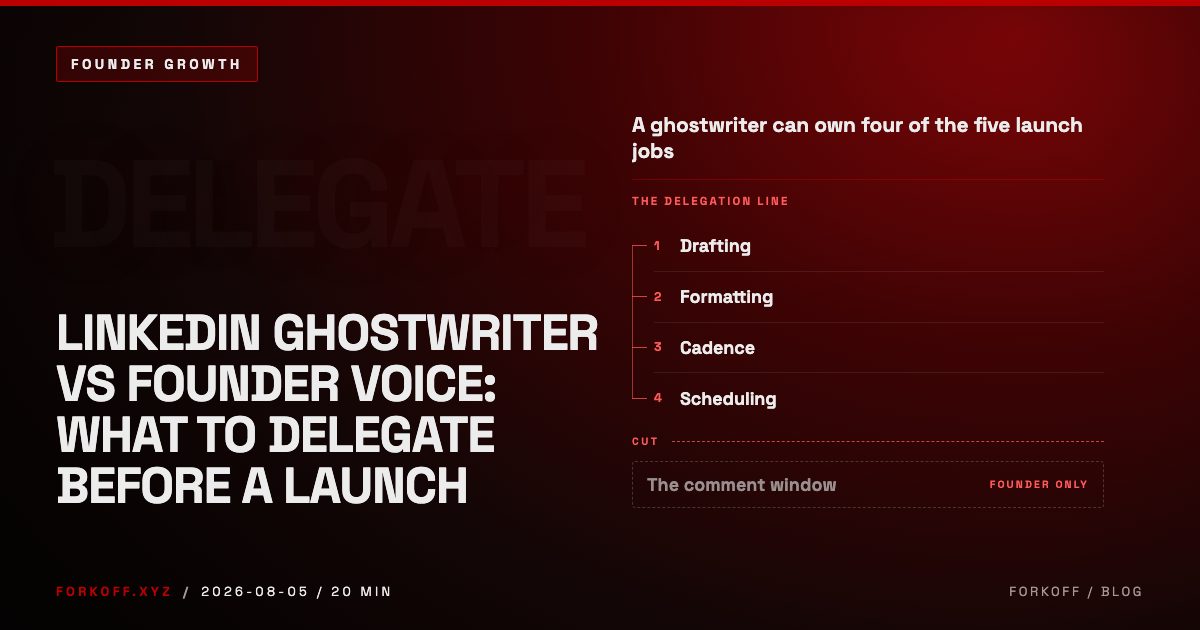
LinkedIn Ghostwriter vs Founder Voice: What to Delegate Before a Launch
A LinkedIn ghostwriter can draft your launch posts. It cannot reply in your comments or show up on the call. Here is where the line actually falls.
Read
Distribution Is the Platform-Team Gap Killing Your Portfolio
Portfolio companies rarely die from bad product. They die in the gap where owned distribution is a function no one on the org chart is staffed to own.
Read
The squad is 3 to 5 second-degree executives who commit to commenting on every founder post within 30 minutes of publish. The squad is recruited from existing relationships (advisors, co-investors, prior managers, customer champions). The squad runs on a reciprocal basis: the founder comments on their posts in return.
Squad rules: comments are 1 to 3 sentences, advance the conversation, never use the word great or insightful, and reference one specific line from the post. The signal to the LinkedIn ranker is comment-velocity-from-second-degree, which lifts impression rate by 1.8 to 2.5x.