

- Lead each section with the answer, not the setup. The first sentence is the citation candidate.
- Paragraphs under 80 words. The LLM will not cite a paragraph it cannot lift cleanly.
- Numbers and named entities in the first 200 words of the page. Specificity is what LLMs index for retrieval.
- One canonical claim per page. Pages that hedge get cited at 30 percent the rate of pages that commit.
- No ai-writing patterns. The avoid-ai-writing gate runs every page before ship; LLMs preferentially cite pages that read human.
- Internal links to canonical sister pages. The citation graph compounds across the cluster.
Playbook · Answer engine optimization
Answer engine optimization playbook ChatGPT, Claude, Gemini, Perplexity.
The complete AEO operating manual. Per-LLM citation measurement across 4 answer engines, schema.org rules that lift citation rate 1.6 to 2.4x, llms.txt manifests, and the parasite ladder that earns recall when the LLM has not crawled your domain directly.
By application · 5 engagements per quarterFive business days from intake to delivery
4Answer engines tracked
WeeklyCitation receipt cadence
By applicationCitation diagnostic · 5 business days
By application5 engagements / quarter
TL;DR
Engineer the answer the LLM repeats.
AEO is the engineering of the citation slot inside ChatGPT, Claude, Gemini, and Perplexity. The buyer journey for AI and Web3 products has shifted from blue-link SEO to answer-slot citation; the brand that gets cited inside the LLM answer wins the qualified inbound that brand-led SEO used to capture.
FORKOFF runs the AEO engagement as the canonical anchor under the AEO service. The first 30 days ship the schema graph, the canonical Q&A corpus, the llms.txt manifest, and the parasite ladder. The weekly receipt is a 4-engine citation share table.
By the numbers
The AI answer shift, in numbers.
AEO is a discovery reallocation, not a tactic. Every figure below is a published benchmark with a named source and a checkable link.
Per our own AI Citation Index, a 50-prompt buyer-intent cluster run against 5 engines, forkoff.xyz moved its average cite rate from 22 percent to 34 percent in four weeks of remediation. (AI Citation Index 2026, 2026)
Gartner projected that traditional search volume will fall 25% by 2026 as buyers move to AI chatbots and answer engines. (Gartner, 2024)
A page cited inside a Google AI Overview earns 120% more organic clicks per impression than an uncited page on the same result. (Seer Interactive, 2026)
Only 38% of AI Overview citations now come from a Google top-10 page, down from 76%, so ranking first no longer earns the citation. (Ahrefs, 2026)
Adding cited statistics to a page lifts its visibility in generative-engine answers by 41%, authoritative-source citations by 115%, and expert quotations by 28%. (Princeton GEO study, 2024)
Brands in the top web-mention quartile earn 10x more AI Overview mentions than the next quartile. (Ahrefs, 2025)
Google users click a traditional result only 8% of the time when an AI summary appears, versus 15% of the time without one. (Pew Research, 2025)
FORKOFF has processed more than 5 billion qualified views across its clipping network, the proof base behind the citation-share reporting in this playbook. (FORKOFF, 2026)
What is AEO
The citation slot is the new top-of-funnel.
Answer engine optimization is the engineering discipline of getting cited inside an LLM answer. The four answer engines FORKOFF tracks are ChatGPT (with web_search retrieval), Claude (with retrieval), Google AI Overviews, and Perplexity. Bing Copilot is added when the engagement targets enterprise buyers. For how AEO sits next to generative engine optimization, the AEO vs GEO guide draws the surface and measurement split.
The buyer query is the unit of analysis, not the keyword. A traditional SEO keyword like "best ai marketing agency" translates to dozens of buyer queries inside the LLM ("which agency runs ai marketing for ai-native startups", "agency for pre-seed ai founders", "how do i hire a marketing agency that understands llm products"). AEO targets the buyer-query cluster, not the head-term keyword.
Why blue-link SEO is dead for AI search
The user never sees the SERP.
Inside an LLM, the SERP is collapsed into the answer. The user reads the answer; the user does not click through to the blue links. A page that ranks position one on Google but is not cited by ChatGPT loses the buyer to the page that is cited (often a page that does not even rank in the top 20 on Google).
Three signals drive LLM citation that traditional SEO does not optimize for. First, schema cleanliness (LLMs prefer pages with FAQPage, HowTo, Article schemas because the schemas shorten the answer-construction prompt). Second, answer-shaped paragraphs (the LLM extracts directly from paragraphs that already read like answers, with the question framed at the top of the paragraph). Third, parasite presence on high-authority secondary domains (Reddit, Wikipedia, HackerNoon, Mirror) that LLMs over-trust for retrieval.
Per-LLM citation measurement
20 to 40 queries · 4 engines · weekly.
The measurement layer runs every Monday. 20 to 40 commercial buyer queries are sent to each of the 4 answer engines. The presence of the brand citation, the ranking inside the citation list, and the surrounding context are logged. The output is a citation share percentage per engine, per week.
Citation share lifts compound on a 60 to 90 day cycle. Weeks 1 through 3 typically show no movement; the schema and content layer have not propagated through the LLM retrieval indexes. Weeks 4 through 8 show the first lift on Perplexity (fastest crawler). Weeks 9 through 12 show the lift across ChatGPT and Google AI Overviews. Claude lags by 2 to 4 weeks on most engagements.
The weekly proof is the deliverable. Pair the AEO retainer with the AI search visibility checker for the public-tool layer of the same measurement.
Schema.org playbook
Five schemas every page ships.
- Organization on the homepage and footer. Includes the founding date, HQ, and operating-team links.
- WebPage on every route. Includes the canonical URL and the isPartOf reference to the WebSite entity.
- BreadcrumbList on every non-home route. Three levels deep typically.
- FAQPage on any page with 4 or more Q&A pairs. Most LLM citations on commercial queries pull from FAQPage schema.
- Article on every blog post and playbook. Includes wordCount, datePublished, dateModified, author Organization, and mainEntityOfPage.
LLM-readable content rules
Six rules every page follows.
llms.txt and parasite ladder
Manifest your content. Plant outside your domain.
The llms.txt manifest lives at the project root and tells LLM crawlers which pages to prefer for which buyer-query clusters. Think of it as the AEO version of sitemap.xml for traditional search. FORKOFF ships a llms.txt for every engagement; coverage is moving from optional in 2026 to baseline by 2027.
The parasite ladder is the secondary-domain coverage layer. LLMs retrieve from Reddit, Wikipedia, HackerNoon, Mirror, Substack, Medium, dev.to, and a long tail of high-authority secondary surfaces at 2 to 4x the rate they retrieve from a single owned domain. Each FORKOFF engagement plants 12 to 18 parasite assets in the first 30 days, anchored on the canonical page back on the brand domain.
Pair the AEO retainer with the ChatGPT SEO service for the directory and listicle stack, the Perplexity SEO service for niche-pub authority, and the AI search optimization service for the umbrella engagement.
Sandbox · citation diagnostic
20 to 40 queries · 4 engines · 5 business days.
The sandbox is a citation diagnostic. The output is a structured-answer map covering 20 to 40 commercial queries across the 4 answer engines, the schema audit, the content gap diagnosis, and the Q&A engineering plan. Five business days from intake to delivery.
After the sandbox, the engagement moves to a retainer (by application) with the weekly report shipping every Monday. 90-day retainer minimum. By application, capped at 5 engagements per quarter.
Cross-links
Sister engagements and playbooks.
The AEO playbook anchors the AI-search cluster. Sister service pages target adjacent surfaces: the AEO service is the canonical retainer, ChatGPT SEO is the directory + listicle stack, Perplexity SEO is the niche-pub authority play, and AI search optimization is the umbrella.
Sister playbooks: founder-led growth covers the trust-velocity layer that LLMs increasingly weight, and cold outreach cadence covers the outbound complement.
Run it yourself
Score a page against the answer-engine signals in this playbook.
Submit a URL and the AEO checker reports schema coverage, answer-capsule presence, entity authority, and citation density the way ChatGPT, Perplexity, Claude, and Google AI Overviews read it. The scan runs in the browser with no registration.
FAQ · 5 questions
Frequently asked questions
What is the difference between AEO, GEO, and LLM SEO?
AEO (answer engine optimization) targets the citation slot in ChatGPT, Perplexity, Bing Copilot, and Google AI Overviews. GEO (generative engine optimization) is a broader umbrella covering the same surfaces plus Claude and Gemini. LLM SEO is the engineering layer underneath both. FORKOFF runs all three; AEO is the most commercial-intent slug because the citation slot maps to a buyer query.
How do you measure citation rate per LLM?
20 to 40 commercial queries are run weekly across 4 answer engines. The presence and ranking of the brand citation in the answer is logged. The output is a citation share percentage per engine, per week, with the delta vs the prior week and the 30-day rolling average.
Does schema.org actually improve LLM citation?
Yes, but the mechanism is indirect. LLMs that retrieve from the open web (ChatGPT web_search, Perplexity sonar, Google AI Overviews) preferentially cite pages with clean schema graphs because the schema shortens the answer-construction prompt. Pages with FAQPage, HowTo, Article, and Organization schema cite at 1.6 to 2.4x the rate of pages without.
What is llms.txt and why does it matter?
llms.txt is a project-level manifest that tells LLM crawlers what to cite, in what shape, for what queries. It is the AEO equivalent of robots.txt for traditional search. FORKOFF ships a llms.txt for every engagement; coverage is moving from optional in 2026 to baseline by 2027.
When does AEO not work?
Three failure conditions. Brand has no commercial-intent query volume (no buyer is asking the LLM). Brand has no canonical authority page that LLMs can retrieve from. Brand product is too new for the LLM training cutoff and has zero parasite presence. FORKOFF gates against all three at the audit stage.
Apply for the auditEngineer the answer.
Engineer the answer.
Earn the citation.
sandbox (by application) audit. After the audit, the engagement runs as a retainer (by application) under the AEO service. By application, capped at 5 engagements per quarter.
From the FORKOFF blog
Receipts, deep dives, and playbooks.
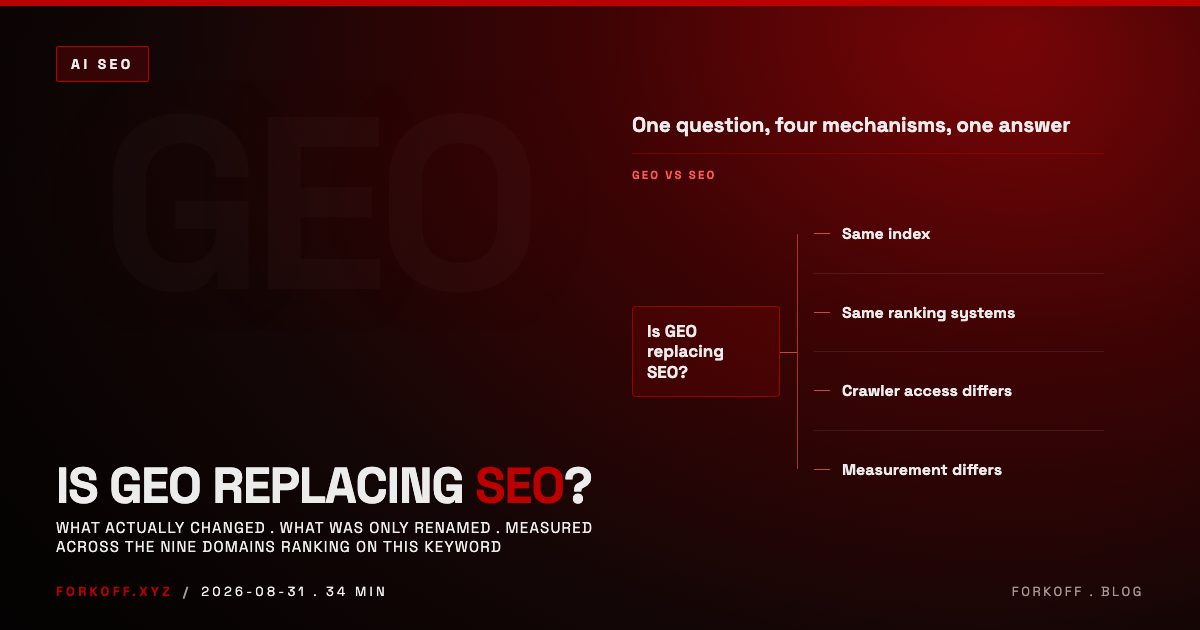
Is GEO Replacing SEO? What Actually Changed, and What Did Not
GEO is not replacing SEO. Here is what genuinely changed, what was only renamed, and measured crawler data on whether the two visibilities differ.
By simba Read
Read
Read
AI SEO Agency vs AI SEO Software: Build, Buy, or Hire in 2026
AI SEO agency vs AI SEO software, decided with real Reddit AMA retainer figures, published tool pricing, and a stage-by-stage framework.
By simbaRead
Read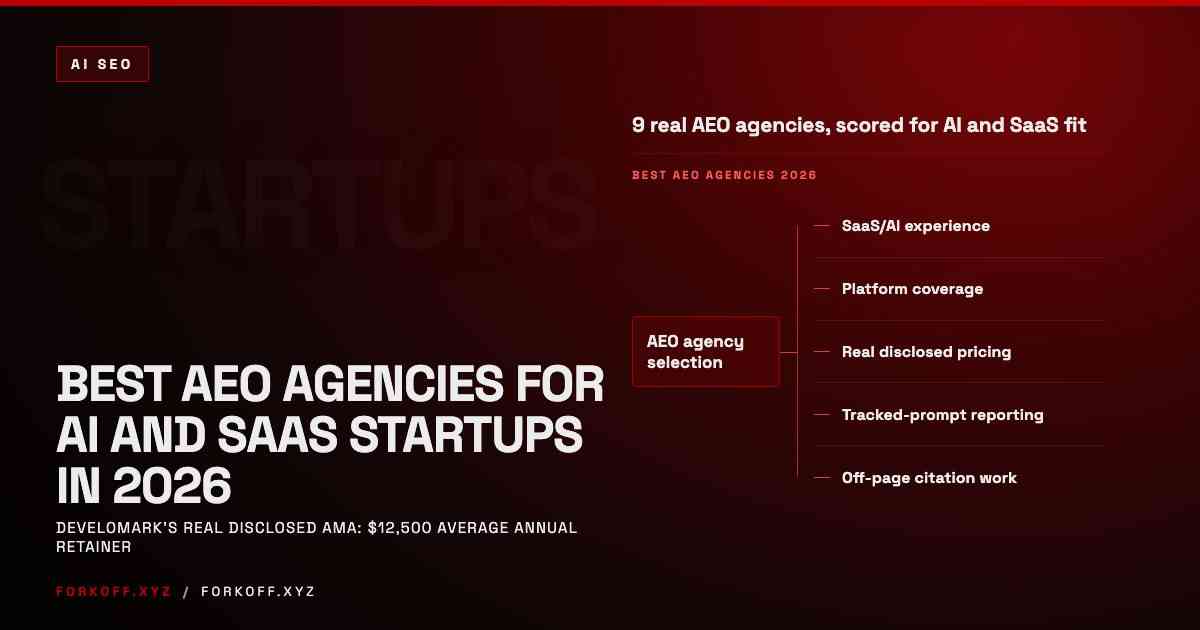
Best AEO Agencies for AI and SaaS Startups in 2026
9 real AEO agencies for AI and SaaS startups: real disclosed pricing where it exists, platform coverage, and the checklist that spots a relabeled SEO shop.
By simbaRead
Read