

NotebookLM
@NotebookLM · 261.3K followers
Introducing Short Video Overviews in NotebookLM. Turn your most complex sources into 60-second vertical videos that deep dive into any concept.
Short Video Overviews (NotebookLM) launchVerified Organic
Short Video Overviews (NotebookLM) is a real product by a real founder (@NotebookLM). RADAR has tracked 2.5M views on this launch, according to the source post linked below. RADAR measures how the launch reach was built, not whether the product works or whether anyone was honest. This reading is verified confidence and every input is public.
By Simba, Launch Intelligence Analyst · Reviewed by JK · Published 26 Aug 2026 · Confidence: verified
Independent, methodology-derived signal, not a statement of fact about any person. RADAR reads how reach was built, a signature, not an accusation. See the methodology.
Did the Short Video Overviews (NotebookLM) launch go viral organically, or was the reach amplified?
The Short Video Overviews (NotebookLM) launch by @NotebookLM drew 2.5M views on 12.0K likes, which is 211 views per like, inside the roughly 500 organic ceiling. RADAR reads the reach as organic: reach and engagement grew together and no distribution-amplified signature shows in the public metrics. This is a verified reading and every input is public and reproducible.
New here? Start with the product
What is RADAR, and what does this grade mean?
RADAR is FORKOFF's launch authenticity rating system. It reads whether a product launch earned its reach through real engagement or bought it through paid distribution, using only public signals anyone can pull from the launch post. Every reading carries a letter grade, a confidence label, and the date it was last checked, and links back to a published method you can reproduce. Short Video Overviews (NotebookLM) is a real product by a real founder (@NotebookLM). RADAR measures how the reach was built, not whether the product works or whether anyone was honest.
Verified Organic
Independent, methodology-derived signal, not a statement of fact about any person. RADAR reads how reach was built, a signature, not an accusation. See the methodology.
What this grade means
This launch carries an Authenticity Grade of Verified Organic. RADAR reads its reach as organic: the views and the genuine engagement grew together, and no distribution-amplified signature shows in the public metrics. That is a favorable, low-risk read.
The signals RADAR reads
Views-to-likes ratio
Organic reach tops out near 500 views per like. When views climb far past that without the likes to match, the extra reach is arriving without the engagement organic reach produces.
Amplification wave shape
Organic amplification spreads over hours and days. A coordinated launch fires a synchronized burst of quote posts in the first few hours, read from each post's own timestamp.
Posting-time fingerprint
A post that fires exactly top of the hour on a weekday is scheduled. On its own it is weak, but it corroborates a coordinated launch alongside the other two signals.
Those three public signals sit on top of RADAR's five-component forensic read. The full method, the bands, and the confidence model are on the RADAR methodology page.
This launch in the data
Where does this reach sit against the tracked corpus?
Where it sits in the corpus
Rank 3 of 30 tracked launches by views per like, lowest (most organic) first. A lower ratio is the favorable end.
Against the benchmark
This launch's views per like next to the organic median (354) and the amplified median (1,441) across the tracked set.
 The product
What is Short Video Overviews?
The important constraint is that the output is grounded in the user's own uploaded material rather than the open web. That is NotebookLM's whole design premise: it reads what you give it and refuses to wander, which is what makes it usable for study, legal reading, research and internal documentation where a general chatbot's confident invention is disqualifying.
This is a feature launch with a long lineage behind it, and reading the launch without that lineage misses why it landed. Google introduced Audio Overviews, the podcast-style two-host summary of a notebook, at Google I/O in 2024, and it became the product's breakout feature. Video Overviews followed in July 2025 as a horizontal, slide-style visual walkthrough that pulled images, diagrams, quotes and numbers out of the source material, and expanded to 80 languages in January 2026. Short Video Overviews is the third step: the same grounded-explainer engine, cut to the vertical, sub-minute shape people already scroll. Press reporting on the launch attributed the generation to Google's Nano Banana 2 Lite model.
The market it competes in is not really other note apps. It is the short-form educational video lane that TikTok, Reels and Shorts already own, where explainer creators earn attention a minute at a time. What Google is offering is the same format generated from a reader's own sources, which sidesteps the accuracy problem that dogs the human version of that lane.
What it does
- Turns uploaded sources into a 60-second vertical video explaining one concept from that material.
- Drafts the script, selects a visual style and records an AI voiceover automatically.
- Stays grounded in the user's uploaded sources rather than pulling from the open web.
- Launched to Google AI Ultra and Google AI Pro subscribers on mobile and web, with free access stated as coming later.
- Started in English, with more languages stated as following.
How the Short Video Overviews launch worked
The launch was a single post carrying a 30-second vertical video, published at 9:01 AM Pacific on Tuesday 30 June 2026 from the @NotebookLM account.
The post opens on a joke, not a product name: Doom scrolling but make it educational, with a nerd-face emoji. Only the second line introduces the feature, and it does the whole pitch in one sentence, that Short Video Overviews turns your most complex sources into 60-second vertical videos that go deep on any concept. The third line is availability: rolling out now to Google AI Ultra and Pro subscribers on mobile and web, with free users noted as coming soon.
The video is the same shape as the product
The demo clip is vertical and it is 30 seconds long, which is half the length of the videos the feature actually produces. That is a deliberate and effective choice: the format of the launch asset is the format of the product, so a viewer understands what they will get without anyone explaining it. A horizontal demo of a vertical feature would have made the same claim and communicated none of it.
What Google did during the launch
No thread, no giveaway, no dated discount, no creator wave. One post, one vertical clip, three lines of copy. Each element is doing a specific job and none of it is filler.
| Asset | What it did |
|---|---|
| Joke as the first line | Doom scrolling but make it educational, an opener that reads as a person rather than a release note |
| 30-second vertical demo video | The launch asset is the same shape as the product, so the format explains itself |
| One-sentence capability line | Turn your most complex sources into 60-second vertical videos, the entire pitch with no feature list |
| Explicit availability line | Google AI Ultra and Pro, mobile and web, so a reader knows in one beat whether it applies to them |
| A stated path for everyone else | Free users soon, which keeps the non-subscriber audience reading instead of scrolling past |
| Timing: Tuesday 9:01 AM PT | Start of the US work day, one minute past the hour, midweek |
The tonal decision is the interesting one. A Google feature launch could easily have opened with the product name and the subscription tier. Opening on a self-aware joke about doom scrolling signals that the team knows exactly what format it is borrowing and is not pretending otherwise, and that costs nothing while making the post far more shareable.
How the launch performed
The launch post reached 2,560,942 views on 11,923 likes, with 1,043 reposts, 422 quote posts, 377 replies and 7,670 bookmarks. These are matured public metrics, re-pulled directly from the source post on 26 August 2026.
At about 215 views per like this sits at less than half RADAR's roughly 500 organic ceiling, which is one of the tighter reach-to-engagement couplings in the tracked set. Underneath it the public layer is thick: 13,765 total public actions, about 0.537 percent of views. Note the ordering inside that layer, because it is unusual. There were more quote posts than replies, 422 against 377. A reply is a comment on someone else's post; a quote is a person carrying the launch to their own audience with their own framing attached. When quotes outrun replies, the post is being distributed by its readers rather than merely discussed.
The bookmark number is the whole story
The standout figure is the save layer: 7,670 bookmarks against 11,923 likes, a rate of about 0.64 bookmarks per like. For comparison, RADAR routinely sees infrastructure and news announcements save at a fraction of that. A like is a reaction that costs nothing and ends there. A bookmark is a person filing the post because they intend to come back and do something with it, which is exactly what a subscriber does when they see a feature they can go and use inside a product they already pay for. On this launch roughly two people saved it for every three who liked it, and that is the fingerprint of demonstrated intent rather than passive approval.
Views per like (matured)
Less than half the roughly 500 organic ceiling. Across 2,560,942 views the like count tracked the reach closely.
Bookmarks per like
7,670 bookmarks against 11,923 likes. An unusually high save rate, and the single strongest signal on this launch.
Written and reshared engagement
11,923 likes, 1,043 reposts, 422 quotes and 377 replies, about 0.537% of views. A thick public layer at this reach.
Quotes above replies
More people wrote a quote post than wrote a reply. A quote carries the launch to a new audience, which is the costlier of the two actions.
Did the reach get earned or bought?
The verdict is a five-signal read rather than a ratio check. RADAR weighs how the view-velocity curve grew, whether the written engagement climbed in step with the reach or lagged behind a flat floor, whether the replying and quoting accounts read as real and spread out rather than as a coordinated cluster, and whether the quote and repost pattern matches word of mouth or a known amplifier ring. All of them agreed here, which is why the confidence is verified rather than reconstructed.
The numbers moved only slightly between detection and this settled pull. RADAR's detection-time snapshot recorded 2,527,487 views on 11,984 likes, a ratio of 211. The matured figures are 2,560,942 views on 11,923 likes, a ratio of 215: views rose by 33,455 while likes fell by 61 as the count settled. Both readings sit deep inside the same organic band. RADAR re-pulls launches because late engagement and count settling can move a ratio far enough to change a band, and this page shows the settled read.
What a founder can take from this launch
The first lesson is the cheapest one to copy: make the launch asset the same shape as the product. A vertical 30-second clip announcing a vertical 60-second feature does the explaining without a sentence of explanation, and it removes the gap between what a viewer sees and what they will get. Founders launching a mobile-first product with a horizontal screen recording are throwing that away for free.
The second is the opening line. Three lines of copy and the first one is a joke that names the behaviour the product is borrowing. That is a decision about tone made by a team confident enough not to lead with the product name, and it is a large part of why this post was quoted 422 times. Self-awareness travels; a release note does not.
The third is a measurement lesson rather than a launch one. If you only watch likes you will miss what happened here. The save rate of 0.64 bookmarks per like is what told RADAR this feature had genuine pull, and it is the number a founder should be watching after their own launch, because it separates the people who approved of the post from the people who plan to use the thing.
FORKOFF builds launch videos designed for the format the product actually lives in, and plans the launch around them. See how we approach it on the viral launch video service, or read the best product launch videos we track for more real examples with the numbers attached.
Questions readers ask about this launch
What is Short Video Overviews in NotebookLM?
+
Did the Short Video Overviews launch go viral organically?
+
How many views did the Short Video Overviews launch get?
+
Who is behind Short Video Overviews?
+
Why does RADAR treat 7,670 bookmarks as the key number?
+
Sources
Primary citation: x.com/NotebookLM/status/2071987494799716626. Every number traces to a public pull; reads re-checked over time.
- Short Video Overviews launch post (source), x.com/NotebookLM
- x.com/Gemini_Notebook (the same account, after the July 2026 rename)
- NotebookLM product site, notebooklm.google.com
- NotebookLM is now Gemini Notebook, blog.google
- Introducing Video Overviews in NotebookLM (July 2025), Google Workspace Updates
- RADAR methodology
How RADAR read this launch, component by component
Each named component carries a plain-English definition and a directional read where the public data supports one. RADAR publishes the component names, never the weights or the formula.
View-velocity signature
Not publishedWhether the view curve grew the way organic spread does, or spiked like an injected burst.
Per-launch read not published in the public dataset. This component needs the forensic engine output.
Engagement coupling
Supports organicWhether likes, replies, and reposts grew in step with views (the organic signature), or the views ran out ahead.
At 211 views per like, likes track views inside the roughly 500 organic ceiling.
Reply-network authenticity
Not publishedWhether the accounts replying are real, distributed people or a coordinated cluster posting together.
Per-launch read not published in the public dataset. This component needs the forensic engine output.
Amplifier-cluster pattern
Not publishedWhether the quote-tweet amplification looks like organic word of mouth or a known activation cluster.
Per-launch read not published in the public dataset. This component needs the forensic engine output.
Smart-follower activation
Not publishedWhether genuinely influential reference accounts engaged, or the reach was only low-quality volume.
Per-launch read not published in the public dataset. This component needs the forensic engine output.
Are you the founder of Short Video Overviews (NotebookLM)? You can claim or contest this read. RADAR attaches a founder response to the launch and re-examines any component you dispute.
Authorship
Simba
Co-founder, FORKOFF
Reviewed by: Kshitij JK
Last reviewed:
Published:
Methodology
RADAR verified reading of the Short Video Overviews (NotebookLM) launch from public metrics: the views-to-likes ratio against the roughly 500 organic ceiling and the posting-time slot, framed as a signature of how reach was built, not an accusation.
Sources cited
Where to go next
Understand launch authenticity
Three ways in, depending on what brought you here: learn how the score works, get a launch read or built, or get the plain answer on this launch.
Learn the score
What a launch authenticity score is
A launch authenticity score reads whether a launch earned its reach or bought it, from public signals. Start with the definitions and the checks you can run yourself.
Verify or build
Launch authenticity verification
Want a launch read by the same method, or a launch video made and distributed on the outcome? RADAR reads any public launch, and FORKOFF builds the launch behind the reach.
The skeptic's question
Is the Short Video Overviews (NotebookLM) launch legit?
If you are checking whether the Short Video Overviews (NotebookLM)launch was real users or bots, here is the honest read: RADAR's reading is Verified Organic, at verified confidence, computed from public metrics and reproducible from the source post. It measures how the reach was built, not whether the product works.
Peer launches
Launches with a similar read
Browserbase Agents launch
@browserbase
90.2K views · 292 per likeRead
Jupiter Wallet biometrics launch
@JupiterExchange
62.4K views · 130 per likeRead
OpenAI's Jalapeño AI chip launch
@OpenAI
7.1M views · 312 per likeRead
Seed Audio 1.0 launch
@higgsfield_ai
197.5K views · 98 per likeRead
Koji launch
@suekhim
4.8M views · 396 per likeRead
Contra Payments launch
@contraben
2.3M views · 445 per likeRead
The benchmark behind every reading
- The organic vs amplified benchmark. What a healthy launch ratio looks like, side by side.
- RADAR methodology. The bands, the confidence model, and how to reproduce a read.
- The Launch Authenticity Report 2026. The aggregate study across the tracked corpus.
- The X Launch Authenticity Study 2026. Two in three tracked launches show a bought-amplification signature.
- Verified-organic leaderboard. The launches RADAR reads as genuinely organic.
- Best product launch videos. The editorial cut of every tracked launch, ranked by views.
- Product launch video service. Get a launch video made and distributed, priced on the outcome.
Want a launch read by RADAR's method?
RADAR reads whether a launch's reach was earned or bought from public data, with the confidence label and the source citation on every reading.
Receipts, deep dives, and playbooks.
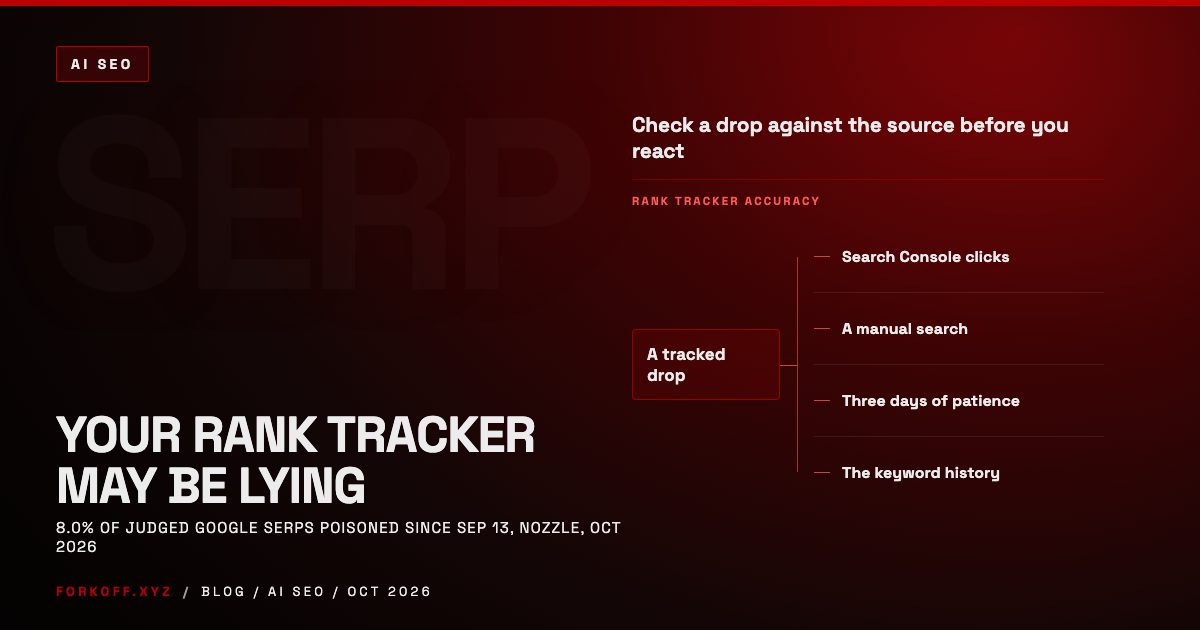
Your Rank Tracker May Be Lying: How to Report SEO and AEO After Google's Poisoned SERPs
Google is serving rank trackers poisoned SERPs. What one tracker measured, how to tell a fake drop from a real one, and how to report SEO and AEO you can trust.
 Read
Read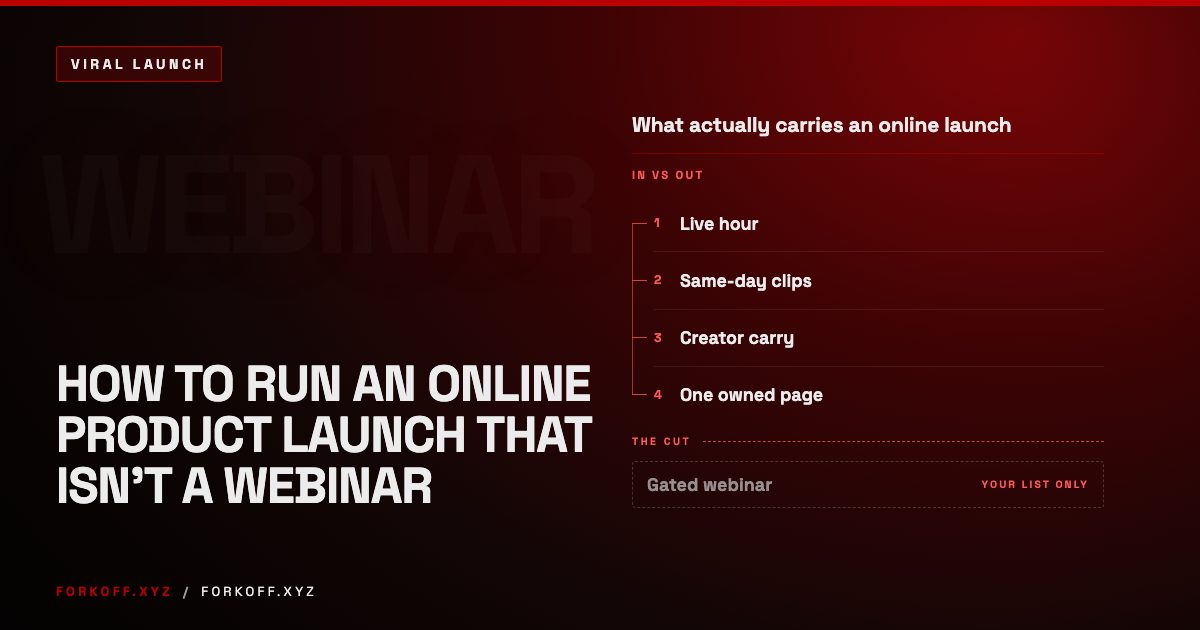
How to Run an Online Product Launch That Isn't a Webinar
An online product launch is a live moment cut into clips that creators carry, not a gated webinar. Here is the livestream, clip and creator stack for 2026.
Read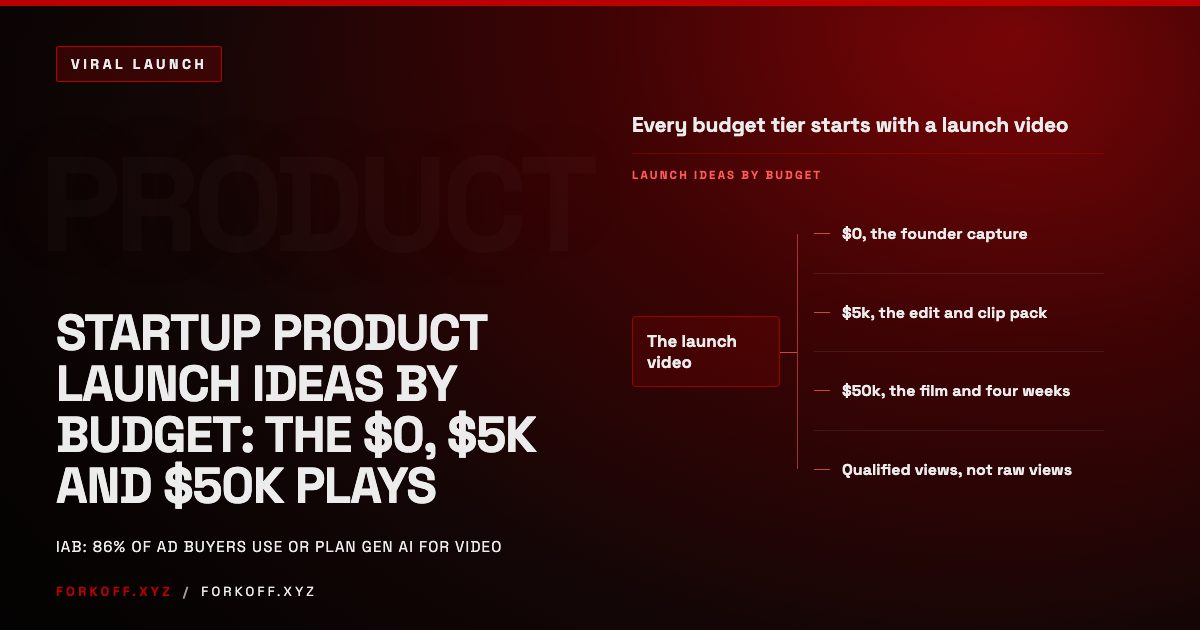
Startup Product Launch Ideas by Budget: The $0, $5k and $50k Plays
Product launch ideas for a SaaS startup sorted by budget: what the launch video should be at $0, $5k and $50k, and the distribution around it.
Read