

OpenAI
@OpenAI · 5.0M followers
We have designed and built our first AI chip: Jalapeno. Designed from the ground up by OpenAI and brought to production with Broadcom, purpose-built for the LLM workloads powering ChatGPT, Codex, and the API.

OpenAI's Jalapeño AI chip launchVerified Organic
OpenAI's Jalapeño AI chip is a real product by a real founder (@OpenAI). RADAR has tracked 7.1M views on this launch, according to the source post linked below. RADAR measures how the launch reach was built, not whether the product works or whether anyone was honest. This reading is verified confidence and every input is public.
By Simba, Launch Intelligence Analyst · Reviewed by JK · Published 26 Aug 2026 · Confidence: verified
Independent, methodology-derived signal, not a statement of fact about any person. RADAR reads how reach was built, a signature, not an accusation. See the methodology.
Did the OpenAI's Jalapeño AI chip launch go viral organically, or was the reach amplified?
The OpenAI's Jalapeño AI chip launch by @OpenAI drew 7.1M views on 22.7K likes, which is 312 views per like, inside the roughly 500 organic ceiling. RADAR reads the reach as organic: reach and engagement grew together and no distribution-amplified signature shows in the public metrics. This is a verified reading and every input is public and reproducible.
New here? Start with the product
What is RADAR, and what does this grade mean?
RADAR is FORKOFF's launch authenticity rating system. It reads whether a product launch earned its reach through real engagement or bought it through paid distribution, using only public signals anyone can pull from the launch post. Every reading carries a letter grade, a confidence label, and the date it was last checked, and links back to a published method you can reproduce. OpenAI's Jalapeño AI chip is a real product by a real founder (@OpenAI). RADAR measures how the reach was built, not whether the product works or whether anyone was honest.
Verified Organic
Independent, methodology-derived signal, not a statement of fact about any person. RADAR reads how reach was built, a signature, not an accusation. See the methodology.
What this grade means
This launch carries an Authenticity Grade of Verified Organic. RADAR reads its reach as organic: the views and the genuine engagement grew together, and no distribution-amplified signature shows in the public metrics. That is a favorable, low-risk read.
The signals RADAR reads
Views-to-likes ratio
Organic reach tops out near 500 views per like. When views climb far past that without the likes to match, the extra reach is arriving without the engagement organic reach produces.
Amplification wave shape
Organic amplification spreads over hours and days. A coordinated launch fires a synchronized burst of quote posts in the first few hours, read from each post's own timestamp.
Posting-time fingerprint
A post that fires exactly top of the hour on a weekday is scheduled. On its own it is weak, but it corroborates a coordinated launch alongside the other two signals.
Those three public signals sit on top of RADAR's five-component forensic read. The full method, the bands, and the confidence model are on the RADAR methodology page.
This launch in the data
Where does this reach sit against the tracked corpus?
Where it sits in the corpus
Rank 5 of 30 tracked launches by views per like, lowest (most organic) first. A lower ratio is the favorable end.
Against the benchmark
This launch's views per like next to the organic median (354) and the amplified median (1,441) across the tracked set.
 The product
What is Jalapeno?
The chip is the first silicon out of a partnership OpenAI and Broadcom announced on 13 October 2025, a multi-year collaboration to deploy 10 gigawatts of OpenAI-designed AI accelerators, with systems rolling out from the second half of 2026 and completing by the end of 2029. OpenAI designs the accelerators and the systems; Broadcom handles silicon implementation, Ethernet networking and connectivity. That framing matters for reading the launch post: this was not a surprise pivot into hardware, it was the first named product from a program the market already knew about.
Jalapeno competes in custom AI silicon, the lane where large model operators build their own accelerators rather than renting general-purpose GPUs. The real alternatives are Nvidia's data-center GPUs, which remain the default for training, and the in-house accelerator programs at the other hyperscalers: Google's TPU line, Amazon's Trainium and Inferentia parts, and Meta's MTIA. The strategic argument is the same everywhere, that a company running one workload at enormous volume can beat a general-purpose part on cost and on performance per watt by designing for that workload specifically.
The performance claims made at announcement are the companies' own. OpenAI and Broadcom said early testing showed performance per watt substantially better than the current state of the art, and press reporting on the announcement put the cost saving at roughly 50 percent against typical AI GPUs. The companies also said the chip went from initial design to manufacturing tape-out in about nine months, with OpenAI's own models assisting the design work. RADAR cites these as the claims made at launch, not as independently verified engineering results. This reading is only about how the reach was built.
What it does
- An inference accelerator, built to run trained models in response to user requests, not to train them. Pre-training work stays on Nvidia hardware.
- Designed by OpenAI end to end and implemented with Broadcom silicon, networking and connectivity technology.
- Targeted at the specific LLM workloads behind ChatGPT, Codex, the API and OpenAI's agent products.
- Stated as the first accelerator in a multi-generation compute platform, with initial deployment by the end of 2026.
- Part of the 10 gigawatt OpenAI and Broadcom program that runs through the end of 2029.
How the Jalapeno launch worked
The launch was a single announcement post carrying one photograph, not a video, published at 6:10 AM Pacific on Wednesday 24 June 2026 from the company account @OpenAI.
The post runs in three beats and it is worth reading the structure, because almost nothing about it is decorated. The first line is the reveal and the name: We've designed and built our first AI chip: Jalapeño. The second paragraph does the credit and the purpose in one breath, naming @Broadcom as the production partner and stating that the chip is purpose-built for the LLM workloads powering ChatGPT, Codex, the API and future agentic products. The third paragraph is the strategic close: chips are foundational to the AI economy, building its own expands OpenAI's full-stack platform from products to models to infrastructure, and it will help the company scale intelligence, serve more people and expand access to AI.
A company account doing the work a founder account usually does
Most of the launches RADAR tracks are posted by a named founder. This one was not. It went out from the corporate account, which at the time of the pull carried 5,126,180 followers across 2,084 posts, with the account open since December 2015. That distribution base is the single most important structural fact on this page, and it is the reason the ratio below is credible without any amplification layer at all. An account with five million followers announcing genuine first-party news does not need to buy reach, and the engagement pattern shows it did not.
What OpenAI did during the launch
There is no giveaway, no thread, no dated offer and no creator wave here. The whole launch is one post and one image, and every element in it is doing a specific job.
| Asset | What it did |
|---|---|
| A single still photograph | The only visual asset, carrying a launch most companies would have filmed |
| The product name in the first line | Jalapeno is stated in the opening sentence, before a single technical detail |
| A named manufacturing partner | Broadcom is credited in the second paragraph, pulling a second large and separate audience into the story |
| Named product surfaces | ChatGPT, Codex, the API and future agentic products, so a reader knows immediately what the chip runs |
| A strategic close, not a spec sheet | Chips are foundational to the AI economy, framing the post as infrastructure strategy rather than a benchmark claim |
| Timing: Wednesday 6:10 AM PT | 9:10 AM on the US east coast, twenty minutes before the opening bell for a publicly listed partner |
The restraint is the tactic. No benchmark chart appears in the post, no throughput number, no die size, no process node. Everything a specialist would argue about was withheld from the announcement itself, which left the replies and quotes to supply the argument. That is a plausible driver of the very heavy quote layer measured below.
How the launch performed
The launch post reached 7,134,004 views on 22,539 likes, with 2,240 reposts, 1,437 replies, 1,437 quote posts and 3,147 bookmarks. These are matured public metrics, re-pulled directly from the source post on 26 August 2026.
At about 317 views per like the reach and the engagement climbed together, which is what earned distribution looks like. The written layer is the part worth pausing on: 1,437 replies and 1,437 quote posts, arriving at effectively the same volume. Replies and quotes are the two most expensive actions on the platform because each one is an original post a person chose to write and attach their own name to, and a bought-view push does not cheaply produce either. Taken with the 2,240 reposts and the likes, the post drew 27,653 public actions, about 0.388 percent of its views.
The bookmark layer is the honest caveat
One number runs the other way, and it is worth stating plainly rather than hiding. The post drew 3,147 bookmarks against 22,539 likes, a save rate of about 0.14 bookmarks per like, which is low for a launch of this size. A save is the signal of something a reader intends to come back and act on. A chip announcement is news to react to, not a tool to go and use, so a thin bookmark layer here is the expected shape rather than a warning sign. It is a useful reminder that the same metric means different things for a product launch and an infrastructure announcement.
Views per like (matured)
Inside the roughly 500 organic ceiling. Across 7,134,004 views the like count stayed coupled to the reach.
Written engagement
22,539 likes, 2,240 reposts, 1,437 replies and 1,437 quotes, about 0.388% of views. A heavy public layer at this scale.
Replies and quotes
The two most costly actions arrived at the same volume. Each quote is an original post a person chose to write.
Bookmarks per like
3,147 bookmarks against 22,539 likes. A low save rate, which is the normal shape for a news announcement rather than a tool a reader intends to go use.
Did the reach get earned or bought?
The verdict is a five-signal read, not a ratio check. The ratio is the headline number, but RADAR also weighs how the view-velocity curve grew, whether the written engagement moved in step with the reach or lagged behind a flat floor, whether the accounts replying and quoting read as real and spread out rather than as a coordinated cluster, and whether the quote and repost pattern matches word of mouth or a known amplifier ring. On this launch all of those pointed the same way, which is why the confidence is verified rather than reconstructed.
The numbers moved slightly between detection and this settled pull. RADAR's detection-time snapshot recorded 7,081,850 views on 22,728 likes, a ratio of 312. The matured figures are 7,134,004 views on 22,539 likes, a ratio of 317: views rose by 52,154 while likes fell by 189 as the count settled. Both readings sit in the same organic band, which is the point of re-pulling. RADAR re-checks launches over time because late engagement and count settling can move a ratio enough to change a band, and this page shows the settled read.
What a founder can take from this launch
The uncomfortable lesson first: most of this launch is not copyable. Five million followers and a genuinely newsworthy piece of first-party hardware do most of the work, and no amount of craft substitutes for either. Reading the post as a template would be the wrong takeaway.
What is copyable is the structure. The name lands in the first sentence, before any explanation. A partner is credited by name in the second paragraph, which pulls that partner's audience into the story and gives the announcement a second set of interested readers. The specific surfaces the product touches are listed so nobody has to guess what it is for. And the technical detail a specialist would fight about is deliberately left out of the post, which is a large part of why the replies and quotes ran so deep. If a founder has real news, that shape carries it.
The second lesson is about media. This launch cleared seven million views on a single photograph, which tells you what a video is actually for: it is the substitute for news value when the news alone will not carry the post. Most launches need one. This one did not.
FORKOFF builds launch videos for the far more common case, where the product is real but the announcement will not travel on its own. See how we approach it on the viral launch video service, or read the best product launch videos we track for more real examples with the numbers attached.
Questions readers ask about this launch
What is OpenAI's Jalapeno chip?
+
Did the OpenAI Jalapeno launch go viral organically?
+
How many views did the OpenAI Jalapeno announcement get?
+
Who is behind the Jalapeno chip?
+
What does RADAR's organic verdict actually mean?
+
Sources
Primary citation: x.com/OpenAI/status/2069770172802773292. Every number traces to a public pull; reads re-checked over time.
How RADAR read this launch, component by component
Each named component carries a plain-English definition and a directional read where the public data supports one. RADAR publishes the component names, never the weights or the formula.
View-velocity signature
Not publishedWhether the view curve grew the way organic spread does, or spiked like an injected burst.
Per-launch read not published in the public dataset. This component needs the forensic engine output.
Engagement coupling
Supports organicWhether likes, replies, and reposts grew in step with views (the organic signature), or the views ran out ahead.
At 312 views per like, likes track views inside the roughly 500 organic ceiling.
Reply-network authenticity
Not publishedWhether the accounts replying are real, distributed people or a coordinated cluster posting together.
Per-launch read not published in the public dataset. This component needs the forensic engine output.
Amplifier-cluster pattern
Not publishedWhether the quote-tweet amplification looks like organic word of mouth or a known activation cluster.
Per-launch read not published in the public dataset. This component needs the forensic engine output.
Smart-follower activation
Not publishedWhether genuinely influential reference accounts engaged, or the reach was only low-quality volume.
Per-launch read not published in the public dataset. This component needs the forensic engine output.
Are you the founder of OpenAI's Jalapeño AI chip? You can claim or contest this read. RADAR attaches a founder response to the launch and re-examines any component you dispute.
Authorship
Simba
Co-founder, FORKOFF
Reviewed by: Kshitij JK
Last reviewed:
Published:
Methodology
RADAR verified reading of the OpenAI's Jalapeño AI chip launch from public metrics: the views-to-likes ratio against the roughly 500 organic ceiling and the posting-time slot, framed as a signature of how reach was built, not an accusation.
Sources cited
- RADAR methodology , FORKOFF
- OpenAI's Jalapeño AI chip source post , X
Where to go next
Understand launch authenticity
Three ways in, depending on what brought you here: learn how the score works, get a launch read or built, or get the plain answer on this launch.
Learn the score
What a launch authenticity score is
A launch authenticity score reads whether a launch earned its reach or bought it, from public signals. Start with the definitions and the checks you can run yourself.
Verify or build
Launch authenticity verification
Want a launch read by the same method, or a launch video made and distributed on the outcome? RADAR reads any public launch, and FORKOFF builds the launch behind the reach.
The skeptic's question
Is the OpenAI's Jalapeño AI chip launch legit?
If you are checking whether the OpenAI's Jalapeño AI chiplaunch was real users or bots, here is the honest read: RADAR's reading is Verified Organic, at verified confidence, computed from public metrics and reproducible from the source post. It measures how the reach was built, not whether the product works.
Peer launches
Launches with a similar read
Browserbase Agents launch
@browserbase
90.2K views · 292 per likeRead
Koji launch
@suekhim
4.8M views · 396 per likeRead
Short Video Overviews (NotebookLM) launch
@NotebookLM
2.5M views · 211 per likeRead
Contra Payments launch
@contraben
2.3M views · 445 per likeRead
Cursor for iOS launch
@cursor_ai
6.4M views · 492 per likeRead
Jupiter Wallet biometrics launch
@JupiterExchange
62.4K views · 130 per likeRead
The benchmark behind every reading
- The organic vs amplified benchmark. What a healthy launch ratio looks like, side by side.
- RADAR methodology. The bands, the confidence model, and how to reproduce a read.
- The Launch Authenticity Report 2026. The aggregate study across the tracked corpus.
- The X Launch Authenticity Study 2026. Two in three tracked launches show a bought-amplification signature.
- Verified-organic leaderboard. The launches RADAR reads as genuinely organic.
- Best product launch videos. The editorial cut of every tracked launch, ranked by views.
- Product launch video service. Get a launch video made and distributed, priced on the outcome.
Want a launch read by RADAR's method?
RADAR reads whether a launch's reach was earned or bought from public data, with the confidence label and the source citation on every reading.
Receipts, deep dives, and playbooks.
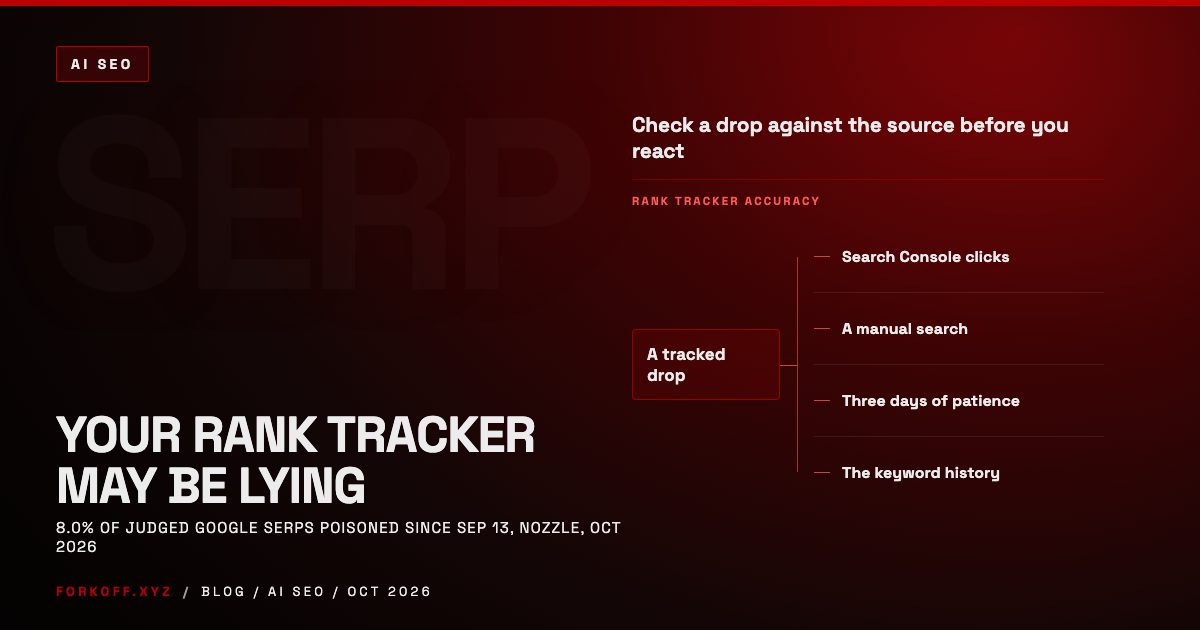
Your Rank Tracker May Be Lying: How to Report SEO and AEO After Google's Poisoned SERPs
Google is serving rank trackers poisoned SERPs. What one tracker measured, how to tell a fake drop from a real one, and how to report SEO and AEO you can trust.
 Read
Read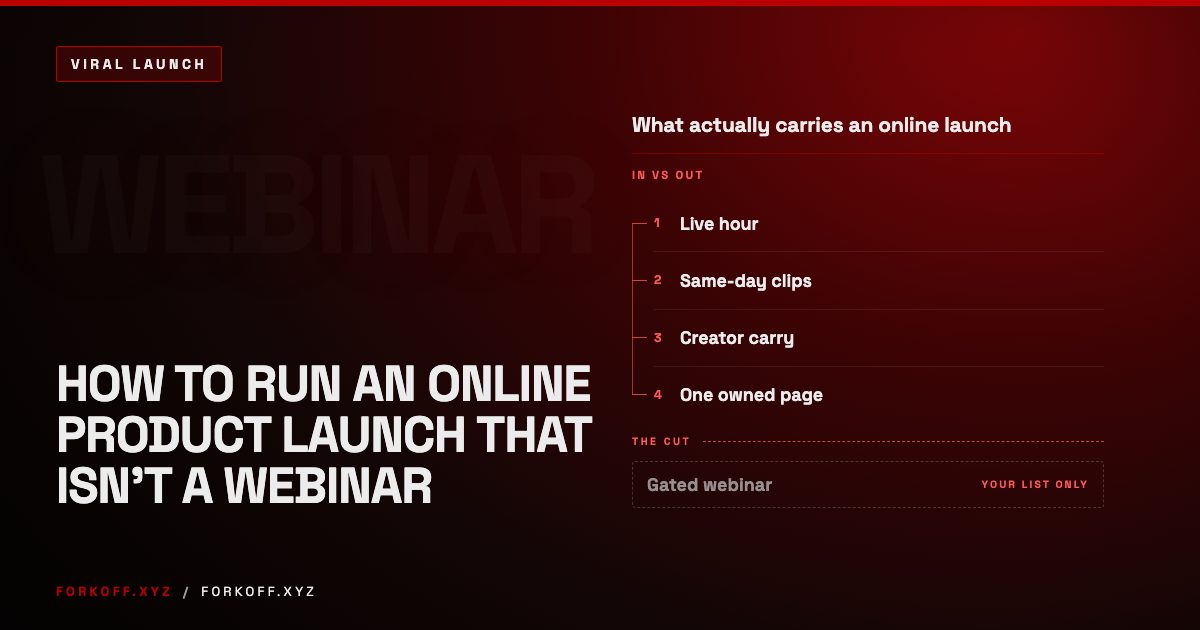
How to Run an Online Product Launch That Isn't a Webinar
An online product launch is a live moment cut into clips that creators carry, not a gated webinar. Here is the livestream, clip and creator stack for 2026.
Read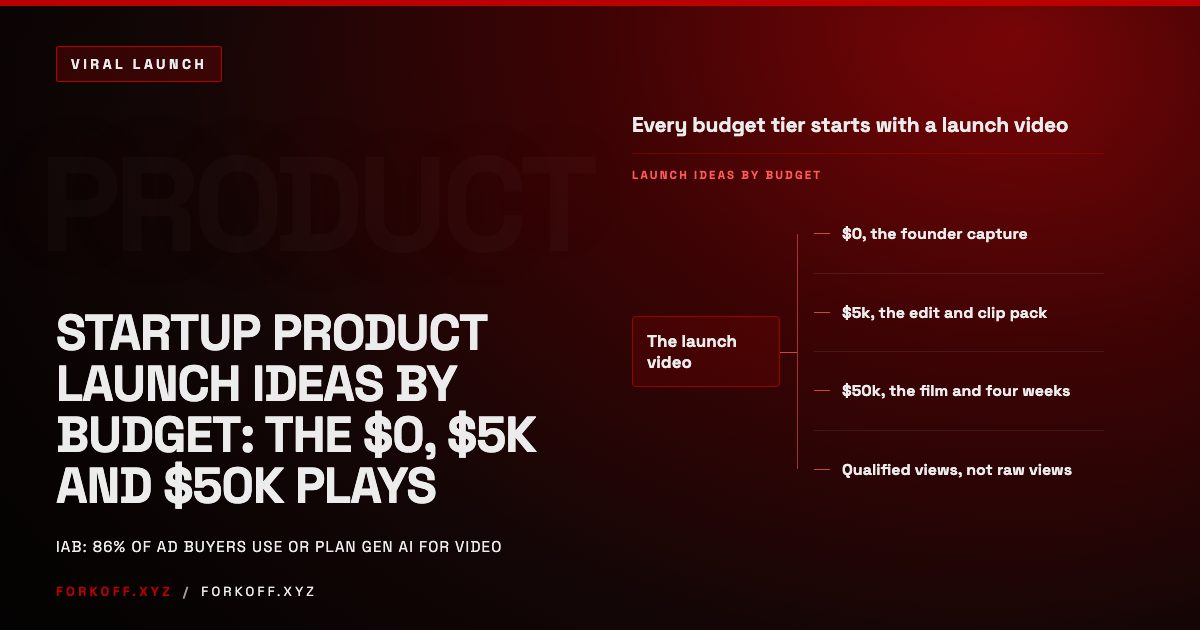
Startup Product Launch Ideas by Budget: The $0, $5k and $50k Plays
Product launch ideas for a SaaS startup sorted by budget: what the launch video should be at $0, $5k and $50k, and the distribution around it.
Read