

Founder-led growth playbook the operator's distribution stack.
The CEO is the operator of the channel. FORKOFF runs the production layer. Voice capture cadence, content factory, distribution map across LinkedIn, Twitter, podcast, and email, with the measurement layer that anchors everything to qualified inbound.
The founder runs the channel. FORKOFF runs the factory.
Founder-led growth is the operator-as-distribution-channel model. The CEO owns the voice, the strategic angles, and the operating account. FORKOFF runs the production layer that converts founder hours into shipped content across LinkedIn, Twitter, podcast, and email. For the narrower distribution view, our guide on how founder-led marketing compounds breaks down the voice capture cadence and content factory in full.
The cadence is two to four founder hours per week. Voice capture session, draft review, optional live posting. The output is 6 to 10 owned posts per week plus a 30 to 45 minute podcast episode every two weeks. The measurement layer reports qualified inbound, not vanity engagement.
Why the founder is the channel, in numbers.
Every figure below is a published benchmark with a named source and a checkable link, the sourced case for putting the founder in front of the buyer.
Per our own X creator engagement benchmark of 511,665 posts, engagement rate varies far more by account tier than by posting frequency. (FORKOFF Creator Engagement Benchmark 2026, 2026)
75% of decision-makers said thought leadership led them to research a product or service they were not previously considering. (Edelman-LinkedIn, 2021)
90% are more receptive to sales outreach from a company that consistently produces high-quality thought leadership. (Edelman-LinkedIn, 2021)
70% of C-suite leaders said a piece of thought leadership led them to question an existing supplier relationship. (Edelman-LinkedIn, 2021)
52% of decision-makers spend an hour or more each week reading thought leadership. (Edelman-LinkedIn, 2021)
FORKOFF has processed more than 5 billion qualified views across its network, the proof base behind the founder-funnel reporting on this engagement. (FORKOFF, 2026)
Trust velocity beats brand reach in AI and Web3.
tech, SaaS, deep tech and Web3/AI buyers buy from operators, not from logos. The pre-Series-B and pre-TGE arcs compound on the founder's authority, not on the company's. Brand-led marketing under-fits the buyer cycle in both markets by 12 to 24 months.
Trust velocity (the rate at which a buyer moves from never-heard-of to ready-to-talk) runs 3 to 5x faster on a founder voice than on a brand voice in these markets. The mechanism is parasocial recall: the buyer recognizes the founder's worldview before the buyer recognizes the company's product.
The competition for founder-led attention is other founders, not other agencies. The bar is operator-grade content, not polished copy. FORKOFF runs to the operator-grade bar by default; brand-led agencies cannot.
One recorded session per week. One hour.
One recorded conversation per week. Sixty minutes. Founder and FORKOFF lead operator. The conversation runs through the prompt stack: what shipped this week, what failed, what is the counter-intuitive take, what does the buyer not understand yet, what is the receipt from a recent engagement.
FORKOFF transcribes the session, extracts 8 to 12 angle candidates, runs each through the avoid-ai-writing gate, and ships drafts back to the founder for a 30-minute review. The review session is async by default; the founder reads, edits in voice, and approves or rejects.
The capture cadence is non-negotiable. A founder who skips two consecutive capture sessions ends the engagement; the production layer cannot ship without fresh founder voice and FORKOFF will not ghostwrite.
From one capture to ten pieces.
One capture session yields the following pieces in a typical week. Three to four LinkedIn posts. Two to three Twitter threads. One long-form blog post or essay (every other week). Five to seven Twitter native posts. Captions and clip prompts for the podcast episode if one shipped that week.
Each piece is per-platform-native, never cross-posted verbatim. LinkedIn drafts run through a different copy mold than Twitter drafts; the underlying angle is the same, the execution is platform-specific.
The factory output is the documentation deliverable. FORKOFF does not build the founder's website; FORKOFF documents the voice, ships the pieces, and reports the receipts.
Four surfaces. Different roles.
LinkedIn is the buyer inbox. 3 to 4 posts per week. Comment engineering on 30 to 50 ICP accounts daily. Pair with the LinkedIn marketing service.
Twitter is the worldview channel. 5 to 7 native posts per week, 2 to 3 threads. The authority compounding lives here for AI buyers. Pair with the Twitter marketing service.
Podcast is the depth-of-trust channel. One 30 to 45 minute episode every two weeks. Founder hosts; FORKOFF books guests, ships clips, runs the production stack. Pair with the podcast pop-up service.
Email is the high-intent loop. Bi-weekly newsletter, 600 to 1,200 words, anchored on one operator-pattern lift from the prior two weeks. Pair with the founder funnel service for the inbound side.
Owned compounds. Earned amplifies.
Owned surfaces (LinkedIn, Twitter, podcast, email) carry the compounding load. Earned surfaces (guest podcasts, conference talks, press) amplify a quarter ahead of the buyer cycle. The split is roughly 80 percent owned, 20 percent earned in the first 90 days; the earned share grows to 30 to 35 percent by month 6.
The earned layer is gated on the owned layer. A founder with no public worldview cannot earn high-trust podcast bookings; the host has nothing to verify. FORKOFF builds the owned spine first, then opens the earned funnel against it.
Qualified inbound, not vanity engagement.
The dashboard reports four metrics weekly. Qualified inbound (replies that pass the ICP gate). Trust signals (DMs from named operators, podcast invites, conference speaker requests). Owned-channel growth (followers, list subscribers, post-to-profile click-through). Buyer-stage attribution (which surface introduced the lead and which surface closed it).
Engagement-only metrics (likes, impressions, reach) are reported but never anchored. The audit ledger flags the week when engagement is up but qualified inbound is flat; that failure mode is the leading indicator for a positioning drift, and FORKOFF rebuilds the worldview prompts on the next capture session.
The handoff to brand-led.
Founder-led wins through Series A and the first by applicationM ARR. Past that scale, the founder hours stop reaching the buyer-cycle ceiling and the brand layer earns its budget. The handoff happens by adding one or two operator voices alongside the founder, never by replacing the founder voice.
The handoff playbook is a separate engagement; pair with the fractional CMO engagement to design the operator-team handoff.
Three ways founder-led growth breaks.
- Founder hands off voice to a ghostwriter. The trust velocity collapses inside 30 days. FORKOFF does not ghostwrite; the engagement ends if the founder requests it.
- Founder over-rotates on engagement metrics. Posts drift to lowest-common-denominator hooks; qualified inbound flatlines. The audit ledger fires the warning at week 4 of the drift.
- Founder will not commit to the capture cadence. Two missed sessions in a row triggers a re-intake conversation; three triggers an engagement close.
By application · 5 engagements per quarter.
Founder-led growth runs as a 90-day retainer minimum. The engagement covers voice capture, content factory, distribution across the four surfaces, and the measurement layer. The anchor service is the founder funnel; pair with the podcast pop-up for depth-of-trust and the cold outreach cadence for the outbound complement.
Frequently asked questions
What does 'founder-led' actually mean?
The operating account belongs to the founder, the voice belongs to the founder, the strategic angles belong to the founder. FORKOFF runs the production layer (capture, edit, schedule, distribute, measure) but never speaks for the founder. The CEO of the company is the operator of the channel.
How much founder time does this take per week?
Two to four hours per week. One hour for the voice capture session (recorded conversation, FORKOFF transcribes and angles). One hour for review of drafts before they ship. Optional one to two hours for replies, comments, and the live posting on Twitter or LinkedIn.
Why does founder-led beat brand-led for AI and Web3?
Tech, SaaS, deep tech and Web3/AI buyers buy from operators, not from logos. The trust velocity on a founder voice is 3 to 5x the trust velocity on a brand voice in those two markets. The pre-Series-B and pre-TGE arc compounds on the founder's authority, not on the company's.
Can FORKOFF run founder-led growth for two co-founders?
Yes. The voice capture cadence runs separately for each founder. The content factory ships in parallel. The distribution map is split (often technical co-founder owns Twitter and GitHub, business co-founder owns LinkedIn and podcast). Measurement is unified.
When does founder-led growth break?
Three failure modes. Founder will not commit to the voice capture cadence (kills the engagement). Founder hands off voice to a ghostwriter (kills the trust velocity). Founder over-scales and the operating account drifts to brand-tone (kills the conversion floor). Each is preventable; FORKOFF gates against all three at intake.
The founder owns the voice.
FORKOFF runs the factory.
By application, capped at 5 engagements per quarter. The engagement runs against the founder funnel anchor. Pair with the Twitter, LinkedIn, and podcast services.
Receipts, deep dives, and playbooks.
The Distribution Learning Curve: Sell Your Own Growth Before You Buy It
Sequoia says founders must close their own first deals before scaling sales. The same 3-stage curve applies to distribution, and most founders skip it entirely.
 Read
Read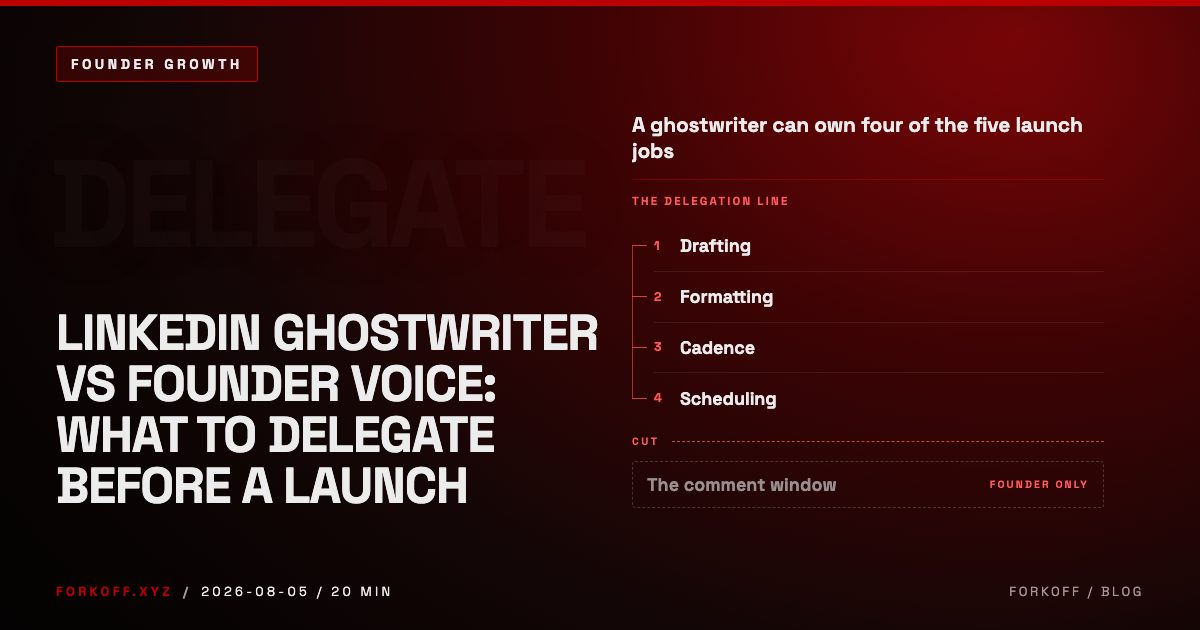
LinkedIn Ghostwriter vs Founder Voice: What to Delegate Before a Launch
A LinkedIn ghostwriter can draft your launch posts. It cannot reply in your comments or show up on the call. Here is where the line actually falls.
Read
Developer Relations for Startups: How to Win Your First 1,000 Developers
Developer relations for startups is a distribution problem, not a hiring one. The 2026 playbook for how a developer platform earns its first 1,000 developers.
Read