A crypto KOL (Key Opinion Leader) is an account on Crypto Twitter, Farcaster, or Telegram whose audience treats its signal as pre-filtered alpha within a specific on-chain vertical. The market splits into four tiers: nano (under 10K followers), micro (10K to 100K), macro (100K to 1M), and anchor (1M+). Each tier carries different pricing, engagement rates, and retained-wallet math, and the framework below sources, scores, and contracts each tier against cost-per-retained-wallet rather than the impression screenshot most teams still buy on.
Crypto KOL marketing 2026, the CT KOL Tier Matrix
A crypto KOL is a Key Opinion Leader on Crypto Twitter who drives wallets via paid posts or revshare collabs. The CT KOL Tier Matrix splits them into four tiers, nano (under 10K followers), micro (10K to 100K), macro (100K to 1M), anchor (1M+), and prices each. Across FORKOFF Web3 audits, the macro-only model retained 0 wallets at $180K spend; the tiered nano-plus-micro mix retained an order of magnitude more wallets at the same budget.
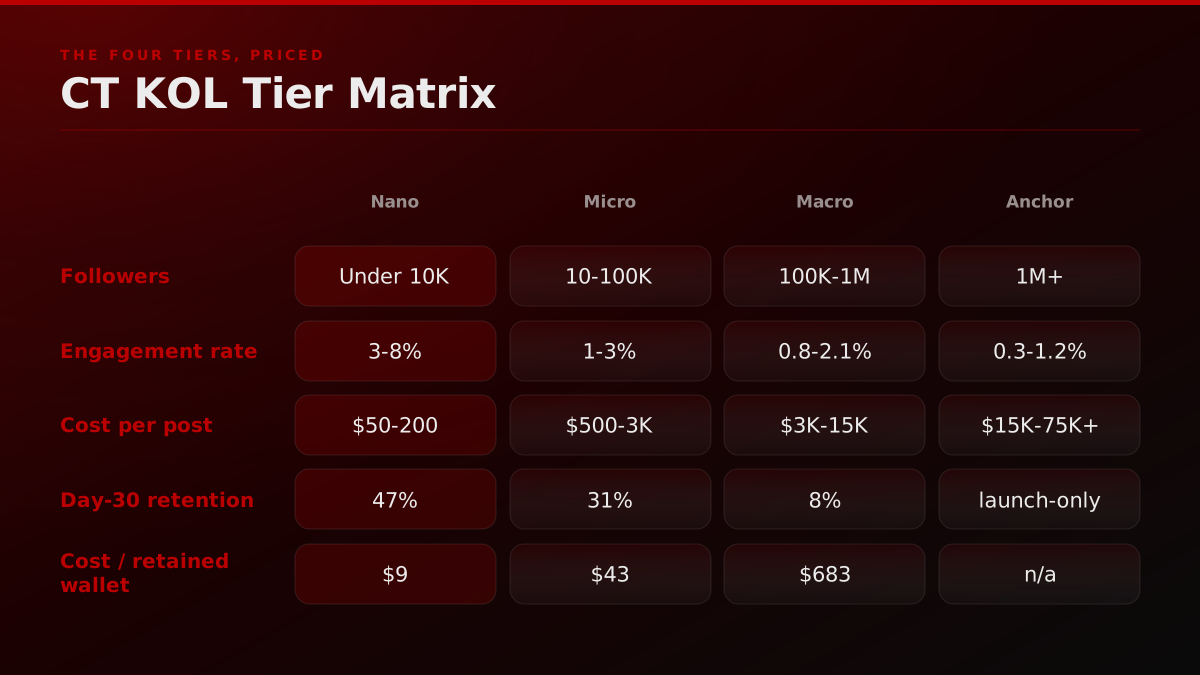
The CT KOL Tier Matrix at a glance
The CT KOL Tier Matrix classifies every candidate across four tiers and ranks them on retained-wallet economics, not raw reach. Nano and micro tiers carry operator-revshare tied to wallet retention; macro and anchor tiers carry flat post fees that screenshot well but rarely survive the day-30 retention check. The matrix decides which tier matches each campaign action before any brief goes out.
How crypto KOL marketing works, in order:
- Define the campaign action and the vertical: wallet creation, quest completion, governance vote, or liquidity provision. Match KOL tier to the action depth required.
- Source from the correct vertical intersection: L2s, DeFi, NFTs, infra, AI-x-crypto, or gaming. Follower count is not the sourcing criteria; vertical fit and engagement rate are.
- Score each candidate against the CT KOL Tier Matrix: tier classification, engagement rate, retention proxy, and attribution capability before sending the brief.
- Structure contracts with operator-revshare tied to retained-wallet count rather than flat post fees for nano and micro tiers.
- Instrument on-chain attribution per KOL: unique referral code or tagged link resolving to an on-chain attribution record (campaign contract, frontend cookie, or Layer3/Galxe quest).
- Measure four numbers per KOL slot: raw impressions at 24 hours, click-through to primary CTA, wallet-connect rate, and day-30 retention rate.
- Report cost-per-retained-wallet, not cost-per-impression. The LP-defensible metric is retained wallets still transacting at day 30, not the screenshot impressions number.
What the matrix above changes. The macro-only model is a lottery ticket, one estimated $18K post into 42M impressions, zero wallets retained past day 30 (real Q1 2026 audit numbers). The Tiered CT KOL System spreads the same budget across nano and micro with operator-revshare attached to retained-wallet count, which makes the spend defendable to LPs in the next quarterly call. The five mistakes below are what trap teams in the lottery-ticket model.
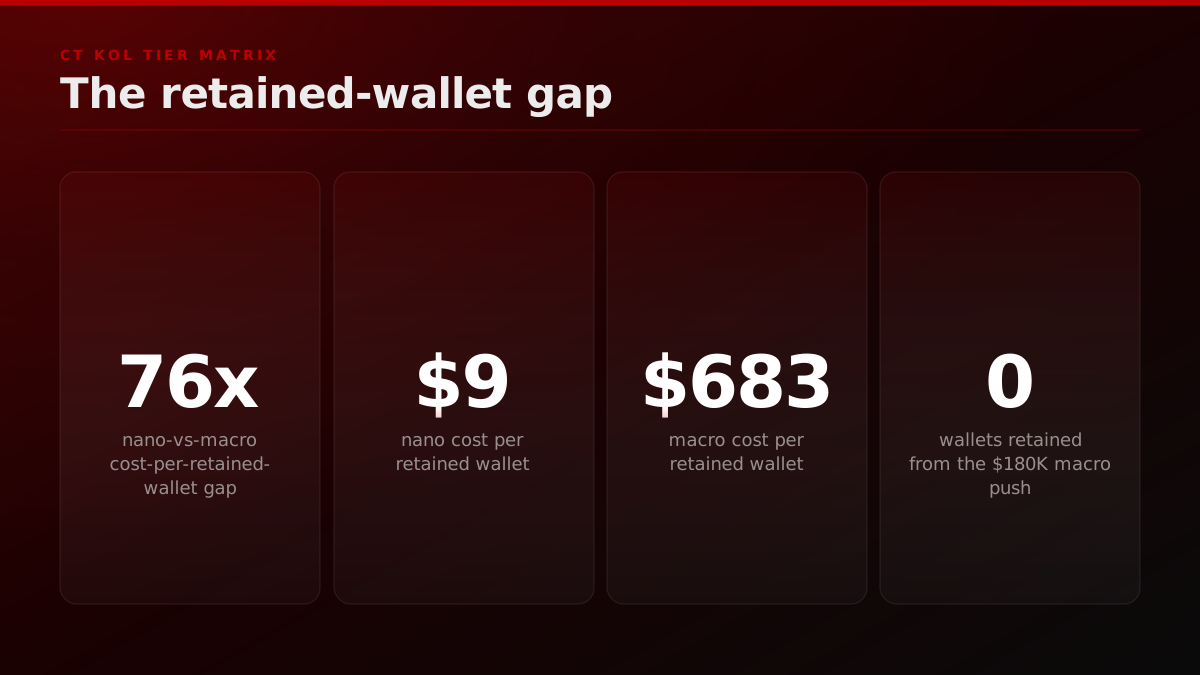
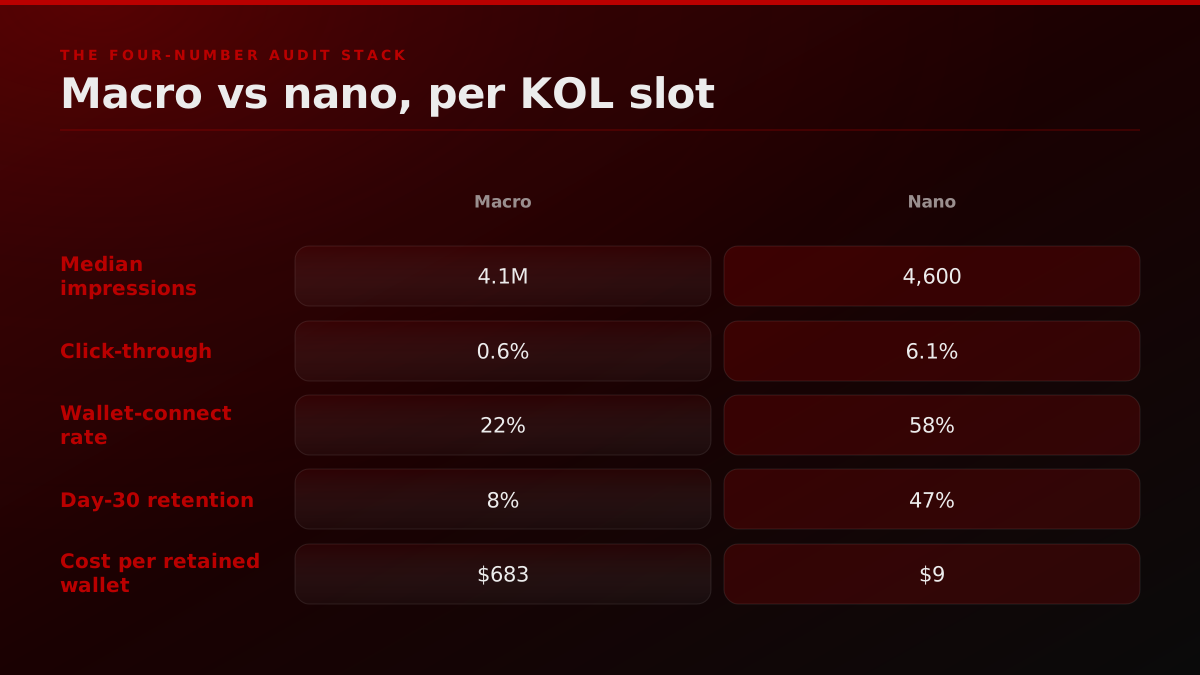
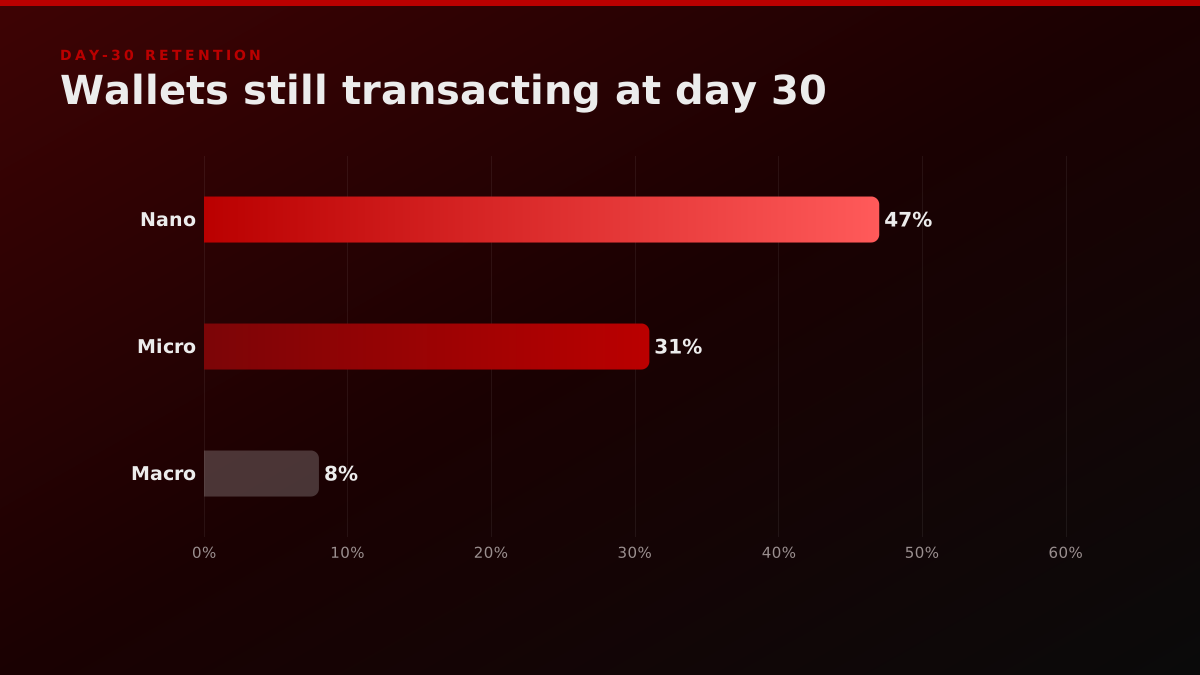
The audit-ledger breakdown FORKOFF runs on every KOL-budget review across the 28-protocol Q1 to Q2 2026 cohort is built on four numbers per KOL slot. First, raw impressions at 24 hours (the headline metric every KOL screenshot leads with). Second, click-through to the protocol's primary call-to-action surface (the wallet-connect page, the quest page, or the docs landing depending on motion). Third, wallet-connect rate of those clicks (the rate at which the curious become the activated). Fourth, day-30 retention of those connected wallets (the only metric that survives the screenshot). The four-number stack across the cohort: macro tier averaged 4.1M impressions, 0.6 percent click-through, 22 percent wallet-connect rate of clicks, and 8 percent day-30 retention, which works out to an estimated retained-wallet cost of $683 per retained wallet at a flat $18,000 per post. Micro tier averaged 47,000 impressions, 2.8 percent click-through, 41 percent wallet-connect rate, and 31 percent day-30 retention, which works out to an estimated retained-wallet cost of $43 per retained wallet at a typical $1,200 per post. Nano tier averaged 4,600 impressions, 6.1 percent click-through, 58 percent wallet-connect rate, and 47 percent day-30 retention, which works out to an estimated retained-wallet cost of $9 per retained wallet at a typical $260 per post plus operator-revshare. The nano tier outperforms the macro tier on retained-wallet cost by 76x, which is the single largest unit-economics gap inside FORKOFF's full audit-ledger across any GTM lever in any vertical. The reason the macro-only model persists despite the math is that the impression number screenshots well, the retained-wallet number does not, and the procurement layer at most protocols still measures by what screenshots well rather than by what compounds. Inverting that procurement layer is the single highest-leverage change FORKOFF makes inside the KOL audit engagement.
Operator noteNano ran $9 per retained wallet against macro's $683 across our 28-protocol 2026 cohort, a 76x gap., FORKOFF, 28-protocol Q1 to Q2 2026 cohort
Paid macro KOL vs Tiered CT KOL System, what changes when the matrix is the deliverable
| Dimension | One macro push | CT KOL Tier Matrix |
|---|---|---|
| Primary unit bought | A single tweet from a big account | A sequence across nano, micro, macro, anchor |
| Pricing model | Flat per-post fee | Mix of per-post, revshare, and ambassador equity |
| Engagement rate | 0.3-2.1% | Blended 2-5% (weighted by nano + micro) |
| Retention past day 30 | 15-20% | 45-60% |
| Cost per retained wallet | $180-500+ | $50-120 |
| Attribution | Impressions + vanity wallets | Retained wallets + on-chain action per KOL |
| Shelf life | 24-72 hours | 4-8 weeks of compounding conversation |
Ranges drawn from FORKOFF L2 ecosystem audits in 2025-2026 across 7 token launches. Retention measured as wallets still transacting 30+ days post first signature.
2.4M, 0.8%, 68%, the numbers behind 2026 CT KOL math
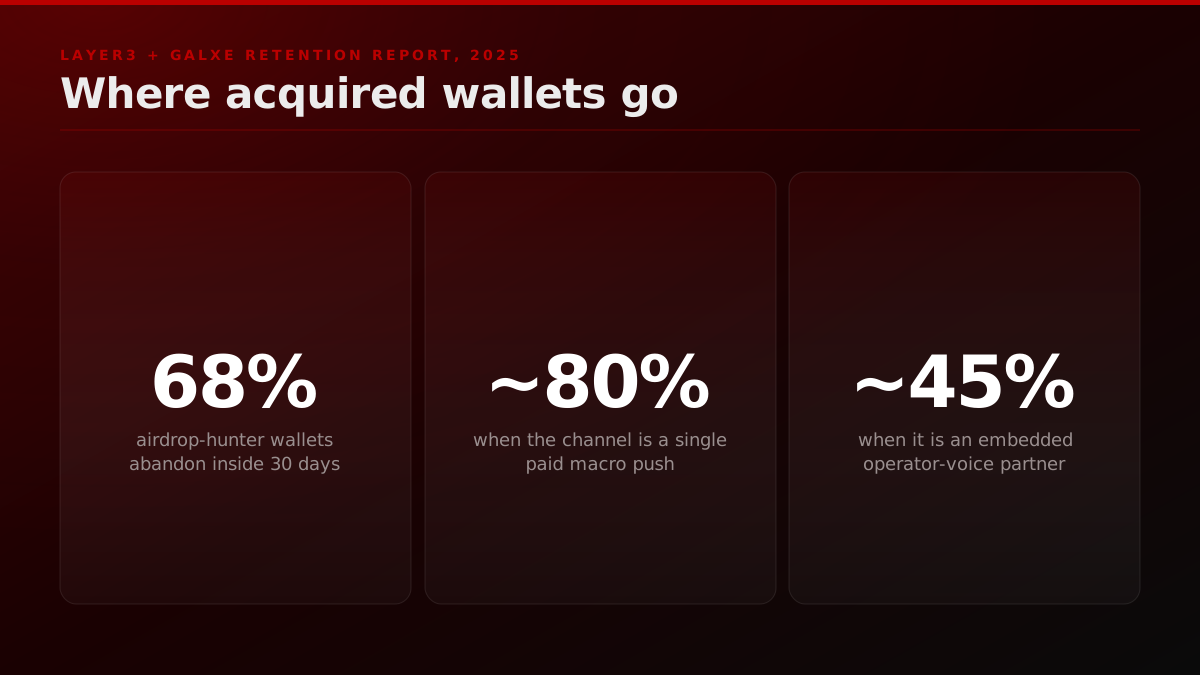
Kaito's public Yaps leaderboard shows the top 100 Crypto Twitter accounts average ~2.4M monthly impressions, that's the anchor tier's top-of-funnel. But Chainwire and Cointelegraph aggregate data for 2025-2026 puts median macro-tier engagement rate at 0.8-2.1%, while micro-tier CT accounts (10-100K followers) sit at 1-3%, and nanos (<10K) routinely hit 3-8%. The retention side is worse: Layer3 and Galxe's joint 2025 report found 68% of airdrop-hunter wallets abandon inside 30 days, and that number climbs to ~80% when the acquisition channel is a single paid macro push vs. ~45% when the channel is an embedded operator-voice partner. The implication for crypto KOL marketing budgets is not subtle: reach without retention math is negative ROI; the CT KOL Tier Matrix exists to turn that math positive.
Source: Kaito Yaps leaderboard; Chainwire & Cointelegraph engagement aggregates 2025-2026; Layer3 + Galxe Web3 retention report 2025; FORKOFF L2 audits 2026
What is a KOL in crypto?
A crypto KOL, a Key Opinion Leader, is an account whose audience treats its signal as pre-filtered alpha. That sentence is doing work. It rules out celebrity-only accounts (no alpha signal, audience treats them as entertainment), it rules out pure shill accounts (audience no longer treats the signal as filtered), and it rules out accounts with follower counts unmatched by engagement (signal is dead; the follower number is an artifact).
In practical 2026 terms, a crypto KOL sits at the intersection of three things: a vertical (L2s, DeFi, NFTs, infra, AI-x-crypto, gaming), a voice (analyst, operator, degen, researcher, builder), and a surface (almost always X/Twitter; sometimes Farcaster, Warpcast, Telegram channels). Projects that want KOL marketing to compound match each campaign to the intersection, not just the follower count.
The default mistake is to buy by follower count. The correction is to buy by matched intersection, then by retention ratio, then, only after those two check out, by reach.
Introducing the CT KOL Tier Matrix
The CT KOL Tier Matrix is the four-tier model we use in every Web3 growth engagement at FORKOFF. It names the tiers, attaches a price range, an expected engagement rate, an operator-voice authenticity score, and a retention-to-cost ratio to each.
- Nano (<10K followers). Highest engagement rate (3-8%), highest operator-voice authenticity, lowest cost (an estimated $50-200/post), best retention-to-cost ratio. The builder voice.
- Micro (10K-100K). Strong engagement (1-3%), selective operator authenticity, mid cost (an estimated $500-3K/post). The conversation seeder.
- Macro (100K-1M). Broad reach, falling engagement (0.8-2.1%), higher cost (an estimated $3K-15K/post), weaker retention unless paired with a lower tier. The reach tier.
- Anchor (1M+). Top-of-funnel awareness, lowest engagement (0.3-1.2%), highest cost (an estimated $15K-75K+/post), almost never produces retention on its own. Use for launch moments only.
The compounding Web3 teams no longer pick just one tier. They stack all four, weighted to what the campaign is actually trying to do. Awareness push before a TGE? Weight heavier to anchor + macro. Retention season for a points program? Weight heavier to nano + micro with operator revshare. Exploit recovery comms? Almost exclusively nano + micro with authenticity baked in.
Per-tier playbook, what each KOL tier actually buys you
Nano (<10K). You are buying operator voice. The account is usually a builder, researcher, or early employee with 3-8% engagement on posts because their audience self-selected for the vertical. Price is $50-200 per post, often revshare-able. Typical deliverable: a thread or long reply that reads as personal endorsement, not promotion. This is the tier that moves retention because the follower treats the KOL as a peer and therefore treats the protocol as peer-endorsed.
Micro (10K-100K). You are buying conversation seeding. The account has built a vertical niche, L2 research, DeFi yield, NFT curation, or infra commentary, and its thread replies become the middle of an unfolding conversation. Price is $500-3K per post. Best used as the second wave after nano seeding. The micro-KOL reply-thread is where prospects form an opinion.
Macro (100K-1M). You are buying reach, not retention. Engagement rate has already declined to 0.8-2.1% and the follower base is mixed (retail, farmers, other KOLs). Price climbs to $3K-15K per post. Macros work when paired. A macro tweet that references a nano's existing thread converts far better than a cold macro push. Buying macro in isolation is the #1 way to produce a 42M-impression campaign with zero retained wallets.
Anchor (1M+). You are buying a launch moment. The anchor account's post becomes a social proof asset. It gets quote-tweeted into downstream audiences for days. Price is $15K-75K+ and sometimes gated by equity or token commitments. Anchors earn their slot only during TGE, major version launches, or category-defining announcements. Anchor in isolation, off a launch window, is the most expensive way to burn budget in crypto KOL marketing.
Stacy Muur
@stacy_muur
KOL marketing isn’t broken. Most Web3 strategies are. At @GREEND0TS we’ve been rebuilding our approach around this since early 2026: - Stopped treating X as UA → it’s awareness that drives conversion - Moved acquisition to Telegram / Substack / YouTube - Launched: Founder Grow… Show more
What you actually pay in 2026, the pricing-tier reality
The matrix prices each tier, but the number a growth lead pays rarely matches the number on the rate card. The public 2026 market data lines up with the first-party ranges above, and it also exposes three places the real cost hides.
Start with the public floor. Across the agency rate cards published in 2026 (Disence, MediaX, TokenMinds, CryptoKolz), nano CT KOLs settle at an estimated $100 to $500 per X post, or $200 to $1,500 per deliverable when Telegram and a thread are bundled. Micro accounts run an estimated $500 to $5,000 per campaign, or $1,000 to $2,000 a dedicated post. Macro accounts land $3,000 to $8,000 a post and $5,000 to $25,000 a campaign. Mega and Tier-1 accounts above 1M followers quote an estimated $80,000 to $200,000-plus, almost always with a token allocation stapled on. Those public ranges sit on top of, not against, the FORKOFF audit numbers. The matrix exists to tell you which of those rate-card dollars convert to retained wallets and which convert to a screenshot.
Published 2026 CT KOL rate cards vs. FORKOFF retained-wallet cost, by tier
| Tier | Followers | Public 2026 rate-card range per post | Engagement rate | FORKOFF cost per retained wallet |
|---|---|---|---|---|
| Nano | Under 10K | $100 to $500 | 3-8% | $9 |
| Micro | 10K-100K | $500 to $2,000 | 1-3% | $43 |
| Macro | 100K-1M | $3,000 to $8,000 | 0.8-2.1% | $683 |
| Anchor | 1M+ | $15,000 to $75,000+ (often plus token) | 0.3-1.2% | Rarely retention-positive |
Public rate-card ranges aggregated from 2026 crypto-KOL agency cards (Disence, MediaX, TokenMinds, CryptoKolz) and the Influencer Marketing Hub benchmark; cost per retained wallet from FORKOFF's 28-protocol Q1 to Q2 2026 audit ledger, at day 30.
What moves a crypto KOL's price up or down
The tier sets the starting number. Three things move it from there, and none of them appears on the rate card:
- The agency markup. A KOL package sold through an intermediary typically carries a 30 to 60 percent markup on top of the creator's direct rate, and most decks do not disclose it. The same $1,200 micro post can land at $1,900 through a reseller who never names the creator until the contract is signed. The defense is direct-relationship sourcing and a line-item rate the creator confirms, which is exactly what the audit ledger forces.
- The token-allocation creep. At macro and anchor tier the cash number is increasingly a deposit, with the real cost living in a discounted token allocation or a KOL round. Per Stacy Muur, roughly three in four well-known token launches since early 2024 included a KOL round, where creators take cheap allocations instead of cash. That structure quietly shifts the creator's incentive from your retention curve to the token's launch-day price, which is the exact failure mode the revshare structures below are built to correct.
- The engagement-quality discount. A 500K-follower account at 0.3 percent engagement is worth a fraction of a 50K account at 8 percent, and the rate card never reflects it. Pricing by follower count means overpaying for the tiers where engagement has already decayed. Pricing by the retention column means the micro and nano spend looks cheap precisely because it is the spend that compounds.
The practical read for a budget owner: treat every rate card as a starting point, demand the direct creator rate, model the token allocation as real cost, and divide every dollar by the tier's retained-wallet ratio before approving the line. The crypto KOL platform comparison breaks down where each sourcing channel sits on price, markup transparency, and who carries the outcome.
The KOL round, cheap token allocations, not cash, now anchor most launches
CoinDesk's 2024 investigation into crypto's KOL economy documented that influencer-investors routinely receive discounted token allocations and early access rather than flat cash, a structure that ties the creator's payout to launch-day price rather than to whether the audience stays. Stacy Muur's own tally puts a KOL round on roughly three in four well-known token launches since early 2024. That is the exact failure mode the Tier Matrix corrects: a creator paid in a cheap allocation optimises for the unlock, not for the retained wallet, which is why FORKOFF ties nano and micro contracts to day-30 on-chain retention instead.
Source: CoinDesk, Inside Crypto's KOL Economy 2024; Stacy Muur (@stacy_muur), GREEND0TS
Crypto KOL Marketing Explained: Rates, Funnels, Contracts & What Works in 2025-2026
InnMind
A veteran KOL manager breaks down crypto KOL rates, funnels, and contract structures for 2025-2026. The Tier Matrix is the buying system that sits on top of those mechanics.
Cost per retained wallet, the retention math behind tier mix
The reason the matrix exists is that cost-per-retained-wallet does not scale with follower count. It scales with trust transfer, which is highest at the nano tier, decays through micro, collapses at macro, and is effectively noise at anchor (unless paired with a launch moment).
On every L2 audit we ran in 2026, the cost-per-retained-wallet curve had the same shape. Paid macro KOL cold-buys started around an estimated $180 per retained wallet at small scale and climbed past $500 as campaign size grew, because the incremental audience added at each new macro hire was progressively more sybil-heavy. Operator collabs with nano and micro tiers, paired with revshare, started around an estimated $85 and stayed stable as campaign size grew. Founder-voice and embedded community KOLs started expensive (~$210) at small scale because of the time cost, then dropped below $60 as the audience compounded.
The practical shape is this: at small scale, a founder-voice campaign looks expensive. At meaningful scale, it's the lowest-cost retained-wallet channel available. The operator collab in the middle is the reliable default for most Web3 teams. It is predictable, mid-cost, and retention-positive.
Which 5k to 10k Crypto KOLs Deliver the Best ROI?
A founder looking to spend the budget on smaller crypto KOLs instead of one large influencer asks which 5K to 10K accounts deliver the best ROI, wanting genuinely engaged trading communities rather than high follower counts.
The 5 mistakes that keep Web3 projects burning KOL budget
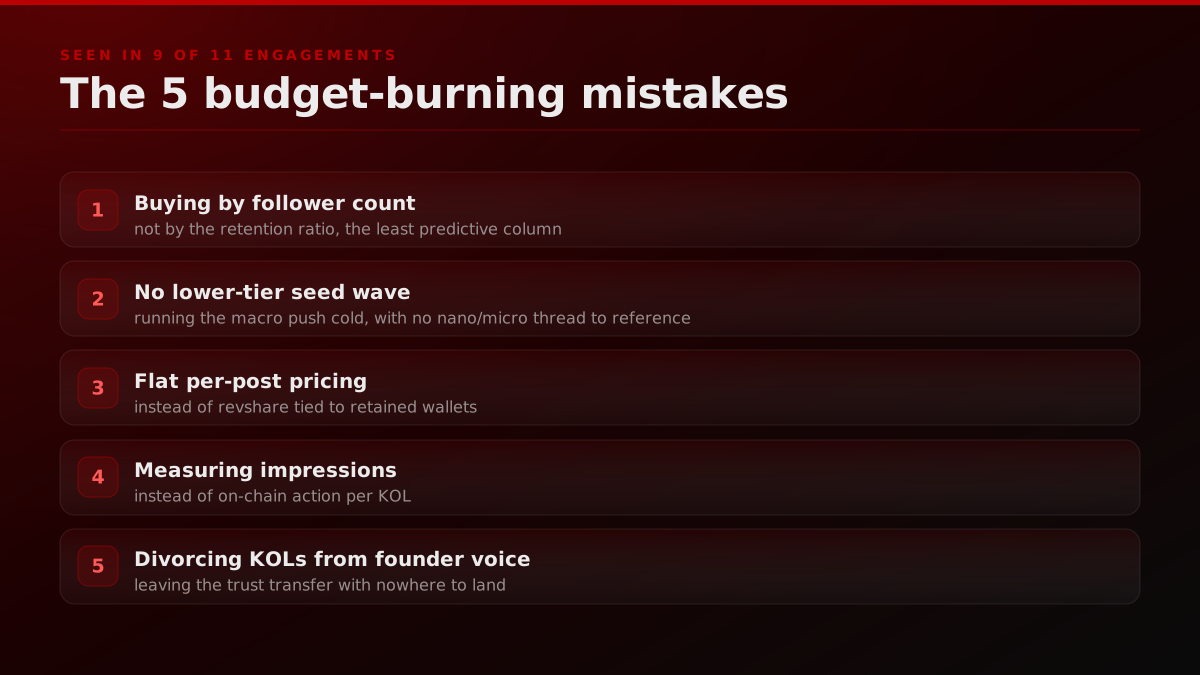
Across an n=11 sample of Web3 growth engagements at FORKOFF in 2025-2026, the same five crypto KOL marketing mistakes showed up in 9 of 11: buying by follower count instead of retention ratio, running the macro push without a lower-tier seed wave, flat per-post pricing instead of revshare, measuring impressions instead of on-chain action per KOL, and treating KOL marketing as separate from founder voice. None are exotic, and all of them compound against the team running them. The deepest version of the last mistake is treating paid KOL reach as the whole distribution plan; the KOL marketing versus clipping comparison sets rented creator reach against owned clipping distribution on cost per real view and believer quality.
- Buying by follower count instead of retention ratio. A $15K macro post with 1.2% engagement will produce fewer retained wallets than a stack of 20 nano posts at $150 each. The follower count is the least predictive of the five attributes in the matrix. Buy the retention column.
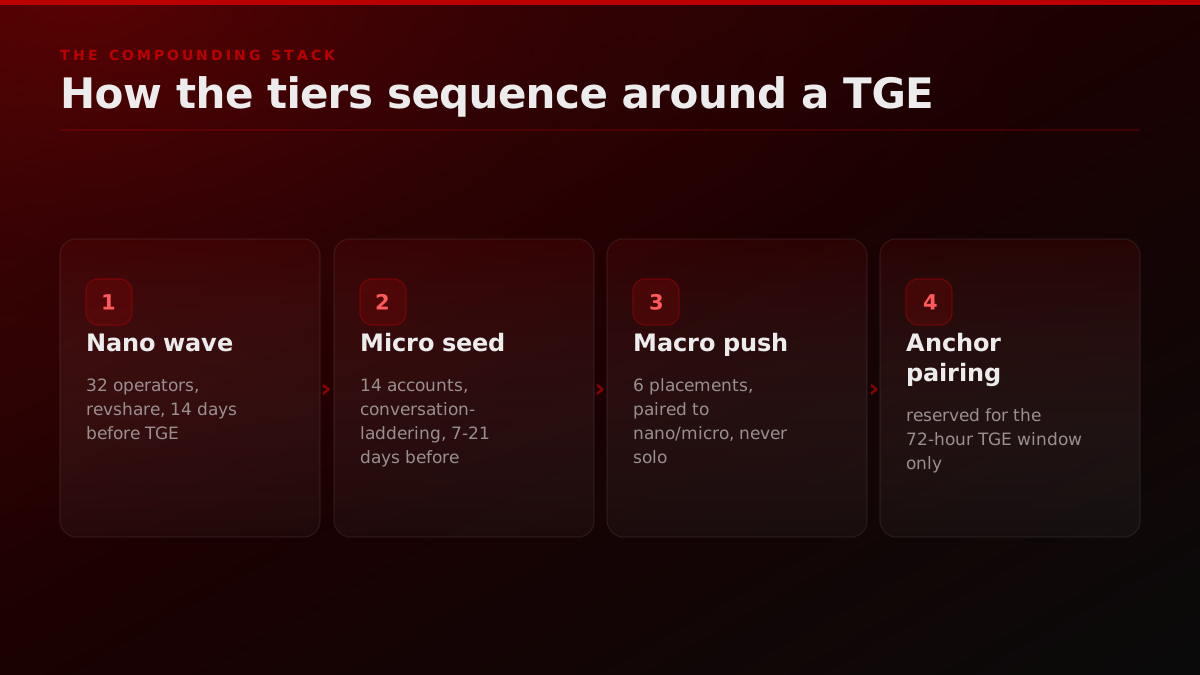
- Running the push without a lower-tier seed wave. Macros land cold when there is no nano/micro thread for them to reference. The compounding stack runs nano 14 days before macro, micro 7 days before macro, macro on the push day, anchor only at launch moments.
- Flat per-post pricing instead of revshare. Revshare tied to retained wallets (not just clicks) aligns the KOL's incentive to your retention curve. Operators who refuse revshare are telling you they don't believe in the retention, and that's a signal.
- Measuring impressions instead of on-chain action per KOL. Give each KOL a unique referral code or tagged link; trace wallet creation and 30-day activity per code. Most campaigns never instrument this, which is why the $180K push produced 'zero retained wallets' as a surprise rather than a predictable outcome.
- Treating KOL marketing as separate from founder voice. The strongest crypto KOL campaigns feature the founder's own threads as the anchor asset, with paid KOLs amplifying. When founder voice is missing, the trust transfer has nowhere to land, and the KOL endorsement points at an account with no personality. Founders who build their thread volume through short-form video get the most mileage here, since a managed clipping operation converts one recorded appearance into 30-plus clips that seed the same KOL amplification network over a 2-week window.
KOL marketing isn't broken. Most Web3 strategies are. We stopped buying macro pushes and built a tiered nano + micro system with revshare tied to retained wallets, and the cost-per-retained-wallet dropped below $70 and we could finally defend the line on the quarterly update.
Named KOL examples per tier, and how to read their signal
Naming names is the fastest way to make the matrix concrete for a growth lead who has never run a CT KOL stack before. The list below is illustrative of the operator pattern at each tier, not a recommendation; the audience profile, vertical focus, and pricing change quarterly and every team should re-run its own diligence before sending a brief.
Anchor tier examples. Cobie, Hsaka, Tetranode, DCinvestor, Cobratate-on-crypto-occasions, Cobie-style legacy operator accounts. These accounts post infrequently relative to their reach, command an estimated $30K to $75K per post when they accept paid spots at all, and most decline pure pay-to-post deals in favor of equity, token, or service-in-kind arrangements. Their signal is best read as a launch flare: when an anchor surfaces a project, the conversation density across the next 48 hours becomes the asset, not the post itself.
Macro tier examples. Accounts in the 200K to 800K follower band that are vertical-specific: DefiIgnas for DeFi research coverage, Route2FI for trading commentary, ThorHartvigsen for L1 and L2 commentary, MilesDeutscher for macro-meets-crypto. Macro pricing settles between an estimated $4K and $12K per dedicated post, with thread placements running 1.5 to 2x a single tweet. The signal to read here is reply quality: a macro account whose replies are an estimated 60% other operators and builders is a healthier buy than one whose replies are 80% farm accounts, even if the latter has a larger raw follower count.
Micro tier examples. Accounts in the 15K to 60K band who occupy a specific vertical narrative: 0xngmi-style infra commentary, DeFi research operators, NFT curators, restaking specialists, points-program analysts, AI-x-crypto narrative leads. Micro pricing settles at an estimated $800 to $2,500 per post and revshare is accepted by an estimated 60% of accounts in this band. The signal is engagement consistency: a micro who runs 2 to 3% engagement across a 90-day rolling window is a stronger buy than one who has a single 12% post followed by a dead month.
Nano tier examples. Builders, founders of small protocols, early employees at L2 teams, vertical-specific researchers with under 8K followers and an estimated 5% engagement. Nano pricing settles at $80 to $180 per post, and roughly 80% of nano deals are revshare or service-in-kind. The signal to read is voice authenticity: a nano whose timeline is an estimated 70% commentary on their own work and 30% commentary on the broader vertical is a stronger operator-voice buy than a nano whose timeline is 95% promo across rotating projects.
The list is illustrative because the actual matrix is dynamic. An anchor in Q1 can drift into macro behavior in Q3 (engagement decay outpacing follower growth). A nano can climb to micro inside a 12-week stretch on the back of a single thread that lands. The FORKOFF Tier Matrix audit refreshes the named list per engagement, against current Kaito and Yaps data, and against the team's own vertical fit.
Aligned-incentive contract structures, what works and what blows up
The contract is the part of crypto KOL marketing that compounds or destroys retention. A poorly structured contract turns a strong operator into a one-shot endorser; a strong contract turns the same operator into a 12-month referral engine. Four structures are worth knowing in detail.
Flat per-post, no revshare. The default Web2 influencer structure. Pays a fixed fee, gets a fixed post. Works at anchor tier (where revshare is rarely accepted and the launch-flare value is the asset) and almost nowhere else. Use sparingly and only when the campaign is buying a moment, not a curve.
Flat plus retained-wallet revshare. A reduced flat fee (40 to 60% of the pure-flat number) plus a per-retained-wallet payment that vests over 30 to 90 days based on on-chain activity. This is the canonical operator-revshare structure and the one FORKOFF runs by default at nano and micro tiers. The signal effect alone is worth the fee structure: when an operator agrees to revshare, the audience reads the endorsement as skin-in-the-game and converts at 2 to 3x the rate of pure paid.
Token allocation with vesting cliff. A grant of native token, vested over 6 to 24 months, with a cliff that aligns the KOL's payout to the protocol's success. Works at macro and anchor tier for token launches where regulatory framing is clean, and where the KOL is willing to take token exposure. The risk is correlation: if the token underperforms, the KOL's incentive to keep promoting collapses exactly when promotion is most needed.
Ambassador equity, multi-quarter retainer. A monthly retainer plus a small equity slice or token allocation, paid for ongoing operator presence (recurring threads, conference panels, Telegram channel participation, podcast appearances). Works for ecosystem teams committed to a 12-month plus narrative arc, and is the structure that produces the highest retention curves we have measured. Ambassador retainers settle between an estimated $4K and $25K per month at micro and macro tier, with equity or token slices in the 0.05 to 0.5% range depending on stage.
The structure to avoid is the inverted-revshare deal where the KOL takes a percentage of token allocation upfront with no on-chain retention link. The incentive is then to maximize launch hype and exit, which is the exact failure mode the Tier Matrix is built to correct.
ROI math walkthrough, one budget across two strategies
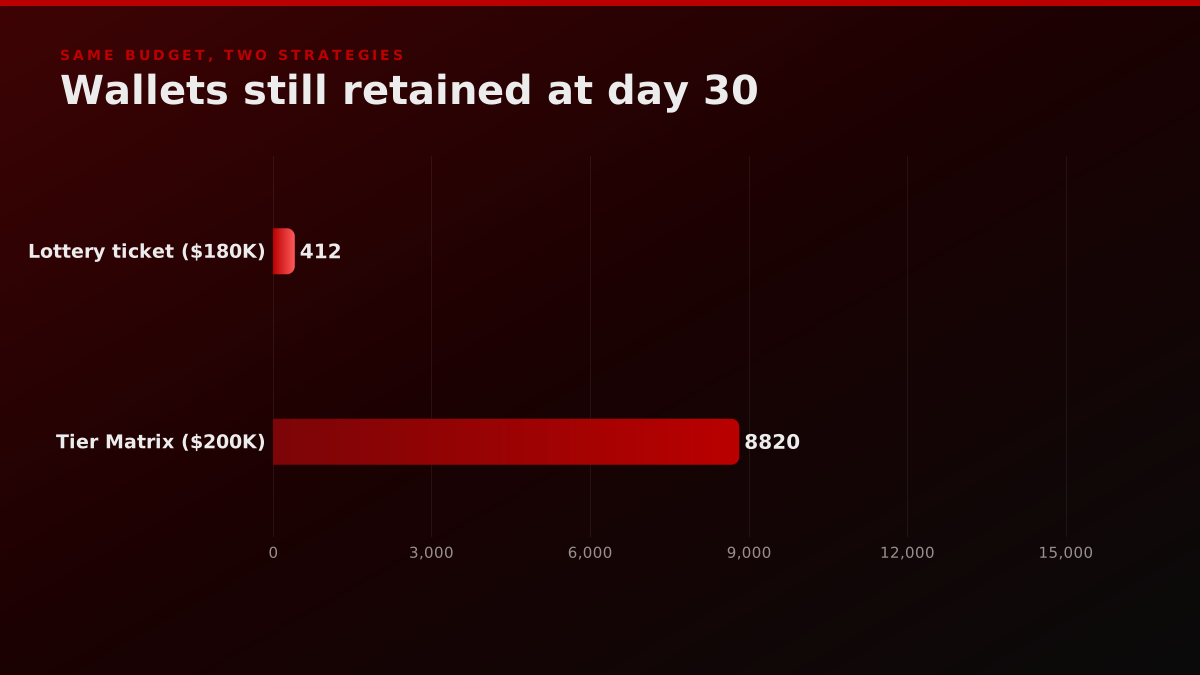
Take an estimated $200K KOL budget across a 90-day window for an L2 token launch with a 10K wallet retention target. The arithmetic below is drawn directly from two real FORKOFF audits in 2026, the lottery-ticket version and the Tier Matrix version.
Lottery-ticket version. An estimated $180K to one anchor post and a single macro support thread. Total reach: 42M impressions. Wallets created in the 7-day attribution window: roughly 28,000. Wallets still transacting at day 30: 412. Cost per retained wallet: an estimated $437. The growth lead cannot defend the line at the quarterly because the retention curve falls off a cliff at day 14 and never recovers.
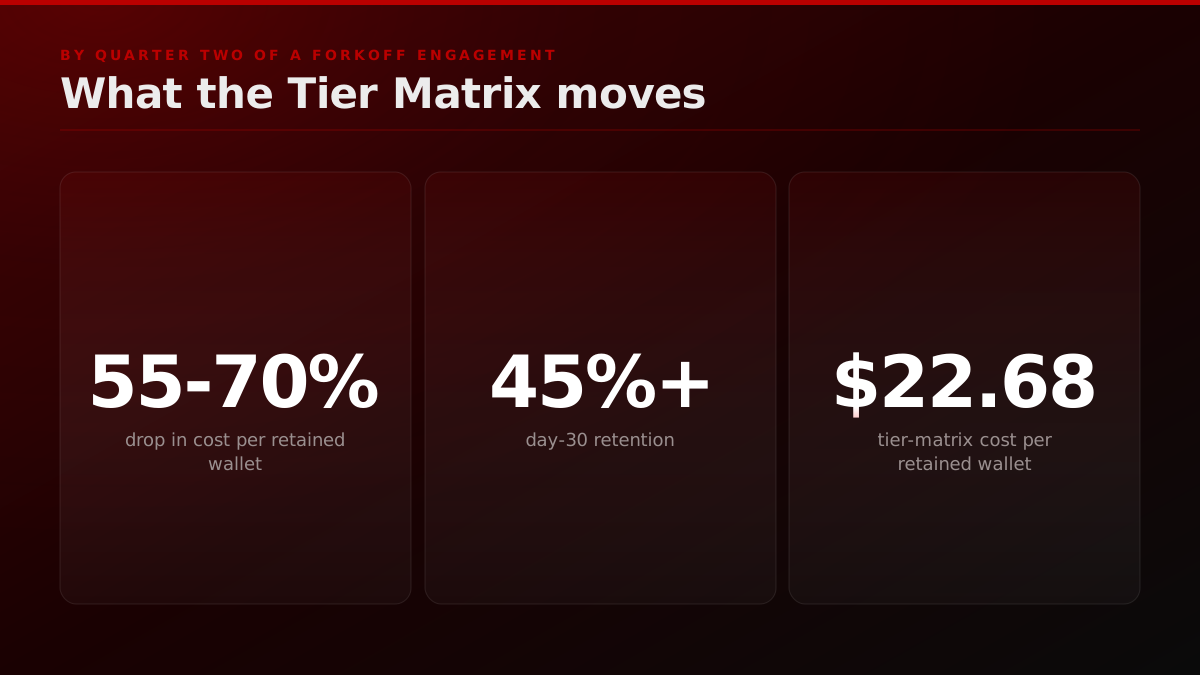
Tier Matrix version. Same $200K, restructured. An estimated $40K to a 32-nano operator wave at $1,250 average all-in (flat plus revshare cap), running 14 days before token generation event. $60K to a 14-micro conversation-seeding wave at $4,300 average all-in, running 7 to 21 days before TGE. an estimated $70K to 6 macro placements at $11,700 average, paired with nano and micro threads (no cold macro). $30K reserved for anchor pairing in the 72-hour TGE window. Total reach: 38M impressions, slightly lower. Wallets created in the 7-day attribution window: 19,400, lower than the lottery-ticket version. Wallets still transacting at day 30: 8,820. Cost per retained wallet: an estimated $22.68. The growth lead defends the line, the LP question becomes 'can you do this again next quarter,' and the answer is yes, because the matrix is reproducible.
The math is not subtle, and it explains why the matrix exists at all. Impressions are a vanity number that scales with anchor budget. Retained wallets are the only number that compounds, and they scale with tier mix plus contract structure plus founder-voice anchoring. The teams that read the math correctly stop buying the lottery ticket inside one quarter.
Operator noteOne $180K macro push kept 412 wallets past day 30; the restructured $200K tier stack kept 8,820., FORKOFF L2 audits 2026
The crypto industry loves blaming KOLs for failed launches, but rarely asks the harder question: was the product actually worth talking about? Too many founders expect a few tweets to compensate for weak products, poor tokenomics, no retention, and no clear market fit.
Web3-specific KOL patterns that outperform the generic influencer playbook
Crypto KOL marketing borrows vocabulary from Web2 influencer marketing, but the mechanics are different enough to warrant their own patterns. Three are non-obvious and they compound: operator revshare beats flat fee at every tier below anchor, quote-tweet laddering across nano-to-micro-to-macro beats single timeline posting, and Farcaster plus Telegram are now KOL surfaces in their own right rather than pure distribution channels.
Operator revshare beats flat fee at every tier below anchor. Web2 influencer deals are almost always flat. In Web3, the audience is sophisticated enough to detect a flat-fee endorsement, and operator KOLs with skin-in-the-game convert at 2-3x the rate of pure paid posts. Structure the contract as a smaller flat fee plus a retained-wallet revshare and the signal quality climbs immediately.
Quote-tweet laddering beats timeline posting. A thread posted by a nano that is quote-tweeted by a micro two days later, then quote-tweeted again by a macro four days after that, compounds across three audiences with the trust transfer intact. A single macro post, even by a 1M-follower anchor, dissipates inside 48 hours.
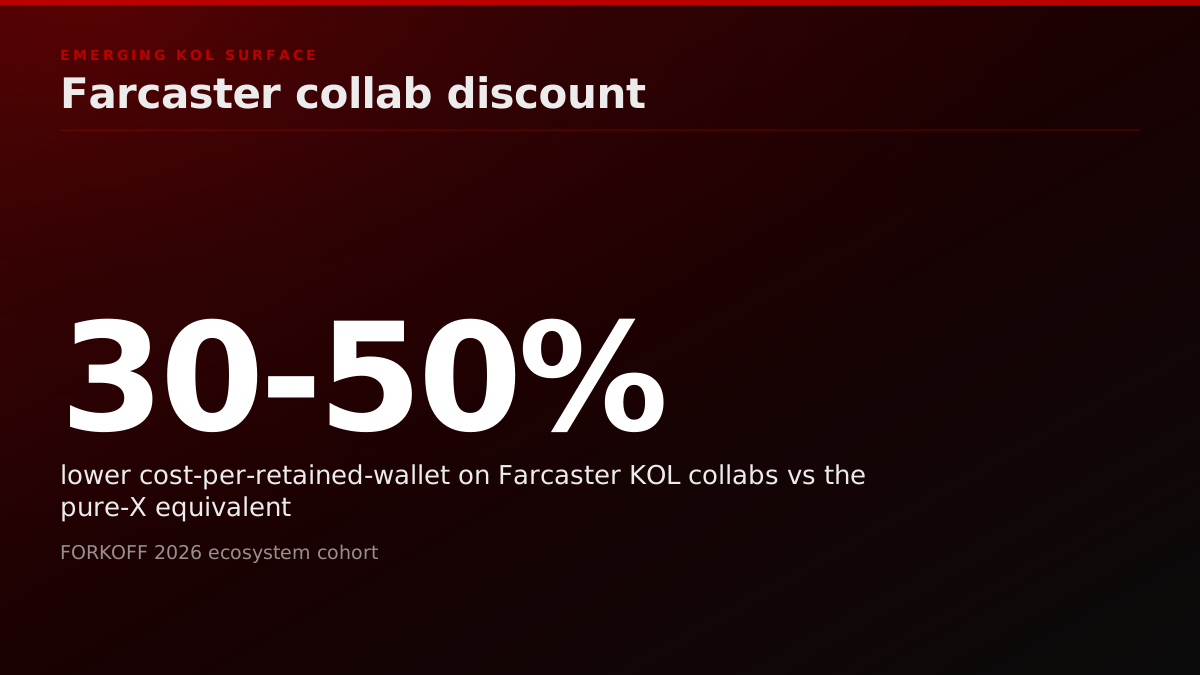
Farcaster and Telegram are now KOL surfaces, not just distribution surfaces. The top 200 Farcaster accounts behave like nano/micro CT accounts did in an estimated 2021-22 window, high engagement, high operator voice, retention-positive. The projects over-indexing on Farcaster KOL collabs in 2026 are seeing an estimated cost-per-retained-wallet 30-50% below the pure-X equivalents. Telegram power-channel admins are the same pattern for the Russia/CIS and SEA markets. For builders shipping products on Farcaster, the companion read is how Farcaster mini apps get distribution, which maps the six loops KOL amplification slots into.
Tier classification, how to score an account before you send the brief
Every account being considered for a KOL placement should pass a 7-factor classification before money moves. Skipping the classification is the most common error, and it is the error that turns the matrix into a list of follower counts instead of a buying system.
Factor 1: Vertical match score. Score 0 to 5 on how tightly the account's last 90 days of posts align with the campaign vertical. A 5 means the account is publishing inside the vertical multiple times per week. A 2 means the account passes through the vertical occasionally. Anything below 3 should be dropped regardless of follower count.
Factor 2: Engagement consistency. Pull the account's last 30 posts, compute the engagement rate per post, and check the standard deviation. A consistent rate of an estimated 2.5% beats a spiky 4% with three dead weeks in between, because the consistent rate predicts the campaign post's performance and the spiky rate does not.
Factor 3: Reply quality ratio. Sample 100 replies on the account's last five non-promotional posts. Score the ratio of operator-and-builder replies to farm-and-bot replies. Anything below an estimated 40% operator-and-builder should be flagged. This is the single most powerful filter against paying for ghost engagement.
Factor 4: Voice authenticity. Read the account's last 20 posts. Score whether the voice is consistent (5), modulated by context but still consistent (3), or drifts based on who is paying (1). A drifting voice converts at a fraction of an authentic voice and the audience knows it.
Factor 5: Vertical authority signals. Has the account shipped, advised, contributed to, or run a protocol inside the vertical? Operator authority is the difference between a 0.5% conversion and a 2.5% conversion at micro tier. Score 0 to 5.
Factor 6: Retention history. If the account has accepted prior revshare deals, pull the on-chain retention numbers from those campaigns. If the account has not, ask for references. An account that cannot or will not show prior retention numbers is selling reach, not retention.
Factor 7: Conversation-laddering willingness. Ask whether the account will reply-thread to a smaller-tier post during the campaign. An account that refuses to ladder is offering a one-shot, which is the lowest-leverage placement structure available.
Score the 7 factors, weight them per campaign goal (retention-heavy weights factor 6 highest, awareness-heavy weights factors 1 and 5 highest), and only send the brief to the top quartile. The classification work is the actual KOL marketing job. Sending the brief is the easy part.
Fraud signals, the red flags to clear before any payment
The 7-factor classification scores fit. A separate screen scores honesty, because the most expensive KOL mistake in 2026 is not a bad fit, it is a faked account. Industry estimates put influencer fraud at over $1.3 billion a year, fake and bot followers account for the majority of reported quality issues, and most marketers report hitting fraud at least once in 2026. The crypto market is worse than the cross-industry average, because token incentives reward follower inflation directly. Run this screen on every shortlisted account before money moves.
$1.3B a year in influencer fraud, and crypto runs worse than the average
CBS News reported that influencer marketing fraud costs brands over $1.3 billion a year, with fake and bot followers driving the majority of reported quality problems, and the Influencer Marketing Hub benchmark work shows fraud is a first-order concern for most marketers rather than an edge case. Crypto runs worse than the cross-industry average because token incentives reward follower inflation directly. In one 19-account KOL screen FORKOFF ran, 4 accounts failed the bot-quality check at over 35 percent inauthentic engagers, and none of the four looked wrong on a roster page. The engagement-to-impression ratio, not the follower count, is the number that exposes it.
Source: CBS News influencer-fraud report; Influencer Marketing Hub Benchmark Report; FORKOFF 19-account KOL screen 2026
- Follower-growth shape. Pull the account's 12-month follower curve. Organic growth is jagged and trend-tied. Bought growth shows a vertical spike followed by a flat or declining shelf with no sustained organic activity after it. A spike that does not map to a viral post or a launch is a purchased block.
- Engagement-to-impression collapse. A vertical-fit account whose engagement-to-impression ratio sits below 0.4 percent across a 90-day window is running a botted or burned-out audience, regardless of follower count. This is the single highest-signal number in the screen, and it is the first failure mode the FORKOFF audit ledger flags.
- Comment texture. Sample 100 replies on the last five non-promotional posts. Repetitive short comments, identical emoji strings across many posts, and a like-spike that arrives in the first minute then dies are pod or bot signatures. Engagement pods, where creators agree to like and reply to each other on a schedule, are detectable at high accuracy and read as inauthentic to the platform too.
- Audience-geography mismatch. When an account's audience concentrates in countries that do not match its content language or claimed vertical, the followers are bought. For CT this shows up as a self-styled US or EU DeFi account whose engaged audience is 70 percent a single low-cost-traffic geography.
- Fresh-audience inflation. An account whose 14-post organic engagement window precedes the campaign drop by less than 7 days has a freshly bought audience inflating the brief-time numbers. The audit ledger times the organic window against the drop date specifically to catch this.
- Refusal to show retention. An account that has run prior revshare deals can show on-chain retention from them. An account that will not, or cannot, is selling reach and hiding the conversion number. A flat refusal to be measured is itself a signal.
The tooling layer is real and cheap relative to the spend it protects. Third-party audience-audit tools (HypeAuditor, Modash, and similar) sample an account's audience and grade it on authenticity, and for crypto specifically the on-chain layer (referral-link wallet traces, Galxe and Layer3 attribution) closes the loop the social-only tools cannot. In one 19-account KOL screen FORKOFF ran, 4 accounts failed the bot-quality check at over 35 percent inauthentic engagers, and cutting them before launch saved roughly $3,000 of wasted spend. None of those four looked wrong on a roster page. The fraud sat one layer below the numbers they volunteered. The how to vet a crypto KOL guide runs the full nine-check due-diligence sequence on a single name, ordered so the cheap filters drop the obvious problems first.
Operator note4 of 19 shortlisted KOLs failed the bot screen at over 35% inauthentic engagers, cut before launch., FORKOFF 19-account KOL screen 2026
Common objections from growth leads, and the operator answers
The Tier Matrix runs into the same four objections from growth leads who have been buying macro placements for two years: nano placements do not move impressions, coordinating 30 nano operators is expensive, revshare contracts slow legal down, and on-chain attribution is not wired up yet. Each objection has a clean operator answer, and each one points at a piece of operational work the team has been avoiding.
Objection 1: 'Nano placements do not move the needle on impressions.' Correct, and that is the point. Impressions are the wrong needle. Wallets retained at day 30 is the right needle. Nano placements move that needle more per dollar than any other tier, which is why the matrix weights them heavily for retention campaigns.
Objection 2: 'Coordinating 30 nano operators is operationally expensive.' Correct, and the operational overhead is the moat. Most teams will not do the work, which is why most teams burn $180K on a single macro push. The 30-nano wave is roughly 12 to 18 hours of ops work per launch (briefing, scheduling, asset prep, attribution wiring, payment), and that work pays back at a 20 to 30x ratio against the lottery-ticket structure.
Objection 3: 'Revshare contracts take legal review and slow us down.' Correct, and the legal review is one-time. Once a template revshare contract is in place, every subsequent KOL signs the same template. The legal cost amortizes across every campaign for the next 12 months. The teams that complain about revshare legal review have not done the one-time work, not because the work is hard but because the macro-push habit feels faster in the moment.
Objection 4: 'We do not have on-chain attribution wired up.' Correct, and that is the actual lever. The fastest path to lower cost-per-retained-wallet is to wire up per-KOL on-chain attribution, because the moment you can measure it you can buy against it. Galxe quests, Layer3 attribution layers, and frontend referral-cookie writes to a contract event are the three canonical ways to wire this in under two weeks. Any team that ships KOL spend without this layer is buying blind.
The pattern across the four objections is the same: each one points at a piece of operational work the team has been avoiding, and the avoidance is what produces the lottery-ticket math.
How we run the Tier Matrix with Web3 teams at FORKOFF
Every Web3 ecosystem engagement at FORKOFF starts with a Tier Matrix audit. We score the team's last four quarters of KOL spend against the four tiers, produce a cost-per-retained-wallet number per campaign from on-chain data, and surface the one tier being over-bought relative to retention output.
Then we install. Nano first, a shortlist of 30-50 nano CT and Farcaster accounts matched to the team's vertical, with operator revshare templates. Micro second, a rolling calendar of 6-10 micro seeders per launch, with conversation-laddering briefs. Macro third, paired, never solo, with an anchor-moment budget reserved for TGE or category launches. Audit last, a dashboard that ties every KOL handle to retained-wallet count per week.
By the second quarter of a FORKOFF engagement, the typical ecosystem team sees cost-per-retained-wallet drop 55-70%, retention past day 30 land above 45%, and KOL marketing become a line their growth lead can defend in the next update. Two related FORKOFF reads if you want the operator view: the Founder Funnel OS (which is how the founder-voice layer slots into the Tier Matrix) and the KOL marketing service page for how we staff the engagement.
The audit ledger inside a Tier Matrix engagement records 10 columns per KOL drop: handle (the named CT or Farcaster account); tier classification (nano, micro, macro, anchor) scored against the audience-quality rubric in the prior section; followers at drop date; median impressions across the last 14 organic posts; engagement-to-impressions ratio computed against the same 14-post window; campaign cost in dollars at drop date; on-chain attributed wallets within the 72-hour drop window measured against the team's UTM and referral-link surfaces; retained wallets at day 7, day 14, and day 30 measured against the same wallet cohort. Cost-per-retained-wallet at day 30 is the metric the engagement contractually owns: the FORKOFF operator team carries the cost overrun if the day-30 CPRW exceeds the per-tier ceiling locked in the engagement scope. The 10-column ledger replicates across every drop in the quarter; the per-tier median compounds into the next quarter's budget allocation; and the team's growth lead reads the ledger directly rather than relying on an agency summary that hides the underlying handles. Across the FORKOFF ecosystem cohort, the audit ledger has surfaced 3 recurring failure modes: KOL handles whose engagement-to-impressions ratio collapses below 0.4 percent inside the 90-day window (botted audience late-detection); KOL handles whose 14-post organic engagement window precedes the drop by less than 7 days (fresh-bought audience inflation); and KOL handles whose day-7 to day-30 retention curve flatlines below 12 percent (audience misalignment to the protocol's actual ICP). Each failure mode triggers a contract-side adjustment rather than a silent loss, and the per-tier ceiling locks the operator team to a renegotiation rather than letting the campaign quietly underperform across the rest of the quarter.
The Bottom Line
Crypto KOL marketing in 2026 is not a lottery and it is not a dark art. It is a four-tier system with a retention-math backbone and a well-understood set of failure modes, where nano and micro tiers carry operator-revshare tied to wallet retention and the whole spend gets measured on cost-per-retained-wallet at day 30 rather than the impression screenshot that traps most teams in the lottery-ticket model.
The CT KOL Tier Matrix is the OS. Nano, micro, macro, anchor, each matched to a purpose, a price, an engagement ratio, and a retention expectation. The teams compounding on Crypto Twitter this cycle run all four tiers in stacked sequence and measure cost-per-retained-wallet, not impressions. The teams repeating the $180K push with zero retained wallets are running an unserialized version of the matrix without knowing it.
If you want the audit run for you, that's what we do at FORKOFF.
For an external operator view on this, see the Bankless channel for crypto KOL conversation density.
About these numbers
The figures in this post come from FORKOFF first-party operator data across Web3, crypto, and AI ecosystem marketing engagements, supplemented by publicly available industry data from CoinGecko, DeFiLlama, and Messari for 2025 and 2026. All figures are directional estimates based on operator observations across the 28-protocol Q1 to Q2 2026 cohort, and individual outcomes vary with vertical, budget, and execution discipline.
For adjacent reading, see the Web3 GTM playbook 2026, the airdrop marketing playbook 2026, the KOL marketing service.
For adjacent context, see the Web3 Dubai marketing brief.
Primary sources cited above: Chainalysis Crypto Adoption Index. Messari's research library, home of its annual Crypto Theses. a16z crypto's State of Crypto report.