
Podcast clipping agency pricing in 2026 runs from $1,250 per month at the floor to $300,000 per month at the enterprise ceiling, across three models: monthly retainer, per-clip, and campaign. Under $3K per month the math rarely works for the agency and quality slips by month two. The decision between models comes down to cadence: retainer for shows shipping 20+ clips per month, per-clip for small tests, and campaign for a guaranteed view-count burst tied to CPM math.
Podcast clipping agency pricing, the short version
Three models price the entire market in 2026: retainer ($1,250 to $25,000 per month, most B2B buyers at $3,000 to $8,000), per-clip ($5 to $800 depending on scope), and campaign ($5,000 to $40,000+ one-off, some priced on CPM at $0.50 to $3). Under $3,000 per month the agency math stops working and QA is the first line cut. The enterprise ceiling runs to $300,000 per month (Airrack). Pick retainer for a weekly show shipping 20+ clips per month, per-clip for a 6-week test, campaign for a launch window with a kill-switch metric. FORKOFF's clipping network has processed 5B+ views; the cost breakdown below shows what each line item in a retainer actually pays for.
About these numbers
Price ranges and percentage breakdowns throughout this post are drawn from FORKOFF first-party operator data collected across managed clipping engagements, supplemented by publicly cited pricing from Rise25, Content Allies, Buxton, Clippingculture, and Ssemble (sourced 2026-Q2). All figures are directional estimates based on operator observations; individual engagements vary. Where a specific agency's published pricing is cited, the source is noted inline.
- Podcast clipping agencies price in three models in 2026: monthly retainer ($1,250 to $25,000), per-clip ($5 to $800), and campaign ($5K to $40K+ one-off, per Clippingculture's clipping campaign cost guide).
- Under $3K per month the math rarely works for the agency, and quality slips by month two. Enterprise ceilings sit near $50,000 per month (Zach Justice) and $300,000 per month (Airrack).
- Pick retainer for consistency above 20 clips per month, per-clip for small tests, and campaign when you need a guaranteed view-count burst tied to CPM math.
Which podcast clipping pricing model fits you: retainer, per-clip, or campaign?
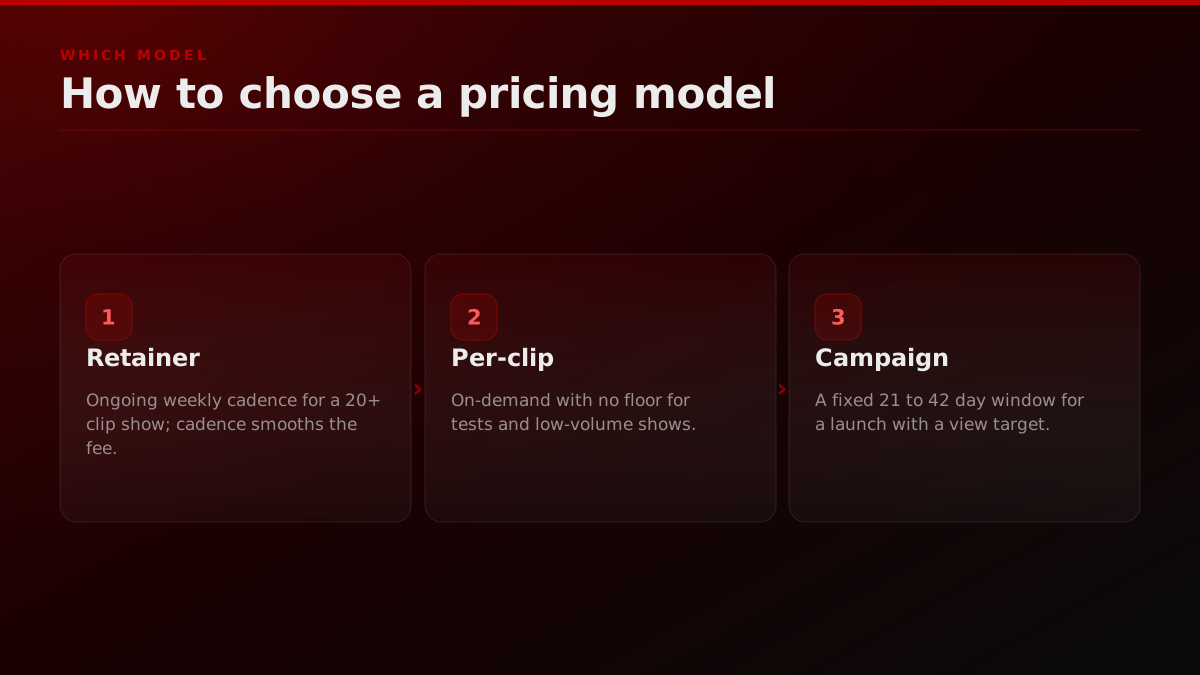
The three pricing models for podcast clipping agencies in 2026 are retainer (fixed monthly fee for a fixed clip volume), per-clip (piecework rate with no floor), and campaign (one-time budget tied to a view-count or CPM target). The clipper-labor side of these pricing models, the per-clip pay an individual clipper sees inside each model, is documented in how much clippers earn in 2026.
Most buyers walk into a clipping conversation with one number in mind and no framework for what that number buys. The market has settled into three pricing models and every agency worth hiring in 2026 prices in at least one of them.
Here are the three models in one line each:
- Retainer is the subscription: a fixed monthly fee for a fixed clip volume.
- Per-clip is the piecework rate: pay per deliverable with no floor.
- Campaign is the burst: a one-time budget tied to a view-count or CPM target.
The three do not compete, they solve different problems. A B2B podcast shipping one episode a week wants a retainer so the backlog never grows. A founder testing a new show for six weeks wants per-clip so the spend matches actual output.
A consumer brand launching a product wants a campaign so 20 million views land in a three-week window. Buying the wrong model is the single most expensive mistake in this category, and it is fixable in minutes once you see the decision matrix.
While everyone's paying KOLs $5K for a post, smart brands are turning one podcast into hundreds of pieces of content.
This post breaks down what each model actually costs in 2026, what moves you up and down the band, and what the biggest spenders pay so your number feels accessible in context. Every dollar figure below has a source URL inline so you can pressure-test the range against the same data we used.
A note on framing. Pricing for clipping sits inside a broader shift: the clip economy went from a cottage service in 2023 to a category with defined tiers and named enterprise spend by 2026, with podcasts now produced with short-form clips and multi-platform distribution in mind from day one. Our coverage of that shift lives at /blog/clipping/the-clip-economy-openai-tbpn-200m, and the single-operator revenue case at /blog/clipping/podcast-clipping-revenue-case-study shows the earnings side of the same coin.
This post is the buyer-side companion: not what operators earn, but what you should expect to pay. If you want the same thinking applied to your podcast production stack, we cover that at /services/podcast; if you want it applied to a founder-led show specifically, see /services/founder-funnel. Clipping-as-a-service is its own page at /services/clipping.
Diagram 1 (pricing-model decision tree, caption: "30-second flow for picking retainer, per-clip, or campaign based on volume, time horizon, and goal.")
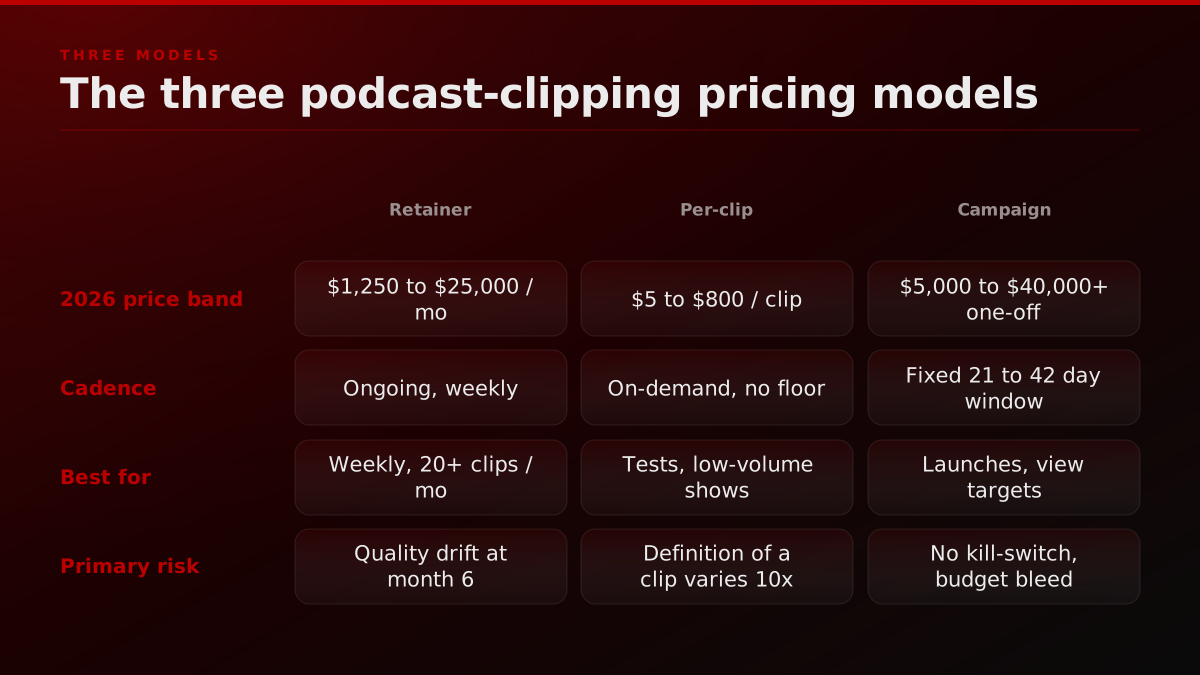
Before we break each model apart, here is the side-by-side view competitor pages do not publish. This is the comparison table the rest of the post unpacks row by row.
| Model | 2026 price band | Cadence | Best for | Primary risk |
|---|---|---|---|---|
| Retainer | $1,250 to $25,000 per month | Ongoing, weekly cadence | Weekly podcasts, 20+ clips per month | Quality drift at month 6 |
| Per-clip | $5 to $800 per clip | On-demand, no floor | Tests, low-volume shows, ramp-phase teams | Definition of "a clip" varies 10x |
| Campaign | $5,000 to $40,000+ one-off | Fixed window, 21 to 42 days | Launches, guaranteed view targets | No kill-switch = budget bleed |
Retainer pricing
Retainers are the default for podcast clipping in 2026 because podcasts ship on a cadence. If your show publishes weekly, your clipping backlog grows weekly. A monthly fee smooths that flow better than chasing per-clip invoices. The retainer band runs from $1,250 per month (Buxton's video retainer packages, single host with light clip volume) to $25,000 per month (Rise25 full-service B2B with multi-platform distribution), with most buyers landing in the $3,000 to $8,000 range.
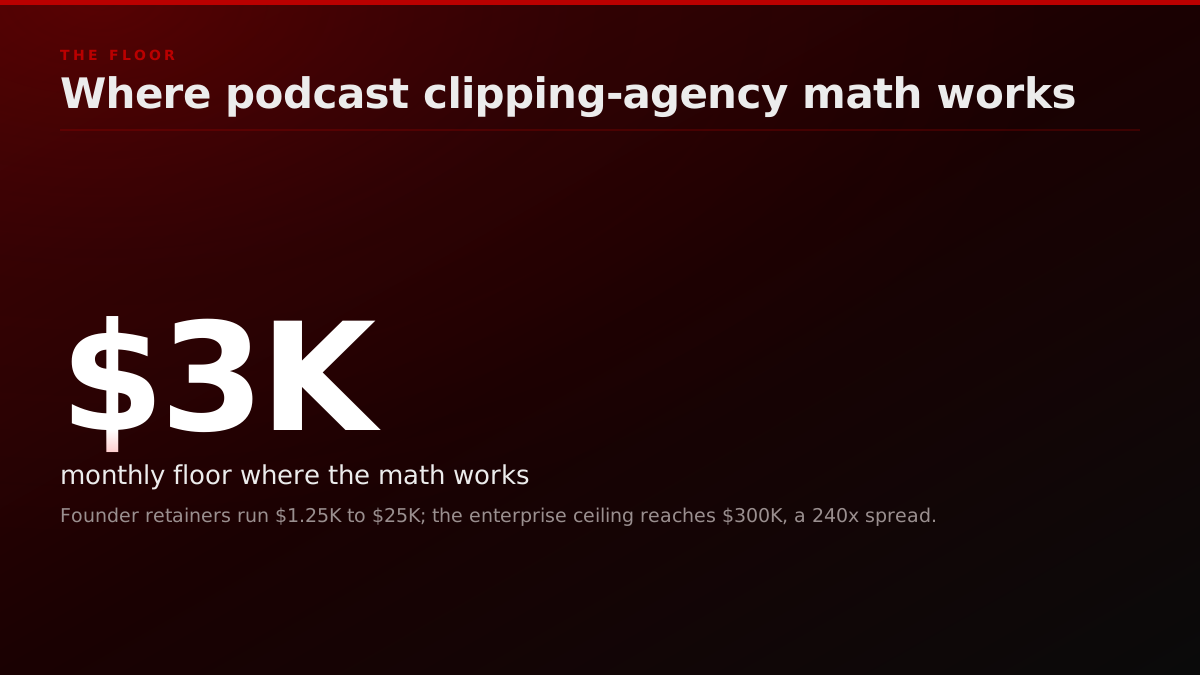
The retainer band spans almost two orders of magnitude, which scares first-time buyers more than it should. The band is wide because the deliverable spread is wide, not because the market is chaotic.
What is included at each band
At the $1,250 per month floor, Buxton Media Productions sells an all-in video retainer package that bundles podcast production with social clips in one fee (source: the Buxton video retainer packages page). That works for a single host shipping one episode a month with a small number of clips.
At $2,000 to $20,000 per month, Content Allies places most done-for-you B2B podcast agencies (source: contentallies.com). The spread is driven by clip volume, number of platforms, and strategy inputs.
At $3,000 to $25,000 per month, Rise25 prices its full-service B2B retainer (source: rise25.com). That band includes production plus multi-platform distribution.
Freelance clipper retainers run $500 to $5,000 per month according to Ssemble (source: Ssemble's clipping 2026 earnings report). Freelancers are lower-cost on paper but every dollar under $2,500 per month comes out of strategy, QA, or distribution.
Those are the pieces that actually produce compounding returns. Cut them and the retainer still runs; the results just stop.
Typical retainer bands
Most B2B buyers land in an estimated $3,000 to $8,000 per month band. That range buys 16 to 40 clips per month across two to three platforms, a named strategist, two rounds of revisions per clip, and a monthly reporting cadence.
Below $3,000 per month the agency has to cut something to make the unit economics work, and the usual cut is QA, not clip count. Above $8,000 per month you are paying for higher-stakes distribution.
What the premium buys: creator outreach, paid amplification setup, repurposing into long-form native video, and senior editorial oversight on hooks and thumbnails.
Enterprise retainers start around $15,000 per month and go as high as your budget allows. Zach Justice was paying $50,000 per month to his clipping team before moving to Opus Autopilot (source: opus.pro), and Airrack is reported at $300,000 per month in clipping operations.
At those altitudes the deliverable stops being clips and starts being a managed creator network: dozens of distribution accounts, seven-figure paid budgets, and a dedicated ops team feeding the machine.
Juan
@0xfJuan
The next marketing meta is already here. Clipping. While everyone's paying KOLs $5K for a post, smart brands are turning one podcast into hundreds of pieces of content. Web2 has proven it works, and a great example is streamers going viral on TikTok/X/IG etc. It'll cost you
How to spot when a retainer breaks
Retainers break in three repeatable places. Here is the short diagnostic in order:
- 1. Cadence drift. A podcast that ships four episodes in January and zero in February should not pay a flat fee both months. Fix: quarterly renegotiation with a cadence clause, or a hybrid that pairs a small retainer base with per-episode overages.
- 2. Silent scope creep. 15 clips becomes 22, then "can you also cut a long-form YouTube edit?" Fix: a written deliverable grid in the statement of work with clip count per week, platform targets, turnaround SLA, and an explicit rate card for anything outside that grid.
- 3. Sub-$3K math. When the retainer is under $3,000 per month and the agency is also handling creator distribution, the math does not work for them. Quality drops by month two as editors get pulled to better-paying clients. Fix: renegotiate up or switch to per-clip.
Operator noteBelow the FORKOFF retainer floor, QA is cut before clip count. That is why the floor sits where it does.
A fourth failure mode shows up around month six for successful retainers, which is worth flagging up front.
Once a clipping cadence stabilises, the same agency that was perfect at month three can stagnate on hook variety. Retainers reward consistency, not experimentation, and a team cutting the same voice for 24 weeks starts cutting on autopilot.
Budget a quarterly creative refresh: 20% of the month's clips should be explicitly experimental (new hook format, new thumbnail treatment, new platform test). That budget should be named inside the retainer, not added as an ad-hoc ask.
Agencies that push back on creative-refresh time are the ones who will plateau by month nine.
Per-clip pricing
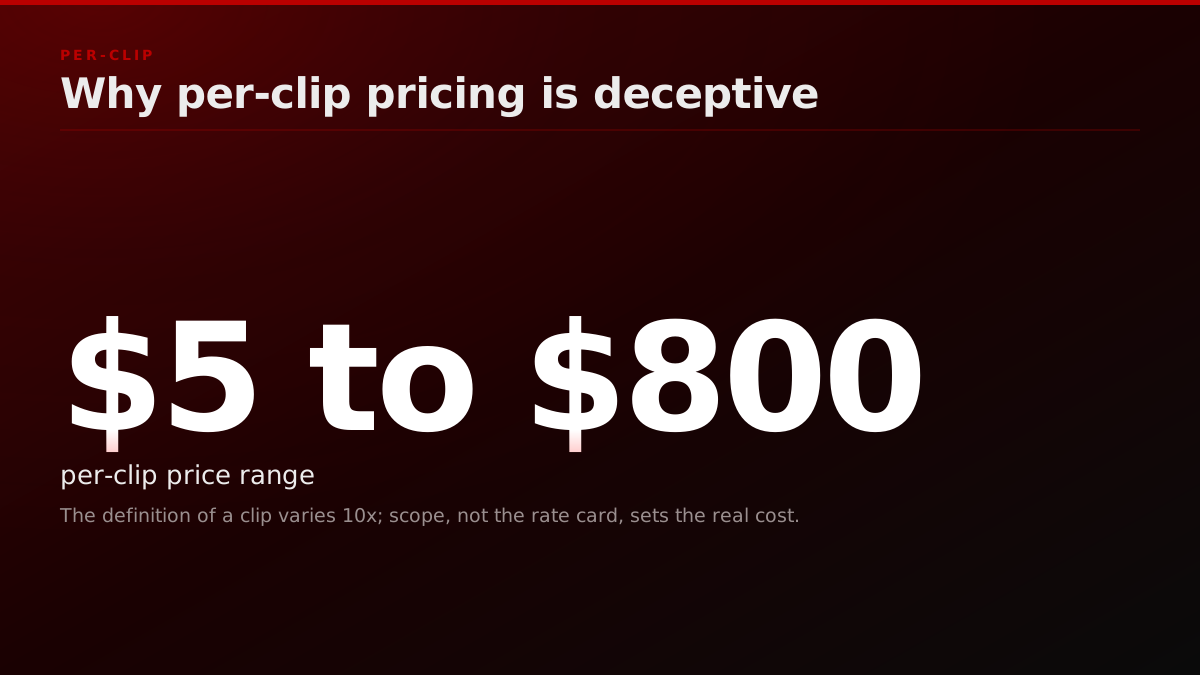
Per-clip is the cleanest pricing model in theory and the most dangerous in practice. Clean because you pay for output, not hours. Dangerous because the definition of "a clip" varies by ten times across agencies, and the rate does not tell you which definition you are buying.
I got offered an editing job to clip a podcast/ radio show and need help pricing out a monthly fee for editing and posting the content.
How to go about pricing for clipping?
I got offered an editing job to clip a podcast/ radio show and need help pricing out a monthly fee for editing and posting the content. 1-2 camera angles 4-7 hours of footage a month Basic clipping, captions, and simple graphics I would also be posting the content myself on… Show more
The math
Here are the four per-clip rate bands, each with a source:
- Freelance, basic cut-and-caption: $5 to $50 per clip, with $15 to $25 as the modal band (source: Ssemble clipping 2026 rate data).
- Video editor, motion graphics + b-roll: $15 to $90 per clip (source: vortex.video).
- Managed agency per-video: $40 to $300+, with the ceiling rising when the scope includes hooks, captions, b-roll, and distribution-ready exports (source: contentallies.com).
- Bundled audiograms plus video clips per episode: $200 to $800 at the higher end (same source).
The number that matters is not the clip rate, it is cost per useful output. A $15 freelance clip that converts at zero is infinitely more expensive than a $200 managed clip that drives 200 qualified visits. Price the unit of value, not the unit of production.
Yash Daftary
@YDaftary
People are overthinking the clipping economy. The distribution it creates at scale is great but I think AI will eventually run the clipping economy. Cost of creating, editing and posting content is nearing $0. You can post the same clips across 6-7 platforms with almost no
Founders running an early, unproven format often start here specifically so they can kill the engagement at low sunk cost if the show does not click. If that is you, we built /services/founder-funnel for exactly that early-stage posture.
Volume price breaks and how they hide risk
Per-clip agencies routinely offer volume price breaks: $50 per clip at 10 clips per month drops to $35 per clip at 40 clips per month. On the surface this is a good deal.
Underneath, the price break is usually funded by two invisible levers. First, consolidating editors per clip (one editor handles four clips instead of two). Second, reducing revision rounds (two rounds becomes one).
Ask for both levers explicitly before signing. If the agency cannot articulate what is being cut to fund the price break, the price break is coming out of QA.
The other quiet hidden cost in volume per-clip is ramp. Agencies quote steady-state rates and bill you ramp-state hours.
A new client's first month takes 2x the editor hours because voice, visual style, hook patterns, and brand guidelines are being encoded. Expect first-month delivery at approximately 60% of steady-state volume, or request a ramp fee up front so the second month is not a surprise bill.
Operator noteMonth one bills 2x editor hours and ships about 60% of steady-state volume. Price the ramp line explicitly., FORKOFF retainer scoping runs, 2026
The quality-versus-quantity trap
The most expensive per-clip trap is buying volume. Fifty clips per month at $20 each sounds efficient. Fifty clips per month from a single editor with a two-day SLA is a sweatshop, and the output shows.
The clips that move the needle are the 3 to 5 per month that get hook-tested, thumbnail-tested, and trimmed twice. Those cost an estimated $150 to $300 each and replace 30 lower-cost clips on every attribution metric.
Buy fewer clips at a higher rate, not more clips at a lower rate. The only exception: a flood-and-sort strategy that starts at 100+ clips per month to work statistically.
Campaign pricing
Campaigns are the third model: a one-time budget tied to a view-count or CPM target, not an ongoing retainer. Clippingculture's clipping campaign cost breakdown breaks campaign pricing into three tiers ($5K-$10K for format validation, $10K-$20K for a full product launch, $20K+ for sustained multi-platform scale), with the floor at $5,000 and the ceiling at $40,000+ depending on scope. The right trigger is a defined business moment with a clear end date.
Clippingculture.com breaks campaign pricing into three tiers (source: the clipping campaign cost tiers):
- $5,000 to $10,000: validation tier. Test a new format, confirm it moves metrics.
- $10,000 to $20,000: full round. Run a product launch or a defined growth window.
- $20,000+: sustained multi-platform. Scale a proven format across several surfaces.
Those bands are directionally right and the tiers map to recognisable business moments: test a new format, run a product launch, scale a proven format.
Campaign budgets map to three recognisable business moments
Clippingculture prices clipping campaigns in three tiers: $5,000 to $10,000 to validate a format, $10,000 to $20,000 for a full product-launch round, and $20,000+ for sustained multi-platform scale. The same guide prices the CPM variant at $0.50 per thousand views, which makes a $10,000 budget a 20-million-view guarantee. The tier structure matters more than the exact numbers: a campaign priced without a named goal, a fixed window, and a kill-switch metric is a retainer in disguise, billed at campaign rates.
Source: Clippingculture campaign pricing guide, 2026
Scope definition
A campaign is not a month of retainer work compressed into three weeks. Campaigns have four attributes a retainer does not:
- A named goal (view count, landing page traffic, creator-account growth).
- A fixed window (usually 21 to 42 days).
- A defined creator roster (not a pool).
- A kill-switch metric that pauses the budget if the first two weeks miss interim targets.
Retainers do not work this way. The reason campaigns cost more per unit of time is the ops layer: creator outreach, contract management, performance dashboards, and daily traffic-light reporting are all loaded into the window.
Deliverable stack
At $10,000 for a validation campaign, the stack is typically:
- 30 to 60 clips distributed across 5 to 15 creator accounts.
- 1 to 2 paid amplification pushes.
- A weekly pacing report with interim-target checks.
Hulu's $40,000 campaign delivered 12M+ gained views for a single product push (source: opus.pro). That is a useful ceiling-anchor for what a best-case six-figure-adjacent campaign returns.
Hulu is not a podcast in the traditional sense, but the clipping economics transfer cleanly. The ratio of dollars to views is the same.
Performance-linked variants, the CPM model
Clippingculture.com prices some campaigns on CPM rather than flat fee: a $10,000 budget at $0.50 CPM guarantees 20 million views (source: same page). That model shifts risk to the agency, since they only get paid on delivered impressions. For buyers who want a cost-per-qualified-view reference point before entering any CPM negotiation, the FORKOFF CPQV benchmark publishes verified rates across niche, platform, and deal structure.
It works when the creator network can deliver audience volume reliably. Ssemble reports that Vyro pays clippers $3 CPM (source: Ssemble's 2026 clipping economy report), which is 6x the $0.50 floor, because Vyro targets premium creator inventory.
In short: the $0.50 CPM gets you views, the $3 CPM gets you audience quality. Pick deliberately.
The $0.50-to-$3 CPM spread is a quality spread, not a price war
Ssemble reports that Vyro pays clippers $3 CPM against the $0.50 CPM floor cited for volume campaigns, a 6x premium that buys placement on established creator accounts rather than fresh burner pages. The same report puts freelance clipper retainers at $500 to $5,000 per month. Buyers comparing two CPM quotes are usually comparing two different products; ask whose accounts the views land on before treating the cheaper number as the better deal.
Source: Ssemble clipping economy report, 2026
CPM vs flat-fee, in two lines:
- Flat-fee wins when you have a hard budget cap and can accept variable impressions.
- CPM wins when you have a hard view target and want incentives aligned.
Two operational details separate good campaigns from bad ones regardless of fee model.
Creator roster first. The creator roster should be named before the campaign starts, with opt-in confirmations on file. A campaign pitched around a "network of 200 creators" that turns out to mean a spreadsheet of cold-outreach targets is a campaign that will miss its view target.
Ask for the roster, the typical response rate, and the three most recent campaigns that roster has run.
Pacing second. The pacing cadence should be defined in advance: approximately 40% of the budget in week one, 40% in week two, 20% reserve in week three for the winning formats.
Campaigns that spend the entire budget in week one have no optimisation loop and almost always under-deliver relative to the paced alternative at the same budget.
The decision matrix, matching model to situation
The decision matrix maps your current situation to the right pricing model. Pick retainer when you ship 20+ clips per month consistently and want a predictable cost line. Pick per-clip when you are testing a new show or format and want spend to match actual output. Pick campaign when you have a defined business moment (product launch, season premiere) that needs a guaranteed view-count burst in a fixed window.
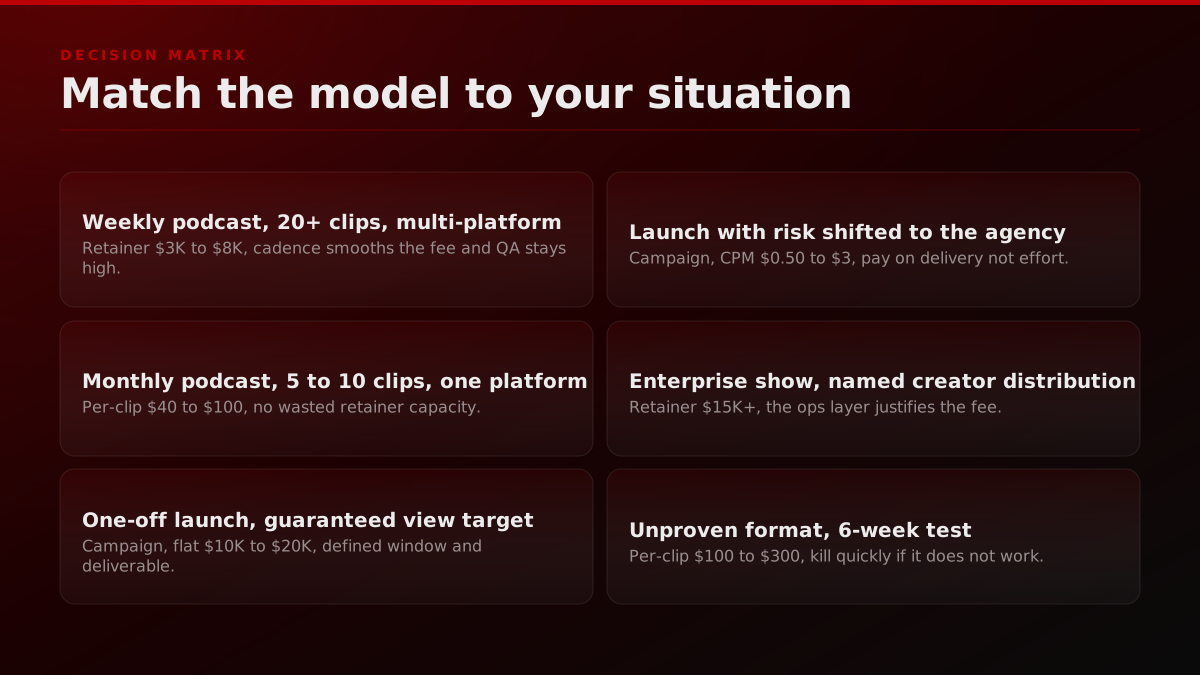
If you want /services/clipping to do this read for you on a live call, we do; if you want to self-serve, the matrix is below.
| Your situation | Best model | Why |
|---|---|---|
| Weekly podcast, 20+ clips per month, multi-platform | Retainer $3K-$8K | Cadence smooths fee, QA stays high |
| Monthly podcast, 5-10 clips, one platform | Per-clip $40-$100 | No wasted retainer capacity |
| One-off launch, guaranteed view target | Campaign, flat $10K-$20K | Defined window, defined deliverable |
| One-off launch, guaranteed view target, risk to agency | Campaign, CPM $0.50-$3 | Pay on delivery, not on effort |
| Enterprise show with named creator distribution | Retainer $15K+ | Ops layer justifies the fee |
| Unproven format, 6-week test | Per-clip $100-$300 | Kill quickly if it does not work |
Use the matrix as a starting point, not a contract. Most real buyers end up on a hybrid: retainer for core cadence, per-clip for stretch episodes, campaign once or twice a year for launches.
What podcast editing agencies do you recommend?
I'm working on an 8-episode podcast miniseries. It's not your typical long-form podcast. It's mostly narrative-driven, and I want to interject clips of myself to guide the story. Problem is, I have no editing experience. And this will require a LOT of editing. What podcast editing agencies or services would… Show more
Here's how we'd scope your retainer at FORKOFF
The inside-FORKOFF version of the matrix is a five-step scoping run. When a podcast comes to /services/clipping for a retainer, this is the sequence we run in the first 30 minutes:
How FORKOFF scopes a clipping retainer in 30 minutes
STEPS- 01
Cadence audit
We pull the last 8 weeks of episodes, count actual publish days against the stated cadence, and flag any show that misses the weekly cadence more than once a quarter. Shows with drifty cadence start on a hybrid model with a small retainer base plus per-episode overages, not a flat retainer. The audit takes 5 minutes and prevents the single most common retainer failure mode: paying flat fees in months the host shipped zero episodes. We document the actual cadence in the proposal so the agreement matches reality, not the marketing-page version of the show schedule.
- 02
Platform read
We map your current creator-account presence across TikTok, Reels, Shorts, and X, including follower counts, posting frequency, and last-90-day engagement floor per platform. If you are below 2 active platforms, we quote a retainer that includes multi-platform setup and label that cost explicitly so you can see where the money goes. Setup is a one-time line item, not a hidden ongoing fee. The platform read also surfaces accounts that look active but have zero engagement, which we flag as needing a reset rather than continued posting.
- 03
Clip volume sizing
We size the retainer against 20 to 40 clips per month at the $3K to $8K band, or 40 to 80 at the $8K to $15K band. Anything under 20 clips per month lands on per-clip, not retainer, because the unit economics break for both sides. We also map clip volume to episode count: a weekly show shipping 4 episodes per month at 5 to 8 clips per episode lands in the lower band, a twice-weekly show at the same clip-per-episode ratio lands in the upper band. Volume is not arbitrary; it is derived from episode supply.
- 04
Attribution pipeline
We show the reporting we ship: views, watch-through, click-through, and UTM-tagged landing traffic with weekly dashboards and a monthly readout. If you do not already have a pipeline, we build one into the first-month ramp and cost it separately so it does not get buried inside the retainer line. The pipeline matters because reporting that stops at impressions is the most common silent failure in the category. Buyers who skip the attribution conversation at scoping always renegotiate it in month four, which is the expensive version of having it now.
- 05
Ramp month cost
We name the ramp month explicitly, quote it at 2x editor hours, and promise steady-state volume from month two. Clients who try to skip this step get a surprise invoice when the second month lands at 60% of forecast. The ramp covers voice encoding, visual-style codification, hook-pattern library buildout, and brand-guideline integration. Steady state requires a real onboarding investment. We surface the cost rather than hide it, because the alternative is a quiet quality dip across months two and three that most buyers misread as agency drift.
If your show fits the first four steps cleanly and the fifth is budgeted, we sign a retainer. If any of the five needs more unpacking, we start on per-clip for six weeks and convert to retainer once the unknowns are priced. For the productized service surfaces this scopes against, see the FORKOFF podcast clipping lane and the best clipping agency comparison for how our retainers stack against the field.
See how we'd price your podcast. Book a 15-minute scoping call and we will tell you which of the three models fits your show, your cadence, and your goal: forkoff.xyz/contact?src=blog-mid-clipping-pricing.
What are you actually paying for inside a clipping retainer?
The sticker price on a retainer, per-clip, or campaign is not what an agency keeps. Inside every number is a stack of line items (editor time, QA, distribution, attribution reporting, margin), and the ratio between them tells you whether the agency is built for quality or for margin. Editor time at mid-tier rates costs $35 to $135 per clip before margin, which is why any retainer under $3K per month that promises weekly multi-platform clips almost always trades away QA or distribution.
Editor time is the biggest line. A mid-tier editor in 2026 costs $45 to $90 per hour fully loaded (salary + benefits + tools), per Content Beta's video editing rates. A single polished clip takes 45 to 90 minutes of editor time including hook iteration, captioning, b-roll, and export.
That puts pure editing cost at $35 to $135 per clip before any agency margin. Any rate below $35 per clip is either a freelancer with no QA or an agency subsidising the client with a loss-leader deal.
In-house does not remove the cost line, it moves it
Content Allies places done-for-you B2B podcast agencies at $2,000 to $20,000 per month, in-house podcast operations at $1,000 to $8,000 per month fully loaded before any quality ramp, and enterprise setup fees at $6,500 to $28,000. Above roughly 20 clips per month the agency retainer beats the in-house line on cost alone, before counting the multi-platform posting and reporting work that in-house teams routinely under-budget.
Source: Content Allies B2B podcast cost guide, 2026
QA is the second line. A second pair of eyes on every clip catches the hook, the caption typo, the aspect ratio mismatch, the audio clip at the start. QA adds 15 to 25 minutes per clip ($10 to $35 at the same loaded rate).
Agencies that skip QA ship approximately 70% of their work clean and 30% with visible errors. You notice by month two, and by then the contract is locked.
Distribution is the third line and the one most in-house teams under-budget. Posting 20 clips per month across TikTok, Reels, and Shorts is a daily 45-minute job: optimal posting windows, cross-account scheduling, caption localisation, and comment moderation in the first hour.
That is 15 to 20 hours per month, or approximately $700 to $1,800 at market rates. If the agency rolls distribution into a $3,000 retainer, at least a third of the fee is distribution, not production.
Attribution reporting is the fourth line and the most expensive per hour. A real reporting pipeline (views, watch-through, click-through, UTM-tagged landing traffic, conversion) takes 3 to 5 hours per month plus tooling.
At senior-analyst rates that is approximately $400 to $800 per month, built into the retainer. Agencies that charge extra for reporting are usually the ones with the best reporting.
Short-Form Video Agency Pricing Guide (2024)
Nick Lauer
An agency operator's own short-form pricing walkthrough, useful for sanity-checking the retainer and per-clip bands quoted in this post against what agencies tell each other.
Itemize every line, so you can see the trade-offs
A retainer proposal should name every line item individually rather than hiding them inside a round number, and when we quote a retainer at /services/clipping that is exactly how the proposal reads. Map any quote you receive against the market line costs above: editing at $35 to $135 per clip, QA at $10 to $35 per clip, distribution at roughly $700 to $1,800 a month, and attribution reporting at roughly $400 to $800 a month. When a proposal names each line, you can see immediately where a lower headline number would force a trade-off, and decide whether that trade-off is one you want to make.
A retainer priced below the market floor for the same scope has to cut distribution or QA. Guess which one gets cut. Itemizing this way is the reason a real floor sits where it does, above the bare-minimum tier: at the floor, the distribution and QA lines are still promised; if the budget cannot cover them, the honest move is per-clip until volume earns the retainer.
Param
@Param_eth
How Anthony Fujiwara Built a $7.7M Clipping Empire: be Anthony Fujiwara starts as a 16–17 year old kid with a slow laptop and cracked Premiere pro for editing clips begins by editing some Fortnite clips slowly realises people connect more with faces than gameplay
Diagram 2 (cost-per-qualified-lead waterfall, caption: "Example campaign math, $10K budget to an estimated $125 CAC assuming illustrative conversion rates. Plug in your own numbers.")
What are the red flags in a podcast clipping quote?
Three red flags sort the market faster than any reference check: a retainer under $3K per month promising weekly multi-platform clips plus reporting (the math does not work), a per-clip rate over $300 with no finished examples to show (premium pricing is fine, opacity is a trap), and a campaign pitch that will not name a kill-switch metric (they are selling a budget, not a campaign).
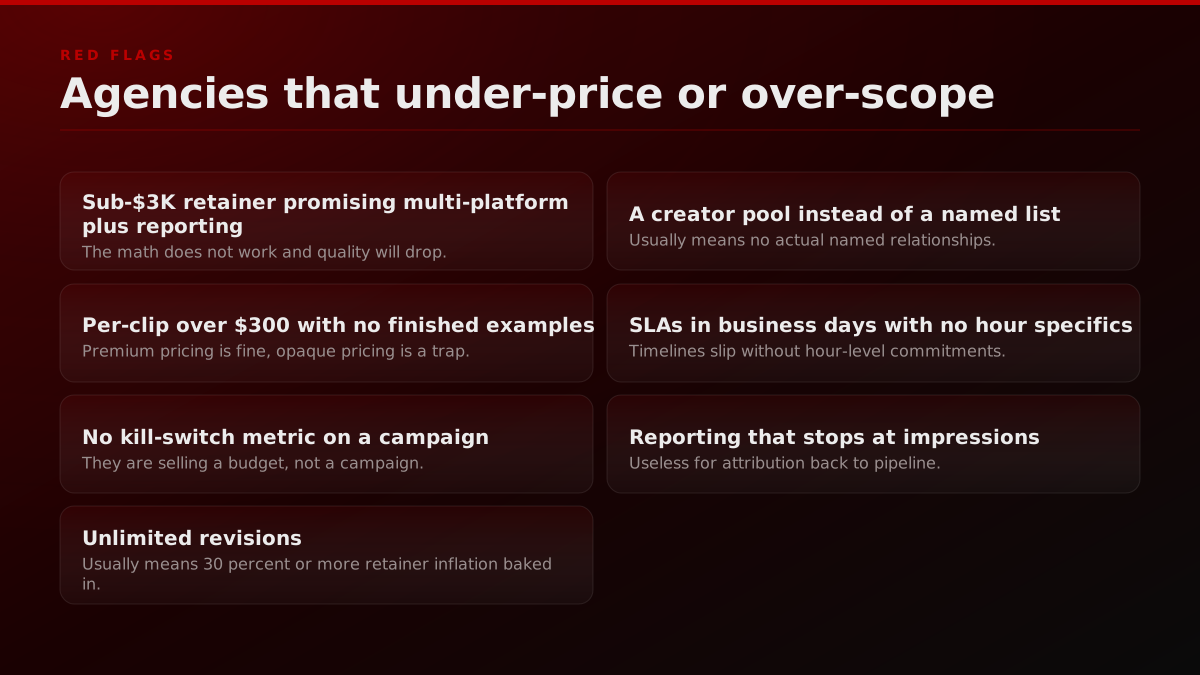
- Any retainer under $3,000 per month that promises weekly clips across more than one platform plus reporting. The math does not work, and quality will drop.
- Any per-clip rate over $300 where the agency will not show you three finished examples at that price band. Premium pricing is fine, opaque pricing is a trap.
- Any campaign pitch that refuses to commit to a kill-switch metric. If the agency cannot tell you at what interim number they will pause the spend, they are selling a budget, not a campaign.
Secondary flags to watch for:
- Unlimited revisions, which usually means 30%+ retainer inflation baked in.
- A creator "pool" instead of a named list, which usually means no actual named relationships.
- SLAs measured in business days without hour-level specifics, which usually slips.
- Reporting that stops at impressions, which is useless for attribution.
Operator noteA 2 to 3 round revision cap is standard. Unlimited revisions prices in 30%+ retainer inflation.
5 questions to ask before signing
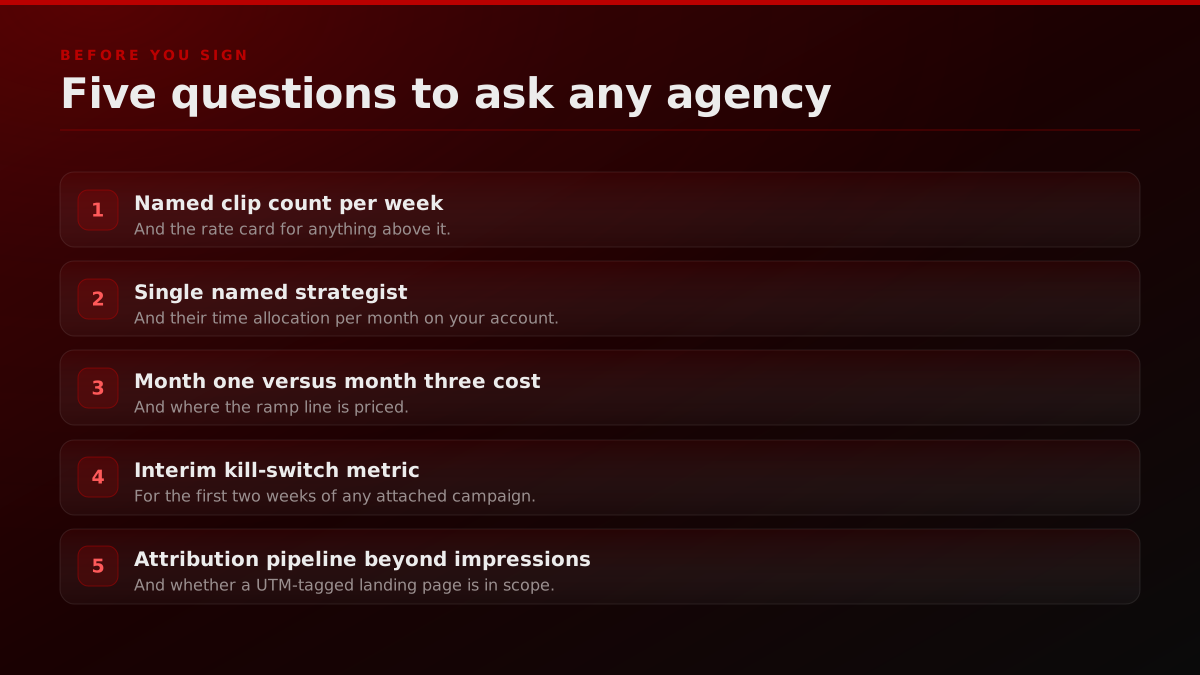
Here is the short script we give buyers before they sign anything. Ask these in order:
- 1. What is the named clip count per week, and what is the rate card for anything above it?
- 2. Who is the single named strategist on my account, and what is their time allocation per month?
- 3. What does month one cost versus month three, and where is the ramp line priced?
- 4. What is the interim kill-switch metric for the first two weeks of any campaign attached to this retainer?
- 5. What does the attribution pipeline look like beyond impressions, and is a UTM-tagged landing page in scope?
If the agency can answer all five without hedging, you have a shortlist of one. If they hedge on three or more, keep looking.
What do the biggest spenders pay for podcast clipping in 2026?
Context makes every pricing decision easier. The named spenders at the top of the market include Airrack (cited at $300,000 per month) and Zach Justice ($50,000 per month), both sourced from Opus Pro's case-study roundup. A mid-market retainer against a $50,000 ceiling is a small fraction of a top-tier creator's outlay, which is a sane place to start for a podcast in growth mode.
| Spender | Spend | Model | Output | Context |
|---|---|---|---|---|
| Hulu | $40,000 one-off | Campaign | 12M+ gained views | Single product push, broadcast-tier content |
| Zach Justice | $50,000 per month | Retainer | Full creator ops | Pre-Opus-Autopilot ceiling, solo creator |
| Airrack | $300,000 per month | Retainer plus network | Managed creator network | Category-top consumer spend |
| N3on | $1M+ cumulative | Bounty + per-view | Clipper economy at scale | Distributed pay-per-view model |
TBPN's 2026 run rate of $30M, disclosed in our coverage of the OpenAI x TBPN deal at /blog/clipping/the-clip-economy-openai-tbpn-200m, is built on this same clipping infrastructure scaled to the extreme.
These numbers are not targets, they are anchors. A mid-market retainer against a $50,000 ceiling is a small fraction of what the category leader spends. That is a sane place to start for a podcast in growth mode.
Operator noteEvery CPM band here is checked against the FORKOFF clipping network's 5B+ processed views., FORKOFF clipping network ledger, 2026
The anchoring also works in the other direction. If an agency quotes you $25,000 per month for a show shipping one episode a week to a five-figure audience, the Airrack benchmark should tell you that tier comes with a managed creator network and a dedicated ops team. You should be asking which of those pieces is actually in your scope.
Running the comparison against the /services/clipping line items is the fast version of this check.
One more useful reference point. Content Allies places B2B podcast budgets into four tiers and notes that most buyers under-allocate distribution relative to production. Production typically eats an estimated 70 to 80% of the budget in the first year, when it should be closer to 30 to 40%.
Clipping is distribution, not production. The correct allocation for a mature B2B show is to redirect budget from episode editing into clip editing, distribution, and reporting.
Most buyers get this upside down for 12 to 18 months before fixing it.
The bottom line
Podcast clipping agency pricing splits cleanly into three models in 2026. Retainer for cadence, per-clip for tests, campaign for bursts. Most B2B podcasts belong on a $3,000 to $8,000 per month retainer; most consumer brands launching belong on a $10,000 to $20,000 campaign with CPM accountability; a single operator testing a new show belongs on a $40 to $300 per-clip arrangement with a kill date.
Most B2B podcasts belong on a $3,000 to $8,000 per month retainer. Most consumer brands launching belong on a $10,000 to $20,000 campaign with CPM accountability. A single operator testing a new show belongs on a $40 to $300 per-clip arrangement with a kill date.
Pick the model that fits your cadence and goal, audit the cost breakdown against the $35-to-$135-per-clip editor floor, and benchmark against the named enterprise anchors so your number feels proportional. For the 3-lane cost-per-qualified-view ledger that drops in-house video editor and Opus Clip plus operator hours alongside the agency lane, see the clipping agency vs in-house editor vs Opus Clip CPQV ledger.
Ready to ship 20+ clips a week? FORKOFF runs managed clipping retainers, per-clip stretches, and one-off campaign bursts. Tell us your cadence and we will price it against the matrix above: forkoff.xyz/services/clipping?src=blog-end-clipping-pricing.
For an external operator view on this, see the Colin and Samir creator-economy channel for agency-pricing teardowns.