
FORKOFF Research · AI Citation Index · Measured 2026-05-19 · 5 engines · 250 measurements
AI Citation and LLM-SEOStatistics 2026
The statistics hub for how AI search engines and large language models choose what to cite. It leads with the FORKOFF AI Citation Index, a first-party benchmark recording a 34 percent average cite rate for forkoff.xyz across ChatGPT, Claude, Perplexity, Gemini, and Google AI Overviews, up from a 22 percent February baseline, then aggregates 40 externally sourced statistics from 20 named authorities.
Sample: 50 prompts across 5 engines for 250 prompt-surface measurements per run. Window: measured 2026-05-19, against the 2026-02-19 baseline, re-run quarterly. Collection: the FORKOFF GEO Audit and AI Search Visibility Checker, with every external figure traced to a named primary source.
34%
First-party cite rate
Average across 5 AI engines on a 50-prompt buyer-intent cluster (FORKOFF, May 2026).
58
Cited data points
18 first-party plus 40 aggregated, every one a number with a named source and year.
20
Named sources
Qwairy, Profound, Semrush, Ahrefs, Pew, Gartner, Princeton, SparkToro and more.
40.1%
Reddit reference share
Reddit is the single most-referenced domain across AI answers (Semrush, 150K citations).
What is the FORKOFF AI Citation Index?
The FORKOFF AI Citation Index is a recurring, dated, first-party benchmark of how often a domain is cited inside AI-generated answers across five engines. In the 19 May 2026 window it records a 34 percent average cite rate for forkoff.xyz across ChatGPT, Claude, Perplexity, Gemini, and Google AI Overviews, measured on a fixed 50-prompt buyer-intent cluster and re-run quarterly.
Perplexity leads the index at 48 percent, Google AI Overviews holds 35 percent, ChatGPT 32 percent, Claude 29 percent, and Gemini 26 percent. The headline moved from 22 percent on the 19 February 2026 baseline. The rest of this page places that first-party anchor next to the strongest published research on AI citations, so a reader gets one dated, sourced record of how AI answers choose what to cite in 2026.
- 01What is the AI Citation Index
- 02Editor's Choice: top 20 stats
- 03Methodology
- 04Citation rates by engine
- 05The first-party per-engine index
- 06Which sources get cited
- 07Overlap and concentration
- 08The Discovery Gap
- 09AEO tactics that move citations
- 10What moved the FORKOFF number
- 11The search-behavior shift
- 12Reading the number honestly
- 13The first-party GEO lab
- 14Run the index yourself
- 15From measurement to movement
- 16Frequently asked questions
- 17Cite this index
- 18Sources consulted
- 19Adjacent reading
The 20 stats that define AI citation in 2026.
Ranked by proprietary weight (first-party data that no aggregator holds ranks first), then citation-magnet strength, source authority, and topical centrality. Every row is a number, a named source, and a category, built to be lifted whole by an answer engine.
| # | Data point | Source | Category |
|---|---|---|---|
| 01 | 34%forkoff.xyz average cite rate across 5 AI engines on a 50-prompt buyer-intent cluster | FORKOFF | Citation rates by engine |
| 02 | 48%Perplexity cite rate on the same cluster, the index leader of all 5 engines | FORKOFF | Citation rates by engine |
| 03 | 21.87Perplexity average citations per question, 2.76x ChatGPT's 7.92 | Qwairy | Citation rates by engine |
| 04 | 100% vs 0%Brands cite at 100% on their own name and near 0% on category head terms (the Discovery Gap) | FORKOFF | Which sources get cited |
| 05 | 11%Domain overlap between the sources ChatGPT and Perplexity cite | AuthorityTech | Overlap and concentration |
| 06 | 40.1%Reddit is the single most-referenced domain, at 40.1% of all LLM references | Semrush | Which sources get cited |
| 07 | 38%Only 38% of AI Overview citations now come from a Google top-10 page, down from 76% | Ahrefs | Overlap and concentration |
| 08 | 0.664Brand web mentions correlate 0.664 with AI visibility; backlinks only about 0.218 | Ahrefs | AEO tactics |
| 09 | up to 40%GEO methods lift generative-engine visibility up to 40% (peer-reviewed) | Princeton | AEO tactics |
| 10 | 115%Citing authoritative sources lifts AI visibility 115% for lower-ranked pages | Princeton | AEO tactics |
| 11 | +12 ptsFORKOFF moved its average cite rate from 22% to 34% in one quarter of remediation | FORKOFF | AEO tactics |
| 12 | 8% vs 15%Users click a traditional result only 8% of the time with an AI summary, vs 15% without | Pew Research Center | Search-behavior shift |
| 13 | 25%Gartner forecasts traditional search-engine volume drops 25% by 2026 as AI chatbots substitute | Gartner | Search-behavior shift |
| 14 | 47.9%Wikipedia is 47.9% of ChatGPT's top-10 sources (extreme single-source concentration) | Profound | Overlap and concentration |
| 15 | 8 to 12Perplexity cites 8 to 12 distinct domains per answer; FORKOFF appears in about half | FORKOFF | Overlap and concentration |
| 16 | 58.5%58.5% of US Google searches ended without a click to the open web in 2024 | SparkToro + Datos | Search-behavior shift |
| 17 | 4.8%ChatGPT is the only major engine that cites Wikipedia meaningfully, at 4.8% vs about 0% elsewhere | Qwairy | Which sources get cited |
| 18 | 26.6% to 44.4%Google AI Overview coverage grew from 26.6% to 44.4% of queries across 9 industries | BrightEdge | Search-behavior shift |
| 19 | 14 of 5014 of 50 buyer-intent prompts returned zero citations on any engine (the discovery blanks) | FORKOFF | Citation rates by engine |
| 20 | 900MChatGPT reached about 900M weekly active users in Feb 2026, up from 400M a year earlier | OpenAI / Statista | Search-behavior shift |
Rows marked FORKOFF are first-party numbers from the two published FORKOFF studies linked in the methodology and the sources list. Every other row links to its named primary source. The full 58-stat pool, including the secondary bench, is grouped by category below.
How the index is measured, and how the aggregation is sourced.
The first-party sample, time window, and collection method are all named. Every external number carries a named source, a report title, and a year. Untraceable figures were excluded rather than laundered, which is the discipline that makes the hub citable.
- First-party sample
- 50-prompt buyer-intent cluster across 5 intent buckets (comparison, service definition, how-to, vendor selection, tooling), run against 5 engines, for 250 prompt-surface measurements per run.
- Engines
- ChatGPT, Claude, Perplexity, Gemini, and Google AI Overviews. Fresh session, US English, web access on where the surface supports it.
- Instruments
- The FORKOFF GEO Audit, the AI Search Visibility Checker, and the free AEO checker. A citation is logged when the domain or named entity appears in the engine response.
- Window and cadence
- Index window measured 2026-05-19, against the 2026-02-19 baseline. Re-run quarterly on the same cluster and engines. Next refresh scheduled 2026-08-19.
- Aggregation
- 40 external statistics from 20 named authorities. Each was traced to a primary named source with a report title and year; a figure with no traceable primary source was excluded.
- Denominators
- First-party single-domain cite rates and cross-web average rates are held apart on purpose, because they answer different questions. They are reconciled in a dedicated section, never blended.
Numbers are directional first-party estimates from a specific measurement window; individual outcomes vary by category, prompt set, and engine. A first-party figure is published only when it is genuinely measured, and the date advances only on a real re-run. External figures are reported as their named source published them.
The exclusion discipline is the part most aggregations skip, and it is where this hub earns its trust. Several widely-quoted AI-citation numbers were deliberately left out because they could not be traced to a single named primary study with a matching denominator. A commonly-cited claim that Perplexity averages 8.79 citations per response conflicts with the Qwairy 21.87 figure used here, so it was dropped rather than reconciled by guesswork. The recurring vendor claims that AI referral traffic grew by several hundred percent were excluded for the same reason: no traceable primary panel. Where a figure is real but confirmed through secondary reporting rather than a primary fetch, it is attributed to its named source and not elevated to a hard first-party claim. A number that cannot be sourced is left off the page, not laundered onto it.
Every engine cites at a different rate, and the gap is wide.
The first question buyers ask is which engine cites the most. Two independent methods, a first-party cite rate and an external citations-per-answer count, land on the same ranking with Perplexity in front.
On the FORKOFF index, Perplexity leads at a 48 percent cite rate, followed by Google AI Overviews at 35 percent, ChatGPT at 32 percent, Claude at 29 percent, and Gemini at 26 percent, for a 34 percent average. That ordering is not unique to FORKOFF's data. Qwairy's Q3 2025 study of 118,101 answers measured how many citations each engine emits per answer and found Perplexity averages 21.87 citations per question, about 2.76 times ChatGPT's 7.92. Google AI Overviews sits at 17.93, Gemini at 17.11, and Microsoft Copilot last at 2.47. The two methods measure different things, one a hit rate for a single domain and one a raw volume across all answers, yet they agree on which engines are generous with citations and which are stingy.
The mechanism is source-pool width. Perplexity live-indexes the web and surfaces the widest set of sources per answer, so a well-formed page clears its citation floor more often. Engines that answer from a narrower internal pool cite fewer domains, and a single domain has to fight harder to appear. This is why the same remediation work produced the largest first-party movement on Perplexity, plus 17 points between runs, and the smallest on Gemini, plus 7 points. The engine you are trying to earn a citation from determines both the ceiling and the lever that moves it.
The buyer takeaway is that an averaged AI-visibility number is close to meaningless. A 34 percent average hides a 22-point spread between the best and worst engine, and the spread on the open web is wider still. AuthorityTech's 21,143-citation audit measured a Perplexity brand cite rate near 13.05 percent against a ChatGPT rate near 0.59 percent, a 46 times gap on the same brands. Any credible measurement reports per engine, because the practical work of earning a citation differs by engine.
One caveat keeps the ranking honest. Citation volume is not the same as citation quality: Microsoft Copilot emits only 2.47 citations per answer and draws from just 111 distinct domains, which looks stingy, but a narrow, high-trust pool can be easier to enter for an already-authoritative brand than a wide pool where the same slot is contested by thousands of pages. The two Perplexity readings, a 48 percent first-party hit rate and 21.87 citations per answer, are consistent precisely because a wide pool plus a well-formed page produces frequent appearances. The takeaway for a buyer is to read cite rate and citation volume together: a high cite rate on a narrow-pool engine is a stronger signal than the same rate on a wide-pool engine, because the narrow engine had fewer slots to give away. This is why the index logs both the hit rate and the per-answer source count for every surface rather than collapsing them into a single visibility score.
Per-engine: first-party cite rate vs external citation volume
Perplexity leads on both the FORKOFF first-party cite rate and the Qwairy raw-citation-volume measure. Two independent methods, run on different samples with different denominators, agree on the ranking. Claude is absent from the Qwairy per-answer set, so only its FORKOFF cite rate is shown.
Sources: FORKOFF GEO Citation Lab Rerun 2026 (cite rate); Qwairy AI Citation Study Q3 2025, 118,101 answers (citations per answer).
Cite rate per AI engine, with the quarter-over-quarter delta.
Source: FORKOFF GEO Citation Lab, 50-prompt buyer-intent cluster run against 5 AI surfaces on 2026-05-19, versus the 2026-02-19 baseline. A citation is logged when the answer names forkoff.xyz.
← scroll horizontally to see more →
| Feature | AI engineMeasured on the FORKOFF 50-prompt buyer-intent cluster | Cite rate (index)2026-05-19 measurement window | Baseline2026-02-19 first run | DeltaPoints gained between runs |
|---|---|---|---|---|
| Perplexity | 48% | 31% | +17 pts | |
| Google AI Overviews | 35% | 23% | +12 pts | |
| ChatGPT | 32% | 18% | +14 pts | |
| Claude | 29% | 21% | +8 pts | |
| Gemini | 26% | 19% | +7 pts | |
| Average (index headline) | 34% | 22% | +12 pts |
Perplexity and Google AI Overviews cite the widest source pool per answer, so they moved the most between runs (plus 17 and plus 12 points). These surfaces rewarded structural readiness and comparison-content density fastest.
Claude at plus 8 points and Gemini at plus 7 points are the most conservative. Claude tracked entity-disambiguation and quote-ready sentence work; Gemini tracked schema-graph completeness. On these surfaces the schema and entity layer moves the number more than structural edits do.
External cross-check · citations per answer
← scroll horizontally to see more →
| Feature | AI engineQwairy Q3 2025, 118,101 answers | Citations per answerAverage, all queries | ReadHow wide the source pool is |
|---|---|---|---|
| Perplexity | 21.87 | Widest source pool per answer | |
| Google AI Overviews | 17.93 | Broad multi-source answers | |
| Gemini | 17.11 | Broad, but narrow unique-domain pool | |
| ChatGPT | 7.92 | Fewer, more concentrated sources | |
| Microsoft Copilot | 2.47 | Least generous, 111 unique domains |
Qwairy's per-engine volume, from 669,065 tracked citations across 118,101 answers, is the definitive external cross-check on the first-party ranking. Both methods put Perplexity first and the more conservative chat surfaces behind it.
AI answers run on Reddit, Wikipedia, and YouTube, not brand blogs.
If citation rate is the how-often, source mix is the from-where. The pattern is consistent across every large study: user-generated content and encyclopedias dominate, and the mix shifts sharply by engine.
Semrush's study of 150,000 AI citations found Reddit is the single most-referenced domain at 40.1 percent of all LLM references, ahead of Wikipedia at 26.3 percent and YouTube at 23.5 percent. The same finding was reported independently by Search Engine Land. Engines lean on user-generated content because forum threads and video transcripts capture first-hand experience that reads as authentic, and because that content is dense with the natural-language phrasing a model matches against a query. A polished brand blog, by contrast, reads as marketing and gets discounted.
The mix is not uniform across engines. Profound's analysis of 680 million citations found Wikipedia is 47.9 percent of ChatGPT's top-10 sources while Reddit is 46.7 percent of Perplexity's top-10 sources, so the two leading engines lean on almost opposite anchors. Overall, Wikipedia is 7.8 percent of all ChatGPT citations and Reddit is 6.6 percent of all Perplexity citations. Qwairy adds the sharpest per-engine contrast: ChatGPT is the only major engine that cites Wikipedia meaningfully, at 4.8 percent of answers, versus about 0 percent elsewhere. Profound also found 80.41 percent of ChatGPT's cited URLs end in .com, so commercial sources are not shut out, they are simply outweighed by the community and reference giants.
For an operator the implication is concrete. Being present where the engines already read, a credible Reddit footprint, a Wikipedia entity, a YouTube presence, and third-party mentions, matters more than publishing another owned post. The FORKOFF Discovery Gap finding sharpens this: a brand cites at 100 percent on its own name and near 0 percent on the category, because the category answer is assembled from those aggregators and not from the brand's site. Winning the category means being cited inside the sources the engine already trusts.
The obvious over-reading of these numbers deserves a caution. That Reddit is 40.1 percent of references does not mean a brand should spam Reddit; low-effort promotional threads are exactly what moderators remove and what engines learn to discount. The signal an engine rewards is a genuine, upvoted, answer-shaped discussion that a retrieval system can lift as a self-contained response. The same logic applies to the .com share: Profound's 80.41 percent commercial-URL figure for ChatGPT shows brand sites are read, so the lesson is not to abandon owned content but to make it liftable, structured, sourced, and quotable, so it can sit alongside the community and reference giants rather than be discounted beneath them. A page that reads like a neutral, well-cited reference clears the bar; a page that reads like a brochure does not, regardless of which domain hosts it.
Which sources get cited: most-referenced domains
AI answers run on user-generated content and encyclopedias, not brand blogs. Reddit is the single most-referenced domain. Shares sum above 100 percent because one citation is counted across every engine that used it, so read each as a share of all LLM references, not a slice of a pie.
Source: Semrush AI Search Visibility Study 2025, 150,000 citations across 5,000 keywords.
The engines read the same web and cite almost disjoint sets.
Two facts sit in tension and both are true: AI citations are highly concentrated on a few domains, and the engines barely agree on which domains those are. Together they explain why per-engine measurement is mandatory.
Start with disagreement. AuthorityTech found only 11 percent of cited domains overlap between ChatGPT and Perplexity, even though both crawl the same open web. Ahrefs found only 12 percent of AI-cited URLs rank in Google's top 10 for the original prompt. So the set of pages an engine cites is largely its own, and it is largely decoupled from classic search rankings. A domain optimized for one engine can be invisible on another, which is the whole argument for measuring each surface separately.
Now concentration. Within any single engine the citations pile onto a handful of domains. Profound measured Wikipedia at 47.9 percent of ChatGPT's top-10 sources and Reddit at 46.7 percent of Perplexity's top-10. Ahrefs found the top 50 brands take 28.9 percent of all AI Overview citations. Qwairy's unique-domain counts show the same skew from the other side: ChatGPT drew from 42,592 distinct domains while Microsoft Copilot drew from just 111, a near-total concentration on that engine. The FORKOFF first-party read matches the shape: Perplexity cites 8 to 12 distinct domains per answer and FORKOFF appears in about half of them, while Gemini's median is 3 distinct domains, the narrowest pool of the five.
The synthesis is that AI citation is a concentrated, per-engine game of a few slots. Ahrefs' finding that only 38 percent of AI Overview citations now come from a Google top-10 page, down from 76 percent, confirms the slots are opening up to sources beyond the classic winners. The opportunity is real but narrow: on each engine there are only a few cited positions per answer, they are not the same positions across engines, and winning one does not win the others.
There is a strategic reading of the decoupling that matters more than the headline. When only 12 percent of AI-cited URLs also rank in Google's top 10, and the top-10 share of AI Overview citations has fallen from 76 percent to 38 percent, a page that cannot win the classic SERP still has a path to the answer box. The concentration cuts both ways: the top 50 brands hold 28.9 percent of AI Overview citations, which is a moat for incumbents, but the other 71 percent is spread across a long tail that a focused, well-sourced page can enter without out-ranking a giant on the blue links. That is the opening a challenger plays for. The discipline is to pick the two or three engines that matter for a category, measure each on its own scorecard, and win the specific slots that engine gives, rather than chase an averaged visibility number that no single answer box ever produces.
ChatGPT and Perplexity domain overlap
AuthorityTech
Unique domains: ChatGPT vs Copilot
Qwairy
Top-50 brands' share of AIO citations
Ahrefs
Concentration: the two leading engines cite opposite anchors
Within a single engine the citations pile onto a handful of domains, yet the two leading engines barely agree on which. ChatGPT leans on Wikipedia at 47.9 percent of its top-10 sources while Perplexity leans on Reddit at 46.7 percent of its top-10, and the top-50 brands alone hold 28.9 percent of every AI Overview citation. Concentrated, and per-engine disjoint, which is why an averaged source-mix describes no engine.
Sources: Profound AI Platform Citation Patterns, 680M citations (top-10 shares); Ahrefs AI SEO Statistics 2025 (top-50 brand share).
AI citation is decoupling from Google's rankings
The share of AI Overview citations coming from a Google top-10 page fell from 76 percent to 38 percent between the 2025 and 2026 studies, across 863,000 SERPs and 4 million AI Overview URLs. Only 12 percent of AI-cited URLs rank in Google's top 10 at all. A page can rank first and still earn zero AI citations, which is why answer engine optimization is a parallel discipline to classic SEO, not a subset of it.
Source: Ahrefs, 38% of AI Overview Citations Pull From The Top 10, 863K SERPs / 4M AI Overview URLs, 2025 to 2026.
100% on your own name. 0% on the category.
Measured through the FORKOFF AI Search Visibility Checker: 12 paired query sets across 4 engines, 48 datapoints. The branded number measures retention; the head-term number measures discovery. The index tracks both so a high branded score never hides a zero discovery score.
The Discovery Gap is the single most counter-intuitive finding in the first-party data, and it reframes the whole category. When a query names the brand, the kind a customer types after they have already heard of you, the engine cites the brand at 100 percent across ChatGPT, Claude, Gemini, and Perplexity, because it trained on the brand's own site. When a query is a category head term, the kind a stranger types to find a vendor, the same engines cite the brand at near 0 percent, because they answer the category with aggregators, review platforms, and competitors.
This is why a brand can feel visible in AI and still be undiscovered. A founder tests the engine with their own name, sees a glowing, accurate answer, and concludes AI search is handled. The test measured retention, not discovery. The gap shape repeats on every brand FORKOFF audits, at varying scales, and it is invisible unless the branded and head-term queries are measured as a matched pair. Of the 50 buyer-intent prompts in the index cluster, 14 returned zero citations on any engine, and those blanks cluster on exactly the head-term and tooling queries where discovery, not retention, is at stake.
The fix is not more owned content about yourself, because that moves 100 to 100 for zero discovery lift. The fix is earning presence inside the sources the engine consults for the category: third-party mentions, comparison and listicle placements, community threads, and the entity and schema work that lets the engine connect the brand to the category in the first place. The full study, including the three-lever fix, is the companion dataset linked below.
The Discovery Gap also explains why so much AI-visibility advice disappoints. Advice that optimizes the owned site, better meta, cleaner headings, more FAQ blocks, tends to lift the branded number that was already near 100 percent, so it feels productive and changes nothing on the query that actually acquires customers. The 14 of 50 index prompts that returned zero citations on any engine are the measurable shape of that trap: they cluster on the category and tooling questions a buyer types before they know the brand exists, the exact queries owned-content work cannot reach. Reading the gap correctly reorders the whole budget. It moves spend away from publishing more about yourself and toward earning citations inside the aggregators, comparisons, and communities the engine assembles a category answer from, which is where a stranger first meets the brand.
The Discovery Gap: retention is not discovery
Every audited brand cites near 100 percent on its own name and near 0 percent on its category head term, across all four engines measured. The branded number measures retention (the engine trained on the brand site); the head-term number measures discovery (the engine answers the category with aggregators and competitors). Writing more About-page copy moves 100 to 100: zero discovery lift.
Source: FORKOFF The Discovery Gap 2026, 12 paired query sets across 4 engines, 48 datapoints.
The full Discovery Gap study lives at the Discovery Gap research page. It is the companion first-party dataset to this index.
Mentions and structure beat backlinks, and the research agrees.
The most useful stats are the ones that tell you what to do. Two independent bodies of evidence, a peer-reviewed experiment and a 75,000-brand correlation study, point at the same levers.
Ahrefs studied 75,000 brands and found that brand web mentions correlate 0.664 with AI visibility while backlinks correlate only about 0.218, and YouTube mentions correlate 0.737 with ChatGPT brand visibility, the single strongest factor measured. Domain Rating, the classic authority metric, correlates a weak 0.326. The direction is unambiguous: for AI visibility, being mentioned across the web out-predicts being linked to. Ahrefs also found brands in the top mention quartile earn 10 times more AI Overview mentions than the next quartile.
Princeton's peer-reviewed GEO study (KDD 2024) ran controlled experiments on what changes to a page move its generative-engine visibility, and ranked the levers by measured impact: citing authoritative sources lifts visibility 115 percent for lower-ranked pages, adding statistics lifts it 41 percent, and adding expert quotations lifts it 28 percent, with GEO methods together lifting visibility up to 40 percent. Ahrefs separately measured that AI Overview content skews 25.7 percent fresher than content cited in traditional organic results, so recency is a lever in its own right.
These are not two unrelated lists. The correlation study says the highest-impact off-site signal is being mentioned and quoted across authoritative sources, and the experiment says the highest-impact on-page change is citing authoritative sources and packing verifiable statistics into the content. Both point at the same underlying behavior: engines reward content that reads as well-sourced and entity-connected, and they reward brands the broader web already talks about. That is the design brief for a page built to be cited, and it is the brief this hub follows.
A correlation is not a guarantee, and the honest reading matters. A 0.664 correlation between brand mentions and AI visibility does not mean mentions alone cause citations; large, well-mentioned brands also tend to have better content, stronger entities, and more of everything, so some of the signal is confounded. What makes the conclusion durable is that the observational study and the controlled Princeton experiment converge from different directions: the experiment isolates causation by changing one page at a time and still finds authoritative sourcing worth up to a 115 percent lift, and the correlation study finds the same lever dominates at scale across 75,000 brands. When a controlled test and a large field study point at the same lever, the recommendation is safe to act on. The weak backlink correlation of about 0.218 is the useful negative result: it does not say links are worthless for classic SEO, it says they are the wrong first place to spend for AI visibility.
What moves the number: AEO levers, two-source
A peer-reviewed experiment and a 75,000-brand correlation study agree. Citing authoritative sources and structuring content around statistics produce the largest generative-engine visibility lifts, and off-site brand mentions out-predict backlinks by roughly three to one for AI visibility.
Sources: Princeton GEO, KDD 2024 (visibility lift); Ahrefs Top Brand Visibility Factors, 75,000 brands 2025 (correlation r).
The plus-12-point lift, mapped to four weeks of work.
The published research predicts which levers work. The first-party deltas show them working on a single domain, on a dated before-and-after.
Between the 19 February baseline and the 19 May index, forkoff.xyz moved its average cite rate from 22 percent to 34 percent, a 12-point gain. The movement was not uniform. Perplexity gained 17 points and ChatGPT gained 14, the two wide-pool surfaces, where source-citation and stat-density work paid off fastest. Claude gained 8 points and Gemini 7, where the gains tracked entity-disambiguation and schema-graph completeness rather than raw structural edits. That split lines up cleanly with the Princeton ranking: the levers that lift lower-ranked pages most, authoritative sourcing and statistics, moved the surfaces with the widest source pools most.
The five patterns behind the lift were structural readiness (llms.txt, agent-readable manifests, and crawler access), a stat-density floor of 3 to 5 verifiable statistics per 1,000 words, quote-ready standalone sentences an engine can lift without rewriting, comparison-content density, and entity consistency across the site. The full method, the 250-cell matrix, and the remediation queue are documented in the GEO Citation Lab rerun that this index consolidates, and the measurement framework is in how to measure share of AI citations.
The sequencing is the part most teams get wrong. The wide-pool surfaces move first because they have the most slots to give and the lowest bar to clear, so structural and stat-density work shows up in Perplexity and ChatGPT within a single re-run. The conservative surfaces lag because their gains depend on entity and schema signals that take longer to propagate and verify, which is why Claude and Gemini moved 8 and 7 points while the wide-pool surfaces moved 17 and 14. A team that judges the program by the Gemini number after four weeks will conclude it failed; a team that reads the per-engine deltas will see the levers working exactly where the research says they should and know the conservative surfaces are a slower, schema-driven track rather than a lost cause. That is the case for measuring on a fixed cadence instead of a single snapshot: the shape of the movement, not just its size, tells you which lever to fund next.
Why the citation is now the click that matters.
AI answers do not just change where citations come from, they change whether anyone clicks at all. The macro data explains why earning the citation is becoming the whole game.
Pew Research studied real browsing behavior and found that when an AI summary appears in Google results, users click a traditional result only 8 percent of the time, versus 15 percent without a summary, and they click a link inside the summary just 1 percent of the time. About 18 percent of US Google searches in March 2025 already produced an AI summary. Ahrefs measured a 34.5 percent click reduction when an AI Overview is present. The click that used to reward a top ranking is being absorbed by the answer itself.
This did not start with AI. SparkToro and Datos found that 58.5 percent of US Google searches already ended without a click to the open web in 2024, so the zero-click search was the baseline the AI era is now accelerating. Gartner forecasts that traditional search-engine volume will fall 25 percent by 2026 as AI chatbots and virtual agents become substitute answer engines, and BrightEdge tracked Google AI Overview coverage growing from 26.6 percent to 44.4 percent of queries across nine industries between May 2024 and September 2025. The surface is expanding, not plateauing.
There is a counter-signal worth holding: the traffic that does come through AI search converts. Ahrefs reported that AI-search visitors convert about 23 times better than traditional organic visitors, despite AI search being roughly 0.5 percent of traffic today, because a user who arrives after an AI answer has already been pre-qualified by it. Meanwhile the audience keeps scaling: ChatGPT reached about 900 million weekly active users in February 2026, up from 400 million a year earlier. Fewer clicks, higher intent, a bigger surface. The rational response is to compete for the citation, because the citation is what the user now sees.
The strategic conclusion is not that clicks disappear but that their value concentrates. If an AI summary answers the low-intent questions in the answer box, the clicks that still happen are the ones from users who need more than a summary, and those users convert at the 23-times rate Ahrefs measured. A brand that earns the citation wins twice: it is named inside the answer the majority read without clicking, and it captures the smaller, higher-intent stream that does click. A brand that is absent from the citation loses both, and it loses them on a surface that is still growing, from 26.6 percent to 44.4 percent AI Overview coverage and toward a 900-million-user chat audience. That asymmetry, most of the visibility with none of the click for those who stay in the answer, plus the best of the clicks for those who leave it, is why the citation rate, not the ranking, is the number this index tracks.
Click rate with vs without AI summary
Pew
Click reduction with an AI Overview
Ahrefs
US searches ending zero-click, 2024
SparkToro
Forecast search-volume drop by 2026
Gartner
Why 48% here and 13% cross-web are both correct.
A first-party single-domain cluster and a cross-web average are different denominators. The index reports the first; public benchmarks report the second. Held apart, they agree.
The index Perplexity figure of 48 percent is a first-party number: it is forkoff.xyz measured on a targeted, remediated 50-prompt buyer-intent cluster. The AuthorityTech analysis of 21,143 citations measured a Perplexity brand cite rate near 13.05 percent and a ChatGPT brand cite rate near 0.59 percent across the general web, a 46 times per-engine spread with only 11 percent domain overlap between the two engines.
These are not in tension. A single domain that ran the remediation on a high-intent cluster sits well above a cross-web average taken across every brand and every query shape. The index reports the narrow, first-party denominator on purpose, because that is the number an operator can actually move. The cross-web benchmark is the backdrop it sits against. Averaging a Perplexity rate with a ChatGPT rate produces a middle number that describes neither engine, which is why the index reports every surface separately.
A worked example
Picture two analysts reporting Perplexity. The first runs a remediated 50-prompt buyer-intent cluster for one domain and finds it cited on 48 percent of prompts. The second samples 21,143 citations across thousands of brands and every query shape and finds the average brand cited near 13.05 percent. Neither is wrong, and neither should be averaged into the other. The first answers what can a focused domain achieve on high-intent queries; the second answers what does a typical brand achieve across the whole web. Quote them together and the picture is complete: a remediated page on the right queries clears the cross-web mean by a wide margin, which is exactly the gap the optimization work is paid to open.
The cross-web denominator: 13.05% vs 0.59% on the same brands
The index Perplexity figure of 48 percent is one remediated domain on a high-intent cluster. The AuthorityTech analysis of 21,143 citations measures the average brand across the open web: 13.05 percent on Perplexity against 0.59 percent on ChatGPT, a 46 times per-engine spread with only 11 percent domain overlap. Different denominators, both correct, and never averaged into a middle number that describes neither engine.
Source: AuthorityTech, AI Citation 11% Platform Overlap Audit, 21,143 citations, 2026.
A dated, quarterly, single-domain, 5-engine time series.
What makes this hub citable is not the aggregation, which anyone can assemble. It is the proprietary dataset at its center: a named method that produces un-hallucinable first-party numbers on a fixed cadence.
Prompt-surface measurements per run
50 prompts across 5 engines, logged as a full matrix every quarter.
Datapoints per Discovery Gap audit
12 paired branded-versus-head-term query sets across 4 engines.
Analyst time to re-run the full cluster
Once the cluster is built, the quarterly re-run is cheap, so the cadence holds.
An aggregated statistics page can be reproduced by any competitor with a search engine. A dated first-party time series cannot, because the number exists only because FORKOFF measured it. That is what an answer engine has to attribute, and it is why the index leads the hub rather than closing it.
The economics are what make the cadence credible. Once the 50-prompt cluster is built, a full re-run across five engines takes about four hours of analyst time, so the quarterly refresh is cheap enough to actually happen rather than slip. That matters because freshness is itself a citation signal: Ahrefs measured AI Overview content skewing 25.7 percent fresher than traditionally-ranked content, so a stale benchmark degrades its own trust case at the same time its numbers go out of date. A dated method with a low re-run cost is therefore not just a research nicety, it is the mechanism that keeps the asset citable over time, and it is the same discipline any operator can copy: freeze the cluster, run it on a calendar, and publish the delta.
The three tools the index runs on.
Every first-party number here is produced by a public FORKOFF instrument. Run them on your own domain to reproduce the method.
AEO Checker · page readiness
Scores answer-capsule readiness and AI Overview eligibility for a page. The fastest read on whether an engine can lift your content.
AEO Checker · agent readiness
Runs the generative-engine citation check on your domain across the same surfaces the index measures. No signup, results in your browser.
AEO Checker · AI citations
Returns your per-engine branded-versus-head-term gap, the exact instrument behind the Discovery Gap finding in this index.
The four services that move the index number.
The stats above prove three things: AI answers now mediate discovery, they cite a concentrated and per-engine-disjoint set of sources, and most brands are invisible on their own category. The work of fixing that runs as separate tracks, and the index tells you which to fund first.
Answer Engine Optimization
The umbrella program: answer capsules, schema, and structural readiness that lift the average cite rate across all five engines.
Generative Engine Optimization
The 50-prompt cluster build, per-surface baseline, four-week remediation, and quarterly rerun cadence delivered as one engagement.
LLM SEO
Targets the training-data-and-retrieval surfaces (ChatGPT, Gemini, Claude) where entity and schema work moves the conservative numbers.
Perplexity SEO
Targets the live-index surface that leads the index at 48 percent, where source-pool width and freshness compound fastest.
Run the index on your domain
Get your own per-engine citation baseline.
FORKOFF ships the 50-prompt cluster build, the per-engine baseline, and the quarterly rerun as one outcome-priced engagement. Bring your category; we bring the method behind this index.
Frequently asked questions
What is the average AI citation rate across engines?
On the FORKOFF AI Citation Index, a 50-prompt buyer-intent cluster run against 5 engines in the 19 May 2026 window, the average cite rate for a single remediated domain is 34 percent, ranging from 48 percent on Perplexity to 26 percent on Gemini. Across the open web the rate is far lower and more uneven: the AuthorityTech analysis of 21,143 citations measured brand cite rates of about 13.05 percent on Perplexity and 0.59 percent on ChatGPT, a 46x spread. Both readings are correct because they use different denominators. The 34 percent is one domain that ran the remediation on a high-intent cluster; the cross-web figure averages every brand and every query shape.
Which AI engine cites the most sources?
Perplexity. Qwairy's Q3 2025 study of 118,101 answers found Perplexity averages 21.87 citations per question, versus 17.93 for Google AI Overviews, 17.11 for Gemini, 7.92 for ChatGPT, and 2.47 for Microsoft Copilot. Perplexity live-indexes the web and surfaces the widest source pool per answer, so a well-formed page clears its citation floor more often. This is why Perplexity also leads the FORKOFF first-party index at 48 percent: the two independent methods agree on the ranking.
What is the most-cited source in AI answers?
Reddit. Semrush's analysis of 150,000 AI citations found Reddit accounts for 40.1 percent of all LLM references, ahead of Wikipedia at 26.3 percent and YouTube at 23.5 percent. AI engines lean on user-generated content because it captures authentic first-hand discussion. Wikipedia still dominates a single engine: it is 47.9 percent of ChatGPT's top-10 sources per Profound's 680 million-citation study, and ChatGPT is the only major engine that cites Wikipedia meaningfully, at 4.8 percent of answers versus about 0 percent elsewhere.
Do different AI engines cite the same sources?
No. AuthorityTech found only 11 percent of cited domains overlap between ChatGPT and Perplexity, even though both read the same web. Ahrefs found only 12 percent of AI-cited URLs rank in Google's top 10 for the original prompt. The practical rule: measure each engine as a separate channel with its own scorecard, because an averaged number describes no engine. FORKOFF reports every surface separately for exactly this reason.
What actually moves a page's AI citation rate?
Off-site brand signals and content structure, not backlinks. Ahrefs' 75,000-brand study found brand web mentions correlate 0.664 with AI visibility while backlinks correlate only about 0.218, and brands in the top mention quartile earn 10x more AI Overview mentions. Princeton's peer-reviewed GEO study (KDD 2024) found citing authoritative sources lifts visibility 115 percent for lower-ranked pages, adding statistics 41 percent, and expert quotations 28 percent, with GEO methods together lifting visibility up to 40 percent.
Can you improve your AI citation rate, and how fast?
Yes, and it is measurable within a quarter. FORKOFF moved its own average cite rate from 22 percent to 34 percent, a 12-point gain, in four weeks of remediation between two dated runs, with Perplexity moving plus 17 points and ChatGPT plus 14. The levers were structural readiness (llms.txt, agent-readable manifests, crawler access), a stat-density floor of 3 to 5 verifiable statistics per 1,000 words, quote-ready sentences, comparison-content density, and entity consistency.
Why do brands cite at 100% on their own name but 0% on their category?
This is the Discovery Gap. FORKOFF measured it across ChatGPT, Claude, Gemini, and Perplexity: branded queries (naming the brand) cite the brand at 100 percent because the engine trained on the brand's own site, while category head terms (best AI marketing agency) cite the brand at near 0 percent because the engine answers with aggregators, review platforms, and competitors. The branded number measures retention; the head-term number measures discovery. Writing more About-page content moves 100 to 100: zero lift.
How much is AI search reducing clicks to websites?
Substantially. Pew Research found users click a traditional result only 8 percent of the time when an AI summary appears, versus 15 percent without one, and click a link inside the summary just 1 percent of the time. Ahrefs measured a 34.5 percent click reduction when an AI Overview is present. SparkToro and Datos found 58.5 percent of US Google searches already ended without a click in 2024, and Gartner forecasts traditional search-engine volume will fall 25 percent by 2026 as AI chatbots become substitute answer engines.
Are AI Overviews still tied to Google's organic rankings?
Decreasingly. Ahrefs found the share of AI Overview citations coming from a Google top-10 page fell from 76 percent to 38 percent between its 2025 and 2026 studies, across 863,000 SERPs and 4 million AI Overview URLs. AI citation is decoupling from classic ranking, which is why a page can rank first and still earn zero AI citations, and why answer engine optimization is a parallel discipline to SEO rather than a subset of it.
How should you measure your own AI citation rate?
Freeze a prompt set of 30 to 60 buyer-intent queries, run each against every engine you care about, and log per-engine cite rate, mention rate, and share of voice separately, on a fixed cadence. FORKOFF runs a fixed 50-prompt cluster against 5 engines quarterly, producing 250 prompt-surface measurements per run in about 4 hours of analyst time once the cluster is built. The cadence, not the single snapshot, is what tells you whether remediation worked.
Cite this index.
Stable for journalist, academic, and AI-engine citation. APA and BibTeX below.
FORKOFF Research. (2026). AI Citation and LLM-SEO Statistics 2026: Per-engine citation rates across five AI surfaces. FORKOFF. https://forkoff.xyz/research/ai-citation-index-2026
@misc{forkoff_ai_citation_index_2026,
  author = {FORKOFF Research},
  title  = {AI Citation and LLM-SEO Statistics 2026},
  year   = {2026},
  url    = {https://forkoff.xyz/research/ai-citation-index-2026},
  note   = {5 AI engines, 50-prompt cluster, 250 measurements, index window 2026-05-19}
}Every stat traces to a named source.
First-party FORKOFF data leads; the aggregation draws on the strongest published research on AI citations. Each source below is named with its study and year, and linked.
| Source | Study and sample | Year |
|---|---|---|
| FORKOFF Research | GEO Citation Lab Rerun, 50 prompts x 5 surfaces = 250 measurements | 2026 |
| FORKOFF Research | The Discovery Gap, 12 paired sets x 4 engines = 48 datapoints | 2026 |
| Qwairy | AI Citation Study Q3 2025, 118,101 answers / 669,065 citations | 2025 |
| Profound | AI Platform Citation Patterns, 680M citations | 2025 |
| Semrush | AI Search Visibility Study, 150,000 citations / 5,000 keywords | 2025 |
| Semrush | The Most-Cited Domains in AI, 100M+ citations / 230K+ prompts | 2025 |
| Ahrefs | Top Brand Visibility Factors, 75,000 brands studied | 2025 |
| Ahrefs | 38% of AI Overview Citations Pull From The Top 10, 863K SERPs | 2026 |
| Ahrefs | 90+ AI SEO Statistics, first-party clickstream + index | 2025 |
| Ahrefs | AI Search Overlap Study, AI-cited URL vs top-10 rank | 2025 |
| Ahrefs | AI Overview Brand Correlation, mention-quartile multiplier | 2025 |
| Pew Research Center | Google AI summary click study, 900 US adults + browsing data | 2025 |
| Gartner | Search Engine Volume Will Drop 25% by 2026, analyst forecast | 2024 |
| Princeton (Aggarwal et al.) | GEO: Generative Engine Optimization, GEO-bench (KDD) | 2024 |
| BrightEdge | Weekly AI Search Insights, 9-industry coverage panel | 2025 |
| SparkToro + Datos | 2024 Zero-Click Search Study, multi-million-device clickstream | 2024 |
| AuthorityTech | AI Citation 11% Platform Overlap Audit, 21,143 citations | 2026 |
| Search Engine Land | AI search engines cite Reddit, YouTube, LinkedIn most | 2025 |
| Search Engine Journal | AI Overview citations from top-ranking pages drop sharply | 2026 |
| OpenAI / Statista | ChatGPT weekly active users report | 2026 |
| AI Overviews documentation, sourcing mechanism | 2025 | |
| Visual Capitalist | Ranked: The Most-Cited Websites by AI Models | 2025 |
The rest of the AI-SEO record.
This index is the source-of-record the AI-SEO cluster cites. Here is the cluster it anchors.
- The AI-SEO blog cluster, the explainer hub on how AI engines rank and cite, each post carrying a datapoint from this index.
- Answer Engine Optimization playbook 2026, the operator pillar that funnels to all four services.
- RADAR Launch Authenticity Report 2026, the sibling first-party data asset, reading whether viral launch reach was earned or amplified.
- The Discovery Gap research, the companion dataset behind the branded-versus-head-term finding in this index.
Measure the citation rate.
Then move it.
FORKOFF built the agent-readiness and AI citation checks in the AEO Checker to produce this index. Run them on your own domain for a per-engine baseline, then run the generative engine optimization engagement to move the number. Owning the method is the authority claim; the per-engine baseline is the call to action.
Authorship
Kartik Chugh (Simba)
Cofounder, FORKOFF
Reviewed by: Kshitij JK
Last reviewed:
Published:
Methodology
The FORKOFF AI Citation Index is measured by running a fixed 50-prompt buyer-intent cluster against five AI engines (ChatGPT, Claude, Perplexity, Gemini, Google AI Overviews) via the FORKOFF GEO Audit and AI Search Visibility Checker, then computing per-engine and average citation rates for the domain under test. The index window was measured 2026-05-19 against a 2026-02-19 baseline and re-runs quarterly. The paired Discovery Gap finding runs 12 branded-versus-head-term query sets across 4 engines. The aggregation layer adds 40 externally sourced statistics, each traced to a named primary source with a report title and year; untraceable figures were excluded. Cross-web reconciliation uses the AuthorityTech 21,143-citation analysis and the Princeton GEO citation-analysis framework (KDD 2024).
Sources cited
- GEO Citation Lab rerun 2026 (first-party source) , FORKOFF
- The Discovery Gap, AI Search Visibility 2026 (first-party source) , FORKOFF
- Qwairy: AI Citation Study Q3 2025 (118,101 answers) , Qwairy 2025
- Semrush: AI Search Visibility Study (150K citations) , Semrush 2025
- Ahrefs: Top Brand Visibility Factors (75,000 brands) , Ahrefs 2025
- Pew Research Center: Google AI summary click study , Pew 2025
- Gartner: search-engine volume drops 25% by 2026 , Gartner 2024
- Princeton GEO: Generative Engine Optimization , arXiv KDD 2024
- Google AI Overviews documentation , Google
Have a question about this index methodology, or need help calibrating against your campaign data? Book a 30-min strategist call
Receipts, deep dives, and playbooks.
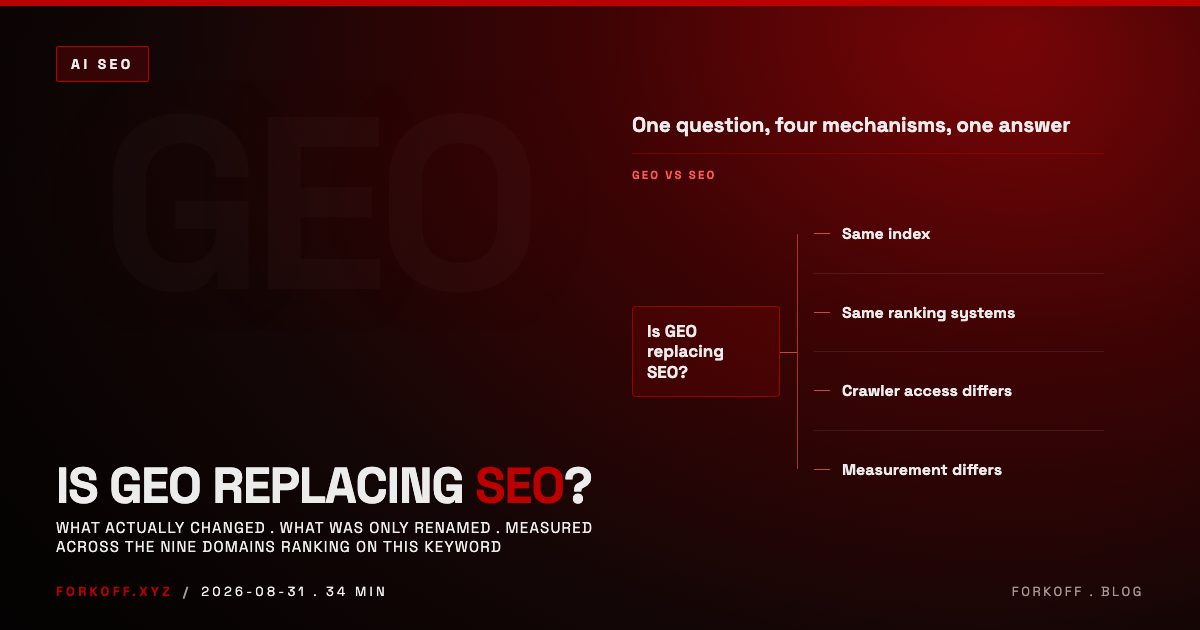
Is GEO Replacing SEO? What Actually Changed, and What Did Not
GEO is not replacing SEO. Here is what genuinely changed, what was only renamed, and measured crawler data on whether the two visibilities differ.
 Read
Read
AI SEO Agency vs AI SEO Software: Build, Buy, or Hire in 2026
AI SEO agency vs AI SEO software, decided with real Reddit AMA retainer figures, published tool pricing, and a stage-by-stage framework.
Read
Best AEO Agencies for AI and SaaS Startups in 2026
9 real AEO agencies for AI and SaaS startups: real disclosed pricing where it exists, platform coverage, and the checklist that spots a relabeled SEO shop.
Read