

Cold outreach cadence playbook D1 D3 D5 D7 D9 D11.
Six touches across 11 days. Open-rate floor of 45 percent by touch four. Reply-rate floor of 3 percent by touch six. The exact cadence FORKOFF runs across LinkedIn, email, and Twitter for founder funnel engagements.
- 01TL;DR
- 02Why D1 / D3 / D5 / D7 / D9 / D11
- 03Touch 1 · D1 · The signal opener
- 04Touch 2 · D3 · The angle pivot
- 05Touch 5 · D5 · The receipt drop
- 06Touch 4 · D7 · The bump
- 07Touch 5 · D9 · The cross-channel ping
- 08Touch 6 · D11 · The breakup
- 09Copy rules
- 10Tooling stack
- 11Open-rate benchmarks
- 12Response thresholds and abandon rules
- 13Apply for the engagement
A cold outreach cadence is a structured multi-touch sequence of messages sent to a prospect across a defined number of days, each touch carrying a different angle. The measurable floor for a working cadence is a 45 percent open rate by touch four and a 3 percent reply rate by touch six. FORKOFF runs a 6-touch D1 D3 D5 D7 D9 D11 cadence across email, LinkedIn, and Twitter, with two-day gaps between touches and a sequence pause if deliverability or list quality drops below the defined floors.
- 01D1: First touch, observation opener Reference one signal observed in the last 14 days. Under 75 words. Subject line references the signal, not a benefit. Goal: open.
- 02D3: Second touch, proof frame Lead with a proof (metric, case study, or data point) that matches the prospect's likely problem. Same thread as D1. Goal: credibility.
- 03D5: Third touch, pain reframe Name the exact problem the prospect is likely facing right now based on the signal from D1. No pitch. Goal: resonance.
- 04D7: Fourth touch, one-sentence ask First direct ask, framed as a question, under 25 words. Not a forward. Open-rate target 45 percent by this touch. Goal: reply.
- 05D9: Fifth touch, contrast frame Name what the prospect is likely doing vs what FORKOFF has seen work. No shame, just contrast. Goal: re-engage.
- 06D11: Sixth touch, clean close Acknowledge it is the last message in the sequence. Offer one low-commitment next step. Under 30 words. Reply-rate floor 3 percent by this touch.
The 11-day cold outreach playbook FORKOFF runs.
Six touches across 11 days. Two-day gaps. Each touch carries a different angle, never a copy paste of the prior message. The cadence runs across email primary, LinkedIn secondary, Twitter tertiary on warm prospects.
The open-rate floor is 45 percent by touch four. The reply-rate floor is 3 percent by touch six. Drop below either floor and the sequence pauses while the list and deliverability layer get rebuilt. The cadence is paired with the founder funnel service and the marketing foundation engagement.
Why cadence beats volume, in numbers.
Every figure below is a published benchmark with a named source and a checkable link, the sourced case for a sequenced, personalized cadence over a single blast.
Per our own cold-email dataset of 1,247 first-touch sends, a warmed domain with a named operator opened at 52 percent. (FORKOFF Cold Email Benchmarks 2026, 2026)
Across 12 million outreach emails, the average reply rate was 8.5%, about 1 in 8. (Backlinko, 2019)
Sending a single follow-up lifted replies by 65.8% over a one-and-done send. (Backlinko, 2019)
Personalizing the email body lifted reply rates by 32.7%, and a personalized subject line by 30.5%. (Backlinko, 2019)
Contacting more than one person at an organization improved response rates by 93%. (Backlinko, 2019)
Combining multiple contacts with a three-step sequence produced a 160% higher response rate than a single email. (Backlinko, 2019)
Platform-wide reply rates have fallen from 5.1% in 2024 toward 3.4% by 2026 as inboxes saturate, so precision now beats volume. (Woodpecker, 2026)
FORKOFF has processed more than 5 billion qualified views across its network, the proof base behind the reporting on this engagement. (FORKOFF, 2026)
Two-day gaps. Six touches. No copy-paste angles.
The D1 / D3 / D5 / D7 / D9 / D11 spacing exists because the prospect inbox compresses recall on a 48-hour window. A 24-hour cadence reads as automation; a 5-day gap loses the thread. Two-day gaps land inside the recall window without tripping the spam pattern detectors that fire on aggressive frequency.
Six touches captures the long tail. On a validated list, 38 percent of replies arrive between touch one and touch three. The remaining 62 percent arrive between touch four and touch six. Cutting the cadence at three touches throws away most of the qualified pipeline.
Each touch carries a distinct angle. Touch one opens on a signal observed in the last 14 days. Touch two pivots to a different angle on the same problem. Touch three drops a proof. Touch four bumps for engagement. Touch five crosses channels. Touch six closes the loop. No touch repeats the prior angle; if it does, the sequence underperforms by 30 to 50 percent on reply rate.
The signal opener.
One signal observed on the prospect in the last 14 days. A recent funding round, a new model release, a conference talk, a blog post, a hiring signal. One sentence on the signal, one sentence on the angle, one sentence on the ask. Subject line under 6 words.
Open-rate target on touch 1 alone is 35 to 42 percent on a validated list. Reply-rate target is 1.5 to 2.5 percent. Below those numbers the signal layer is wrong; the list goes back through the validate-prospects gate.
The angle pivot.
Same problem, different angle. If touch 1 led with the signal, touch 2 leads with the operator-pattern lift. If touch 1 led with a question, touch 2 leads with a proof. The body length is shorter than touch 1, never longer. Subject line is fresh, never RE: the touch 1 thread.
Touch 2 reply rate stacks with touch 1. Combined reply rate target by D3 is 2.5 to 4 percent on the engaged subset (opens of touch 1).
The proof drop.
One operator-pattern lift, anonymized. The format is fixed: one-line setup, one-line outcome, one-line ask. The proof chosen matches the prospect cohort observed in the validate gate, not a generic case study. Touch 3 carries the highest single-touch reply rate in the sequence (target 2 to 3 percent standalone).
The bump.
One sentence reply on the touch 1 thread. Not a forward, not a new thread. The body is shorter than 25 words. The phrase structure is a question, never a statement. Touch 4 is the only touch in the sequence that uses the original thread.
Open-rate target by D7 is 45 percent (the cadence floor). Below that floor the deliverability layer is broken; the cadence pauses for an inbox health check.
The cross-channel ping.
LinkedIn or Twitter, never email. A connection request with a note that references the touch 3 proof. Note length under 200 characters. The cross-channel ping signals the cadence is not blast email and lifts the touch 6 reply rate by 1.5 to 2x.
The breakup.
One sentence. Closing the loop. No ask. The structure is a single line that gives the prospect permission to opt out, with an offer to ping again in 90 days. Touch 6 reply rate target is 1.5 to 2.5 percent, weighted heavily toward yes-defer-to-Q-next replies that re-enter the cadence on a 90-day cycle.
Six rules every touch follows.
- Subject line under 6 words. No question marks. No emojis.
- Body under 90 words on touches 1 through 3, under 25 words on touches 4 through 6.
- One signal observed in the last 14 days, never older.
- Zero adjectives in the ask. The CTA is a verb plus a noun plus a date.
- No second-person possessive in the opener. Never start with "your".
- Never copy the prior touch angle. Six touches, six angles, full stop.
The exact stack FORKOFF runs.
ReachInbox or Smartlead for the sequencer (warmup gates wired in). One inbox per persona, capped at 35 sends per inbox per day. Domain warmup ages new sender domains for 21 days before the first touch ships.
Apollo + Clay + Apify for list build. Validate-prospects gate kills any row that fails firmographics, signal-recency, or deliverability checks. List size after the validate gate typically lands at 40 to 55 percent of the input list.
HubSpot or Attio for the CRM. PostHog for the activity dashboard. The audit ledger reads from PostHog and ships every Monday with open rate, reply rate, qualified-meeting count, and the abandon-rule status.
Floors by touch.
- Touch 1 (D1): 35 to 42 percent open, 1.5 to 2.5 percent reply.
- Touch 2 (D3): 38 to 45 percent open, 1 to 2 percent reply.
- Touch 3 (D5): 40 to 48 percent open, 2 to 3 percent reply.
- Touch 4 (D7): 45 percent open floor, 1 to 2 percent reply.
- Touch 5 (D9): cross-channel, accept rate 25 to 35 percent on connection requests.
- Touch 6 (D11): 30 to 40 percent open, 1.5 to 2.5 percent reply.
The first-touch floor numbers above derive from the underlying FORKOFF outreach ledger. For the full segment-level breakdown (52 percent cross-industry average, Web3 founder ICP +8 pp, Heads of Sales -11 pp, 7 subject-line and send-time patterns audited), see the Cold Email Open Rates 2026 dataset with downloadable CSV and APA + BibTeX citation.
How long should your cadence run?
Eleven days, six touches, then stop. That window is long enough to reach the touches where most replies land, since 62 percent of replies on a validated list arrive between touch four and touch six, and short enough that the account is out of the sequence before it starts to read as pressure. Running past D11 rarely adds replies; it mostly adds unsubscribes and spam complaints.
Shorten it only when the list is thin on signal. If the D5 open rate is already under 35 percent, the problem is deliverability or the list itself, and more touches will not fix it. Lengthen it by spacing, never by adding touches: a prospect who answers the breakup with a not-now re-enters on a 90-day cycle with a fresh signal, rather than getting touch seven on D13.
Across channels the clock is shared. The D9 LinkedIn or Twitter ping counts as one of the six touches, not a parallel sequence, so the prospect sees one conversation across channels instead of two campaigns running at once.
When to abandon a sequence.
Three abandon conditions. The cadence pauses on any one of them and the list goes back through the validate-prospects gate before the next attempt.
- Open rate under 35 percent at D5: deliverability or list problem.
- Spam complaint rate over 0.3 percent at any touch: pause sender domain.
- Reply rate under 1 percent at D11: ICP fit problem, rebuild signal layer.
Pair the cadence with the fractional CMO engagement when the abandon rule fires more than once per quarter; the failure is upstream of the cadence and lives in positioning, ICP, or product.
Sandbox sized to the cadence. By application.
FORKOFF runs the cadence for you. The sandbox covers the first 14 days, with the 35 percent open-rate floor checked at D5. After the sandbox, the engagement moves to a 90-day retainer at outcome-priced rates with the weekly report shipping every Monday. Sandbox sized by application.
Sister playbook: founder-led growth covers the inbound side of the same buyer journey. Pair them for the full pipeline. Internal tool: qualified view auditor for the measurement layer.
Model what a cold-outreach budget returns before you scale the cadence.
Allocate a monthly budget across outbound and the channels around it, then read the projected return with FORKOFF first-party CAC benchmarks layered in. It tells you whether the cadence in this playbook is worth funding at the volume you have in mind.
Frequently asked questions
What is a cold outreach cadence and how does it work?
A cold outreach cadence is a structured multi-touch sequence sent to a cold prospect over a defined window, each touch using a different angle and channel. The sequence starts with an observation opener referencing a recent signal, builds through a proof frame, pain reframe, direct ask, contrast frame, and clean close. The D1/D3/D5/D7/D9/D11 structure produces two-day gaps that respect the prospect inbox while staying inside the recall window. The measurable floor for a working cadence is 45 percent open rate by D7 and 3 percent reply rate by D11.
What is the best cold outreach sequence length for B2B sales?
Six touches across 11 days is the floor that captures the full long-tail reply window without over-fitting and triggering spam complaints. FORKOFF data: on validated high-fit lists, touch 3 through touch 5 produces the majority of replies. A 3-touch sequence cuts the sequence before those touches. A 12-touch sequence inflates the spam complaint rate above the 0.3 percent abandon threshold. The 6-touch 11-day structure is the validated floor for founder-led B2B SaaS outreach. List quality, signal-depth of the opener, and deliverability infrastructure matter more than adding additional touches beyond six.
Why six touches and not three or twelve?
Three touches under-fits the cadence. Most replies on a high-fit list arrive between touch 3 and touch 5, and a 3-touch sequence cuts the inbox before the second-best replies surface. Twelve touches over-fits and trips spam complaints. Six is the floor that captures the long tail without burning the domain.
Why the D1 / D3 / D5 / D7 / D9 / D11 spacing?
Two-day gaps respect the prospect inbox while staying inside the recall window. Touches one through three land in the same calendar week. Touches four through six pick up the second week. Skipping weekends shifts the cadence by 1 to 2 days but the spacing logic holds.
What open-rate floor does FORKOFF hold?
45 percent open rate by touch 4 (D7) on a validated list. Below 40 percent the deliverability layer is broken; below 35 percent the list is broken. Both fail conditions trigger an abandon and a list rebuild before the cadence resumes.
When does FORKOFF abandon a sequence?
Three conditions. Open rate under 35 percent at D5. Spam complaint rate over 0.3 percent at any touch. Reply rate under 1 percent at D11. Any one fires, the sequence pauses and the list goes back through the validate-prospects gate.
Does this work for AI founders specifically?
Yes. The cadence is the same; the signal layer adjusts. AI founder lists weight on GitHub stars, recent funding, model release cadence, and conference talks instead of generic firmographics. The opener references one signal observed in the last 14 days.
The cadence is the manual.
FORKOFF runs the engagement.
By application, capped at 5 engagements per quarter. Sandbox covers the first 14 days. Pair with the founder funnel service for inbound, marketing foundation for the full operating wrapper, or fractional CMO when the cadence fails for upstream reasons.
Receipts, deep dives, and playbooks.
The Distribution Learning Curve: Sell Your Own Growth Before You Buy It
Sequoia says founders must close their own first deals before scaling sales. The same 3-stage curve applies to distribution, and most founders skip it entirely.
 Read
Read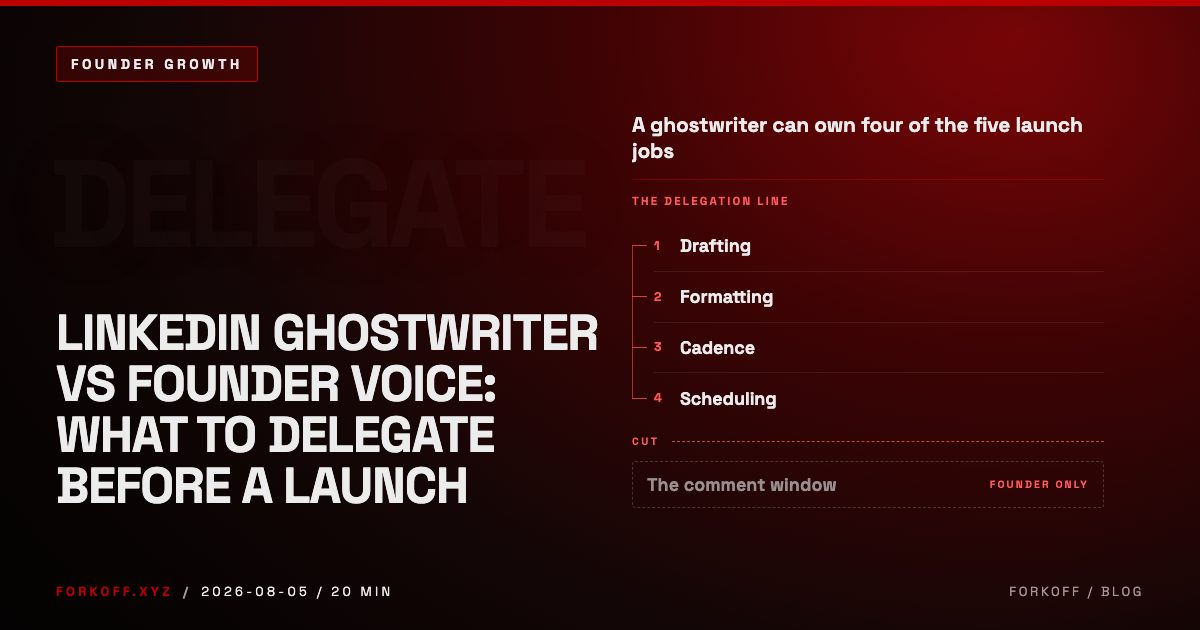
LinkedIn Ghostwriter vs Founder Voice: What to Delegate Before a Launch
A LinkedIn ghostwriter can draft your launch posts. It cannot reply in your comments or show up on the call. Here is where the line actually falls.
Read
Developer Relations for Startups: How to Win Your First 1,000 Developers
Developer relations for startups is a distribution problem, not a hiring one. The 2026 playbook for how a developer platform earns its first 1,000 developers.
Read