Buy software before you buy an agency. That is the answer-first version of this entire article: the cheapest AI SEO tracking tier, Otterly.AI's Lite plan, costs under $50 a month and tells you, in under a week, whether you actually have a citation gap worth paying four or five figures a month to close. An agency retainer without that data first is a bet placed blind. Software alone, forever, is a bet you never place at all. The right path depends on your stage, your team's existing skill, and whether the gap the software finds is big enough to justify paying someone else to close it, which is exactly the decision this piece walks through with real numbers on both sides.
AI SEO agency vs AI SEO software, the short answer
Buy software first, always. It costs under $50 a month at the entry tier and tells you whether you have a real citation gap before you spend on fixing one. Once that gap is real and sustained against named competitors, and your team lacks the bandwidth to close it, add an agency (real disclosed retainers run $1,000 to $25,000 a year depending on scope, not the vague $3-5k/mo "checklist" buyers complain about on Reddit) or an in-house hire. Most teams past the earliest stage end up running both: software as the permanent measurement layer, a human as the execution layer that ships the fix and gets it cited.
Operator noteAlways buy the cheapest software tier before any agency conversation. It costs under $50/mo and answers whether you're actually invisible., FORKOFF client onboarding pattern, 2026
That sequencing matters more than which specific vendor or agency you end up choosing. Most of the confusion buyers report in this category, across dozens of Reddit threads, traces back to skipping the measurement step entirely and going straight to a sales conversation, on either side of the purchase. A software vendor's demo will always show you a gap, because showing a gap is the entire pitch. An agency's sales call will always find work to do, because finding work is how the retainer gets justified. Neither one is lying, exactly, but neither one is a substitute for your own data either.
What "AI SEO agency vs AI SEO software" actually means
An AI SEO agency and AI SEO software solve two different halves of the same problem, and most of the confusion in this category comes from vendors on both sides pretending their half is the whole thing. Software, sold under the labels AI SEO tracking, AEO monitoring, or GEO visibility, measures where you stand: it runs a fixed set of prompts against ChatGPT, Gemini, Perplexity, and Google AI Overviews on a schedule, and reports whether you're cited, how often, and against which named competitors. An agency does the execution work the measurement layer cannot do itself, content that earns the citation, technical fixes that let a crawler actually reach your pages, and outreach that gets you placed somewhere a model already trusts. Neither one is optional once you have a real gap; the question this article answers is which one to buy first, and when the second one becomes worth the spend.

The confusion is not accidental. A real competitor, one of the few pages that directly answers this exact framing, runs the identical "build, buy, or hire" question as a blog post, which is itself evidence the query converts. What that page and most of the rest of the ranking set skip is real, sourced pricing on either side of the decision, which is the gap this piece exists to fill.
There is also a category mistake worth naming up front, since it costs buyers real money before they even get to the pricing question. "AI SEO" and "AEO" (answer engine optimization) get used almost interchangeably in vendor copy, and both get used loosely enough that a buyer can walk into a sales call thinking they're evaluating one thing and leave having bought something else entirely. A software subscription measures citations. An agency retainer ships fixes. A generalist SEO agency that added "AI" to its service list without changing its actual deliverables is neither, and it is the single most common thing buyers report accidentally purchasing when they skip the definitional step this section exists to close.
The three real paths, priced and timed
Build in-house, buy software, or hire an agency: the three paths differ less on final cost, over a year, than on when the money leaves and who does the work. Building in-house means hiring a specialist, which per the fully-loaded salary math below runs $85,000 to $120,000 a year before a single page ships, plus three to six months of ramp time before that hire's output starts compounding. Buying software means an instant start, a few hundred dollars a month at most tiers, and zero execution, since nobody on the software's payroll fixes anything for you. Hiring an agency sits in between: $1,250 to $25,000 a month depending on scope, a 30- to 90-day window before the first real fix ships, and someone else's team doing the work.
None of the three is universally correct. A team with an existing SEO or content hire on staff can often skip the agency step entirely and work straight off the software's own gap list. A team with budget but no in-house skill is usually better served hiring an agency than trying to build the capability from scratch, since the ramp time on a new hire is real and expensive. And a team with neither budget nor skill has exactly one honest starting move: the cheapest software tier, which is covered next.
The framing that trips up most buyers is treating this as a single irreversible choice rather than a sequence. Nobody is locked into whichever path they pick first. A pre-seed team that starts on software-only is expected to add execution capacity later, once the gap the software surfaces is real enough to justify it. A funded team that jumps straight to a full agency retainer without ever running tracking software independently is the one path that tends to go wrong, because there is no independent way to confirm the retainer is producing anything beyond the agency's own self-reported dashboard.
What Does AI SEO Software Actually Deliver?
AI SEO software answers one question: are you being cited, and by whom instead of you. It runs a fixed set of prompts against ChatGPT, Gemini, Perplexity, and Google AI Overviews on a schedule, logs every citation it finds, and reports the gap against named competitors. Six specific capabilities make up that job, covered below, and every one of them stops at measurement. Nothing in this layer writes a page, fixes a blocked crawler, or pitches an editor, which is the category doing exactly what it was built to do, not a shortfall.

The measurement layer does six things well, and stops there by design. Prompt tracking runs a fixed query set against the major AI answer engines on a schedule instead of you manually asking ChatGPT the same ten questions every Monday. Citation monitoring flags the moment your brand, or a named competitor, gets cited in a tracked answer. Share of voice turns raw citation counts into a comparative score against the competitors you actually care about, rather than the internet at large. Crawler access checks confirm GPTBot, PerplexityBot, ClaudeBot, and Google-Extended can physically reach your pages, since a robots.txt rule inherited from an old plugin silently blocks all of them at once and reads identically to a content problem until someone checks. Alerting pings you the moment something changes, so the gap doesn't sit unnoticed for a quarter. And dashboards translate raw citation data into something a non-technical stakeholder can actually read.
One caution on what "tracking" actually measures: a raw prompt-tracking count can look like AEO progress while mostly reflecting a temporarily hijacked live-search result rather than genuine model knowledge, a distinction one SEO consultant broke down in detail after watching a software product surface in AI answers only when live retrieval was on.
Harpreet
@harpreetchatha_
AI prompt tracking can fool you into thinking you’re doing great at AEO or GEO, when really you've just temporarily hijacked a search result. When you “track ai prompts,” you’re usually just tracking citations and brand mentions, not comparing answers across models or separating… Show more
Is an AI SEO agency worth it for early-stage SaaS, or too early?
We’re pre-Series A and trying to decide if hiring an AI SEO agency is worth the spend. We don’t have a massive content budget, so every dollar matters. Should we wait until later stages or invest early?
That thread is worth reading in full, since it captures the exact bind most early-stage teams are in: real budget constraints, real uncertainty about whether the spend is early or overdue, and no independent data to settle the question either way. That is precisely the gap software closes cheaply. Before spending a five-figure annual sum on an agency retainer, or spending nothing and hoping the visibility question resolves itself, a $29-a-month subscription answers it directly: either the brand is already showing up across the tracked prompts, in which case the spend can wait, or it is consistently absent while named competitors are consistently present, in which case the case for spending is now made with data instead of anxiety.
A dashboard has never fixed a robots.txt file
Every AI SEO software tool in this category, from the cheapest self-serve tier to the most expensive enterprise contract, does the same core job: it measures. None of them write the page, edit the code, or pitch the listicle. Buying software and stopping there is functionally identical to running a smoke detector with no fire extinguisher in the building. The measurement has real value, since it tells you exactly where to point the extinguisher, but it is not itself the fix.
Source: FORKOFF analysis of the AI SEO / AEO software category, 2026
Published pricing on Otterly.AI, one of the few tools in this category with transparent self-serve tiers, runs from $29 a month at the Lite tier through $189 Standard, $489 Premium, and custom Enterprise pricing starting around $1,000 a month, with a roughly 15 percent discount on annual billing.
AI SEO / AEO software pricing, published tiers
| Tier | Monthly (billed monthly) | Monthly (billed annually) | Who it fits |
|---|---|---|---|
| Lite | $29 | $25 | Solo marketers, small teams testing the category |
| Standard | $189 | $160 | SMEs, small marketing teams tracking multiple prompts |
| Premium | $489 | $422 | Mid-sized companies and agencies managing several accounts |
| Enterprise | from $1,000 | custom | Organizations needing bespoke prompt sets and API access |
Published pricing from Otterly.AI (live-fetched 2026-08-19). Profound also publishes self-serve tiers, $99/mo and $399/mo, with a free trial. Scrunch AI prices custom and sales-led; treat that figure as directional, not published.

That entry price is real, but it is not the whole price a buyer actually pays. A recent buyer thread comparing tools by name reported the cost climbing fast once Gemini and Claude coverage gets added on top of a ChatGPT-only starting configuration. Profound publishes self-serve tiers at $99 and $399 a month with a free trial, so that warning applies to a published-tier tool too, not only to the sales-led ones. Scrunch AI is the one that skips the published-tier step entirely and routes every prospect to a sales call, which is itself a signal about where its real pricing tends to land.

The published entry price is rarely the real price
Otterly.AI's $29 Lite tier is real and self-serve, but buyers who have actually run these tools report the cost climbing fast the moment Gemini and Claude coverage gets added on top of a ChatGPT-only starting configuration. Profound publishes its own self-serve tiers at $99 and $399 a month with a free trial, so the same warning applies there too. Scrunch AI skips the published-tier step entirely and goes straight to a sales call, which is itself informative: a custom, sales-led price for a SaaS product usually means the vendor expects most real buyers to land well above whatever number a self-serve competitor advertises.
Source: Reddit r/aeo, "Most AI visibility tools show citations now", 2026
Profound has the most detailed data, and there are many people talking about it. But I dont know how they calculate the search volume for those prompts. Overall, their data seems to vary quite a lot. Otterly is cheap when you start with a small number of prompts. But adding Gemini and Claude increases the real cost.
What Does an AI SEO Agency Actually Deliver?
An AI SEO agency sells the six things software cannot ship itself: content built to earn a citation, technical fixes a crawler can actually reach, third-party placement on pages a model already trusts, prompt-fanout coverage against sub-questions rather than one head term, reporting that ties citations to pipeline, and ongoing iteration as models update. Priced honestly, a retainer buys execution capacity, not a dashboard with a person attached. SimpleTiger's dedicated AEO service is one example of an agency that publishes its scope rather than folding "AI" into a generic SEO retainer. Priced dishonestly, which the checklist-agency section below covers, it is a one-time audit stretched across twelve months of invoices.

An agency retainer, priced honestly, is buying six things software cannot provide. Content that earns the citation, since a model cites specific passages of text, not a blank dashboard. Technical fixes, since the software can report a blocked crawler but somebody still has to edit the code and redeploy it. Third-party placement, since getting listed on a comparison page or a directory a model already trusts is outreach work, not something a tool generates for you. Prompt-fanout coverage, building content against the sub-questions a model actually asks itself rather than just the head term you'd naturally target. Client reporting that ties the same citation data to pipeline instead of a raw visibility score nobody outside marketing understands. And ongoing iteration, since models update and a page that earned a citation in March can lose it by June without anyone touching it.
ivan dyankov
@webvyx
In AI search, the question is: “What does the market say about our brand?” This is the shift from SEO backlinks to GEO mentions. Backlinks tell search engines which pages matter. Mentions tell AI systems what the brand means.
That distinction between links and mentions is a useful test for whether an agency's stated process actually understands the category it's selling. Traditional SEO retainers were built almost entirely around backlink acquisition, and a retainer that still frames its deliverables primarily as "link building" with AEO bolted on as a reporting label is describing the old game with a new name. A retainer that can explain how it earns third- party mentions, not just links, and how it structures content so a specific passage answers a specific sub-question a model is likely to ask, is describing work that actually maps to how these systems retrieve and cite content.
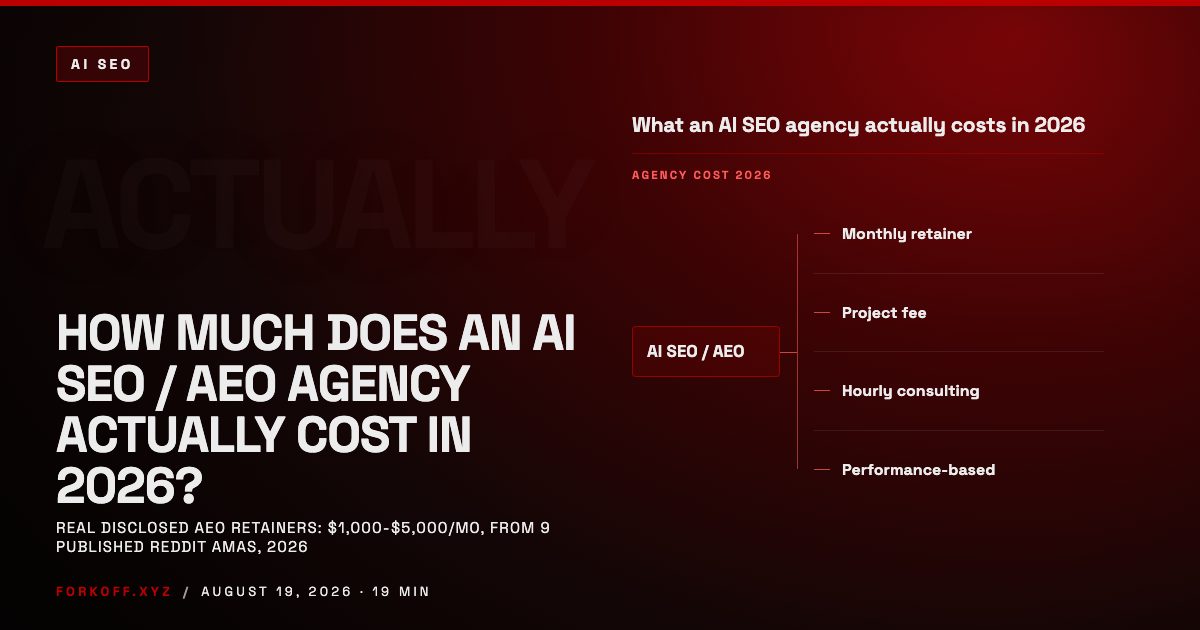
Real, disclosed agency pricing clusters into three bands, all sourced from operators posting their own numbers rather than marketing copy. Local-service AEO programs run $1,000 to $4,500 a month on 12-month terms. A narrower "AEO checklist" add-on, the exact shape of the complaint covered next, runs $3,000 to $5,000 a month. And a full-service program with content, technical work, and reporting runs $12,500 to $25,000 a year, billed monthly, roughly $1,000 to $2,100 a month depending on where in that range a given engagement lands.
I run search engine marketing and answer engine optimization (AEO) for tree service companies getting them found both in Google and in AI tools like ChatGPT, Gemini, and Google's AI Overviews. Pricing typically runs $12,500 to $25,000 per year, billed into monthly installments.

AI SEO / AEO agency pricing, real disclosed retainers
| Segment | Reported monthly range | Term | Source |
|---|---|---|---|
| Local-service AEO | $1,000 to $4,500/mo | 12-month | Reddit r/aeo AMA, local-service AEO agency |
| 'Checklist' AEO add-on | $3,000 to $5,000/mo | Month-to-month typical | Reddit r/AskMarketing buyer complaint thread |
| Full-service program | approx. $1,040 to $2,080/mo | 12-month, billed monthly | Reddit r/aeo AMA, $12,500 to $25,000/yr disclosed |
| Growth-stage, funded startup | $6,000 to $10,000/mo | Quarterly or 12-month | Mid-market AEO retainer benchmark, funded SaaS segment |
The first three rows are figures agency operators posted about their own business on Reddit AMAs, not marketing copy. The fourth row reflects standard mid-market AEO retainer pricing for funded, content-heavy startups scaling past the local-service band.
Real pricing, side by side
Putting both sides of the ledger next to each other is where most vendor content in this category goes quiet, since a software vendor has no reason to publish agency pricing and an agency has every reason to keep its own pricing vague until a discovery call. Here it is anyway, with a source attached to every figure that has one, starting with a 3-person agency's own disclosed pipeline data.

Over the last 18 months we logged 80 deals. 24 of them (30%) came from AI search. Companies asking ChatGPT, Claude or Perplexity for an agency and landing on our name. EUR230,400 in sourced pipeline. The average AI lead is worth 2x our outbound lead (EUR11.5k vs EUR5.7k). And over the same period cold email brought even more leads (26) but converted 4x less.
One disclosed dataset shows the upside is real, not just theoretical
A 3-person agency's own CRM data, posted publicly rather than kept as a private case study, showed 24 of 80 deals (30 percent) sourced from AI search citations over 18 months, with the average AI-sourced lead worth roughly 2x an outbound-sourced lead. That is one dataset, not a category-wide guarantee, and results will vary heavily by niche and how narrow the agency's positioning is. But it is a real, CRM-screenshotted number in a category where most claims are unfalsifiable marketing copy.
Source: Reddit r/aeo, "I sourced EUR230k of pipeline from AI search with my agency", 2026
That pipeline figure is one dataset from one 3-person agency over 18 months, not a category-wide guarantee, and results depend heavily on how narrow and credible the agency's own positioning is. It is still a real, CRM-screenshotted number in a category where most public claims about AEO return-on-spend are unfalsifiable marketing copy, which is exactly why it is worth citing specifically rather than folding into a generic "AI search drives leads" claim.
Operator noteDefault to hybrid past seed stage. Software alone leaves every flagged gap unfixed; agency alone with no tracking means paying blind.
What stands out most in that specific dataset is not the raw pipeline figure but the deal-value comparison: the agency's own numbers show AI- sourced leads closing at roughly twice the value of outbound-sourced leads, even though outbound (cold email, in this case) actually produced a slightly higher lead count over the same period. That is a conversion- quality story, not just a volume story, and it lines up with the broader reported conversion premium for AI referral traffic covered later in this piece. The number worth remembering is not "AI search brings leads," which every vendor claims, it's "AI-sourced leads in this dataset were worth roughly double," which is a specific, falsifiable claim someone actually put a real figure behind.
The checklist-agency trap, and how to spot it before you sign
The most common complaint about AI SEO agencies is not that the work fails, it is that the price does not match the deliverable. A four- or five-figure monthly retainer described as ongoing strategic AEO work often turns out to be a one-time technical checklist, featured snippet formatting, structured data, FAQ schema, repackaged as a subscription. None of those individual fixes are worthless. The problem is billing a one-week audit as twelve months of strategy, and there is one question that separates the two, covered below.

The single loudest complaint about AI SEO agencies, repeated across multiple buyer threads, is not that the work fails to move visibility. It is that a $3,000 to $5,000 monthly retainer turns out to be a checklist of things a technically capable team could implement themselves in a week: featured snippet formatting, structured data, FAQ schema.
Some are quoting like $3-5k/month for "answer engine optimization" but when I dig into what they're actually doing it kinda seems like they're just handing over a checklist of things we could probably do ourselves? Like optimizing for featured snippets, structured data, FAQ schema... isn't that stuff we should already be doing anyway? Or is there actually some proprietary process that makes hiring an AEO agency worth it?
The most common agency complaint has a specific, avoidable shape
The single loudest buyer complaint in this category is not that AEO doesn't work, it's that a $3,000 to $5,000 monthly retainer turned out to be a checklist of things the team could have implemented themselves in a week: featured snippet formatting, structured data, FAQ schema. That complaint is avoidable with one pre-purchase question: ask the agency to name one citation that exists today that did not exist before their engagement started. A real answer names a specific prompt and a specific date. A checklist-only shop cannot answer specifically.
Source: Reddit r/AskMarketing, "Are AEO agency services worth the cost", 2026
There is one question that separates a real AEO practice from a relabeled SEO retainer wearing a new acronym, and it is worth asking before any contract gets signed: name one specific citation, on one specific prompt, that exists today and did not exist before this engagement started. An agency doing real work can answer that with a date and a screenshot. An agency selling a checklist cannot, because a checklist produces a trend line, not a documented before-and-after.

Are AEO agency services worth the cost or are most just giving you a checklist to implement yourself?
So I've been getting pitched by a few different agencies about AEO services lately and honestly the prices are all over the place. Some are quoting like $3-5k/month for "answer engine optimization" but when I dig into what they're actually doing it kinda seems like they're just handing over a… Show more
Operator noteNever sign a 12-month agency term without a trial or month-to-month period first, even though Reddit AMAs show 12-month is the market norm.
None of this means the checklist items themselves are worthless. Featured snippet formatting, structured data, and FAQ schema are all real, load- bearing technical foundations, and a site missing them genuinely is leaving citations on the table. The problem buyers describe is not that these fixes don't matter, it's that a four-figure monthly retainer priced as ongoing strategic work turns out to be a one-time technical audit stretched across twelve months of invoices. A fair retainer either prices that work as a smaller one-time project, or it demonstrates ongoing work beyond the initial checklist, content, outreach, iteration, that actually justifies a recurring monthly charge.
Where Does Software Structurally Stop, and Why Is a Human Still Required?
No tool in this category writes the page that reverses a lost citation, edits a robots.txt file, or cold-pitches a listicle editor. That is not a pricing-tier limitation, it is structural: every vendor in this space, cheap or expensive, sells measurement, not execution. Understanding why a competitor gets cited instead of you requires understanding how these systems actually retrieve and score content, which is more mechanical than most buyers assume, and is the subject of the rest of this section.

No tool in this category, at any price, writes the page that reverses a citation loss. None of them edit a robots.txt file. None of them cold-pitch a listicle editor or a directory owner. And none of them can tell you, with any real confidence, WHY a specific competitor got cited over you for a specific prompt, only that they did. Understanding that "why" requires understanding how these systems actually retrieve and cite content in the first place, which is more mechanical than most buyers assume.
Operator noteModels cite the chunk that answers a question in one place, not the page. Put the answer, the number, and the caveat in one paragraph., Reddit r/aeo citation-mechanics thread, 2026
Here is the mechanism, laid out plainly: a model rewrites a question into several separate search queries, fetches the pages, strips everything but the main text, cuts that text into passages, and scores each passage against the fanned-out queries independently. Only the top-scoring passages ever reach the model that writes the final answer, and the citation attaches to whichever passage the cited sentence came from, not to the page as a whole. If your pricing answer lives in a heading in one place, a table three screens down, and a caveat in a footnote, that's three separate passages, and none of them alone answers the question a buyer actually asked.
AI SEO Agents vs a $300K Agency: Which Actually Wins? (2026)
A direct build-vs-hire comparison video for the same decision this post frames.

That mechanical reality is also the strongest argument for the hybrid model rather than picking one path forever. Software measures which passage is losing and to whom. A human, whether in-house or agency, decides which gap is worth fixing first given real constraints on time and budget, then writes or rebuilds the passage that should win the citation back. The same software then re-runs the prompt and confirms, independently, whether the fix actually worked, rather than everyone simply hoping it did.
The two layers were never meant to compete with each other
Software and agency work solve different halves of the same loop. Software measures the gap and confirms whether a fix moved it; an agency or in-house hire ships the fix the software cannot ship itself. Framing the decision as either/or, which most of this category's own marketing does, misses that the strongest setups run both, permanently, with the software cost staying flat while the human-execution spend scales up or down with how much fix volume is actually needed.
Source: FORKOFF client engagement pattern, answer engine optimization programs, 2026
That hybrid loop is also how a team avoids the checklist trap covered earlier without avoiding agencies altogether. A buyer who is already tracking their own citation data walks into an agency sales call able to say exactly which prompts they're losing and to whom, rather than accepting whatever gap analysis the agency presents. That single change, arriving with your own data instead of the vendor's, is usually enough on its own to push a pitch away from a generic checklist and toward a scoped, specific plan, because a vague pitch does not survive contact with a buyer who already knows the numbers.
Build in-house: what it really costs
Building AI SEO capability in-house looks free on a whiteboard and rarely is in practice. The real cost is a fully-loaded specialist salary, a supporting tool stack, and a ramp period before that hire's output starts compounding, three separate costs a build-versus-buy comparison usually collapses into one line. Priced out honestly below, in-house is the right call for a team that already has SEO or content skill on staff and simply needs to extend it into AI answer engines, and the wrong first move for a team starting from zero.

The build option looks free on a whiteboard and rarely is in practice. A fully-loaded specialist hire, salary plus benefits plus overhead, runs roughly $85,000 to $120,000 a year in most US markets for someone with real SEO and content skill. On top of that sits a tool stack, typically $500 to $2,000 a month once you're running real prompt tracking, competitive monitoring, and content tooling together rather than a single free tier. And there is a genuine ramp period, three to six months in most cases, before that hire's output starts compounding rather than still being spent on onboarding and learning the product.
Operator noteCheck robots.txt for GPTBot, PerplexityBot, and ClaudeBot before writing a single word. A blocked crawler makes every content fix invisible., FORKOFF technical AEO audits, 2026
Building in-house makes the most sense for a company that already has genuine SEO or content skill on staff and simply needs to extend that skill's scope into AI answer engines, since the specific AEO techniques (answer capsules, schema, prompt-fanout coverage) layer onto existing SEO fundamentals rather than replacing them entirely. It makes the least sense as a first move for a team with no existing content or technical hire, where the ramp time alone can cost a full fiscal quarter before any output exists to measure.
Which Path Fits Your Company's Stage?
The right path changes as the company does, and treating build-versus-buy as a single permanent decision is the second most common mistake in this category, after the checklist trap. A pre-seed team with no dedicated SEO hire needs to know whether it has a real gap before spending on either path. A funded, scaling team needs execution capacity software cannot provide. The table below maps the recommended path to four company stages, with the reasoning behind each one.

The right path changes as the company does, and treating it as a once-and-forever decision is the second most common mistake in this category after the checklist trap. A pre-seed team with no dedicated SEO hire and a thin content budget should buy the cheapest software tier and nothing else, because the first job is finding out whether a real gap exists at all. A seed-stage team with some organic traffic already flowing should move to hybrid, keeping the software running permanently and adding a fractional or project-based agency engagement scoped to the specific gaps the software has already surfaced. A Series A or later team scaling content production should move to a full agency retainer or an in-house hire, because the volume of fixes the software's own gap list generates now outpaces what a part-time effort can realistically ship. And an enterprise running multiple brands typically ends up running agency and enterprise software as two permanent, separate line items rather than choosing between them at all.
Which path fits which company stage
| Stage | Recommended path | Why |
|---|---|---|
| Pre-seed, no SEO hire | Software only | You need to know if you're invisible before you spend on fixing it |
| Seed, some organic traffic | Hybrid, software plus fractional or project-based agency work | A real gap now exists, but full-time headcount isn't justified yet |
| Series A+, scaling content | Full agency retainer or in-house hire | Fix volume now outpaces what a part-time effort can ship |
| Enterprise, multiple brands | Agency plus enterprise software, as two permanent line items | Scale requires both a measurement system and a standing execution team |
Stage is a proxy for team bandwidth and the size of the visibility gap, not a hard rule. A well-staffed seed-stage team can skip straight to a full retainer; an under-resourced Series B team can stay hybrid longer than this table implies.
What to expect, realistically, in the first 90 days
None of the three paths, software, agency, or in-house hire, produces a meaningful result inside the first 30 days, and any pitch promising otherwise deserves skepticism. Software needs several weeks of scheduled prompt runs before a trend line means anything. An agency needs time to audit and map prompt-fanout coverage before the first fix ships. An in-house hire needs a ramp period before there is output to measure. The timeline below breaks out what each path realistically produces at 30, 60, and 90 days.

None of the three paths produces a meaningful result inside the first 30 days, and any pitch promising otherwise is worth treating skeptically. In the first month, software delivers a baseline read of where you already stand, an agency runs its audit and maps the prompt-fanout coverage it plans to build against, and an in-house hire is still mostly hiring and onboarding. By day 60, the software's trend lines start to mean something once there's enough data behind them, an agency's first content and technical fixes begin shipping, and an in-house hire is producing first drafts. By day 90, the software finally has enough history for a real share-of-voice number against named competitors, an agency should show its first actual citation movement, and an in-house hire is typically still ramping toward full output. Anyone quoting faster timelines than this, on any of the three paths, is quoting hope rather than the mechanics of how these systems actually re-crawl and re-cite content.
SEO in 2026: How I'd Rank in Google in the AI Era
Ahrefs on ranking in the AI search era, the backdrop this whole category sits inside.
Why any of this spend happens at all
Strip away the acronyms and the entire economic case for spending on either software or an agency in this category rests on one number: AI referral traffic reportedly converts far better than traditional organic search traffic. A smaller, higher-intent channel that closes at a meaningfully higher rate justifies real budget on its own, an argument most vendor marketing in this space badly under-states in favor of vaguer be-visible-everywhere framing. The figure behind that claim, and why it holds up even discounted for optimism, follows below.

Strip away the acronyms and the underlying economic argument for spending on either software or an agency in this category comes down to one recurring figure in buyer discussions: AI referral traffic is reported converting around 14 percent, against roughly 3 percent for traditional Google organic traffic. Even discounted heavily for optimistic self-reporting, a channel converting meaningfully better than your existing organic traffic deserves real budget, which is the case most vendors in this category badly under-argue in favor of vaguer "be visible everywhere" framing.
The conversion gap is why any of this spend happens at all
A recurring figure in buyer discussions on r/aeo puts AI referral traffic conversion around 14 percent versus roughly 3 percent for traditional Google organic traffic. Even if that specific figure runs optimistic, a 2x to 5x conversion premium on a smaller but higher-intent traffic source is the entire economic case for spending on either software or an agency in this category. The spend is not about vanity visibility, it is about a channel that reportedly closes at a materially higher rate once someone actually clicks through from an AI answer.
Source: Reddit r/aeo buyer discussion, "Anyone here actually paying for GEO/AEO tools?", 2026
Operator noteGetting onto a "best AI SEO agencies" or comparison listicle a model already trusts moves citations faster than another blog post does., Reddit r/aeo, sourced-pipeline AMA, 2026
That conversion premium is also why the third-party placement lever, listed earlier as something only an agency delivers, matters more than it first sounds. A citation on a listicle or comparison page a model already trusts converts a reader who has already been pre-qualified by that trusted source, arriving at your site with most of the buying decision already made rather than starting cold.
The hybrid model, in practice
Laid out feature by feature rather than as an abstract argument, the case for running both software and execution, instead of picking one forever, is straightforward. Software alone tracks a gap permanently but fixes nothing. An agency alone, with no independent tracking layer, means paying for work with no outside confirmation it moved anything. The table below puts both options and the hybrid combination side by side across the five capabilities that matter most to a buyer.
Software vs agency vs hybrid: what you actually get
| Capability | Software only | Agency only | Hybrid |
|---|---|---|---|
| Citation and share-of-voice tracking | Yes | Sometimes, as a report | Yes, permanent |
| Content that earns a citation | No | Yes | Yes |
| Technical fixes shipped | No | Yes | Yes |
| Independent confirmation a fix worked | N/A, nothing was fixed | Rare, self-reported only | Yes, via the tracking layer |
| Ongoing cost floor | $29 to $189/mo | $1,000 to $25,000+/yr | Both costs, additive |
Hybrid costs more in dollar terms than either path alone. What it buys is the one thing neither path alone can provide: a fix that is both shipped and independently confirmed to have worked.
Laid out feature by feature, the case for running both, rather than picking one forever, is straightforward. Software alone tracks the gap permanently but fixes nothing, so every flagged issue simply sits there. An agency alone, with no independent tracking layer, means paying for work with no confirmation the specific citation you cared about actually moved, only the agency's own word for it. Hybrid costs more in absolute dollars than either path run alone, but it is the only configuration where a fix both ships and gets independently confirmed to have worked, closing the loop instead of running it open.
The verdict
Software first, always, because it is cheap enough to be an obvious yes and it turns every later decision from a guess into a measurement. Add execution, whether an agency or an in-house hire, once that measurement shows a real, sustained gap against named competitors and your existing team lacks the bandwidth or skill to close it alone. And when you do bring in an agency, price the retainer against the real, disclosed numbers in this piece rather than a vendor's own pitch deck, and ask the one question that separates real execution from a rebranded checklist: name a specific citation, on a specific prompt, that exists today because of this engagement. A real answer to that question is the only pricing signal that actually matters.

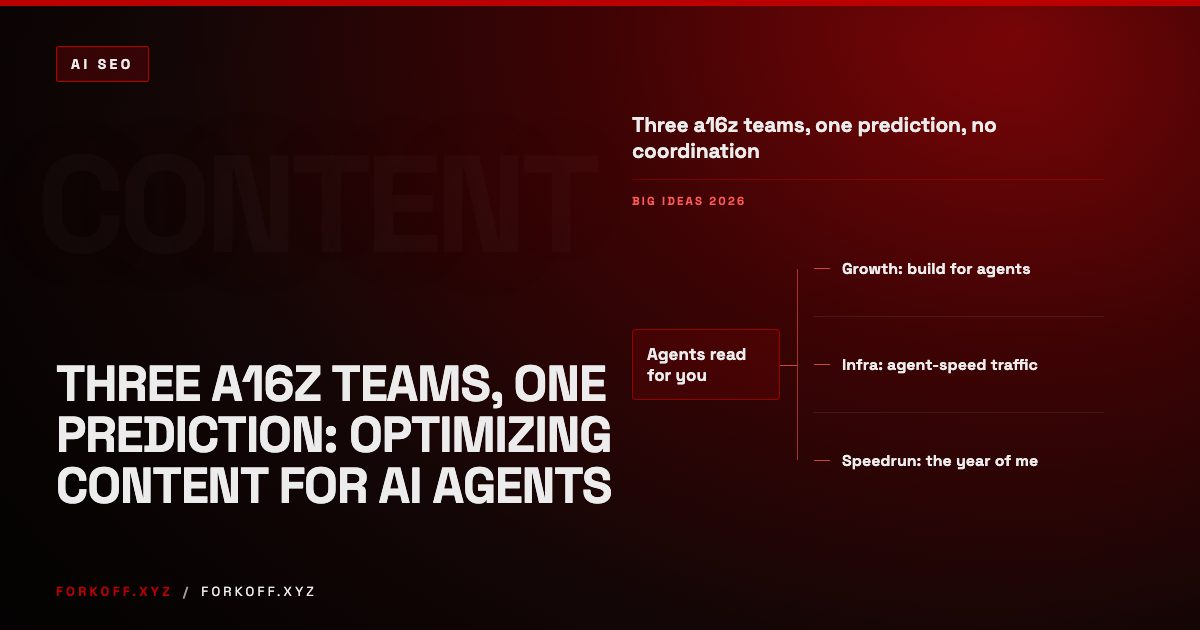
Further reading on the mechanics behind this decision: how AI Overviews rank brands once a citation is on the table, how to measure share of AI citations once you have software in place, the schema markup that supports AEO work an agency should be shipping, the 12 structural patterns that make a page citable in the first place, Perplexity vs Google AI Overviews if you're deciding which engine to prioritize first, and the broader a16z 2026 read on content for AI agents for where this category is headed next. For the full service scope behind the agency side of this comparison, see answer engine optimization, AI marketing agency, Perplexity SEO, and the pre-AI readiness audit if you're not yet sure which gap to prioritize. The free AEO checker, which runs the AEO, GEO and AI citation checks in one pass, is a free starting point before any retainer conversation; AEO vs GEO explains which of its scores to fix first, the discovery gap research shows why brands cited for their own name still miss category questions, and the broader founder funnel overview covers where this fits against everything else on a growth roadmap. When you're ready to talk specifics, get in touch.