What is the difference between AEO and GEO?
Per our own AI-Overview audit of 1,026 buyer queries (June 2026), 879 returned an AI Overview and 233 of those cited FORKOFF, so roughly one in four AI Overviews in this category already names a source we control.
AEO (answer engine optimization) optimizes content for extraction into short answer surfaces: AI Overviews, People Also Ask, and voice. GEO (generative engine optimization) optimizes for synthesis and citation inside long AI answers: ChatGPT, Perplexity, and Gemini. Same discipline, different surface.
AEO and GEO are two layers of the same goal: being the source an AI engine cites. They split on surface and tactic. Answer engine optimization (AEO) targets answer surfaces where a short extracted fact wins, Google AI Overviews, People Also Ask, featured snippets, and voice assistants. The lever is extractable structure: definition capsules, FAQ schema, clean headers. Generative engine optimization (GEO) targets long-form generative answers where an LLM synthesizes and cites a trusted authority, ChatGPT, Perplexity, and Gemini. The lever is demonstrated expertise: original data, cited statistics, and authority quotes, the levers the Princeton GEO paper (Aggarwal et al., KDD 2024, arXiv:2405.20708) measured as highest-ROI: citing authoritative sources lifted visibility 115% for lower-ranked pages, adding statistics lifted it 41%, and the GEO method set together lifted visibility up to 40%. Same discipline, different surface.
Are AEO and GEO the same thing? Not quite. The underlying discipline overlaps, both make your content the source an AI answer is built from. The difference is operational: AEO optimizes for extraction into a short answer block, GEO optimizes for synthesis into a long generative response. FORKOFF runs both as one outcome-priced engagement, measured on a fixed query-bank citation ledger across every engine, not on rankings alone.
Answer engine optimization service|Generative engine optimization service|AEO vs SEO difference
AEO vs GEO at a glance
The fastest way to hold the distinction is a side-by-side. Each row is an axis where the two disciplines diverge. The surface and the measurement axes are the ones that matter most, because they are the two places where GEO is genuinely not repackaged SEO.
| Axis | AEO (Answer Engine Optimization) | GEO (Generative Engine Optimization) |
|---|---|---|
| Target surface | Google AI Overviews, People Also Ask, featured snippets, voice assistants | ChatGPT, Perplexity, Gemini long-form generative answers |
| What wins | A short extracted fact or definition | A synthesized, cited authority inside a longer answer |
| Primary lever | Extractable structure: definition capsules, FAQ schema, clean headers | Demonstrated expertise: original data, cited statistics, authority quotes |
| Best content shape | FAQs, how-to, definitions, comparison tables, pricing | Original research, comprehensive guides, data studies, comparisons |
| How to measure | Citation in AI Overview or PAA on your query bank | Named-brand citation share inside ChatGPT, Perplexity, Gemini answers |
| Time to result | Days to weeks once an AI Overview fires on your query | Weeks to months for named-brand citation share to move |
| Buyer moment | Short factual category question | Comparative or research question |
The table renders as real HTML, not an image, so the AI Overview can lift it row by row. That is itself an AEO move: an extractable comparison is exactly the content an answer engine pulls into a direct answer.
Are AEO and GEO the same thing?
This is the question the search results actually fight over, so it deserves a straight answer rather than a dodge. The honest position: same underlying discipline, different operating surface. Both AEO and GEO are about being the source an AI answer is built from. Where they part ways is what that answer looks like and where it appears.
The skeptic case is worth quoting because it is partly correct. On r/DigitalMarketing, operators argue that AEO and GEO are not replacing SEO, they are repackaging it, and one widely-cited comment calls the whole category a set of science experiments based on synthetic testing. That critique lands on a lot of vendor advice: a great deal of what gets sold as AEO or GEO is plain SEO hygiene, crawlability, schema, clean structure, with a new label stapled on.
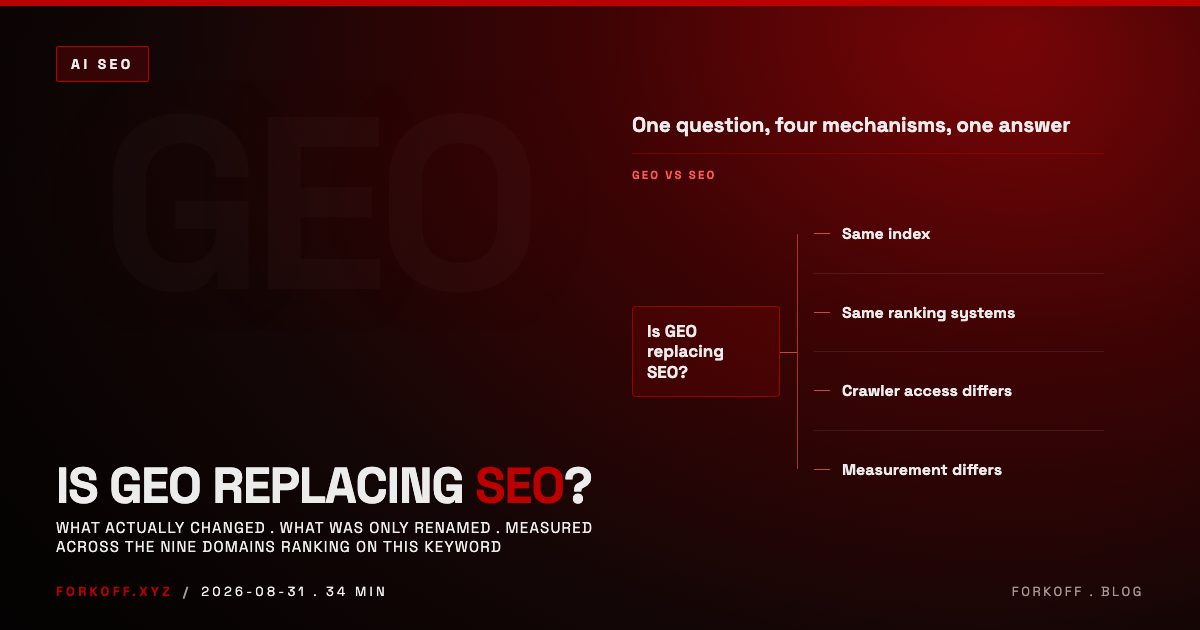
Here is the one thing that is not repackaging: the measurement surface moved. You cannot measure citation share inside ChatGPT, Perplexity, or Gemini with a rank tracker. The blue-link rank report does not see whether your brand was named inside a generated answer. That single fact is why GEO is a distinct operating discipline and not a rename, and it is the concrete, non-hype difference a credible page should lead with after acknowledging the skeptics. Vendors that cannot tell you how they measure citation share are selling SEO with a fresh sticker. To baseline the surface a rank tracker cannot see, run the AI visibility checker across your own query bank first.
Geo vs aeo: same question, same answer
People type this comparison in both word orders, geo vs aeo and aeo vs geo, and they want the same thing. There is no separate framework for geo vs aeo. The split is identical: GEO targets long-form generative answers where an LLM synthesizes and cites a trusted authority (ChatGPT, Perplexity, Gemini), and AEO targets answer surfaces where a short extracted fact wins (AI Overviews, People Also Ask, featured snippets, voice).
We call this page out explicitly because the two phrasings are word-order variants of one query, not two topics. Building a separate page for geo vs aeo would split the same intent across two URLs and let them cannibalize each other in the index. One canonical page answers both. If you arrived searching geo vs aeo, the comparison table and the surface-and-measurement distinction above are your answer, read in whichever order you prefer.
What each optimization approach does: AEO vs GEO vs LLMO vs AISO
AEO targets extraction surfaces (AI Overviews, PAA, voice). GEO and LLMO both target synthesis inside an LLM answer (ChatGPT, Claude, Perplexity, Gemini) and are used interchangeably. AISO and AIO are broad umbrella labels for the same AI-search work.
The acronym sprawl is mostly vendors branding one discipline. The durable line is the surface, not the label:
- AEO (answer engine optimization): optimize for a short extracted fact on AI Overviews, People Also Ask, featured snippets, and voice. The lever is extractable structure.
- GEO (generative engine optimization): optimize for synthesis and citation inside a long generative answer on ChatGPT, Perplexity, and Gemini. The lever is demonstrated expertise and cited data, the term of record is the Princeton GEO paper.
- LLMO (large language model optimization): the same synthesis-and-citation work as GEO under a newer label. Most practitioners use GEO and LLMO interchangeably.
- AISO / AIO (AI search optimization): umbrella terms for optimizing across AI-search surfaces in general, usually a mix of AEO and GEO sitting on a classic SEO foundation.
Where SEO fits (and why you still need it)
AEO and GEO do not float free of SEO. They sit on top of it. The cleanest way to hold all three is on a time-to-value axis, the framing operators like David Manela use: SEO is the foundation, slow to build but compounding; AEO is the extraction layer that captures short answer surfaces; GEO is the synthesis layer that wins long generative answers.
- SEO is the index layer. AI engines retrieve candidate pages from the same crawl index Googlebot and Bingbot populate. A page that 404s, redirects in a loop, or noindexes is invisible to AEO and GEO automatically. Crawlability, sitemaps, canonicalization, and Core Web Vitals remain table stakes for all three.
- AEO is the extraction layer. On top of a healthy index, AEO reshapes content so a short fact can be lifted into an AI Overview, a People Also Ask answer, or a voice response.
- GEO is the synthesis layer. On the same foundation, GEO builds the demonstrated-expertise signals, original data, cited statistics, authority quotes, that make an LLM synthesize and cite you inside a long answer.
The SEO-versus-AEO question has its own depth. For the 4-axis framework, the AEO operating stack, and the 30-60-90 migration playbook for SEO teams, read the AEO vs SEO difference guide. This page stays on the AEO-versus-GEO split and does not re-litigate the SEO comparison.
Content should support the full decision journey: when to prioritize AEO vs GEO
The disambiguation question most buyers are really asking is not what is the difference, it is which should I do first. The answer is a decision rule, not a coin flip. Match the discipline to where your buyers actually ask their questions, the framing Meltwater sums up as match strategy to goal.
- Prioritize AEO when your buyers ask short, factual, category-level questions and AI Overviews fire on your terms. If the money queries are definitional (what is X, X pricing, X vs Y at a glance) and Google is rendering an AI Overview on them, extraction wins fast. Ship definition capsules, FAQ schema, and clean comparison tables first.
- Prioritize GEO when your buyers ask comparative or research questions that get answered inside ChatGPT, Perplexity, and Gemini rather than on a Google SERP. If your buyers research vendors by asking an LLM to compare options, synthesis wins, and the lever is original data, comprehensive comparisons, and cited statistics that the model pulls into its answer.
- Run both when the buyer journey spans both moments, which for most B2B and founder-led companies it does. The category question fires an AI Overview (AEO), the vendor-shortlist question fires inside ChatGPT (GEO). The two compound when shipped on one content foundation.
The decision is not abstract once you have a query bank. Run your buyer questions across the engines, see which surface your demand actually lives on, and weight the work toward it. That is the same measurement discipline the answer engine optimization pillar guide walks through in operator depth.
Does GEO replace AEO, or do you run both?
You run both. GEO does not replace AEO. AEO captures the extraction surfaces (AI Overviews, PAA, voice) and GEO captures the synthesis surfaces (ChatGPT, Perplexity, Gemini). They compound on one content foundation rather than competing.
The replace framing is the wrong lens. AEO and GEO answer different buyer moments on different surfaces, so dropping one to chase the other forfeits the demand that lives on the surface you abandoned. A buyer who asks a short category question gets an AI Overview (AEO); the same buyer asks an LLM to compare vendors a week later (GEO). Win both and you are present across the whole journey.
The only real reason to weight one over the other is where your demand actually sits. Run your query bank across the engines, see which surface returns your buyer questions, and load the work toward it first. That is a measurement decision, not a replace-the-old-one decision.
What's changed in 2026: how AI crawlers work
Two mechanical shifts changed how this whole page should be read versus a year ago. First, the crawler layer split from the search layer: GPTBot, ClaudeBot, PerplexityBot, and Google-Extended crawl and index independently of Googlebot, each honoring its own robots.txt directive and, increasingly, reading a site's llms.txt file for explicit permission and a machine-readable map of what the site wants surfaced. A page blocked from GPTBot can still rank #1 on Google and never once get cited by ChatGPT.
Second, platform-specific indexing got more granular. Perplexity runs its own Sonar retrieval path with a distinct freshness weighting from ChatGPT's browsing tool, and Google AI Overviews draws from the classic search index rather than a separate crawl. The practical implication: a robots.txt audit and an llms.txt file are now table stakes before any AEO or GEO work, because the best-optimized page on earth cites nothing if the relevant bot is blocked from reading it in the first place.
How FORKOFF runs AEO and GEO as one engagement
Every page that ranks for this query stops at what is the difference. None of them answers which should I do first, and how would I know it worked. That gap is where FORKOFF operates. The disambiguation is not academic, it is an operating decision, and FORKOFF runs it as one outcome-priced engagement rather than two SKUs.
One engagement, both layers, one ledger
FORKOFF does not sell AEO and GEO separately. It runs both as a single engagement measured on a fixed query-bank citation ledger: a bank of 100 to 200 buyer questions run weekly across ChatGPT Search, Claude with Search, Perplexity, Gemini, and Google AI Overviews, logging named-brand citation, source-domain mention, and answer position per query per engine. The week-over-week delta is the receipt. This is the same 178-query proof referenced on the AEO vs SEO guide, so the measurement method is consistent across the cluster. The verified proof tracks what moved; it does not promise a fabricated lift number. For a public calibration point, the FORKOFF AI Citation Index measured a 34% average cite rate across the five engines on a 50-prompt buyer cluster, with Perplexity leading at 48%. And because the engines cite communities heavily, the Semrush AI visibility study of 150K citations found Reddit alone accounts for 40.1% of LLM references, which is why the community layer sits inside the same engagement.
Outcome-priced, not retainer-for-effort
The should I do AEO or GEO question gets answered the FORKOFF way: do whichever moves your citation share on the queries your buyers actually ask, and pay on that movement, not on hours. That reframes the entire pick-a-tactic debate into pick-an-outcome, which is the agency's positioning. AEO and GEO are levers inside one proof, not two invoices.
Operator-written authority
The page you are reading is written by the operator who runs the engagements, not a content team, with the Princeton GEO paper (Aggarwal et al., KDD 2024, arXiv:2405.20708) as the term-of-record anchor and first-party DataForSEO numbers, the same demonstrated- expertise and cited-statistics levers the paper found win the AI citation. If your real question is why a competitor gets named and you do not, the why ChatGPT recommends your competitor diagnostic walks the four causes and the prompt audit that finds yours. When you are ready to act, the two commercial destinations are Answer Engine Optimization and Generative Engine Optimization.