No, GEO is not replacing SEO, and the strongest evidence for that comes from the only party whose opinion actually settles it. In June 2026 Google's search product lead said the company's generative AI features are rooted in the same core ranking and quality systems as traditional Search, and that because those AI experiences retrieve up to date content from the existing search index, the best formula for success remains foundational SEO. That is a description of an architecture, not a marketing position, and every replacement claim has to survive it.
What follows is not another feature matrix. The top of this search result already has five of those and they are functionally the same article. This post does the thing none of them does: it draws a line between what genuinely changed and what was renamed, it answers the directional question practitioners keep asking in public and nobody in the top ten answers, and it puts a first party measurement behind that answer. We fetched robots.txt for all nine domains ranking on this keyword and found the one control that really does decouple search visibility from answer engine visibility. It is not content structure. It is permission.
The short answer, and the part nobody measures
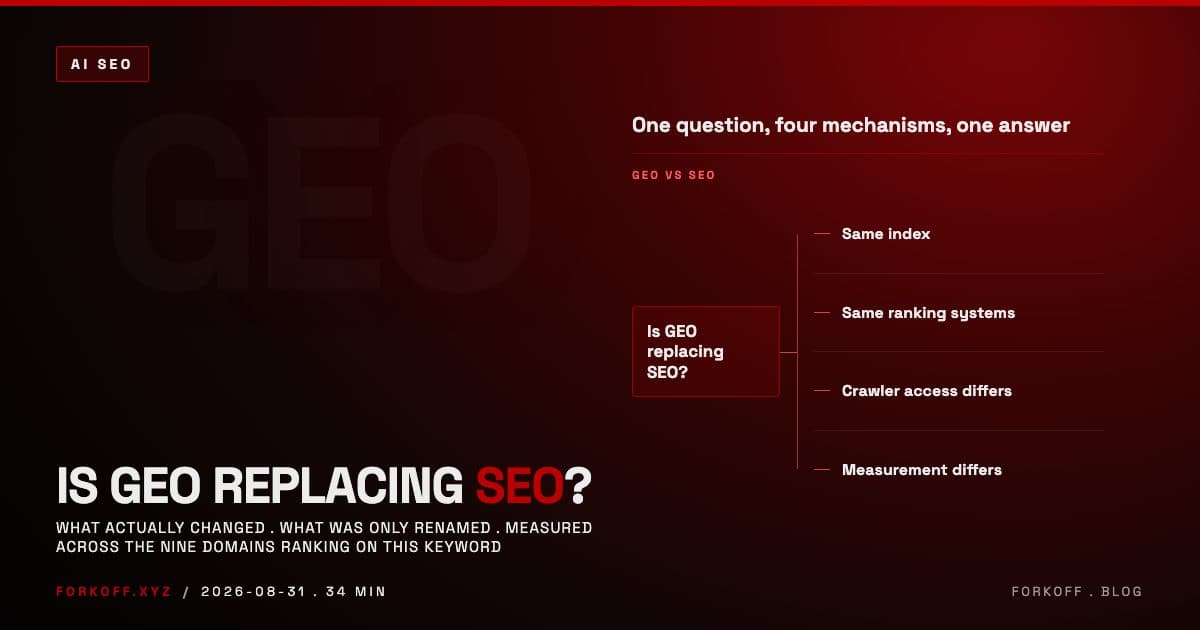
No, GEO is not replacing SEO. Google's own search product lead said in June 2026 that its generative AI features are rooted in the same core ranking and quality systems as Search and retrieve from the existing search index. Four things genuinely changed: prompts fan out into several queries, answers cite a few sources instead of listing ten, AI crawlers are a separate permission surface from search crawlers, and reporting moved from rank to citation share. Almost everything else sold as GEO is standard SEO practice with a new label. The one control that genuinely splits the two visibilities is crawler access, and it is the only one nobody audits. We fetched robots.txt for all nine domains ranking on this keyword on 2026-09-01. Six were readable. Exactly one names AI crawlers with a blanket disallow, and it holds two of the ten organic slots, which is a page that ranks in Google and is closed to two named AI crawlers at the same time. Check your own file before you buy anything.

If you want the short version before the long one: the tactics did not change much, the reporting genuinely did, and the one thing worth auditing this week is which automated agents your own site currently lets in. That last item is covered in full further down, with the exact commands, because it is cheap and almost nobody has run it.
Is GEO replacing SEO?
No. Generative engine optimisation is not replacing search engine optimisation, and the reason is structural rather than a matter of taste. Google's AI answers are built on the same index and the same quality systems that produce its classic results, which means the content that qualifies for one is drawing from the same pool as the content that qualifies for the other. A discipline cannot replace another discipline when it depends on that discipline's output as its input. The relationship is a layer, not a successor. Anybody telling you otherwise is describing a business model rather than a retrieval system.
Is GEO replacing SEO?
No. Google states its generative AI features run on the same core ranking and quality systems as Search and retrieve from the existing search index, so the work that earns a ranking is the work that earns a citation.
Google search product lead Brendon Kraham, quoted by SEO consultant Glenn Gabe on 22 June 2026. The exception is crawler access, which is a genuinely separate control surface and is covered in detail in this post.
Our new generative AI features are rooted in the same core ranking and quality systems as traditional Search. And, because these AI experiences retrieve up-to-date content from the existing search index, the best formula for success remains foundational SEO.
Glenn Gabe
@glenngabe
New from Google's Brendon Kraham -> Good SEO is good GEO "Our new generative AI features are rooted in the same core ranking and quality systems as traditional Search. And, because these AI experiences retrieve up-to-date content from the existing search index, the best formula… Show more
That statement matters more than any agency blog post on this subject, including this one, because it is first party. Google is describing how its own product retrieves. Independent practitioners reached the same conclusion from the other direction, by watching what happened to their own pages. One of the most upvoted substantive comments in the community thread that ranks first for this keyword puts it in one sentence: in Google, Gemini uses the Google index, so what you do to rank pages in organic search affects the AI output directly, and if you cannot rank organically you probably will not appear in Gemini either.
In Google, Gemini uses the Google index. Therefore what you do to rank pages in Google organic search impacts AI directly, meaning if you cannot rank organically you probably will not rank in Gemini.
Operator noteGoogle, June 2026: the AI features run on the same core ranking and quality systems as traditional Search.
The honest qualification is that this argument is strongest for Google and weaker as you move away from it. Google's AI Overviews and Gemini demonstrably share the Google index. ChatGPT's search grounded answers lean on a different index. Perplexity runs its own crawler, which is why we keep a separate page on Perplexity visibility and a comparison of Perplexity against Google AI Overviews. So the claim is not that every answer engine is Google in a costume. The claim is narrower and survives better: every one of these systems retrieves from an index of the open web, none of them has built a separate ranking science that ignores content quality, and the work that makes a page retrievable and quotable is the same work in each case. Where they genuinely diverge is covered later, and there are exactly four places.
The platform whose behaviour is in dispute already answered the question
Google said its generative AI features run on the same core ranking and quality systems as traditional Search and retrieve from the existing search index. That is dispositive in a way no agency blog post can be, because it describes the retrieval architecture rather than speculating about it. Any GEO claim that contradicts it needs to explain which part of the architecture it thinks is wrong.
Source: Brendon Kraham, Google, quoted 22 June 2026
There is one more reason to distrust the replacement framing on its face. Replacement claims in this industry have a track record. Social was going to replace search. Voice was going to replace typing. Apps were going to replace the web. In each case the new surface took a real share of attention, the old surface kept most of it, and the practitioners who quietly kept doing the underlying work outperformed the ones who rebuilt their whole practice around the new name. That is a prior, not a proof, and a prior is not a reason to ignore genuine evidence. It is a reason to demand some.
What is GEO, and who actually named it?
Generative engine optimisation is a real term with a traceable origin, which is worth knowing because the origin is more modest than the marketing. The phrase comes from a 2023 research paper by Aggarwal and colleagues that formalised what it called generative engines, systems that answer a query by retrieving multiple sources and synthesising them with a language model. The paper introduced a benchmark of user queries, tested specific content modifications against it, and reported that the strategies it tested could improve source visibility in generated responses by up to forty percent. That is where the word came from.

Read the paper's own framing carefully, because it is not a replacement argument. The problem it sets out to solve is that content creators have little control over when and how their material appears inside a generated answer, and that this is a fairness problem for the people who produce the web that these systems summarise. Its proposed answer is a set of content modifications, things like adding citations, quoting sources, and including statistics. Those are, without exception, editorial practices that a good publisher was already doing. The paper's contribution is measuring their effect on a new surface, not inventing them.
Operator noteSix of nine robots files read, one confirmed absent, two unreadable. Unreadable is recorded as unknown., FORKOFF pull, 2026-09-01
The gap between that paper and the commercial category that grew around the term is where most of the confusion lives. A research finding that structured, well cited, statistic bearing content is more likely to be quoted got repackaged as a new discipline requiring a new vendor. Notice that the paper's own recommended tactics are indistinguishable from what an answer engine optimisation practitioner or a competent editor would have recommended in 2019. The effect size is real and worth having. The claim that capturing it requires a separate agency, a separate budget line and a separate strategy is a leap the paper never makes.
Gagan Ghotra
@gaganghotra_
If you're fighting about terms nowadays GEO vs SEO vs LLMO vs AEO! Keep going cuz that's what SEOs do and have been doing forever!
It is also worth being precise about the acronym pile, because the pile itself is part of the story. GEO, AEO, AIO, LLMO, LEO and AI SEO are in active use, sometimes by the same person in the same paragraph, with meanings that overlap almost entirely. Our own guide to AEO versus GEO exists because readers kept asking us to distinguish two terms that mostly do not distinguish. When a field generates six names for one activity inside three years, the names are competing for market position rather than describing different things.
Why does a Reddit thread outrank the software vendors on this keyword?
Is SEO dead in 2026?
No. The keyword that asks this ranks a Reddit thread at position one above four vendor explainers, which is a market telling you the replacement story does not match what practitioners see in their own data.
Because the published answers are not answering the question. The position one organic result for geo vs seo, pulled live on 2026-09-01, is a community thread in r/SEO titled what is the real difference between approaching SEO and GEO. Sitting beneath it are the major SEO software vendors and established publishers, each with a well made explainer on the same term. A forum thread beating all of them on their own keyword is not a ranking accident. It is readers pushing a complaint above the answers that failed to satisfy them, on the exact query those answers were written for.
What the top ten organic results for geo vs seo are made of
| Result type | Count out of 10 | Positions | Source |
|---|---|---|---|
| Community or forum thread | 1 | 1 | measured |
| Vendor or publisher explainer article | 5 | 2, 3, 4, 6, 7 | measured |
| Social post | 1 | 5 | measured |
| Video | 1 | 8 | measured |
| Open publishing platform article | 2 | 9, 10 | measured |
n = 10 · as of 2026-09-01
Method: Each of the ten organic results returned by the live search pull was classified by its host and page template. Falsified by a fresh pull returning a different result set, which is expected over time on any query.
Pulled 2026-09-01 via firecrawl for United States, web results. Positions 9 and 10 resolve to the same article URL.

Look at what those editorial results have in common. The Semrush comparative guide, the Digital Marketing Institute explainer and the XFunnel breakdown are all well made and all structurally identical. Four of the top five are the same article with different branding: define GEO, define SEO, then print a table contrasting them across a set of attributes. None of them commits to whether one replaces the other. None separates practices that are genuinely new from practices that were renamed. None carries any measurement of its own. A reader arriving with a live question, should I be doing something different, leaves with a vocabulary lesson.
A forum thread outranking the software vendors is a verdict, not a fluke
The position one organic result for geo vs seo is a community thread asking what the real difference is. Four of the five editorial results beneath it are the same article with different branding: define GEO, define SEO, print a feature table. When readers push a complaint above the published answers on the exact keyword those answers target, the complaint is the data.
Source: Live search pull, United States, 2026-09-01
What's the *REAL* Difference Between Approaching SEO and GEO?
The poster keeps seeing claims that AI has completely changed how we approach SEO, and that it has become something entirely new called GEO, yet every expert then recommends the exact same approach the field has used for years. The question is what has actually changed, or whether it is… Show more
The thread itself is more useful than any of them, which is the whole point. It contains a practitioner arguing that answer engines are not search engines at all and have no independent ranking model. It contains another arguing that Gemini rides the Google index so ranking and citation are the same problem. It contains a dated first hand observation about Reddit citations dropping after a specific Google change. It contains an allegation that tool vendors are paying people to push the replacement narrative. And it contains the single best summary of the whole debate, which we will get to. That is a genuine argument between people with skin in the game, and Google ranked it first for a reason.
Operator noteReddit disallows every unnamed crawler in robots.txt, and it holds position one for geo vs seo., FORKOFF pull, 2026-09-01
There is a lesson here that outlives this keyword. When a forum result beats the commercial results on a commercial term, the market is telling you the demand is unmet, not that forums are having a moment. The correct response is to answer the question the forum thread is asking, with evidence, and to take a position. That is a harder piece to write than a matrix, which is exactly why the matrix keeps getting written.
What does Google itself say about GEO versus SEO?
It says the AI features share the machinery. The fullest public statement we found comes from Google search product lead Brendon Kraham, circulated in June 2026 by SEO consultant Glenn Gabe: the new generative AI features are rooted in the same core ranking and quality systems as traditional Search, and because those AI experiences retrieve up to date content from the existing search index, the best formula for success remains foundational SEO. Alongside that, Kraham gave four pieces of guidance that read like a direct response to the GEO vendor pitch.

The four points, as reported: do not worry about all the new names, because good GEO, AEO and LLM SEO is good SEO. Do not optimise for bots, optimise for people, because there is no need to write awkward keyword stuffed copy or chop content into tiny artificial snippets when the systems understand language the way a human does. Do not focus on generic content, prioritise your own perspective. And do not forget your website, build a good web experience. Google's own documentation on AI features carries the same message in more careful language.
Operator noteMedium blocks GPTBot and ClaudeBot at the robots layer and still holds two of the ten organic slots for this keyword., FORKOFF pull, 2026-09-01
Take the second point seriously, because it cuts against advice that is currently being sold. A meaningful share of GEO guidance in circulation tells you to restructure your pages into short artificial chunks so a model can lift them cleanly. Google is explicitly saying that is unnecessary and that it produces worse pages for humans. There is a defensible version of that advice, which is to answer the question near the heading so a reader and a machine both find the answer fast. There is an indefensible version, which is to shred a good article into disconnected fragments because a vendor said retrieval likes it. The first is editing. The second is damage.
The obvious objection is that Google has an interest in telling you nothing has changed, since a market panicking about the death of search is a market shopping elsewhere. That is fair, and it is why we did not stop at the statement. Every claim in this post that rests on Google's word is marked as such, and the claim we care most about, that the two visibilities can genuinely come apart, we went and measured ourselves rather than taking anyone's word for it. The measurement is a few sections down and it does not entirely agree with Google.
What genuinely changed?
What actually changed with the arrival of AI search?
Four things: retrieval now fans one prompt into several queries, answers cite a handful of sources instead of ten blue links, AI crawlers are separate from search crawlers, and measurement moved from rank to citation share.
Everything else sold under the GEO label, structured content, clear headings, entity clarity, original data, schema, page speed, was already standard SEO practice before generative engines existed.
Four things changed, and they are worth naming precisely because the vagueness is what lets a rebrand pass as a revolution. First, retrieval shape: a prompt no longer maps to one query. Systems expand a single natural language prompt into several modified queries, retrieve against each, and synthesise across the results. Second, the result surface: instead of ten links, a reader gets a written answer citing a handful of sources, which compresses the number of winners per query dramatically. Third, crawler permissions became a live control surface. Fourth, measurement changed shape entirely.

Take retrieval shape first. Query fan out means a page targeting the exact head term is no longer the only way to be present in the answer for that term. A page that answers one of the expanded sub queries well can be pulled into the synthesis even though it does not rank for the original prompt. This is a genuine change and it has a genuine tactical consequence: topical coverage across the sub questions a buyer actually asks matters more relative to a single perfectly optimised page than it used to. Our breakdown of AI search ranking factors goes further into how that retrieval step behaves, and how AI Overviews rank brands covers the Google specific version of it.
So ChatGPT and Perplexity and Claude are NOT search engines. They do not have alternative ranking models/systems/algorithms. What they do is break Prompts and create modified Queries known as the Query Fan Out.
The compression of winners is the change with the sharpest business consequence and the least written about it. On a classic results page, positions one through ten all get some traffic, unevenly. In a synthesised answer, three or four sources get named and everybody else gets nothing at all for that prompt. That does not change what makes a source good enough to be picked. It changes how brutal the gap is between being picked and not being picked. Anyone whose model assumed a long tail of modest traffic from mid ranking pages has a real problem, and it is a distribution problem rather than an optimisation problem.

Crawler permissions are the third change and they get their own section below, because they are the only lever we found that genuinely decouples search visibility from answer engine visibility, and because they are almost never audited. Measurement is the fourth and it is the strongest argument the other side has, so it gets its own section too. Those four are the list. If a proposal in front of you names a fifth genuinely new thing, we want to hear it, and we will update this post.
Measurement genuinely changed, and that is the strongest case against us
Rank position is one number with one meaning. Citation share is a rate across a prompt set you chose, sampled from a system that answers the same prompt differently on different days. A practitioner arguing that the old KPIs do not transfer is right about reporting even when they are wrong about tactics. Anyone selling GEO would do better arguing measurement than arguing replacement.
Source: Practitioner argument we agree with, sourced in the body
What was renamed rather than changed?
What is the actual difference between GEO and SEO?
GEO optimises for being quoted inside a generated answer, SEO for being ranked as a link. The tactics overlap almost entirely. The controls that genuinely differ are crawler permissions and how you measure the result.
Most of it. When we listed every distinct practice named as GEO across the ten results ranking for this keyword and asked of each whether a competent practitioner would have recommended it in 2022, five of eight came back yes. Clear heading structure, schema markup, original data, unambiguous entity naming, and answering the question near the top of the page are all standard practice that predate generative engines by years and in some cases by more than a decade. They are being resold with new labels attached, and the labels are doing a lot of work.
What genuinely changed, and what was renamed
| Practice | Existed before generative engines | Sold today as | Genuinely new | Source |
|---|---|---|---|---|
| Clear heading structure and scannable sections | Yes, standard on page SEO since the 2000s | Chunking for LLM retrieval | No | derived |
| Schema and structured data markup | Yes, schema.org dates to 2011 | Machine readable context for AI | No | derived |
| Publishing original data nobody else has | Yes, the linkable asset play | Citation bait for answer engines | No | derived |
| Unambiguous entity naming and consistent brand references | Yes, entity SEO predates AI answers | Entity optimisation for LLMs | No | derived |
| Answering the question directly at the top of the page | Yes, featured snippet optimisation | Answer capsules | Partly, the target surface changed | derived |
| Deciding which automated agents may fetch your pages | Barely, robots.txt existed but AI agents did not | AI crawler access control | Yes | derived |
| Reporting visibility as citation share across prompts | No equivalent existed | AI visibility tracking | Yes | derived |
| Optimising for one prompt expanding into several queries | No equivalent existed | Query fan out coverage | Yes | derived |
as of 2026-09-01
Method: We listed every distinct practice named as GEO across the top ten organic results for geo vs seo, then asked of each whether a competent SEO practitioner would have recommended it in 2022. Yes means renamed, no means new. Falsified by naming a practice on the renamed side that had no pre 2023 equivalent.
Classification is our reading of the practices named across the top ten results for this keyword, not a vendor list. Argue with any row.

Consider the rename that gets the most airtime, chunking. The claim is that you must restructure content into retrievable chunks for language models. Strip the vocabulary and the recommendation is: use descriptive headings, keep sections self contained, and put the answer near the question. That is how a good technical writer has structured a document since long before anyone shipped a language model, and it is what featured snippet optimisation asked for in 2016. The retrieval target changed. The editing instruction did not.
I guess I will just have to tell local would-be employers that yes, I totally know all the best practices for GEO/AIO... which, given that they are pretty much identical to SEO best practices, would be technically true
Schema markup is the same story with a longer history. Structured data has existed since 2011 and its purpose has always been to give machines an unambiguous reading of what a page contains. Sold as GEO, it becomes machine readable context for AI. That is a true statement about a thing you should have been doing anyway, and our own guide to structured data for AI search and post on schema markup for AEO both start from the same position: the markup is not new, the reason to prioritise it got slightly stronger.
Operator noteTwo accounts, 233,409 combined followers, posted the same thirty four words three days apart in July 2025., Measured on X, 2026-09-01
Original data production is the third and the most cynical rename, because the pitch is nearly identical to the link building pitch from ten years ago. Publish research nobody else has, and other people will reference it. That was true when the reference was a backlink and it is true now that the reference is a citation inside an answer. The GEO version of the pitch prices it higher and calls it citation bait. The activity is the same activity, and it was always the hardest and most valuable thing on the list.
None of this means the renamed practices are worthless. They are the opposite: they are the practices with the longest track record and the best evidence behind them. The problem with the rename is not that the advice is bad. The problem is that a buyer who already funds this work through an SEO retainer is being invited to fund it a second time under a new heading, and nothing in the proposal tells them which line items are duplicates. That is what our comparison of AI SEO agencies and software was written to help with, and it is why the triage question in this post is which items would not have existed in 2022.
Can you be visible in ChatGPT but not in Google?
Can you be visible in ChatGPT but not in Google?
Yes, in both directions, and the mechanism is crawler access. A site can allow one crawler and block another, so a page that ranks in Google can be unreadable to an AI crawler, and vice versa.
We fetched robots.txt for the nine domains ranking on this keyword on 2026-09-01. One of them names GPTBot and ClaudeBot with a blanket disallow and still holds two of the ten organic slots.
This is the question the whole search result fails to answer, and it was asked plainly on X by a practitioner: is it possible to execute methods that make you visible in ChatGPT but not in Google, and is it possible to rank in Google without being visible in ChatGPT. Nobody in the top ten takes it on. The answer is yes in both directions, the mechanism is nameable, and it is not content structure. It is crawler permission, plus one secondary effect from how prompts fan out into queries.
Jesper Nissen
@JespernissenSEO
GEO vs SEO Is it possible to execute methods that make you visible in Chatgpt, but not in Google? Is it possible to rank in Google without being visible in Chatgpt

Here is the direction that surprises people. On 2026-09-01 we fetched robots.txt for every distinct domain in the top ten organic results for this keyword. One of them, a large open publishing platform holding two of the ten slots, names eight automated agents in a single group and gives that group a blanket disallow. Two of the eight are GPTBot and ClaudeBot. So a page that Google ranks on page one of this very keyword tells OpenAI's crawler and Anthropic's crawler, in writing, not to fetch it. Ranking and citability are separable, and we did not have to model it or theorise it. It is sitting in a public file anyone can read.
AI crawler rules on the nine domains ranking for geo vs seo
| Domain | robots.txt readable | Named AI crawler group | What the file actually says | Source |
|---|---|---|---|---|
| medium.com | Yes, 884 bytes | Yes, 8 agents including GPTBot and ClaudeBot | Blanket Disallow / for that group, with a short allow list of marketing pages. Bingbot and OAI-SearchBot are not named. | measured |
| reddit.com | Yes, 538 bytes | No named group | User-agent * with Disallow /, plus a comment pointing at a public content policy. Every unnamed crawler is disallowed. | measured |
| semrush.com | Yes, 3,645 bytes | No named group | 11 user agent groups, none of them an AI crawler. The wildcard group disallows a handful of paths only. | measured |
| youtube.com | Yes, 792 bytes | No named group | Two groups. The wildcard blocks app paths such as /api/ and /comment, nothing crawler specific. | measured |
| informatechtarget.com | Yes, 337 bytes | No named group | Wildcard disallows /wp-admin/ and a search parameter. No AI agent is addressed either way. | measured |
| xfunnel.ai | Yes, 410 bytes | No named group | Wildcard Allow /. Nothing is disallowed at the robots layer. | measured |
| digitalmarketinginstitute.com | No, 404 at /robots.txt | None, the file does not exist | A missing robots.txt disallows nothing. Every crawler is permitted by default. | measured |
| contentful.com | No, HTTP 429 on two attempts | Not measured | Rate limited. Recorded as unknown rather than as permissive. | unknown |
| linkedin.com | No, HTTP 200 returning a challenge page | Not measured | The 200 was a bot challenge, not the file. Recorded as unknown. | unknown |
n = 9 · as of 2026-09-01
Method: For each distinct domain in the top ten organic results for geo vs seo, we requested https://domain/robots.txt over HTTPS, following redirects, and parsed user agent groups with a script that treats consecutive User-agent lines as one shared group. We asserted each response body was robots syntax rather than HTML, which is what caught the LinkedIn challenge page returning HTTP 200. Falsified by any of these files changing, by a rule applied at the edge rather than in robots.txt, or by a crawler ignoring the file.
Six of nine files read, one confirmed absent, two unreadable. An unreadable file is recorded as unknown, never as permissive.

The precision matters here and this is where most coverage of crawler blocking goes wrong. That same file does not name OAI-SearchBot and does not name Bingbot. OpenAI's own crawler documentation lists three separate crawlers with three separate purposes: GPTBot fetches for model training, OAI-SearchBot fetches for search results, and ChatGPT-User fetches when a person asks for a specific page. Blocking GPTBot stops the training crawler. It leaves the retrieval path that answers a live question completely open. So the honest reading of that file is not this site is invisible to ChatGPT. It is this site has opted out of training and stayed available for search grounded answers, whether or not that was the intention.
Does blocking GPTBot hide you from ChatGPT?
Not entirely. OpenAI documents three separate crawlers, GPTBot, OAI-SearchBot and ChatGPT-User. Blocking GPTBot stops the training crawler and leaves the search-time retrieval crawler untouched.
Read from OpenAI's own bot documentation on 2026-09-01, which names all three agents and describes their separate purposes.
One block is not a block: OpenAI documents three crawlers, not one
GPTBot fetches for training. OAI-SearchBot fetches for search results. ChatGPT-User fetches when a person asks for a specific page. A robots.txt rule naming only GPTBot leaves the other two entirely untouched, and a rule naming all three has a very different consequence. Teams that copied a GPTBot block from a template in 2023 rarely know which of the three they actually stopped.
Source: OpenAI bot documentation, read 2026-09-01
What a twenty minute crawler check actually returns
Domains checked
9
robots.txt readable
6 of 9
Naming an AI crawler
1 of 6
File absent entirely
1
A worked illustration of our own 2026-09-01 pull across the nine domains ranking for geo vs seo, not a product screenshot and not your results. The counts are the measured ones from the table in this post.
Now the other direction, visible in an answer without ranking for the prompt. Query fan out makes this ordinary rather than exotic. If a prompt expands into five sub queries and your page ranks for one of them, your content can be pulled into the synthesis and cited in an answer to a question your page does not rank for at all. That is not a loophole, it is how the retrieval works. It also means an AI visibility report showing citations for prompts you have no ranking page for is not evidence that something magical happened. It is evidence that the fan out found you sideways.
Operator noteOpenAI ships three named crawlers. A rule blocking GPTBot leaves OAI-SearchBot untouched., OpenAI bot docs, 2026-09-01
So the complete answer to the question is this. The two visibilities are strongly correlated, because they draw on shared or overlapping indexes and the same notions of quality. They are not identical, because permission is a separate control that any site owner can set differently per agent, and because retrieval reaches pages through expanded queries rather than the one you targeted. Correlated but separable is a more useful mental model than either same thing or different discipline, and it is the one the measurement supports.
Can you rank in Google and still be invisible to an answer engine?
Yes, and the failure mode is almost always accidental rather than strategic. Very few teams sat down and decided to exclude themselves from AI answers. What happened instead is that in 2023, when GPTBot was announced and a wave of publishers blocked it, a lot of sites copied a robots.txt snippet from a blog post, pasted it in, and never revisited it. Three years later that rule is still there, the agent list has grown, and nobody on the current marketing team knows the rule exists because it is invisible in every reporting tool they use.
GEO tool builders are literally paying SEOs to spread disinformation. I was offered money and equity if I did the same for 2 years while being monitored. I posted this on the sub with a screengrab of the offer presentation deck.
Our measurement gives a sense of how little attention this gets. Of the nine domains ranking for this keyword, we could read six robots files, one domain has no robots.txt at all, and two returned something other than the file. Of the six readable files, exactly one names any AI crawler. The other five address none of GPTBot, OAI-SearchBot, ClaudeBot, PerplexityBot or Google-Extended, either to allow or to block. These are sites publishing articles about optimising for generative engines, and five of six have made no decision about generative engine access whatsoever.

Robots.txt is not the only place this goes wrong, and the other places are harder to see. A content delivery network or bot management rule can block an agent by user agent string or by network range before the request ever reaches your origin, and that block leaves no trace in your robots file. Some managed bot protection products ship AI crawler blocking as a default on setting. If your robots.txt looks permissive and an agent still never fetches you, the edge is the next place to look, and the only reliable way to know is to check your server or CDN logs for the agent names rather than reasoning about the config.
The reverse accident happens too and it is worth naming for balance. A site with no robots.txt at all, which is what we found on one of the nine domains, disallows nothing. Every crawler that respects the protocol is welcome, including the ones a legal or brand team might have opinions about. That is a decision by default rather than a decision, and defaults are how most sites end up where they are. Neither direction of this is a catastrophe. Both are worth knowing on purpose instead of by accident.
What did we actually measure, and what would falsify it?
We measured one thing, narrowly. On 2026-09-01 we requested robots.txt over HTTPS for each of the nine distinct domains appearing in the top ten organic results for geo vs seo, followed redirects, and parsed the user agent groups with a script that treats consecutive User-agent lines as one shared group, per the exclusion protocol. Then we checked whether each named group carried a blanket disallow. The sample is nine domains, which is small and deliberately not a random sample of the web. It is the set of pages a person researching this exact question would land on.

The most useful thing that pull taught us was about the instrument rather than the web. One domain returned HTTP 200 with a twenty one kilobyte body that turned out to be a bot challenge page rather than a robots file. If we had trusted the status code we would have parsed an interactive challenge as a crawler policy and reported zero rules, which reads exactly like a permissive file. Another returned 429 twice, which is rate limiting, not permission. Both are recorded in the table as unknown, because an unreadable file is not an open one, and reporting a zero we did not observe would have been the worst thing in this post.
Four claims about GEO, and what backs each one
| Claim | Who said it | What backs it | Provenance | Source |
|---|---|---|---|---|
| Good SEO is good GEO, the AI features share the ranking systems and the index | Google search product lead, quoted by an SEO consultant in June 2026 | A first party platform statement about its own architecture | Published, first party | published |
| GEO best practices are pretty much identical to SEO best practices | A practitioner in the position one forum thread | Practitioner experience, no dataset attached | Published, anecdotal | published |
| Structured content changes lift visibility in generative engines by up to 40 percent | A 2023 academic paper introducing the term | A benchmark of user queries with reported evaluation | Published, peer reviewed venue | published |
| GEO tool builders are paying practitioners to spread the replacement narrative | A named practitioner in the same forum thread | An allegation with a screengrab posted to the subreddit, which we did not verify | Unknown | unknown |
as of 2026-09-01
Method: Each row names the speaker and the evidence class rather than restating the claim as fact. Falsified by producing a stronger evidence class for any row, which we would happily update.
The last row is reported speech. We repeat it as a claim someone made in public, never as an established fact.
Every number in this piece carries a provenance tag at the point of use for the same reason. Measured means we ran it and read the output. Derived means we computed it from something measured. Published means somebody else measured it and we are relying on their report. Unknown means we do not know and are saying so rather than picking the flattering assumption. The allegation about paid disinformation is tagged unknown and stays tagged unknown, because we did not see the screengrab and we are not in a position to verify it.
Here is what would change our conclusion, stated before you ask. If an answer engine built and ranked against an index of its own, independent of any web search index, the shared trunk argument weakens immediately. If a controlled test showed pages performing very differently in generated answers than their search performance predicts, with content structure held constant, that would be direct evidence for a separate discipline. If Google's own statement is contradicted by Google's later behaviour, the citation loses its force. If any of those happens, this post is wrong and we will say so on this page rather than quietly.

What would not change our conclusion is a vendor case study showing citations went up after a content programme, because that is exactly what better content does on both surfaces and it cannot distinguish the two hypotheses. If you want to know how we think about that measurement problem in general, our post on measuring share of AI citations sets out what a study would need to control for before its result means anything.
Why does the SEO is dead framing keep coming back?
Because it sells, and because the people it sells to are anxious. A category with a settled definition does not need a death announcement. A category being created does. The replacement framing performs two jobs at once for a vendor: it makes existing spend look obsolete, which frees budget, and it makes the vendor's own newness an advantage rather than a risk. That is a strong commercial incentive and it does not require anybody to be lying. It only requires that the most alarming version of a true observation travels furthest.
Sarvesh Shrivastava
@bloggersarvesh
The biggest threat to your local business? Local SEO is being replaced by LLM SEO - or LEO. Every time someone asks AI for "best [your service] near me"... Your competitor gets the call - and the cash. You get nothing. Here's your chance to get ahead:
The claim in its purest form is easy to find. In June 2025 an SEO consultant with roughly fifty seven thousand followers posted that local SEO is being replaced by LLM SEO, that every time somebody asks an AI for the best service near them, a competitor gets the call and the cash while you get nothing. That is the exact claim this post's title interrogates, from a real practitioner with a real audience, and it deserves a straight answer rather than a sneer. The straight answer is that AI answers for local intent do change who gets the call, and that the inputs to those answers are the same business listings, reviews and site content that local SEO has always worked on.
Two large accounts, the same thirty four words, three days apart
In July 2025 two X accounts with a combined 233,409 followers posted byte identical text announcing that the future of SEO is already here, that it is called LLM SEO or LEO, and that one team has been shipping it with numbers to prove it. Different shortlinks, same words. That is directly observable. It is not proof of coordination and we do not claim it is, but it is the sort of thing worth knowing before you accept the framing.
Source: Measured on X, 2026-09-01

Then there is the part we can observe directly. In a pull of posts about LLM SEO, two accounts with a combined 233,409 followers had published byte identical text three days apart in July 2025: big breaking, the future of SEO is already here, it is called LLM SEO or LEO, it is quietly driving hundreds of thousands of users, one team has been shipping this for months with numbers to prove it. Same thirty four words. Different shortlinks. Together those two posts carry over 250,000 views.
Two accounts posting identical copy is directly observable and we are reporting it as an observation, nothing more. It is consistent with paid distribution of a message, which is an ordinary and legal thing that happens constantly. It is also consistent with two accounts running the same content syndication tool. We cannot distinguish those from the outside and we are not going to pretend we can. What we will say is that when you encounter the replacement framing, it is worth asking who benefits and whether the specific wording in front of you originated with the person posting it.
KPIs from Google SEO will not help with LLM SEO. Here are 11 KPIs that actually matter now.
That brings us to the sharpest claim in the source material, and the one we handle most carefully. In the community thread that ranks first for this keyword, a named practitioner alleges that GEO tool builders are paying SEOs to spread disinformation, and says he was personally offered money and equity to do so for two years under monitoring, with a screengrab of the offer deck posted to the subreddit. We did not see that deck. We cannot verify the claim and we are not asserting it. We are reporting that a practitioner made it in public, on the page Google ranks first for this question, and that it is part of why the debate is as heated as it is.
Crawler access is the one control that genuinely separates the two visibilities
Ranking and citation share an index, so they move together most of the time. Permissions do not. A site can allow the search crawler and disallow a named AI agent in the same file, on the same day, with no effect on its rankings and a total effect on whether an answer engine can read it. That is the only lever we found that reliably decouples the two.
Source: FORKOFF robots.txt pull across the ranking corpus, 2026-09-01
None of this means GEO vendors are acting in bad faith. Most are not. It means the incentive structure around this term rewards the strongest version of the claim, and that a buyer should therefore weight first party platform statements and their own measurements above anything in a pitch deck, including ours. That is why this post links the sources and states its method: so you can check us rather than trust us.
What is the strongest argument on the other side?
That the measurement genuinely changed, and that measurement is not a detail. The best version of the case against this post comes from an agency founder who put it plainly on X: the KPIs from Google SEO will not help with LLM SEO, and here are eleven that actually matter now. That is a serious argument made by somebody doing the work, and it does not depend on any replacement story. It says the tactics can overlap completely and the reporting still has to be rebuilt from scratch. We think that is correct.
Jake Ward
@jakezward
KPIs from Google SEO won't help with LLM SEO. Here are 11 KPIs that actually matter now:
The four controls where GEO work is not SEO work
| Control | What SEO does with it | What changes for answer engines | Evidence class | Source |
|---|---|---|---|---|
| Crawler permissions | Allow Googlebot and Bingbot, block scrapers | Several named AI agents per vendor, each a separate decision. OpenAI documents three. | Measured from robots.txt and vendor docs | measured |
| Query shape | One keyword maps to one ranking page | One prompt expands into several sub queries, so coverage matters more than a single target | Reported by practitioners, not measured here | published |
| Result surface | A link in a list of ten | A quoted passage inside a synthesised answer with a handful of sources | Directly observable in any answer engine | published |
| Measurement | Rank position, stable and single valued | Citation share across a prompt set, noisy and sample dependent | Argued by practitioners, no agreed standard yet | unknown |
as of 2026-09-01
Method: Row one is from our own robots.txt pull plus OpenAI and Perplexity crawler documentation read the same day. Rows two and three summarise claims published in the ranking corpus. Row four is tagged unknown because no source we read defines a standard citation share metric.
These four are the honest divergence list. Everything outside them is shared practice under a different name.
Think about what rank position gives you as a metric. It is one number, it has one meaning, it is stable enough day to day that a change is a signal, and everybody in the room agrees on what position three means. Now think about citation share. It is a rate: how often a named source appears inside generated answers, across a set of prompts, over some number of runs. Every part of that sentence is a choice you made. Which prompts represent your buyer. How many runs are enough. Whether personalisation and location are held constant. Two agencies measuring the same brand on the same day can report very different numbers without either one being dishonest.
That is a genuinely new problem and it is unsolved. There is no agreed standard for a citation share metric the way there is for rank position. Our own post on measuring share of AI citations is an attempt at a method rather than a claim to have settled it, and the honest position is that this part of the field is where the useful work is right now. If somebody wants to sell a new discipline, this is the ground on which the argument is winnable.
The place we part company with the strongest opposing case is the inference. Measurement changing does not mean the underlying work changed. Marketing has been through this before: the arrival of view through attribution did not mean advertising creative worked differently, it meant the old report could not see something that was already happening. New instrument, same phenomenon. A vendor arguing you need new reporting is on solid ground. A vendor arguing that new reporting implies a new content strategy has skipped a step and should be asked to show it.
Are answer engines search engines at all?
This is a live disagreement among practitioners and it is more substantive than it sounds. The strongest sceptical position, argued repeatedly in the thread that ranks first for this keyword, is that systems like ChatGPT, Perplexity and Claude are not search engines and do not have alternative ranking models, systems or algorithms. On that reading, what they do is take a prompt, break it into modified queries, retrieve, and synthesise. They are consumers of search rather than competitors to it, which would explain neatly why the same quality work moves both.
There is a reasonable counterargument and it deserves stating. A system that retrieves twenty candidate passages and quotes four of them has performed a selection, and selection under a quality criterion is a ranking function whatever you call it. The synthesis step is not neutral: it prefers sources it can quote cleanly, sources that state a claim directly, sources that carry a number with an attribution. Those preferences are real and they differ in emphasis from what a classic ranking system rewards, even if they are drawing from the same pool of candidates.
iPullRank Digital Marketing Agency
@iPullRank
On stage: Ross Simmonds (@TheCoolestCool) on how we're arguing the wrong things GEO vs SEO is not the point Memory is. Content = investment Influence > output Shorts matter "Memory is the future."
Both readings converge on the same practical conclusion, which is why we can leave the semantic argument open. If answer engines are search consumers, then retrievability and quality are the whole game and it is the same game. If answer engines rank in their own right, they still cannot rank a page that was never retrieved, and the retrieval step draws on an index built by a crawler you either allowed or did not. Either way you cannot be cited from a page nothing can fetch, and either way the content that gets quoted is the content that states things clearly and backs them.
There is a third framing worth carrying, reported from a conference stage: the GEO versus SEO argument is not the point, memory is. The idea being that as these systems retain context about a user across sessions, the durable question becomes whether a brand is present in what the system already knows rather than what it retrieves at query time. We flag that as an argument to watch rather than one we can measure today, and we are not going to pretend a stage quote is a finding. It does suggest the naming fight has a short shelf life.
Our practical view is that the taxonomy question absorbs far more argument than it repays. The reason to care at all is that if answer engines really did have a fully independent index and ranking science, a separate discipline would follow logically. As far as anyone has shown, they do not. Until somebody demonstrates otherwise, the parsimonious model is one body of work with two output surfaces, and our guide to the AEO versus SEO difference is written from exactly that position.
How do you audit your own AI crawler access in twenty minutes?
Start with the file, and read it with your own eyes rather than through a tool that summarises it. Request your robots.txt directly, save the response, and check the byte count and the first line before you interpret anything. The single most common way this audit goes wrong is trusting an HTTP status code: we hit a domain in this very study that returned 200 with a bot challenge page in the body. A status code tells you a response arrived. It does not tell you the response was the file you asked for.
curl -sL -A "Mozilla/5.0" -o robots.txt -w "%{http_code}\n" https://yourdomain.com/robots.txt
head -c 200 robots.txt

Step two, list the agents you care about and check each one by name rather than scanning for the word AI. The current list worth checking is GPTBot, OAI-SearchBot and ChatGPT-User from OpenAI, ClaudeBot from Anthropic, PerplexityBot from Perplexity, Google-Extended for Gemini training, Applebot-Extended, Bytespider, Amazonbot and meta-externalagent. That list grows, so treat it as current rather than complete, and read each vendor's own documentation, such as the OpenAI bot reference and the Perplexity crawler reference, rather than a third party summary, because the vendors are the emitting system for their own agent names.
Step three, understand the grouping rule, because this is where a careless read produces a wrong answer. The robots exclusion protocol says consecutive User-agent lines with no directive between them form one shared group, so a file can name eight agents in a row and then apply a single blanket disallow to all of them. If your parser treats each User-agent line as starting a fresh group, you will read that as eight groups with no rules and conclude the site is permissive. That is precisely the file we found on one domain in this study, and getting it wrong would have inverted the headline finding.
Step four, check the layer robots.txt cannot see. Your edge is where a bot management product or a firewall rule can block an agent by user agent string or by network range before the request reaches your origin, leaving your robots file looking entirely permissive. The only honest way to answer this is to grep your access logs for the agent names over the last thirty days and see which ones actually fetched. If an agent appears in no log line and no rule, it either never tried or something upstream stopped it, and those are different problems.
Step five, decide on purpose and write down why. There are legitimate reasons to block a training crawler and keep a retrieval crawler, and there are legitimate reasons to allow everything. What is not legitimate is finding out in month four of a paid engagement that a rule somebody pasted in 2023 has been quietly excluding you the whole time. Record the decision, the date and the reason next to the rule, so the next person who reads the file inherits the reasoning rather than guessing at it.
If you would rather not do this by hand, our free AEO checker covers the mechanical parts (AI crawler access, llms.txt, live citations) and the on page side in one run, the schema JSON-LD generator writes the markup it asks for, and the discovery gap research explains the citation score. None of them replaces reading the file yourself once, because the point of this exercise is that you know what your own site says to the machines that decide whether you exist inside an answer.
What should a team actually do differently on Monday?
Two things, and then stop, because the list of genuinely new work is short and everything else is work you are already funding. The first is the crawler audit above. It costs twenty minutes, it is the only failure mode here that is completely invisible in every rank tracker you own, and it is binary: either the agents can fetch you or they cannot. Nothing else on any GEO checklist has that combination of low cost, high consequence and zero visibility in your existing reporting.
Sorting a GEO scope into new work and renamed work
Practices reviewed
8
Genuinely new
3
Renamed SEO practice
5
An illustration of the classification in this post applied to a scope document, not a live product view. Three of eight practices had no pre 2023 equivalent, and answer placement sits between the two columns.
The second is answer placement. Put a short, self contained answer directly beneath each question shaped heading, before the context and the caveats. Not a fragment, not a chopped up chunk, a real answer of two or three sentences that stands on its own if someone lifts it out of the page, which is the same shape our answer on how to get cited in AI Overviews recommends. This is featured snippet practice pointed at a new surface and it is the one renamed item worth doing deliberately, because a system quoting your page should not have to guess where your answer begins and ends. Our post on AI overview structural patterns has the specifics.
Everything else is the work you were already meant to be doing. Publish something nobody else has published, because a synthesis engine has no reason to quote your restatement of a fact it found in four other places. Keep entity references unambiguous so the system knows which company you are. Mark up the page properly. Keep it fast and crawlable. Update it when it stops being true rather than when a calendar says so. If that list sounds like an SEO brief from 2019, that is the finding, not a failure of imagination.

There is one thing worth adding that sits between old and new: track your citations, badly, starting now. A rough baseline you take yourself, by asking the ten prompts your buyers actually use across the engines they actually use, and writing down who got named, is worth more than a perfect measurement system you deploy in six months. It costs an hour a month and it means that when a vendor tells you they moved something, you have your own record to check it against. The methodology problems from the measurement section are all still there. A flawed baseline you understand still beats no baseline.
What to actively avoid: do not shred good pages into artificial fragments, do not buy a second retainer to redo work your first retainer already covers, and do not chase brand mentions on low quality sites because somebody said mentions are the new links. Google's own guidance calls out chasing inauthentic mentions specifically as less helpful than it might seem. When the platform tells you a tactic does not work and a vendor tells you it does, ask the vendor for the measurement.
Does depth still matter, or is that an old SEO habit?
Depth matters more now, not less, and we can be specific about why. A synthesis engine picks sources it can quote, and a page that covers one narrow slice of a topic gives it one chance to be quoted. A page that genuinely covers the sub questions a reader asks gives it many, and query fan out means those sub questions are being retrieved separately. That is a mechanical reason for coverage rather than a length target, and the distinction matters because padding a thin page to hit a word count achieves nothing at all.

We know this one from our own corpus rather than from a vendor study, and the numbers are not flattering to us. Before we raised our own editorial floor in August 2026, the median post on this blog ran 4,594 words and only eight percent of 226 live posts cleared 8,000. We had been publishing perfectly respectable articles that answered the main question and stopped, and the sub questions a reader would ask next were sitting in some other post or in no post at all. Raising the floor was a response to that measurement, and this post is written to the raised one.
SEO vs GEO: Understanding the Key Differences
James Dooley
A practitioner walkthrough of the same comparison, which holds position eight on this keyword.
The trap to avoid is treating depth as volume. A 9,000 word page that says the same thing nine different ways is worse than a 2,000 word page that answers the question, because it buries the answer and gives a retrieval step more noise to sift. Depth in the sense that matters means coverage of distinct sub questions, each answered where a reader would look for it, each self contained enough to be lifted. That is a structural property and you can check it by listing the questions the page answers and seeing whether any of them are duplicates.
There is a freshness dimension here too and it is easy to get wrong in the honest direction. Answer engines do favour current material, and the temptation is to bump a date field and call the page updated. Do not. A date that moves without the content moving is a claim about the page that is not true, and it is the kind of small dishonesty that compounds across a corpus. Update the content when it stops being right, then move the date. Our post on citation decay covers what actually goes stale and how fast.
How should you split budget between SEO and GEO work?
Fund the shared trunk, then fund the four genuinely new items, in that order. Because search and answer visibility draw on the same index and the same quality signals, the content and technical work you do serves both surfaces at once, which makes it the spend that returns most per pound on the list. Splitting a budget into an SEO line and a GEO line and staffing them separately produces two teams writing the same brief, and the duplication is invisible to whoever signs both invoices because the vocabulary differs.
The four new items are worth their own money and none of them is expensive. Crawler access is an audit, not a programme, so it is hours rather than a retainer. Citation measurement is a recurring cost and it is the one place where tooling genuinely helps, because doing it manually across several engines and a real prompt set does not scale. Query fan out coverage is a content planning input, meaning it changes what you brief rather than adding a workstream. Answer placement is an editing standard applied to work you were already commissioning.
For anyone weighing an agency proposal, the triage is mechanical. Go line by line and mark each item as either would have existed in 2022 or would not. Then ask what you are paying for the first group and whether an existing supplier is already delivering it. We wrote when you need an AEO or GEO agency rather than an SEO agency for exactly this decision, and our AEO pricing answer gives the ranges so you have a reference point before the call. If you are buying for a software company specifically, the AEO guide for B2B SaaS and our breakdown of what ChatGPT SEO services actually include both set expectations on scope.
One structural point about vendors, offered without cynicism. A firm that runs both surfaces as one engagement has an incentive to tell you the truth about the overlap, because they get paid either way and the duplication costs them credibility. A firm that only sells the new thing has to argue the new thing is separable, whether or not it is. That does not make the second firm wrong. It does mean you should ask them the overlap question directly and listen carefully to whether the answer names mechanisms or names categories.
What does a real GEO deliverable look like next to a renamed one?
A real one names a mechanism and a measurement. A renamed one names a category. That single test separates most proposals in front of most buyers right now, and it does not require you to know anything technical. If a line item says AI optimisation of key pages, ask which engine behaviour that targets and how you would know if it worked. If the answer is a longer version of the same category words, you are looking at existing work in new packaging.
Here is the shape of a real deliverable. A crawler access report that lists every named agent, the rule currently applied to it, where that rule lives, robots or edge, and thirty days of log evidence showing which agents actually fetched. That is a mechanism, an artefact and a check. A buyer can read it, disagree with it, and verify it independently. Contrast that with an AI readiness score out of a hundred with no stated inputs, which cannot be wrong and therefore cannot be useful.
Here is another. A citation baseline that states the prompt set, why those prompts represent your buyer, how many runs per prompt, the date, and the raw per run results rather than only the average. That is falsifiable. You can rerun it. You can argue about the prompt set, which is the right thing to argue about. Compare it to a dashboard reporting a visibility index with no disclosed prompt set, which is a number nobody can check and which will move when the vendor changes the prompts.
And a third. Original research: a dataset, a measurement, a survey, something that did not exist before you paid for it. That is the most expensive item on any of these proposals and it is the only one that reliably creates something for an engine to cite that competitors cannot copy by rewriting their headings. It is also the item most likely to be quietly dropped from scope when the budget tightens, which tells you something about how the rest of the scope is valued.
The renamed versions are recognisable by a shared property: they cannot fail. An AI readiness audit, a GEO content refresh, entity optimisation and a semantic content strategy can all be delivered, invoiced and reported without any observable event occurring in the world. Ask of every line item, what would it look like if this did not work. If the honest answer is that it would look identical, that line item is not buying you anything, whatever it is called.
What would make us change this answer?
Four things, and we would rather state them now than be argued into them later. First, an answer engine building and ranking against a genuinely independent index of the open web, not licensed from or grounded in an existing search index. That is the load bearing assumption in this whole post: the shared trunk. Remove it and the argument for a separate discipline gets much stronger immediately, because the input to the new surface would no longer be the output of the old one.
Second, a controlled comparison showing pages performing very differently in generated answers than their search performance predicts, with content and crawler access both held constant. Not a case study where somebody improved their content and both numbers rose, which cannot separate the hypotheses. A real comparison, where the only thing that varies is the thing being tested. Nobody in the top ten results for this keyword has published one, and neither have we, which is a gap in the field rather than a point in our favour.
Third, evidence that the four items we call genuinely new are actually five or six. Our classification of what changed is a judgement made by reading the ranking corpus and asking a 2022 question of each practice. It is derived, it is tagged derived in the table, and it is arguable. If somebody names a practice on our renamed list that genuinely had no pre 2023 equivalent, we will move the row and say why. That is the row level provenance doing its job.
Fourth, Google's behaviour contradicting Google's statement. The Kraham quote is doing real work in this post and it is a first party claim about a system we cannot inspect. If AI Overview citations start diverging systematically from organic rankings in a way that shared systems cannot explain, the statement stops being sufficient evidence and we would need to go and measure the divergence ourselves rather than cite it. We would treat that as interesting rather than embarrassing, which is the only sane posture to hold about a fast moving system.
What will not change our answer is another explainer, another matrix, or another account with a large following announcing the death of a discipline. We have been specific about the evidence classes we accept and where each claim in this post sits on that ladder. Anything that wants to move us has to come in above the level of the thing it is trying to displace.
Where this leaves you
The answer to the question in the title is no, with four named exceptions and one thing you should go and check today. GEO is not replacing SEO because the systems doing the generating retrieve from the indexes the searching built, and the platform whose behaviour is under discussion has said so directly. Most of what is sold under the new name is practice that predates it. The parts that are genuinely new are worth attention and money, and there are four of them, not forty.
The thing to check today is your own crawler access. It is twenty minutes, it is invisible in every tool you currently pay for, and in a sample of nine domains that publish articles about this exact topic, five of the six readable robots files had made no decision about AI crawlers at all. That is the state of the practice among people writing the guidance. Read your own file, decide on purpose, and write down why next to the rule.
The last word belongs to the commenter in the position one thread who summarised the whole thing better than any of the articles ranking beneath it, saying they would tell prospective employers that yes, they totally know all the best practices for GEO and AIO, which, given that they are pretty much identical to SEO best practices, would be technically true. That is a joke carrying a real finding, and it beat five explainers to the top of the page for a reason.