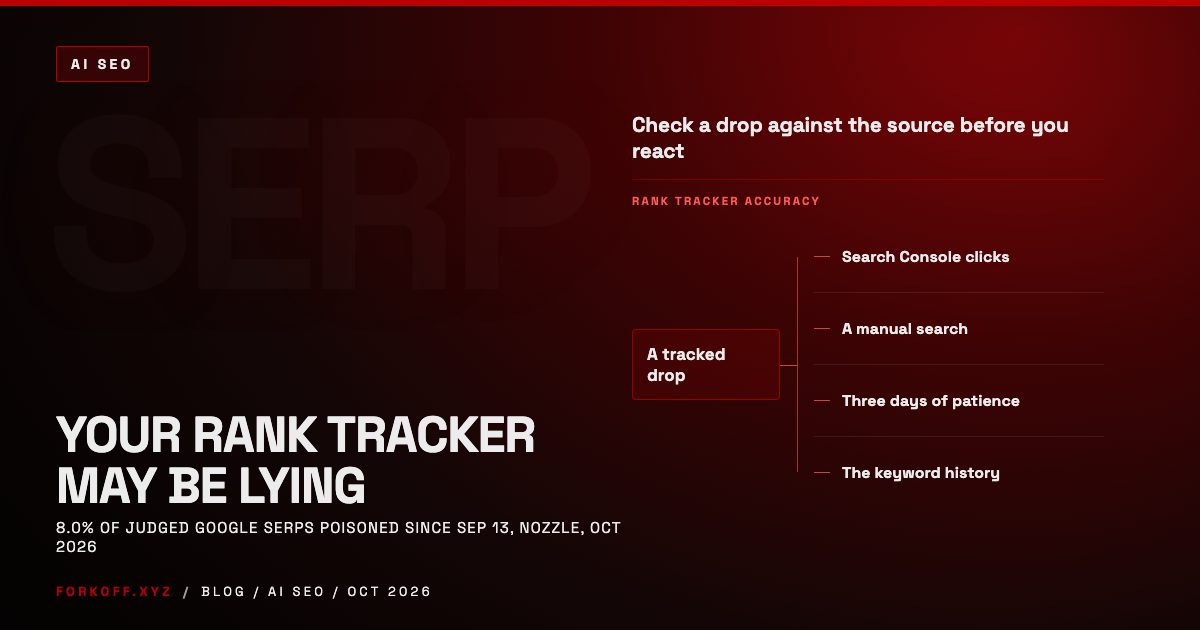

Rank tracker accuracy took a real hit in the autumn of 2026. Since September, Google has been answering some automated requests with complete, normal-looking results pages whose results were swapped out, and rank trackers store those pages as real. Nozzle's study, published 12 October 2026, put the share at 8.0 percent of judged pages since 13 September. A founder reading an SEO report now needs to check every drop against Google's own data before acting on it.
The short version
Since September 2026 Google has been answering some rank tracker requests with complete, normal-looking results pages whose results have been swapped out. Nozzle, a rank tracker that published the first large study on 12 October 2026, found 8.0 percent of the 17.8 million results pages it judged since 13 September came back poisoned, rising to about a quarter on 27 to 29 September. On a poisoned page a tracked site falls out of the top 10 most of the time, so a rank report reads it as a crash that never happened. For a founder buying SEO or AEO, the fix is not a new tool. It is a reporting rule: no ranking drop gets acted on until Search Console clicks and impressions, a manual search and a few days of patience agree with it, and every number in a report says where it came from.

If you pay an agency or a freelancer for SEO, or you run it yourself and send a monthly report to your board, the last month of ranking data probably contains readings that never happened to a real searcher. Some keywords you rank for on page 1 will have shown up as missing for a day. Some reports will have gone red at exactly the moment a Google spam update was rolling out, which Google said finished on 8 October 2026, so it was easy to read a data problem as an algorithm hit.
This post explains what was measured, how to tell a poisoned reading from a real ranking drop, and how to rebuild an SEO and AEO report so that every number in it can be checked. At FORKOFF we run classic SEO, answer engine optimization and generative engine optimization as one engagement, with contracts tied to citations, rankings and pipeline, so the question of which ranking numbers to trust is not academic for us. It is the number a contract is judged on.
What are poisoned SERPs?
A poisoned SERP is a Google results page that loads normally, with no error and no captcha, but carries the wrong results. Nozzle defines it, in its 12 October 2026 study, as a page where fewer than half of the keyword's usual sites appear anywhere, and those sites come back on a later collection. Real searchers did not see it.
The usual sites, in Nozzle's method, are the ones that appeared in a keyword's top 10 on at least 60 percent of its results pages between 20 August and 9 September 2026. A poisoned page drops most of them at once and puts other sites in their place. The template, the layout and the build of Google's page are the same as a normal page, which is what makes it dangerous. A rank tracker has no error to catch.
Since September 2026, Google has been poisoning the SERPs it serves rank trackers: complete, normal-looking pages whose results have been swapped out. Nothing on the page gives it away. Each keyword's own history does.
The study's own example is the search "white label local seo", collected on desktop in the United States on 4 October and again on 7 October 2026. On the second collection, 9 of 9 page-one sites were gone. A rank report would read that as every tracked site on the page crashing overnight. Nothing had happened to any of them.
A refused request gets retried. A poisoned one gets stored.
Nozzle's explanation of why it uses the word poisoning is the most important paragraph in the study for anyone reading reports. Google is not refusing these requests. It answers them with a complete page whose results are wrong, and nothing on the page says so. A refused request tells the collecting software to try again, while a poisoned one gets stored as real data, charted and emailed to a client. The study links it to Google's response to bulk collection of its results for AI answers, with rank trackers caught in the same net.
Source: Nozzle, Poisoned Google SERPs, 12 October 2026
What did Nozzle measure?
Nozzle measured a sample of the Google results pages it collects for its own customers, across 49 countries and three device types. Of 27.5 million pages collected since 13 September 2026, 17.8 million could be judged against a keyword history, and 8.0 percent of those were poisoned, against 0.17 percent in the August baseline.
What Nozzle measured, in its own figures
| Measure | Baseline | Since 13 September 2026 | Source |
|---|---|---|---|
| Share of SERPs poisoned | 0.17% | 8.0% | published |
| Sites gone per SERP, of the previous top 10 | 0.23 | 1.79 | published |
| Organic sites kept from the previous SERP | 88.5% | 20.7% | published |
| Tracked site out of the top 10 | 2.7% | 58.6% of poisoned SERPs | published |
| Desktop pagination stopping at page 4 or earlier | 0.19% | 32.5% on 28 September | published |
as of 2026-10-14
Method: Every figure is quoted from Nozzle's Poisoned Google SERPs study, published 12 October 2026, which compares a baseline of 20 August to 9 September with the period from 13 September, across 17.8 million judged SERPs collected since that date. A row is wrong if the study page shows a different figure for the same measure.
Read on the study page on 14 October 2026. The last few days of its chart were still filling in at publication.
The timeline matters as much as the average. According to the study's daily table, requests to Google started failing in large numbers on 13 September, and for two weeks fewer pages came through at all. The pages that did arrive were normal until 20 September, when poisoned pages first appeared at 1.9 percent. The share climbed to 18.4 percent on 26 September and peaked at 27.0 percent on 29 September, before settling at roughly 5 to 11 percent a day from 1 October.
The worst days fell on 27 to 29 September 2026
Read from Nozzle's daily table, published 12 October 2026. The last days were still filling in at publication.


That order, blocked first and poisoned second, is why Nozzle chose the word. Search Engine Roundtable reported on 12 October 2026 that Nozzle described three parts to Google's response: much wider IP blocking, a large increase in captchas, and bad data injected into suspect pages. The same report notes that Google had already tested goto redirects on result links back in July, and that several tool vendors posted notices to customers about missing positions.
The third approach, injecting bad data, concerns me the most. I suspect most tools won't pick up on this issue too quickly and thus think all is good when Google may be just toying with them.
What does a poisoned page do to a rank report?
A poisoned page makes a site you rank for disappear from the report for a day. Nozzle found that for keywords where a project's own site was one of the usual top 10, that site was out of the top 10 on 58.6 percent of poisoned pages, against 2.7 percent in the baseline and 10.2 percent on other pages since 13 September.

The organic results are the part of the page most rank reports are built on, and they are the part that changes most. On a poisoned page, the organic results kept 20.7 percent of the previous page's sites, against 88.5 percent normally. On average 1.79 of the previous top 10 sites were gone per page since 13 September, against 0.23 in the baseline.
Organic results change most, ads and shopping barely move
From Nozzle's comparison of each part of the page with the keyword's previous SERP, published 12 October 2026. Baseline organic retention was 88.5 percent.

Other parts of the page shift too. People also ask kept 46.9 percent of its questions, against 87.4 percent normally, and the pagination often stopped early: on 28 September, 32.5 percent of desktop pages for long keywords stopped at page 4 or earlier, against 0.19 percent in the baseline. A tracker that measures how deep you rank on page 6 had nothing to read on those days.
AI Overview tracking inherits the same problem
Nozzle compared each part of the results page with the keyword's previous page. On poisoned pages the AI Overview appeared 34.9 percent of the time against 54.2 percent in the baseline, and its cited sources kept 42.3 percent of the previous set against 68.8 percent. A tool that reports AI Overview presence or citations from collected Google pages will show swings that did not happen to real searchers. Ads and shopping results barely moved, which Nozzle notes are the parts advertisers pay for.
Source: Nozzle, Poisoned Google SERPs, 12 October 2026
Who fills the space is a tell in its own right. Reddit appeared in the top 10 of 28.8 percent of poisoned pages, against 20.8 percent of the same keywords' other pages, a rise of 8.0 points. Facebook, LinkedIn, Instagram and Quora also showed up more, while YouTube fell from 16.3 to 13.9 percent. If the site that "beat" you overnight is a forum thread that has never ranked for that keyword before, suspect the page before you suspect your content. We cover the real version of that pattern, a Reddit thread that genuinely outranks your page, separately, and the wider question of whether GEO is replacing SEO in its own post.

Which keywords and markets were hit hardest?
Smaller, longer keywords were hit harder than big ones, and some countries far more than others. Phrases searched fewer than 100 times a month were poisoned 9.4 percent of the time, against 6.1 to 7.1 percent for more popular phrases, and brand searches sat lowest at 5.3 percent.

That matters for startups specifically. A young site usually wins long tail keywords first, so the part of a report a founder watches most closely is the part most exposed. "Near me" searches ran at 11.4 percent against 7.8 percent for everything else. Local targeting itself made no difference: the same phrase tracked nationally and locally came out at 7.5 and 7.4 percent across 21,508 pairs.
By country, the United States ran at 8.5 percent across 10,855,400 judged pages, close to the overall average. Australia ran at 11.5 percent, India at 10.9 and Canada at 10.5, while the United Kingdom was lowest of the large markets at 3.0 percent. The device barely mattered, with 7.7 percent on desktop, 8.3 percent on iPhone and 7.1 percent on Android.

By industry, legal searches in the US ran highest at 15.9 percent since 13 September, peaking at 51.3 percent on 27 September. Software and technology sat at 8.8 percent with a worst day of 28.3 percent, close to the 8.5 percent for all US pages. Pets ran lowest at 4.3 percent. Every industry peaked between 27 and 29 September; what differed was how high.

The route a request takes to Google mattered as well. Between 30 September and 9 October 2026, one collection route returned 1 to 7 percent poisoned pages and another 9 to 30 percent, on the same days. That is why two tools can disagree about the same keyword on the same morning, and why neither is necessarily right.
How do you tell a poisoned reading from a real ranking drop?
You check the drop against sources the poisoning cannot reach. Nozzle lists five tells in its 12 October 2026 study: the page looks complete, the result set does not match the keyword's history, it does not last, poisoned pages are thinner on average, and Search Console disagrees. The last one is the decisive check.

Poisoned reading or real ranking drop, check by check
| Check | Poisoned reading | Real ranking drop | Source |
|---|---|---|---|
| Search Console clicks and impressions | Steady | Fall with the position | derived |
| A manual logged-out search | You are still there | You are lower too | derived |
| Three days later | Usually back, 77.9% of the time | Still down | published |
| Who replaced you | Social sites and forums | A competing page on your topic | published |
| How many usual sites vanished | Most of the page | One or two | derived |
as of 2026-10-14
Method: Derived from the five tells listed in Nozzle's study under how to tell it from a real ranking change, published 12 October 2026, and from Google's Search Console documentation of how clicks, impressions and position are recorded. The 77.9 percent figure is Nozzle's. A row is wrong if a confirmed real drop routinely passes the left-hand column.
One check is a hint. Three agreeing is a finding.
Operator noteA ranking drop in a third-party report is a hypothesis. A drop in Search Console clicks is a finding.
Search Console first. Open the Performance report for the same query and the same page over the same dates. Google's documentation explains that an impression is counted when your link appears in the current page of results a user sees, and a click when they follow it to your site. Those numbers come from real searches, so the poisoning cannot touch them. If impressions and clicks held steady while the tracker shows you falling off page 1, nothing happened to your site.
Search it yourself. Run the keyword logged out, in a private window, set to the target location if you can. A manual check is a single sample, so it settles nothing on its own, but if you are sitting where you usually sit, the tracker's reading was probably the odd one.
Give it three days. Nozzle found 80 percent of poisoning spells were a single results page, 15 percent were two and 5 percent were three or more. The next collection had the usual sites back 55.9 percent of the time, and 77.9 percent were back within three days, two days at the median. A real ranking change stays.

Operator noteMost poisoned readings fix themselves in three days. Most panicked rewrites take longer than that to undo.
Compare against the keyword's history, not yesterday. Yesterday may have been poisoned too. Compare against the sites that usually hold the top 10 over the previous weeks. If most of them vanished at once, the page is the problem. If one or two moved, and a competing page on your topic moved up, that is a ranking change.
Look at the spread. A real drop clusters: one page, one topic, one template or one type of query. Poisoning lands on random keywords across unrelated pages on the same day.

From a swapped results page to a wrong call in a client meeting
What were practitioners seeing before the study?
Practitioners saw the symptom in their dashboards weeks before the explanation. An agency owner posted in r/SEO on 8 October 2026 that their clients' rankings and Search Console traffic were up while the rank reports looked terrible, and that their two rank data sources reported opposite results for the same keywords.
Our clients are doing well, rankings haven't dropped, and in a lot of cases has increased (along with GSC data, traffic, etc.) but the ranking reports are horrendous.
What rank tracking tools are you using and is the data accurate?
The detail in that post is the whole lesson in one line. In some cases one tool showed a keyword ranked first while the other showed it not ranking at all, and sometimes both showed it missing while it was ranking first "with tons of traffic and great CTR in GSC". The thread drew 21 comments when read on 14 October 2026. The agency had the right answer in front of them the whole time, in Search Console.
The same week, Lily Ray posted on 8 October 2026 that she was trying to share findings on the spam update but rank trackers were too unreliable at the moment, a post seen 9,692 times by 14 October. Barry Schwartz asked his followers on 9 October what they were experiencing with Google rank tracking tools and got 30 replies.
Lily Ray
@lilyraynyc
Trying to share some findings on this but rank trackers are too unreliable at the moment
Barry Schwartz
@rustybrick
What are you all experiencing with Google rank tracking tools these days? I wrote about the issue a few weeks ago but wanted to hear from you all for a new story - let me know
When the study landed, the r/SEO moderators posted it to the community on 13 October 2026, where it drew 68 upvotes and 28 comments with a 96 percent upvote ratio by the next day. For a founder, the takeaway is simple: if your SEO partner did not raise this with you in October, ask them why.
Third-Party Google Rank Tracking Not Fully Working Now

The poisoning overlapped a confirmed spam update
Google Search Central said its spam update finished rolling out on 8 October 2026. The worst days of poisoning, 27 to 29 September, fell inside that rollout window. That is exactly the situation in which a team can mistake a data problem for an algorithm hit, or the reverse. The r/SEO thread from 8 October describes rank reports that looked horrendous while Search Console traffic was rising. Two things happening at once is the case the cross-check exists for.
Source: Google Search Central on X, 2026-10-08
Did other rank trackers see the same thing?
Yes. Morningscore published its own measurement on 8 October 2026, across more than 4 million searches, four days before Nozzle's study. It found Google returning truncated results from the evening of 24 September, peaking on 30 September and 1 October, when about 60 percent of its searches came back short.
A second rank tracker measured the same window independently
Morningscore published its own numbers on 8 October 2026, four days before Nozzle. From 22:10 UTC on 24 September a growing share of its searches came back truncated, with page links stopping at 4 or earlier. At the peak on 30 September and 1 October about 60 percent of its searches were short, and on truncated results 7.9 of the previous top 10 sites were missing on average, against 0.2 normally. Searching in a normal browser at the same time showed the full results.
Source: Morningscore, How Google Gave Rank Trackers Truncated Results for a Week, 8 October 2026
Most of the drops this caused weren't real, and most scores have already recovered. If your rankings dropped between September 24 and October 2, check again before you act.
The two studies use different definitions, poisoned against truncated, and different samples, so their percentages should not be compared directly. What matters is that two companies measuring separately describe the same late September window, the same missing top 10 sites and the same quick recovery. Search Engine Roundtable had already reported on 18 September 2026 that Google was blocking scrapers and tracking tools more successfully than before, and Advanced Web Ranking wrote the same day that Google serves different results to suspected automated queries than to people.
Operator noteTwo trackers disagreeing tells you the data is noisy. It does not tell you which one is right. Search Console does.
What does Search Console actually measure?
Search Console reports what happened when real people searched Google: impressions, clicks, click-through rate and average position. Google defines average position as the topmost position of your link, averaged across all the queries where you appeared, so it is a summary, not a single-location reading like a tracker's.

Google's own worked example shows why the numbers will never match a tracker exactly. If one query shows your site at positions 2, 4 and 6 and another at 3, 5 and 9, your average position is 2.5, the mean of the two topmost positions. A position is only recorded when the link actually gets an impression, so a result on page 3 that nobody scrolled to leaves no position at all.
The Performance report overview explains that the chart shows the average position of the topmost result from your whole site, while each table row shows the average for that URL or query. Use the table, filtered to one query and one page, when you check a specific drop.
AI features are counted inside the same report, and Google's AI Overviews documentation says sites appearing in them are included in Search Console's Performance report. Google says an AI Overview occupies a single position, and every link inside it is assigned that same position, while clicks and impressions in AI Mode follow the standard rules. Search Engine Roundtable noted on 12 October 2026 that Search Console does not break AI Overview and AI Mode clicks out on their own, which is a real gap for AEO reporting, but it does not make the totals wrong.
Search Console is Google's record of real searches, with its own limits
Google's documentation defines an impression as your link appearing in the current page of results a user saw, and average position as the topmost position of your link, averaged across the queries where you appeared. An AI Overview occupies a single position, and every link inside it shares that position. Those definitions make Search Console the reference point for checking a tracker. They also mean an average position will never match a tracker's single-location reading, so compare direction and size of change, not the exact number.
Source: Google Search Console Help, What are impressions, position, and clicks, read 2026-10-14
Search Console is not a perfect referee either. When Google stopped showing 100 results per page in September 2025, Search Engine Land reported on 15 September 2025 that many sites saw desktop impressions drop and average position jump in Search Console, with no change in real visitors. So use it for direction and clicks, which come from real searches, and be careful reading a small move in average position as a ranking change.
Search Console moves too when Google changes how results are served
When Google dropped the option to show 100 results per page in September 2025, Search Engine Land reported that many sites saw desktop impressions fall and average position rise sharply in Search Console, with no change in real visitors. Advanced Web Ranking made a related point on 18 September 2026: average position blends every query, device and location into one number. Search Console is the best reference for clicks and direction, not a precise position oracle.
Source: Search Engine Land, 15 September 2025
Google Search Central
@googlesearchc
The rollout was complete as of October 8, 2026.
Performance reports in Search Console - Google Search Console Training
Google Search Central
Google's own training video on the Search Console Performance report, the reference this post uses for every cross-check.
What should a trustworthy SEO and AEO report look like now?
A trustworthy report names the source and date of every number, leads with what Google recorded from real searches, treats tracker positions as a smoothed trend rather than a daily verdict, reports AI answer citations with the sample behind them, and ends with pipeline. Nothing in it should depend on a single collection of a results page.
The source decides how much weight a number can carry
Search Console
Rank tracker
AI answer tracking
Recorded from real searches
Safe from poisoned SERPs
Shows clicks to your site
Shows competitors
Shows AI answer citations
Derived from Google's Search Console documentation and Nozzle's study, both read on 14 October 2026. Partial for AI answer tracking because AI Overview readings come from collected Google pages, and partial for Search Console because AI Overview clicks are counted but not broken out.
How to rebuild a monthly SEO and AEO report so every number is checkable
| Line in the report | Source | How to present it | Source |
|---|---|---|---|
| Clicks and impressions | Search Console | Monthly total, with the date range | derived |
| Average position | Search Console | Per page group, noting it is averaged | derived |
| Tracked keyword positions | Rank tracker | Weekly median, suspect days marked | derived |
| Results page features won | Rank tracker plus manual check | Only when confirmed twice | derived |
| AI answer citations | Repeated prompt runs | Share of runs, with the run count | derived |
| Pipeline from search | Analytics and CRM | Leads, meetings and revenue | derived |
as of 2026-10-14
Method: A reporting structure derived from the measurement limits described in this post: Google's Search Console documentation for the first two rows, Nozzle's 12 October 2026 study for the tracker rows, and sampling limits for AI answers. A row is wrong if its source cannot produce the figure on demand for a stated date range.
The order matters. Lead with what Google recorded from real searches and close with what the business earned.

Three changes do most of the work. First, move Search Console clicks and impressions to the top of the report and keep the date range on the chart. Second, report tracker positions as a weekly median, and mark any keyword whose drop did not survive the cross-check above. A median of seven readings shrugs off a single poisoned day; a single reading does not. Third, mark 20 September to early October 2026 as a suspect window in any trend line that covers it, because that is when Nozzle saw the poisoning appear and peak.
Operator noteIf a number in your SEO report cannot name its source and date, it is decoration.
AI answer reporting needs the same discipline. Citation share in ChatGPT, Perplexity or Google's AI features is a sample, not a census, so a report should say how many prompt runs sit behind each figure. Our guide on how to measure share of AI citations covers prompt sets and cadence in detail, and why citations decay over time explains why a single good week proves little. Any AI Overview figure read from a collected Google page carries the poisoning risk too: Nozzle found the AI Overview on 34.9 percent of poisoned pages against 54.2 percent in the baseline.
For the structural side of earning those citations, our AI Overview optimization patterns, the schema markup guide for AEO and the B2B AEO checklist go deeper. If Perplexity matters more than Google for your buyers, read Perplexity against Google AI Overviews first.
What should you ask your SEO or AEO partner this month?
Ask where each number came from and what they did about the bad weeks. A partner who reports rankings to you should already know that 8.0 percent of judged results pages in one large sample were poisoned since 13 September 2026, and should be able to show which of your drops they checked against Search Console.

- Which source is each ranking number from? A tracker, Search Console or a manual check. If they cannot say, the report is not finished.
- Do any drops fall between 20 September and 9 October 2026? That is the window Nozzle's data covers, with the worst days on 27 to 29 September.
- Was every drop checked against clicks and impressions? The answer should come with a screenshot of the Performance report, filtered to the query and page.
- Do you report single days or a weekly median? Single-day positions are the reading most exposed to a poisoned page.
- How many prompt runs sit behind each AI citation figure? A citation share from three runs and one from thirty are different claims.
- Which number in this report ties to pipeline? Leads, meetings and revenue from search are the point. Positions are a means.
Operator notePositions are a means. If the report does not end in pipeline, it is measuring the wrong thing.
Operator noteThe best SEO partners told their clients about this before the client asked. That is a fair test of who is watching the data.
If a partner pushes back on these, it is worth understanding what you are actually paying for. Our breakdown of what ChatGPT SEO services include and the explainer on how AI Overviews choose which brands to show are a good place to start. For the buying decision itself, see when you need an AEO or GEO agency rather than an SEO agency, what AI SEO and AEO agencies cost and agency against software.
Should you change rank tracking tools?
Switching tools is rarely the fix, because every tool that collects Google results is exposed to the same response from Google. Nozzle observed that the route a request took mattered more than the vendor, with one route at 1 to 7 percent poisoned and another at 9 to 30 percent on the same days. The useful question is whether a tool detects poisoned pages and re-collects them.
Search Engine Roundtable listed several vendors that posted notices to customers by 12 October 2026, and noted that many confused the earlier goto redirect change with the new problem. Ask yours three things: whether it compares each page against the keyword's history, whether it re-collects a page whose usual sites vanished, and whether it flags those readings in the report rather than silently storing them.
A tracker is still worth having. It shows competitors and results page features, and keywords where you have no impressions yet, which Search Console cannot. Use it as a lead to investigate, keep Search Console as the reference, and let outcomes from analytics and the CRM decide whether the work is paying off.
How FORKOFF reports search results
FORKOFF reports SEO and AEO results against three sources, in this order: Search Console for what Google recorded from real searches, repeated prompt runs for AI answer citations, and analytics plus the CRM for pipeline. Tracker positions appear as weekly medians, with every drop cross-checked before it reaches a client.
What the evidence in this post was read from, and when
| Artefact | Figure read | Date read | Source |
|---|---|---|---|
| Nozzle study, Poisoned Google SERPs | 8.0% of 17.8M judged SERPs | 2026-10-14 | published |
| Morningscore measurement | 60% truncated at the peak, 4M+ searches | 2026-10-14 | published |
| r/SEO moderator post | 68 upvotes, 28 comments | 2026-10-14 | measured |
| r/SEO tracker disagreement thread | 12 upvotes, 21 comments | 2026-10-14 | measured |
| Lily Ray post on X | 129 likes, 9,692 views | 2026-10-14 | measured |
| Barry Schwartz post on X | 61 likes, 30 replies | 2026-10-14 | measured |
| Google Search Central post on X | Spam update complete 8 October | 2026-10-14 | published |
n = 7 · as of 2026-10-14
Method: Every figure was read from the original page or platform on 14 October 2026, never copied from a search listing or another article. Engagement counts keep moving after publication. A row is wrong if a fresh read on the same day returns a materially different figure.
Seven artefacts, one reading date. The date is what makes each figure checkable.
That order follows from how we sell the work. FORKOFF runs classic SEO, answer engine optimization and generative engine optimization as one engagement, with outcome-priced contracts tied to citations, rankings and pipeline created, including generative engine optimization for the AI answer side. Our answer engine optimization playbook lays out the method. A contract judged on rankings is only fair if the rankings are measured honestly, in both directions: a poisoned day should not count against us, and it should not count for us either.
The blunt answer
Your rank tracker is not lying on purpose, but in the autumn of 2026 it was sometimes handed pages that were. One tracker's sample showed 8.0 percent of judged Google results pages poisoned since 13 September, peaking at 27.0 percent on 29 September. A ranking drop in a report is now a hypothesis until Search Console, a manual check and three days of patience agree with it.
The fix is a reporting habit, not a new subscription. Lead with Search Console, smooth the tracker, sample AI answers honestly, mark the suspect weeks and judge the work on pipeline. If you want that kind of reporting from the team doing your search work, start with our answer engine optimization service, or measure your AI citations yourself first.