

Alexander Whedon
@alex_whedon · 25.0K followers
Introducing SubQ - a major breakthrough in LLM intelligence. It is the first model built on a fully sub-quadratic sparse-attention architecture (SSA), And the first frontier model with a 12 million token context window which is: - 52x faster than FlashAttention at 1MM tokens -
SubQ launchDistribution-amplified (light)
SubQ is a real product by a real founder (@alex_whedon). RADAR has tracked 13.1M views on this launch, according to the source post linked below. RADAR measures how the launch reach was built, not whether the product works or whether anyone was honest. This reading is verified confidence and every input is public.
By Simba, Launch Intelligence Analyst · Reviewed by JK · Published 22 Aug 2026 · Confidence: verified
Independent, methodology-derived signal, not a statement of fact about any person. RADAR reads how reach was built, a signature, not an accusation. See the methodology.
Did the SubQ launch go viral organically, or was the reach amplified?
The SubQ launch by @alex_whedon drew 13.1M views on 23.1K likes, which is 568 views per like, above the roughly 500 organic ceiling. RADAR reads a distribution-amplified (light) in how that reach was built, a signature of the mechanics and not a claim about the product or the founder. This is a verified reading and every input is public and reproducible.
New here? Start with the product
What is RADAR, and what does this grade mean?
RADAR is FORKOFF's launch authenticity rating system. It reads whether a product launch earned its reach through real engagement or bought it through paid distribution, using only public signals anyone can pull from the launch post. Every reading carries a letter grade, a confidence label, and the date it was last checked, and links back to a published method you can reproduce. SubQ is a real product by a real founder (@alex_whedon). RADAR measures how the reach was built, not whether the product works or whether anyone was honest.
Distribution-amplified (light)
Independent, methodology-derived signal, not a statement of fact about any person. RADAR reads how reach was built, a signature, not an accusation. See the methodology.
What this grade means
RADAR reads a distribution-amplified (light) on this launch: the reach ran ahead of the engagement that organic reach produces. The grade describes how the reach was built, not whether the product works or whether anyone was honest. Paying for distribution is legal and common.
The signals RADAR reads
Views-to-likes ratio
Organic reach tops out near 500 views per like. When views climb far past that without the likes to match, the extra reach is arriving without the engagement organic reach produces.
Amplification wave shape
Organic amplification spreads over hours and days. A coordinated launch fires a synchronized burst of quote posts in the first few hours, read from each post's own timestamp.
Posting-time fingerprint
A post that fires exactly top of the hour on a weekday is scheduled. On its own it is weak, but it corroborates a coordinated launch alongside the other two signals.
Those three public signals sit on top of RADAR's five-component forensic read. The full method, the bands, and the confidence model are on the RADAR methodology page.
This launch in the data
Where does this reach sit against the tracked corpus?
Where it sits in the corpus
Rank 11 of 30 tracked launches by views per like, lowest (most organic) first. A lower ratio is the favorable end.
Against the benchmark
This launch's views per like next to the organic median (354) and the amplified median (1,441) across the tracked set.
 The product
What is SubQ?
SubQ sits in the foundation-model layer of the AI market, the small and heavily funded group of labs building the models everything else is built on top of. Its stated edge is architectural: standard transformer attention checks every token against every other token, an approach that gets quadratically more expensive as context grows. Subquadratic's pitch is that most of those comparisons do not matter, and a sparse-attention design that finds and processes only the ones that do can scale further for a fraction of the compute.
The launch post states three headline numbers: 52 times faster than FlashAttention at one million tokens, under five percent of the cost of Anthropic's Opus model at that context length, and roughly a thousand times less compute overall. These are the company's own stated benchmarks, cited here as the claim made at launch, not independently verified by RADAR. This reading is only about how the reach was built.
Who built it
- A fully sub-quadratic sparse-attention architecture (SSA), the team's own term for the model's core design.
- A 12 million token context window at launch, the number the announcement leads with.
- Benchmarked by the team against FlashAttention and against Anthropic's Opus on cost per token.
- Built by Subquadratic (@subquadratic), a company whose X presence is the founder's own account plus the company handle.
How the SubQ launch worked
The launch was a single video-led announcement posted at 7:00 AM Pacific, on the hour, on Tuesday 5 May 2026, from Subquadratic co-founder Alexander Whedon's own account, @alex_whedon.
The post opens with a direct claim, "a major breakthrough in LLM intelligence," then states the two firsts back to back: the first model on a fully sub-quadratic sparse-attention architecture, and the first frontier model with a 12 million token context window. It follows with the two comparison numbers (52x faster than FlashAttention, under 5 percent of the cost of Opus) before closing on the compute-efficiency framing, "nearly 1,000x less compute and a new way for LLMs to scale."
The founder account, not a company account
The announcement ran from the co-founder's personal account rather than @subquadratic itself, a common pattern for an early-stage model lab where the founder's own following carries more real reach than a fresh company handle. Whedon's account was created in November 2024 and describes him simply as "Building better algorithms. Co-Founder at @subquadratic."
What Subquadratic did during the launch
The launch leaned on a small set of assets. Read together they are a template a technical founder can repeat.
| Asset | What it did |
|---|---|
| Product video | The hook, demonstrating the model rather than only describing it |
| Two named benchmarks | FlashAttention speed and Opus cost, concrete comparisons a technical audience can check |
| A single superlative claim | First frontier model with a 12M-token window, the kind of specific, falsifiable claim that draws scrutiny and discussion |
| Timing: Tuesday 7:00 AM PT | Top of the hour, start of the US work week, the slot RADAR most often sees scheduled launches use |
Nothing here is unusual for a model-lab launch. A technical claim this specific invites both praise and pushback from an audience that can evaluate it, which is consistent with the heavy, two-sided written engagement the post drew.
How the launch performed
The launch post reached 13,278,316 views on 22,511 likes, with 2,752 reposts, 1,486 replies, 1,962 quote posts, and 19,122 bookmarks. These are matured public metrics, re-pulled directly from the source post rather than a detection-time snapshot.
SubQ carries the largest raw like count of any launch in RADAR's tracked set at this reach, and that depth is the main reason the reading lands as a light lift rather than a heavy one. Under the 22,511 likes the post carried a combined 3,448 replies and quote posts, a heavy, costly written layer for a launch of this size. Replies and quotes are the hardest actions to manufacture because each is an original post a real person chose to write.
Views per like (matured)
About 1.2 times the roughly 500 organic ceiling. The gap between reach and likes is small.
Written engagement
1,486 replies and 1,962 quote posts, the two hardest actions to fake at scale, both arrived in volume.
Coordinated pod clusters
A retroactive sample of 40 quote-tweets and 39 replies found no tight-window engager clusters. No sign of a bought-engagement ring.
Quote-tweet timing
Zero sampled quote-tweets landed inside the first six hours; the wave built over the following days, the shape of word of mouth, not an injected spike.
The quote-tweet wave built over days, not minutes
A retroactive sample of the quote-tweets citing this launch found zero landing inside the first six hours, with the sampled wave building across the following three-plus days instead. That shape, a slow build rather than a front-loaded burst, is the pattern RADAR associates with word of mouth spreading through a technical community over time, not an injected spike timed to the launch window. The same sample found no coordinated engager clusters: 40 sampled quote-tweets and 39 sampled replies, checked for accounts posting within a two-minute window of each other, turned up none.
Did the reach get earned or bought?
One number moved slightly since detection. The like count settled from 23,050 at first pull to 22,511 on this re-check, a small decline that is common as a platform prunes low-quality engagement over time; the view count rose from 13,090,265 to 13,278,316 over the same window. Neither shift changes the reading: the ratio moved from 568 to 590, still comfortably inside the light band, not the heavy band that begins at 2,000.
What a founder can take from this launch
The SubQ launch shows what a technical, benchmark-led announcement looks like when it lands with the audience it is built for: a demonstration video, two comparisons a reader can independently check, one specific and falsifiable claim, and a launch slot at the start of the work week. The light amplification layer on top did not need to do much work, because the underlying claim was strong enough to generate its own written conversation.
FORKOFF builds launch videos made to travel and plans distribution around the claim a founder can actually defend. See how we approach it on the launch video service, or read the best product launch videos we track for more real examples.
Questions readers ask about this launch
What is SubQ?
+
Did the SubQ launch go viral organically?
+
How many views did the SubQ launch get?
+
Who is behind SubQ?
+
What does a light distribution-amplified signature mean?
+
Sources
Primary citation: x.com/alex_whedon/status/2051663268704636937. Every number traces to a public pull; reads re-checked over time.
How RADAR read this launch, component by component
Each named component carries a plain-English definition and a directional read where the public data supports one. RADAR publishes the component names, never the weights or the formula.
View-velocity signature
Not publishedWhether the view curve grew the way organic spread does, or spiked like an injected burst.
Per-launch read not published in the public dataset. This component needs the forensic engine output.
Engagement coupling
NeutralWhether likes, replies, and reposts grew in step with views (the organic signature), or the views ran out ahead.
At 568 views per like, reach runs a step ahead of the likes: a light lift above the roughly 500 organic ceiling.
Reply-network authenticity
Not publishedWhether the accounts replying are real, distributed people or a coordinated cluster posting together.
Per-launch read not published in the public dataset. This component needs the forensic engine output.
Amplifier-cluster pattern
Not publishedWhether the quote-tweet amplification looks like organic word of mouth or a known activation cluster.
Per-launch read not published in the public dataset. This component needs the forensic engine output.
Smart-follower activation
Not publishedWhether genuinely influential reference accounts engaged, or the reach was only low-quality volume.
Per-launch read not published in the public dataset. This component needs the forensic engine output.
Are you the founder of SubQ? You can claim or contest this read. RADAR attaches a founder response to the launch and re-examines any component you dispute.
Authorship
Simba
Co-founder, FORKOFF
Reviewed by: Kshitij JK
Last reviewed:
Published:
Methodology
RADAR verified reading of the SubQ launch from public metrics: the views-to-likes ratio against the roughly 500 organic ceiling and the posting-time slot, framed as a signature of how reach was built, not an accusation.
Sources cited
- RADAR methodology , FORKOFF
- SubQ source post , X
Where to go next
Understand launch authenticity
Three ways in, depending on what brought you here: learn how the score works, get a launch read or built, or get the plain answer on this launch.
Learn the score
What a launch authenticity score is
A launch authenticity score reads whether a launch earned its reach or bought it, from public signals. Start with the definitions and the checks you can run yourself.
Verify or build
Launch authenticity verification
Want a launch read by the same method, or a launch video made and distributed on the outcome? RADAR reads any public launch, and FORKOFF builds the launch behind the reach.
The skeptic's question
Is the SubQ launch legit?
If you are checking whether the SubQlaunch was real users or bots, here is the honest read: RADAR's reading is Distribution-amplified (light), at verified confidence, computed from public metrics and reproducible from the source post. It measures how the reach was built, not whether the product works.
Peer launches
Launches with a similar read
Moda launch
@anvisha
4.5M views · 556 per likeRead
Parker launch
@alexgoughcooper
1.6M views · 498 per likeRead
Helena launch
@SeijinJung
3.7M views · 643 per likeRead
Cursor for iOS launch
@cursor_ai
6.4M views · 492 per likeRead
Durable launch
@jamesclift
3.6M views · 651 per likeRead
Contra Payments launch
@contraben
2.3M views · 445 per likeRead
The benchmark behind every reading
- The organic vs amplified benchmark. What a healthy launch ratio looks like, side by side.
- RADAR methodology. The bands, the confidence model, and how to reproduce a read.
- The Launch Authenticity Report 2026. The aggregate study across the tracked corpus.
- The X Launch Authenticity Study 2026. Two in three tracked launches show a bought-amplification signature.
- Verified-organic leaderboard. The launches RADAR reads as genuinely organic.
- Best product launch videos. The editorial cut of every tracked launch, ranked by views.
- Product launch video service. Get a launch video made and distributed, priced on the outcome.
Want a launch read by RADAR's method?
RADAR reads whether a launch's reach was earned or bought from public data, with the confidence label and the source citation on every reading.
Receipts, deep dives, and playbooks.
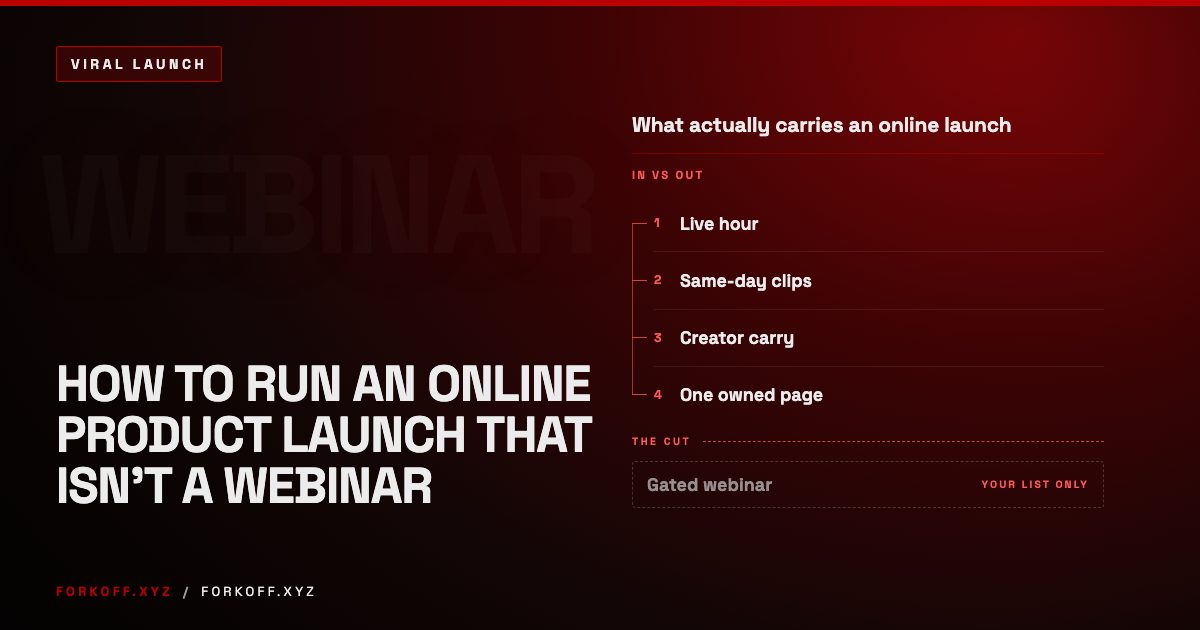
How to Run an Online Product Launch That Isn't a Webinar
An online product launch is a live moment cut into clips that creators carry, not a gated webinar. Here is the livestream, clip and creator stack for 2026.
 Read
Read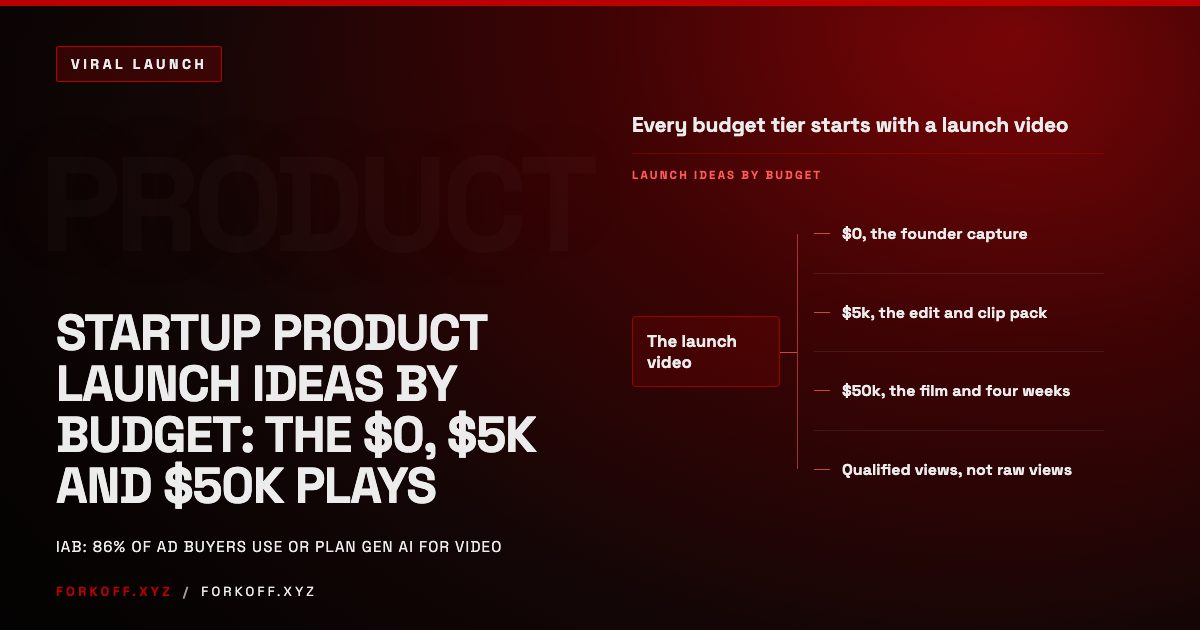
Startup Product Launch Ideas by Budget: The $0, $5k and $50k Plays
Product launch ideas for a SaaS startup sorted by budget: what the launch video should be at $0, $5k and $50k, and the distribution around it.
Read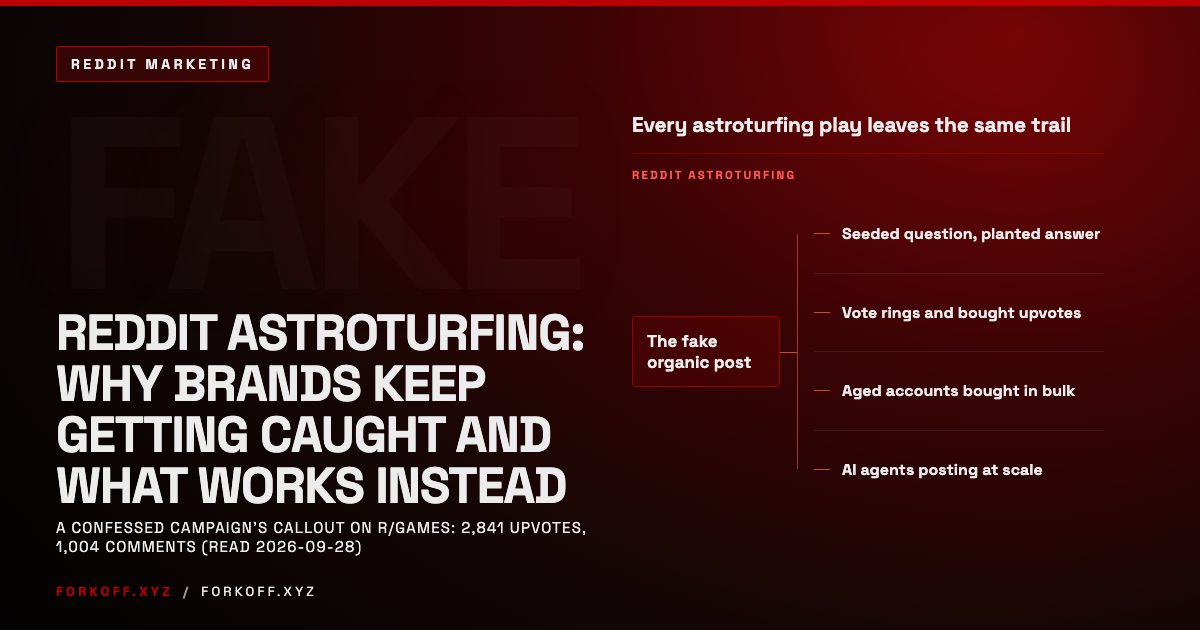
Reddit Astroturfing: Why Brands Keep Getting Caught and What Works Instead
Reddit astroturfing is paid promotion dressed up as organic talk. Why brands keep getting caught, what exposure costs, and the legitimate way to show up.
Read