
RADAR · Methodology · Published 2026-06-27
Earned reach or bought reach:RADAR reads it from public data
RADAR measures whether a viral launch's view count reflects organic reach or paid distribution. RADAR has analyzed 110.4M+ combined views across the tracked corpus using three public signals: whether reach and genuine engagement move together, how the amplification spread, and when the post went out. It does not judge the product or the founder. Paying for distribution is legal and common. RADAR measures how the reach was built, and every input is public.
RADAR measures whether a viral launch's view count reflects organic reach or paid distribution, using three public signals: whether reach and genuine engagement move together, how the amplification spread, and when the post went out. A launch reads as distribution-amplified when views climb far faster than the engagement that reach would normally carry, when the amplification arrives in a single coordinated window instead of spreading over days, and when the posting time fits a scheduled launch. Every input is public.
This is a narrow finding, not a character judgment. When RADAR labels a launch distribution-amplified it is reporting how the reach was built, not alleging that the product is fake or the founder dishonest. Paying for distribution is legal and common. The methodology, the confidence labels, and the source citation are how that line stays clear.
What RADAR answers, and what it does not
RADAR answers one question: did a launch's reach grow the way organic reach grows, or was paid distribution layered on top of a real post. It reads that from public platform data rather than opinion, and it stops there. The product, the founder, and whether buying distribution was a good idea are all outside what this method measures.
A launch video crosses several million views in a day. Did that reach grow the way organic reach grows, or was distribution bought and layered on top of a real post? RADAR answers that narrow question with evidence, not opinion.
It does not judge the product or the founder. Paying for distribution is legal and common, and often a sound launch tactic. RADAR measures how the reach was built. That distinction is the entire reason it exists, and it is the line the rest of this page holds.
Reach vs engagement coherence
This is the signal RADAR leans on hardest. It compares how far a post's reach travelled against how much genuine engagement that reach carried, then reads the size of the gap between them. The table below names the three patterns that gap falls into, from reach and engagement rising together to reach running far ahead of it.
On organic posts, reach and genuine engagement rise together, because the same feed that surfaces a post also makes it easy to like it. When views climb but the engagement does not keep pace, the extra views are arriving from somewhere that does not also produce engagement. That gap is the fingerprint of bought distribution.
| Pattern | Reading |
|---|---|
| Coupled | Views and genuine engagement rise together. Earned reach. |
| Decoupled | Views run ahead of the engagement organic reach produces. A distribution buy. |
| Sharply decoupled | Views vastly outrun any matching engagement. A like-farm signature. |
The gap widens as reach outruns engagement. RADAR reads its size against a labeled set of real launches, not a single published cutoff.
One note on why follower count is a weak signal. A large account can post reach that looks modest next to its follower base while still being heavily bought, because a big following hides the buy. Reach measured against followers is not trusted. Reach measured against genuine engagement is the signal that holds.
Amplification patterns
The second signal is timing. RADAR takes the public amplification a launch collected and looks at how it was spread across the hours after the post went out. Amplification that keeps arriving over days as new people find the post reads differently from amplification that lands inside one narrow early window.
Organic amplification spreads. A genuinely viral post collects amplification in a long, irregular tail as different people find it over hours and days. A bought amplification tends to be a burst: a coordinated set of accounts amplifies in a synchronized window early on, manufacturing the velocity the paid distribution then rides.
RADAR reads the timing pattern of a launch's public amplification and how tightly it clusters. Amplification that lands in a narrow early window, rather than spreading as different people find the post over days, reads as coordinated rather than organic. RADAR weighs the shape of that pattern, not any single account.
Timing signals
The third signal is when the post went out. RADAR checks whether the posting time fits a planned slot or a spontaneous moment. This one is deliberately weak and never carries a reading by itself. It only counts when the first two signals already point the same way, and then it corroborates them.
Coordinated launches tend to be scheduled. A post whose timing fits a planned, scheduled slot rather than a spontaneous moment is a mild tell. On its own it means little, but alongside a large reach-to-engagement gap and a coordinated amplification pattern it corroborates a coordinated launch.
Beyond the ratio: RADAR's forensic grade
For launches inside RADAR's live monitoring feed, the reach-to-engagement ratio is one input into a five-signal forensic grade, not the whole method. The section below names each of the five components, explains why a raw ratio misleads on large passive audiences, and states how the grade maps back to the confidence labels used everywhere else.
The three signals above are RADAR's original, hand-audited method, and every launch page states which method produced its read. Launches RADAR monitors live carry a richer, five-component forensic grade instead of the ratio alone: the view-velocity curve's shape (organic spread vs an injected burst), engagement coupling weighed across the full reply and quote layer rather than the like count in isolation, reply-network authenticity (real, distributed accounts vs a coordinated pod), the amplifier-cluster pattern (word of mouth vs a known repost ring), and smart-follower activation (whether specific high-influence accounts engaged, when that data exists).
This matters most on exactly the launches where a raw ratio would mislead: a large, established account posting to a broad, largely passive audience can show a views-to-likes ratio deep in what looks like fraud-tier range while every other engagement layer, replies, reposts, quotes, moves the way real reach moves. RADAR's forensic grade is built to catch that case rather than flag it as bought on the ratio alone. A launch graded this way still shows its raw ratio in full, RADAR does not hide an unusual number, it explains why the grade weighs it differently.
Grade and confidence band come from the same evidence standard as the rest of this page: a High-confidence grade requires the underlying signal to have enough data to read reliably, and maps to the verified confidence label used across RADAR; a lower-confidence band maps to reconstructed. A launch with too little data on a given component shows that component as neutral, still monitoring, rather than forcing a call either way.
Confidence, sample size, and micro launches
Confidence scales with the evidence available, so a small launch is never over-called. Every reading carries one of three labels, set by how much data stood behind it: a full forensic trace, the reach-to-engagement signal alone, or too few data points to read the amplification pattern. The three are defined below, in that order.
RADAR covers launches of every size, from micro to major, and the confidence label scales with the evidence available.
Verified
A full forensic trace exists: the complete amplification pull plus the live metric snapshot. High confidence.
Reconstructed
The reading is derived from the reach-to-engagement signal alone, without a full amplification trace. Labeled as lower confidence.
Insufficient sample
A micro launch with too few data points to read the amplification pattern reliably. It cannot earn a high-confidence bought verdict, because there are not enough engagers to be sure. It is shown with its metrics and an evidence-only label, never an over-called verdict.
Every RADAR page shows the launch size and the confidence level, so a small launch is never treated like a large one.
What RADAR is not saying
When RADAR labels a launch distribution-amplified, here is what that does not mean. The three lines below set the outer edge of the claim, and the paragraph after them states the narrow finding that is left once those three are ruled out. This is the part of the method that keeps a reading about reach rather than about a person.
When RADAR labels a launch distribution-amplified, it is not saying:
- 01that the product is fake or does not work,
- 02that the founder did anything against the rules,
- 03that buying distribution is wrong. It is legal, common, and often a sound launch tactic.
The finding is narrow: the headline view number reflects bought reach built through coordinated amplification, not organic word of mouth. That distinction is the entire reason RADAR exists. Every verdict states the product and founder are real where that is the case, and frames the result as a signature of how reach was built.
The evidence behind a reading
Every reading rests on public data. If you are its subject, you can see the specific signals behind it. This section lists what those inputs are, explains why RADAR stops short of publishing a step-by-step reproduction guide, gives the address to write to, and notes that a reading is point-in-time and gets re-checked.
Every input a RADAR reading rests on is public platform data, not private information: the reach and engagement a post carried, the shape of its amplification, and when it went out. RADAR does not publish a step-by-step reproduction guide, but the basis of any reading is available to the person it concerns.
If you are the subject of a reading and want to see the specific signals behind it, or believe a fact is wrong, email crew@forkoff.xyz and we will share the evidence the reading was based on and consider any correction or response.
A reading is point-in-time. RADAR re-checks launches over time, because bot purges and late engagement shift the numbers, and each page carries a last-checked date for that reason.
Data provenance
The bands are calibrated against real launches, and the method is versioned. This section says where the calibration corpus came from, how a live monitor keeps watching launches as they happen, and which other FORKOFF pages the method connects to, from the plain-English answer pages to the tracked launches it has already been applied to.
RADAR's readings are calibrated against a labeled corpus of real launches (30 fully profiled, with a high-resolution time-series reference set), and a live monitor watches launches in real time as they happen. The methodology is versioned and refreshed as the platform's dynamics change. Every input traces to that corpus and public platform data, not to any private source.
RADAR sits alongside the rest of FORKOFF's first-party measurement work in FORKOFF research, and it grows out of running managed distribution and influencer marketing at the scale where the difference between earned and bought reach stops being a guess and becomes a measured signal.
For the plain-English version of the questions this method answers, read what a botted launch is, how to tell if a launch is botted or organic, and the organic vs amplified launch benchmark.
To see the method applied, browse the best product launch videos ranked by views or the full set of tracked launches on the Launch Radar hub.
FORKOFF sells distribution and runs RADAR. Here is how that stays honest
The disclosure first, then the four things that keep a reading independent of who is paying. FORKOFF sells managed distribution and also reads whether reach was bought, which puts it on both sides of the same question. The four points below are structural properties of the method, not assurances, and each one can be checked.
FORKOFF runs managed distribution. We help launches reach more people, and that is a paid service. RADAR reads whether a launch's reach was earned or bought. So FORKOFF sits on both sides of the same question, and you should know that before you trust a reading.
That is a real conflict, and the answer to it is not a promise. It is the method itself. Four things keep a RADAR reading independent of who is paying FORKOFF.
The method is disclosed
Every reading rests on public X data, and the categories of signal behind it are disclosed here. A method built on public data and stated, open categories cannot be quietly bent toward a client.
No privileged inputs
RADAR reads the same public view counts, like counts, quote-tweets, and timestamps for everyone. There is no private data that a FORKOFF client gets graded on more softly.
The verdict ignores the relationship
A reading is a function of the evidence, not of whether the launch is a FORKOFF client, a competitor, or a stranger. The confidence label and the source citation travel with every verdict, so the basis is always visible.
We grade our own work by the same bar
FORKOFF's own launches are read by the same signals and the same bands as everyone else. We hold our distribution to the standard RADAR publishes rather than exempting it.
The short version: the way to check FORKOFF is not to take our word for it. Every reading rests on public data, the subject of any reading can see the evidence behind it, and our own launches are held to the same bar. That is the whole reason the method is disclosed.
If you are the subject of a reading
A reading is point-in-time and open to correction. The path is the same for everyone. This section sets out what to send, where to send it, and what happens next: a factual error is corrected, a response can be published alongside the reading, and an erasure request is reviewed. Client status changes none of it.
A RADAR reading is an evidence-based opinion derived from public data, not a statement of fact about any person, and it is open to correction and reply. If you are the subject of a reading and believe a fact is inaccurate, wish to add a response, or want to request erasure, email crew@forkoff.xyz with the launch and the specific point at issue. We review requests in good faith, correct any factual error, and consider a response for publication alongside the reading. The path is the same for everyone, whether or not they are a FORKOFF client.
The full detail is set out in the privacy policy and the terms of service.
RADAR methodology FAQ
The most common questions about bought views, how reach and engagement compare, and what a verdict does and does not claim. The answers below repeat the method in everyday language for readers arriving from a search rather than from the top of this page, and they cover small launches, the conflict of interest, and how to see the evidence.
Frequently asked questions
How can you tell if Twitter/X views are bought?
The clearest public signal is whether reach and genuine engagement move together. On organic posts they rise in step, because the same feed that shows a post also makes it easy to like it, so when views climb far past the engagement that reach would normally carry, the extra views are arriving from somewhere that does not also produce engagement. The shape of the amplification confirms it: reach that spreads naturally over days reads differently from reach that arrives in a single coordinated window.
Does a high view count mean a launch is fake?
No. The product can be entirely real and the founder can have done nothing against the rules. A high view count paired with far less engagement than that reach would normally carry means the reach was distribution-amplified, not that the product or founder is fake. RADAR measures how reach was built, not whether anyone was honest.
Is buying distribution against the rules?
No. Paying for distribution is legal and common, and it is often a sound launch tactic. RADAR does not allege wrongdoing. It reports a narrow, evidence-based finding: that the headline view number reflects bought reach built through coordinated amplification rather than organic word of mouth.
What is a normal views-to-likes ratio on X?
There is no single magic number, and fixating on one misses the point. What matters is whether reach and genuine engagement move together. On organic posts, views and likes rise roughly in step, because the feed that surfaces a post also makes it easy to like it. When views run far ahead of the engagement that reach would normally carry, that gap, not any one threshold, is the signal that distribution was bought. RADAR reads the size of that gap against a labeled set of real launches rather than a single published cutoff.
How many views is viral for a launch on X?
There is no fixed threshold, and view count on its own is the wrong number to fixate on. The informal bar people use for a launch video on X is around one million views in a day, but RADAR treats a high view count as a question rather than an answer, because those views can be earned through genuine engagement or bought through paid distribution. What separates a genuinely viral launch from an inflated one is whether the engagement kept pace with the reach: a launch that crosses a million views with likes that rose alongside it reads as organic, while the same reach with far less engagement reads as distribution-amplified.
What is the difference between organic and bought virality?
Organic virality is reach that grew with its engagement: views and likes rose together, and the amplifying quote-tweets spread over hours and days as different people found the post. Bought virality is reach layered on with paid distribution: views climb far past what the engagement supports, and the amplification arrives in a single coordinated window rather than spreading naturally. Neither is dishonest by default, paying for distribution is legal and common, but they are built differently, and the gap between reach and engagement plus the shape of the amplification tell them apart from public data.
How does RADAR handle small launches?
Micro launches have too few quote-tweets to read the amplification wave reliably, so they cannot earn a high-confidence bought verdict. There are simply not enough engagers to be sure. A micro launch is shown with its metrics and an evidence-only label, never an over-called verdict. Every RADAR page shows the launch size and the confidence level so a small launch is never treated like a large one.
Can I see the evidence behind a RADAR reading?
Every input a reading rests on is public platform data, not private information: the reach and engagement a post carried, the shape of its amplification, and when it went out. RADAR does not publish a step-by-step reproduction guide, but if you are the subject of a reading you can request the specific signals behind it. Email crew@forkoff.xyz and we will share the evidence your reading was based on and consider any correction or response.
What is RADAR not claiming when it labels a launch distribution-amplified?
It is not saying the product is fake or does not work, not saying the founder did anything against the rules, and not saying that buying distribution is wrong. The finding is narrow and specific: the headline view number reflects bought reach built through coordinated amplification, not organic word of mouth. Where the product and founder are real, the page states that up front.
FORKOFF sells distribution and runs RADAR. Is that a conflict of interest?
Yes, and we state it plainly. FORKOFF runs managed distribution as a paid service, and RADAR reads whether a launch's reach was earned or bought, so FORKOFF sits on both sides of the same question. The safeguard is not a promise, it is the method. Every reading rests on public platform data, there are no privileged inputs that grade a client more softly, a verdict is a function of the evidence rather than the relationship, and FORKOFF's own launches are read by the same signals and the same bar as everyone else. Anyone who is the subject of a reading can see the evidence it rests on.
Authorship
Simba
Co-founder, FORKOFF
Reviewed by: Kshitij JK
Last reviewed:
Published:
Methodology
RADAR methodology: three public signals (whether reach and genuine engagement move together, the shape of the amplification, and the posting time), calibrated against a labeled corpus of 30 launches, with verified, reconstructed, and insufficient-sample confidence labels.
Sources cited
- How to tell if Twitter/X views are bought , FORKOFF
- What RADAR is not saying , FORKOFF
Want a launch read by RADAR's method?
RADAR reads whether a launch's reach was earned or bought from public data, with the confidence label and the source citation on every reading. Talk to a strategist about a launch you want measured.
Explore the launches
Launches RADAR is tracking
HyperAgent launch
@howietl
14.3M views · 2,265 per likeRead
SubQ launch
@alex_whedon
13.1M views · 568 per likeRead
OpenAI's Jalapeño AI chip launch
@OpenAI
7.1M views · 312 per likeRead
Cursor for iOS launch
@cursor_ai
6.4M views · 492 per likeRead
Anoria launch
@michaelblhssn
5.7M views · 4,410 per likeRead
Meridian launch
@alexmdees
5.3M views · 1,523 per likeRead
The benchmark behind every reading
- The organic vs amplified benchmark. What a healthy launch ratio looks like, side by side.
- RADAR methodology. The bands, the confidence model, and how to reproduce a read.
- The Launch Authenticity Report 2026. The aggregate study across the tracked corpus.
- The X Launch Authenticity Study 2026. Two in three tracked launches show a bought-amplification signature.
- Verified-organic leaderboard. The launches RADAR reads as genuinely organic.
- Best product launch videos. The editorial cut of every tracked launch, ranked by views.
- Product launch video service. Get a launch video made and distributed, priced on the outcome.
Receipts, deep dives, and playbooks.
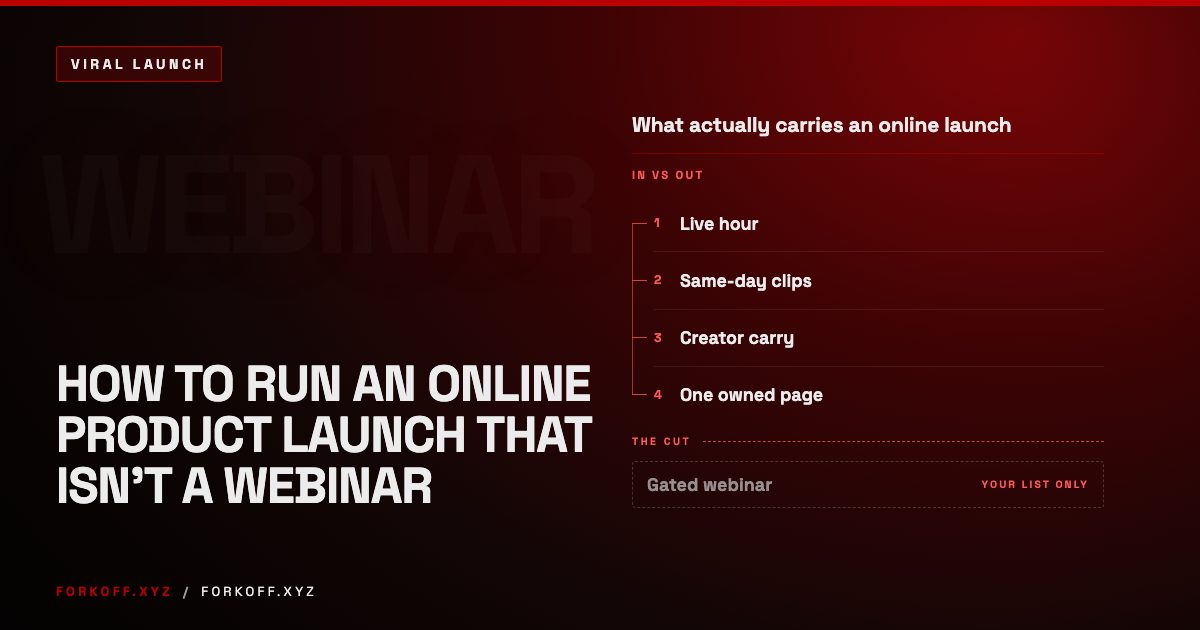
How to Run an Online Product Launch That Isn't a Webinar
An online product launch is a live moment cut into clips that creators carry, not a gated webinar. Here is the livestream, clip and creator stack for 2026.
 Read
Read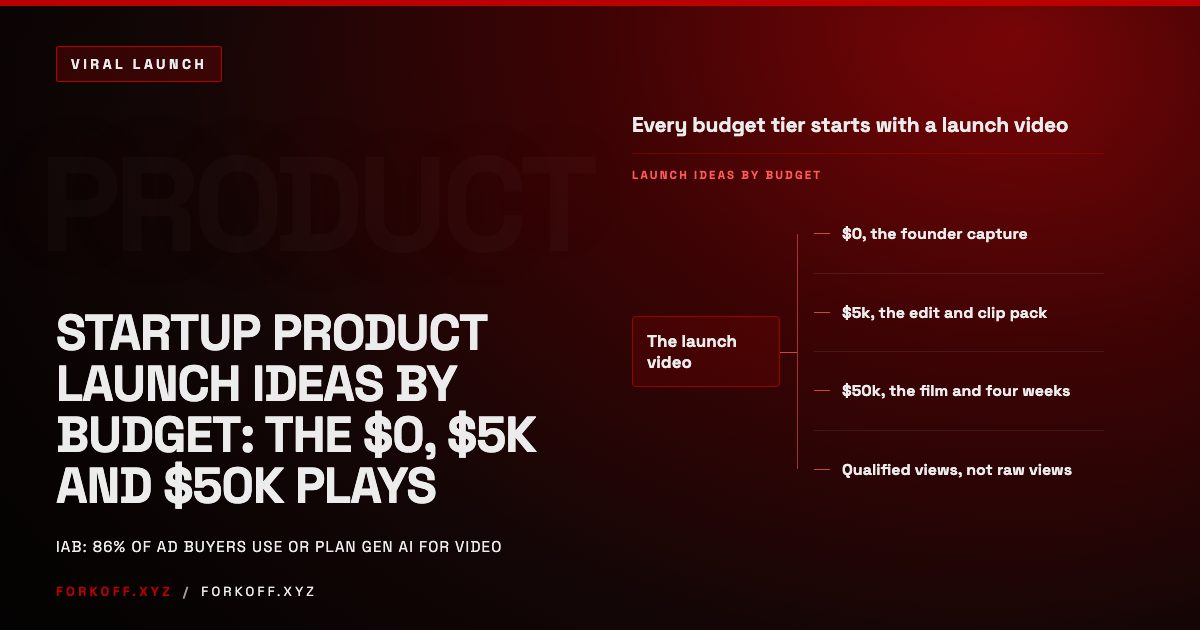
Startup Product Launch Ideas by Budget: The $0, $5k and $50k Plays
Product launch ideas for a SaaS startup sorted by budget: what the launch video should be at $0, $5k and $50k, and the distribution around it.
Read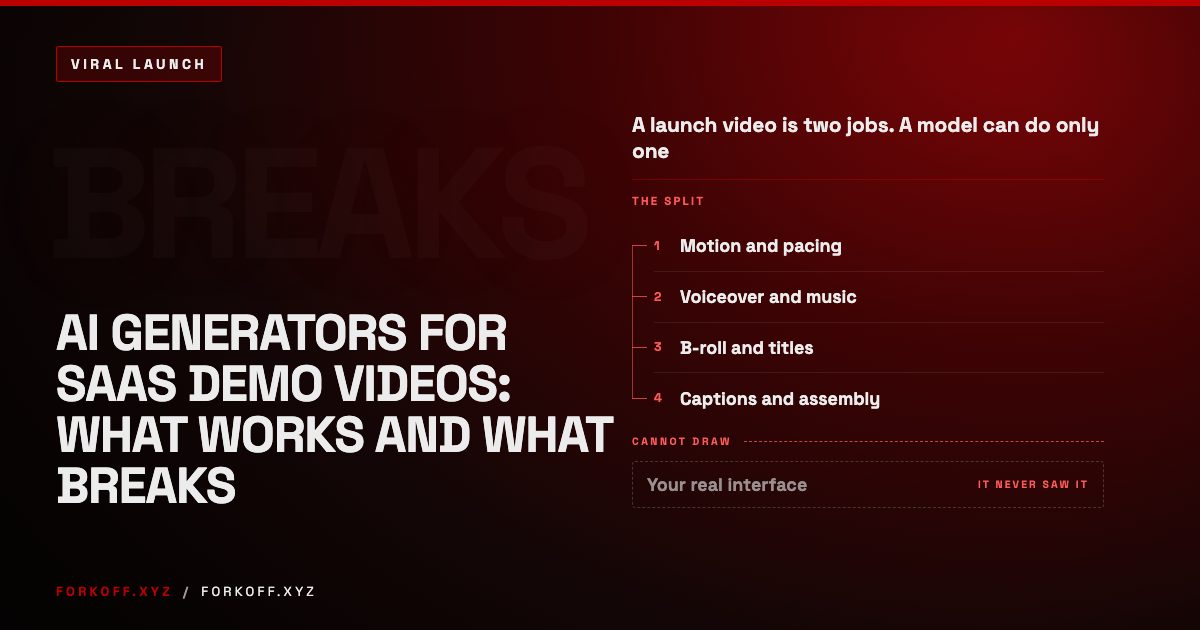
AI Generators for SaaS Demo Videos: What Works and What Breaks
AI video generators handle motion, voiceover and pacing well and draw your interface badly. Which half of a launch video to give a model, which half to keep.
Read