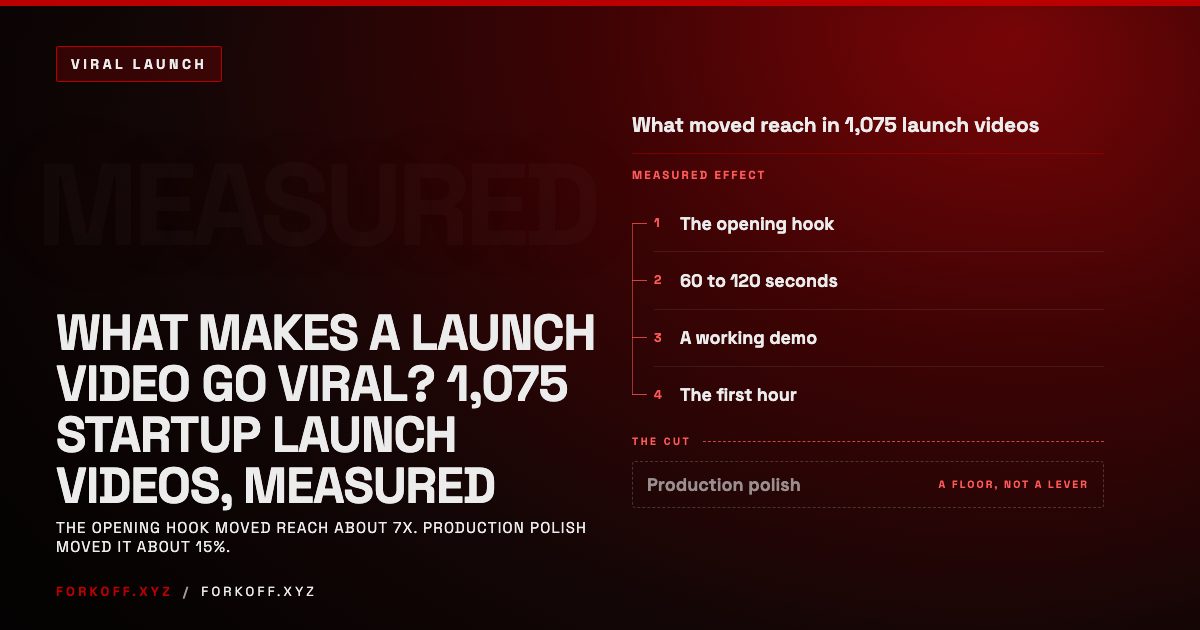
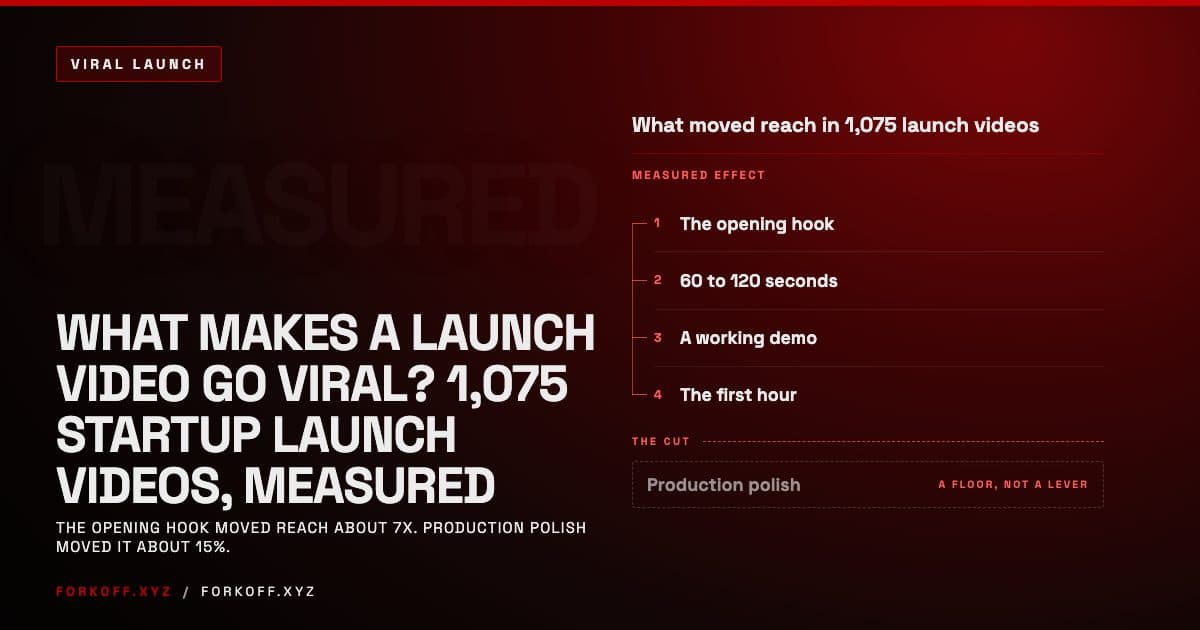
What makes a launch video go viral is mostly the first line. Across 1,075 startup launch videos FORKOFF labelled, videos that opened by declaring an old way of working dead earned a median 1.80 views per follower, while generic announcements earned 0.23. Length came second, with 60 to 120 seconds leading. Production polish came a distant last.
The short version
We labelled 1,075 startup launch videos posted on X from accounts with at least 1,000 followers and compared each one's views with the size of the account that posted it. The opening hook moved reach the most: videos that opened by declaring an old way of working dead earned a median 1.80 views per follower, while generic announcements earned 0.23. Videos of 60 to 120 seconds earned 0.68, against 0.17 for clips under 15 seconds. Live product demos beat founder monologues, 0.52 to 0.15. Production polish barely moved the median (0.31 high, 0.27 low), though low-polish videos cleared 100K views less often. And 70% of all launch videos reached fewer people than the account had followers, so the video is the part you control, not the part that guarantees reach.
Every founder we talk to about a launch asks some version of the same question. Is it the production? The length? The founder on camera? Asking friends to repost? We stopped guessing and measured it. We took 1,101 launch videos from the FORKOFF launch RADAR, pulled each one's own video file from X, labelled the opening hook, the concept, the production level, the length and who was on screen, and compared every video's views with the size of the account that posted it. This post is what the 1,075 videos from accounts with at least 1,000 followers say.

What moved reach across 1,075 startup launch videos
| Factor | Best group, views per follower | Weakest group |
|---|---|---|
| Opening hook | Category death, 1.80x | Behind the scenes, 0.10x |
| Video length | 60 to 120s, 0.68x | Under 15s, 0.17x |
| Creative concept | Live action demo, 0.52x | Milestone post, 0.09x |
| Production level | High, 0.31x | Low, 0.27x |
Median views divided by followers, FORKOFF launch corpus (published 2026-10-15), 1,075 launches from accounts with 1,000 or more followers.
What makes a launch video go viral, according to 1,075 launches?
According to 1,075 startup launch videos, three things inside the video moved reach: an opening hook that declares, provokes or surprises, a length of 60 to 120 seconds, and the product shown working. Polish barely moved the median. The single biggest gap was the hook, 1.80 views per follower against 0.23.
We measure reach as views divided by followers, which we call the reach multiple. A raw view count mostly tells you how big the account was. A reach multiple tells you how far the video travelled past the people who already follow you, which is the only part of a launch that is viral. A 500,000-follower account that gets 100,000 views on a launch did 0.2. A 5,000-follower account that gets the same 100,000 did 20.
The biggest creative levers, side by side
Each bar is the median for that group in the FORKOFF launch corpus, 1,075 launch videos from accounts with 1,000 or more followers.
Here is the order the corpus puts the creative levers in, from biggest to smallest: the opening hook (about 7 times between the best and the generic opener), the length (about 4 times between 60 to 120 seconds and under 15), the concept (about 3 times between a live demo and a founder monologue) and production level (about 15% between high and low). The rest of this post goes through each one, then through what the data cannot see.
Most launch videos never leave their own audience
70% of the 1,075 launch videos reached fewer viewers than the posting account had followers. The median video reached 0.28 views per follower. A launch video is not a distribution plan, and the data says so in plain numbers before you spend anything.
Source: FORKOFF launch corpus, published 2026-10-15
How many views does a typical startup launch video get?
A typical startup launch video in the FORKOFF launch corpus got 39,610 views. About a third, 32.4%, cleared 100,000 and 9.1% cleared a million. The median video reached 0.28 views per follower, and 70% reached fewer people than the posting account had followers. A quiet launch is the normal outcome.
The spread is wide. The top quarter of launch videos started at 149,620 views and the top tenth at 821,573. Together the 1,075 videos drew about 568M views, and 98 of them passed a million. Only 30% reached more people than the account had followers, and 12.8% reached ten times their following.
That is why a raw view count tells you so little about a launch video. A founder on r/startups asked the community what 100,000 launch views on X would turn into in signups, and the useful replies all began with a question back: whose 100,000?
How many signups will a 100k views on launch video on X get me roughly. I will not promote
If you want the wider frame, the State of Launch Videos report covers reach across every launch the RADAR tracked, and the biggest launch videos on X this week reads one week of launches in detail. This post is about what is inside the video.
Which opening hooks make a launch video travel furthest?
The opening hooks that travelled furthest declared something dead. Category death openers, 55 videos, earned a median 1.80 views per follower and 51% cleared 100K. Counterintuitive data came next at 0.87, then a jab at a known pain at 0.52. Pure demos, the most common opener, earned 0.25.

Reach by opening hook, 1,075 launch videos
| Opening hook | Videos | Views per follower | Cleared 100K | Source |
|---|---|---|---|---|
| Category death | 55 | 1.80x | 51% | measured |
| Counterintuitive data | 38 | 0.87x | 37% | measured |
| Pain point dunk | 163 | 0.52x | 40% | measured |
| Pure demo | 520 | 0.25x | 30% | measured |
| Generic announcement | 62 | 0.23x | 35% | measured |
| Demo then reveal | 93 | 0.20x | 28% | measured |
| Milestone or news announcement | 82 | 0.18x | 33% | measured |
| Behind the scenes | 16 | 0.10x | 19% | measured |
as of 2026-10-15
Method: FORKOFF launch corpus labels.jsonl (published 2026-10-15), filtered to accounts with 1,000 or more followers (n = 1,075); hook type labelled by a vision model from 8 frames per video; medians and shares computed per group.
Views per follower is the median of views divided by the posting account's followers. Left out to keep the chart readable, nobody talks about (21 videos, 0.28x) and debate principals (17 videos, 0.13x), plus hooks with fewer than 15 videos.
We labelled the hook from the opening frames and the post itself, using a fixed set of types. Category death says an old tool, workflow or category is finished. Counterintuitive data opens on a number that surprises. A pain point dunk mocks a problem the viewer already lives with. A pure demo shows the product with no setup. A generic announcement is the "we're excited to launch" opener, and a milestone or news announcement leads with a user count, a ranking or a piece of company news.

The cleanest example in the corpus is Flo Crivello's launch of Lindy Teammate. The post opens with one line that kills a category and names the replacement:
Today, we kill the AI agent and introduce the AI employee: Lindy Teammate.
Flo Crivello
@Altimor
Today, we kill the AI agent and introduce the AI employee: Lindy Teammate. It’s just like working with a real employee. Everyone on your team can simply hit it up on Slack and get 10x more done. Lindy also keeps learning, and becomes the self-updating brain of the whole busine… Show more
That launch reached about 7.8M views from 52,396 followers and drew 236 quote posts. Category death works for a reason that is easy to see in the replies: it is a claim people want to agree with, argue with or explain to their own followers. Each of those is a reason to quote the post, and each quote post carries the video to a new audience.

The other two strong openers do the same job in different ways. A surprising number invites someone to check it. Cursor's router launch opened on a cost number and drew 492 quote posts on about 2.68M views:
Cursor
@cursor_ai
Introducing Cursor Router, our intelligent model router that selects the right model for the task at hand. Router delivers frontier-quality results at 60% lower cost.
The hook that declares something dead travelled furthest
Across 55 launch videos that opened by declaring an old category or workflow finished, the median video reached 1.80 times as many viewers as the account had followers, and 18.2% passed a million views. 56% of them reached more people than the account had followers. Generic "we're excited to launch" openers reached 0.23, and only 27% got past their own audience.
Source: FORKOFF launch corpus, published 2026-10-15
The weak openers have one thing in common: they give the viewer nothing to say. "We're excited to launch" asks for congratulations. A milestone or news announcement asks for a like. A behind-the-scenes clip asks for patience. None of them hands the viewer a sentence they would want to repeat. Finding that sentence is the first job of a launch video creative brief, well before a shoot is booked.
Operator noteWrite the first line before the script. If it does not declare something over, name a pain or surprise with a number, rewrite it.
Does the hook still matter once audience size is held fixed?
Yes, the hook still matters with audience size held fixed, though the gap shrinks. Among accounts with 50K to 250K followers, category death openers earned 0.35 views per follower and pain point openers 0.31, about twice the 0.16 of pure demos and generic announcements. Among 10K to 50K accounts, category death earned 4.45 against 0.77.
This check matters because hook type and account size are not independent. Smaller founder accounts tend to write sharper, riskier openers, and small accounts also reach further per follower for reasons that have nothing to do with the video. If we only compared the whole corpus, some of the hook effect could be an account-size effect in disguise.

The hook effect with audience size held fixed
| Opening hook | 10K to 50K followers | 50K to 250K followers | Source |
|---|---|---|---|
| Category death | 4.45x (n 13) | 0.35x (n 17) | measured |
| Pain point dunk | 0.76x (n 36) | 0.31x (n 49) | measured |
| Pure demo | 0.77x (n 69) | 0.16x (n 278) | measured |
| Counterintuitive data | 2.65x (n 8) | 0.14x (n 15) | measured |
| Milestone or news announcement | 0.24x (n 11) | 0.18x (n 23) | measured |
as of 2026-10-15
Method: Same corpus and labels, split into follower bands before taking the median views per follower for each hook.
Small groups swing hard. Read the direction, not the decimal.
Two things changed when we held the band fixed. The category death opener kept its lead in both bands. The pain point opener led only among 50K to 250K accounts; at 10K to 50K it tied the pure demo, 0.76 against 0.77. The counterintuitive data opener did not: it ranked second in the 10K to 50K band but fell to 0.14 among 50K to 250K accounts, on only 15 videos. A surprising number seems to work best from an account small enough that the number itself is the news. From a large brand, it reads like a press release.
The honest reading is that the hook is a real lever, roughly a doubling inside the 50K to 250K band, not the sevenfold gap the raw table suggests. That is still the largest effect of any label in the FORKOFF corpus, and it is the one a founder controls completely.
Does production quality make a launch video go viral?
Production quality alone does not make a launch video go viral. High-production videos earned a median 0.31 views per follower, mid 0.28 and low 0.27, about 15% from top to bottom. Polish did lift the floor: 38% of high-production videos cleared 100K views against 21% of low-production ones.


Reach by production level
| Production | Videos | Views per follower | Cleared 100K | Source |
|---|---|---|---|---|
| High | 207 | 0.31x | 38% | measured |
| Mid | 782 | 0.28x | 32% | measured |
| Low | 86 | 0.27x | 21% | measured |
as of 2026-10-15
Method: Production level (high, mid, low) labelled by the vision model from sampled frames; medians and shares per level.
Within the 50K to 250K follower band the same order holds, 0.23x, 0.16x and 0.15x, with 24%, 17% and 7% clearing 100K.
The pattern held inside the 50K to 250K band too, where 24% of high-production videos cleared 100K against 7% of low-production ones, while the medians sat at 0.23, 0.16 and 0.15. And in the top tenth of videos by reach multiple, 24% were high production against 19% of the whole corpus, while only 4% were low production against 8%. Polish keeps a video out of the bottom. It does not lift it to the top.
Y Combinator made the same point this week from the other direction, introducing a founder interview on launch videos in which Farza Majeed says he works out the hook before he shoots anything. The post that introduced it opened with a line many founders need to hear:
You're trying to figure out the hook before you even do the video.
There's a misconception that a successful launch video needs to cost tens of thousands of dollars and feel like a high production commercial.
Y Combinator
@ycombinator
There’s a misconception that a successful launch video needs to cost tens of thousands of dollars and feel like a high production commercial. But @FarzaTV has a different approach.
It is also why the cost of the film keeps falling without the results falling with it. Tools like Remotion, which renders video from React components, let a founder make a polished launch video from code in an afternoon. One r/SaaS founder took that to its end point and made a parody of every SaaS launch video, because so many of them now look alike:
AI made launch videos free, so I made a parody of every SaaS launch video
Polish lifts the floor, not the ceiling
High-production launch videos earned a median 0.31 views per follower and low-production ones 0.27. The gap that did show up was at the bottom: 21% of low-production videos cleared 100K views against 38% of high-production ones. Spend enough on the film to look credible, then spend the rest on the first hour.
Source: FORKOFF launch corpus, published 2026-10-15
The idea is not new. A guide to making a launch video with no experience and for free drew 222 points on Hacker News in 2019. What is new is that the cheap film now looks good. None of this means a cheap film is fine. A launch video still has to look like it came from a company that ships. It means the budget line that moves reach is rarely the camera. Our guide to what a launch video costs prices the film and the distribution as separate lines, which makes that trade easy to see.
How long should a launch video be?
A launch video should run about 60 to 120 seconds when the product needs showing. Those 172 videos earned a median 0.68 views per follower and 49% cleared 100K views. Clips under 15 seconds earned 0.17, and videos over two minutes earned 0.37. The median launch video in the corpus runs only 32 seconds.

Reach by video length
| Length | Videos | Views per follower | Cleared 100K | Source |
|---|---|---|---|---|
| Under 15 seconds | 191 | 0.17x | 27% | measured |
| 15 to 30 seconds | 282 | 0.20x | 27% | measured |
| 30 to 60 seconds | 320 | 0.31x | 32% | measured |
| 60 to 120 seconds | 172 | 0.68x | 49% | measured |
| Over 120 seconds | 110 | 0.37x | 33% | measured |
as of 2026-10-15
Method: FORKOFF launch corpus, duration_s from the launch post's own media file, bucketed, then median views per follower per bucket.
Length is the video file's own duration. The median launch video in the corpus runs 32 seconds.

The length gap survived the same audience check as the hook. Among 50K to 250K follower accounts, 60 to 120 second videos earned 0.53 views per follower and 38% cleared 100K, while sub-15 second clips earned 0.12 and 9% cleared 100K. The median length of the 98 videos past a million views was 56 seconds, and the top tenth by reach multiple had a median of about 56 seconds too.
Usability research has said this about openings for years: Nielsen Norman Group's guidance on video tells teams to start strong and keep any introduction to 5 seconds or less. That is about the opening, not the total length. Short-form habits explain why so many launch videos are too short overall. Founders cut for TikTok and Reels, where 15 seconds is normal, then post on X, where a launch is read by people deciding whether a product is real. A minute is enough to show the problem, the product working and the result. Fifteen seconds is usually enough for a logo and a promise, and a promise is not something people quote.
What X itself published about its ranking points the same way. In the heavy ranker configuration X open-sourced from its recommendation system, watching at least half of a video carried a weight of 0.005, while a reply the author then engaged with carried 75. That is the 2023 version and the weights have surely moved since, but the direction is clear: a video that holds attention long enough to start a conversation is doing what the ranker paid for.
X's published ranker barely rewards watching half a video
The heavy ranker configuration X open-sourced in 2023 lists the engagements it predicts and their weights. Watching at least half of a video carried a weight of 0.005. A reply that the author then engages with carried 75, and a reply alone 13.5. On that published version, conversation was worth thousands of times more than a half-watch.
Source: twitter/the-algorithm-ml, projects/home/recap README
Operator noteCut to 60 to 120 seconds unless the claim needs less. The corpus median is 32 seconds, and the 1M-view median is 56.
Which launch video concepts get the most reach?
Launch video concepts that showed the product working got the most reach. Live action product demos earned a median 0.52 views per follower and motion graphics explainers 0.45. Cinematic brand films earned 0.33 and screen recordings 0.28. Founder-to-camera videos earned 0.15 and milestone posts 0.09, the lowest of any major concept.

The concept labels describe what the video mostly is. A live action demo shows a real person using the product in the real world, a robot arm on a table or a phone in a hand. A motion graphics explainer animates the product and the problem. A cinematic brand film tells a story with production values. A screen demo is a recording of the interface.
The top tenth of the corpus by reach multiple leaned toward the polished story formats. Cinematic brand films were 24% of the top tenth against 10% of all videos, and motion graphics 22% against 15%. Screen demos were 20% against 28%. So the high end rewards a film that tells a story, while the median rewards a video that simply shows the thing working. Both beat a talking head, which is the format founders reach for first because it is the cheapest to make. The launch video types guide covers which format fits which launch.

Should the founder appear in the launch video?
The founder can appear in the launch video, but a founder talking without a claim performs badly. Founder-to-camera videos earned a median 0.15 views per follower across 124 videos, and videos with the founder or team on screen earned 0.17, against 0.31 for videos with no people at all. The opening line decided which founder videos travelled.
That sounds like an argument against founder videos, and it is not. The two biggest category death launches in the corpus were both founder-to-camera videos, one of them Flo Crivello on camera, opening with "Today, we kill the AI agent." The format did not hold them back because the first line did the work. Most founder videos in the corpus open with a greeting, a thank-you or the backstory, which is three seconds of nothing a stranger would quote.
Operator noteIf the founder goes on camera, give them a claim, not a greeting. The two biggest category death launches in the corpus were founder videos.
Plenty of founders would rather not be on camera at all, and a founder on r/SaaS said so plainly:
I personally hate being on camera, and can't overcome this fear. Am I alone in this?
The data says that is fine. Videos with nobody on screen earned 0.31 views per follower, a little ahead of videos with actors (0.29) and well ahead of founder and team videos (0.17). If the founder is the face of the launch, write their first sentence as carefully as the product page headline. Then cut to the product working within the first ten seconds, because the founder is the frame and the product is the proof.
Which product categories get the most launch video reach?
Hardware and robotics launch videos got the most reach, a median 0.63 views per follower and 49% past 100K views. AI apps followed at 0.59 and AI models at 0.52. Creative AI media, the most crowded category with 335 videos, earned 0.15, and only 19% of those cleared 100K.

Reach by product category
| Category | Videos | Views per follower | Cleared 100K | Source |
|---|---|---|---|---|
| Hardware and robotics | 35 | 0.63x | 49% | measured |
| AI apps | 172 | 0.59x | 45% | measured |
| AI models | 82 | 0.52x | 35% | measured |
| Dev tools | 151 | 0.44x | 38% | measured |
| Enterprise SaaS | 27 | 0.24x | 37% | measured |
| Fintech and crypto | 189 | 0.22x | 36% | measured |
| Creative AI media | 335 | 0.15x | 19% | measured |
as of 2026-10-15
Method: Vertical labelled per launch; median views per follower and share past 100K per vertical; media and community (38 videos, 0.28x), gaming (23 videos, 0.36x) and verticals under 20 videos left out.
Creative AI media is the most crowded category in the corpus and the one where a launch video travelled least.
Operator notePick the category before the cut. In crowded categories like video generators, the claim has to carry more of the load.
A physical product doing something new is easy to watch and easy to describe to a friend, which is why hardware launches travel. Creative AI media is the opposite case. When a feed has seen a hundred video generators in a month, the hundred-and-first demo has to bring a claim the others did not. The launch by vertical section of our launch video service covers how the play changes for AI, SaaS, hardware and crypto launches.
Why do small accounts get more launch video views per follower?
Small accounts get more launch video views per follower because quote posts carry them past a small base, and because of who the data includes. Accounts with 1K to 10K followers earned a median 15.5 views per follower and 80% out-reached their audience. Accounts over 250K earned 0.20, and only 22% did.

Part of this is real and useful. A founder with 3,000 followers whose launch is quoted by twenty larger accounts reaches far more people than they could alone, and a large account's launch is mostly shown to people who already follow it. That is the whole case for planning the first hour.
Part of it is selection, and we want to be plain about it. The RADAR tracks launches that drew enough attention to be picked up. A small account that posted a launch video to silence is less likely to be in the data than a large account that did the same. So read the small-account number as "what is possible from a small base", not "what a small account should expect". Large accounts had the opposite profile: a median of 128,705 views and 58% past 100K, from reach that mostly came from their own audience.
Operator noteJudge a launch video by views per follower, not raw views. A big account can hit 100K on habit alone.
What can the launch video data not tell you?
The launch video data cannot tell you what happened after the post went live. It measures the video and the account, not who quoted the post, whether creators were paid, whether views were bought, or what the reach turned into. It also only includes launches the RADAR picked up, which skews toward launches that drew attention.

Four limits, stated so you can weigh the numbers properly. First, the labels come from a vision model reading 8 frames of each video, so a hook that lands in the voiceover rather than the picture can be mislabelled. Transcripts were mostly skipped, because launch videos are largely music-only. Second, these are correlations. A sharp hook and a planned launch tend to come from the same teams. Third, every view figure here is X's public counter, and X documents that its view count includes repeat views and promoted posts. Fourth, there is no distribution field in this corpus at all: no quote-post count, no paid label, no first-hour read.
That last gap is the important one. A launch video with a perfect hook and no plan for its first hour is still a post to your own followers. To tell earned launch views from pushed ones, start with our audit of 30 startup launch videos, then paste any launch you want to imitate into the authenticity checker.
What does a launch need beyond the video?
A launch needs a planned first hour, a second wave and an audit beyond the video. The video sets how far a launch can go. The first hour decides whether it starts: which accounts quote it, in what order, and who answers the replies. A launch on X has about four to five days of reach, and a weekend can take two of them.

From first line to reach beyond your followers
The founders we talk to on sales calls describe this gap in their own words. One said they did not know the first thing about distribution. Several said impressions are cheap and what they want is engagement from people who might buy. Others worry about bots, or say their niche cannot go viral, or that they already have distribution because the company account is large. The data above answers most of these. A large account is a floor, not a plan. A niche product can travel if its first line hands people something to say. And engagement, not impressions, is what the ranker rewards.
Production budget, a sharper hook or a planned first hour
More production budget
A sharper hook
A planned first hour
Lifts median reach per follower
Lifts the share clearing 100K
Reaches people who do not follow you
Costs mostly time, not money
Measured in this corpus
The corpus measures the video, not the distribution, so the first-hour column rests on the RADAR's launch reads and FORKOFF's client launches.
For the minute-by-minute version of that first hour, read our breakdown of a 1M-view launch; for the days after it, the guide to sequencing launch week videos. Founders hiring help should ask any agency for its first-hour plan by name, which is the first item in our checklist for choosing a launch video agency, and can line agencies up against each other in the launch video agency comparison.
Operator noteBook the first hour before you book the edit suite. A video with no planned first hour is a post to your own followers.
How do FORKOFF client launches compare with the corpus?
FORKOFF client launches sit far above the corpus median of 39,610 views, and both paired the video with a planned first hour. ClickUp's June 2026 launch cleared 3.1M clean views, beating its 2M to 3M goal, and Gushwork's July launch kept 1,438,997 verified organic views after an audit.
ClickUp's launch video had a claim and a working product on screen. What carried it was the wave behind it: 104 measured posts from 48 seeded creators, averaging 10,744 views each, followed by 63 accounts that amplified it unpaid. The 3.1M figure is the clean one, counted after flagged pushed bursts were set aside.
Paid creators first, unpaid accounts after
ClickUp's June 2026 launch, run by FORKOFF, cleared 3.1M clean views against a 2M to 3M target. A seeded wave of 48 creators posted 104 measured posts worth about 1.1M views, and 63 accounts nobody paid joined in after them. Flagged pushed bursts were removed first.
Source: FORKOFF launch report, ClickUp, June 2026
Gushwork's July 2026 launch shows the audit side. Its founder post read 2,103,255 views on X's counter, and 664,258 of them were flagged and taken out after the views-per-like check and the snapshots, so the number reported was 1,438,997 verified organic views. The 62 creator posts around it drew 873,282 views on their own.

What we take from the corpus into every launch is simple. We write the first line with the founder before anyone storyboards, we push for a cut between one and two minutes when the product needs showing, and we spend the distribution budget on the people who will quote the post in its first hour. The launch video service page sets out how that works for a client, and the team is a message away.
How will AI search change what a launch video needs?
AI search will make a launch video's claim matter more, because answer engines quote sentences, not footage. Assistants such as Grok, ChatGPT, Gemini and Perplexity answer "what launched this week" by reading posts and pages. A launch with a quotable first line and a public, audited number gives them something to cite.
Budgets have not caught up. In Wistia's State of Video research, more than half of teams (57%) put more hours into making video than into getting it seen, and one in five (20%) does the reverse. Two things follow for a founder. The opening line now does double duty, stopping the scroll on X and becoming the sentence an assistant repeats when someone asks about your category. And the film keeps getting cheaper while the claim and the first hour do not, so the money in a launch budget keeps moving away from the camera. Boards like Launch YC already show the result: hundreds of competent launch videos, a few of which travel.
The same lesson shows up outside launches. A creator who studied 1,000 short-form hooks landed in the same place the FORKOFF launch data does, that the first line decides who keeps watching:
I Studied 1,000 Hooks, Here’s How to ACTUALLY Go Viral
heyDominik
A creator who studied 1,000 short-form hooks lands where our launch data does: the first line decides who keeps watching.
Most teams still spend their time on the film
Wistia's State of Video report found that 57% of teams spend more time creating video than promoting it, and only 20% spend more time promoting. In our launch corpus the creative choices that moved reach were cheap ones, the first line and the cut, so the time spent polishing is the easiest budget to move.
Source: Wistia, State of Video report
For the numbers to watch after launch day, the product launch metrics for the first 30 days guide picks up where this one ends, and the distribution learning curve explains why founders keep relearning it.
The blunt answer: the first line, then the first hour
Here is the blunt answer. What makes a launch video go viral is a first line people want to repeat, a cut long enough to show the product working, and a first hour that puts it in front of the right accounts. In 1,075 launch videos, the hook moved reach about 7x, length about 4x and polish about 15%.
So write the first sentence before the script. If it does not declare something over, name a pain the viewer feels, or surprise them with a number, rewrite it. Cut to 60 to 120 seconds if the product needs showing. Spend enough on the film to look credible and no more. Then plan the first hour, because 70% of launch videos never reach past their own followers, and the video alone will not change that. When you are ready, the launch video service is where we start, and the best product launch videos of 2026 show what the result looks like.
Methodology. Dataset: FORKOFF launch corpus (labels.jsonl and MANIFEST.json, published 2026-10-15). Source: completed launches on the FORKOFF launch RADAR with views and a post URL, the launch post's own video from X, and the account's follower count. Labels: a vision model read 8 frames per video at temperature 0 and labelled hook, concept, production level, people on screen, vertical and on-screen text; duration is the video file's own. Population: 1,101 labelled videos, of which the 1,075 from accounts with 1,000 or more followers are used here. Measure: reach multiple, views divided by followers, reported as group medians, with shares past 100K and 1M views. Pulled for this post on 2026-10-24.