

ben
@contraben · 14.7K followers
Introducing Contra Payments. The first payments platform that lets you sell to AI Agents. RT + Comment “Contra” and I’ll send you 100 products AI agents are looking for.
Contra Payments launchLargely Organic
Contra Payments is a real product by a real founder (@contraben). RADAR has tracked 2.3M views on this launch, according to the source post linked below. RADAR measures how the launch reach was built, not whether the product works or whether anyone was honest. This reading is reconstructed confidence and every input is public.
By Simba, Launch Intelligence Analyst · Reviewed by JK · Published 28 Jun 2026 · Confidence: reconstructed
Independent, methodology-derived signal, not a statement of fact about any person. RADAR reads how reach was built, a signature, not an accusation. See the methodology.
Did the Contra Payments launch go viral organically, or was the reach amplified?
The Contra Payments launch by @contraben drew 2.3M views on 5.1K likes, which is 445 views per like, inside the roughly 500 organic ceiling. RADAR reads the reach as organic: reach and engagement grew together and no distribution-amplified signature shows in the public metrics. This is a reconstructed reading and every input is public and reproducible.
New here? Start with the product
What is RADAR, and what does this grade mean?
RADAR is FORKOFF's launch authenticity rating system. It reads whether a product launch earned its reach through real engagement or bought it through paid distribution, using only public signals anyone can pull from the launch post. Every reading carries a letter grade, a confidence label, and the date it was last checked, and links back to a published method you can reproduce. Contra Payments is a real product by a real founder (@contraben). RADAR measures how the reach was built, not whether the product works or whether anyone was honest.
Largely Organic
Independent, methodology-derived signal, not a statement of fact about any person. RADAR reads how reach was built, a signature, not an accusation. See the methodology.
What this grade means
This launch carries an Authenticity Grade of Largely Organic. RADAR reads its reach as organic: the views and the genuine engagement grew together, and no distribution-amplified signature shows in the public metrics. That is a favorable, low-risk read.
The signals RADAR reads
Views-to-likes ratio
Organic reach tops out near 500 views per like. When views climb far past that without the likes to match, the extra reach is arriving without the engagement organic reach produces.
Amplification wave shape
Organic amplification spreads over hours and days. A coordinated launch fires a synchronized burst of quote posts in the first few hours, read from each post's own timestamp.
Posting-time fingerprint
A post that fires exactly top of the hour on a weekday is scheduled. On its own it is weak, but it corroborates a coordinated launch alongside the other two signals.
Those three public signals sit on top of RADAR's five-component forensic read. The full method, the bands, and the confidence model are on the RADAR methodology page.
This launch in the data
Where does this reach sit against the tracked corpus?
Where it sits in the corpus
Rank 7 of 30 tracked launches by views per like, lowest (most organic) first. A lower ratio is the favorable end.
Against the benchmark
This launch's views per like next to the organic median (354) and the amplified median (1,441) across the tracked set.
A real founder, a real product, and reach that engagement kept pace with.
Here is what makes this launch a clean positive read. Almost every public signal points the same way at once. A genuine, seven-year-old company's founder posted to his own audience. The like rate held proportionate to a mega-viral view count. The reply and bookmark layers, which a like-farm cannot cheaply manufacture, came in heavy. And when every layer of engagement rises with the reach instead of lagging far behind it, the simplest explanation is the true one: the post spread because real people passed it on and saved it for later.
One nuance belongs up front, because it shapes the numbers. The launch carried a giveaway hook, "RT + Comment Contra and I'll send you 100 products AI agents are looking for" (x.com/contraben). That is a legitimate organic growth tactic that deliberately pushes reposts and one-word replies up, which lowers the views-to-likes ratio and lifts the reply count. It is incentivized human engagement, not purchased views. RADAR accounts for it below rather than mistaking it for a bought-amplification tell.
The rest of this teardown walks the reading first, then steps back to the product, the founder, the funding, and the market, so a reader can audit the read and understand the launch in full. RADAR exists to separate the marketing layer (what a launch claims) from the data layer (what the public signals actually show). A reads-organic verdict is a compliment about how the launch spread. It is not, and we will say this plainly later, an endorsement of the product itself.
Engagement coupling: the layers rose with the reach
The thing that often hides a buy is missing here. Ben Huffman's personal account carries a modest base, around 14,700 followers, against a 2.28M-view launch. A bought-view operation typically inflates views far faster than it can buy proportionate, coupled engagement, so the tell is reach that outruns the likes, replies, and bookmarks. RADAR went looking for that gap and did not find it. The engagement scaled with the reach.
Signal one: the views-to-likes gauge in the organic zone
The load-bearing signal is V:L, views divided by likes. On X, the feed that surfaces a post also makes it easy to like, so under organic distribution reach and likes rise together up to roughly 500 views per like. X's 2026 ranking treats engagement types as interconnected signals and rewards them together, with written replies weighted heavily for authenticity because a reply is costly effort (tweetarchivist.com). When views climb but likes do not keep pace, the views are arriving from a channel that does not also produce engagement. The Contra Payments launch shows the opposite: 2,275,499 views divided by 5,118 likes is 444.6 views per like, a like rate near 0.22 percent. Median X engagement runs roughly 0.015 to 0.045 percent, so this post's interaction depth sits well above baseline for its reach (tweetarchivist.com).
Signal two: the costly layers came in heavy
Likes are the cheapest action to fake. Replies, quotes, and bookmarks are not, because each one is either a written post a real person had to compose or a private save signalling genuine intent. Fake-engagement detection guidance describes the bought pattern as a ratio mismatch, like-and-retweet symmetry, or tiny follower counts paired with huge interaction, often arriving in unnatural waves (scrapebadger.com, tweetarchivist.com). The Contra Payments launch is the inverse. Every layer is present and human-shaped: 5,118 likes, 1,715 reposts, 2,848 replies, 399 quotes, and roughly 4,953 bookmarks. The mix is asymmetric (likes and replies and bookmarks all roughly comparable, reposts lower), which is what real distribution looks like, and the bookmark count sitting near the like count is the hardest, lowest-yield metric to buy.
Views per like
Under the 500 organic ceiling. Likes kept pace with a 2.28M-view reach instead of lagging far behind it.
Replies
Written posts, the costliest action to fake at scale. The giveaway hook lifts this layer, but the conversation under it is genuine.
Bookmarks
A private save signalling real intent, almost level with likes. Bookmarks are the lowest-yield, hardest metric to manufacture.
Total coupling
Likes plus reposts plus replies plus quotes (10,080) against 2.28M views, before bookmarks. Above the normal band for very high reach.
Signal three: earned amplification, not a single coordinated push
The shape of the spread matters as much as its size. The launch drew earned third-party pickup from mainstream and crypto press within hours rather than one orchestrated burst. The Kobeissi Letter, a large finance account, amplified it with a "BREAKING" framing that agent-driven commerce had arrived (x.com/KobeissiLetter), and crypto outlets covered the USDC payout rail as accelerating on-chain payment adoption (ourcryptotalk.com). A bought spike does not earn independent writeups from named outlets. Distributed, multi-source pickup is a strong tell of authentic reach.
Read together, the three signals tell one story. The reach grew the way organic reach grows. A genuine founder posted to his own audience on a live, established product; the like rate held under the organic ceiling; the expensive engagement and bookmark layers came in heavy; and earned press carried it outward. There is no decoupled view spike here to explain away.
What Contra Payments actually is
Ben Huffman announced it from his own account. The launch tweet read: "Introducing Contra Payments. The first payments platform that lets you sell to AI Agents. RT + Comment Contra and I'll send you 100 products AI agents are looking for" (x.com/contraben, 18 Feb 2026). Worth stating precisely, because the wedge is load-bearing: the headline positioning is selling to AI agents, not simply "selling to anyone." That agent-native framing, tied to Huffman's second venture Contra Labs, is what gave the launch its contrarian hook and its mainstream plus crypto pickup. The product's own website leads on the calmer promise, "100 percent commission free" creator payouts (contra.com/blog/payments).
The official blog frames the goal directly: more than 1.2M creatives have earned over $200M on Contra since 2021, and the company wants to help them earn "the next $1B" commission-free (contra.com/blog/payments). Press describes the agent angle as "one of the first mainstream moves toward agent-native commerce," where millions of AI agents browsing the platform can buy digital products, prompt packs, templates, and full projects through guest checkout with no account creation, settling "in seconds" for digital items (ourcryptotalk.com).
Who it is for, and what it covers
Contra Payments targets independent creatives, designers, writers, developers, and marketers, who sell both 1:1 client work (invoices, escrow projects) and 1:many digital products (templates, AI workflows, prompt packs, scripts, coaching, subscriptions). The differentiator against Upwork and Fiverr is explicit: Contra takes zero platform commission. The "sell to AI agents" layer extends that to a new buyer, an autonomous agent purchasing a digital product on a human's behalf (ourcryptotalk.com). One honest caveat: the 1.2M-creatives and $200M-earned figures are cumulative platform metrics that predate this launch. Neither the blog nor the press provides any agent-driven transaction volume, so agent GMV is unproven at launch and RADAR does not treat it as demonstrated.
Pricing and the crypto rail
There is no platform commission. Instead Contra charges a scalable per-sale fee that grows with the transaction size rather than a flat percentage: roughly $2 to $29 for non-Pro users, a 50 percent reduction on the Pro tier, and $0 in fees on the Max tier. Standard payment-processor fees (about 2.9 percent plus $0.30 on cards, 0.8 percent on ACH, 0.5 percent plus $0.30 on SEPA) are charged by the processor, not Contra (contra.com/blog/payments). Creators can withdraw to Coinbase as USDC at a 2 percent fee, or use bank transfer and PayPal. That USDC option is what earned the launch its crypto-press coverage (ourcryptotalk.com). That the launch landed on an existing 1.2M-creative user base, not a cold audience, is part of why the reach reads organic.
Ben Huffman, co-founder and CEO of Contra
Huffman has led Contra since founding. He posts from a personal handle (id 1080856485528244226, 14,714 followers, 6,340 tweets) that links his second venture, Contra Labs, alongside Contra, which is directly relevant given Contra Payments is pitched at selling to AI agents (crunchbase.com). His backstory is the kind that makes the message read authentic rather than manufactured. He grew up in Lexington, South Carolina, to entrepreneurial parents (his mother a Venezuelan immigrant from Caracas), dropped out of school at 20, and moved to New York City (alejandrocremades.com).
Before tech he worked as a professional music producer, including radio music work with Sony in the UK, then taught himself web development and freelanced at $20K to $30K a month. He became a power user of the freelance marketplaces Elance and oDesk (now Upwork), and his frustration with their commission model seeded Contra directly. He has described Contra as "a cross between LinkedIn and Shopify" (techcrunch.com). His prior company was Ripe, a corporate catering startup that hit about $1M in first-year sales and was acquired by Hungry during the 2020 downturn (alejandrocremades.com).
The credibility markers line up with a real operator. Contra was a 2018 side project that took roughly 300 to 400 pitch-deck iterations to fund, and the company has raised just under $45M through a Series B led by NEA (huntscanlon.com). The commission-free "monetize the value you create, not the time you spend" positioning has been consistent for years, and the Contra Payments launch is a continuation of it, which supports an authentic-message read rather than a hype launch.
What is behind Contra Payments, and how it is financed
Contra (the company) has raised just under $45M total to date, a figure consistent across TechCrunch, Crunchbase, Tracxn, and PitchBook, all of it predating this launch (techcrunch.com). The Series B was $30M led by New Enterprise Associates (NEA), announced 2 November 2021, with Unusual Ventures and Cowboy Ventures participating, and it coincided with Contra going fully commission-free. The earlier $14.5M Series A closed in early 2021 with Unusual Ventures (the earliest institutional backer) and Cowboy Ventures (crunchbase.com).
| Structural fact | Reading |
|---|---|
| Contra Payments round | None public; financed within Contra |
| Series B | $30M led by NEA, Nov 2021 |
| Series A | $14.5M, Unusual Ventures + Cowboy Ventures, early 2021 |
| Total raised | ~$45M through Series B |
| Most recent round | ~Jan 2022, roughly four years stale at launch |
Two clarifications belong here. First, Coinbase is a payment rail, not an investor. Contra Payments settles creator payouts in USDC "via Coinbase," but no capital relationship from Coinbase or Coinbase Ventures is disclosed; do not read it as a backer (ourcryptotalk.com). Second, data aggregators report fragmented tranche figures (a $2.45M Series A line, an $8.21M Series B line, a $7.74M 2022 grant line) that conflict with the headline press numbers (tracxn.com). RADAR uses the primary-source TechCrunch round figures ($14.5M plus $30M, about $45M total) and flags the aggregator breakdown as partial reporting rather than averaging the two.
Where this launch sits, and why the timing helped it spread
The category the hook rode
"Sell to AI agents" sat on top of the most-discussed commerce shift of 2026. As of early 2026 the live agentic-checkout deployments include ChatGPT Instant Checkout, Amazon "Buy for Me," Mastercard Agent Pay, Visa Intelligent Commerce, and Coinbase's x402, with two competing standards: the Agentic Commerce Protocol (ACP) from OpenAI and Stripe, and the Agent Payments Protocol (AP2) that Google donated to the FIDO Alliance (github.com, stripe.com, orium.com). Contra's "first payments platform that lets you sell to AI agents" is a creator-side framing of selling into that stack, not a competing rail, which is the accurate way to place it.
Early demand signals make the pitch credible rather than vaporware. Adobe Analytics measured a 4,700 percent year-over-year jump in generative-AI traffic to US retail sites, and Coinbase's x402 protocol processed roughly 165 million agent transactions in its first months (eco.com, metarouter.io). On the digital-product side, the closest comparables are merchant-of-record creator checkouts: Gumroad (10 percent plus $0.50), Lemon Squeezy (about 3.5 percent plus $0.30), Paddle (5 percent plus $0.50), and raw Stripe (2.9 percent plus $0.30). Contra's commission-free model with flat per-sale fees undercuts the 5 to 10 percent incumbents on higher-ticket creator sales (globalsolo.global).
Underneath it all is a large base. The creator economy is put at roughly $252.3B in 2025 growing toward $1.35T by 2033, and the US independent workforce reached about 72.9M freelancers generating roughly $1.5T in 2025 earnings (Grand View Research, autofaceless.ai). Contra's "help creatives earn the next $1B" framing maps onto that base, and an attentive, opinionated audience reacting authentically is exactly the engagement profile RADAR read.
Comparable RADAR launches
RADAR has profiled a library of launches. Compare the Contra Payments reading against two other reads-organic peers and two distribution-amplified contrasts:
A name-collision check, done and cleared
"Contra" is a generic word, so RADAR checked for confusion. The handle @contraben, the contra.com Payments blog, Crunchbase, and Tracxn all confirm the launcher is the Contra freelance and creative network run by Ben Huffman; there is no rival fintech shipping a same-named "Contra Payments" product (tracxn.com, crunchbase.com). "Contra" does collide with unrelated namesakes, the Konami "Contra" video-game franchise, the accounting term "contra entry" or "contra account," and unrelated marketing shops, but none are payments products (sage.co.uk). Disambiguation risk on this read is low; we flag it as checked-and-clear rather than ignored.
Methodology, and what we are not saying
RADAR does not output a pass or fail on a person. It outputs a signature and a confidence label, both built from public metrics anyone can pull, so the reader can check the work. For Contra Payments, the reads-organic signature rests on the coupling between reach and engagement:
- The views-per-like ratio (445:1) sat under the 500:1 organic ceiling, so likes kept pace with a 2.28M-view reach.
- The costly engagement layers came in heavy: 2,848 replies, 399 quotes, and roughly 4,953 bookmarks, the hardest actions to fake at scale, alongside 5,118 likes and 1,715 reposts.
- Earned third-party pickup from named mainstream and crypto outlets carried it outward, rather than a single coordinated push.
- The giveaway hook (RT + Comment Contra) is an incentivized-but-real organic tactic that lowered the V:L ratio and lifted replies; RADAR accounts for it rather than reading it as a bought-amplification tell.
Confidence and how to reproduce it
Confidence is labeled reconstructed: built from the live metric snapshot and the engagement-ratio reading, not a full forensic trace of every engager. The SSOT figures (2,275,499 views, 5,118 likes) and a later live read (2,276,797 views) differ only by continued accrual, which supports the read. Every input is public. Pull the anchor post's view, like, repost, reply, quote, and bookmark counts; divide views by likes for the gauge; and check that the costly layers are present and proportionate, accounting for the giveaway hook on the reply layer. See the full method at the RADAR methodology.
Questions readers ask about this launch
Is Contra Payments real?
+
Who is Ben Huffman?
+
What is a healthy views-to-likes ratio on X?
+
How do you know the Contra Payments reach was organic?
+
What does Contra Payments do?
+
Sources
Primary citation: x.com/contraben/status/2024182864506761617. Every number traces to a public pull; reads re-checked over time.
- x.com/contraben/status/2024182864506761617 (launch post, 18 Feb 2026)
- contra.com/blog/payments (Introducing Contra Payments)
- ourcryptotalk.com Contra agent-native payments
- web.ourcryptotalk.com Contra coverage
- x.com/KobeissiLetter amplification
- crunchbase.com/person/benhuffman
- crunchbase.com Contra organization
- alejandrocremades.com Ben Huffman profile
- techcrunch.com Contra Series A
- techcrunch.com Contra Series B (NEA)
- huntscanlon.com Contra $30M
- tracxn.com Contra funding
- medium.com Founders Everywhere, Ben Huffman
- grandviewresearch.com agentic commerce market
- stellagent.ai agentic commerce forecast
- mordorintelligence.com agentic AI in retail
- github.com Agentic Commerce Protocol (ACP)
- stripe.com agentic commerce suite
- orium.com ACP, AP2, x402
- eco.com agentic commerce 2026 guide
- metarouter.io agentic commerce statistics
- globalsolo.global Stripe vs Paddle vs Lemon Squeezy
- grandviewresearch.com creator economy market
- grandviewresearch.com freelance platforms market
- autofaceless.ai freelancer economy statistics
- tweetarchivist.com engagement rate guide
- tweetarchivist.com bots detection
- scrapebadger.com bot detection
- sage.co.uk contra entry (name-collision check)
How RADAR read this launch, component by component
Each named component carries a plain-English definition and a directional read where the public data supports one. RADAR publishes the component names, never the weights or the formula.
View-velocity signature
Not publishedWhether the view curve grew the way organic spread does, or spiked like an injected burst.
Per-launch read not published in the public dataset. This component needs the forensic engine output.
Engagement coupling
Supports organicWhether likes, replies, and reposts grew in step with views (the organic signature), or the views ran out ahead.
At 445 views per like, likes track views inside the roughly 500 organic ceiling.
Reply-network authenticity
Not publishedWhether the accounts replying are real, distributed people or a coordinated cluster posting together.
Per-launch read not published in the public dataset. This component needs the forensic engine output.
Amplifier-cluster pattern
Not publishedWhether the quote-tweet amplification looks like organic word of mouth or a known activation cluster.
Per-launch read not published in the public dataset. This component needs the forensic engine output.
Smart-follower activation
Not publishedWhether genuinely influential reference accounts engaged, or the reach was only low-quality volume.
Per-launch read not published in the public dataset. This component needs the forensic engine output.
Are you the founder of Contra Payments? You can claim or contest this read. RADAR attaches a founder response to the launch and re-examines any component you dispute.
Authorship
Simba
Co-founder, FORKOFF
Reviewed by: Kshitij JK
Last reviewed:
Published:
Methodology
RADAR reconstructed reading of the Contra Payments launch from public metrics: the views-to-likes ratio against the roughly 500 organic ceiling and the posting-time slot, framed as a signature of how reach was built, not an accusation.
Sources cited
- RADAR methodology , FORKOFF
- Contra Payments source post , X
Where to go next
Understand launch authenticity
Three ways in, depending on what brought you here: learn how the score works, get a launch read or built, or get the plain answer on this launch.
Learn the score
What a launch authenticity score is
A launch authenticity score reads whether a launch earned its reach or bought it, from public signals. Start with the definitions and the checks you can run yourself.
Verify or build
Launch authenticity verification
Want a launch read by the same method, or a launch video made and distributed on the outcome? RADAR reads any public launch, and FORKOFF builds the launch behind the reach.
The skeptic's question
Is the Contra Payments launch legit?
If you are checking whether the Contra Paymentslaunch was real users or bots, here is the honest read: RADAR's reading is Largely Organic, at reconstructed confidence, computed from public metrics and reproducible from the source post. It measures how the reach was built, not whether the product works.
Peer launches
Launches with a similar read
Cursor for iOS launch
@cursor_ai
6.4M views · 492 per likeRead
Koji launch
@suekhim
4.8M views · 396 per likeRead
Parker launch
@alexgoughcooper
1.6M views · 498 per likeRead
Moda launch
@anvisha
4.5M views · 556 per likeRead
SubQ launch
@alex_whedon
13.1M views · 568 per likeRead
OpenAI's Jalapeño AI chip launch
@OpenAI
7.1M views · 312 per likeRead
The benchmark behind every reading
- The organic vs amplified benchmark. What a healthy launch ratio looks like, side by side.
- RADAR methodology. The bands, the confidence model, and how to reproduce a read.
- The Launch Authenticity Report 2026. The aggregate study across the tracked corpus.
- The X Launch Authenticity Study 2026. Two in three tracked launches show a bought-amplification signature.
- Verified-organic leaderboard. The launches RADAR reads as genuinely organic.
- Best product launch videos. The editorial cut of every tracked launch, ranked by views.
- Product launch video service. Get a launch video made and distributed, priced on the outcome.
Want a launch read by RADAR's method?
RADAR reads whether a launch's reach was earned or bought from public data, with the confidence label and the source citation on every reading.
Receipts, deep dives, and playbooks.
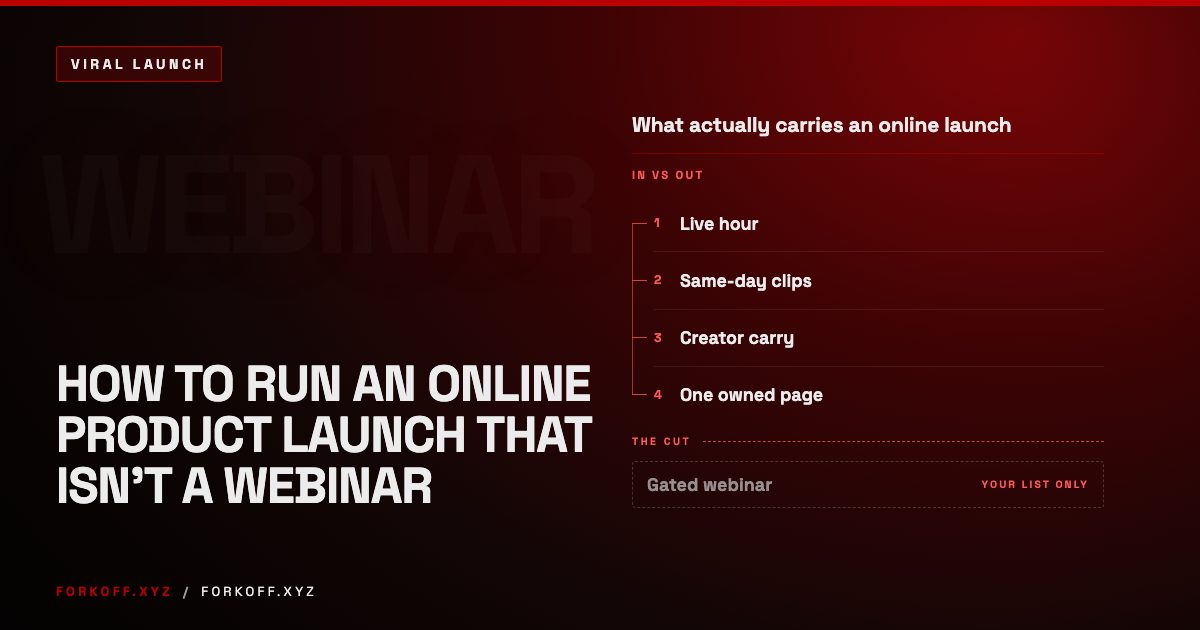
How to Run an Online Product Launch That Isn't a Webinar
An online product launch is a live moment cut into clips that creators carry, not a gated webinar. Here is the livestream, clip and creator stack for 2026.
 Read
Read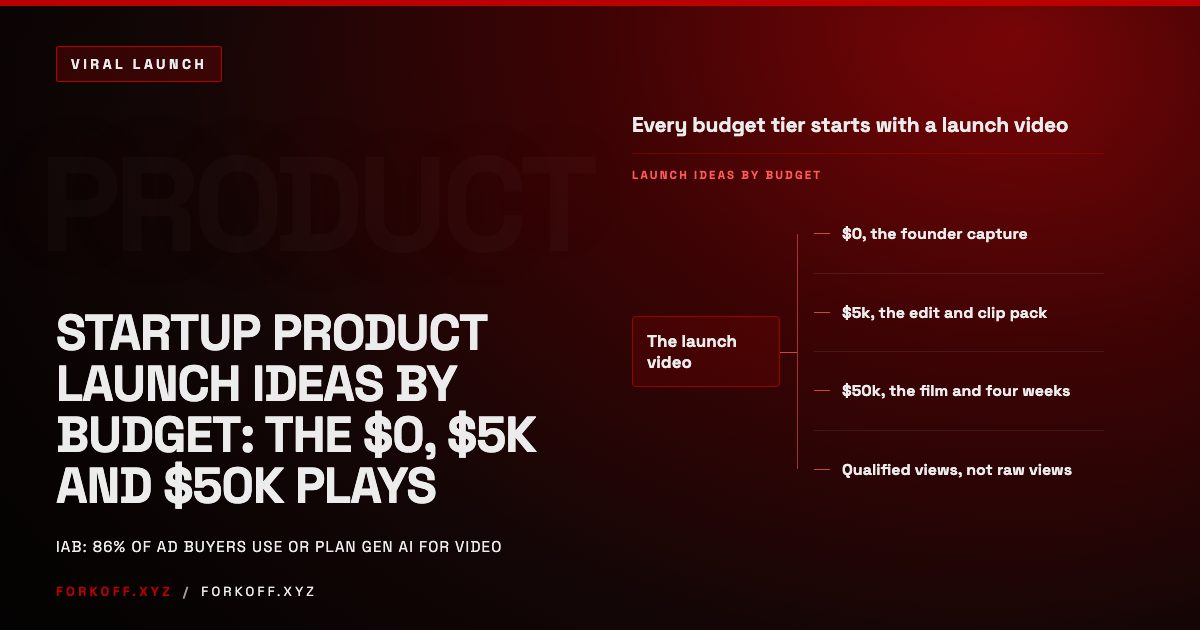
Startup Product Launch Ideas by Budget: The $0, $5k and $50k Plays
Product launch ideas for a SaaS startup sorted by budget: what the launch video should be at $0, $5k and $50k, and the distribution around it.
Read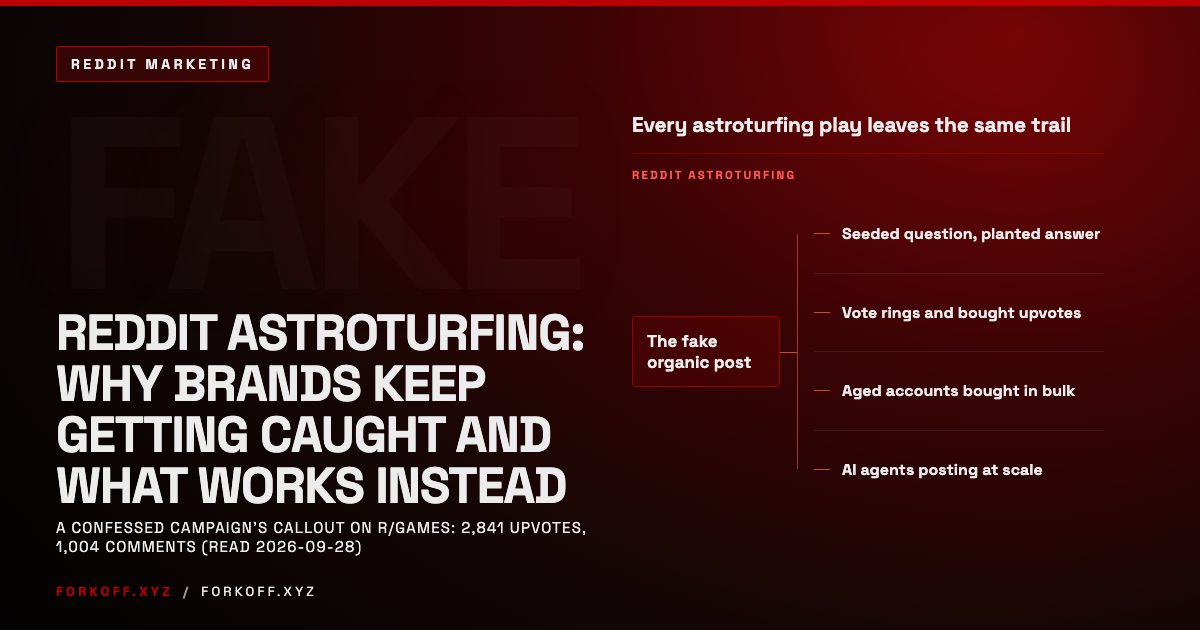
Reddit Astroturfing: Why Brands Keep Getting Caught and What Works Instead
Reddit astroturfing is paid promotion dressed up as organic talk. Why brands keep getting caught, what exposure costs, and the legitimate way to show up.
Read