

Alex Cooper
@alexgoughcooper · 31.1K followers
Introducing Parker: The world's first AI Creative Director. 100+ brands like Grüns, Lume and Legends use us already. RT + Comment "Parker" and I'll send you 100+ AI prompt engineers for hire.
Parker launchLargely Organic
Parker is a real product by a real founder (@alexgoughcooper). RADAR has tracked 1.6M views on this launch, according to the source post linked below. RADAR measures how the launch reach was built, not whether the product works or whether anyone was honest. This reading is reconstructed confidence and every input is public.
By Simba, Launch Intelligence Analyst · Reviewed by JK · Published 28 Jun 2026 · Confidence: reconstructed
Independent, methodology-derived signal, not a statement of fact about any person. RADAR reads how reach was built, a signature, not an accusation. See the methodology.
Did the Parker launch go viral organically, or was the reach amplified?
The Parker launch by @alexgoughcooper drew 1.6M views on 3.3K likes, which is 498 views per like, inside the roughly 500 organic ceiling. RADAR reads the reach as organic: reach and engagement grew together and no distribution-amplified signature shows in the public metrics. This is a reconstructed reading and every input is public and reproducible.
New here? Start with the product
What is RADAR, and what does this grade mean?
RADAR is FORKOFF's launch authenticity rating system. It reads whether a product launch earned its reach through real engagement or bought it through paid distribution, using only public signals anyone can pull from the launch post. Every reading carries a letter grade, a confidence label, and the date it was last checked, and links back to a published method you can reproduce. Parker is a real product by a real founder (@alexgoughcooper). RADAR measures how the reach was built, not whether the product works or whether anyone was honest.
Largely Organic
Independent, methodology-derived signal, not a statement of fact about any person. RADAR reads how reach was built, a signature, not an accusation. See the methodology.
What this grade means
This launch carries an Authenticity Grade of Largely Organic. RADAR reads its reach as organic: the views and the genuine engagement grew together, and no distribution-amplified signature shows in the public metrics. That is a favorable, low-risk read.
The signals RADAR reads
Views-to-likes ratio
Organic reach tops out near 500 views per like. When views climb far past that without the likes to match, the extra reach is arriving without the engagement organic reach produces.
Amplification wave shape
Organic amplification spreads over hours and days. A coordinated launch fires a synchronized burst of quote posts in the first few hours, read from each post's own timestamp.
Posting-time fingerprint
A post that fires exactly top of the hour on a weekday is scheduled. On its own it is weak, but it corroborates a coordinated launch alongside the other two signals.
Those three public signals sit on top of RADAR's five-component forensic read. The full method, the bands, and the confidence model are on the RADAR methodology page.
This launch in the data
Where does this reach sit against the tracked corpus?
Where it sits in the corpus
Rank 9 of 30 tracked launches by views per like, lowest (most organic) first. A lower ratio is the favorable end.
Against the benchmark
This launch's views per like next to the organic median (354) and the amplified median (1,441) across the tracked set.
A real founder, a real product, and reach that real people carried.
Here is what makes this a positive read rather than a flag. The author is a genuine, long-standing operator posting to his own audience, not a fresh or impersonator handle (x.com/alexgoughcooper). The like rate held proportionate to a seven-figure view count. The expensive engagement layers, replies and quotes that a like-farm cannot cheaply manufacture, came in heavy. And the shape of the spread is asymmetric and human: more likes than replies, more replies than reposts, far fewer quotes, the descending stair you expect from real diffusion rather than the flat one-to-one pattern that flags coordinated automation.
RADAR exists to separate the marketing layer, what a launch claims, from the data layer, what the public signals actually show. The rest of this teardown walks the reading first, then steps back to the product, the founder, the funding, and the market, so a reader can audit the read and understand the launch in full. A reads-organic verdict is a statement about how the launch spread. It is not, and we will say this plainly later, an endorsement of the product or of the "world's first" claim stamped on it.
Engagement coupling: the layers held with the reach
The thing that usually hides a buy is missing here. A bought-view operation inflates impressions far faster than it can buy proportionate, coupled engagement, so the tell is reach that outruns the likes, replies, and quotes. RADAR went looking for that gap and did not find it. Every engagement layer is present, and the two costliest layers, written replies and quotes, are heavy.
Signal one: the views-to-likes gauge at the organic edge
The first signal is V:L, views divided by likes. On X, the feed that surfaces a post also makes it easy to like, so under organic distribution reach and likes rise together up to roughly 500 views per like. The Parker launch shows 1,632,025 views divided by 3,280 likes, which is 497.6, call it 498 views per like, a like rate near 0.20 percent. Benchmark data is clear that on massive-reach posts the like rate compresses to the 0.2 to 1 percent band because views balloon faster than likes on viral video, so a 0.20 percent like rate on a 1.6M-view launch video is exactly what the low end of that band looks like (tweetarchivist.com, monolit.sh). The honest reading: the ratio is just inside the organic zone, but it sits at the edge, so on its own it cannot prove organic. RADAR does not rest the verdict on it.
Signal two: the costly layers came in heavy
Likes are the cheapest action to fake. Replies and quotes are not, because each one is a written post a real person had to compose. Engagement-quality guidance is consistent that replies are "harder to manufacture at scale" and "represent genuine interaction," and that a high like count with few replies is the classic inflated-metrics tell (medium.com). The Parker launch is the inverse of the inflated pattern. The reply layer is not just present, it is unusually large relative to likes: 3,280 likes, 1,076 reposts, 1,911 replies, and 132 quotes. Replies running at roughly 58 percent of likes is exceptionally high, and total engagement of 6,399 actions sits near 0.39 percent of views, inside the normal band for a mega-viral post.
Views per like
Just under the 500 organic ceiling. Likes kept pace with a 1.63M-view reach instead of lagging far behind it, though by a thin margin.
Replies
Written posts, the costliest action to fake at scale, running near 58 percent of likes. Heavy conversation is the hallmark of real reach, not a view buy.
Quotes
Each quote is an original post amplifying with commentary, including the producer and the brand designer publicly crediting the work.
Total coupling
Likes plus reposts plus replies plus quotes (6,399) against 1.63M views. Inside the normal engagement band for very high reach.
Signal three: a human-shaped spread, with one honest caveat
The shape of the spread matters as much as its size. Bot-detection guidance flags near one-to-one like-to-repost symmetry as a coordinated-automation tell, and warns that instant bursts seconds after posting signal artificial inflation (tweetarchivist.com). Parker's spread is asymmetric: reposts run at about 0.33 of likes, and quotes (132) sit far below reposts. People liked more than they re-shared, re-shared more than they wrote replies-as-quotes, the descending stair of organic diffusion rather than a flat purchased package (x.com/alexgoughcooper).
Read together, the three signals tell one story. The reach grew the way organic reach grows. A genuine operator posted a produced launch to his own audience on a live product; the like rate held under the organic ceiling; and the costly engagement layers came in heavy and human-shaped. There is no decoupled view spike to explain away. The giveaway pumped the reply count, but it pumped it with real people, not bots.
What Parker actually is
The launch tweet headline read "Introducing Parker: The world's first AI Creative Director," followed by the traction claim "100-plus brands like Gruns, Lume and Legends use us already" (x.com/alexgoughcooper, 27 Jan 2026). The product site adds a testimonial wall naming Parlor Games, Jupiter, Shown Media, Murad Australia, Adcrate, Exposure, and Legends Apparel (heyparker.ai). The buyer is specific: direct-to-consumer brands running Meta ads, digital agencies, freelance creative strategists, and media buyers. That is a buyer with a real paid-social budget, and the pricing reflects it.
Parker's marketing framing is that it ingests millions of ads plus social signal and competitor activity, works autonomously overnight, and delivers concepts by morning at output positioned as "10x a human creative director" (linkedin.com). RADAR treats the 10x claim as a vendor positioning statement, not independently benchmarked performance. The "world's first AI Creative Director" superlative is similarly a marketing claim, not a settled fact, and we examine the contest over it in the market section.
How it is priced
Pricing is spend-tiered, gated by monthly Meta ad spend: Starter at 299 dollars a month for brands spending up to 100,000 dollars a month on Meta ads, Growth at 499 dollars a month up to 500,000, Scale at 699 dollars a month up to 2,000,000, plus custom enterprise. Every plan includes the full product; the tiers scale with ad spend (heyparker.ai). Independent commentary corroborated the entry point at "299 dollars per month for brands spending 100,000 dollars on Meta ads per month." The live pricing page sometimes shows a "let's talk through pricing" contact gate rather than the public numbers, so RADAR treats the exact figures as the published tiers at launch, subject to that gating.
The launch was engineered, and that is not a flag
The 1m41s launch video was a coordinated, produced campaign. It was made by Matt Epstein, who posted that Cooper had asked him to "launch his company" 67 days earlier and cited 15 rounds of script revisions and a packed sales calendar as the result (x.com/MattEpstein16). Brand identity was credited publicly to designer Alex Socoloff (x.com/socoloffalex). A deliberately engineered launch is normal and is not, by itself, an inauthentic-reach signal. RADAR separates "produced," meaning a real team built a real campaign, from "bought," meaning bots inflated the view counter. Parker is the former. The producer and the designer publicly quoting the announcement is itself earned, third-party amplification rather than a single coordinated bot push.
Alex Gough Cooper, co-founder of Parker
His X bio reads "Building things with AI. Tweets about AI and advertising. Co-Founder @heyparkerdotai," with location flags for the UK and South Africa (x.com/alexgoughcooper). His operating record is the agency. Companies House shows ADCRATE LTD (company 14492687) with Gough-Cooper appointed director on 18 November 2022, status active, and he describes himself as a "2x agency founder" (Companies House). At Adcrate's two-year mark he reported, in a founder post, partnering with 50-plus brands, a team of 32, thousands of ads that spent over 40,000,000 dollars, and four creative-house events across Miami, New York, and LA, with a roster cited as including Huel, Laura Geller, InVideo, Gruns, Lume, and Legends (x.com/alexgoughcooper). These are founder self-reported figures, not independently audited, and RADAR flags them as such.
He is an active advertising-industry public figure: an Affiliate World Conferences speaker, a Foreplay-listed ad-creative expert, and a content creator on AI and advertising with a YouTube channel and a beehiiv newsletter (affiliateworldconferences.com, linkedin.com). That audience base is precisely what makes a launch like this read organic: a real operator with real reach, productizing his own agency's creative-strategy IP. Parker uses "Co-Founder," so there is a second co-founder; the designer Alex Socoloff is a brand-identity collaborator, not a company founder, a distinction his own post makes clear (x.com/socoloffalex).
What is behind Parker, and how it is financed
Targeted searches across Crunchbase, Clay, Tracxn, and PitchBook surface no funding profile for the heyparker.ai tool, and the company website carries no investor logos, no "backed by," no accelerator badge, and no founding-story capitalization detail; it is feature, pricing, and testimonial only (heyparker.ai). The founder's own LinkedIn names no round or investors for Parker, which is a meaningful absence given founders typically announce raises (linkedin.com). Positioning Parker as the AI productization of Adcrate's creative-strategy process points to self or agency funding (motionapp.com).
| Structural fact | Reading |
|---|---|
| Parker round | None public; reads bootstrapped / agency-incubated |
| Named backer | None disclosed |
| Accelerator | None found (no Y Combinator, etc.) |
| Parent / incubator | Adcrate (Gough-Cooper's creative agency) |
| Launch headline number | 100-plus brands (traction, not capital) |
For an organic launch read, no-outside-funding is not a weakness, it is part of the explanation. A founder with a real agency, a real customer base, and real industry relationships has a legitimate owned audience that plainly produces unpaid launch reach. The go-to-market here was the founder's own distribution plus a produced video plus a giveaway, not a publicized raise, which is consistent with a product financed off the agency's own book rather than venture capital.
Where this launch sits, and why the timing helped it spread
The buyers are already adopting
Adoption is mainstream among the exact buyers Parker sells to. Industry reporting puts roughly 86 percent of advertisers and media buyers already using or planning to use generative AI for video ads in 2026, and names the "AI Creative Agent," software that analyzes top-performing ads and generates briefs from winning patterns, as the standout capability of the year (stackadapt.com, adobe.com). Parker's pitch, learn your brand, research competitors and ad performance, return answers built for ads, maps squarely onto that emerging sub-category. A product landing on a pain a majority of its buyers already feel is a natural organic-share trigger, which helps explain the heavy reply layer.
A dense competitive field, and one cautionary comparable
Parker did not launch into a vacuum, which is itself proof the demand is real. The 2026 competitive set splits into UGC-video generators (Arcads, Creatify), all-in-one asset generators (AdCreative.ai), cinematic generative video (Higgs Field), and brand-aware agents that push to ad platforms (Hyper). Parker positions as the creative-strategy layer above the render-the-ad tools, framing itself as "the Anti-Icon for Creative Strategists" (linkedin.com, aijourn.com). The closest "world's first" comparable, Icon (the AI Admaker, backed by Founders Fund, which bought Icon.com for about 12,000,000 dollars), is the cautionary tale: multiple outlets reported Icon shut down by March 2026 after failing to ship working AI (techstartups.com). Parker uses the same "world's first" framing in an adjacent lane, which is exactly why an authentic, organic launch signal, rather than paid hype, is the more defensible proof point.
Comparable RADAR launches
RADAR has profiled a library of launches. Compare the Parker reading against two other reads-organic peers and two distribution-amplified contrasts:
Methodology, and what we are not saying
RADAR does not output a pass or fail on a person. It outputs a signature and a confidence label, both built from public metrics anyone can pull, so the reader can check the work. For Parker, the reads-organic signature rests on the coupling between reach and engagement, with the reply layer doing most of the work because the views-to-likes ratio sits at the organic edge:
- The views-per-like ratio (498:1) sat just under the 500:1 organic ceiling, so likes kept pace with a 1.63M-view reach, though by a thin margin RADAR does not lean on alone.
- The costly engagement layers came in heavy: 1,911 replies (near 58 percent of likes) and 132 quotes, the hardest actions to fake at scale, alongside 3,280 likes and 1,076 reposts.
- The spread is asymmetric and human-shaped, the descending stair of organic diffusion, not the one-to-one like-to-repost symmetry that flags coordinated automation.
Confidence and how to reproduce it
Confidence is labeled reconstructed: built from the live metric snapshot and the engagement-ratio reading, not a full forensic trace of every engager. A confident-organic read, labeled reconstructed so it is never overclaimed, and held slightly in check by the edge-of-ceiling ratio and the giveaway-prompted replies.
Every input is public. Pull the anchor post's view, like, repost, reply, and quote counts; divide views by likes for the gauge; check that the costly layers (replies, quotes) are present and proportionate; and read the launch copy for any engagement-bait mechanic that prompts the reply count. The coupling falls out of the data.
Questions readers ask about this launch
Is Parker real?
+
Who is Alex Gough Cooper?
+
What is a healthy views-to-likes ratio on X?
+
Was the Parker launch organic or paid?
+
Is Parker really the world's first AI creative director?
+
Sources
Primary citation: x.com/alexgoughcooper/status/2016201366234939867. Every number traces to a public pull; reads re-checked over time.
- x.com/alexgoughcooper/status/2016201366234939867 (launch post, 27 Jan 2026)
- x.com/alexgoughcooper (verified founder account)
- heyparker.ai (product, pricing, testimonials)
- linkedin.com Parker introduction post
- linkedin.com Parker vs Icon
- x.com/MattEpstein16 (launch producer)
- x.com/socoloffalex (brand identity)
- Companies House, Alexander Vincent Gough-Cooper appointments
- x.com/alexgoughcooper (Adcrate two-year post)
- uk.linkedin.com/in/alexgoughcooper
- affiliateworldconferences.com speaker
- motionapp.com Alex Cooper
- variety.com (Call Her Daddy Alex Cooper, name collision)
- finsmes.com fintech Parker (funding name collision)
- fintechfutures.com fintech Parker
- Companies House PARKER.AI LIMITED (name collision)
- grandviewresearch.com AI in marketing
- thebusinessresearchcompany.com generative AI creative
- stackadapt.com AI advertising
- adobe.com AI marketing trends
- aijourn.com AI ad platforms 2026
- techstartups.com Icon shutdown
- medium.com replies vs likes
- tweetarchivist.com bought-engagement tells
- tweetarchivist.com engagement benchmarks
- monolit.sh engagement rate 2026
How RADAR read this launch, component by component
Each named component carries a plain-English definition and a directional read where the public data supports one. RADAR publishes the component names, never the weights or the formula.
View-velocity signature
Not publishedWhether the view curve grew the way organic spread does, or spiked like an injected burst.
Per-launch read not published in the public dataset. This component needs the forensic engine output.
Engagement coupling
Supports organicWhether likes, replies, and reposts grew in step with views (the organic signature), or the views ran out ahead.
At 498 views per like, likes track views inside the roughly 500 organic ceiling.
Reply-network authenticity
Not publishedWhether the accounts replying are real, distributed people or a coordinated cluster posting together.
Per-launch read not published in the public dataset. This component needs the forensic engine output.
Amplifier-cluster pattern
Not publishedWhether the quote-tweet amplification looks like organic word of mouth or a known activation cluster.
Per-launch read not published in the public dataset. This component needs the forensic engine output.
Smart-follower activation
Not publishedWhether genuinely influential reference accounts engaged, or the reach was only low-quality volume.
Per-launch read not published in the public dataset. This component needs the forensic engine output.
Are you the founder of Parker? You can claim or contest this read. RADAR attaches a founder response to the launch and re-examines any component you dispute.
Authorship
Simba
Co-founder, FORKOFF
Reviewed by: Kshitij JK
Last reviewed:
Published:
Methodology
RADAR reconstructed reading of the Parker launch from public metrics: the views-to-likes ratio against the roughly 500 organic ceiling and the posting-time slot, framed as a signature of how reach was built, not an accusation.
Sources cited
- RADAR methodology , FORKOFF
- Parker source post , X
Where to go next
Understand launch authenticity
Three ways in, depending on what brought you here: learn how the score works, get a launch read or built, or get the plain answer on this launch.
Learn the score
What a launch authenticity score is
A launch authenticity score reads whether a launch earned its reach or bought it, from public signals. Start with the definitions and the checks you can run yourself.
Verify or build
Launch authenticity verification
Want a launch read by the same method, or a launch video made and distributed on the outcome? RADAR reads any public launch, and FORKOFF builds the launch behind the reach.
The skeptic's question
Is the Parker launch legit?
If you are checking whether the Parkerlaunch was real users or bots, here is the honest read: RADAR's reading is Largely Organic, at reconstructed confidence, computed from public metrics and reproducible from the source post. It measures how the reach was built, not whether the product works.
Peer launches
Launches with a similar read
Cursor for iOS launch
@cursor_ai
6.4M views · 492 per likeRead
Contra Payments launch
@contraben
2.3M views · 445 per likeRead
Moda launch
@anvisha
4.5M views · 556 per likeRead
SubQ launch
@alex_whedon
13.1M views · 568 per likeRead
Koji launch
@suekhim
4.8M views · 396 per likeRead
Helena launch
@SeijinJung
3.7M views · 643 per likeRead
The benchmark behind every reading
- The organic vs amplified benchmark. What a healthy launch ratio looks like, side by side.
- RADAR methodology. The bands, the confidence model, and how to reproduce a read.
- The Launch Authenticity Report 2026. The aggregate study across the tracked corpus.
- The X Launch Authenticity Study 2026. Two in three tracked launches show a bought-amplification signature.
- Verified-organic leaderboard. The launches RADAR reads as genuinely organic.
- Best product launch videos. The editorial cut of every tracked launch, ranked by views.
- Product launch video service. Get a launch video made and distributed, priced on the outcome.
Want a launch read by RADAR's method?
RADAR reads whether a launch's reach was earned or bought from public data, with the confidence label and the source citation on every reading.
Receipts, deep dives, and playbooks.
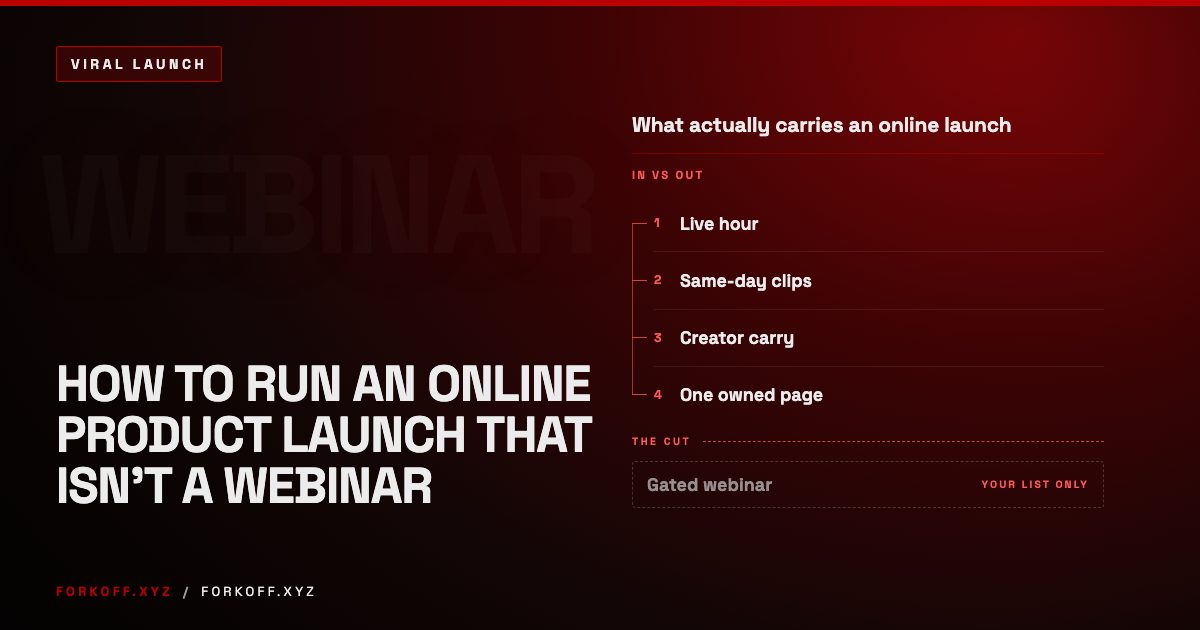
How to Run an Online Product Launch That Isn't a Webinar
An online product launch is a live moment cut into clips that creators carry, not a gated webinar. Here is the livestream, clip and creator stack for 2026.
 Read
Read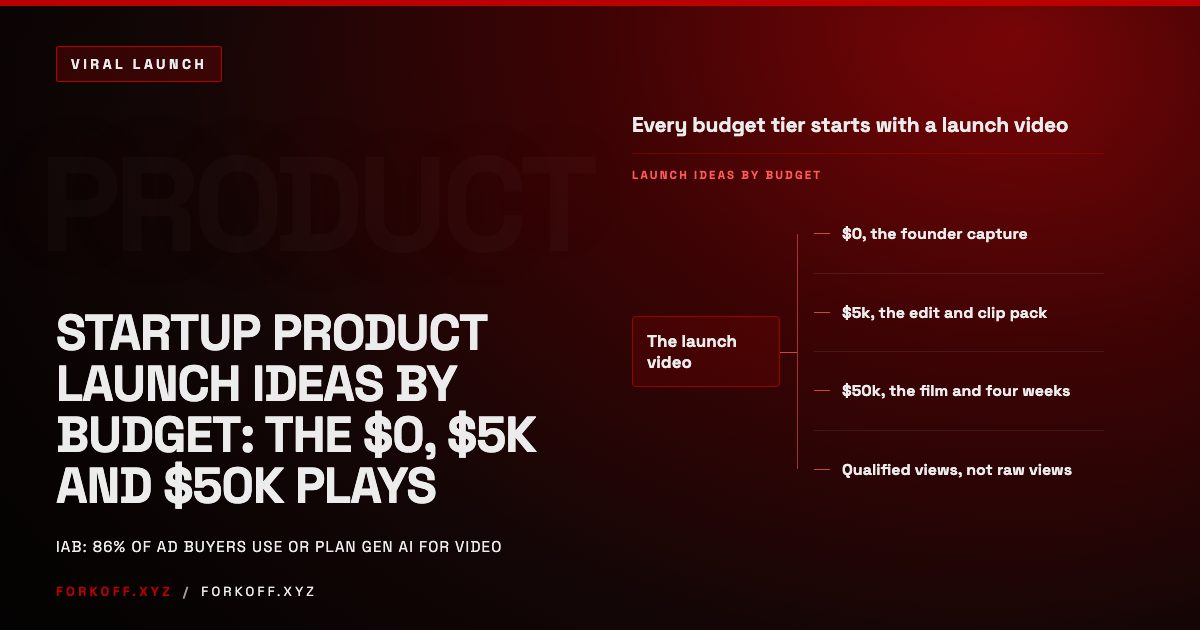
Startup Product Launch Ideas by Budget: The $0, $5k and $50k Plays
Product launch ideas for a SaaS startup sorted by budget: what the launch video should be at $0, $5k and $50k, and the distribution around it.
Read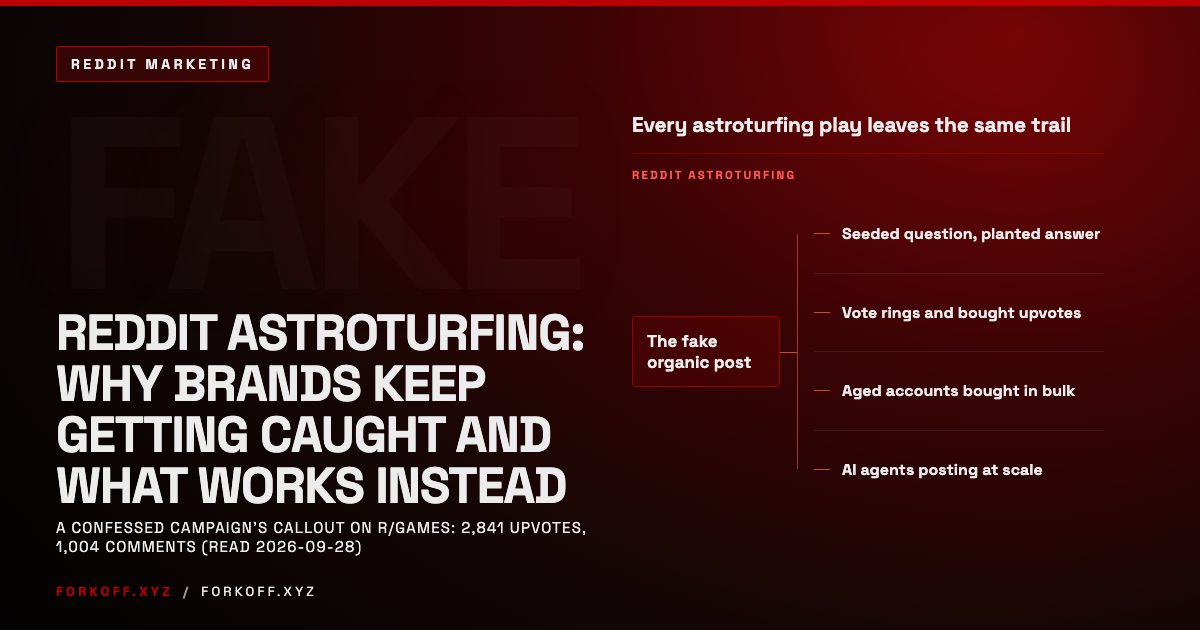
Reddit Astroturfing: Why Brands Keep Getting Caught and What Works Instead
Reddit astroturfing is paid promotion dressed up as organic talk. Why brands keep getting caught, what exposure costs, and the legitimate way to show up.
Read