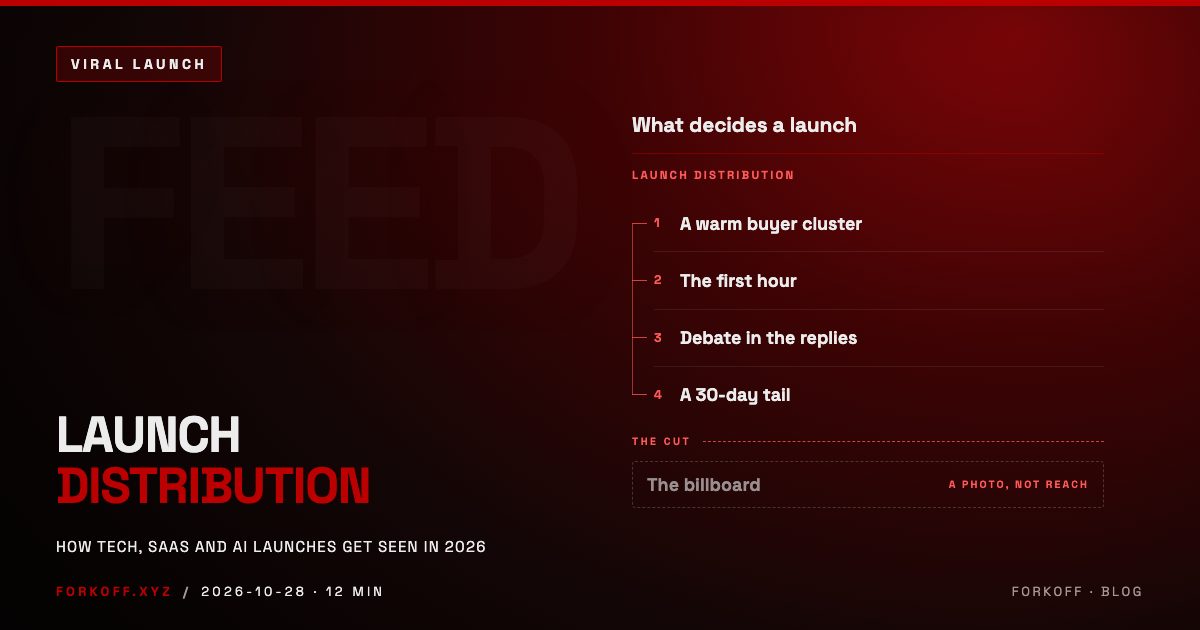
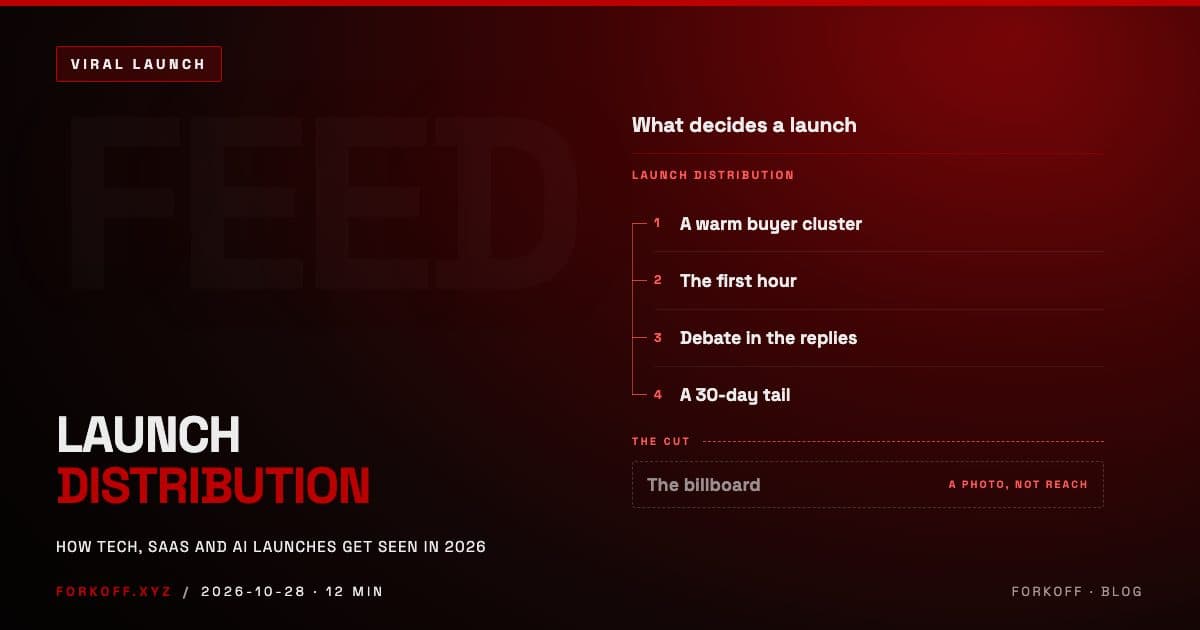
Launch distribution is the work that decides who sees a tech, SaaS or AI launch in its first 72 hours, and in what order. X and LinkedIn show a new post to a small test audience first and widen it only if that audience responds, so the first 60 minutes decide the rest. FORKOFF runs launch distribution as one engineered event: a 14-day warm-up, a first hour built for debate, recap accounts briefed early and a 30-day tail.
The short version
Launch distribution is the work that decides who sees a tech, SaaS or AI launch in its first 72 hours. X and LinkedIn test a new post on a small audience first, so the first 60 minutes decide the rest. A seed-stage AI founder spent $140,000 on a billboard, a bus wrap and a party and reached 11,400 views. Relaunched after a 14-day warm-up on 300 to 600 buyer accounts, the same product reached 2.1M views in 72 hours and 214 demo calls in a month. The method has five stages: warm the cluster, open on the product, tag the debate, seed the recap accounts and ride the waves, then a 30-day tail of clips and buyer answers.
Founders are spending more on launches than ever, and a lot of that money is going to the parts of a launch the feed never sees. Wistia's State of Video report found that 57% of teams spend more time creating video than promoting it. This post explains how launch distribution works, using one launch we ran twice: once with a billboard, once without.

The same product, launched two ways
| Measure | Billboard launch | Warmed relaunch |
|---|---|---|
| Spend before launch day | $140K on outdoor and a party | 14 days of founder replies |
| Views in hour one | 640 | 41,000 |
| Views in 72 hours | 11,400 | 2.1M |
| Demo calls in 30 days | 3 | 214 |
One seed-stage AI company, same founder account, six weeks apart, autumn 2026.
Why are founders buying billboards to launch?
Founders are buying billboards to launch because attention on the feed is scarce and outdoor media feels like a visible, controllable bet. It gets photographed, shared in the team channel and talked about at dinner. The problem is who sees it: the founder's own network, not the strangers the feed tests a launch post on.
Greg Isenberg spent two days with AI founders in San Francisco in October 2026 and put it in one line:
Getting SIGNIFICANT distribution is HARD right now. Founders are sponsoring buses, buying billboards like crazy and throwing parties with famous DJs to get noticed.
GREG ISENBERG
@gregisenberg
I spent 48 hours in SF hanging out with billionaires, data labs and AI founders and execs running $1B to $100B companies. My observations: [...] 21. Getting SIGNIFICANT distribution is HARD right now. Founders are sponsoring buses, buying billboards like crazy and throwing par… Show more
That post passed 2.5M views and 31,900 bookmarks in two weeks, which tells you how many founders recognise the problem. A seed-stage AI founder we worked with this autumn is the clearest example we have seen. He spent $140,000 on a billboard on Highway 101, a wrapped city bus and a launch party with a well-known DJ. His launch post reached 11,400 views and booked 3 demo calls.

Founders are buying billboards because distribution is hard
After 48 hours with AI founders in San Francisco in October 2026, Greg Isenberg wrote that founders are sponsoring buses, buying billboards and throwing parties with famous DJs to get noticed. The post passed 2.5M views and 31,900 bookmarks in two weeks.
Source: Greg Isenberg on X, October 14, 2026
Why do SaaS and AI launches fail to get distribution?
SaaS and AI launches fail to get distribution when the audience watching in the first hour is cold. The feed reads the first hour as a test: if the accounts it sampled ignore the post, it stops widening. A launch seen mostly by the founder's team and investors produces almost no signal from buyers. Guides to how the X algorithm works and how the LinkedIn algorithm works describe the same pattern: early engagement from relevant accounts decides how far a post travels.
Our founder's first launch drew 640 views in its first hour. Most came from his own team and his angel investors, who had seen the billboard and already knew the product. The ranker read that as a niche post and moved on.

Supply makes it harder every month. A new AI product reaches the feed every day, many of them close variants of one another. Codie Sanchez said it plainly, that almost every founder pitching her an AI startup has no audience to sell it to:
Codie Sanchez
@Codie_Sanchez
Nobody wants to hear this, but distribution is the new moat. Almost every founder pitching me their new AI startup has no audience to sell it to.
Founders without a big audience say the same thing with less polish. This r/SaaS post on getting anyone to care is a good example of where most launches end up:
The hardest part of building SaaS isn't building the product. It's getting anyone to care.
None of that matters if the people who need your product never discover it.
The fix is not more spend around the launch. It is a different audience at minute zero. The longer view on why launch videos stall is in why startup launch videos get zero views.
What is launch distribution for SaaS and AI products?
For SaaS and AI products, launch distribution is the planned sequence that controls which audiences meet a launch during its first three days. It means buyers are warmed before publication, credible critics engage with the claim, recap accounts carry the post into adjacent audiences and someone answers every wave of attention as it arrives.
It is a narrower job than SaaS distribution as a whole, which covers the standing channels a company uses every month. The launch video is part of it, but it is the payload, not the vehicle. A strong film posted to a cold timeline usually stalls inside the first hour. That is why FORKOFF builds launch distribution for tech, SaaS and AI companies together with the film from the first brief, never as an add-on once editing is finished.

From a warm cluster to reach beyond your followers
Six weeks after the billboard launch we ran the same product again, from the same founder account, with nothing spent on outdoor media. It drew 41,000 views in the first hour and 2.1M views in 72 hours. The launch RADAR tracks the public 2026 launches that travelled this far, and the State of Launch Videos report covers the whole corpus.


How does launch distribution work, step by step?
Launch distribution runs in five stages over about three weeks. Two weeks go to warming a named cluster of buyer accounts, then the launch opens on the product working, tags the people likely to disagree, briefs recap accounts in advance and keeps someone watching every surge in real time. Each stage feeds the signal the feed reads early.

1. Warm a named cluster for 14 days. Pick 300 to 600 real accounts the buyer already follows: operators in the role you sell to, category investors, builders of adjacent tools. For two weeks the founder replies to them, quotes them and answers their questions, with zero mention of the launch. It is Paul Graham's do things that don't scale, applied to the two weeks before a launch.

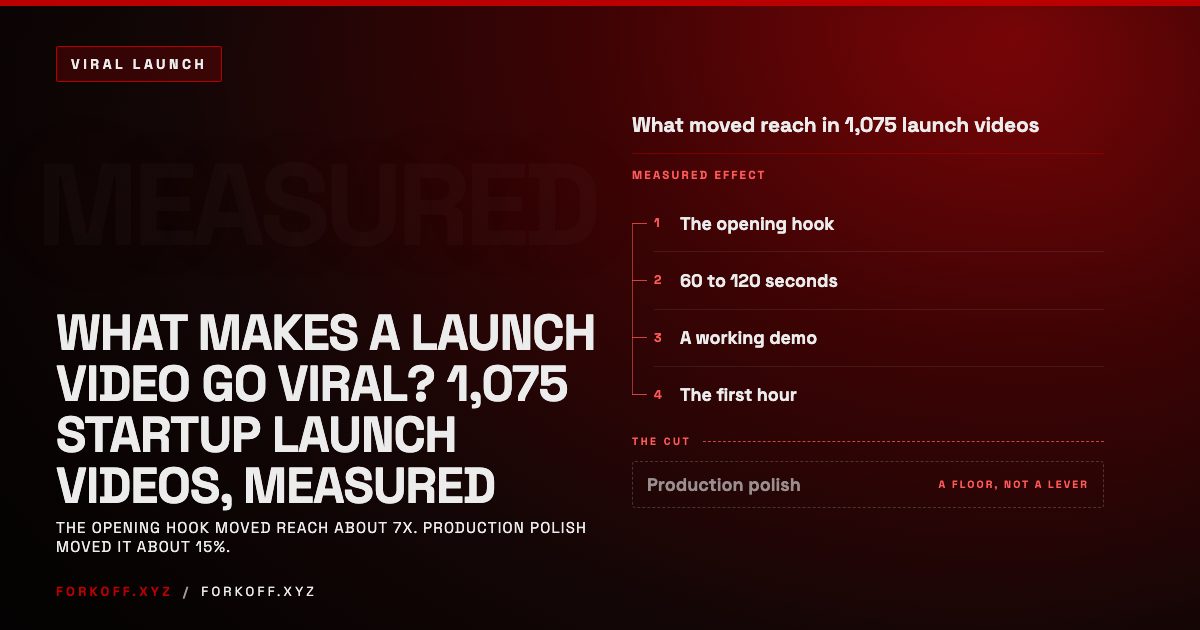
2. Open on the product working. The first frame is the product completing a real task. No logo animation, no "introducing". Y Combinator's founder interview on making launch videos starts with the hook, not the edit. Our data on what makes a launch video go viral puts the opening hook ahead of every other creative choice, and the launch video readiness checklist scores a cut before launch day. How a launch video and its distribution are built as one event covers the film side.
3. Tag the debate. The launch post names the two or three credible people most likely to push back on its claim. A real argument in the replies is one of the strongest signals a feed reads in hour one: in the ranking configuration X published alongside its recommendation algorithm code in 2023, a reply the author engages with carried a weight of 75, against 0.005 for watching half a video.
4. Seed the recap layer. Accounts that post weekly launch roundups get the asset 24 hours early, with a line they can use. The anatomy of a 1M-view launch video shows how those accounts carry a launch into its second wave.
5. Ride the waves. Someone watches the post minute by minute. When a large account quotes it, the founder is in that thread within 10 minutes.

What does the 14-day warm-up look like?
The 14-day warm-up is two weeks of genuine founder engagement with the buyer cluster before anything about the launch is said. The founder replies, quotes and answers questions daily, shows the problem the product solves in the final days, confirms the first-hour roster on day 13 and posts nothing on day 14.

The 14-day warm-up calendar
| Days | What the founder does | What never happens | Source |
|---|---|---|---|
| 1 to 4 | 15 specific replies a day to cluster accounts | A product mention or a link | derived |
| 5 to 9 | 3 quote posts a day, each with one data point | A teaser of the launch | derived |
| 10 to 12 | Post the problem the product fixes | A launch date | derived |
| 13 | Final cut, first-hour roster confirmed | A paid boost or engagement swap | derived |
| 14 | Rest | Any post at all | derived |
as of 2026-10-28
Method: FORKOFF launch playbook, the warm-up we run before every SaaS and AI launch.
The cluster is 300 to 600 real accounts the buyer already follows.
The warm-up is the launch-week end of pre-launch marketing, and it sits inside the wider product launch plan. The rule that matters most is what never happens. No teaser, no launch date, no paid boost and no engagement swap. A teased launch reads as an ad and the feed treats it like one, and a reciprocal engagement ring is the pattern the spam systems look for in the first hour.
Operator noteNever tease the launch during the warm-up. A teased launch reads as an ad, and the feed treats it like one.
Operator noteBook the first hour before you book the edit suite. A launch post with nobody waiting is a post to your own followers.
How much reach can a tech launch get without ads?
A well-sequenced tech launch can reach the low millions of views in 72 hours without paid media, because the feed keeps widening distribution while engagement stays real. Of the 31 SaaS and AI launches FORKOFF ran in 2026, 27 reached their contracted view tier within 72 hours.

27 of 31 launches cleared their tier in 72 hours
Of the 31 SaaS and AI launches FORKOFF ran in 2026, 27 reached their contracted view tier within 72 hours. Launches are contracted at 1.2M, 3M or 5M views, and a launch that misses keeps being distributed or is re-run.
Source: FORKOFF launch reports, 2026
ClickUp's Brain2 launch in June 2026 is a public example. The founder's launch post reached 3,936,620 views. About 800,000 of those came from accounts outside the roster with bought-reach signatures, so we set them aside and counted about 3.1M clean views against a 2M to 3M target. A seeded wave of 48 creators posted 104 measured posts worth about 1.1M views.


ClickUp Brain2 launch on X, June 2026
| Measure | Value | Source |
|---|---|---|
| Founder launch post, raw views | 3,936,620 | measured |
| Views from outside the roster, flagged and set aside | about 800,000 | measured |
| Clean views counted against the target | about 3,100,000 | measured |
| Target | 2,000,000 to 3,000,000 | published |
| Seeded creator wave | 48 creators, 104 measured posts, about 1,117,343 views | measured |
as of 2026-06-30
Method: FORKOFF launch report for ClickUp Brain2, views read from X post analytics and audited on views per like; accounts outside the contracted roster that showed bought-reach signatures were set aside.
Flagged pushed bursts were removed before the result was counted.
Launch directories are a different job again: Product Hunt's own launch guide treats launch day as a community event that needs preparation, the same principle at a smaller scale. Paid creator ads are a different job. Wispr Flow's programme runs 500 to 700 creator ads a month through one media buyer, which works because it is a standing channel with a team. Most seed-stage AI companies cannot staff that in launch week.
Paid creator ads are a channel, not a launch
Wispr Flow's creator ads programme runs 500 to 700 ads a month through one media buyer and about 50 creators. It is a standing system with a team behind it, and most seed-stage AI companies cannot staff one in launch week.
Source: Ira Bodnar on X, October 9, 2026
Outdoor media, paid creator ads or launch distribution
Billboards and parties
Paid creator ads
Launch distribution
Reaches buyers in the first hour
Counts in the feed's first-hour test
Pays off within 72 hours
Works without a standing ads team
Audited for bought reach
Paid creator ads are a strong channel once a company knows which message converts; they are a different job from a launch.
The billboard launch against the warmed relaunch
Same product and founder account, six weeks apart.
How do you know a launch's views are real?
You check views per like, the same ratio the free launch authenticity checker reads from any public launch. Organic launches on X usually land between 40 and 120 views per like, and launches with purchased reach fall well outside that band. FORKOFF audits every launch it runs on that ratio, its own included, and sets aside reach that fails before counting the result.

Operator noteJudge the launch by views per like before you celebrate. Organic X launches usually land between 40 and 120.
What happens after launch day?
After launch day the job is to stop the usual 48-hour fade. FORKOFF turns each launch into 30 days of distribution: short clips of the film and the founder's best replies, answers to the buyer questions the launch raised where AI assistants read them, and a personal follow-up on every serious question.

The clips run through the clipping network that carries a launch past its first week, which has passed 5B views. The buyer answers go on Reddit and LinkedIn, the threads ChatGPT and Google's AI answers cite when someone asks what to use; that is the work our Reddit marketing team runs month to month, and the LinkedIn side follows the LinkedIn playbook for B2B SaaS.
Our billboard founder booked 3 demo calls from the first launch. From the relaunch and its 30-day tail he booked 214.

What are the most common launch distribution mistakes?
The most common launch distribution mistakes are spending on reach the feed never counts, announcing the launch before it happens, asking friends to like the post, launching on a day the buyer is offline and treating launch day as the finish line. Each one wastes the first hour, which is the only part of a launch that is hard to repeat.
1. Buying visibility instead of attention. A billboard, a bus wrap or a sponsored newsletter slot is seen. It is not engaged with on the feed, so it does nothing for the test the feed runs on the launch post. Our billboard founder had both a strong film and a large budget, and the launch still stalled in its first hour.
2. Teasing the launch. "Something big is coming Thursday" reads as an ad. The people who would have engaged with the real launch scroll past the teaser, and the launch post itself arrives as the second time they have seen the claim.
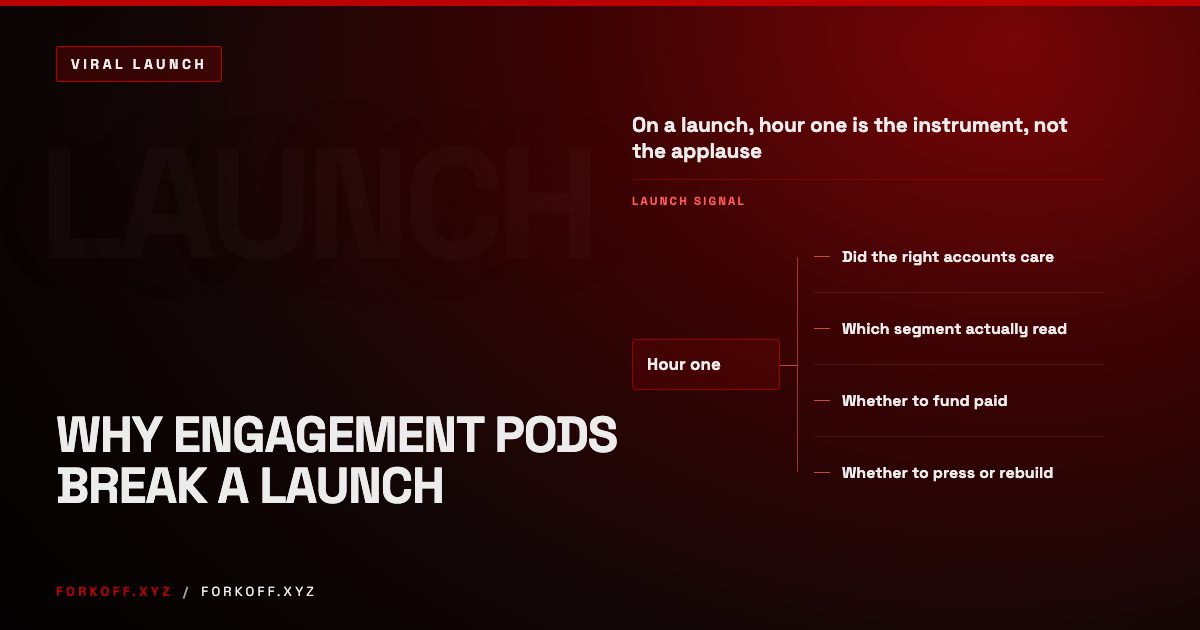
3. Pods and engagement swaps. A group of founders who like each other's launches looks like engagement to a person and like a ring to the spam systems. The pattern is easy to detect because the same accounts appear together on every post.
4. The wrong hour. A launch posted when the buyer cluster is asleep spends its first hour on the wrong time zone. For most US B2B buyers that means a weekday morning Pacific time, but the cluster list tells you, because you can see when those accounts post.
5. Stopping at 72 hours. Most launches are over by the second evening. The questions and objections that arrived under the post are the best content brief the company will get all quarter, and most teams never use them.
How is launch distribution different for AI products?
Launch distribution for AI products differs in three ways: the feed is more crowded, the buyer has seen more demos that did not hold up, and a large share of buyers now ask an AI assistant which tool to use. That raises the bar for the first frame and makes the 30-day tail of buyer answers matter more than it does for most SaaS.
The crowding is the first problem. A new AI product reaches the feed every day, often doing something close to last week's launch. A launch that opens on a generic claim ("the AI copilot for X") is read as a copy before anyone watches the demo. The first frame has to show the product doing a specific job, ideally one a competitor visibly fails at.
The second is trust. AI buyers have watched polished demos of products that did not survive a real workflow. Showing the product on real data, with a limit stated plainly, earns more replies than a perfect run. The replies that ask "does it work on X?" are the debate the first hour needs.
The third is where buyers look after the launch. More of them ask ChatGPT or Google's AI answer which tool to choose, and those answers lean on discussion threads and comparison pages. The buyer answers in the 30-day tail are what put the product into those threads, so for an AI launch they are part of the distribution, not an extra.
How does launch distribution work on LinkedIn?
Launch distribution on LinkedIn follows the same logic as on X with a different cast. The first audience is the founder's connections and followers, LinkedIn widens the post when early comments are substantive, and the warm cluster is made of buyers and operators the founder has already been talking with in comments for two weeks.
Three things change on LinkedIn. The link goes in the first comment, not the post, because LinkedIn shows posts with outbound links to fewer people. Comments carry more weight than reactions, so the first-hour roster should be people who will write a real sentence, not people who will click a reaction. And the post itself should open with the problem in the buyer's words, because the first two lines are all a reader sees before "see more".
For B2B and developer tools buyers we run a LinkedIn-native track beside the X launch: the founder's post, a team post from a different angle and a company page post, spaced across the first day so each lands in a fresh feed window.
What should a launch distribution budget pay for?
A launch distribution budget should pay for the work that changes who sees the launch in its first hour and what happens after it: the buyer cluster research, the founder's time during the warm-up, the launch film, the recap and creator layer, live monitoring and the 30-day tail. Anything that does not touch one of those is visibility, not distribution.
In practice most of the budget that goes to outdoor media, event sponsorships and launch parties can move to the film and the tail without losing anything the feed counts. The exception is a launch where the buyer is physically in one place, such as a conference, where an in-person presence and the online launch reinforce each other.
The other line worth protecting is measurement. A views-per-like audit and a record of which accounts drove the first hour turn one launch into a playbook for the next one, which is where most of the long-run value of a launch sits.
Where should a founder start?
A founder should start with the buyer cluster, not the billboard. List the 300 to 600 accounts your buyer already follows, start replying to them two weeks before launch, and book the first hour before you book the edit suite. The rest of the sequence builds on that list.
If you are earlier than that, Y Combinator's Startup School talk on first customers makes the same point from the other side: go where the buyers already are.
How to Get Your First Customers | Startup School
Y Combinator
Y Combinator Startup School on getting first customers. The same lesson the billboard founder learned: go where the buyers already are, before launch day.
If you are choosing between one big launch and several smaller ones, start with big bang against rolling launches; if you only want more views on the film, read how to get 100K views on a launch video. For the longer go-to-market frame around a launch, read the three ring distribution model for SaaS.
Operator noteTag the two people most likely to disagree with your claim. A real argument in the replies beats a hundred congratulations.