

James Clift
@jamesclift · 8.2K followers
Introducing Durable. The first AI business builder that replaces your 9-5 income. RT + comment “Durable” and we'll build your business for FREE.
Durable launchReconstructed reading
Durable is a real product by a real founder (@jamesclift). RADAR has tracked 3.6M views on this launch, according to the source post linked below. RADAR measures how the launch reach was built, not whether the product works or whether anyone was honest. This reading is reconstructed confidence and every input is public.
By Simba, Launch Intelligence Analyst · Reviewed by JK · Published 29 Jun 2026 · Confidence: reconstructed
Independent, methodology-derived signal, not a statement of fact about any person. RADAR reads how reach was built, a signature, not an accusation. See the methodology.
Did the Durable launch go viral organically, or was the reach amplified?
The Durable launch by @jamesclift drew 3.6M views on 5.5K likes, which is 651 views per like, above the roughly 500 organic ceiling. RADAR reads a reconstructed reading in how that reach was built, a signature of the mechanics and not a claim about the product or the founder. This is a reconstructed reading and every input is public and reproducible.
New here? Start with the product
What is RADAR, and what does this grade mean?
RADAR is FORKOFF's launch authenticity rating system. It reads whether a product launch earned its reach through real engagement or bought it through paid distribution, using only public signals anyone can pull from the launch post. Every reading carries a letter grade, a confidence label, and the date it was last checked, and links back to a published method you can reproduce. Durable is a real product by a real founder (@jamesclift). RADAR measures how the reach was built, not whether the product works or whether anyone was honest.
Reconstructed reading
Independent, methodology-derived signal, not a statement of fact about any person. RADAR reads how reach was built, a signature, not an accusation. See the methodology.
What this grade means
RADAR reads this launch from its views-to-likes ratio alone, without a full amplification trace, so the grade is labeled reconstructed and held at lower confidence. The read is a signature of how the reach was built, not a claim about the product or the founder.
The signals RADAR reads
Views-to-likes ratio
Organic reach tops out near 500 views per like. When views climb far past that without the likes to match, the extra reach is arriving without the engagement organic reach produces.
Amplification wave shape
Organic amplification spreads over hours and days. A coordinated launch fires a synchronized burst of quote posts in the first few hours, read from each post's own timestamp.
Posting-time fingerprint
A post that fires exactly top of the hour on a weekday is scheduled. On its own it is weak, but it corroborates a coordinated launch alongside the other two signals.
Those three public signals sit on top of RADAR's five-component forensic read. The full method, the bands, and the confidence model are on the RADAR methodology page.
This launch in the data
Where does this reach sit against the tracked corpus?
Where it sits in the corpus
Rank 13 of 30 tracked launches by views per like, lowest (most organic) first. A lower ratio is the favorable end.
Against the benchmark
This launch's views per like next to the organic median (354) and the amplified median (1,441) across the tracked set.
A real founder, a real product, and reach that outran the engagement under it.
Here is what makes this a distribution-amplified read rather than a clean organic one. The like rate, near 0.15 percent, is roughly a third to a half of where organic mega-viral launches land, and the total engagement of 8,819 actions sits at 0.25 percent of views, below the normal band for a post that has reached this far. When a post reaches 3.58 million people but the likes, reposts, and quotes do not rise in proportion, the simplest explanation is that some of the reach arrived from a channel that does not also produce engagement. That is the definition of distribution amplification: views that travel faster than the audience interacts with them.
The "lite" in paid-lite is load-bearing and we will not blur it. This is not a fabricated, bot-driven spike. The reply count of 1,826 written posts is the layer hardest to manufacture cheaply, and it is present at a believable scale. The reading is that a real launch on a real, funded company got help crossing the 3.58M line, not that the engagement was wholesale invented. RADAR exists to separate the marketing layer (what a launch claims) from the data layer (what the public signals actually show). A paid-lite signature is a statement about how the reach was built. It is not, and we will say this plainly later, an accusation against the founder, the company, or anyone who invested in it.
The rest of this teardown walks the reading first, then steps back to the product, the founder, the funding, and the market, so a reader can audit the read and understand the launch in full.
Engagement coupling: the reach outran the layers under it
Signal one: the views-to-likes gauge above the organic ceiling
The load-bearing signal is V:L, views divided by likes. On X, the feed that surfaces a post also makes it easy to like, so under organic distribution reach and likes rise together up to roughly 500 views per like. X's 2026 ranking treats engagement types as interconnected signals and rewards them together, with written replies weighted heavily for authenticity because a reply is costly effort (opentweet.io, sproutsocial.com). When views climb but likes do not keep pace, the views are arriving from a channel that does not also produce engagement. The Durable launch shows that pattern: 3,584,479 views divided by 5,508 likes is 650.8 views per like, a like rate near 0.15 percent. That is below the band an organic mega-viral post tends to hold, which is the coupling break that distribution amplification produces (tweetarchivist.com).
Signal two: the costly layers lagged the reach
Likes are the cheapest action to take. Replies and quotes are costlier, because each one is a written post a real person had to compose. Fake-engagement detection guidance describes the distribution-amplified pattern as a ratio mismatch, where impressions sit far above the interaction the audience actually produced (miqwal.com, tweetarchivist.com). The Durable launch carries that mismatch in a mild form. The layers are 5,508 likes, 1,176 reposts, 1,826 replies, and 309 quotes, totaling 8,819 actions at 0.25 percent of views. The reply layer being present and human-shaped is what keeps this read on the paid-lite side of the line rather than the botted side. The distance between a 3.58M reach and an 8,819-action engagement base is what places it above the organic ceiling.
Views per like
Above the 500 organic ceiling. Views arrived faster than the audience liked them, the fingerprint of reach that got help rather than reach that engagement kept pace with.
Replies
Written posts, the costliest action to fake at scale. The reply layer is present and human-shaped, which is why this reads distribution-amplified-lite, not a wholesale fabricated spike.
Quotes
Original posts amplifying with commentary. Present but thin against a 3,584,479-view reach, so the conversation layer did not scale with the impressions.
Total coupling
Likes plus reposts plus replies plus quotes (8,819 actions) against 3,584,479 views. Below the normal band for an organic mega-viral post, consistent with reach that outran its engagement.
Signal three: a reach larger than the account that posted it
The shape of the spread matters as much as its size. The launch posted from a founder account whose own following is a small fraction of a 3.58M-view reach, which is normal for a viral post but also the condition under which a distribution push is hardest to distinguish from pure word of mouth. RADAR does not name, and cannot from a reconstructed read identify, any specific amplifying account or tool. What the public metrics support is narrow and we will not overclaim it: the gap between the impressions and the proportionate engagement is consistent with the reach receiving help, whether through paid promotion, an amplification arrangement, or coordinated resharing. RADAR describes that pattern only by its public footprint and names no third party.
Read together, the three signals tell one story. A genuine founder launched a genuine, funded product, and the announcement reached 3.58 million people, but the likes, replies, and quotes under that reach did not rise in proportion. The reach outran the engagement. That is a distribution-amplified signature, read at paid-lite strength because the reply layer is real.
What Durable actually is
James Clift announced it from his own account. The launch tweet positioned Durable as "the first AI business builder that replaces your 9-5 income" (x.com/jamesclift). That "replaces your 9-5 income" line is a contrarian, high-promise hook, the kind of framing built to drive replies and quote-debate, which is consistent with the reply layer RADAR read above. Coverage of the launch framed the same claim plainly: a tool the founder says can replace your nine-to-five by building an entire business for you (founded.com).
Who it is for, and what it covers
Durable targets people starting or running a service business: contractors, cleaners, freelancers, local operators, and side-hustle owners who want a web presence and the back-office tooling to invoice and get paid without assembling a stack themselves. The differentiator the company leans on is speed plus bundling: a roughly 30-second site generation from three questions, then a CRM, invoicing, payments, and AI agents in one place, rather than a template library a user has to configure (durable.co, max-productive.ai). Durable reports 3M-plus users and 11M-plus websites generated, scale metrics that predate this specific launch and that plainly support a real owned-audience distribution base.
Availability and pricing
Durable is live and freemium, with the AI site generator usable on a free tier and the business tooling (CRM, invoicing, AI agents) layered into paid plans (max-productive.ai). That the launch landed on an existing multi-million-user base, not a cold audience, is worth stating in both directions: it gives the founder a legitimate organic reach to start from, and it also means a distribution push on top of that base is harder to separate from the base's own word of mouth. RADAR treats the reconstructed read accordingly and does not overclaim.
James Clift, co-founder of Durable
Clift's track record predates Durable. He has founded before, and his public founder interviews show a consistent focus on building tools for independent workers (ideamensch.com). That backstory is the kind that makes a launch message read as a real operator's continuation rather than a manufactured persona: a second-time founder shipping an AI tool aimed at the same independent-worker audience he has served before.
None of this is in tension with the reading. A real, credible founder is exactly the precondition for a paid-lite read rather than a botted one. RADAR's signature speaks to how the 3.58M reach was assembled, not to who James Clift is. The founder is real, the company is real, and the product is live. The only narrow claim RADAR makes is that the impressions on this specific post outran the engagement under them.
What is behind Durable, and how it is financed
The headline round is a $14M USD Series A (reported as $18M CAD), announced December 12, 2023, led by Spark Capital, with participation from Torch Capital, South Park Commons, Infinity Ventures, Dash Fund, Altman Capital, and Soma Capital (durable.co/blog/series-a, techcrunch.com, betakit.com). The Series A press release cited over six million websites built at the time of the raise (businesswire.com). A prior seed round of roughly $6.25M came from Altman Capital, Torch Capital, Infinity Ventures, Dash Fund, South Park Commons, Soma, Night Capital, Lorimer Ventures, and angels (tracxn.com, crunchbase.com).
| Structural fact | Reading |
|---|---|
| Round at this launch | None disclosed; the launch is a product release, not a raise |
| Series A | $14M USD ($18M CAD), led by Spark Capital, Dec 12, 2023 |
| Seed | ~$6.25M, Altman Capital, Torch Capital, Infinity Ventures and others |
| Total raised | ~$20M USD (~$26.5M to $27M CAD) across ~4 rounds |
| Scale claims | 3M-plus users, 11M-plus websites generated (pre-launch) |
That the most recent disclosed raise predates this launch matters for the read in a specific way. Because no fresh capital was announced with the post, the 3.58M-view reach cannot be attributed to a funding-news cycle, and the distribution-amplified signature stands on the engagement coupling alone. A funded, established company gives the founder a legitimate audience and press relationships that explain a large share of organic reach on their own. RADAR's read is that those organic foundations were real and were also pushed past the organic ceiling on this particular post.
Where this launch sits, and why the category draws attention
Comparable RADAR launches
RADAR has profiled a library of launches. Compare the Durable reading against two launches that read organic and two distribution-amplified contrasts:
The contrast is the point. Koji (396:1) and Contra Payments (445:1) held under the 500 organic ceiling, with their costly engagement layers rising in proportion to their reach. Durable, at 651:1, sat above it. Same category of real, funded founder; different shape of reach.
Methodology, and what we are not saying
RADAR does not output a pass or fail on a person. It outputs a signature and a confidence label, both built from public metrics anyone can pull, so the reader can check the work. For Durable, the distribution-amplified signature rests on the gap between reach and engagement:
- The views-per-like ratio (651:1) sat above the 500:1 organic ceiling, so likes did not keep pace with a 3.58M-view reach.
- The total engagement, 8,819 actions across 5,508 likes, 1,176 reposts, 1,826 replies, and 309 quotes, came to 0.25 percent of views, below the band an organic mega-viral post tends to hold.
- The reply layer (1,826 written posts) is present and human-shaped, which keeps the read at paid-lite rather than botted: the conversation is real, the impressions outran it.
Confidence and how to reproduce it
Confidence is labeled reconstructed: built from the live metric snapshot and the engagement-ratio reading, not a full forensic trace of every engager. There is no per-account wave in this read, only the engagement-coupling evidence. Every input is public. Pull the anchor post's view, like, repost, reply, and quote counts; divide views by likes for the gauge; and check whether the costly layers (replies, quotes) rose in proportion to the reach or lagged it. Here they lagged, and the ratio crossed the ceiling. See the full method at the RADAR methodology.
Questions readers ask about this launch
Is Durable real?
+
Who is James Clift?
+
What does a 651:1 views-to-likes ratio mean?
+
Why is the verdict paid-lite and not botted?
+
Is RADAR accusing Durable or its investors of buying fake engagement?
+
Sources
Primary citation: x.com/jamesclift/status/2033957044714410368. Every number traces to a public pull; reads re-checked over time.
- x.com/jamesclift/status/2033957044714410368 (launch post, March 2026)
- x.com/jamesclift (founder account)
- durable.co (product site)
- durable.co/blog/series-a (Series A announcement)
- betakit.com Durable $18M CAD Series A
- techcrunch.com Durable $14M Series A
- businesswire.com Durable Series A (investor list)
- tracxn.com Durable funding
- crunchbase.com/organization/durable
- ideamensch.com James Clift founder interview
- founded.com Durable 9-5 framing coverage
- linkedin.com Durable company page
- thesaasnews.com Durable Series A
- bctechnology.com Durable Series A
- max-productive.ai Durable review
- opentweet.io X algorithm 2026
- sproutsocial.com Twitter algorithm
- tweetarchivist.com impressions guide
- tweetarchivist.com bots detection
- miqwal.com fake engagement detection
How RADAR read this launch, component by component
Each named component carries a plain-English definition and a directional read where the public data supports one. RADAR publishes the component names, never the weights or the formula.
View-velocity signature
Not publishedWhether the view curve grew the way organic spread does, or spiked like an injected burst.
Per-launch read not published in the public dataset. This component needs the forensic engine output.
Engagement coupling
NeutralWhether likes, replies, and reposts grew in step with views (the organic signature), or the views ran out ahead.
At 651 views per like, reach runs a step ahead of the likes: a light lift above the roughly 500 organic ceiling.
Reply-network authenticity
Not publishedWhether the accounts replying are real, distributed people or a coordinated cluster posting together.
Per-launch read not published in the public dataset. This component needs the forensic engine output.
Amplifier-cluster pattern
Not publishedWhether the quote-tweet amplification looks like organic word of mouth or a known activation cluster.
Per-launch read not published in the public dataset. This component needs the forensic engine output.
Smart-follower activation
Not publishedWhether genuinely influential reference accounts engaged, or the reach was only low-quality volume.
Per-launch read not published in the public dataset. This component needs the forensic engine output.
Are you the founder of Durable? You can claim or contest this read. RADAR attaches a founder response to the launch and re-examines any component you dispute.
Authorship
Simba
Co-founder, FORKOFF
Reviewed by: Kshitij JK
Last reviewed:
Published:
Methodology
RADAR reconstructed reading of the Durable launch from public metrics: the views-to-likes ratio against the roughly 500 organic ceiling and the posting-time slot, framed as a signature of how reach was built, not an accusation.
Sources cited
- RADAR methodology , FORKOFF
- Durable source post , X
Where to go next
Understand launch authenticity
Three ways in, depending on what brought you here: learn how the score works, get a launch read or built, or get the plain answer on this launch.
Learn the score
What a launch authenticity score is
A launch authenticity score reads whether a launch earned its reach or bought it, from public signals. Start with the definitions and the checks you can run yourself.
Verify or build
Launch authenticity verification
Want a launch read by the same method, or a launch video made and distributed on the outcome? RADAR reads any public launch, and FORKOFF builds the launch behind the reach.
The skeptic's question
Is the Durable launch legit?
If you are checking whether the Durablelaunch was real users or bots, here is the honest read: RADAR's reading is Reconstructed reading, at reconstructed confidence, computed from public metrics and reproducible from the source post. It measures how the reach was built, not whether the product works.
Peer launches
Launches with a similar read
Helena launch
@SeijinJung
3.7M views · 643 per likeRead
Slash (Series C) launch
@victorcardenas
1.9M views · 724 per likeRead
SubQ launch
@alex_whedon
13.1M views · 568 per likeRead
Moda launch
@anvisha
4.5M views · 556 per likeRead
Runable launch
@itsumeshk
408.0K views · 754 per likeRead
Parker launch
@alexgoughcooper
1.6M views · 498 per likeRead
The benchmark behind every reading
- The organic vs amplified benchmark. What a healthy launch ratio looks like, side by side.
- RADAR methodology. The bands, the confidence model, and how to reproduce a read.
- The Launch Authenticity Report 2026. The aggregate study across the tracked corpus.
- The X Launch Authenticity Study 2026. Two in three tracked launches show a bought-amplification signature.
- Verified-organic leaderboard. The launches RADAR reads as genuinely organic.
- Best product launch videos. The editorial cut of every tracked launch, ranked by views.
- Product launch video service. Get a launch video made and distributed, priced on the outcome.
Want a launch read by RADAR's method?
RADAR reads whether a launch's reach was earned or bought from public data, with the confidence label and the source citation on every reading.
Receipts, deep dives, and playbooks.
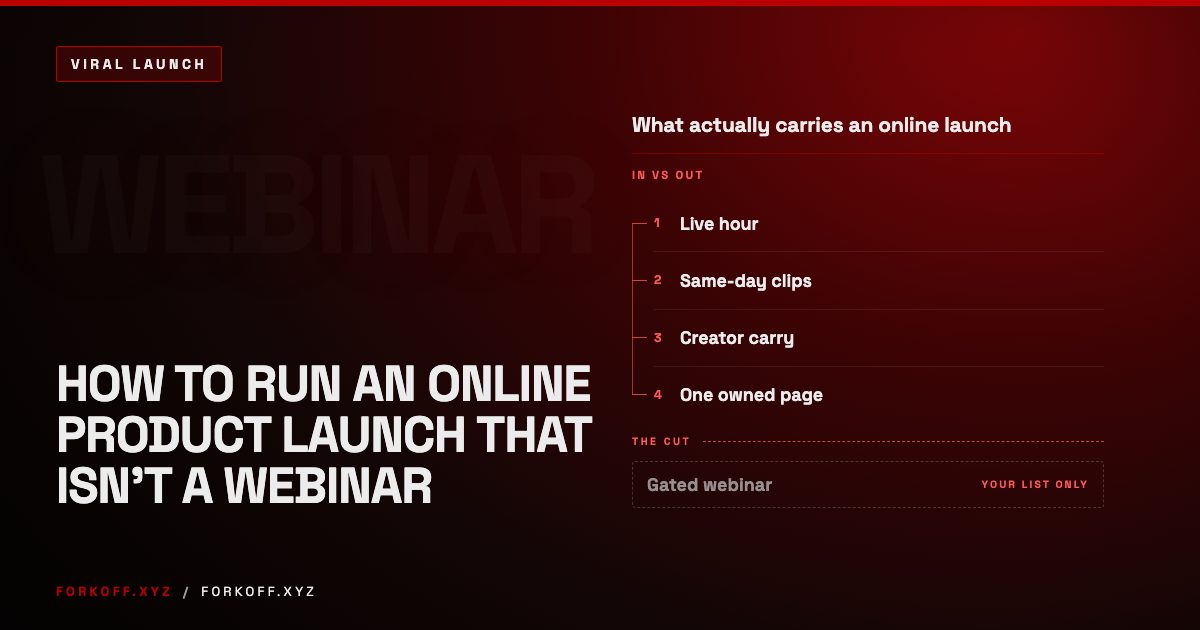
How to Run an Online Product Launch That Isn't a Webinar
An online product launch is a live moment cut into clips that creators carry, not a gated webinar. Here is the livestream, clip and creator stack for 2026.
 Read
Read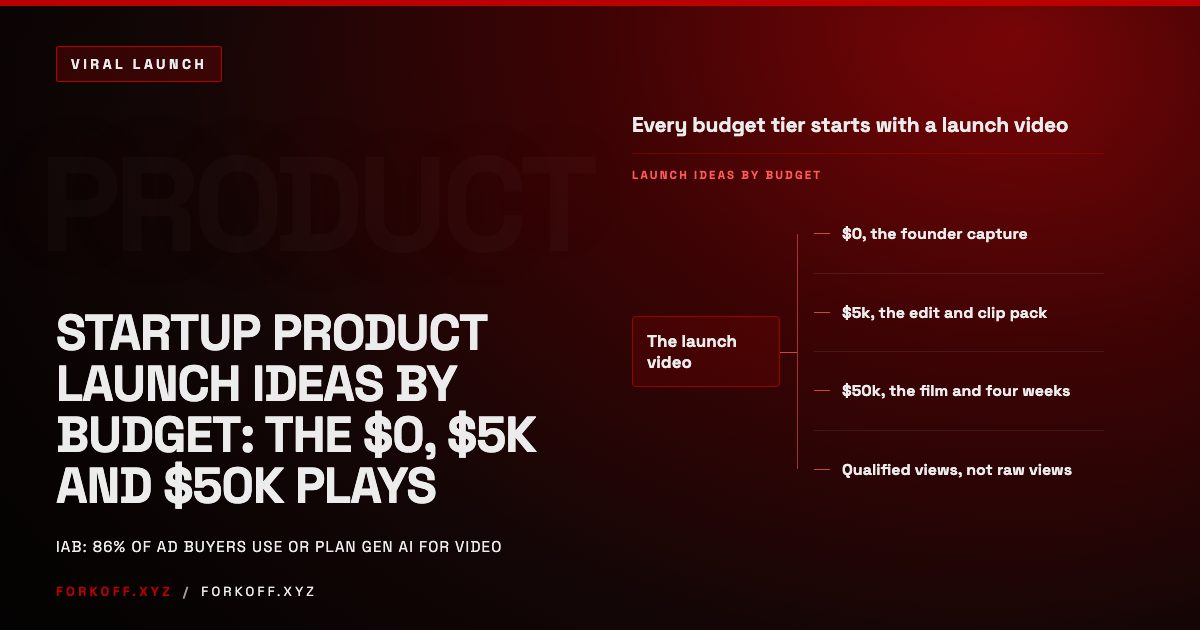
Startup Product Launch Ideas by Budget: The $0, $5k and $50k Plays
Product launch ideas for a SaaS startup sorted by budget: what the launch video should be at $0, $5k and $50k, and the distribution around it.
Read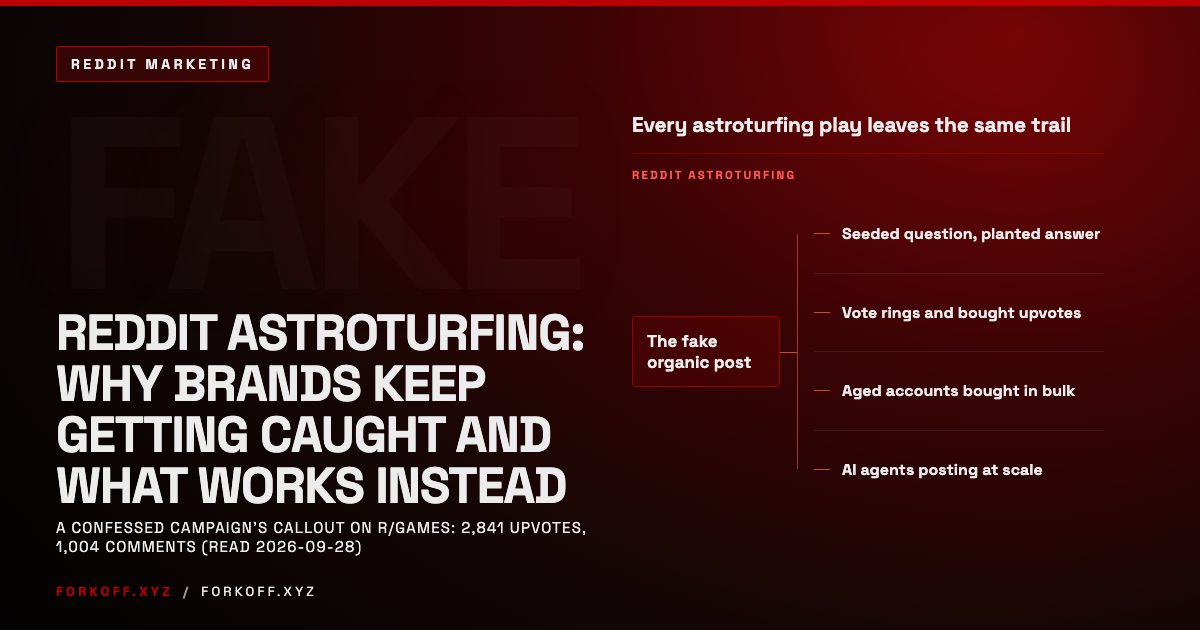
Reddit Astroturfing: Why Brands Keep Getting Caught and What Works Instead
Reddit astroturfing is paid promotion dressed up as organic talk. Why brands keep getting caught, what exposure costs, and the legitimate way to show up.
Read