
FORKOFF Research · RADAR · Statistics Hub · Updated 2026-09-19
Launch authenticity andengagement statistics 2026
50-plus cited statistics on how reach really gets built in 2026. It leads with FORKOFF first-party data no aggregator holds: RADAR scored a 30-launch forensic corpus worth 110.4M+ views on the views-per-like method, 67% carried a paid or amplified reach signature, with every external stat traced to a named source and year, read from public data with the published RADAR method.
Paying for distribution is legal, common, and often a sound launch tactic. This hub measures how reach was built, not whether anyone was honest. It is reported at the aggregate and benchmark level and carries no per-launch accusation. This page is the statistics digest, the current-state numbers. For how the read is done, the sampling, the views-per-like model, and the grading rubric, see the companion X Launch Authenticity Study.
Live corpus as of Thu, 08 Oct 2026 04:50 UTC: RADAR tracks 1,239 launches, 94 monitoring right now, 235.4M views of reach read. The whole corpus is on the board, and this figure updates live.
What this hub covers
- 01Editor's Choice: top 20 statistics
- 02What the 2026 report found
- 03The first-party anchor (RADAR)
- 0467% carried a paid or amplified signature
- 05The views-per-like benchmark
- 06Organic versus amplified reach
- 07The top-of-hour fingerprint
- 08The reach-class breakdown
- 09The organic minority
- 10Fraud prevalence
- 11Bot traffic
- 12Engagement benchmarks
- 13Financial impact
- 14Detection and regulation
- 15Methodology
- 16What this report is not saying
- 17Why the aggregate, not a leaderboard
- 18Frequently asked questions
- 19Sources consulted
- 20Where this study fits
The top 20 launch authenticity statistics for 2026
The most citable numbers in this hub, ranked for liftability: a specific number, a named source, and one clean sentence each. The first-party RADAR rows lead because no other source holds them. Every external row links to its named authority.
The ranking is not by size of number. It is by how self-contained and quotable each claim is, since a statistic that carries its own number, source, and year is the kind an answer engine can lift whole and a writer can cite without hunting for context. The three first-party rows sit at the top because they are the only numbers here that cannot be found anywhere else, which is what a primary source is for. Everything below the table then expands each of these into a full deep-dive, so the table is the summary and the sections are the evidence.
| # | Statistic | Source |
|---|---|---|
| 1 | First-party67% of high-reach 2026 launches carried a paid or amplified reach signature (20 of 30, 110.4M views) | FORKOFF RADAR |
| 2 | First-partyOrganic reach on X tops out near 500 views per like; across the 30-launch corpus the median was 788 and the 90th percentile 3,126 | FORKOFF RADAR |
| 3 | First-partyPaid-lite is the modal launch class at 43.3% of the corpus; only 10 of 30 launches (33%) read organic | FORKOFF RADAR |
| 4 | Automated traffic passed human traffic for the first time, at 51% of all web traffic | Imperva 2025 Bad Bot Report |
| 5 | Bad bots hit 37% of all internet traffic, up from 32%, the sixth straight yearly rise | Imperva 2025 Bad Bot Report |
| 6 | Global ad-fraud losses ran about $84B in 2023, forecast to reach $172B by 2028 | Juniper Research |
| 7 | 42.7% of influencers were impacted by fraud in 2024 | HypeAuditor, State of Influencer Marketing 2025 |
| 8 | 19.42% of active Twitter accounts fit a conservative fake-or-spam definition (44,058-account study) | SparkToro and Followerwonk |
| 9 | Buying fake engagement costs about $15 per 1,000 Twitter followers | Cavazos, University of Baltimore, with CHEQ |
| 10 | The FTC now bans buying or selling fake followers and views, with penalties up to $51,744 per violation | US FTC final rule, effective Oct 21, 2024 |
| 11 | 50% of engagement on sponsored influencer content was estimated fake | Cavazos, University of Baltimore |
| 12 | 9% to 15% of active Twitter accounts are bots | Varol, Ferrara et al., 2017 |
| 13 | Influencer fraud cost advertisers about $1.3B in 2019 | Cavazos and CHEQ, via CBS News |
| 14 | First-partyOrganic launches ran 354 views per like versus 1,441 for amplified ones, a 4.1x gap | FORKOFF RADAR |
| 15 | 57.5% of HTTP requests to HTML content came from bots, not people | Cloudflare Radar 2025 |
| 16 | Median Instagram engagement across industries sits near 0.36% to 0.48% | RivalIQ and Sprout Social, 2025 |
| 17 | First-party33% of tracked launches (10 of 30) fired at exactly the top of the hour, a scheduled-launch fingerprint | FORKOFF RADAR |
| 18 | About 55% of Instagram influencer engagement is fake | HypeAuditor data, 2025 |
| 19 | The influencer-marketing industry reached about $32.55B in 2025 | Influencer Marketing Hub Benchmark Report 2025 |
| 20 | About $100B was lost to ad fraud in 2024, roughly 22% of media spend | Juniper Research |
First-party rows: FORKOFF RADAR forensic corpus, 2026. External rows link to their named source. Full method and every number below.
What did the 2026 launch authenticity study find?
Most high-reach product launches in 2026 did not grow organically. FORKOFF RADAR scored a 30-launch forensic corpus (110.4M combined views) on the views-per-like method and found 20 of 30 (67%) carried a paid or amplified reach signature, while 10 of 30 (33%) read as genuinely organic. Organic reach on X tops out near 500 views per like; across the corpus the median was 788 and the 90th percentile 3,126. This sits against a wider fake-engagement landscape where automated traffic passed human traffic for the first time in 2025 at 51% of the web (Imperva), about 55% of Instagram influencer engagement is fake (HypeAuditor), and buying fake followers costs about $15 per 1,000 (University of Baltimore).
These are narrow, evidence-based findings, not character judgments. The hub describes how reach was assembled, using only public signals anyone can reproduce.
RADAR scores the launch, not the account
Every fraud statistic you will read below measures an account or a follower list. A detection tool scores whether a profile looks fake. A benchmark study measures the average engagement rate of an influencer tier. None of them reads a single launch post to answer the question founders and investors actually ask: was this launch's reach earned, or was it bought and amplified. That is the gap RADAR fills, and it is the one number no aggregator holds.
RADAR works from a single 30-launch forensic corpus, each launch individually linkable and computed live from public X metrics, so every figure on this page is re-derived from the same source on each build and cannot drift. The load-bearing signal is the views-per-like ratio, how many views a post pulled for each like it earned. Organic reach and engagement rise together, so an organic launch holds a low ratio. Bought reach arrives without the matching engagement, so the ratio climbs. Everything that follows is derived from public data, with a confidence label on every reading and aggregate framing only.
It is worth being precise about what makes a launch-level measurement different from an account-level one, because that distinction is the whole reason RADAR exists as its own instrument. An account detector asks a durable question: over months, does this profile behave like a real person or like automation. A launch is the opposite kind of object. It is a single event, often the most consequential post an account will ever publish, and its reach is assembled in a window of hours by some mix of the founder's own audience, paid distribution, and whatever coordinated amplification was arranged for the day. Averaging an account over a year tells you nothing about how that one post got its number. RADAR reads the event itself, which is why it can answer the question a fundraise deck actually raises, and why its finding is not redundant with the account detectors that already exist.
A second point of care is the word amplified. It does not mean fake, and it does not mean viral in the earned sense. Genuine virality is reach that compounds because real people keep choosing to pass a post along, so engagement scales with exposure. Amplified reach is exposure purchased and coordinated up front, so the exposure arrives first and the engagement, if it comes at all, trails behind at a rate the buy cannot manufacture. Both can produce a large view count. Only one of them is evidence that an audience wanted the thing. Keeping those two apart is the practical job this hub is built to do, and every signal below is a different way of telling them apart from public data.
67% of tracked launches carried a paid or amplified signature
Across the 30-launch forensic corpus, 20 of 30 launches, about 67%, carried a paid or amplified reach signature. Together the corpus pulled 110,418,632 views, a combined 110.4M. That is the headline first-party finding of this hub, and it is worth stating precisely: it does not mean 67% of products were fake, or that 67% of founders broke a rule. It means that in a set of the most-discussed launches of the year, most of the headline view counts were built with paid distribution amplified by a coordinated roster of accounts, rather than by organic word of mouth spreading on its own.
The reason this matters is that the headline number is the number everyone repeats. A founder posts a launch, it clears several million views inside a day, and the view count becomes the proof of traction that shows up in the next fundraise deck and the next press pitch. If most of those view counts were amplified, then the view count is not the evidence of demand it is treated as. The 67% figure is a measurement of how a specific, observable set of launches got their reach, and it says the vanity number and the real signal have come apart.
The signature is not read from one number in isolation. It is the combination of three public signals: a views-per-like ratio that climbs far past the roughly 500 organic ceiling, an amplification wave that fires inside a single coordinated window instead of spreading over days, and a scheduled top-of-hour posting time. When those line up, the launch is labeled amplified. When reach and engagement stayed coupled, it is labeled organic. Only 10 launches in the corpus of 30 did the latter. The rest of this section takes each signal in turn.
One more framing point keeps the 67% honest. The corpus is not a random sample of all product launches. It is a set of high-reach, widely-discussed launches, the ones that cleared millions of views and got talked about, which is exactly the population where paid amplification is most common and most worth doing. So the right way to read the figure is conditional: among the launches whose numbers people actually cite as proof of traction, most of those numbers were amplified. That is the population that matters, because it is the population whose view counts get repeated in decks, in press, and in the running commentary about who is winning. A random small launch that nobody amplified is not the thing anyone is quoting, so leaving it out of the set does not weaken the finding. It sharpens it.
The reason this is the headline number of the whole hub, above any external statistic, is that it reads the object people actually argue about. Everyone in a startup timeline has seen a launch clear ten million views and felt the pull to treat that as proof the thing is working. The 67% figure is the direct, measured answer to the instinct that number triggers: in the set of launches whose view counts get repeated as evidence, most of those counts were built rather than earned. It does not tell anyone to stop being impressed by good launches. It tells them to check which kind of launch they are looking at before they let the number do any work.
The views-per-like benchmark
The single most useful number for reading a launch is the views-per-like ratio, and this is where RADAR's first-party data does what no aggregator can: it publishes a real distribution of that ratio across 30 named 2026 launches. Organic reach on X tops out near 500 views per like. Across the 30 launches, the median was 788views per like, the 25th percentile 494, the 75th percentile 2,054, and the 90th percentile 3,126. The widest gap in the set reached 12,075 views for every single like. That distribution is the benchmark this hub exists to provide.
Read the chart from left to right. The organic band sits under 500 views per like, where reach and engagement rose together. Only 9 launches landed there. The paid band runs from 500 to 2,000, and it is where most of the set clustered: a distribution buy layered on a real post pushes reach just past the ceiling while the like count cannot keep pace. The heavy band from 2,000 to 5,000 holds launches whose reach ran well ahead of any organic explanation. Past 5,000 is the fraud-tier band, where a like-farm signature shows reach with almost no matching engagement at all.
This is exactly the question an LLM gets asked, what is a normal views-to-likes ratio, and until now the honest answer was a practitioner rule of thumb. James Surowiecki has described a healthy likes-to-views baseline of roughly 1 in 100, tightening to 1 in 40 to 50 as X weights follower feeds, which inverts to about 40 to 100 views per like for a well-engaged post. RADAR's 30-launch distribution turns that rule of thumb into a measured spread with named launches behind every percentile, which is what makes it citable.
The percentiles are worth reading as practical thresholds rather than abstract statistics. The 25th percentile at 494 sits right at the roughly 500 organic ceiling, so even the more tightly-engaged quarter of these high-reach launches is already at the edge of organic territory, and it takes genuine engagement to hold there at this scale. The median at 788 means the typical launch in the set pulled well over half again the ceiling in views for every like. The 75th percentile at 2,054 and the 90th at 3,126 describe the heavy end, where reach has clearly detached from engagement, and the 12,075 maximum is the shape of a like-farm reading where the views are effectively free-floating. A reader can take a single new launch, compute its ratio, and place it on this same track to see immediately whether it is behaving like the organic tail or the amplified bulk.
A fair objection is that raw ratio can be distorted by a post that happens to be controversial, since replies and quote-tweets can pull views without matching likes. RADAR handles that by reading the wave shape and the reply depth alongside the ratio, not the ratio alone. A genuinely contested organic post shows a reply layer that grows over days as people argue; an amplified post shows a single coordinated pulse of quote-tweets and then silence. The distribution above is the headline, but it is never the sole input, which is why the confidence label on each reading distinguishes a fully-traced launch from a ratio-only reconstruction.
Organic launches ran a 4.1x tighter ratio
Split the 30 launches into the ones RADAR read as organic and the ones it read as amplified, and the median views-per-like ratio separates cleanly: 354 for the organic launches versus 1,441 for the amplified ones, a 4.1x gap. That gap is the whole thesis in a single comparison. When a launch earns its reach, each burst of views brings a proportional burst of likes, so the ratio stays low. When a launch buys its reach, the views arrive in a wave that the like count never catches up to, so the ratio widens.
The value of the split is that it gives a reader a threshold, not just a vibe. A launch sitting near 354 views per like is behaving the way earned reach behaves. A launch near 1,441 is behaving the way amplified reach behaves. The gap is wide enough that it is hard to land in the middle by accident, which is why the ratio is the first thing RADAR reads on any new launch. It is also fully reproducible: pull the anchor post's view and like counts, divide, and compare against 500 and against these two medians.
The split also answers a question that comes up whenever someone first meets the methodology: is not every big launch just paid these days, so what is the point of measuring it. The 354 median proves the answer is no. Real, earned, high-reach launches do exist, 10 of them sit in this very set, and they read exactly the way the theory predicts, with reach and engagement locked together at a tight ratio. If everything were amplified, the organic median would not separate from the amplified one; it would sit on top of it. The fact that it lands several times tighter is the evidence that the signal is real and that earned reach is a distinct, measurable thing rather than a story people tell.
For an investor or an operator, the split turns into a two-minute due-diligence step. When a founder's deck cites a launch view count as traction, pull the anchor post, take its likes over its views, and see which median it sits closer to. Near 354, the reach behaved like earned attention and the number is probably telling you something real about demand. Near 1,441 or beyond, the reach behaved like a buy, and the number is telling you about a distribution budget rather than a market. Neither reading is a verdict on the company, but they are very different inputs to a decision, and until this benchmark existed there was no quick, public way to tell them apart.
33% fired at exactly the top of the hour
The third signal is a timing fingerprint. Across the tracked launches, 33% (10 of 30) fired at exactly the top of the hour, on the minute. Organic posts do not cluster on round numbers. A founder posting when the thought strikes lands at 8:13, or 10:39, or 11:02. A launch scheduled through a distribution tool, with a roster primed to engage on cue, lands at 9:00 or 10:00 sharp. The top-of-hour share is not proof on its own, but it corroborates the other two signals: a launch that reads amplified on ratio and wave shape, and also fired precisely top-of-hour, is very unlikely to have grown by accident.
This is the kind of signal that only shows up when you read the launch post itself rather than the account. An account-level fraud tool has no view into when a specific post published or whether that timing was engineered. RADAR reads the posting time straight from the anchor tweet's own id, which encodes its timestamp, so the fingerprint is available on any public launch without special access. It is a small signal, but it is the kind of small, independent, reproducible signal that makes an aggregate finding hard to argue with.
The reason the fingerprint carries weight is base rates. If launches published at random minutes, only a small fraction would land exactly on the hour by chance. Seeing 33% of the set do it is far above what randomness would produce, and the simplest explanation is a scheduling tool set to a round time so a primed roster knows precisely when to engage. This is also why the signal is corroborative rather than accusatory on its own: plenty of careful founders schedule an important post for a clean hour for entirely innocent reasons of coordination and timezone reach. The fingerprint earns its place only in combination, tipping a launch that already reads amplified on ratio and wave shape from probable to well-supported.
The reach-class breakdown
In the 30-launch forensic corpus, every launch was labeled into one of four reach classes. Paid-lite, paid, and botted together are the paid or amplified group. This is the source of the 67% figure.
Paid or amplified (paid-lite plus paid plus botted) = 20 of 30 = 66.7%. Organic = 10 of 30 = 33.3%.
| Reach class | What it means | Launches | Share |
|---|---|---|---|
| Paid-lite | A distribution buy layered on a real post, just over the organic ceiling. | 13 | 43.3% |
| Paid | Sustained reach well above the organic ceiling. | 5 | 16.7% |
| Botted | A like-farm signature: reach with almost no matching engagement. | 2 | 6.7% |
| Organic | Reach and engagement grew together. Earned word of mouth. | 10 | 33.3% |
| Total | All labeled launches | 30 | 100% |
Source: FORKOFF RADAR forensic corpus of 30 launches, verdicts computed from the underlying data on every build. Shares rounded to one decimal.
The split is worth reading closely, because the largest class is the least dramatic one. Paid-lite, at 43.3%, is not a fraud story. It is a real launch with a distribution buy layered on top, pushing reach just over the organic ceiling. That is a normal, legal, widely used tactic, and it is the modal shape of a 2026 launch. The paid class at 16.7% runs the same play harder. The botted class at 6.7% is the only one with a genuine like-farm signature, reach with almost no matching engagement. Organic, at 33.3%, is the minority where reach and engagement grew together on their own. Grouping the first three gives the paid or amplified figure of 20 of 30, or 67%.
The verdict breakdown and the views-per-like distribution are two lenses on the same corpus, and they agree: the classes with the heavier labels are the ones whose ratios sit further past the roughly 500 organic ceiling, which is why the band thresholds in the distribution chart above sit where they do. Because both are re-derived from the same underlying data on every build, the two readings cannot drift apart.
It matters that paid-lite, the least dramatic class, is the biggest one, because it sets the correct emotional register for the whole hub. The dominant reality of a 2026 launch is not fraud. It is a real product with a real founder buying a modest layer of distribution on top of a genuine post, which is a normal cost of doing business on a platform where organic reach has collapsed. Reading this data as an indictment would be reading it wrong. The useful takeaway is narrower and more actionable: because the modal launch is amplified even a little, the headline view count is systematically inflated as a proxy for demand, so anyone relying on it, an investor, a journalist, a competitor sizing the field, should discount it and look at the ratio instead.
The organic minority, named
The genuinely organic launches are the ones this hub is comfortable naming, because the finding about them is positive. In the 30-launch corpus, 10 launches read organic, where reach and engagement stayed coupled the way earned reach behaves and RADAR found no distribution-amplified signature. Three of them are shown here, each holding its views-per-like ratio at or near the roughly 500 organic ceiling, and each with a public reading you can check.
Koji
396 views per like · organic
The AI tutor built to make kids think hit 4.8M views on 12,229 likes.
Read the readingContra Payments
445 views per like · organic
Built to let you sell to AI agents, it reached 2.3M views on 5,118 likes.
Read the readingParker
498 views per like · organic
An AI creative director used by 100-plus brands, 1.6M views on 3,280 likes.
Read the readingNaming the organic minority is deliberate. The safe, correct finding for the amplified majority is the aggregate, not a per-launch verdict, because paying for distribution is legal and common and a named negative reading is a different, higher bar. But a positive reading, that a launch's reach was earned, is exactly the kind of finding worth attaching a name to.
Look at what these three organic launches share. None fired at the top of the hour. All three carried a deep reply layer, thousands of replies against the likes, the mark of a conversation people actually joined rather than a wave they were prompted to amplify. And all three held their ratio at or under 500, so reach never outran engagement. That is the profile of earned reach, and it is reassuringly ordinary: a strong product, a founder with a real audience, and a post that people chose to spread. The lesson for anyone launching is not that amplification is forbidden. It is that the launches which read organic did so because the underlying engagement was genuinely there, which is the thing no buy can fake.
Fraud prevalence
RADAR's launch-level findings sit inside a much larger, well-documented fake-engagement landscape. On the influencer side, HypeAuditor's State of Influencer Marketing 2025 reported that 42.7% of influencers were impacted by fraud in 2024, and its underlying audit data points to roughly 55% of Instagram influencer engagement being fake once bots, pods, and automation are counted. The same body of audit work has found that only about 39.98% of Instagram influencers are fully fraud-free and 22.46% show suspicious growth anomalies, per figures compiled from HypeAuditor audits.
On the platform side, the independent SparkToro and Followerwonk joint Twitter analysis found that 19.42% of active Twitter accounts fit a conservative fake-or-spam definition, a number built from a 44,058-account sample weighing more than 25 spam-correlated factors. Going back to the foundational work, Roberto Cavazos at the University of Baltimore, working with CHEQ, found that 25% of the followers of some 10,000 studied influencers were fake, and estimated that 50% of all engagement on sponsored influencer content was fake. The World Federation of Advertisers has been widely cited reporting that 81% of marketers encountered influencer fraud in the prior year.
Put together, these numbers explain why a big launch view count no longer proves demand. If a majority of influencer engagement is fake and a fifth of an entire platform's active accounts are spam, then reach is a resource that can be manufactured cheaply and at scale, and the burden of proof shifts to whoever is quoting the number. That is the premise RADAR's launch-level reading is built on: the account-level fraud is documented, so the launch-level reading of how a specific post got its reach is the natural next question.
A note on reading these figures well. Fraud-prevalence numbers vary by definition, and the spread between sources is a feature, not a contradiction. HypeAuditor's 42.7% counts influencers who were impacted by fraud at all, a broad bar. SparkToro's 19.42% counts active accounts meeting a deliberately conservative fake-or-spam threshold, a narrow bar. The Cavazos 50% estimates fake engagement specifically on sponsored content, a different object again. They are not competing claims about one quantity; they are measurements of adjacent quantities with different methods, and taken together they describe a landscape where fake engagement is common enough that no single number captures it. That is precisely why this hub cites the range rather than picking one figure and presenting it as the truth.
The through-line from these prevalence figures to a launch is the follower graph. A large share of the accounts that can be marshaled to amplify a post are the same low-quality, purchased, or automated accounts these studies measure, which is why buying a follower base and buying a launch wave are two ends of the same market. The University of Baltimore work found a quarter of the followers of thousands of studied influencers were fake; those fake followers are inventory, and a launch is one of the moments that inventory gets deployed. Reading the launch is therefore downstream of everything in this category: the account-level fraud is the supply, and the amplified launch is the supply being spent.
Bot traffic
The macro backdrop crossed a symbolic line in 2025. The Imperva 2025 Bad Bot Report found that automated traffic surpassed human traffic for the first time, reaching 51% of all web traffic, with bad bots alone accounting for 37%, up from 32% the year before and rising for the sixth consecutive year. This is the single most quotable fact in the entire fake-engagement landscape, and it reframes everything downstream: when most of the traffic on the internet is not human, a raw view count is a measure of exposure to machines as much as to people.
The corroborating measurements come from different vantage points. Infrastructure telemetry from Cloudflare's Radar 2025 Year in Review found that 57.5% of HTTP requests to HTML content came from bots rather than people. Data aggregated by Statista from Imperva figures shows bad bots exceeding 50% of traffic in sectors like telecom, community, and computing, with advanced bad bots roughly doubling in prevalence over two years. CHEQ's invalid-traffic research put the share of invalid website visitors near 18%, a 58% year-over-year increase.
The academic baseline is older but sets the floor. The peer-reviewed Varol, Ferrara, and colleagues study estimated that 9% to 15% of active Twitter accounts were bots as far back as 2017, before the current wave of generative automation made convincing fake accounts far cheaper to run. The direction of travel across every one of these sources is the same, up and to the right, which is why the launch-level reading matters more each year, not less.
The bot-traffic numbers connect to the launch findings through a simple mechanism. When a bought distribution wave hits a post, some of the accounts amplifying it are real people paid or organized to engage, and some are automation. The higher the ambient share of automated accounts on a platform, the cheaper and easier it becomes to manufacture the appearance of reach, because there is more machine capacity available to rent. So the rise from 32% to 37% bad-bot traffic in a single year is not just a security headline; it is a supply curve for fake engagement moving in the wrong direction. The views-per-like signal survives this because a bot can serve a view far more cheaply than it can convincingly generate the sustained, human-shaped engagement that organic reach produces, so the ratio still gives the game away.
Engagement benchmarks
To read a launch as abnormal you need to know what normal looks like, and the benchmark vendors provide the baseline. The RivalIQ 2025 Social Media Industry Benchmark Report measured median Instagram engagement across industries at about 0.36%, and found that Twitter posting fell the sharpest of any platform, down about 33%, with engagement sliding toward zero. Sprout Social's benchmarks by industry put Instagram engagement near 0.48%, more than three times Facebook's 0.15%. These are the rates a healthy account actually earns, and they are strikingly low, which is the point: real engagement is scarce, so a launch showing millions of views with engagement far below these bands has a gap that needs explaining.
Tier matters too. Modash's engagement benchmarks show nano-influencers of 1,000 to 10,000 followers averaging 4% to 6% Instagram engagement, while mega-influencers over 1M typically see just 0.5% to 2%. The Influencer Marketing Hub Benchmark Report 2025 shows the same inverse pattern on TikTok, where nano-influencers hit 10.3% engagement versus 7.1% for mega accounts. Engagement rate falls as audience grows, which is the natural, organic pattern.
For X specifically, the practitioner baseline comes from James Surowiecki, who described a healthy likes-to-views ratio of roughly 1 in 100, tightening to 1 in 40 to 50 as the platform weights follower feeds. That inverts to about 40 to 100 views per like for a well-engaged post, which is why RADAR's roughly 500 views-per-like organic ceiling for a broad launch is a generous, conservative threshold rather than an aggressive one. A launch has to run well past a lenient bar before RADAR reads it as amplified.
There is an important translation to make between these benchmarks and the launch data, because they measure engagement differently. The vendor benchmarks report engagement as a percentage of followers or impressions, while RADAR reads views per like on a single post. They are two views of the same underlying scarcity: real engagement is rare and expensive to earn, so any method that shows a lot of reach with very little engagement is describing the same anomaly, whether it expresses it as a sub-1% engagement rate or a four-figure views-per-like ratio. The benchmarks establish that low engagement is the norm even for healthy accounts, which is what makes the launch-level anomaly legible: it is not that an amplified launch has slightly-below-average engagement, it is that its engagement is a rounding error against its reach.
The platform-decline numbers add urgency to all of this. RivalIQ measured X posting falling about a third year over year with engagement sliding toward zero, which means the organic reach a founder could once expect for free has largely evaporated. When organic reach collapses, the temptation to buy reach rises, because the alternative is launching to near-silence. That is not a moral failing; it is a rational response to a platform that stopped distributing content for free. It does, however, make the measurement more necessary, because in an environment where almost everyone has to buy some distribution to be seen at all, the ratio is one of the few remaining signals that still separates a launch people wanted from a launch that was merely purchased into view.
Financial impact
The economics of fake reach cut two ways, and both are documented. On the cost-of-fraud side, Juniper Research put global ad-fraud losses at about $84B in 2023, forecast to reach $172B by 2028, and a later Juniper update estimated about $100B lost to ad fraud in 2024, roughly 22% of all media spend. Specific to influencers, the Cavazos study reported via CBS News found influencer fraud cost advertisers about $1.3B in 2019, and the underlying University of Baltimore report worked the per-post math: a mega-influencer earning up to $250,000 per post loses about $37,500 of that value to fraud.
On the cost-to-fake side, the numbers are small enough to explain the whole problem. The same University of Baltimore study priced fake engagement at about $15 per 1,000 followers on Twitter, $16 on Instagram, $34 on Facebook, and $49 on YouTube. When manufacturing a headline follower count costs less than lunch, and the headline number carries real weight in fundraising and press, the incentive to buy reach is obvious. The asymmetry between how cheap fake reach is to produce and how expensive its downstream cost is to the market is the entire reason this category of measurement exists.
It is worth naming the size of the legitimate market too, so the fraud figures have a denominator. The Influencer Marketing Hub Benchmark Report 2025 put the influencer-marketing industry at about $32.55B in 2025, up from roughly $24B in 2024. This is a large, fast-growing, mostly legitimate market, and that is exactly why the measurement problem is worth solving rather than dismissing. The goal is not to indict the industry. It is to give buyers a way to tell earned reach from bought reach inside it.
The two-sided economics are what make the problem self-sustaining. Because fake reach is cheap to produce and the headline number it inflates is valuable, there is a standing incentive to buy it, and because everyone else in a founder's peer set may be buying it too, opting out can feel like unilateral disarmament. That dynamic is exactly why a neutral, reproducible measurement is worth building. It does not moralize and it does not try to stop anyone from buying distribution. It restores the ability to tell the two apart, which puts the value back where it belongs, on the launches whose reach was actually earned, and takes the free ride away from a headline number that no longer means what it is quoted to mean.
Detection and regulation
The regulatory line moved decisively in 2024. The US Federal Trade Commission final rule banning fake reviews and fake indicators of social-media influence took effect October 21, 2024. It passed on a unanimous 5-0 Commission vote and carries civil penalties of up to $51,744 per violation. Crucially, the rule explicitly covers buying or selling followers or views generated by bots or hijacked accounts, which is the first time the practice at the heart of this hub carries a clear federal penalty in the United States. Buying honest distribution stays legal; manufacturing fake indicators of influence does not.
On the detection side, the established tools all score accounts. SparkToro's fake-follower audit samples 44,058 accounts and weighs more than 25 spam-correlated factors. Botometer, from the Observatory on Social Media at Indiana University, scores accounts using more than 1,000 features drawn from public profile and network data. These are rigorous, peer-reviewed instruments, and they answer the account-level question well: is this profile likely to be a bot.
RADAR is deliberately a different instrument for a different question. It does not score whether an account is fake. It scores whether a single launch post's reach was earned or amplified, from the same public data, with a published method and a confidence label on every reading. The two approaches are complementary: the account detectors tell you whether the crowd around a launch is real, and RADAR tells you whether the launch's own headline number was built organically. Regulation now backs the distinction, and the measurement makes it checkable.
The complementarity is where RADAR adds something the mature detectors cannot. Run a launch through Botometer or SparkToro and you learn whether the accounts around it look real. That is necessary but not sufficient, because a launch can be amplified entirely by real people, a paid roster of genuine humans organized to quote and reply on cue, and every account passes an account-level check while the reach is still manufactured. RADAR catches that case because it does not ask whether the accounts are bots; it asks whether the post's reach and engagement moved together the way earned attention moves. The account detectors and the launch reading answer different halves of the question, and only both together tell you whether a headline number reflects a real audience.
Methodology
30
Launches in the forensic corpus
20
Carried a paid or amplified signature
10
Read cleanly organic
22
Named external sources aggregated
Every first-party number in this hub is computed from public X signals only. The views-to-likes ratio reads against a roughly 500 views-per-like organic ceiling. The amplification wave shape comes from bucketing each quote-tweet's tweet-id timestamp by hour, so a single coordinated pulse separates cleanly from a natural spread over days. The posting-time fingerprint, read from the anchor tweet's own id, corroborates a scheduled launch. Launches are sorted into paid-lite, paid, botted, or organic, and the paid, paid-lite, and botted classes together form the paid or amplified group. Aggregate framing only, no named negative per-launch verdict, and confidence is capped for reconstructed launches where only the ratio was available.
Every external number is traced to a named source with a year and a link, and marked verified or partial. A stat is verified when it comes from a named primary source or is corroborated across multiple independent sources; it is partial when reached through a vendor summary or a data aggregator where the exact primary page could not be re-fetched live. Widely-quoted figures that could not be traced to a real report were excluded, not presented as fact. Excluding untraceable numbers is itself part of the method. The full calibration, the confidence labels, and the reproduce-it-yourself steps are on the RADAR methodology page.
The reading is reproducible by anyone with a browser, which is the point. To read a launch yourself, start with the anchor post and pull its view count and its like count, then divide the views by the likes to get the ratio and compare it against roughly 500 and against the 354 organic and 1,441 amplified medians. Next, open the quote-tweets and note their timestamps: a natural spread over days reads organic, a single dense pulse inside a few hours reads amplified. Read the posting time from the anchor tweet id to see whether it fired exactly top-of-hour. Finally, weigh the reply depth, since a thick reply layer that grew over time is the signature of a real conversation rather than a prompted wave. No private data, no special access, and no proprietary tool is required at any step, which is what lets this hub publish a method rather than just a verdict.
A note on independence, stated plainly: FORKOFF runs managed distribution as a paid service and also runs RADAR, so it sits on both sides of the same question. The safeguard is the method, not a promise. FORKOFF's own launches are read by the same signals and the same bands as everyone else. See the independence section for how that stays honest.
What this report is not saying
When a launch is labeled paid or amplified, this hub is not saying:
- 01that the product is fake or does not work,
- 02that the founder did anything against the rules,
- 03that buying distribution is wrong. It is legal, common, and often a sound launch tactic.
The finding is narrow: across these corpora, most headline launch numbers reflect bought reach amplified by a coordinated roster rather than organic word of mouth. That distinction, between how much reach was earned and how much was bought, is the entire reason the study exists.
Why we publish the aggregate, not a named leaderboard
The 67% figure is built off a first-party corpus, so it is correct at the aggregate level and safe to publish. A named per-launch negative leaderboard is a different, higher bar. FORKOFF's live per-launch detector currently runs a single-signal lean mode that cannot reliably tell paid from organic on its own, so a named leaderboard built off today's live verdicts would risk publishing false reads about real people and companies. That is a line worth not crossing.
So the honest thing to publish now is the aggregate, plus the positive named readings of the organic minority, which carry no risk of unfairly labeling anyone. Once balanced-mode detection makes the live per-launch verdicts trustworthy, a fuller named reading can follow, held to the same published method and the same confidence labels as everything else here.
This posture, signature not accusation, is a deliberate design choice and not a limitation to apologize for. The most valuable thing a measurement can be is trusted, and trust is spent the moment a method publishes a confident negative verdict that later turns out to be wrong. By reporting the aggregate, naming only the positive readings, and framing amplified reach as the legal, common tactic it is, the hub keeps its findings on the ground it can fully stand behind. That restraint is what makes the 67% figure worth citing: it is stated at exactly the level of confidence the evidence supports, no more, and that is precisely the property that makes a source durable rather than merely provocative.
Frequently asked questions
Frequently asked questions
What percentage of viral product launches are actually organic?
In FORKOFF RADAR's forensic study of 30 high-profile launches, 33% (10 of 30) read as genuinely organic; 67% (20 of 30) carried a paid or amplified reach signature. The finding measures how reach was built, not whether any product or founder was honest.
What is a healthy views-to-likes ratio on X?
Organic reach on X tops out near 500 views per like. Across the 30-launch corpus, the median was 788 views per like and the 90th percentile was 3,126 (FORKOFF RADAR). A ratio far above roughly 500 means reach is arriving without the engagement organic spread produces.
How common is fake engagement on social media?
About 55% of Instagram influencer engagement is fake, per HypeAuditor data, and 42.7% of influencers were impacted by fraud in 2024 (HypeAuditor State of Influencer Marketing 2025). On sponsored content specifically, the University of Baltimore's Cavazos study estimated 50% of engagement is fake.
How much of internet traffic is bots?
Automated traffic passed human traffic for the first time in 2025, at 51% of all web traffic, with bad bots alone at 37%, up from 32% the prior year (Imperva 2025 Bad Bot Report). Cloudflare measured 57.5% of HTTP requests to HTML content coming from bots.
How many Twitter accounts are fake or bots?
SparkToro and Followerwonk found 19.42% of active Twitter accounts fit a conservative fake-or-spam definition (44,058-account study, 2022). The academic Varol study estimated 9% to 15% of active accounts are bots (2017).
How much does influencer and ad fraud cost?
Influencer fraud cost advertisers about $1.3B in 2019 (Cavazos and CHEQ). Broader ad fraud ran about $84B in 2023 and is forecast to reach $172B by 2028 (Juniper Research), or about $100B in 2024, roughly 22% of media spend.
How cheap is it to buy fake engagement?
Very cheap. The University of Baltimore study priced fake followers at about $15 per 1,000 on Twitter, $16 on Instagram, $34 on Facebook, and $49 on YouTube. That low cost is why a big headline view count can be bought.
Is it illegal to buy fake followers or views?
As of October 21, 2024, the US FTC final rule bans selling or buying fake indicators of social-media influence, including followers or views generated by bots or hijacked accounts, with civil penalties up to $51,744 per violation. The rule passed on a unanimous 5-0 vote.
What does a normal engagement rate look like, so I can spot an abnormal launch?
Median Instagram engagement sits near 0.36% to 0.48% (RivalIQ, Sprout Social 2025). By tier, nano-influencers average 4% to 6% and mega-influencers 0.5% to 2% on Instagram (Modash). A launch with millions of views but engagement far below these bands is the shape RADAR flags as amplified.
How do you detect a botted or amplified product launch?
Read three public signals: the views-to-likes ratio against the roughly 500 organic ceiling, the amplification wave shape (bucket quote-tweet timestamps by hour to see a single coordinated pulse), and the posting-time fingerprint (33% of tracked launches fired exactly top-of-hour). Established detectors like SparkToro (25-plus factors) and Botometer (1,000-plus features) score accounts; RADAR scores the launch post itself.
Sources consulted
Twenty-two named authorities behind the external statistics, plus the FORKOFF RADAR first-party corpus. Every external stat above links inline to its source; this table is the full roster.
Where this study fits
The problem, in the numbers this hub just proved: bots now outnumber people on the web, fake engagement is both rampant and cheap, and it costs the market billions, which is exactly why a big launch view count no longer means the launch was real. Every incumbent statistic measures an account or a follower list. None of them reads a single launch post for how its reach was built. RADAR is the source that does, from public data, with a published method and a confidence label on every reading.
The method
Read exactly how RADAR separates earned reach from bought reach on the RADAR methodology page, then browse the Launch Radar hub.
Counting real views
The same discipline drives managed distribution, where FORKOFF counts qualified views, the real reach, not the vanity number.
Getting cited by AI
Original data like this is what AI answer engines cite. See the AI SEO cluster and the AI search visibility work it seeds.
Authorship
Simba
Co-founder, FORKOFF
Reviewed by: Kshitij JK
Last reviewed:
Published:
Methodology
Launch Authenticity and Engagement Statistics 2026: a first-party-anchored statistics hub. FORKOFF RADAR figures are computed live from a 30-launch forensic corpus (110.4M views; views-per-like distribution with median 788, p90 3,126; 20 of 30 or 67% carrying a paid or amplified signature, 10 or 33% organic). Signals: views-to-likes ratio against a roughly 500 organic ceiling, quote-tweet amplification wave shape from tweet-id timestamps, and posting-time fingerprint. External statistics (33 across 22 named authorities) are each traced to a named source with a year and a link, marked verified or partial; untraceable figures were excluded. Reported at aggregate and benchmark level; the only named launches are the genuinely organic ones. Every first-party number is re-derived from the underlying data on each build, so the figures cannot drift from the corpus.
Sources cited
- RADAR methodology: how RADAR reads earned vs bought reach , FORKOFF
- Imperva 2025 Bad Bot Report: automated traffic at 51% of the web , Imperva
- SparkToro and Followerwonk: 19.42% of active Twitter accounts fake or spam , SparkToro
- US FTC final rule banning fake indicators of social-media influence , US FTC
Changelog
- 2026-07-15 · Reconciled every figure to the live 30-launch corpus (20 of 30, 67% paid or amplified; 10 or 33% organic), each number re-derived from the source data on every build so the page cannot drift.
- 2026-07-03 · Expanded to a full statistics hub: 51 cited data points, Editor's Choice top 20, four charts, external aggregation across 22 named sources, and a 10-question FAQ.
- 2026-07-02 · Published the aggregate forensic finding: most tracked launches carried a paid or amplified reach signature.
Want your launch read by RADAR's method?
RADAR reads whether a launch's reach was earned or bought from public data, with a confidence label and the source citation on every reading. Talk to a strategist about a launch you want measured.
Explore the launches
Launches RADAR is tracking
HyperAgent launch
@howietl
14.3M views · 2,265 per likeRead
SubQ launch
@alex_whedon
13.1M views · 568 per likeRead
OpenAI's Jalapeño AI chip launch
@OpenAI
7.1M views · 312 per likeRead
Cursor for iOS launch
@cursor_ai
6.4M views · 492 per likeRead
Anoria launch
@michaelblhssn
5.7M views · 4,410 per likeRead
Meridian launch
@alexmdees
5.3M views · 1,523 per likeRead
The benchmark behind every reading
- The organic vs amplified benchmark. What a healthy launch ratio looks like, side by side.
- RADAR methodology. The bands, the confidence model, and how to reproduce a read.
- The Launch Authenticity Report 2026. The aggregate study across the tracked corpus.
- The X Launch Authenticity Study 2026. Two in three tracked launches show a bought-amplification signature.
- Verified-organic leaderboard. The launches RADAR reads as genuinely organic.
- Best product launch videos. The editorial cut of every tracked launch, ranked by views.
- Product launch video service. Get a launch video made and distributed, priced on the outcome.
Receipts, deep dives, and playbooks.
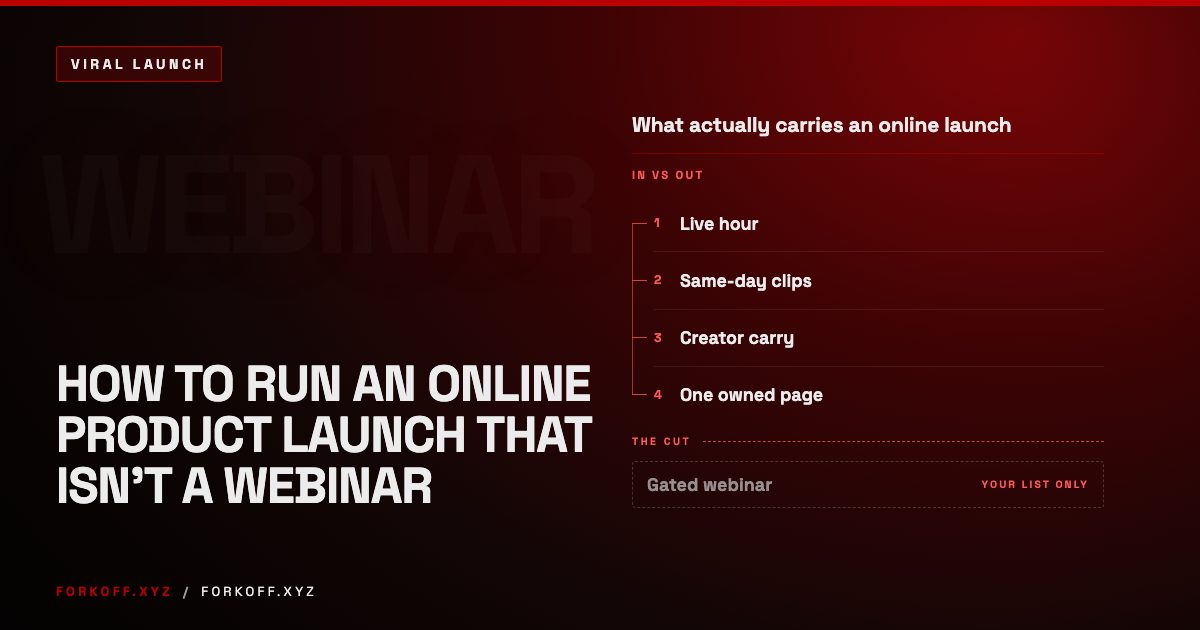
How to Run an Online Product Launch That Isn't a Webinar
An online product launch is a live moment cut into clips that creators carry, not a gated webinar. Here is the livestream, clip and creator stack for 2026.
 Read
Read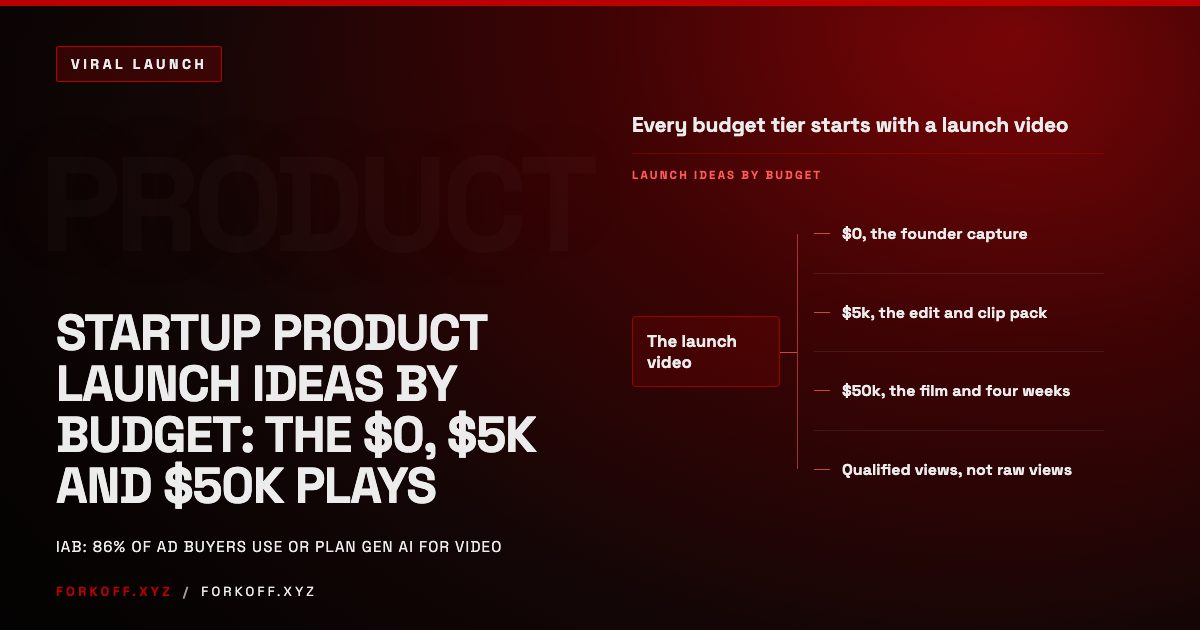
Startup Product Launch Ideas by Budget: The $0, $5k and $50k Plays
Product launch ideas for a SaaS startup sorted by budget: what the launch video should be at $0, $5k and $50k, and the distribution around it.
Read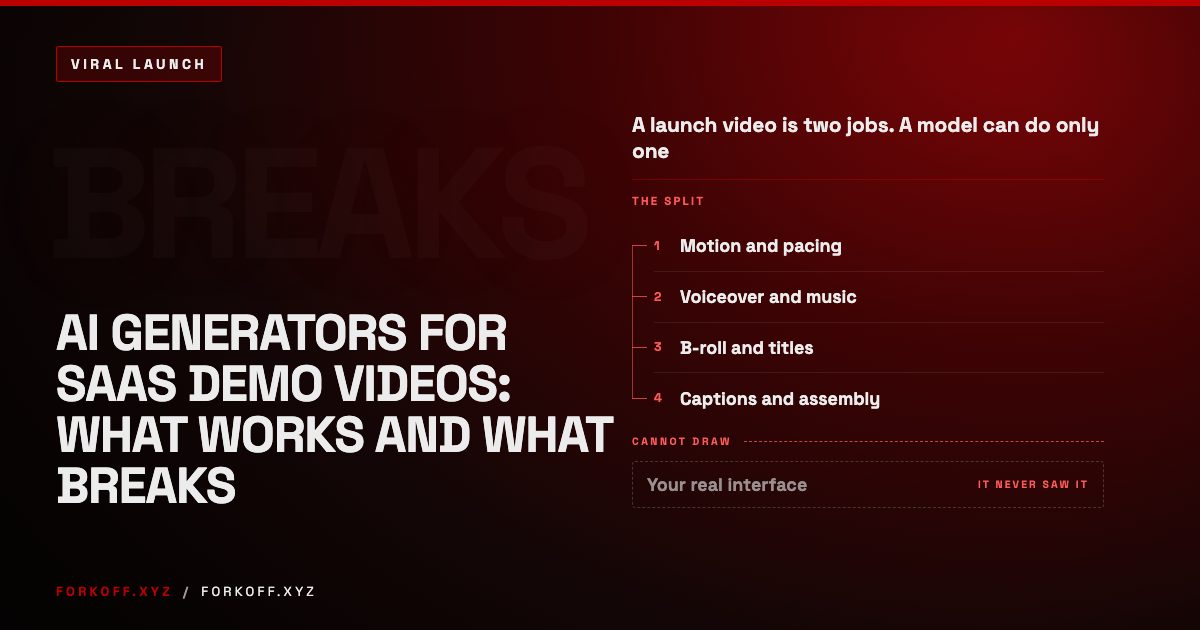
AI Generators for SaaS Demo Videos: What Works and What Breaks
AI video generators handle motion, voiceover and pacing well and draw your interface badly. Which half of a launch video to give a model, which half to keep.
Read