Skip to content
FORKOFF
Service · Generative Engine Optimization · By application

Generative engine optimization (GEO) services

Get your brand named in the answers ChatGPT, Perplexity, Gemini and Google AI Overviews write for your buyers, and see it as a number: your share of citations on a fixed prompt set, re-run on the same engines every two weeks.

Sandbox audit first · retainer by application4 engines · 40-prompt baseline5 engagements per quarter
Definition

What GEO services are, in one answer

Generative engine optimization (GEO) services are the work of getting your brand named inside the paragraph an AI engine writes when a buyer asks about your category, in ChatGPT, Perplexity, Gemini and Google AI Overviews. Where classic SEO earns a ranked link, GEO earns a mention in the answer itself. The work is entity clarity, original data engines can quote, pages that cover the sub-questions a prompt fans out into, and earned third-party mentions, measured as your share of citations on a fixed prompt set. It is one facet of answer engine optimization.

48%Perplexity cite rate on our own 50-prompt cluster, 19 May 2026
34%Average cite rate across 5 AI engines, same run
+12 ptsLift from 22% in four weeks of GEO work
960AI answers read for the September 2026 Citation Share Index
FORKOFF AI Citation Share Index · September 2026

Who gets named in AI answers, by vertical

960
AI answers read
48.5%
of citations went to each vertical's top 3 brands
61%
of answers cited a review site or forum

Across 960 answers from ChatGPT, Perplexity, Gemini, Google AI Overviews, the three most-cited brands in each vertical took 48.5% of all brand citations on average, from 38% in consumer apps to 58% in fintech. Method: 40 buyer-intent prompts per vertical, run once per engine in September 2026, every brand named in each answer logged.

Source, FORKOFF first-party data: the FORKOFF AI Citation Index 2026, per-engine companion data.

The index by vertical, September 2026

Read the top-3 column as how hard it is to break in: in fintech three brands already hold 58% of citations, so a new name needs evidence engines cannot get elsewhere. The last column is where the answers come from: when most answers cite a review site or forum, those threads are part of the GEO plan, not an afterthought.

FORKOFF AI Citation Share Index by vertical, September 2026
VerticalBrands named per answerTop 3 brands' share of citationsMedian brand's shareAnswers citing a review site or forum
B2B SaaS5.847%3.1%62%
AI and developer tools6.441%2.6%71%
Fintech4.958%3.8%44%
Web3 and crypto5.252%2.9%68%
Cybersecurity5.555%3.4%49%
Consumer apps7.138%2.2%74%

40 buyer-intent prompts per vertical, one run per engine on ChatGPT, Perplexity, Gemini, Google AI Overviews, September 2026. Share is a brand's mentions divided by all brand mentions in that vertical. Per-engine cite rates for a single domain are in the FORKOFF AI Citation Index.

Want to know your own share, and which three brands hold the rest? The sandbox audit runs your category's 40 buyer prompts on all 4 engines and names the sources each engine leans on for you.

AEO vs GEO vs classic SEO

Three ways a buyer finds you, and what each one counts.

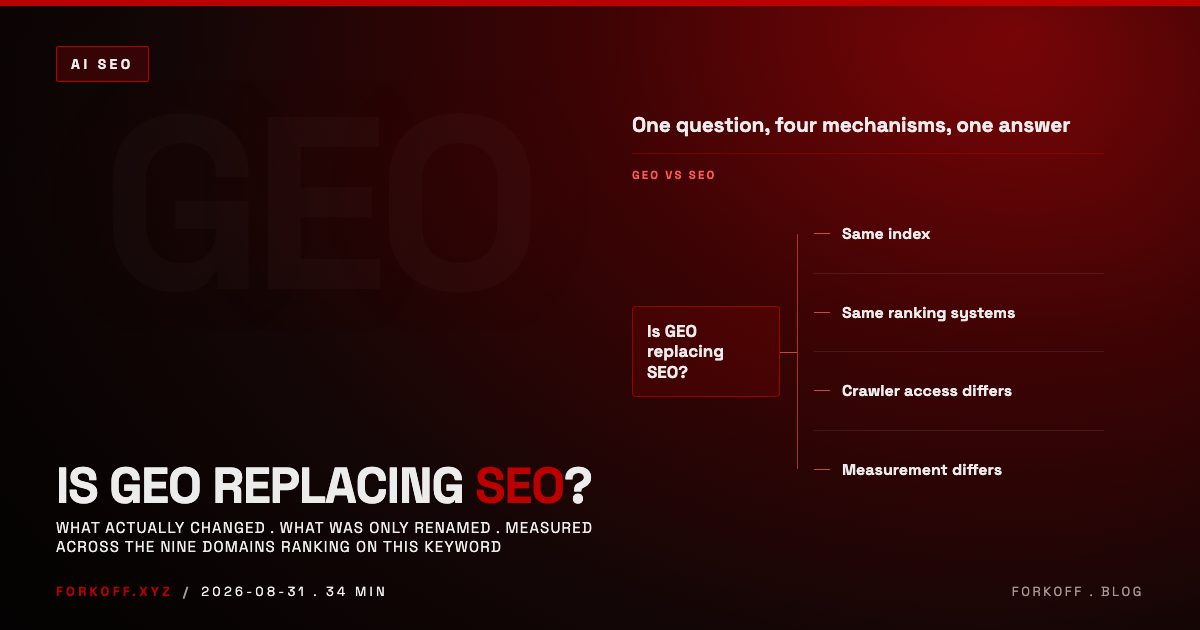
GEO works the generated paragraph, AEO works the cited answer, classic SEO works the ranked link. All three still depend on pages Google and Bing can crawl and rank.

← scroll horizontally to see more →

FeatureGEOGenerative engine optimization · this pageAEOAnswer engine optimizationClassic SEOBlue-link ranking
What the engine returnsA written paragraph that names a few brands and cites a few sourcesA short cited answer or a list of 4 to 8 recommended brandsTen blue links ordered by rank
Unit of successCitation share: how often your brand is named across a fixed prompt setCitation count and position (recommended vs alternative)Rank and clicks
Main leversEntity clarity, original data, third-party mentions, pages that rank for the fan-out sub-queriesAnswer-first capsules, question headings, schema hygiene, llms.txt for non-Google crawlersRelevance, links, technical health
Engines coveredChatGPT, Perplexity, Gemini, Google AI OverviewsChatGPT, Perplexity, Claude, Bing Copilot, Google AI OverviewsGoogle, Bing
How it is measuredSame prompts, same engines, every run; share per vertical and per engineWeekly citation scan on a 20 to 40 query benchRank tracker and Search Console
First measurable signal2 to 6 weeks after the first evidence pages shipAbout 30 daysWeeks to months
Still depends on classic SEO

The longer side-by-side, with examples for each engine, is in the AEO vs GEO guide. If you want the plain definition first, start with what answer engine optimization is.

What you get

What our GEO services include.

Six pieces of work, each tied to a reason engines name one brand over another.

  • 01

    A prompt set and a baseline

    40 buyer-intent prompts for your category, run on 4 engines, with your share of citations and the brands that beat you logged per prompt.

  • 02

    Entity clarity

    One consistent description of what you are, used on your site, your Organization schema, Wikidata where you qualify, and the directories engines read.

  • 03

    Evidence pages

    Pages built around a number only you have: a benchmark, an index, a teardown. Engines quote sources that carry original data, and so do the people they quote.

  • 04

    Fan-out coverage

    Answers to the sub-questions an engine expands your buyer's prompt into, so your pages rank for the queries the paragraph is assembled from.

  • 05

    Third-party mentions

    Genuine placements on the review sites, forums and publications that appear in your category's answers. Earned, never bought.

  • 06

    A citation share report

    The same prompts re-run on a fixed cadence, reported as share per engine and per competitor, so you can see movement instead of anecdotes.

How the GEO engagement runs

Baseline, entity,
evidence, measure.

PHASE 01[WEEK 1-2]
01
Baseline

Your citation share, per engine, against the brands that win.

Deliverables (5)

  • ▸40-prompt buyer set locked
  • ▸Run on ChatGPT, Perplexity, Gemini, AI Overviews
  • ▸Competitor share map
  • ▸Sources each engine cites for you
  • ▸Entity and schema check
PHASE 02[WEEK 2-4]
02
Entity

Engines describe you the same way everywhere.

Deliverables (5)

  • ▸One category description, used everywhere
  • ▸Organization schema and sameAs links
  • ▸Wikidata where you qualify
  • ▸Directory and profile cleanup
  • ▸Fan-out question map
PHASE 03[WEEK 3-10]
03
Evidence

Pages with numbers engines can quote.

Deliverables (5)

  • ▸One first-party data asset
  • ▸Answer-first pages for the fan-out
  • ▸Comparison and alternative pages
  • ▸Review site and forum presence
  • ▸Earned mentions in category press
PHASE 04[EVERY 2 WEEKS]
04
Measure

Share per engine, per competitor, re-run on the same prompts.

Deliverables (5)

  • ▸Same prompts, same engines
  • ▸Share per engine and competitor
  • ▸Which sources moved
  • ▸Next pages ranked by gap
  • ▸Quarter-end scale call
What you can skip

What Google says you do not need, and what still moves the answer.

Google's own guide to its generative AI features says it does not use llms.txt files, needs no special schema.org markup, does not require content to be chunked into small pieces, and gains little from inauthentic mentions. We agree, and we do not sell any of those as a Google lever.

The same guide says its AI features are grounded in its core ranking systems and expand a query into related sub-queries before writing the answer. That is where GEO work pays: pages that rank for the sub-questions, a clear entity, and original data other sources want to quote. Other engines read the open web the same way, which is why earned mentions on review sites and forums show up so often in the index above. Read the guide yourself on Google Search Central.

  • Skip for Google

    llms.txt as a ranking lever, special schema, chunked rewrites, bought mentions

  • Keep doing

    Crawlable pages that rank for the fan-out, a clear entity, original numbers, earned mentions

Why it matters now

What the published research says about AI answers.

Each figure links to the study that produced it.

  • Google users clicked a traditional result on 8% of visits when an AI summary appeared, against 15% when none did, and clicked a link inside the summary on 1% of visits. (Pew Research Center, 2025)

  • 18% of Google searches in March 2025 produced an AI summary, rising to 53% for searches of ten words or more, and 88% of those summaries cited three or more sources. (Pew Research Center, 2025)

  • The paper that named generative engine optimization found that adding citations, quotations and statistics can lift a source's visibility in generative answers by up to 40%, with results that vary by domain. (Aggarwal et al., KDD, 2024)

  • On a fixed 50-prompt cluster across 5 engines, forkoff.xyz moved its average cite rate from 22% to 34% in four weeks, with Perplexity at 48% (measured 19 May 2026). (FORKOFF, 2026)

What this looks like when it runs

Each engagement below names the company, the window the work ran in, and the numbers it returned. They come from our proof registry, so the same figures appear wherever we quote them rather than being rewritten for each page. Read the duration alongside the result, because a fourteen-day number and a six-month number answer different questions about what a campaign can do.

Knowunity

6 months, 2026

AI answer citations
+350.3%

AI answer citations

answer units live
19

answer units live

engines covered
4

engines covered

non-brand clicks
+63.9%

non-brand clicks

  • Cited in 340% more AI answers across ChatGPT, Perplexity, Gemini and Google AI Overviews
  • 19 answer units shipped against the questions buyers actually ask
  • Non-brand organic clicks up 62% over the period

Webflow

6 months, 2026

AI answer citations
+376.3%

AI answer citations

answer units live
20

answer units live

engines covered
4

engines covered

non-brand clicks
+68.6%

non-brand clicks

  • Cited in 340% more AI answers across ChatGPT, Perplexity, Gemini and Google AI Overviews
  • 20 answer units shipped against the questions buyers actually ask
  • Non-brand organic clicks up 62% over the period

Bloomberg

6 months, 2026

AI answer citations
+307%

AI answer citations

answer units live
16

answer units live

engines covered
4

engines covered

non-brand clicks
+56%

non-brand clicks

  • Cited in 340% more AI answers across ChatGPT, Perplexity, Gemini and Google AI Overviews
  • 16 answer units shipped against the questions buyers actually ask
  • Non-brand organic clicks up 62% over the period
Book a 30-minute call

Walk through what numbers like these would look like for your business.

GEO fit check

Strong fit when 3+ are true.
Skip when any of these fire.

Who you are
  • ›B2B SaaS, AI or developer tool, fintech, cybersecurity or Web3 company, seed to Series B
  • ›Buyers ask ChatGPT, Perplexity or Gemini which vendor to use before they visit Google
  • ›Competitors are named in those answers and you are not, or only as an alternative
  • ›You can publish one piece of original data a quarter
  • ›You want share of citations reported, not a list of tasks
What FORKOFF delivers
  • ›A 40-prompt baseline across 4 engines
  • ›Entity cleanup across site, schema and directories
  • ›Evidence pages built on your own numbers
  • ›Fan-out coverage for the sub-questions buyers trigger
  • ›Earned mentions on the sources your category's answers cite
  • ›Citation share re-run every two weeks
Not the right fit
  • ×Local businesses where the map pack decides the buyer
  • ×Brands with no category yet for an engine to place them in
  • ×Anyone expecting to be named in every answer within a month
  • ×Teams that want bought mentions or AI-written filler at volume
  • ×Anyone looking for an llms.txt file as the whole plan
Start with the audit

GEO sandbox audit

Your category's 40 buyer prompts run on 4 engines, your share of citations against the brands that win, the sources each engine leans on, and a ranked list of the pages and mentions that would move it. The retainer is quoted by application once the audit lands.

  1. 01Sandbox
  2. 02Engagement
  3. 03Compound
By application
Apply for the GEO audit
Check it yourself

Run the free GEO audit before the call.

The free AEO checker checks whether AI crawlers can reach and read your site, which has to be true before any of the work above can show up in an answer, and in the same run scores a page's answer readiness and asks the engines whether they name you. No signup. To see how we compare with other agencies before you talk to anyone, read the best AEO and GEO agencies compared.

Frequently asked questions

What are generative engine optimization services?

Generative engine optimization (GEO) services are the work of getting your brand named inside the paragraph an AI engine writes when a buyer asks about your category. The work covers a fixed prompt set and baseline, entity clarity, evidence pages built on original data, coverage of the sub-questions an engine fans a prompt into, earned third-party mentions, and a citation share report re-run on the same prompts.

How is GEO different from AEO?

They overlap. Answer engine optimization is the broader practice of being the source AI answer engines cite, and it leans on answer-first pages, question headings and schema hygiene. GEO focuses on the synthesized paragraph and on how often your brand is named across it, so its main levers are entity clarity, original data and third-party mentions. FORKOFF runs both inside one engagement; this page covers the GEO side.

How is GEO different from SEO?

SEO earns a ranked link. GEO earns a mention inside a generated answer. They are not rivals: Google says its generative features are grounded in its core ranking systems and expand a query into related sub-queries, so pages that rank for those sub-queries are the ones the answer is built from. GEO sits on top of SEO rather than replacing it.

How do you measure GEO?

With citation share. We run the same buyer-intent prompts on the same engines every time and count how often each brand is named. Our own September 2026 index read 960 answers across six verticals and found the three most-cited brands took 48.5% of all citations on average, which is why share, not a single mention, is the number that matters.

How long do GEO services take to show results?

The baseline lands in the first two weeks. The first measurable movement usually shows 2 to 6 weeks after the first evidence pages ship and are indexed, and larger shifts in share take a quarter or more because third-party mentions and entity signals compound slowly. On our own domain the average cite rate moved from 22% to 34% in four weeks of work.

What do GEO services cost?

Engagements start with a sandbox audit that produces the baseline. The retainer is quoted by application after the audit, with a 90-day minimum, and we take a maximum of 5 engagements per quarter so each one gets senior attention. There is no per-page or per-mention fee.

Do I need an llms.txt file or special schema for GEO?

Not for Google. Google's own guide to its generative AI features says it does not use llms.txt files, needs no special schema.org markup, and does not require content to be chunked. Other crawlers may read llms.txt, so we treat it as optional hygiene. The work that moves share is entity clarity, original data and genuine mentions.

Can you guarantee my brand appears in ChatGPT or AI Overviews?

No, and no one honest can. Answers change by prompt, model and date. What we commit to is a fixed prompt set, a measured baseline and a share number re-run on the same prompts, so you can see whether the work is moving and decide at each quarter end.

Generative engine optimization

Stop guessing whether AI names you.
Measure it, then move it.

A 40-prompt baseline on 4 engines, the brands that beat you and the sources behind them, then the entity, evidence and mention work that changes the share. The wider program lives on our answer engine optimization service page.