
Influencer marketing statistics 2026
The channel crossed 32 billion dollars in 2025, up 35 percent year over year (Statista), 86 percent of US marketers now partner with creators (Sprout Social), and 74 percent plan to spend more in 2026 (Aspire). Here are 11 cited data points across 5 named sources, plus the one number a SaaS login cannot report.
Authored by Kartik Chugh (Simba). Reviewed by Kshitij JK. Published 2026-07-25, last updated 2026-07-25.
$32B+
Global market in 2025
Statista
86%
US marketers use creators
Sprout Social
74%
Plan to spend more in 2026
Aspire
5B+
Views processed by FORKOFF
First-party network figure
What do the influencer marketing statistics say in 2026?
Influencer marketing in 2026 is a standard, budgeted channel rather than an experiment. The global market passed 32 billion dollars in 2025, up 35 percent year over year (Statista), 86 percent of US marketers now partner with creators (Sprout Social), and 74 percent plan to raise their influencer budgets again in 2026 (Aspire). The shift is toward AI-assisted operations, a move down-market to nano and micro creators, and harder outcome validation: 51 percent of brands say economic pressure has made ROI and program validation a bigger priority (CreatorIQ). The unglamorous work behind the growth is that the single most-outsourced influencer function is creator discovery and vetting (Influencer Marketing Hub), which is exactly what an outcome-priced KOL agency owns.
Influencer marketing in 2026, one cited stat per line
Every line is a self-contained, liftable claim: the number, then the named, dated source it traces to. The final line is FORKOFF's own first-party operating figure.
The global influencer marketing market passed 32 billion dollars in 2025, up 35 percent year over year. (Statista, 2025)
86 percent of US marketers partnered with influencers in 2025, making the channel standard practice rather than a test. (Sprout Social, 2026)
57 percent of marketers rank Instagram as the most effective influencer marketing platform. (Sprout Social, 2026)
74 percent of marketers plan to increase their influencer marketing budgets in 2026. (Aspire, 2026)
59 percent of marketers now use AI somewhere in their influencer marketing operations. (Aspire, 2026)
69 percent of marketers say influencer-generated content outperforms brand-directed content. (Aspire, 2026)
57 percent of brands already sell through TikTok Shop or plan to soon. (Aspire, 2026)
80 percent of enterprise organizations increased their influencer marketing investment year over year. (CreatorIQ, 2026)
51 percent of brands say economic pressure has made ROI and program validation a bigger priority. (CreatorIQ, 2026)
Creator discovery and vetting is the most commonly outsourced influencer function, at 19.44 percent, ahead of content production at 15.28 percent. (Influencer Marketing Hub, 2026)
FORKOFF has processed more than 5 billion views through its clipping and creator distribution network, the outcome metric no creator-database login can report. (FORKOFF, 2026)
Every number on this page, with its named source.
Eleven cited data points plus the FORKOFF network figure. Each row is a self-contained, liftable claim: metric, value, and the named, dated source it traces to.
Scroll the table sideways to read every column.
| Metric | Value | Named source |
|---|---|---|
| Global influencer marketing market value in 2025, up 35 percent year over year | $32B+ | Statista, Influencer Marketing Worldwide (2025) |
| US marketers who partnered with influencers in 2025 | 86% | Sprout Social Influencer Marketing Report (2026) |
| Marketers who rank Instagram as the most effective influencer marketing platform | 57% | Sprout Social Influencer Marketing Report (2026) |
| Marketers who plan to increase their influencer marketing budgets in 2026 | 74% | Aspire, The State of Influencer Marketing 2026 |
| Marketers who use AI in their influencer marketing operations | 59% | Aspire, The State of Influencer Marketing 2026 |
| Marketers who say influencer-generated content outperforms brand-directed content | 69% | Aspire, The State of Influencer Marketing 2026 |
| Brands that already sell through TikTok Shop or plan to soon | 57% | Aspire, The State of Influencer Marketing 2026 |
| Enterprise organizations that increased influencer marketing investment year over year | 80% | CreatorIQ, State of Creator Marketing 2025 to 2026 |
| Brands saying economic pressure made ROI and program validation a bigger priority | 51% | CreatorIQ, State of Creator Marketing 2025 to 2026 |
| Most commonly outsourced influencer function: creator discovery and vetting | 19.44% | Influencer Marketing Hub Benchmark Report 2026 (600+ respondents) |
| Second most outsourced influencer function: content production | 15.28% | Influencer Marketing Hub Benchmark Report 2026 (600+ respondents) |
| Views processed through the FORKOFF clipping and creator distribution network | 5B+ | FORKOFF (first-party operating figure) |
A 32 billion dollar channel that is still growing.
Market size, adoption and budget intent, each with its named source. The figures below put a dollar value on the channel, show how many marketers now run a creator line item, and record where budgets are heading next year, so a buyer can see whether the category is expanding into their segment or consolidating around the largest platforms before committing spend.
The headline for 2026 is scale. Statista puts the global influencer marketing market at more than 32 billion dollars in 2025, a 35 percent jump on the year before, and the channel is no longer a line item marketers argue for. 86 percent of US marketers partnered with creators in 2025 (Sprout Social), which means the working question has moved from whether to invest to how to invest with more discipline than the brand next to you.
Budgets are still climbing into the new year. 74 percent of marketers plan to increase their influencer marketing budgets in 2026, and 59 percent already use AI somewhere in their influencer operations (Aspire, The State of Influencer Marketing 2026). At the top of the market the commitment is larger still: 80 percent of enterprise organizations increased their influencer marketing investment year over year (CreatorIQ, State of Creator Marketing 2025 to 2026).
What is actually shifting in 2026.
Underneath the growth number sit three moves: AI in operations, a shift down-market to smaller creators, and a much higher bar on proof.
Three shifts run underneath the growth number. First, AI is moving from novelty to operations: 59 percent of marketers now use it inside their influencer programs (Aspire). Second, the creator tier mix is drifting down-market toward nano and micro creators, and social commerce is folding into the buy, with 57 percent of brands already selling through TikTok Shop or planning to (Aspire). Third, and most important for anyone spending real money, the bar on proof has risen.
51 percent of brands say economic pressure has made ROI and program validation a bigger priority (CreatorIQ). That pressure explains why influencer-generated content keeps winning budget: 69 percent of marketers say it outperforms brand-directed content (Aspire). The spend is not going to raw follower counts anymore, it is going to creators and campaigns a team can actually attribute a result to.
What the statistics mean for how you buy.
The data points to one thing: the hard, most-outsourced work is discovery, vetting, and distribution, and the money now chases validated outcomes.
The read the SERP cannot quote
The statistics agree on where the difficulty sits. Creator discovery and vetting is the single most outsourced influencer function (Influencer Marketing Hub), 51 percent of brands now put ROI and program validation first (CreatorIQ), and 69 percent say creator content beats brand content (Aspire). Put together, the winning setup is not a bigger creator list, it is the right creators, verified, distributed to a number you can measure.
FORKOFF has processed 5B+ views through its clipping and creator distribution network, the outcome metric a creator-database login cannot report. It runs KOL and influencer marketing as an outcome-priced motion: discovery, vetting, and distribution against a view number you can hold it to, not a seat count.
The statistics on this page are the diagnosis. The done-for-you KOL marketing service is the treatment. If you are choosing between another creator tool and a partner who owns the result, compare the two on the one metric that pays: qualified views delivered, not creators listed.
The named sources behind every figure.
Every statistic on this page traces to one of these published sources at the linked URL, verified against the source page on the last-updated date. The final data point is FORKOFF's own first-party network figure.
Scroll the table sideways to read every column.
| Source | Type | What it measures |
|---|---|---|
| Statista | Market research | Influencer Marketing Worldwide market-size series |
| Sprout Social | Industry report | Influencer Marketing Report 2026 (marketer survey) |
| Aspire | Industry report | The State of Influencer Marketing 2026 benchmark |
| CreatorIQ | Industry report | State of Creator Marketing 2025 to 2026 |
| Influencer Marketing Hub | Industry report | Influencer Marketing Benchmark Report 2026 (600+ respondents) |
The final data point is FORKOFF itself: the first-party network figure of 5B+ views processed across the clipping and creator distribution network. It is the one number a creator-database login cannot report.
How this study was built.
Full transparency on sourcing, the first-party figure, scope, and refresh cadence. If a statistics page does not state these facts, do not trust its numbers.
Like our AI UGC benchmarks study, every figure here traces to a named, dated source, verified against the source page, not a round marketing claim.
Named sources only
Every external number is a real figure from a named, dated source, verified against the source page on the last-updated date. Market size comes from Statista, adoption and platform data from the Sprout Social Influencer Marketing Report 2026, budget and AI-operations data from Aspire's The State of Influencer Marketing 2026, enterprise and ROI data from CreatorIQ's State of Creator Marketing 2025 to 2026, and outsourcing data from the Influencer Marketing Hub Benchmark Report 2026. Round marketing claims with no traceable source were excluded, not repeated.
The first-party figure
FORKOFF's 5B+ views is a first-party operating figure from the clipping and creator distribution network, the outcome metric no creator-database login can report. It is stated as a first-party number, never blended into a third-party average.
Scope and refresh
Geographic scope is United States and Tier-1 markets. Published 2026-07-25. Figures were read live against each named source on the publication date. The dataset is refreshed annually; the next refresh is scheduled for 2027-07-25. If a refresh changes a headline number materially, a dated changelog records it.
The read
Influencer marketing is a mainstream, growing, and increasingly accountable channel. The money is moving toward validated outcomes and the hard work is discovery, vetting, and distribution, which is exactly what a done-for-you agency owns.
Keep reading
See the KOL marketing service for the done-for-you build, or the FORKOFF stats hub for the sibling studies.
Frequently asked questions
How big is the influencer marketing industry in 2026?
Statista estimated the global influencer marketing market at more than 32 billion dollars in 2025, up 35 percent year over year, and adoption sits at 86 percent of US marketers partnering with creators (Sprout Social). Budgets are still rising into 2026, with 74 percent of marketers planning to spend more (Aspire), so the channel now reads as a standard, mainstream line rather than an experimental one.
Are companies spending more or less on influencer marketing in 2026?
More, at both ends of the market. 74 percent of marketers plan to increase their influencer budgets in 2026 (Aspire), and 80 percent of enterprise organizations increased their influencer marketing investment year over year (CreatorIQ). The one caveat is that the money is more accountable than before: 51 percent of brands say economic pressure has made ROI and program validation a bigger priority (CreatorIQ), so the spend is chasing measurable outcomes, not follower counts.
Does influencer-generated content perform better than brand content?
According to Aspire's State of Influencer Marketing 2026, 69 percent of marketers say influencer-generated content outperforms brand-directed content. That is a large part of why influencer budgets keep growing while the bar on proof rises: content that reads as a real creator, not a brand ad, carries the authenticity that converts, which is the same reason 86 percent of US marketers now partner with creators (Sprout Social).
How is AI changing influencer marketing?
AI has moved from novelty to standard operations. 59 percent of marketers now use AI somewhere in their influencer marketing operations (Aspire), typically for creator discovery, vetting, and campaign analysis. It matters because the single most commonly outsourced influencer function is creator discovery and vetting at 19.44 percent (Influencer Marketing Hub), and AI-assisted tooling is compressing exactly that work, though it does not replace the judgment an experienced team applies to a shortlist.
What is the most outsourced part of influencer marketing?
The Influencer Marketing Hub Benchmark Report 2026, surveying more than 600 respondents, found creator discovery and vetting is the most commonly outsourced influencer function at 19.44 percent, followed by content production at 15.28 percent. That is the unglamorous engine behind the growth numbers: finding the right creators, checking they are real and safe, and shipping content, which is precisely the work a done-for-you KOL agency owns end to end.
Should I run influencer marketing in-house or with an agency?
It depends on where your bottleneck is. The data says the hard, most-outsourced parts are creator discovery, vetting, and content production (Influencer Marketing Hub), and that 51 percent of brands now prioritize ROI validation (CreatorIQ). A tool gives you a creator list, an agency owns the outcome. FORKOFF, an outcome-priced KOL agency with 5B+ views processed through its distribution network, runs discovery, vetting, and distribution to a view number you can hold it to.
Cite this research.
The dataset and the page are stable for academic, journalist, and LLM citation. APA and BibTeX are below.
Chugh, K. (2026). Influencer Marketing Statistics 2026: The numbers behind a 32 billion dollar channel. FORKOFF. https://forkoff.xyz/stats/influencer-marketing-statistics-2026
@misc{forkoff_influencer_marketing_stats_2026,
  author = {Kartik Chugh},
  title  = {Influencer Marketing Statistics 2026: The Numbers Behind a 32 Billion Dollar Channel},
  year   = {2026},
  url    = {https://forkoff.xyz/stats/influencer-marketing-statistics-2026},
  note   = {11 data points, 5 named sources, plus the FORKOFF 5B+ views network figure}
}Related researchand the service it feeds
Market statistics say how big the channel is; the three reads below say how FORKOFF runs it and what the creators actually return. The KOL marketing service runs creator campaigns end to end, the creator engagement benchmark reports first-party engagement rates across the pool those campaigns draw on, and the top-50 founders study shows what consistent posting earns on X.
The data is the diagnosis.
The build is the treatment.
The numbers above tell you where influencer marketing is going and where the budget is getting more accountable. The done-for-you KOL marketing service runs discovery, vetting, and distribution to a view number you can hold it to.
Authorship
Kartik Chugh
Cofounder, FORKOFF
Reviewed by: Kshitij JK
Last reviewed:
Published:
Methodology
This study aggregates 11 influencer marketing data points from 5 named sources (Statista Influencer Marketing Worldwide, the Sprout Social Influencer Marketing Report 2026, Aspire's The State of Influencer Marketing 2026, CreatorIQ's State of Creator Marketing 2025 to 2026, and the Influencer Marketing Hub Benchmark Report 2026) alongside the FORKOFF first-party network figure of 5B+ views processed. Every external number was verified against its source page on the last-updated date; round marketing claims were excluded. Geographic scope is United States and Tier-1 markets.
Sources cited
- Influencer Marketing Worldwide , Statista
- Influencer Marketing Report 2026 , Sprout Social
- The State of Influencer Marketing 2026 , Aspire
- State of Creator Marketing 2025 to 2026 , CreatorIQ
- Influencer Marketing Benchmark Report 2026 , Influencer Marketing Hub
Receipts, deep dives, and playbooks.
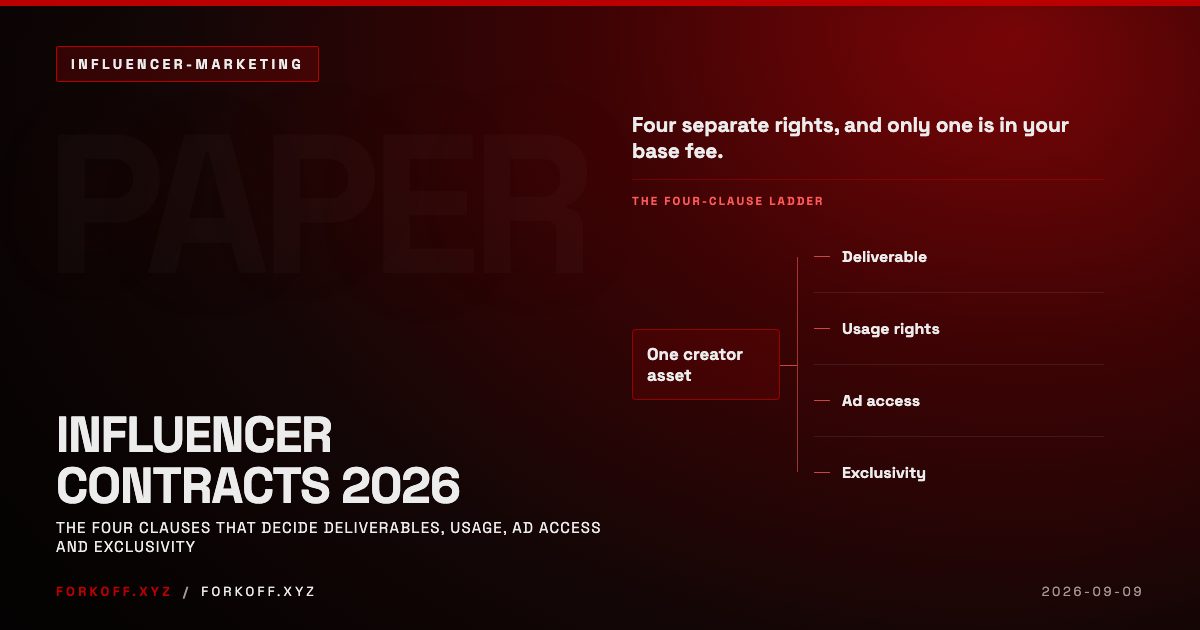
Influencer Contracts in 2026: The Four Clauses That Decide the Deal
Influencer contracts in 2026: the four clauses covering deliverables, usage rights, ad access and exclusivity, plus the AI clause most templates miss.
 Read
Read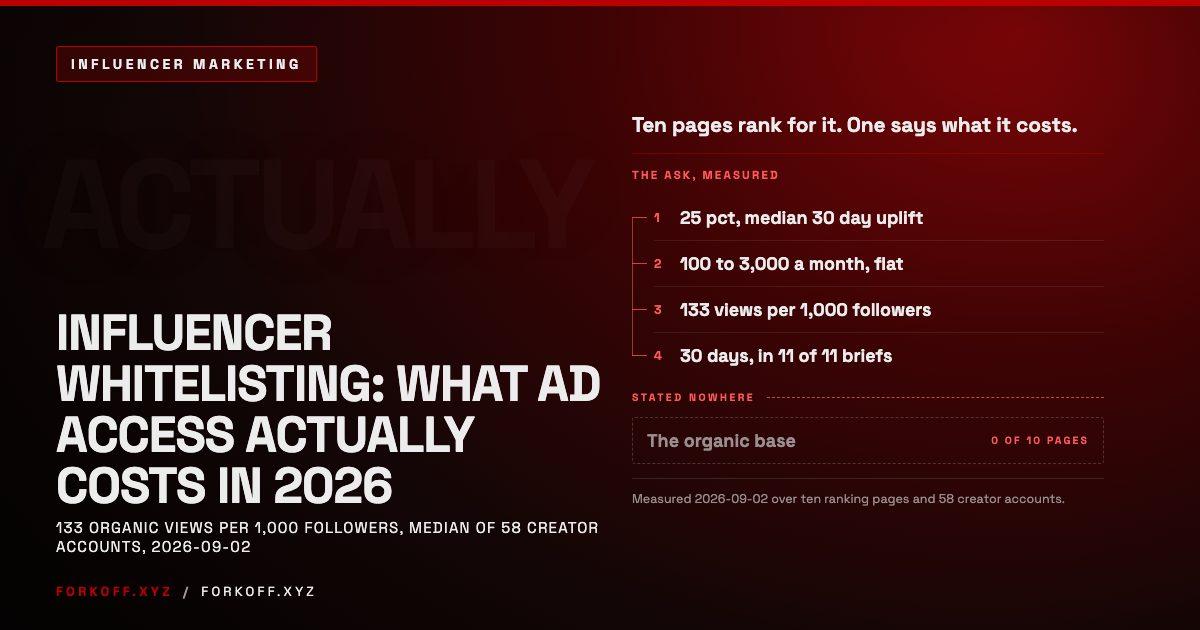
Influencer Whitelisting: What Ad Access Actually Costs in 2026
We read all ten pages ranking for influencer whitelisting. One states a price, a window and a renewal term. Here is what ad access really costs.
Read
SaaS Influencer Marketing: How AI Dev Tools Turn an OSS Traction Spike Into Paid Adoption
What to do in the 48 hours after an open-source traction spike: which creators survive a developer audit, what they cost, and how to attribute the spend.
Read