A creator quotes you two thousand dollars for a Reel. Then, in the same message, they add a line about ad access. Maybe it is a percentage. Maybe it is a monthly figure. Maybe it is one sentence saying whitelisting is included, which sounds generous and is the version that costs you the most later.
You have no idea whether that number is fair, because nobody publishes what it should be. So you either pay it, or you push back on a figure you cannot argue with, and either way you find out afterwards.
The 90-second version
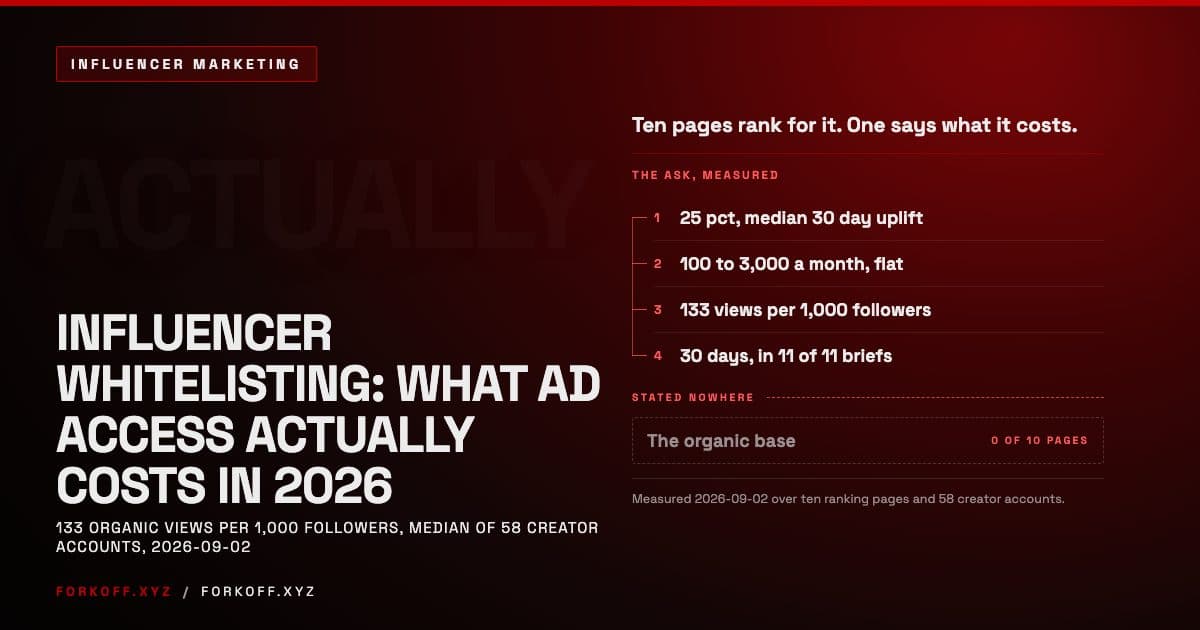
Influencer whitelisting is the right to run paid ads from a creator's own handle. On 2026-09-02 we read all ten pages Google ranks for the term. Four state a price for that right. Three state a window. One states a renewal term. One page of ten states all three, and none of the ten reports an observed sample of real deals. So we ran one. Across 483 threads and 7,083 posts and comments, plus 228 posts on X, the median public ask for a 30 day window is 25 percent of the content fee, with a range of 20 to 40 percent, while flat monthly quotes for the same right run from 100 dollars to 3,000 dollars, a spread of 30 times. Longer windows are far cheaper per day: 30 days at 25 percent works out at 0.83 percent of the fee per day, and two years at 62.5 percent works out at 0.086 percent, about a tenth. Then we measured what the fee is actually amplifying. Across 58 creator accounts and 771 original posts, the median account earns 133 organic views per 1,000 followers, and that figure FALLS as accounts get bigger, from 206 in the 1,000 to 5,000 band to 56 in the 20,000 to 100,000 band. Fees are quoted against follower tier. Reach is not.
We went looking for the answer on 2026-09-02 and found the shape of the problem first. Google ranks ten pages for influencer whitelisting. Four of them state a price for ad access. Three state a rights window. One states a renewal term. Exactly one page states all three together, and not one of the ten reports what a sample of real asks looks like. So we ran the sample: 483 Reddit threads, 7,083 posts and comments, 228 original posts on X, and a posting-history panel of 58 creator accounts.

Everything numeric below is either a live reading we took on 2026-09-02 and tagged measured, arithmetic on those readings tagged derived, or somebody's public asking price tagged published. That third tag carries most of the pricing, because pricing in this market exists only as asks. Nobody publishes contracts, ourselves included, and a post that presented a self-reported ask as a market rate would be doing the same thing the ranking pages do, just with more decimal places.
What is influencer whitelisting, and what are you actually buying?
Influencer whitelisting is the right to run paid advertising from a creator's own account rather than from your brand page. Their handle sits at the top of the ad. Their profile picture is the avatar. The post that already exists on their feed usually becomes the creative. Everything commercial stays with you: the targeting, the budget, the schedule, the destination, and the ability to turn it off. What you are buying is not content and not reach. You are renting an identity for a set period, and the whole reason it works is that people stop for a person and scroll past a logo.
What is influencer whitelisting?
It is the right to run paid ads from a creator's own account rather than your brand page, using their handle and their existing post as the ad. The brand controls targeting, budget and the destination. The viewer sees the creator's name at the top and often has to look hard to see it is an ad.
That definition matters because it tells you what a fair price is anchored to, and the honest answer is that it is anchored to nothing obvious. The content has a production cost. The media has a market price per thousand impressions. Ad access sits between them and has neither. It is the only line in a creator deal whose value depends entirely on how much money you put behind it afterwards, which is why two reasonable people looking at the same handle can be four hundred percent apart on what it is worth.

There are four ways to put creator content into a paid feed and the words for them are used interchangeably in almost every conversation we read. Boosting means putting spend behind a post that already exists on your own brand page. A partnership ad shows two names, yours and the creator's, and is granted through the platform's own partnership hub in about a minute. Whitelisting shows only the creator, and needs deeper access to their underlying page. Brand-owned creative is a video you commissioned, running from your handle, with no creator identity attached at all.
Boosting, partnership ads, whitelisting and brand-owned, on what actually differs
Boosting
Partnership ads
Whitelisting
Brand-owned
Runs from the creator handle
Brand name shown on the ad
Brand controls targeting and budget
Needs access to the creator's page
Creator can revoke it
Setup lives in the partnership hub
Read against a practitioner walkthrough and the platform's own setup path, 2026-09-02. Partial means the answer depends on the objective or on how the grant was made. No two columns match on all six rows, which is why a contract that names the wrong one sends you to the wrong request screen.
No two of those four share the same combination of properties, which is why the word in your contract has real consequences. A practitioner walkthrough puts the distinction precisely: with whitelisting the ad is fully controlled by the brand using the creator's identity, whereas with a partnership ad the content is boosted from the creator's own post and both parties are visible in the final ad. Same commercial idea, different grant, different request screen, different revocation path.
Is whitelisting the same as a partnership ad?
No. A partnership ad shows both names and is granted through the platform's partnership hub. Whitelisting shows only the creator and needs deeper access to their page. They are different grants with different setup paths, so naming the wrong one sends you to the wrong request screen.
Whitelisting Ads vs Partnership Ads (EXPLAINED)
Fraser Cottrell
A practitioner walkthrough of the difference between whitelisting and partnership ads, including where each grant is requested and why one platform keeps pushing people toward the other.
The same walkthrough is candid about where the practice came from, calling it a black hat technique from five or six years ago that people did on the side to get you to interact with something you did not think was an ad, before one platform built a transparent version of it and started steering everyone there. That history is not a reason to avoid it. It is a reason to write down which of the two you are actually buying, because the platform's incentive is to move you toward the transparent one and your contract may still say the other.
Operator noteWrite partnership ads or page access into the contract by name. They are different grants and different request screens.
What did the ten pages ranking for this actually say?
Before running any measurement of our own we did the cheap thing and read the competition. All ten organic results for the head term, pulled on 2026-09-02 at United States location. Eight of them scraped to full text, between 12,233 and 41,847 characters each. The one at position two is a Reddit thread, which declines scraping, so we read it through our own Reddit data infrastructure instead, post plus the whole comment tree. The tenth is a thirty second video and is recorded as unmeasured rather than quietly counted as a zero.
We fixed three criteria before reading anything, so the scoring could not drift toward whatever we hoped to find. Does the page state a price the brand pays the creator for ad access, excluding ad spend arithmetic and the vendor's own subscription pricing? Does it state a rights window as a number of days, excluding its own free trial? Does it state a renewal or extension term?
Every page ranking for influencer whitelisting, scored on the three terms a buyer needs, 2026-09-02
| Position | What kind of page it is | States a price for ad access | States a rights window | States a renewal term | Source |
|---|---|---|---|---|---|
| 1 | Vendor blog explainer | Yes, 20 to 30 percent of the collaboration fee | No | No | measured |
| 2 | Reddit thread, posted 2025-05-21 | No | Yes, a commenter says 60 to 90 days | No | measured |
| 3 | Glossary entry | No | No | No | measured |
| 4 | Agency blog, platform setup walkthrough | No | No | No | measured |
| 5 | Creator-side education | Yes, 25 percent on top, or 1,000 a month | No | No | measured |
| 6 | A 30 second video | Unmeasured | Unmeasured | Unmeasured | unknown |
| 7 | SaaS blog from an access tool | No, its figures are ad-budget arithmetic | No, its day counts are its own free trial | No | measured |
| 8 | Agency blog, dated in its own title | Yes, 150 to 500 and 500 to 2,000 a month | Yes, 30, 90 and 180 days | Yes, a 20 to 30 percent premium | measured |
| 9 | Platform blog with one brand example | Yes, about 1,000 euro, plus a 10 percent of spend ask | Yes, 30 days and three months | No | measured |
| 10 | Marketplace guide | No | No | No | measured |
n = 10 · as of 2026-09-02
Method: All ten organic results pulled 2026-09-02 at United States location. Eight scraped to markdown, main content only, 12,233 to 41,847 characters each. The thread at position 2 was read through our own Reddit data infrastructure, post plus full comment tree. The video is recorded unmeasured rather than scored as a zero. A price means a figure the brand pays the creator for ad access, not ad spend and not the vendor's own subscription. A window means days of access, not a free trial. Falsified by re-running the pull, or by reading any page and scoring a cell differently.
Four of nine measured pages state a price, three state a window, one states a renewal term, one states all three, and zero report a sample of real deals.
Four of the nine measured pages state a price. Three state a window. One states a renewal term. One page of ten does all three, and it is the only one on the SERP whose title carries a month and a year, which is not a coincidence.

The prediction we started with, written down before the audit ran, was that not one ranking page would state a price, a duration or a renewal term. That prediction is partly wrong and we are keeping it in rather than quietly rewriting history, because the way it was wrong is the interesting part. The pages do carry numbers. They carry them without windows, without renewal terms, and without any indication of where the numbers came from.
How many of the nine measured ranking pages state each term
Nine of the ten pages ranking for the head term on 2026-09-02, read in full. The tenth is a video and is unmeasured rather than counted as a zero. The last bar is the one that decided this post: no page on the SERP reports what a sample of real asks looks like, so we measured one.
The last bar is the one that decided this post. Zero of the nine report an observed sample. Every figure on that SERP is a rate-card assertion, a survey citation, or one anecdote about one brand. The two pages that carry the most specific numbers disagree by roughly an order of magnitude on the same question and neither of them mentions that the other exists.

There is a second absence that is easier to miss. Not one of the nine pages states what the underlying post was already reaching organically. A whitelisted ad amplifies an organic post. The size of that organic base is the denominator in every honest version of this decision, and the entire ranking set treats it as though it does not exist.

Read the funnel the other way and the shape of the gap is clear. The pages are not withholding prices out of coyness. They are answering a different question from the one their own visitors arrived with, and the two questions have been separated by the search results themselves.
Two different markets are using the same word
The vendor pages that rank for this term price ad access as a separate recurring line, 150 to 500 a month for a micro creator on one page and about 1,000 euro for 30 days on another. The live creator briefs we read on the same day do something else entirely: they fold a 30 day window into a package price of 200 to 350 dollars for the whole deliverable set and never name a fee for it at all. Both are real. A buyer reading the first and negotiating in the second will overpay by a wide margin, and a creator doing the reverse will underprice by a wider one.
Source: FORKOFF whitelisting market sweep, 2026-09-02
Why does the head term not answer the money question?
Because the money question has its own search results and nothing routes you there. On the same day we pulled two more SERPs. influencer whitelisting cost returned ten distinct domains with only two shared with the head term, and four of its ten titles carry a price or a price range. influencer usage rights returned ten more domains, again with two shared. Thirty results across three queries, and the overlap between the definitional head and the two money-adjacent tails is three domains.
That is a routing hole rather than a content gap. The buyer types the head term because it is the word in the contract in front of them. They land on an explainer, get the definition they already had, and never see the pages that would have answered them. Meanwhile the pages with prices rank for a phrase nobody types while mid-negotiation, because at that moment you are not asking what something costs in general, you are asking whether the number in the email is reasonable.
Influencer Whitelisting / Dark Posting: Are creators charging you way more for ad access in 2026?
A brand-side buyer running whitelisted ads for CPG clients asks what ad access should cost in 2026, reports that micro-influencers used to add roughly 20 percent for it and that management agencies now quote far more, and asks whether other buyers are eating the increase or going back to brand-owned… Show more
The clearest evidence that this is a real gap rather than a convenient one is a thread from March. A brand-side operator running whitelisted ads for consumer packaged goods clients asked whether creators were charging much more for ad access in 2026, and gave the context that makes the question specific.
Last year, most micro-influencers just threw in ad access for an extra 20%. Now, management agencies are demanding insane licensing fees just to run paid spend behind their organic posts.
That post has one upvote and zero replies. It sat there for six months. The person asking is not a beginner, they run this at agency scale across multiple clients, and they still could not get a number out of the internet. We found it because it was the sharpest demand signal in our own topic research, and the thing that made it worth writing about was the reply count.
The buyer asked this in March and nobody answered
On 2026-03-03 a brand-side operator running whitelisted ads for CPG clients posted a question asking whether creators were charging much more for ad access in 2026, saying micro-influencers used to add about 20 percent and that management agencies now quote far more. The thread has one upvote and zero replies. Meanwhile the term's own head SERP is eight vendor explainers, and the pages carrying actual prices sit on a different result set the buyer never gets routed to. The demand is loud and the supply of answers is a definition.
Source: r/SocialMediaMarketing, 2026-03-03, read 2026-09-02
What do people actually quote for ad access?
We swept for it. Fourteen Reddit queries naming whitelisting, dark posting, Spark Ads, partnership ads, ad access and usage rights, run at both an all-time and a one-year window, returning 483 candidate posts whose title or body carried one of those terms. For every candidate we pulled the complete comment tree, giving 7,083 units where a unit is one post body or one comment. A unit counted as a quoted ask when a price token sat within four hundred characters of an ad-access token. That produced 224 raw hits, which came down to 69 after scoping to marketing and creator communities and removing the unrelated senses of the word, mostly crypto allowlists and device configuration. Then we read all 69 by hand before any of them entered a table.
How much does influencer whitelisting cost?
There is no market rate, and the spread is the finding. Across public asks read on 2026-09-02, the median uplift for a 30 day window is 25 percent of the content fee, ranging 20 to 40 percent. As a flat monthly fee, the same right runs from 100 dollars to 3,000 dollars a month.
Ten public percentage quotes for a 30 day or monthly window from Reddit, X and the ranking pages themselves, plus twelve flat-fee quotes, all read 2026-09-02. Each is somebody's self-reported ask, not a contract we have seen.
Public percentage asks for a 30 day or monthly whitelisting window
| Who is quoting | Where | The ask | Midpoint used | Source |
|---|---|---|---|---|
| A creator advising another creator | r/influencermarketing | 30 percent above your fee for every 30 days | 30 | published |
| A creator quoting standard rates | r/UGCcreators | 20 to 30 percent of base rate per month | 25 | published |
| A creator with 19,000 on TikTok | r/UGCcreators | 20 percent monthly of the base rate | 20 | published |
| A creator with 30,000 on Instagram | r/influencermarketing | 20 percent of my rate per month of usage | 20 | published |
| A commenter pricing a specific deal | r/influencermarketing | 30 to 40 percent for a 30 day window | 35 | published |
| A second commenter on the same deal | r/influencermarketing | 30 to 50 percent on top of base rate | 40 | published |
| A creator quoting a travel deal | r/influencermarketing | 30 to 50 percent of a post for 30 days | 40 | published |
| The page at position 1 | Head SERP | 20 to 30 percent of the collaboration fee | 25 | published |
| The page at position 5 | Head SERP | 25 percent on top of the campaign fee | 25 | published |
| The page at position 8 | Head SERP | 20 to 30 percent beyond 30 days | 25 | published |
n = 10 · as of 2026-09-02
Method: Every row is somebody's stated ask, read live on 2026-09-02, tagged published rather than measured because no contract was seen. Reddit rows come from a sweep of 483 candidate threads and 7,083 posts and comments, filtered to a price token within 400 characters of an ad-access token, then read by hand. SERP rows come from the scraped ranking pages. Where a range was quoted the midpoint is used and both figures are shown. The distribution, not any single row, is the claim.
Sorted midpoints: 20, 20, 20, 25, 25, 25, 30, 35, 40, 40. Median 25 percent of the content fee for a 30 day window.
Ten of those quotes name a percentage uplift for a thirty day or monthly window, and they come from both sides of the table plus the ranking pages themselves. Sorted, the midpoints run 20, 20, 20, 25, 25, 25, 30, 35, 40, 40. The median is 25 percent of the content fee.
That is the closest thing to a benchmark that exists in public for this term, and it is worth being clear about what it is not. It is ten people's asking prices, not ten transactions. Several of the people quoting it are advising other creators to charge more. At least one is a buyer describing what used to be normal rather than what they pay now. Treat it as the centre of a conversation rather than as a rate.

The quoting shape matters more than the number. A percentage uplift is easy to agree and prices ad access against production cost, which has nothing to do with what the access is worth. A flat monthly fee is at least honest about being rent. Bundling it into the package price, which is what almost every live creator brief does, means neither side can renew or extend without reopening the whole deal. The fourth shape, a percentage of the ad spend behind the post, is the only one whose cost tracks whether the thing is working, and it is the one almost nobody uses. We saw it quoted at around ten percent.
Operator noteAsk for the content price and the ad-access price as two numbers. A single number means you cannot renew without reopening the whole deal.
Quoted as a flat monthly figure instead, the same right has no rate at all. Twelve public quotes we collected span 100 dollars a month at the low end to 3,000 dollars a month at the high end, with a mid-market cluster around 150 to 500. That is a spread of roughly thirty times for a term with one name, and every one of those figures was stated by somebody who believed it was normal.
Nawi
@Aria_Nawi
Assets used: 5 (The $10K Stack Angle) D2C folks, your creative budget has a leak Motion: $1K+/mo just to read your own analytics Adscook: $399+/mo to manage ads you already made Whitelisting: $2K+/mo for usage rights Agency: $50K+/mo to glue it all together You're not paying f… Show more
Two thousand dollars a month and two hundred dollars a package are both real quotes from the same fortnight, aimed at the same term. Nothing in either post is dishonest. They are describing different tiers of a market with no published midpoint, and the buyer is expected to work out which one they are standing in.
Why does a thirty day window cost ten times as much per day as a two year one?
Because the market prices duration in bands and the bands are not linear. The same sweep that produced the thirty day figure also produced quotes for longer windows: 30 percent for ninety days from two independent sources, 50 percent for a hundred and eighty days, and 60 to 65 percent for two years or perpetual. Line those up and convert each to a cost per day of access, as a share of the content fee, and the shape is not a gentle discount. It is a cliff.
What a day of ad access costs, by window length
| Window | Typical quoted uplift | Cost per day as a share of the content fee | Multiple of the two year rate | Source |
|---|---|---|---|---|
| 30 days | 25 percent | 0.83 percent | 9.7x | derived |
| 90 days | 30 percent | 0.33 percent | 3.9x | derived |
| 180 days | 50 percent | 0.28 percent | 3.2x | derived |
| 730 days, two years or perpetual | 62.5 percent | 0.086 percent | 1.0x | derived |
n = 4 · as of 2026-09-02
Method: The uplift column is the median or the midpoint of the public asks we read for each window on 2026-09-02: ten quotes at 30 days, two independent quotes at 90 days, one at 180 days, one at two years or perpetual expressed as 60 to 65 percent. The per-day column divides the uplift by the number of days. This is arithmetic on other people's asks, so it is derived rather than measured, and it assumes the buyer uses the whole window, which is the assumption that makes 30 days look worse than it is if you genuinely stop after a week.
The 90 day and 180 day rows rest on two and one public quotes respectively, which is thin, and is stated here rather than smoothed over.
Thirty days at 25 percent works out at 0.83 percent of the content fee for each day of access. Two years at 62.5 percent works out at 0.086 percent. That is a factor of about ten. Ninety days at 30 percent is 0.33 percent per day, which is already two and a half times cheaper per day than the default window everybody buys.
We are stating the assumption that makes this arithmetic true, because it is doing real work: it assumes you use the whole window. If you genuinely turn the ad off after nine days, thirty days was the right purchase and the per-day comparison flatters the longer options. In practice, on a creative that performs, nobody turns it off at nine days. They renew at day thirty-one, at a price set by somebody who has now watched the ad run for a month.
The per-day price of ad access collapses as the window lengthens
Public asks cluster at 25 percent of the content fee for 30 days, 30 percent for 90 days, 50 percent for 180 days, and 60 to 65 percent for two years or perpetual. Expressed per day of access those are 0.83 percent, 0.33 percent, 0.28 percent and 0.086 percent of the fee. A brand buying the default 30 days is paying roughly ten times per day what a brand buying two years pays. Not one page on the ranking set states this, for the simple reason that no page on it states more than one window.
Source: Ten public percentage quotes read 2026-09-02
There is a negotiating consequence here that neither side of the market seems to talk about. The buyer has most of the bargaining power before the first impression, when the creative is unproven and the creator has no evidence it is worth more. That is exactly the moment the market default sends you to buy the shortest and most expensive window. If you have any real expectation of running the creative past a month, the ninety day price is available before you have proved anything and unavailable afterwards.
Operator noteIf you will renew, buy 90 days up front. Thirty days costs about 2.5 times as much per day of access.
Be honest with yourself about the estimate, though. Most whitelisted creatives do not survive thirty days. A creator writing about their own approach put it well: even having paid for three months of usage rights, if performance dips after seven days they turn it off, because the money is better spent on another collaboration or on other ads. The longer window is cheap insurance, not a commitment to keep spending.
Which pricing shape should you push for?
The shape decides more than the number does, and there are only four of them in circulation. A bundled package price, a percentage uplift on the content fee, a flat monthly rent, and a percentage of the ad spend behind the post. We saw all four quoted publicly in the same fortnight, sometimes by people addressing the same deal. If you can influence only one thing in the negotiation, influence this rather than the headline figure, because the shape determines what happens at renewal, what happens if the creative flops, and whether you can extend without reopening the whole agreement.
Bundled is what live briefs default to and it is the worst of the four for a buyer who succeeds. Every one of the fourteen casting briefs we read folds the window into a package total, which reads as simplicity and behaves as a trap: there is no ad-access price on record, so when you want day thirty-one there is nothing to extend, only a new conversation with somebody who has now seen the numbers. It suits a buyer who genuinely intends one campaign and never a second, which is almost nobody.
A percentage uplift is the most quoted shape and the most arbitrary. It prices access against production cost, so a creator who shot the video on a phone in an afternoon is cheaper to whitelist than one who hired a studio, which has nothing to do with what either handle is worth as an advertising identity. It has one real virtue: it is fast to agree, and both sides understand it immediately. If you are doing ten deals and want them all closed this week, this is the shape that closes them.
Flat monthly rent is the most honest of the four about what is happening. You are renting an identity by the month. It survives contact with reality better than a percentage because it does not care what the video cost, and it is the shape the higher end of the market has moved to, with public quotes running from 150 to 500 dollars a month at the small end and past 2,000 at the top. The downside is that it runs whether you spend or not, which punishes exactly the campaign that should have been turned off.
The fourth shape, a percentage of the media behind the post, is the one that actually tracks value and the one almost nobody uses. We found it quoted at around ten percent, once, from a creator describing what larger accounts ask for. It costs you almost nothing on a test budget, scales with the thing it is priced against, and aligns both sides on whether the ad works. If you are running a first campaign with a creator you have not worked with before, this is the shape worth proposing, and the reason to propose it is that it makes your downside small enough that you can afford to be wrong about the handle.
Who decided that thirty days is the answer?
Nobody decided it. It hardened into a default, and the way you can tell is that it appears with no variance at all in the place where deals actually get made. From the same X sweep that fed the reach panel, we isolated posts that are genuine casting calls rather than commentary, using markers fixed in advance: an opportunity hashtag, a Deliverables or Budget line, a looking-for-a-creator phrase, or a comment-below call. Fourteen of them name ad access.
Fourteen live creator briefs on X that name ad access, read 2026-09-02
| What the brief states | Count | Detail | Source |
|---|---|---|---|
| Names a rights window | 11 of 14 | Every one of the eleven says 30 days. No other window appears | measured |
| Names a total package fee | 12 of 14 | 200 dollars five times, 300 twice, 350 five times. Median 300 | measured |
| Prices ad access as its own line | 0 of 14 | The window is always inside the package price | measured |
| Comes from a single casting account | 11 of 14 | Concentration disclosed. This is the shape of the briefs, not a market rate | measured |
n = 14 · as of 2026-09-02
Method: From the same 228 original posts as the reach panel. A post counted as a casting brief only if it carried both an ad-access token and a fixed casting marker: an opportunity hashtag, a Deliverables or Budget line, a looking-for-a-creator phrase, or a comment-below call. Every hit was read by hand and two false positives, a product announcement and an earnings post, were removed. The counts are measurements of what those fourteen posts say. They are not a market rate and the concentration row exists so nobody reads them as one.
Four distinct advertisers, eleven of the fourteen briefs from one of them, so treat this as a sample of one buying style rather than of the market.
Eleven of the fourteen state a rights window. All eleven say thirty days. Not ten, not sixty, not "the campaign period". Thirty.
How long should a whitelisting window be?
Thirty days is the default. In fourteen live creator briefs naming ad access, read 2026-09-02, eleven state a window and all eleven say 30 days. It is also the most expensive window per day. If you expect to renew, price the longer window before the first ad runs.

We should disclose the concentration rather than let the unanimity carry more weight than it can hold: eleven of those fourteen briefs come from a single casting account, and four advertisers are represented in total. That means this is a picture of how one active buyer writes briefs, and how the creators replying to them have learned to expect briefs to be written. It is not a survey of the market. It is still a real observation, because that account is casting continuously and publicly and the creators answering it are pricing against exactly this shape.

The second half of those briefs is more interesting than the window. Twelve of the fourteen name a total package fee: 200 dollars five times, 300 twice, 350 five times, with a median of 300. That total covers everything. Two scripts, ten pieces of b-roll, no editing required, and thirty days of whitelisting. None of the fourteen prices the ad access as its own line.
Hold that against the rate cards on the ranking pages. One says a micro creator charges 150 to 500 dollars a month for whitelisting access alone. Another says about a thousand euro for thirty days. And here is a live brief offering 200 dollars for the whole thing, window included, filled within the hour. Both markets exist. A buyer reading the first and negotiating in the second overpays by a wide margin, and a creator doing the reverse gives away the most valuable term in the deal.
What is a whitelisted post actually amplifying before you spend anything?
This is the number the entire decision rests on and not one page on the SERP states it. A whitelisted ad borrows an identity that already reaches a certain number of people on its own. If that organic base is large, the identity is doing real work and the premium is defensible. If it is small, you are paying for a costume rather than an audience, and you could have bought the same impressions from your own handle for less.
So we measured it. From the fourteen query X sweep we took every account that quoted an ad-access price or window, plus every account in the sweep whose bio names UGC or creator work, bounded between 1,000 and 2,000,000 followers. For each one we pulled up to sixty recent timeline items and kept only originals, meaning not a retweet, not a reply, not a quote, and carrying a view count. Accounts with fewer than eight usable originals were dropped. Eighty accounts entered, twenty two were dropped, fifty eight remained, covering 771 original posts and 702,221 followers.

The median account earns 133 organic views per 1,000 followers. Put differently, a hundred thousand follower account at the panel median gets roughly 13,300 views on a typical post before anybody spends a cent.
How much reach does a creator post actually get organically?
Far less than the follower count implies. Across 58 creator accounts and 771 original posts measured on 2026-09-02, the median account earned 133 organic views per 1,000 followers. A 100,000 follower account at that median sees roughly 13,300 views on a typical post.
Panel of 58 accounts, 702,221 followers between them, drawn from operators publicly discussing ad access on X. Lower quartile 65, upper quartile 259, full range 8.9 to 991.6.
What a creator post reaches organically, by follower band
| Follower band | Accounts | Median organic views per 1,000 followers | Median organic views per post | Implied views for a 50,000 follower account | Source |
|---|---|---|---|---|---|
| 1,000 to 5,000 | 29 | 205.6 | 524 | 10,280 | measured |
| 5,000 to 20,000 | 17 | 129.6 | 1,106 | 6,480 | measured |
| 20,000 to 100,000 | 12 | 55.9 | 2,735 | 2,795 | measured |
| Whole panel | 58 | 133.0 | 800 | 6,650 | derived |
n = 58 · as of 2026-09-02
Method: Panel drawn 2026-09-02 from a 14 query sweep of X naming whitelisting, dark posting, Spark Ads, partnership ads, usage rights or ad access since 2026-01-01. Every author quoting a price or window, plus every author whose bio names UGC or creator work, at 1,000 to 2,000,000 followers. Up to 60 timeline items each, keeping only originals carrying a view count. Accounts under 8 usable originals were dropped: 22 of 80, leaving 58 covering 771 posts. The last column is arithmetic on band medians, so derived. These are accounts that discuss ad access in public, not a random sample of creators.
Whole-panel spread: minimum 8.9, lower quartile 65.4, median 133.0, upper quartile 259.4, maximum 991.6. A factor of 111 from end to end.
The spread is the part that should change how you negotiate. The lower quartile is 65 views per thousand followers and the upper quartile is 259, so the middle half of the panel spans a factor of four. End to end it spans a factor of 111, from 8.9 to 991.6. Twenty three of the fifty eight accounts sit under a hundred views per thousand followers.
A follower count therefore tells you almost nothing about what your ad access is buying. Two accounts with identical follower counts, quoting identical fees, can be a factor of ten apart on the thing you are actually renting. The information you need to tell them apart is one message away and almost nobody asks for it.
Josh Graham
@truejoshg
CREATOR LED CONTENT vs INFLUENCER CONTENT: (for eCommerce brands) Creator-led content (no audience): • ~$250-500 per video • Plus $50-150/month for whitelisting their handle. Influencer (real audience): • $1K - $5K+ per video • Often with an additional whitelist fee on top.… Show more
Why does a bigger creator return less per follower?
Because reach per follower falls as accounts grow, consistently, across every band in our panel. Accounts between 1,000 and 5,000 followers earn a median 206 organic views per thousand followers. Between 5,000 and 20,000, 130. Between 20,000 and 100,000, 56. That last band earns 27 percent of the per-follower reach of the first. Absolute reach still rises with size, from a median of 524 views per post in the smallest band to 2,735 in the largest, but it rises far more slowly than follower count does.

The direction of that line is the finding, not its exact slope. Three bands, each smaller than the one before it on a per-follower basis, with twenty nine accounts in the first, seventeen in the second and twelve in the third.
Reach per follower falls as creators get bigger, and fees do the opposite
Our panel of 58 creator accounts splits cleanly by size. Accounts with 1,000 to 5,000 followers earn a median 206 organic views per 1,000 followers. Accounts with 5,000 to 20,000 earn 130. Accounts with 20,000 to 100,000 earn 56, which is 27 percent of the smallest band. Absolute reach still rises with size, and it rises much more slowly than the follower count does. Every published fee ladder we found is indexed to follower tier, so the price per organic view a brand is amplifying rises steeply with creator size while the rate card pretends it is flat.
Source: FORKOFF creator reach panel, 58 accounts, 771 posts, 2026-09-02
Now put that next to how ad access is priced. Every published fee ladder we found is indexed to follower tier: one page quotes 150 to 500 dollars a month for creators between ten thousand and a hundred thousand followers, and 500 to 2,000 for creators between a hundred thousand and five hundred thousand. The fee roughly triples across that step. The per-follower reach, on our panel's trajectory, does not. So the price per organic view you are amplifying climbs steeply as creators get bigger, and every rate card treats it as flat.
Creator-led content (no audience): ~$250-500 per video. Plus $50-150/month for whitelisting their handle. Influencer (real audience): $1K - $5K+ per video. Often with an additional whitelist fee on top. These are two different products with two different price tags.
An operator writing about ecommerce creator spend draws the distinction the ranking pages never make, and it resolves most of this. Creator-led content from someone with no meaningful audience is a production purchase: you are buying a native-looking asset and the handle contributes nothing but plausibility. Influencer content from someone with a real audience is a reach purchase, and the fee reflects that. Paying influencer rates for creator-led content is the single most common way to overspend here, and the two are indistinguishable on a rate card.
What you know about a creator before you agree the ad-access fee
Follower count
50,000
Median organic views
Unknown
Ad-access ask
25 pct
An illustration of the information asymmetry at the moment the fee is agreed, drawn against figures measured on 2026-09-02. The follower count is a worked example. The three empty rows below it are the ones that decide whether the fee was fair, and all three are answerable in one message.
Look at that panel and notice which rows are filled at the moment the fee gets agreed. Follower count, from the profile. Engagement rate, from a quick scroll. Everything below the line is unknown, and all of it is answerable before you sign.
Operator noteAsk for median views on the last ten posts, not the follower count. Our panel spans a factor of 111 on that ratio.
What actually happens between agreeing the fee and the first impression?
Six steps, and most contracts describe one of them. You agree the fee. You name the window. You choose the mechanism. The creator makes the grant. You run the ad. Somebody closes the window. Written out like that it sounds procedural, and the reason it is worth writing out is that steps two, three and six are where both the money and the risk live, and all three are routinely left to be worked out later by whoever is on the call when it comes up.

Step four is the one that surprises brand-side teams, because the grant is not one thing. On Meta, a partnership ad is requested through the partnership hub at the creator level, and the creator approves it from a notification in about a minute. Whitelisting proper needs shared access to the creator's underlying Facebook page, requested through your business settings, and if you want the Instagram account directly you need the login, which you are not getting. The practitioner walkthrough we read is blunt about why the second path is harder: the platform is deliberately steering people toward the first.
How to Run Meta Partnership Ads with Influencers (Step-by-Step Guide)
Jamie Stenton - Digital Marketing Expert
The setup path itself, end to end. Useful next to the contract section, because the terms you write have to match the request screen you will actually use.
On TikTok the equivalent runs through an authorisation code the creator generates from their own account and sends to you. That code has its own expiry, set by the creator, which is a genuinely different model from Meta's: the window is enforced by the platform rather than by your good intentions. If you are running across both platforms, you have two different revocation stories in the same campaign and only one of them takes care of itself.
Four parties, and the one grant that has to travel between them
There is also a fourth party in the room now, and it did not used to be there. The buyer thread that prompted this post names it directly: it is not the creators who repriced, it is the management agencies representing them. That matches what the creator side is saying from the other direction, where the advice being upvoted is consistently to charge separately, cap the spend, and never grant in perpetuity.

What changes between Meta and TikTok?
Enough that a single contract clause covering both is usually wrong. On Meta the grant is a permission held in your business settings, either a partnership at the creator level or shared access to their underlying page, and it persists until somebody actively revokes it. On TikTok the equivalent runs through an authorisation code the creator generates from their own post and hands to you, and that code carries its own expiry set at the moment it is created. The commercial arrangement can be identical and the enforcement is completely different: one window is enforced by the platform, the other by your calendar discipline.
That asymmetry has a practical consequence for how you write the term. On the code-based side, the expiry in the contract and the expiry in the mechanism can be made to match, and if they do you have removed an entire failure mode. On the permission-based side they cannot match, because the permission has no expiry to set, so the contract date is a promise and the revocation is a task. If you are running both platforms from one agreement, say so explicitly and give the permission-based side its own revoke owner.
There is a second difference in what the creative is allowed to become. Where the grant is scoped to a specific post, your ability to iterate is bounded by that post. Where the grant is page-level, it is bounded only by the claim scope you wrote down, which is the clause most agreements do not have. That is precisely why the page-level grant is the one that produces the identity failures: not because anyone set out to misrepresent a creator, but because a media buyer with page access and no written scope will build the variants that perform.
The third difference is who notices. A partnership ad shows both names, so the creator's audience can see the arrangement and so can the creator. A page-level whitelisted ad shows only theirs, and unless the creator is actively watching their own ad library they have no routine way to know what is running under their name. The August case we cited earlier is exactly that gap, discovered by accident. If you hold page-level access, sending the creator a monthly list of live creatives costs you one message and removes the entire category of dispute.
What has to be in the paper?
Five terms, and most creator agreements carry two of them. The window, as a number of days from a stated start date rather than the phrase from posting, because a post that goes live three weeks late has just eaten three weeks of your access. The mechanism, named explicitly, because partnership access and page access are different grants requested from different screens. The claim scope, meaning what the advertising is permitted to say, which reads like a formality and is the single term that protects the creator's name and therefore the relationship. A spend cap, which the creator side now asks for consistently. And the exit: who revokes, on what date, and what happens to ads already running.

The rights tiers themselves, organic-only versus whitelisting versus full licensing, are settled ground and we have written them up already in the UGC ad campaign playbook, whose third stage covers the choice between them properly. This section is the layer above that: given you have chosen whitelisting, what has to be written down so the thing you bought is the thing you get.
you're pricing content and they're buying media. Different units, so the negotiation never converges. Whitelisting rents them your handle as an ad account. The value scales with their spend, not with your followers
The spend cap deserves more attention than it gets, because it explains why these negotiations stall. A commenter on a creator asking whether to grant ad access at all identifies the actual mismatch, and it is not greed on either side. One party is pricing content, which is a production cost with a known floor. The other party is buying media, whose value scales with spend. Those are different units, so the negotiation has no natural meeting point, and a single flat fee sits equally on top of five hundred dollars of delivery or five hundred thousand.
The negotiation stalls because the two sides are pricing different units
A creator commenting on this exact problem put it better than any of the ranking pages: the creator is pricing content and the brand is buying media, so the negotiation never converges. Ad access rents your handle as an ad account, and its value scales with the brand's spend rather than with the creator's followers, which is why a single flat fee can sit on top of 500 dollars of delivery or 500,000. That is also the argument for a spend cap, which is the term the creator side now asks for most consistently and the brand side almost never volunteers.
Source: r/InstagramMarketing, read 2026-09-02
A cap resolves that, and it costs the buyer nothing at low spend. If you are planning two thousand dollars behind a post, offering a ten thousand dollar ceiling is free, and it converts an open-ended argument into an arithmetic one. Creators who have been burned ask for it. Brands who have not been burned rarely volunteer it, which is a shame, because volunteering it is the cheapest credibility available in a first negotiation.
Operator noteOffer a spend cap before the creator asks. It costs you nothing at low spend and it closes the argument you would otherwise have.
What breaks after the window opens?
Six things, and each one has a public example from the last twelve months. The order matters because they compound: an unclosed window makes claim drift more likely, claim drift lands on the creator's inbox, and the creator's response arrives in the middle of the campaign that was working.

Start with the window that never closes, because it is the most common and the least visible. Ad access has no expiry of its own on Meta. Your contract can name a date and the access keeps functioning until a human revokes it. From the brand side this looks like absolutely nothing, which is the problem. From the creator side it looks like this.
Red Flag Rundown #1: Unlimited Usage and Content Ownership (And Why It’s Almost Never Worth It)
A creator-side breakdown of unlimited-usage and content-ownership clauses, including a case where a brand was still running ads through a creator's handle a full year after she assumed the window had closed, because nothing in the contract required them to stop.
Another creator didn't set a limit on whitelisting. A full year later, the brand was still running ads through her handle. She assumed it had ended months earlier. It hadn't. And the contract didn't require them to stop
A full year of ads running through somebody's handle after they believed it had ended, because the paper never required anyone to stop. Nobody in that story is a villain. The brand was running a creative that worked and no calendar entry existed to tell them to stop. That is the whole mechanism, and the fix is one recurring reminder with a named owner.
Nothing closes the window for you
Ad access has no expiry of its own. The contract can name a date, and the access itself keeps working until somebody revokes it. A creator-side write-up documents exactly that: a brand still running ads through a creator's handle a full year after she assumed the window had ended, because the contract never required them to stop. The clause that closes it is covered in Influencer Contracts in 2026. On the brand side this looks like nothing at all, which is the problem. It is not a dispute you want to be having in month thirteen, and the fix costs one calendar reminder.
Source: r/UGCcreators, read 2026-09-02
Operator notePut the revoke date in a calendar with a named owner. Access does not expire on its own and nobody is watching it.
The second failure is worse and it is the one no rate card prices. When a brand holds ad access, it can build new advertising from the footage, and unless the claim scope is written down, the boundary on what those ads may say is whatever the media buyer thinks is defensible. In August a creator documented what that looks like when it goes wrong.
Jaclyn Forero | UGC & Paid Social Strategist
@jaclynforero
UGC creators: CHECK the ads running from your handle❗️❗️❗️ I was paid $150 to create two videos for a cortisol supplement brand and approved 30 days of whitelisting. Today I discovered a flood of static ads under my name claiming I lost 32 pounds on a GLP-1 and that my husband… Show more
Read the last line of that post rather than the first. She is asking other creators whether it has happened to them, which tells you she suspects it is common, and the replies suggest she is right.
I was paid $150 to create two videos for a cortisol supplement brand and approved 30 days of whitelisting. Today I discovered a flood of static ads under my name claiming I lost 32 pounds on a GLP-1... I never said, wrote, experienced, or approved any of it.
A hundred and fifty dollars, two videos, thirty days of approved access, and a flood of static advertising under her name making health claims she had never made. From a pure risk view this is a brand problem before it is a creator problem: the claims are yours, the regulatory exposure is yours, and the person whose face is on them has every reason to say so publicly. A claim scope clause costs one sentence.
The remaining four are quieter. Platform mechanisms change and the grant you hold stops doing what it did, which is why the mechanism belongs in the contract by name. Comments land on the creator, because the ad carries their handle, which means somebody has to be answering them and it will not be your community manager. Attribution splits, because the organic post and the whitelisted ad report separately and the same view gets counted twice by anyone summing dashboards. And the renewal is not a renewal, it is a fresh negotiation with somebody who has now watched your ad run for a month.
Who moved the price, and when?
Both sides moved, in opposite directions, and the middle of the market is where they collided. On the creator side the repricing is deliberate, public and well argued. The advice being upvoted in creator communities is to charge separately for ad access, to refuse perpetuity, to cap spend, and to treat a flat fee with no rights as an underpriced deal. The reasoning is usually a story rather than a theory.
when I did a collab for $500, and my video hit 8 million views on TikTok, and I didn't negotiate whitelisting or usage rights or negotiate better, I was making more money for the brand, and I only got paid a one-time fee of $500.
She wrote that after advising another creator to negotiate rights on a first deal and being told by the replies to stay out of it. The post is worth reading in full for the tone as much as the numbers.
Omobolaji Ajibare
@tsocialmediaoga
Someone made a post yesterday about getting her first brand deal, and I said she should either reject it or consider negotiating usage rights or whitelisting. A lot of people told her to ignore me, but that's fine. I am speaking from experience because when I did a collab for $… Show more
Five hundred dollars for a video that reached eight million people, with no rights negotiated, and the brand keeping every dollar of downstream value. That is not an unusual story. It is the story that convinced an entire cohort of creators to itemise, and the itemisation is what a brand experiences as a price rise.
On the brand side the change is structural rather than attitudinal. Ad access used to be a courtesy that came with the deal, thrown in for about twenty percent according to the buyer whose thread started this. Once representation entered, it became a line item with a margin attached, and the person quoting it is now a professional negotiator rather than the creator.

The clean way to see it is as three stacked purchases wearing one invoice. The content layer is production: scripts, footage, raw files, organic posting. The rights layer is ad access, the window, the claim scope, the cap. The media layer is your spend, your targeting, your reporting. What people describe as whitelisting getting expensive is almost always the rights layer being unbundled from the content layer, and once unbundled it does not go back.
Does running the ad from their handle actually work?
Sometimes, substantially, and it is a testable claim rather than a property of the mechanism. The two most specific public accounts we found point in opposite directions, and both of them are honest. One reports a large efficiency gain across a portfolio of accounts. The other reports a single campaign that returned thirty cents on the dollar. Neither is a controlled test and both are more useful than a rate card, because both decompose. The strongest public case comes from an operator running these across multiple accounts, and it is specific enough to argue with.
Collin Slattery
@CJSlattery
Partnership ads on Meta are the closest thing to a free lunch I've seen in paid social in a long time. Across our accounts: 58% lower CPA, 40% higher ROAS, 2x CTR. Partnership ads let you run ads under two handles at the same time (your brand's and a creator's). The ad shows up… Show more
Fifty eight percent lower cost per acquisition, forty percent higher return on ad spend, and twice the click-through rate against brand-only ads, with the full breakdown underneath: cost per thousand impressions at twenty one dollars against twenty six, click-through at 1.4 percent against 0.7, cost per click at 1.47 dollars against 1.65, cost per reach at forty eight dollars against eighty eight. That is one operator's own accounts, self-reported, with no control for creative quality or category, and it is still the most useful number on the subject in public because it is decomposed.
Now the counterexample, which is equally specific and points the other way.
whitelisted a creator for spark ads, total waste of budget
A DTC skincare brand whitelisted an 80,000 follower creator with a 4.2 percent engagement rate, put 2,000 dollars behind the posts as Spark Ads, and returned 0.3x ROAS. The engagement turned out to be a pod of the same 15 accounts.
A direct-to-consumer skincare brand whitelisted a creator with eighty thousand followers and a 4.2 percent engagement rate, put two thousand dollars behind the posts, and returned 0.3x. The engagement turned out to be a pod, the same fifteen accounts producing it. Both of these are true at once, and the difference between them is not the mechanism. It is whether the identity being rented reaches real people.
That is the through-line of this entire post. Ad access is a multiplier on something you have not measured. If the something is real, the multiplier is worth paying for and the published performance numbers are believable. If the something is transacted, the multiplier applies to nothing, and you will find out at the end of the month with a screenshot. We have written the checks for the second case up separately in the engagement authenticity checklist and the crypto KOL vetting checklist, and they apply before the ad-access conversation rather than after it.
Is influencer whitelisting worth paying for?
It is worth it when the creative performs better from that handle than from yours, which is testable and not a given. One operator reports 58 percent lower cost per acquisition. Another brand put 2,000 dollars behind an 80,000 follower creator and returned 0.3x, because the engagement was a pod.
When should you not pay for ad access at all?
Three cases, and they are more common than the ranking pages suggest. First, when the creator has no meaningful audience. If you are buying a native-looking asset from someone with a few hundred followers, the handle contributes plausibility rather than reach, and the honest version of that deal is a production fee with organic-only rights and no premium. One creator with a small portfolio account describes charging a hundred dollars to whitelist precisely because she knows the handle is not what the brand is buying. That is the market working correctly.
Second, when you can get the content without the fee. A creative strategist we read describes running product seeding as an alternative and reports zero retainer, zero whitelisting access and zero usage fees, by offering creators a structured choice of concept in exchange for the product. That is not free content, it is a different trade with different costs and a much lower hit rate, and it will not produce a handle you can advertise from. As a way to fill a creative testing pipeline before you know which angles work, it is a real option and it is almost never presented next to whitelisting as the alternative it actually is. We have written up the mechanics of that trade in the UGC ad campaign playbook.
Third, when the ad is not going to run long enough to matter. If the whole campaign is two weeks around a launch, and you have brand-owned creative that tests within a few points of the creator version, the identity premium is buying you very little and the operational cost is real: a grant to request, a window to track, a person to notify, and a revocation that somebody has to remember. That overhead is trivial across twenty creators and disproportionate across one.
There is a fourth case that is less about economics and more about exposure. If your category makes claims that a regulator cares about, and the creator's audience includes people who will act on those claims, running ads from a personal handle concentrates a real risk on a person who has no ability to review what is being said. That is the situation that produced the fabricated weight-loss claims we cited, and it is a good reason to run brand-owned creative and pay the creator properly for the content instead. The mechanism is not the problem. Running it without a written claim scope in a regulated category is.
So what should you actually pay?
Start from what you are buying rather than from a benchmark, because the benchmark has a thirty times spread and will justify almost any number you were already thinking of. Ad access is worth paying for in proportion to two things: how much better the creative performs from their handle than from yours, and how many real people their handle reaches without help. The first is testable in a week. The second is answerable in one message.
Our working position, and we are stating it as a position rather than as a finding: for a creator whose organic base you have actually checked, twenty to thirty percent of the content fee for thirty days is defensible and sits at the middle of what the market quotes. Above forty percent you should be asking what the handle is contributing that your own is not. Below twenty percent, on a creator with real reach, somebody is underpricing and it will be renegotiated the moment the ad works.

Seven questions, one message, and the last one is the only one that lets you price the other six. Ask for median views across the creator's last ten original posts. Not follower count, not engagement rate, not their best month. If they will not send it, that is an answer too, and it costs nothing to have asked.
Three practical rules fall out of everything above. Buy the longer window before the first impression, because it is cheaper per day and the price only moves against you afterwards. Price ad access as its own line, because a bundled fee cannot be renewed or extended without reopening the whole deal. And cap the spend, because it costs nothing at the volumes you are actually planning and it ends the argument that otherwise has no natural end.
A worked example, with the arithmetic shown
Every figure in this section is either a median from the tables above or a stated assumption, and the assumptions are marked so you can swap yours in. Take a creator with 42,000 followers who quotes 1,200 dollars for one video and asks for 30 percent on top for ad access. That is 360 dollars for a thirty day window, and on the face of it 30 percent sits at the upper end of the 20 to 40 percent range the public asks cluster in, so the first instinct is to push back on the percentage. That instinct is aimed at the wrong number.
Ask for the median views on their last ten original posts first. Suppose they come back with 2,900. Against 42,000 followers that is 69 views per thousand, which sits just above the lower quartile of 65.4 in our panel and well below the median of 133. So this is a below-average handle for reach, and it is also, importantly, a real number rather than a follower count.
Now put the 2,900 next to the media plan rather than next to the fee. If you are testing with 3,000 dollars at a 12 dollar cost per thousand impressions, that budget buys about 250,000 impressions. The creator's own organic base is 2,900 of them, which is 1.2 percent. You are not renting their audience. You are renting the name on 250,000 paid impressions that you were buying anyway, and their audience is a rounding error inside it.
That reframes what the 360 dollars is. Spread across 250,000 impressions it is 1.44 dollars per thousand, which on a 12 dollar cost per thousand is a 12 percent uplift on your media cost. The correct question is therefore not whether 30 percent of the content fee is fair. It is whether the same creative, from their handle rather than yours, performs at least 12 percent better. That is a testable proposition with a clear pass mark, and it is a different conversation entirely from arguing about a percentage.
Then look at the window, because that is where the recoverable money is. On the same 1,200 dollar content fee, the market medians in the table above price thirty days at 25 percent, or 300 dollars, which is 10 dollars per day of access. Ninety days at 30 percent is 360 dollars, which is 4 dollars per day. A hundred and eighty days at 50 percent is 600 dollars, or 3.33 dollars per day. Two years at 62.5 percent is 750 dollars, or 1.03 dollars per day.
Read that ladder twice. Moving from thirty days to ninety costs an extra 60 dollars and triples the window. If there is any chance you run this creative past a month, and on a creative that works there always is, the 60 dollars is the cheapest decision in the whole negotiation and it is only available before anybody knows whether the ad works. After thirty days you are not extending a window, you are opening a negotiation with somebody who has watched your spend.
None of this makes the deal good or bad on its own. What it does is replace one unanswerable question, is 30 percent fair, with three answerable ones. What is the organic base, and is it real. What performance edge does the handle have to deliver to cover the fee against my actual media cost. And which window is cheapest per day given how long I would keep this running if it works.
Run the same arithmetic on a creator with a genuinely strong handle and the answer flips. At the panel upper quartile of 259 views per thousand, a 42,000 follower account would be doing about 10,900 organic views a post, nearly four times the example above, and the identity is contributing something you cannot buy from a media auction. The fee has not changed. What it is buying has.
How do you know whether the ad access earned its fee?
Test it against your own handle in the same week, with the same creative, and stop treating the comparison as unnecessary. This is the one measurement almost nobody runs, and it is the only one that answers the question the fee is charged for. Same video, same targeting, same budget, two identities. If the creator's handle wins by enough to cover the access fee, you have a fact. If it does not, you have learned that you are buying production rather than reach, and you should be paying production prices.
The reason nobody runs it is that it feels like a waste of half a budget on a duplicate. It is not, because the split is not between a good ad and a bad one, it is between two versions of the ad you were going to run anyway, and the answer applies to every subsequent deal with every subsequent creator in that tier. Run it once per tier per quarter and you will stop guessing at the premium.
There are three secondary reads worth keeping. Watch the frequency at which the whitelisted ad decays against your own creative, because a borrowed identity often front-loads its advantage and gives it back by day ten. Watch where the comments land, because volume arriving on the creator's post rather than in your ad account is a real cost you are pushing onto somebody else. And keep a dated note of when each window opened and closes, because six months from now the most expensive question in this whole subject will be which handles you are still running ads from, and nobody will be able to answer it from memory.
How FORKOFF runs whitelisting inside a creator programme
We run creator and influencer marketing for tech, SaaS, deep tech and Web3 companies, and ad access is a standing part of it rather than a clause somebody notices during contracting. In practice that means four things. We source on real reach rather than follower count, which is the same discipline as the agency vetting step we run before any roster is approved. We price ad access as its own line with its own window, so a renewal is a renewal and not a renegotiation. We write the mechanism, the claim scope, the cap and the revoke owner into the paper before money moves. And we keep the open windows on a calendar, because that is the control that costs nothing and is missing almost everywhere.
Two of the numbers in this post do work in that process every week. The organic base decides whether a fee is fair before we open a negotiation, and it comes from the creator's own posting history rather than from their media kit. The per-day cost of the window decides which window we buy, and the answer is almost never the thirty day default. Neither of those requires a tool or a subscription. They require asking two questions before agreeing a number, which is exactly the moment nobody asks them.
If you want the wider unit economics rather than this one line item, we have published what a creator programme costs end to end and how the tiers break down across a launch. This post deliberately covers one term inside those deals, because it is the term with the widest public price spread and the least public evidence behind any of it.
What we would want checked before you trust any of this
Everything above is repeatable and most of it will drift. The page audit reflects a SERP on one day and SERPs move, so re-running the pull will return a different set and possibly a different count. The reach panel is drawn from accounts that publicly discuss ad access on X, which is a specific population and not a random sample of creators, and it measures one platform. Instagram and TikTok organic reach were not measured here and nothing in this post claims them.
The pricing figures are asks. Not one of them is a contract we have read, and several come from people whose stated purpose is to persuade other creators to charge more. The casting brief sample is fourteen posts from four advertisers with eleven from one of them, which we have said everywhere the number appears because unanimity across a concentrated sample is exactly the kind of number that gets quoted later without its caveat. The per-day arithmetic assumes a buyer uses the whole window, which is often false.
What would change our minds. A sample of actual signed terms would replace most of the pricing here overnight, and we would publish it against these figures rather than instead of them. A reach panel drawn from a discovery route that does not select for people who talk about ad access would test whether the 133 median holds. And a properly controlled split of the same creative across two identities, run at real budget, would settle the performance question that currently rests on one operator's self-report on one side and one brand's bad quarter on the other.
Until somebody publishes those, this is the most specific answer available to a question a brand-side operator asked in March and nobody answered: ad access has no market rate, the median public ask for thirty days is a quarter of the content fee, the window you default to is the most expensive one per day, and the handle you are renting probably reaches fewer people than its follower count suggests.