An influencer contract is the document that decides which rights you actually bought. Four clauses carry almost all the money: the deliverable, the usage grant, ad access from the creator handle, and exclusivity. Each is a separate purchase. When the paper is silent on any of them, the default is the one that costs you.
The 40-second answer
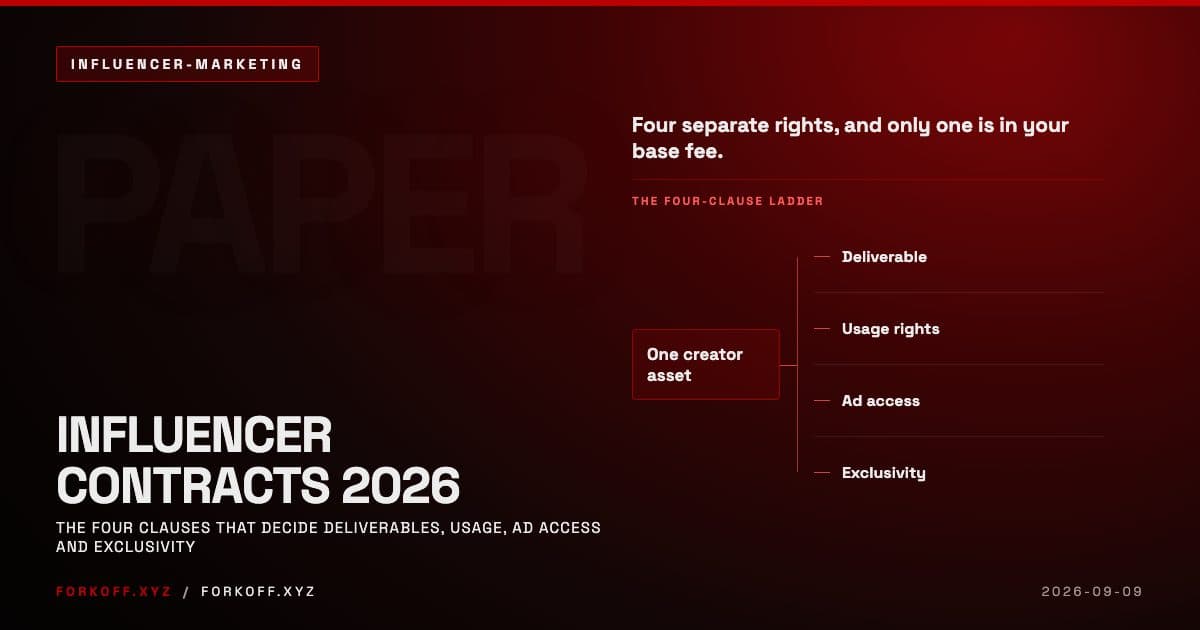
An influencer contract is the document that decides which rights you actually bought. Four clauses carry almost all the money: the deliverable, the usage grant, ad access from the creator handle, and exclusivity. Each is a separate purchase. When the paper is silent on any of them, the default is the one that costs you.

That sentence is the whole guide compressed, and the expensive half of it is the last line. A contract is not mainly a list of things that will happen. It is a list of rights that transfer, and every right you do not name stays where it started.
This is not legal advice, and we are not a law firm. Two of the three highest-ranking pages on this query are a law firm and a union, and they are better than us at the legal question. What follows is the operator version: which four clauses decide whether the money you spent bought an asset or rented a post, what each one actually grants, what the platforms require underneath them, and what happens when the paper says nothing.
how do you create contracts for influencers?
how do you create contracts for influencers?
We wrote it because of something we measured rather than something we assumed. On 9 September 2026 we scraped every readable page ranking in the top ten for this keyword and counted coverage subtopic by subtopic. The result is in the table below and it is stark: the rights language that buyers are already transacting on is close to absent from page one.
What page one of the query influencer contract actually covers
| Subtopic | Ranking pages covering it | Consequence for a buyer | Source |
|---|---|---|---|
| Spark Ads or partnership ads | 0 of 9 | Nobody explains that ad access is a separate grant | measured |
| The word whitelisting anywhere on the page | 1 of 9 | The right buyers transact on is barely named | measured |
| Usage rights against whitelisting, stated as a contrast | 0 of 9 | The ambiguity that produces the dispute survives | measured |
| A concrete time window attached to a usage grant | 1 of 9 | Duration is left to whoever drafts first | measured |
| The word perpetuity | 2 of 9 | The most common brand-side overreach goes unnamed | measured |
| AI-generated, AI-edited or synthetic likeness content | 0 of 9 | Every incumbent page predates the question | measured |
| Kill fee | 0 of 9 | What a creator is owed on cancellation is unstated | measured |
| Any non-US advertising regulator | 0 of 9 | A UK, EU or Australian campaign gets no guidance | measured |
| The FTC | 7 of 9 | The one subject page one covers well | measured |
| Reviewing a contract somebody else drafted | 0 of 9 | Only drafting is served, never reviewing | measured |
Method: Top ten United States organic results for 'influencer contract' pulled through firecrawl on 9 September 2026, nine scraped to main-content markdown and pattern-matched for each subtopic. Both controls ran in the same pass: the positive control, the word contract, hit nine of nine; the negative control hit zero of nine. The Reddit result at rank four returned HTTP 403 and is excluded rather than rounded to ten. Falsified by any of the nine pages covering a subtopic this table scores zero.
First-party. Nine of the top ten ranking bodies scraped via firecrawl on 9 September 2026 and pattern-matched per subtopic. Both controls printed in the same pass: positive control contract 9 of 9, negative 0 of 9. Rank four returned HTTP 403, excluded.

What is an influencer contract?
An influencer contract is a written agreement between a brand and a creator that defines the content to be produced, the fee to be paid, and the rights the brand receives in that content. It is a rights document more than a production document. The content is the smallest thing it decides.
That framing is not a semantic preference. It changes what you read first. If you open the document looking for the deliverable and the fee, you will find both quickly, agree they are fine, and sign a page whose expensive clauses you skimmed. If you open it looking for the rights, you will read the four paragraphs that decide whether the same spend produces one post or a year of paid creative.
The document goes by several names and they mean the same thing. Influencer agreement, creator agreement, brand partnership agreement, content licence, and in the enterprise world a statement of work hanging off a master services agreement. SAG-AFTRA calls its creator-side explainer an influencer agreement, and it is written for the person signing rather than the person sending, which makes it worth reading even if you are the brand.
The parties matter more than the title. A contract between a brand and a creator is one shape. A contract between a brand and an agency, with the creator subcontracted underneath, is a different shape, because the rights have to travel through two documents to reach you. If the agency has not secured ad access from the creator, the agency cannot grant it to you, whatever your contract with the agency says. That gap is invisible from the brand side until the campaign is live and the ads will not run.
Why do you need a contract for influencers?
Because without one you bought a post, not an asset. Every right you did not name stays with the creator by default, so you cannot repost, cannot run paid media, and cannot stop them working with a competitor next week. The contract is what converts spend into something reusable.
The default position is the part most brands get wrong, and it is worth stating plainly. Under United States law a work created by an independent contractor is generally not a work made for hire unless it falls into one of nine specific categories and there is a signed written agreement saying so. The statutory definition sits at 17 U.S.C. section 101, and the Copyright Office explains the practical consequence in Circular 30. A creator you paid to make a video owns that video unless the paper says otherwise.
So the question is never whether you have rights. It is which rights you were granted, in writing, and for how long. A brand that paid five figures and then discovers it cannot use the footage in a paid ad has not been cheated. It has been handed exactly what it asked for.
There is a second reason, less discussed and increasingly expensive. Disclosure obligations attach to the brand, not only to the creator. The FTC endorsement guides put the burden on advertisers to make material connections clear, and the 2024 Rule on the Use of Consumer Reviews and Testimonials added civil penalties to a subset of that behaviour. A contract with no disclosure clause does not remove the obligation. It removes your ability to enforce it against the person who has to carry it out.
The FTC now has a rule with civil penalties behind it, not only guidance
The endorsement guides have always been guidance. The Rule on the Use of Consumer Reviews and Testimonials, finalised in 2024, is a rule, and it carries civil penalties. It targets fake reviews, undisclosed insider testimonials and suppressed negative reviews. For a brand paying creators, the shift matters at the contract layer: disclosure and truthfulness stop being reputational risks handled by a marketing team and start being compliance obligations that belong in the agreement.
Source: Federal Trade Commission, Rule on the Use of Consumer Reviews and Testimonials, 2024
What is the purpose of an influencer agreement?
To convert a payment into defined, durable rights. The agreement fixes what gets made, where it may appear, for how long, who may run it as advertising, and who is restricted from doing what. Everything else in the document exists to make those five answers enforceable.
Most published guidance on this question answers in the risk frame: you need an agreement so that things do not go wrong. That is true and it is the less useful half. The money frame is better. Two brands can pay the same creator the same fee for the same video and end up with assets worth very different amounts, and the difference is entirely in four paragraphs.
Brand A pays for one post. It goes live, it performs, it scrolls away. Brand B pays the same fee plus a usage fee plus an ad-access fee, and now holds a video it can run as paid creative from the creator handle for twelve months. Brand B spent more in cash and less per unit of media, because the asset kept working. That is the whole argument for treating creator spend as a distribution channel rather than a series of posts.
The agreement is also the only place a multi-market campaign gets reconciled. One creator, one video, running in the United States and the United Kingdom, sits under two disclosure regimes with different enforcement shapes. No brief resolves that. The contract does.
What should an influencer contract include in 2026?
Four clauses carry the money: the deliverable, the usage grant, ad access from the creator handle, and exclusivity. Around them sit fee and payment terms, disclosure obligations, approval and revision limits, term end, cancellation, and, since 2025, an explicit clause on AI editing and synthetic likeness.
We call the first four the FORKOFF Four-Clause Rights Ladder, and the name is doing work rather than decorating. The four sit in a specific order, each one grants strictly more than the one below it, and each one has its own price. A brand that negotiates the fee and ignores the ladder is negotiating the cheapest variable in the deal.

| Question | Usage rights | Ad access | Exclusivity |
|---|---|---|---|
| Whose account does it appear on | Yours | Theirs | Neither |
| Does it allow paid spend | Boost from your handle only | Yes, from their handle | No |
| What does the creator give up | Control of where it runs | Use of their identity | Other paid work |
| Is it in the base fee | Sometimes, and it should not be | Almost never | Never |
| How is it switched off | The term expires | The creator revokes access | The window closes |
Derived from the platform mechanisms published by TikTok and Meta plus FORKOFF creator-deal practice in 2026. None of the nine ranking pages we measured draws this contrast in a single sentence.
Read the grid above the way a buyer should read a contract. Four rights, four different answers to the same questions, and the answers do not travel together. You can hold usage without ad access. You can hold ad access without exclusivity. You can hold all three for thirty days or for a year, and those are different purchases at different prices.
The full clause list around the ladder is longer, and the Rights Ledger below is the version we actually use on client deals. The right-hand column is the one worth reading twice, because it is the answer to the question nobody asks in a negotiation: what happens if we simply do not write this down.
The FORKOFF Rights Ledger
| Clause | The question it answers | Priced separately | What happens if the paper is silent | Source |
|---|---|---|---|---|
| Deliverable | What exactly are we buying | No, it is the base fee | Undefined scope, so every revision is a negotiation | derived |
| Usage | Where may the brand republish it | Yes | Often read as the campaign window only | derived |
| Ad access | May ads run from the creator handle | Yes | No grant at all, so no ads from their handle | published |
| Exclusivity | Who else may they work with | Yes | No restriction, a competitor can book them tomorrow | derived |
| AI rights | May the asset be AI-edited, cloned or used to train | Yes | Unsettled, and increasingly regulated by state law | published |
| Term end | What stops, what stays up, what you may archive | No | The most common post-campaign dispute | derived |
| Disclosure | How is the commercial relationship labelled | No | Regulator obligations apply to the brand regardless | published |
| Kill fee | What is owed if the deliverable is cancelled | Yes | Nothing is owed, which is why creators hold dates loosely | derived |
Method: Derived from the four clauses as they appear in real creator deals FORKOFF has negotiated, cross-read against the branded-content and partnership permissions TikTok and Meta publish. Rows tagged published follow a platform's own documented mechanism; rows tagged derived are our reading of what a silent contract defaults to. Falsified by a platform changing who holds the revocation control.
Rows tagged published are anchored to a platform or regulator document cited here. Rows tagged derived are FORKOFF operator practice on client creator deals in 2026, not a legal standard and not a published benchmark. Nothing here is legal advice.
Operator noteA silent clause is not a neutral clause. Silence always resolves in favour of whoever holds the thing by default.
Clause one, what counts as a deliverable?
A deliverable clause names exactly what will exist at the end. Asset count per platform, format and run length, hook and call-to-action requirements, revision rounds, the approval clock, posting window, and whether raw files transfer. The word content, on its own, is not a deliverable. It is a placeholder for an argument.

Six lines turn the word into something enforceable. Take them in order.
Count and platform. Three videos is ambiguous. Three videos, one posted to the creator TikTok account and two delivered as unposted files for brand use, is not. The distinction between posted and delivered is the single most common scoping gap we see, because a creator prices a post and a brand assumes a file.
Format and run length. Aspect ratio, minimum and maximum duration, whether captions are burned in, whether a version without music is delivered. If you intend to cut the asset down for paid, say so here, because that is an edit right and it belongs in the usage clause too.
Hook and call-to-action requirements. Name what must appear rather than what must be said. A required first line kills more creator content than any other note, and a required outcome, such as the product visible in the first three seconds, gets you the same result without flattening the voice that made the creator worth booking.
Revision rounds and the approval clock. Two rounds is standard. Unlimited rounds is the clause that turns a fixed fee into unpaid labour, and it is a red flag in either direction. Attach a clock: forty-eight or seventy-two hours for brand feedback, with silence counting as approval. Without a clock, a creator carries the schedule risk of your internal process.
Raw files. Whether the project files, the unedited footage, or neither transfer. This is genuinely valuable and genuinely expensive, and it is a separate ask from usage. A brand that wants to re-cut the asset for six paid variants needs raw footage plus an edit right, and neither is implied by a licence to republish the finished video.
Posting window and dwell time. The date range the creator will post inside, and how long the post stays up on their account. Dwell time is quietly important. A post removed after two weeks takes your social proof with it, and it also takes down whatever ad you were running through it.
What an ad-access grant looks like on the platform side
Branded content toggle
On
Brand partner
Your ad account
Ad authorisation
Granted, expires 12 Oct
Ad code
Issued, single campaign
Illustrative composite of the branded-content and partnership permissions published by TikTok and Meta, drawn 2026-09-09. Field names differ per platform.
Clause two, what do usage rights actually grant?
A usage grant is permission to republish the creator content from channels you control. It has four variables: which channels, for how long, in which territories, and whether you may edit. Change any one of those and you have changed what you bought, which is why usage belongs on its own line with its own price.
The four variables are worth taking separately because brands routinely negotiate one and inherit the other three.
The cost of getting this wrong is not abstract, and the communities where buyers talk are specific about it. One founder reports spending $4,200 on influencer marketing and getting 3 signups. Another puts the figure at $50,000 with no customers attributed. At the other end of the market, a live job post prices 2 short scripts, 10 b-rolls and 30 days of whitelisting at $200 total, which tells you ad access is already being sold as a dated line item rather than a favour. Neither end of that range is a pricing problem. Both are paper problems: the first two bought something they could not measure or reuse, and the third sold a 30-day grant that a brand will still be running on day 90 unless somebody writes the end date down.
Channels. Organic social on your own accounts is the narrowest. Website and email is broader. Paid social from your own handle is broader again. Connected television, out-of-home and packaging are broader still and are almost never included by default. Name the list rather than writing all marketing channels, which reads as unlimited to a brand and as this campaign to a creator.
Term. Covered in its own section below, because it is where the most common overreach lives.
Territory. Worldwide sounds free and is not. For a creator with a regional audience and regional brand relationships, a worldwide grant is exactly what stops them selling the next deal. If your campaign runs in the United States and Canada, say the United States and Canada.
Edit rights. Whether you may cut, re-caption, re-score, translate, or combine the asset with other footage. This one is asymmetric: it is cheap to grant, valuable to hold, and almost never mentioned. If you plan to run UGC video ads built from creator footage, you need it explicitly, and our guide to running a UGC ad campaign covers the production side of that in more detail than fits here.

One asset, six sellable rights. That diagram is the argument against treating usage as a single block. A brand that named two of the six has bought two, whatever it believes it paid for, and the creator is entirely within their rights to sell the other four to somebody else.
This is not a theoretical risk. Rob Freund, an advertising and e-commerce lawyer who tracks these disputes publicly to an audience of 26,822, has flagged the same failure reaching a federal court, where a brand's motion to dismiss was denied and the argument turned on exactly this question of what the creator agreement granted. His thread on it has been seen 89,106 times and carries 233 likes against 15 reposts, which is a ratio worth reading: people save this one rather than broadcast it, because it is the scenario they are quietly worried about. The case dates to 2023 and the clause it turned on has not become standard in the 2 years since.
Rob Freund
@RobertFreundLaw
This case is a great reminder for brands and influencers about usage rights and the importance of understanding creator agreements. Today, a federal judge denied the brand's motion to dismiss. First, let's look at the allegations. 1/
The pattern in that thread is the one worth internalising: the disagreement was not about whether the content was good or whether the creator was paid. It was about which rights the paper transferred, and the paper was the only witness.
What is the difference between usage rights and whitelisting rights?
Usage rights let you republish the creator content from your own channels. Whitelisting rights let you run paid advertising from the creator handle, so the ad carries their name and their face. One is permission to reuse an asset. The other is temporary access to an identity.
That distinction is the single most valuable sentence in this guide, and it is the one page one does not contain. Zero of the nine readable ranking pages draw the contrast in a sentence. One of the nine uses the word whitelisting anywhere at all. We measured that with both controls printed in the same pass, and the counts are in the coverage table above.
A practitioner on X put the general version of the problem better than any vendor page we read. Captured verbatim in our own advanced-search read on 2 September 2026:
The most expensive words in an influencer contract are often the ones that aren't there. Usage rights is not whitelisting rights. Content is not a defined deliverable. Exclusivity is not a defined term.
We cannot link that post. Our platform pull for this piece was refused by the session permission set rather than by the API, so we are quoting our own earlier capture and saying so rather than presenting an unverifiable link. That is a smaller claim than the ones around it, and it should be read as one.

The practical test we use on every deal is one question, and we call it the FORKOFF Ad-Access Test: does the ad run from their handle or from ours? If the answer is ours, you need usage rights covering paid social. If the answer is theirs, you need a separate grant, and no amount of usage language gets you there. The two words that most often hide this are the phrase paid usage, which brands read as ads from the creator account and creators read as boosting on the brand account.
Operator noteAsk one question before signing: does the ad run from their handle or ours? It sorts the whole rights conversation., FORKOFF Ad-Access Test, 2026
Whitelisting also has a scale problem that usage does not. Usage is a licence you hold and control. Ad access is permission you hold at the creator pleasure, revocable, tied to an account you do not own. If that account gets suspended, renamed, or sold, your ads stop. Write the revocation terms and the notice period down, because the platform will not.
Can a brand run an influencer post as a paid ad without extra permission?
Not from the creator handle. Boosting content you already hold usage rights to runs from your own account. Running the post as though the creator published the advertisement needs a separate contractual grant plus a platform authorisation the creator switches on, such as a TikTok Spark Ads code or a Meta partnership permission.
The mechanism matters, because a clause with no mechanism behind it buys you nothing you can actually run.

On TikTok, Spark Ads are the native format for this. The creator authorises the use of a specific organic post, and the ad runs from the creator account with their handle, their follower count, and comments that persist on the original post. The creator issues an access code with its own scope and its own expiry. Your contract clause needs to say who issues that code, when, for which posts, and for how long, because the code is the thing that makes the clause operational.
On Meta, the equivalent runs through the branded content and partnership permissions the creator grants to a specific business account. The creator turns the permission on, names your ad account, and can turn it off. TikTok additionally requires the creator to flag commercial content under its branded content policy, and YouTube requires a paid-promotion declaration under its paid product placement policy. Those platform obligations sit alongside the regulator obligations rather than replacing them.
Influencer Whitelisting Explained in 30 Seconds
Leadsie
Whitelisting explained in thirty seconds. It ranks sixth for influencer whitelisting, which is a fair measure of how thin the published explanation of this clause still is.
Two failure modes follow directly. The first is a signed clause and no authorisation, which is the most common: the paper says the brand may run ads from the creator handle, nobody scheduled the ten minutes where the creator actually turns the permission on, and the media plan slips a week. The second is authorisation with no clause, which is worse: access was granted informally, there is no term, no revocation notice and no fee attached, and the arrangement collapses the first time the relationship cools.
How much extra do creators charge for whitelisting or Spark Ads access?
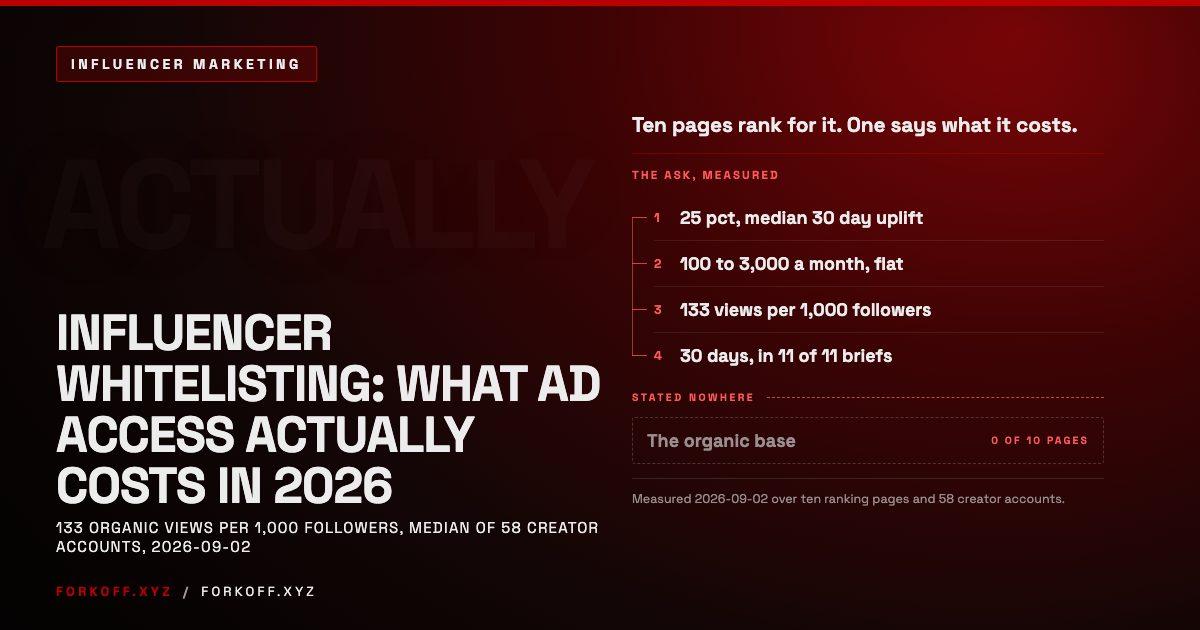
More than they did last year, and it is quoted as its own line item rather than negotiated as a favour. We do not have to guess at the benchmark, because we measured it: our companion post on what ad access actually costs collects the public asks and they cluster at 20 to 30 percent of the content fee per month, with a midpoint of 25 percent. The interesting part is what that does per day. A 30-day window at 25 percent works out to 0.83 percent of the content fee per day. A 730-day window at 62.5 percent works out to 0.086 percent per day. The middle sits where you would expect: a 180-day window at 50 percent lands at 0.28 percent per day, about 3.2 times the two-year rate. So the short window is roughly 9.7 times more expensive per day than the long one, which is why creators quoting 60 to 90 days are often quoting the worst value on the board for both sides. Go there for the number, and stay here for the clause that makes it enforceable.
The shape is visible at the bottom of the price range, which is where market norms usually show up first. A live UGC job post captured in our own X read on 2 September 2026 reads, verbatim: two short scripts yapper style, ten brolls, thirty days whitelisting, no editing, two hundred dollars available.
Ad access is already a dated, priced line item at the bottom of the market
A live UGC job post captured in our own X read on 2 September 2026 reads, verbatim: two short scripts yapper style, ten brolls, thirty days whitelisting, no editing, two hundred dollars available. Read what that says about the market rather than the number. Ad access is being quoted in the same breath as the content, with a duration attached, at the very bottom of the price range. A brand still treating whitelisting as a favour is negotiating against people who already treat it as a line item.
Source: FORKOFF topic radar, X advanced search, 2 September 2026
Read the structure, not the number. At two hundred dollars, whitelisting is already a named line with a duration attached. A brand negotiating at ten times that price and treating ad access as an afterthought is negotiating against people who priced it before the brief arrived.
The demand signal agrees. A r/SocialMediaMarketing thread captured in the same sweep asks the question directly in its title: influencer whitelisting and dark posting, are creators charging you way more for ad access in 2026. That is a buyer asking, this year, for a number, and page one does not answer it.
Our own read on what ad access costs, with the measurement behind it, lives in what influencer whitelisting and ad access costs. That post owns the price of ad access and this one owns the paper that grants it, deliberately, so neither has to restate the other badly. For base creator rates before any rights are added, our influencer marketing pricing tiers carries the rate-card view.
The pricing logic itself is simple enough to state without a benchmark. Ad access is priced against three things: how long you hold it, how much you intend to spend behind it, and how closely the creator identity gets tied to your category. A thirty-day window behind a small test budget is a modest ask. Twelve months of unlimited spend from a creator primary handle is close to a partial endorsement deal, and it should cost like one.
How long should influencer usage rights last?
Match the term to the use. Thirty days covers a campaign window, three months covers a paid creative test, and twelve months suits an asset you plan to run continuously. Perpetuity should be priced as a buyout and treated as an exception, never as the default line in a template.

Only one of the nine ranking pages we measured attaches a concrete time window to a usage grant at all, and only two use the word perpetuity anywhere, despite in-perpetuity being the single most common overreach in brand-side templates. That combination is the reason duration goes wrong so often: the pages a brand reads before drafting do not tell them a decision exists here.
Work through the ladder honestly and the right answer is usually shorter than the template says.
Thirty days, campaign window. Right when the content supports a launch moment and you have no plan to run it afterwards. It is the cheapest grant and it is the correct one far more often than brands assume.
Three months, creative testing. Right when the asset enters a paid creative rotation and you need enough runway to test, iterate and read a result. This is the sweet spot for most performance-led creator programmes.
Twelve months, evergreen. Right when the asset becomes a standing part of an ad account. Worth paying properly for, because the alternative is re-licensing under time pressure once the creative is proven and the creator knows it.
Perpetuity. Almost never right as a line in a base fee. If you genuinely need it, name it as a buyout, price it as a buyout, and expect the creator to price the loss of every future negotiation on that asset. A perpetual worldwide grant folded into a base fee is the clause we redline out of brand-side templates more than any other.
Operator notePerpetual usage in a base fee is the single most common line we redline out of brand-side templates., FORKOFF creator-deal practice, 2026
There is a version of this that costs a brand rather than a creator. Short usage on an asset that turns out to be your best-performing ad is an expensive mistake in the other direction, because you are re-negotiating from a position where both sides know the number. The honest answer is to buy the term that matches your plan and to write a renewal option with a pre-agreed price into the original contract. A renewal option costs almost nothing at signature and removes the entire negotiation later.
Clause four, what does an exclusivity clause cost in an influencer deal?
It depends entirely on how much work it removes. Exclusivity is priced against what the creator gives up, so a narrow named-competitor restriction for thirty days costs far less than a whole-category lock for a quarter. Name the category, the width, the term and the carve-outs, or the clause is both unpriced and unenforceable.

Zero of the nine ranking pages price exclusivity. One names a thirty-day no-competing-content window and stops there, with no uplift and no discussion of category width. So this is a clause almost every brand includes and almost nobody sizes.
The four shapes in the grid are the ones worth knowing, and they differ by an order of magnitude in what they take from the creator.
Platform exclusivity stops the creator posting competing content on one channel. Narrow, cheap, and usually sufficient when your concern is a competitor appearing next to you in the same feed during a launch week.
Named-competitor exclusivity lists three to eight specific companies. This is the shape we recommend most often, because it is precise enough to be enforceable and narrow enough that a creator can accept it without pricing in the unknown.
Category exclusivity blocks a whole vertical. Expensive, and the expense is rational: you are asking a creator to turn away every deal in a category for the term, including ones that have not been offered yet. Categories also need defining. Fintech is not a category a creator can safely agree to, because nobody knows where its edge sits.
Total exclusivity blocks all paid work. This is an ambassador or talent deal wearing a campaign contract, and it should be structured and priced as one.
Operator noteUndefined exclusivity is worse than none. It gets read broadly by the brand and narrowly by the creator, every time.
Two drafting notes that save arguments. First, exclusivity needs carve-outs for existing commitments; a creator with a live annual deal cannot honestly grant a category lock, and asking them to is how you get a quiet breach. Second, an exclusivity term that outlasts the usage term is a common and asymmetric ask. If your content rights end at ninety days, your restriction on their other work probably should too.
If you are running this in crypto or Web3, where a single creator will be approached by several protocols in the same week, the vetting question and the exclusivity question collapse into one. How to vet a crypto KOL covers the diligence half, and KOL marketing against clipping for a token launch covers when a creator deal is the wrong instrument entirely.
What happens to influencer content when the contract term ends?
Whatever the contract says, and if it says nothing this is the most common post-campaign dispute. Paid placements must stop on the expiry date, the creator organic post usually stays up, and your internal archive is not a licence to run it again. Write the three outcomes down separately.
What happens to the content when the term ends

Only two of the nine ranking pages address takedown, archiving or the creator obligation after expiry at all, which means seven of the ten pages a brand is likely to read before drafting leave the most common dispute unanswered.
The three outcomes have to be written separately because they genuinely differ.
Live paid placements stop. This is the hard one operationally, not legally. Somebody has to actually pause the ad sets, and if the ad access sits inside an agency account nobody on the brand side may have visibility into what is still running. Put a named owner and a date in the contract, and diarise it at signature rather than at expiry.
The creator organic post normally stays up. Their account, their post, and it is usually in both parties interest to leave it. But if you need it removed, for a discontinued product or a changed claim, that is a takedown obligation and it needs its own line, including how much notice you must give and whether a fee applies.
Your archive is internal. Holding a copy is not a licence. A file in a brand asset library outlives every term in the contract, and the second most common breach we see is an old creator video reappearing in a deck, a website hero, or a paid ad two years later because nobody attached an expiry to the file. Tag rights expiry into the asset library itself, not only into the contract.
A renewal option written at signature solves most of this. One paragraph, a pre-agreed price, a notice window, and the awkward conversation never happens.
Who owns AI-generated or AI-edited influencer content?
It is unsettled, so name it. The US Copyright Office holds that purely AI-generated material without sufficient human authorship is not copyrightable, and several states now require specific consent for a digital replica of a person. Address AI editing, voice and likeness cloning, model training, and synthetic ad variants as their own clause.

This is the largest single gap on the search results page and the one that dates every incumbent page. Zero of the nine readable ranking pages mention AI-generated content, generative AI, digital replicas, or voice and likeness cloning. Meanwhile r/influencermarketing carries a thread whose title states the position exactly: AI content rights are becoming the next influencer contract problem.
Purely AI-generated material is not copyrightable, which changes who owns what
The United States Copyright Office published the second part of its Copyright and Artificial Intelligence report in January 2025, concluding that existing law is adequate and that material generated purely by artificial intelligence, without sufficient human authorship, is not protected by copyright. The practical consequence for a creator deal is direct. If a synthetic variant of an asset is not copyrightable, a clause assigning ownership of it is assigning something that may not exist, and the parties need to agree on use and consent instead.
Source: US Copyright Office, Copyright and Artificial Intelligence, Part 2, January 2025
Consent for a digital replica is now a contract-drafting requirement, not a courtesy
Tennessee passed the ELVIS Act in 2024, extending its right-of-publicity statute to cover a persons voice explicitly. California AB 2602, effective January 2025, goes further for contracts: a provision allowing a digital replica of an individual in place of their own work is unenforceable when the use is not reasonably specific and the individual was not represented. A creator agreement that grants generic rights to a likeness is now drafting into an unenforceable clause in at least one large market.
Source: California Assembly Bill 2602, chaptered 2024
Five questions need answering, and none of them has a settled market default yet, which is precisely why silence is dangerous here.
May the delivered asset be AI-edited? Upscaling, background replacement, re-lighting and voice cleanup are already routine in performance creative. A creator who signed a licence before those tools were routine did not agree to that, and some of them mind a great deal.
May the creator voice or likeness be cloned? This is the clause with real legal weight behind it now. Tennessee extended its right-of-publicity statute to cover voice explicitly in 2024, and California AB 2602 makes a contract provision permitting a digital replica unenforceable when the use is not reasonably specific and the individual was unrepresented. A generic grant of likeness rights is now drafting into a clause that may not hold.
May the asset train a model? Distinct from producing a replica, and increasingly asked for by brands building internal creative tooling. Answer it explicitly rather than letting a broad licence imply an answer.
May synthetic variants run as advertising? If you generate twelve versions of a creator video with different hooks and run them as paid media, whose asset are those, and does the creator ad-access grant extend to them? Almost no contract written before 2025 answers this.
What happens to replicas at term end? Deletion, retention, or an internal-only archive. Same three-outcome logic as the content itself, applied to a thing that is much easier to copy.
The ownership question underneath all five is genuinely open. The Copyright Office Part 2 report on copyrightability concluded that existing law is adequate and that purely machine-generated output lacks the human authorship copyright requires. Assigning ownership of something that may not be property is not a solution. Agreeing on permitted use and consent is.
Does an influencer contract need an FTC disclosure clause?
Yes, and it needs more than that if you run outside the United States. The FTC endorsement guides put the disclosure burden on the advertiser as well as the endorser, and the 2024 consumer reviews rule attached civil penalties to part of that behaviour. A disclosure clause is how a brand converts its own obligation into something a creator is contractually required to perform.


Seven of the nine ranking pages cover the FTC. Zero cover any non-US regulator. For a brand running a Tier-1 campaign across the United States, the United Kingdom, Canada, Australia and New Zealand, that means page one of this query answers one column of a four-column problem.
United States. The endorsement guides require clear and conspicuous disclosure of a material connection, and Disclosures 101 for social media influencers is specific about placement: in the post, not only in a profile or behind a more link. The reviews and testimonials rule adds penalties for fake reviews and undisclosed insider endorsements.
United Kingdom. Two bodies, one problem. The ASA and CAP influencers guide governs the ad label and expects it up front, and the CMA publishes its own social media endorsements guide for influencers. The ASA also maintains a public list of non-compliant influencers, which is a reputational mechanism the United States does not have.
The UK publishes a named list of influencers who keep getting disclosure wrong
The Advertising Standards Authority maintains a public page of non-compliant social media influencers, alongside a dedicated guide on making clear that ads are ads. That is a different enforcement shape from the United States, and it lands on the creator as well as the brand. A campaign running the same creator across the United States and the United Kingdom is running under two regimes at once, and the contract is the only place that gets reconciled.
Source: Advertising Standards Authority, non-compliant social media influencers
European Union. The Digital Services Act puts advertising transparency and ad-repository obligations onto platforms, which shapes how paid creator content gets labelled and surfaced. It is not a creator-facing rulebook in the way the FTC guides are, but it changes the environment the content runs in.
Australia, New Zealand and Canada. Local advertising codes and consumer-protection regulators apply, with the same clear-and-close disclosure expectation. The contract should say the creator will comply with the rules of every market the content will run in, and name those markets, rather than gesturing at applicable law.
Platform obligations sit on top of all of this. TikTok requires branded content flagging under its branded content policy, and YouTube requires a paid promotion declaration. A creator who added a hashtag but did not tick the platform toggle has satisfied neither obligation cleanly.
One more line belongs here because it is genuinely missed. Only one of the nine ranking pages mentions tax forms at all, and none connects it to the independent-contractor clause every page tells you to include. If you are paying a United States creator as a contractor, you are collecting a W-9 and reporting on Form 1099-NEC. Put the form collection in the payment clause so it does not surprise your finance team in January.
What is a kill fee in an influencer contract?
A kill fee is what the creator is paid when a booked deliverable is cancelled after work has started. It protects reserved time, not delivered content. Structures usually pay a share on cancellation after brief acceptance and a larger share after first draft. Zero of the nine ranking pages mention it.
That absence is telling. All nine pages discuss termination, and termination is the brand-side question: how do we get out. None of them discusses what the creator is owed when the brand gets out, which is the creator-side question and the one that determines whether good creators hold dates for you.
The mechanics are simple and worth writing down in one paragraph.
After brief acceptance, before production. The creator has turned down other work for those dates and done the thinking. A partial fee is normal and fair.
After first draft. Substantially all the work has happened. The fee should be close to full, and the rights question needs answering too: does the brand hold any licence in an asset it cancelled and never ran? The usual and cleanest answer is no, and the creator may repurpose the work with brand identifiers removed.
After delivery and approval. This is not a kill fee situation. The deliverable exists, the fee is owed, and the only live question is whether usage was granted for something that never posted.
Attach a notice period to each stage. Cancellation with two days notice and cancellation with three weeks notice are different events, and a contract that prices them identically is pricing one of them wrong.
How do you create contracts for influencers?
Work outward from the rights, not inward from a template. Write the deliverable, then the usage grant, then ad access, then exclusivity, each as its own clause with its own price. Add the AI clause, write term end as three separate outcomes, then put disclosure, kill fee and payment terms around them and have a lawyer read the result.
How to create an influencer contract in seven steps
STEPS- 01
Step 1, write the deliverable before the fee
Name the asset count per platform, the format and run length, the hook and call-to-action requirements, the number of revision rounds, and whether raw files transfer. A fee attached to the word content is a fee attached to nothing.
- 02
Step 2, decide the usage grant as a separate line
State the channels, the term, the territory and whether the brand may edit or re-cut. Then price it. A usage grant folded silently into the base fee is the clause creators later argue was never sold.
- 03
Step 3, decide ad access explicitly, in its own paragraph
Say whether paid media may run from the creator handle, on which platforms, for how long, and how access is granted and revoked. Do not let this hide inside the word usage. It is a different thing with a different price.
- 04
Step 4, size exclusivity against what it removes
Name the category, the width, the term and the carve-outs. A narrow named-competitor restriction for thirty days is a cheap ask. A whole-category lock for a quarter is a large one, and it should be priced like one.
- 05
Step 5, add the AI clause your template does not have
Cover AI editing of the delivered asset, cloning of voice or likeness, whether the asset may train a model, whether synthetic variants may run as advertising, and what happens to replicas at term end.
- 06
Step 6, write term end as three separate outcomes
Paid placements stop, the creator organic post usually stays up, and the brand archive is internal only unless renewed. Writing one sentence about expiry is how the most common post-campaign dispute gets created.
- 07
Step 7, put disclosure and payment terms in writing, then have a lawyer read it
Disclosure obligations, kill fee, payment window, contractor status and tax forms. Then send it to counsel. This guide is an operators map of where the money sits, and it is not legal advice.
The step order matters more than it looks. Most brands start from a template, fill in the fee and the dates, and inherit the rights language whoever wrote the template chose. That is how a perpetual worldwide grant ends up in a thirty-day campaign contract: nobody chose it, it was already there.
Working outward from the rights inverts that. You decide what you need, you price each piece, and you use the template as a drafting aid rather than as the decision. It also makes the negotiation faster, because a creator can say yes to three of four clauses immediately when the four are separable, and cannot say yes to any of them when they arrive as one paragraph called usage.
Two practical notes on process. Send the brief and the contract together, not the contract after a verbal agreement, because the brief is where the deliverable clause comes from and a mismatch between the two is the most common source of a scope argument. And build the contract from a set of clause options rather than a single template, so that choosing thirty days over twelve months is a selection your team makes deliberately rather than an edit somebody forgets.
We should be explicit about the boundary here. This is a map of where the money sits in a creator agreement, written by operators who negotiate these deals. It is not legal advice, no part of it is a substitute for counsel in your jurisdiction, and we are deliberately not shipping a template. Template vendors and law firms already publish those, and a marketing agency handing out contract text would be doing something it has no business doing. What we can tell you is which clauses to read first, and the work made for hire definition is where the drafting conversation with your counsel should start, because it decides who owns the asset before any licence language is written.
The supporting clauses that sit around the four
The four clauses carry the money, but a contract missing its supporting clauses still fails, usually on a Friday afternoon when a post is late or a payment has not arrived. None of these is where the price is set. Each is where an argument starts if it is left vague, so each deserves one clear sentence rather than a template default.
Parties involved and scope of work
Name the legal entities, not just the people. A creator often invoices through a company or a management agency, and a brand often contracts through an agency of its own, so the contract should say who is bound, who is paid and who can approve changes. The scope of work then states what the engagement covers and, just as usefully, what it does not: one campaign, named platforms, a start and end date. A scope line that says "social content as agreed" is an invitation to add a fourth video without a fourth fee.
Deliverables and approval
Each deliverable gets its own line: format, platform, length, number of posts, the posting window, and whether the brand approves a draft before it goes live. Write the approval window as a number of business days, and say what happens if the brand does not respond inside it. Without that sentence, a slow approval quietly moves the posting date and the creator's other bookings with it.
Revision rounds
State how many rounds of revisions the fee includes, usually one or two, and what counts as a revision. A change to a caption or a cut is a revision. A new concept after the draft is approved is a new deliverable. Pricing an extra round in advance takes the heat out of the conversation when the third round of notes arrives.
Payment terms and payment structure
Payment terms cover when and how the creator is paid: the invoice trigger, the number of days to pay, the currency, and who carries transfer fees. The payment structure covers how the fee is split. A common structure pays part on signature or brief acceptance and the balance on delivery, which lines up with the kill fee stages above, so a cancellation and a normal payment follow the same milestones. If usage, ad access and exclusivity are priced as separate clauses, list them as separate line items on the invoice schedule too.
Morals clause
A morals clause lets either side end the agreement if the other does something that damages its reputation. Brands usually draft it one way only. Ask for it to run both ways, since a creator can be harmed by a brand scandal as easily as the reverse, and ask for the trigger to be defined conduct rather than anything the brand later finds embarrassing. Say what happens to fees already earned and content already posted if the clause is used.
Governing law and disputes
The governing law clause picks which jurisdiction's law reads the contract, and the dispute clause picks where and how a disagreement is resolved. With a creator in one country and a brand in another, leaving this out means both sides find out only when something has already gone wrong. This is the clause most worth a short conversation with counsel, because the choice interacts with the consumer protection and advertising rules covered in the disclosure section above.
What are the red flags in an agency influencer contract?
Perpetual worldwide usage inside the base fee, undefined exclusivity, unlimited revisions, approval with no clock, ad access assumed rather than granted, silence on term end, and payment conditioned on a third party paying the agency. Any single one of those converts a fixed fee into an open-ended obligation.

Zero of the nine ranking pages cover this, which is a strange gap given how much creator work runs through agencies. Every page teaches drafting. Nobody teaches reviewing. And reviewing is what most people actually do, because most people are handed paper.
r/influencermarketing has the experience recorded in a thread title, verbatim: super unfair influencer contract from an agency, sent revisions and was told we are unable to make changes in the agreement. That sentence, we are unable to make changes, is worth treating as information rather than as a wall. Sometimes it is true, in the sense that a large agency operating at volume genuinely runs one paper. More often it means changes are expensive to process and nobody has decided this deal is worth the process.
We call the review pass the FORKOFF Paper Review Pass, and it has six questions in a fixed order.
- Where does the usage grant end? Find the term, the territory and the channel list. If any of the three is missing or reads as unlimited, that is your first redline, and it is usually the only one worth spending real capital on.
- Is ad access granted or assumed? Search the document for whitelisting, spark, partnership, dark post and paid amplification. If none of those words appear and the media plan needs ads from the creator handle, the contract does not do what the plan needs.
- How is exclusivity defined? Category, width, term, carve-outs. Undefined exclusivity is worse than none, because it gets read broadly by the party enforcing it and narrowly by the party bound.
- Is there a clock on approvals and a cap on revisions? Uncapped revision plus unclocked approval is the mechanism by which a fixed-fee deal becomes an indefinite one.
- What does the paper say about term end? If it says nothing, add the three outcomes. This is the cheapest amendment to get accepted because it costs the other side nothing.
- Is payment conditional on somebody else paying? A pay-when-paid clause moves the agency client credit risk onto the creator. It is common, it is often negotiable, and it is worth asking about even when the rest of the paper is fine.
If you are the brand deciding which agency to sign in the first place, the paper is a signal in itself. Our guide to vetting an influencer marketing agency covers what else to look at, and how to tell if tweet engagement was bought covers the diligence question underneath every creator shortlist.
What changed in 2026, and why do incumbent guides read as dated?
Three things moved at once: ad access became a standard priced line rather than an occasional favour, synthetic media arrived in creative workflows faster than contracts adapted, and disclosure enforcement gained penalties and named lists. Every page currently ranking for this query predates at least one of those shifts.
The first shift is the one with the clearest evidence. Ad access is being quoted with a duration attached in two-hundred-dollar job posts, and a brand-side buyer is publicly asking whether creators are charging more for it this year. That is a market with a settled vocabulary and an unsettled price, which is exactly the phase where a contract clause matters most.
The second is the widest gap and the one that will date these pages fastest. The Copyright Office published its copyrightability conclusion in January 2025, California AB 2602 took effect in January 2025, and Tennessee extended publicity rights to voice in 2024. Contract practice has not caught up. A template drafted before those changes landed is silent on every question a 2026 creative workflow raises.
The third is a change of instrument rather than of rule. The FTC endorsement guides have existed for years, but a rule with civil penalties is a different object from guidance, and a public list of named non-compliant influencers is a different enforcement mechanism from a warning letter. Both raise the cost of a vague disclosure clause.

There is a fourth change that is about search rather than about law, and it explains why this guide is shaped the way it is. People search for the document, not the clause. In United States exact-match volumes measured on 2 September 2026, influencer contract runs at 260 searches a month while influencer usage rights runs at 10, a gap of twenty six times. The rights are what cost money and the document is what people look for, so the honest structure is to lead with the paper and teach the rights inside it.
Measured US search demand across the rights lane
| Keyword | US searches per month | Measured | Source |
|---|---|---|---|
| influencer marketing | 6,600 | 2026-09-02 | measured |
| influencer contract | 260 | 2026-09-02 | measured |
| creator partnerships | 260 | 2026-09-02 | measured |
| influencer brief | 170 | 2026-09-02 | measured |
| influencer whitelisting | 110 | 2026-09-02 | measured |
| influencer rates | 110 | 2026-09-02 | measured |
| influencer pricing | 90 | 2026-09-02 | measured |
| influencer usage rights | 10 | 2026-09-02 | measured |
| influencer campaign brief | 10 | 2026-09-02 | measured |
| influencer contract keyword difficulty | not measured | never | unknown |
Method: United States monthly search volume read on 2 September 2026 through the sanctioned keyword-metrics vendor and written back to the tenant keyword canon in the same pass. Every figure is a vendor reading, not an estimate. Falsified by a re-pull returning a different order of magnitude.
First-party. Exact-match US volumes, 44-term keyword pull, 2 September 2026, location 2840, language en. A positive control fired in the same request set, so the one no-reading term is genuinely sub-threshold, not an account fault. Unknown is not zero.
How we measured this
Everything in this guide that carries a number comes from one of three dated first-party passes: a search-results pass over the ranking pages, a community pass over what creators and buyers say in public, and a rate pass over the asks we see. Each is named below so you can weigh it yourself. Nothing here is an industry estimate we found and repeated.
The search results pass, 9 September 2026. We pulled the top ten United States results for influencer contract through firecrawl, scraped nine of the ten readable bodies once each with main-content extraction, counted body words after stripping code, images, link syntax and bare URLs, and pattern-matched every page for each subtopic in the coverage table. Both controls ran in the same pass and printed: the positive control, the word contract, hit nine of nine, and the negative control hit zero of nine. The Reddit result at rank four returned HTTP 403 and is excluded from every count, which we state rather than quietly rounding to ten.
Here is what that pull returned, because the shape of the page-one field is the argument for writing this post at all. Ten results, ten distinct domains, no repeat publisher. Two of them carry authority we cannot outrank on their own ground: Morgan Lewis at position 1 is an international law firm, and SAG-AFTRA at position 2 is the performers' union. Reddit sits at position 4. The remaining seven are vendor and template pages: Modash at 3, LawDepot at 5, Ironclad at 6, SARAL at 7, amt.ai at 8, Collabstr at 9, Avokaado at 10.
Measured body length runs from 679 words at the shortest to 4,120 at the longest, with a median of 2,725 and a ninetieth percentile of 3,890. The middle of that field sits between 2,110 and 3,422. So the page-one norm for this query is roughly a 2,700-word explainer, and 6 of the 9 readable pages come in under 3,500.
One more number from that pull, because it sets the honest expectation for this page. The radar scored the SERP gap at 1 of 3, the lowest of any candidate it looked at that day, and the cluster hub influencer marketing carries a keyword difficulty of 69 against a domain rank of 149, with 0 of its top 10 currently reachable for us. That is why this post targets the document noun at 260 searches rather than the category at 6,600. Positions 1 and 2 are a law firm and a union, and we will not outrank either on legal authority. What is contestable is the 7 vendor and template pages below them, on the one axis they all leave open, which is operator specificity about what each clause costs. Even the weakest incumbent on that page, Collabstr at domain rank 313, still sits 2.1 times above us on authority, so the only lever left is being more specific than they are. We also deliberately left the money term alone: influencer marketing agency carries 8,100 searches and a SERP made of agency homepages, which no article wins. And this is genuinely new ground for us rather than a rewrite, since a full-text search for influencer contract across all 281 posts on this site returned nothing, against 43 terms already on record for the wider cluster.
The coverage counts are where it gets interesting, and they are the reason the four clauses are worth separating. Spark Ads or partnership ads: named on 0 of 9. Usage rights set against whitelisting as an explicit contrast: 0 of 9. The word whitelisting anywhere on the page: 1 of 9. A concrete time window attached to a usage grant: 1 of 9. The word perpetuity: 2 of 9. So the single clause with the clearest price attached to it, ad access, is absent from every page a buyer reads before drafting.
Demand across the lane is similarly lopsided. The head term influencer marketing carries 6,600 United States searches a month. Influencer contract carries 260, as does creator partnerships. Below that the rights vocabulary thins fast: b2b influencer marketing and influencer marketing roi at 210, influencer brief and influencer outreach at 170, influencer seeding at 140, influencer whitelisting and influencer rates at 110, influencer discovery and influencer pricing at 90, influencer marketing budget at 70, influencer marketing attribution and how to vet influencers and influencer usage rights at 10 each. The clauses that decide the money are searched two orders of magnitude less than the category that contains them.
Measured body length of the pages ranking for influencer contract
First-party. Body words counted per URL after stripping code, images and link syntax, firecrawl with onlyMainContent, 9 September 2026. Nine pages were readable; the eight longest are plotted and SAG-AFTRA at 570 words is omitted for space. Rank four returned HTTP 403 and is excluded. Median 2,725.

Body lengths ran from 570 to 4,120 words with a median of 2,725. Two page shapes rank here: short authority explainers from a law firm and a union, and long template-bearing pages that carry full contract text inline. Length is not the differentiator. Coverage is, which is why we set this guide against the gap table rather than against a word count.
The keyword pass, 2 September 2026. Forty-four terms measured through the sanctioned keywords endpoint at location code 2840, language en, exact match. A positive control fired in the same request set, so the single term that returned no reading is a genuine sub-threshold term rather than an account fault. Those are the volumes in the demand table.
The community pass, 2 September 2026. Twelve scoped queries returning 263 on-topic rows, plus two advanced-search reads on X returning forty posts. That is where the practitioner quote, the AI content rights thread, the unfair agency contract thread, the dark posting price question and the two-hundred-dollar job post all come from.
Three honest limits, because a methodology that only lists strengths is marketing.
We could not re-run the platform pull for this guide. The session drafting it had its own Reddit and X tool access refused, so community material is quoted from the 2 September capture rather than re-verified today, and the X post above is quoted without a link because we hold the text and not the permalink. We would rather say that than present a link we did not open.
A bare-noun community search on this topic returns the wrong sense of the word. A cached probe on the plain phrase influencer contract came back with three high-upvote threads about a political smear campaign, marriage law and a repost of the first. Zero were about influencer marketing. That is a finding about the matcher, not about demand, and it is why every query behind this piece is either subreddit-scoped or written in clause language.
We hold no keyword difficulty figure for this term. An automated check on our side printed a difficulty of zero, which is not credible for a results page holding a law firm, a union and two contract-software vendors. The likeliest reading is a blank cell comparing as zero against a maximum. We have tagged it unknown in the demand table rather than repeating a number that flatters us.
We have not measured a price distribution for ad access or exclusivity. We could have written a plausible percentage. We have deliberately not, because the two most useful numbers in this space are unmeasured by everyone including us, and inventing them would make this page exactly as unreliable as the pages it is criticising.
Operator noteEvery creator deal we inherit that went wrong went wrong on one of four clauses. Never on the fee., FORKOFF creator-deal practice, 2026
The mistakes that cost the most
Ranked by what we see cost brands and creators real money on the deals we inherit, rather than by how often they appear in a template checklist. Five of the six cost nothing to fix at drafting time and a great deal to fix afterwards.
One, treating usage and ad access as one thing. The most expensive confusion in the category. It produces a brand that believes it bought paid media and a creator who believes it sold a repost, and neither party is lying.
Two, perpetual usage inside a base fee. A creator who did not price the loss of every future negotiation on that asset, and a brand that will discover the goodwill cost the first time it wants a second deal with the same person.
Three, undefined exclusivity. Enforced broadly, understood narrowly, and unenforceable in the middle. Naming three competitors takes one line and removes the whole problem.
Four, silence on term end. The most common post-campaign dispute, unaddressed by seven of the ten pages a brand is likely to read first.
Five, no AI clause. Not yet expensive on most deals, and about to be. Every contract signed this quarter with no position on AI editing or likeness is a contract that will need renegotiating.
Six, no clock on approvals. Turns your internal review process into the creator schedule risk, and it is the clause most likely to sour a relationship you wanted to repeat.
Operator noteHalf the paper we see is somebody else drafted. Reviewing is a different skill from drafting and nobody teaches it.
Where the paper sits in the rest of the programme
The contract is one of four things a creator programme needs, and it is the one that decides what the other three are worth. Sourcing finds the creator, the brief decides what gets made, the contract decides what you own, and measurement decides whether to do it again.
Each of those has its own answer and they are deliberately separate pages rather than one long one. For what to pay before any rights are added, influencer marketing pricing tiers carries the rate-card view, and what influencer marketing actually cost thirty founders carries the first-party cost data. For ad access specifically, what whitelisting costs is the price half of this page. For production, how to run a UGC ad campaign covers the workflow, and for the software side of a creator shortlist, the best crypto KOL marketing platforms covers tooling.
For B2B and developer-tool brands, where the creator motion looks different because the buyer is technical, SaaS influencer marketing from open-source traction to paid adoption is the closer fit, and the same rights logic applies unchanged. The rest of the category sits at our influencer marketing writing.
If the distribution question is broader than creators, the adjacent channels have their own paper and their own economics. Clipping runs on a different commercial model entirely, paying per qualified view rather than per post, which changes the rights conversation completely. Video production covers the case where you would rather own the asset outright than license somebody else. And where the audience lives in communities rather than in feeds, Reddit marketing and our Reddit marketing playbook are the better instrument, with Twitter marketing and the founder funnel covering the founder-led half of the same problem.
We run influencer marketing as an outcome-priced service, which means the rights conversation is ours to get right rather than yours to discover afterwards. Kshitij JK, who runs operations here, sits on the creator negotiations directly, and the four clauses above are the ones he pushes back on before a deal is signed rather than after the first renewal notice arrives. If you are mid-negotiation and want a second read on the four clauses before you sign, talk to us.