SaaS influencer marketing is paying independent creators with a standing audience to put your software in front of buyers who already trust them. For an AI developer tool the motion that matters is narrower: an open-source project spikes on stars, a Show HN or a Product Hunt run, and the team has days, not quarters, to convert that borrowed attention into paid adoption before the window closes. That is also the case where buying ad access on the creator's handle earns its price, because the organic post decays long before the spike does.
The short version
SaaS influencer marketing means paying independent creators with a standing audience to put your software in front of people who already trust them. For most SaaS categories that is a media buy. For an AI developer tool it is a different exercise, because the buyer reads source code, blocks ads at a rate far above the general population, and treats vendor content as a claim rather than as evidence. The trigger almost nobody writes about is the open-source traction spike: a Show HN, a front-page day, a Product Hunt run, a week where the stars move. Attention is real and perishable, and most teams spend it on a free tier that never asks for money. This guide covers what the spike actually is and how long the window lasts, the four time windows of the conversion motion, the creator selection criteria that survive a technical audience, what technical creators cost, the six clauses the contract has to name, how to attribute spend when the research happens somewhere you cannot see, and the five states where this is the wrong call. We sell this service, so every test here is one we have to pass.
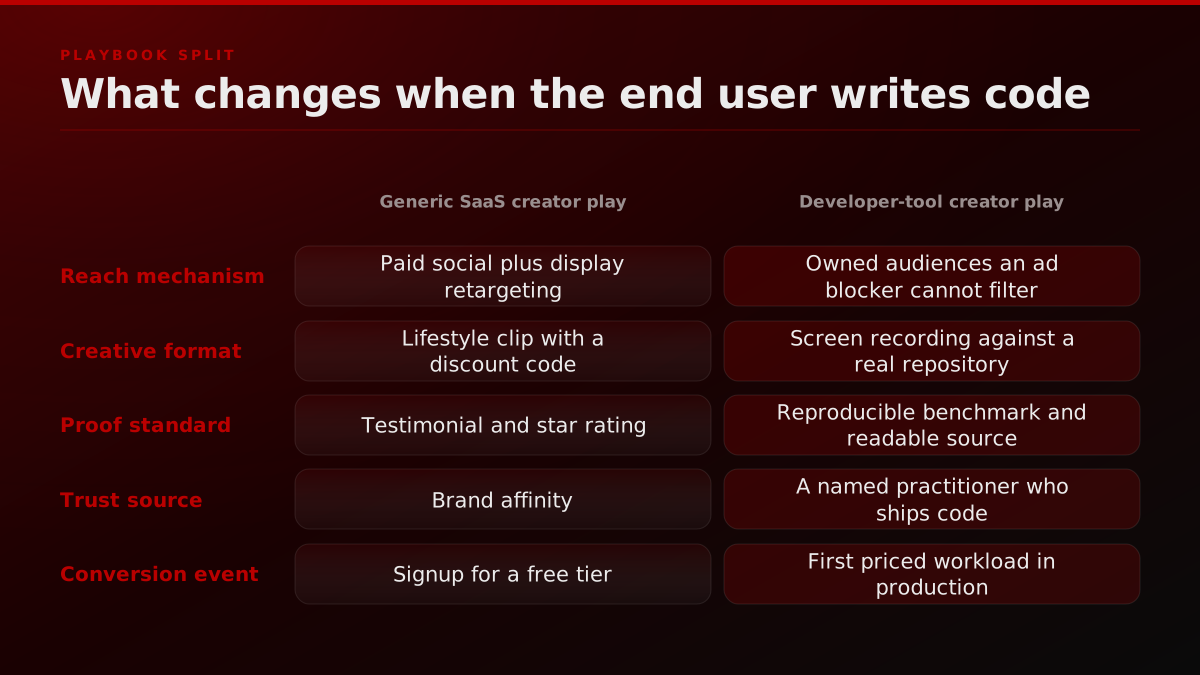
That buyer is why the standard playbook does not transfer. A developer blocks ads at a rate well above the general population, treats vendor content as a claim rather than as evidence, and evaluates by reading the source. In most SaaS categories creator spend behaves like a media buy with a warmer click-through rate. Here it behaves like sourcing credible practitioners, and the trigger that sends these teams looking is almost always the same one nobody writes about.
Here is what that looks like from the inside. In July 2026 a founder posted a one-month retrospective on r/SaaS covering the four weeks after launching a paid plan. Week one, the funnel was broken and nobody noticed until late. Week two, ads went live. Reddit ads, in his own account, burned almost $520 dollars of cash and 500 dollars worth of ad credits without producing a single payment. Week three, influencer marketing started. Payments surged. And then he wrote the sentence that is the real subject of this guide.
Influencer marketing started after the posts started going out we saw a surge of payments but ironically we are not sure if it was because of other efforts or influencer marketing as we had also distributed coupons to creators but only 1 user actually used the creator coupon code.
One coupon code. Out of an entire creator programme and a visible surge in revenue, exactly one user redeemed the thing that was supposed to prove the creators caused it. He is not confused about whether it worked. He is confused about whether he can ever know, which is a different and much harder problem, and it is the problem sitting underneath every creator budget in this category.
1 month since we launched, this what i learned
This guide exists because that motion, the open-source or launch traction spike converted into paid adoption, is not covered anywhere in the results people actually read. Across thirty results pulled for the terms a founder would type, the strongest ranking asset for the head query is a community thread of people asking whether this works at all. Every written guide that ranks treats SaaS as one flat audience. None of them segments to the case where the buyer is a developer, and not one covers what to do in the days after a repository spikes. We are an agency that sells influencer and KOL work, so this page has an obvious commercial interest, and stating that plainly is more useful than pretending to be neutral about it.
We sell this service, so read this page as an interested party's argument
FORKOFF is an AI agency and influencer marketing is one of the services we sell. A page published by a vendor about the thing the vendor sells is a sales document with a research layer on it, and pretending otherwise would be the first dishonest thing in this guide. What we can offer instead of neutrality is specificity: the numbers here are all linked to a primary source you can open, the disqualifying cases in the last section are ones we turn down, and our own distribution network has processed 5B+ views, which is a first-party figure and should be weighed as one.
What is SaaS influencer marketing, and what is it not?
It is renting distribution and borrowed credibility from someone whose audience already contains your buyer, in exchange for money, on terms you write down. That is the whole definition. It is not affiliate marketing, which pays only on a tracked conversion and therefore selects for creators willing to work on spec. It is not sponsorship in the brand-awareness sense, where the goal is impressions against a demographic. And it is decidedly not developer relations, which is an internal function staffed by your own people with a mandate that outlives any campaign. Our breakdown of developer marketing versus developer relations covers where that line sits, and it matters here because teams routinely buy one when they needed the other.
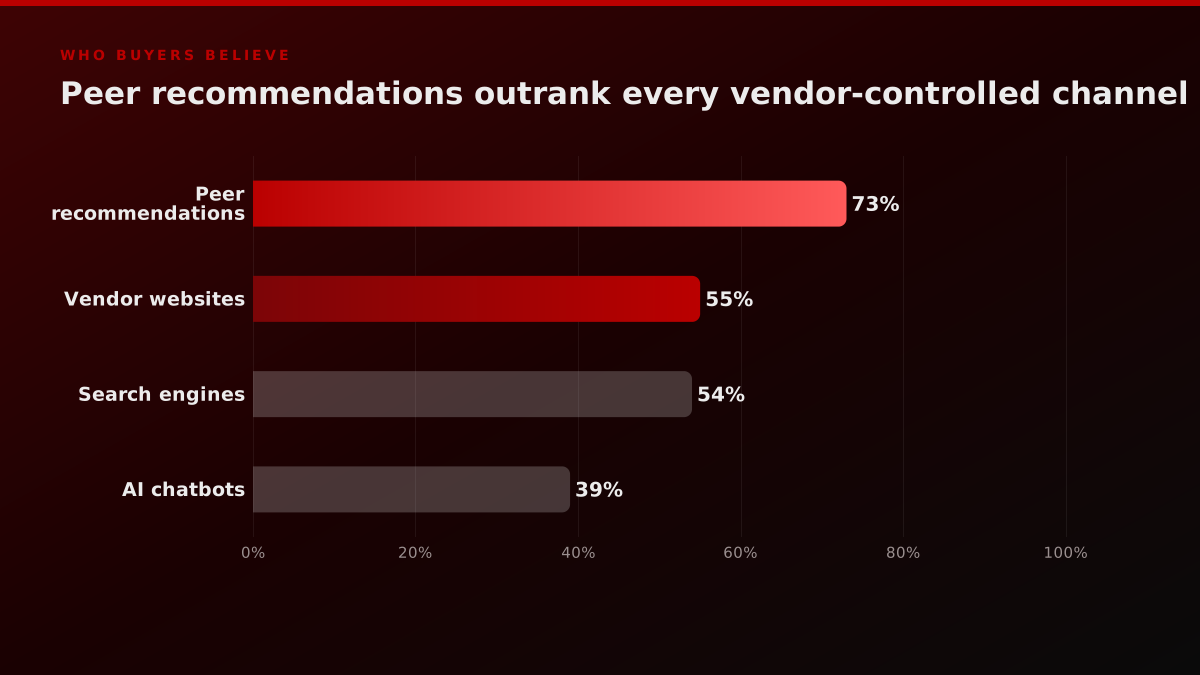
The reason the category exists at all is a trust asymmetry that has been measured properly. Across 1,202 US business decision-makers, SurveyMonkey and Reddit found 73% trust peer recommendations, 55% vendor websites, 54% search engines and 46% review sites. AI chatbots and social media sit at the bottom of the same ranking. A creator sits in the first bucket if the audience believes the relationship is genuine, and slides into the last bucket the moment it does not. That single sentence is the entire risk profile of the channel.
The structural shift underneath it is that the trusted intermediary changed shape. Fielding 1,862 buyers and 444 vendors in January 2026, the TrustRadius 2026 B2B buying disconnect report found 74% of B2B technology buyers using customer reviews to inform a purchase. The same report puts analyst usage at 13% of buyers, a 63% decrease since 2022. The analyst report used to be the third-party voice that made a purchase defensible internally. It has been replaced by peers, and a credible practitioner with an audience is the most concentrated form of peer available for money.
Money is moving accordingly. In the 2026 Influencer Marketing Benchmark Report, built on more than 600 respondents, 72.2% expect their creator budget to increase by 50% or more this year, and 66.3% run the programme entirely in-house. That second number matters more than the first for a founder reading this, because it means the default state of this channel is a founder or a growth hire doing it themselves without an agency, and the comparison you should be making is not agency versus nothing. It is your own time versus somebody else's process. Our guide to what an influencer marketing agency costs sets out where that line usually falls.
The industry's own benchmark concedes that revenue attribution is rare
In the 2026 Influencer Marketing Benchmark Report (influencermarketinghub.com), brand awareness is the most-selected KPI at 55.1%, ahead of revenue and sales measures, and 65.9% of respondents say they expect payback on creator spend within a single month. Those two findings sit oddly together. A channel measured primarily on awareness is not a channel with a trustworthy one-month payback signal, and a buyer who takes the second number at face value without reading the first will build a forecast on a KPI nobody in the survey is actually tracking.
The same benchmark report has an uncomfortable KPI finding: brand awareness leads at 55.1%, and 65.9% expect payback inside one month, 48.4% inside two weeks. A channel whose practitioners mostly measure awareness is not a channel that has earned a two-week payback expectation. Both numbers are self-reported by people who buy this, and holding them next to each other tells you the category has an expectation problem before you have spent anything.
Why do developer tools break the standard influencer playbook?
Because every assumption the standard playbook rests on inverts when the end user writes code. Paid reach is the first casualty. Ghostery's privacy report on advertisers and ad blockers, fielded by Censuswide across 2,000 US consumers, found 72% of experienced programmers and 76% of experienced cybersecurity professionals running ad blockers, against 52% of Americans overall. Roughly three quarters of the audience you most want has installed a technical countermeasure against the format you were planning to buy. That is not a targeting problem you can solve with better creative or a bigger budget.
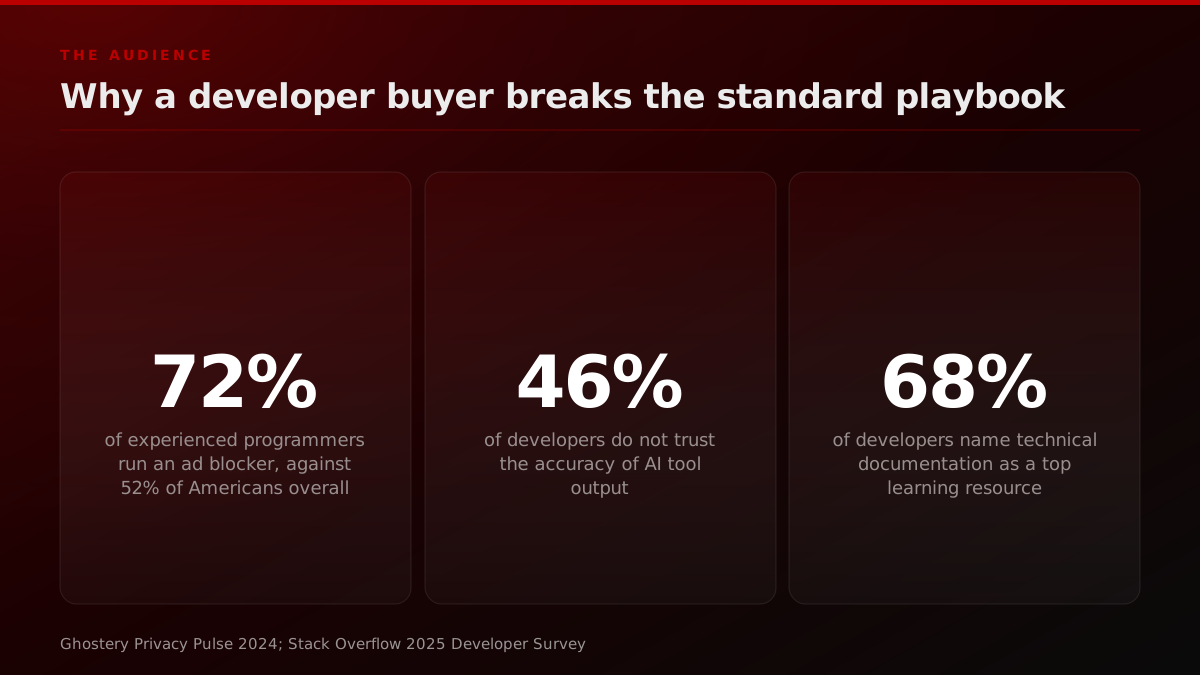
The second inversion is trust, and it has moved sharply in the wrong direction for anyone selling AI tooling. The Stack Overflow 2025 Developer Survey, with more than 49,000 respondents, found 46% of developers do not trust the accuracy of AI tool output, up from 31% the prior year. The same developer survey records only 33% trusting it and 3% trusting it highly, despite 84% using or planning to use AI tools. The JetBrains State of Developer Ecosystem 2025, surveying 24,534 developers, found 85% regularly using AI tools for coding and 62% relying on at least one AI coding assistant, agent or editor. Adoption and trust have decoupled completely. Your buyer uses the category daily and does not believe what it tells him, which means a creator saying your tool is good moves nothing. A creator showing it working against a hard problem moves everything.
The third inversion is where learning happens. The same Stack Overflow developer survey puts technical documentation at 68%, online resources at 59% and Stack Overflow itself at 51%. Documentation beats every channel you can buy, and documentation is the one surface a creator can complement but not replace. The practical consequence is that a creator campaign into a product with weak docs converts attention into a bounce, because the mention sends a developer to a page that cannot answer the next question.
There is a fourth factor that is not a statistic, and it explains why this channel keeps getting bought by technical founders who dislike it. In February 2026 a senior developer posted on r/SaaS under the title "20 years coding, 0 money made. why is selling so hard for devs?" and described a loop that anyone who has shipped a side project recognises: the idea, the flow state, months of over-engineering the backend, the finished app, and then the freeze. He wrote that building a personal brand makes him cringe and that he feels like a scammer whenever he tries to sell something even when he knows the code is solid, and asked whether it is possible to grow a SaaS in 2026 without becoming an influencer.
20 years coding, 0 money made. why is selling so hard for devs?
That post drew 169 comments. Renting an audience is, for a large share of technical founders, not a growth tactic at all. It is a workaround for a distribution problem they have no intention of solving personally, and understanding that is the difference between a brief that works and a brief that asks a founder to become someone he is not. Our developer marketing strategy guide and the AI DevRel playbook both cover the in-house alternative, and for a lot of teams the honest answer is a mix. If you want the definitional version of the whole discipline first, what developer marketing is is the shorter read, and our dev tools page sets out how we scope this for a technical product.
The audience you are buying is the one most likely to reject the format
Ghostery's Privacy Pulse research (ghostery.com), fielded by Censuswide across 2,000 US consumers, found 72% of experienced programmers and 76% of experienced cybersecurity professionals running ad blockers against 52% of Americans overall. That is the structural reason performance marketing underperforms here, and it is also a warning about creator content: the same instinct that installs the blocker recognises a paid read. A sponsored segment that sounds like an ad gets skipped by the exact people you paid to reach.
What counts as an open-source traction spike, and how long does the window last?
A spike is any event that puts your repository in front of an audience that did not seek it out: a Show HN that reaches the front page, a Product Hunt run, a viral thread, a maintainer of something larger linking to you, or a week where the star count moves by an order of magnitude over its baseline. The window is measured in days. The capture phase is the first 48 hours, the creator phase runs to roughly week three while the story is still current, and anything still unconverted by week twelve was never going to convert on that wave. Treating a spike as a quarter-long opportunity is the most expensive mistake in this section, because the marketing cycle that would respond in a quarter is slower than the attention it is responding to.
The reason the window is that short is arithmetic. GitHub Octoverse 2025 reports 180 million or more developers on the platform, with over 36 million joining in the past year, roughly one per second. The same GitHub Octoverse report counts 1.12 billion contributions across 395 million public repositories, averaging 43.2 million merged pull requests per month. Your spike is a brief local maximum inside that. The noise closes over it fast and nothing about the platform is designed to keep it visible.
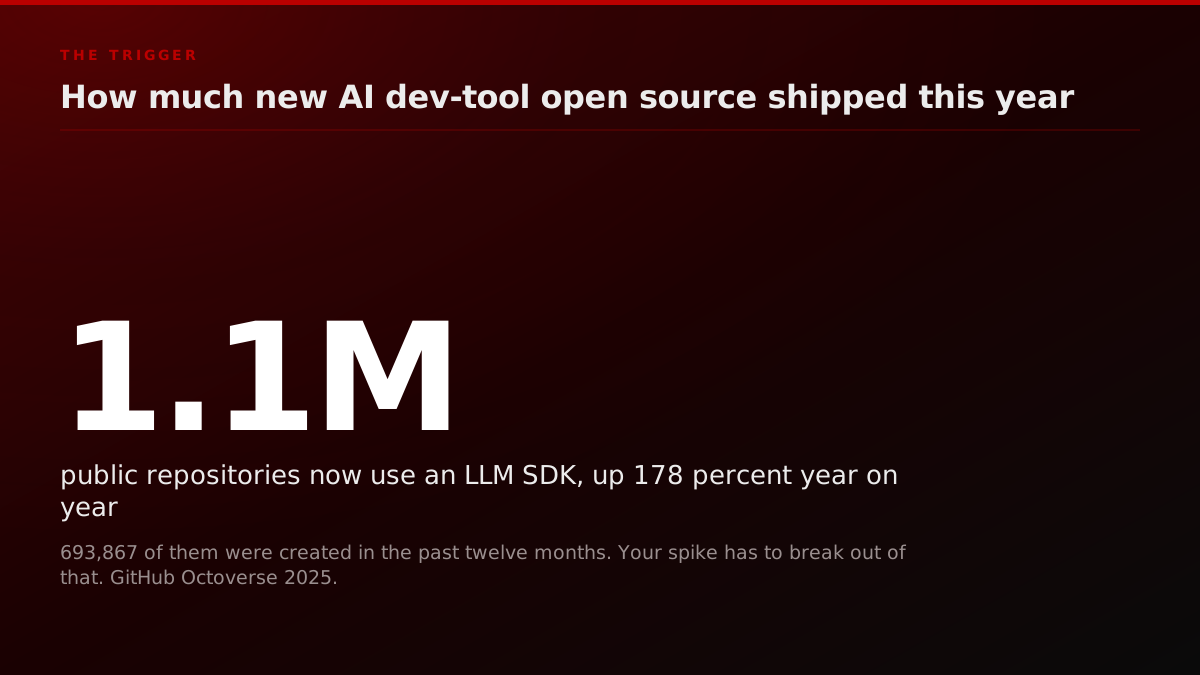
The specific surge this guide is about is sharper still. The same GitHub Octoverse report counts 1.1 million public repositories now using an LLM SDK, up 178% year on year, with 693,867 of them created in the past twelve months. Roughly two thirds of the entire installed base of LLM-adjacent repositories appeared inside one year. That is the competitive set your spike is breaking out of, and it is also why a spike happens at all: there is enormous appetite for tooling in this space and very little settled preference. Our AI startups page and AI agents page cover how the buying pattern differs across those two shapes.
The four windows after an open-source traction spike, and what each one is for
| Window | The job | What good looks like | The common failure |
|---|---|---|---|
| Hour 0 to 48 | Capture and instrument | One priced path visible in the README, and every arrival tagged at source | A free tier with no ask, and no idea which link sent the traffic |
| Day 3 to 21 | Brief creators who already use it | Practitioners who ran the tool before you paid them, shipping auditable proof | A cold outreach list bought on follower count |
| Week 4 to 12 | Convert on a paid trigger | A workload, a limit, or a team seat that forces a pricing decision | Signups that never encounter a bill |
| Quarter 2 | Re-fire or stop | A second real release that gives creators something new to say | Paying the same creators to repeat the first message |
Two things distort what teams do with a spike, and both are worth naming before the motion. The first is that the star count became a fundraising input rather than a product signal.
TIL - Orgs use GitHub stars to get funding and for that they go for ANY type of marketing campaigns and also any type of influencer collab including paid tweets etc.
That is one practitioner's observation from 2023, not survey data, and it should be read that way. It has not stopped being true, and it produces a recognisable failure: a campaign engineered to move a number a venture investor will read, run by a team that has not yet decided what the paid product is or who inside a company signs for it. There is also academic work suggesting that open-source funding has a substantial effect on subsequent development activity, published in Organization Science in 2025, but the full text sits behind a paywall and the circulating secondhand figures conflict with each other, so treat the direction as real and refuse to attach a number to it.
Saiyam Pathak
@SaiyamPathak
TIL - Orgs use GitHub stars to get funding and for that they go for ANY type of marketing campaigns and also any type of influencer collab including paid tweets etc. But all in all GitHub stars matter because VC's see them ¯\_(ツ)_/¯
The second distortion is the outcome shape everyone has in mind. In July 2026 TechCrunch reported that a popular open-source AI developer tool raised $65M and grew to nearly 9M users, which is a real and recent proof that this transition works at scale.
TechCrunch
@TechCrunch
Popular open source AI developer tool Ollama raises $65M, grows to nearly 9M users https://t.co/Yxn26QGYq4
It is also survivorship bias in its purest form. The repositories that convert an audience into revenue are visible precisely because they converted. The far larger population of projects with respectable star counts and no commercial motion is invisible by construction, and the difference between the two groups is rarely the quality of the code.
How do you turn the spike into paid adoption, stage by stage?
In four windows, each with one job, and the discipline is refusing to do window three's work during window one. Hours zero to 48 are for capture and instrumentation. Days three to 21 are for briefing creators who already use the tool and shipping proof a developer can audit. Weeks four to 12 are for moving that audience onto a paid trigger. Quarter two is for re-firing on a genuine release or stopping and saying why. Most teams compress all four into a single frantic week, discover that they cannot measure any of it, and conclude the channel does not work.
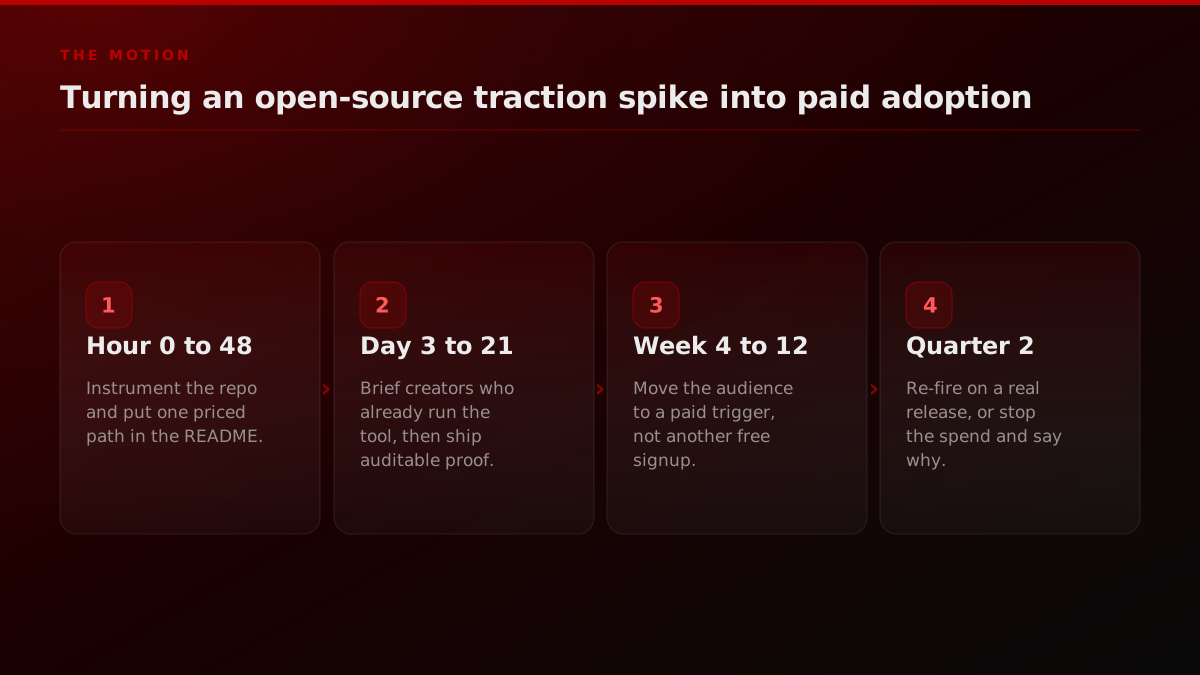
Window one is unglamorous and it decides everything downstream. Put one priced path where the traffic already is, which means the README, not a landing page nobody clicks through to. Tag every arrival at source so that the creator links, the Hacker News referral and the organic search traffic are separable later. Decide, before any money moves, what the paid product actually is: a hosted version, a team tier, a support contract, an enterprise feature set. A repository with no priced tier converts a spike into a traffic report, which is a fine thing to have and not a business.
Operator notePut a priced path in the README before you brief a single creator. Attention with nothing to buy is a traffic report, not a campaign.
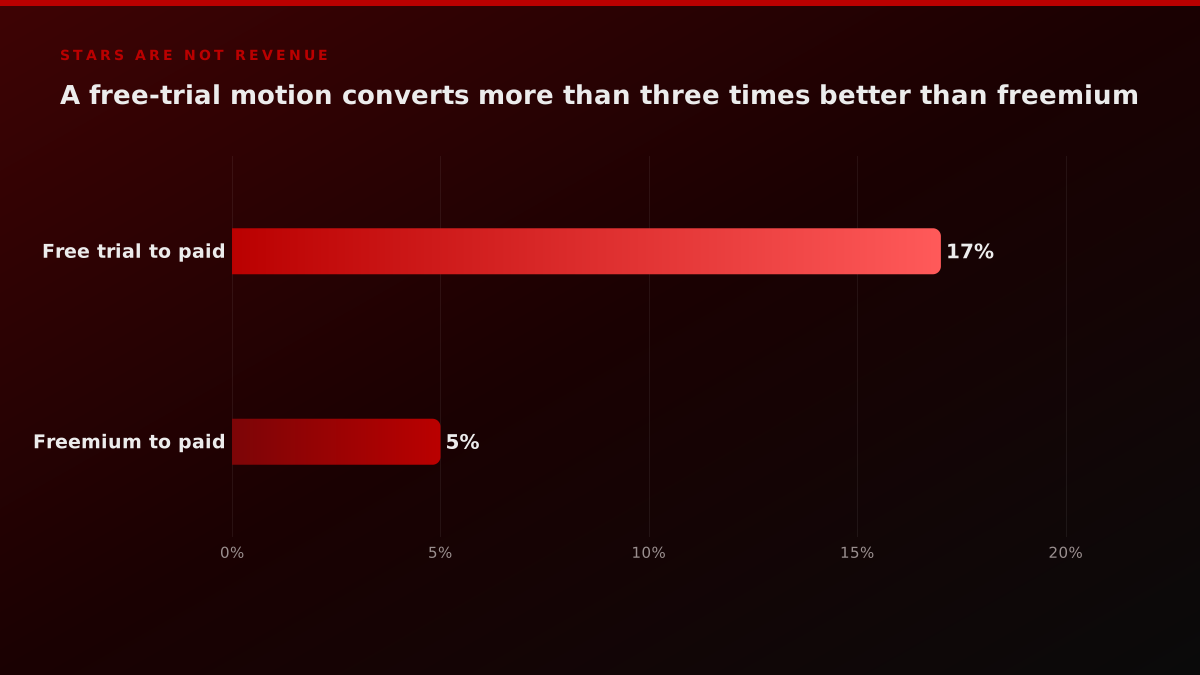
The shape of that paid path matters more than most teams assume, and there is a benchmark for it. OpenView's 2022 Product Benchmarks report, built on interviews with more than 450 product-led founders and CEOs, found free-trial motions converting 17% of signups to paid against 5% for freemium. The same report tracked product-led growth adoption rising from 45% of respondents in 2019 to 55% in 2022. An open-source project defaults to the freemium shape, because the free thing is the product and it is genuinely free forever. Pointing a creator wave at a freemium funnel means accepting roughly a third of the conversion rate a trial would give you, and the fix is usually not removing the open-source tier. It is adding a time-boxed, credit-card-free trial of the commercial capability so that the wave has a second thing to do.
Window two is the creator window, and the single rule that governs it is that you brief people who already use the thing. A practitioner who adopted your tool before you paid them produces a segment that reads as a recommendation. A creator who receives a brief and a login produces a segment that reads as an advertisement, and against an audience with a 72% ad-blocking rate, the second one is close to worthless regardless of reach. This is the window where the proof artifacts get made: a benchmark somebody can rerun, a screen recording against a real repository, an integration that exists in public and can be read.
Operator noteAsk a creator what they already use. If your tool is not in the answer, you are paying for a first impression they will deliver badly.
The category argument about whether any of this works gets re-litigated constantly, and the most useful version of it is a founder who opened by rejecting the whole premise and then reversed inside the same post.
B2B influencer marketing doesn’t work.
At least that’s what I thought before @antinertia told me about this new Influencer Flywheel Playbook behind Lovable, Gamma, or n8n’s success.
He is selling a distribution product, so the reversal is an interested one and should be read as a hypothesis rather than as a finding. What makes it worth including is the honesty of the starting position. The default belief among people who have tried this in B2B is that it does not work, and any argument that skips past that belief instead of engaging with it will not survive a founder's first bad month.
Florian Darroman
@floriandarroman
B2B influencer marketing doesn’t work. At least that’s what I thought before @antinertia told me about this new Influencer Flywheel Playbook behind Lovable, Gamma, or n8n’s success. (and it also works for bootstrapped SaaS/app) Watch the full episode: https://t.co/z54CtBsTLZ h… Show more
The $100M Playbook Used by Lovable, Gamma & n8n (Influencer Flywheel)
Florian Darroman
The long version of the reversal in the tweet above, an interview arguing that a creator flywheel carried several fast-growing software products. It is a founder interview on a distribution product, so treat the framework as a hypothesis worth testing.
Window three is where the money is made or lost. Moving an audience onto a paid trigger means giving them a reason to encounter pricing while the memory of the creator segment is still warm: a usage limit that a serious workload hits, a team feature that a second engineer needs, a hosted option that removes an hour of setup. The failure mode is a signup flow so frictionless that nobody ever meets a bill. If you want the distribution mechanics of getting the same proof artifact in front of the audience repeatedly, our clipping service is the surface we use for that, and our SaaS companies page covers how the motion changes for a non-technical buyer.
Window four is the one nobody plans. A creator programme that keeps paying the same people to repeat the first message decays fast, because their audience has already heard it and the second telling reads as an ad in a way the first did not. Either you have a genuine release that gives them something new to say, or you stop and report honestly on what the first wave produced.
How do you pick creators for a product developers will audit?
By selecting on evidence of practice rather than on audience size, and by writing the criteria so that a creator who is wrong for a technical product cannot pass them. The tests that matter are whether they ship code in public under a real name, whether their replies come from engineers rather than marketers, whether they label paid work without being asked, whether their default format is a screen recording against their own project, and whether they price on the work rather than on follower count. Every one of those is checkable in twenty minutes before you send a rate request.
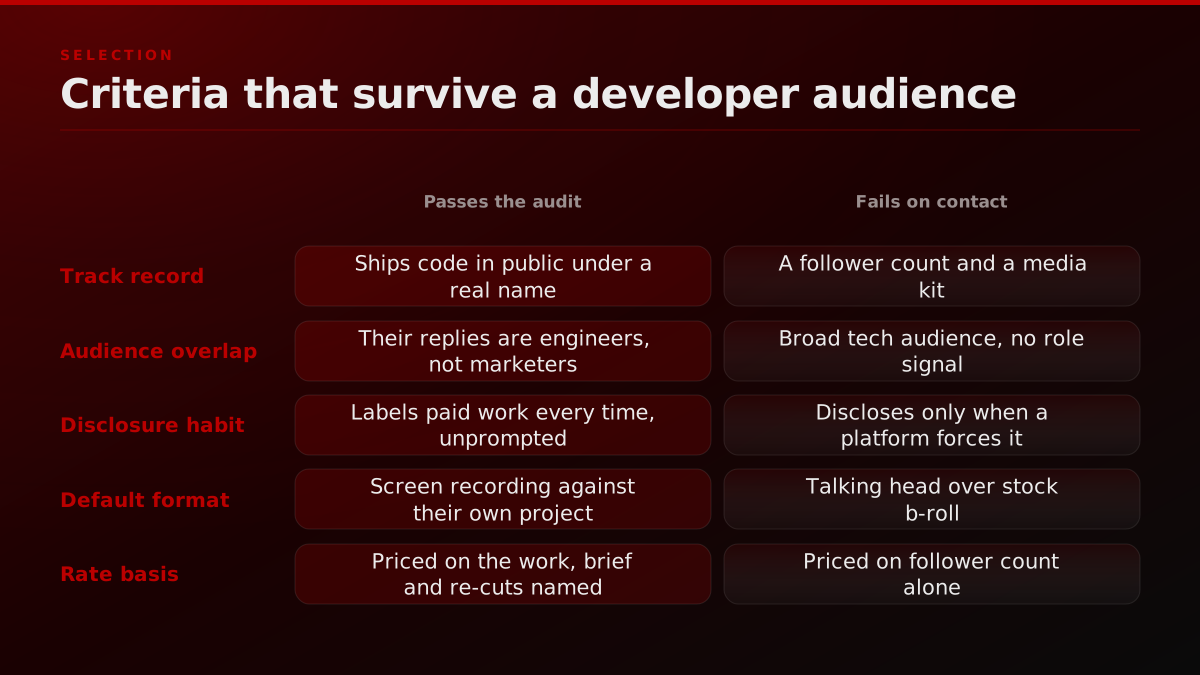
Audience composition is where most selection processes go wrong, and it is checkable in a way follower count is not. Open the creator's last ten posts and read the replies rather than counting them. An audience of engineers argues about implementation details, corrects the creator on specifics, and asks questions with code in them. An audience of marketers congratulates. Both look identical in a media kit and they convert at rates that are not comparable. Our guides to vetting a KOL and to telling whether tweet engagement was bought cover the mechanical checks, and both transfer directly to a developer audience even though they were written for a different vertical.
Four kinds of technical creator, and what each one is actually good for
| Type | What they produce | What it moves | What it will not do |
|---|---|---|---|
| The practitioner | Screen recordings, teardowns, and honest benchmarks against their own work | Trial starts from engineers who already had the problem | Scale. There are very few of them and they are booked |
| The educator | Tutorials, course modules, conference talks, long explainers | Considered adoption and search-visible documentation you do not own | Fast results. Their production cycle runs in weeks |
| The newsletter operator | A written placement inside a curated developer digest | Reach into a list that opted in and does not block the email | Depth. A placement is a mention, not a demonstration |
| The commentator | Opinion threads, takes, ecosystem coverage | Awareness among people who are not yet buyers | Conversion. Their audience is broad by design |
The four creator types in that table are not a hierarchy and the budget should rarely go to one of them. A practitioner produces the highest-converting asset and cannot be scaled, because there are very few of them and the good ones are booked. An educator produces something that keeps working for years and takes weeks to arrive. A newsletter operator produces reach into a list that opted in and does not block the email, which is structurally valuable against an ad-blocking audience and shallow by format. A commentator produces awareness among people who are not yet buyers, which is the right purchase when the category itself is unfamiliar and the wrong one when you need trials this quarter.
Two practical filters cut a long list down quickly. First, ask what they currently use for the job your product does. If your tool is not in the answer, you are buying a first impression that they will deliver badly, and no brief fixes that. Second, ask what they have declined. A creator who has never turned down a sponsorship has no editorial standard, which means their endorsement carries no information, which is the entire thing you are buying. That test comes from the vendor selection side of this business and it works identically in both directions. Our guide to choosing a KOL marketing agency applies the same logic to the partner rather than the creator, and our KOL marketing service is the same discipline under the name most technical categories use for it.
Stars became a funding signal, which changed what the campaigns are for
A developer relations lead at an infrastructure company posted that organisations use GitHub stars to raise money, and that this pushes them toward any marketing campaign and any influencer collaboration that moves the number. Read it as one practitioner's observation, not as market data. It does explain a specific failure we see often: a campaign optimised for a metric a venture investor will read, run by a team that has not decided what the paid product is or who signs for it.
What do technical creators actually cost?
More than general creators with the same audience size, and the premium is real rather than negotiable posturing. The clearest published signal is on the newsletter side. beehiiv's breakdown of newsletter sponsorship cost puts specialised B2B and developer newsletters at $50 to $100 or more CPM against $15 to $35 for general consumer lists. The same analysis puts per-placement newsletter sponsorship rates at $50 to $250 under 5,000 subscribers, rising to $3,000 to $20,000 or more above 50,000. That is one operator's analysis of its own platform rather than a disclosed-methodology benchmark survey, so treat the ratio between the two bands as the durable finding and the exact figures as directional.
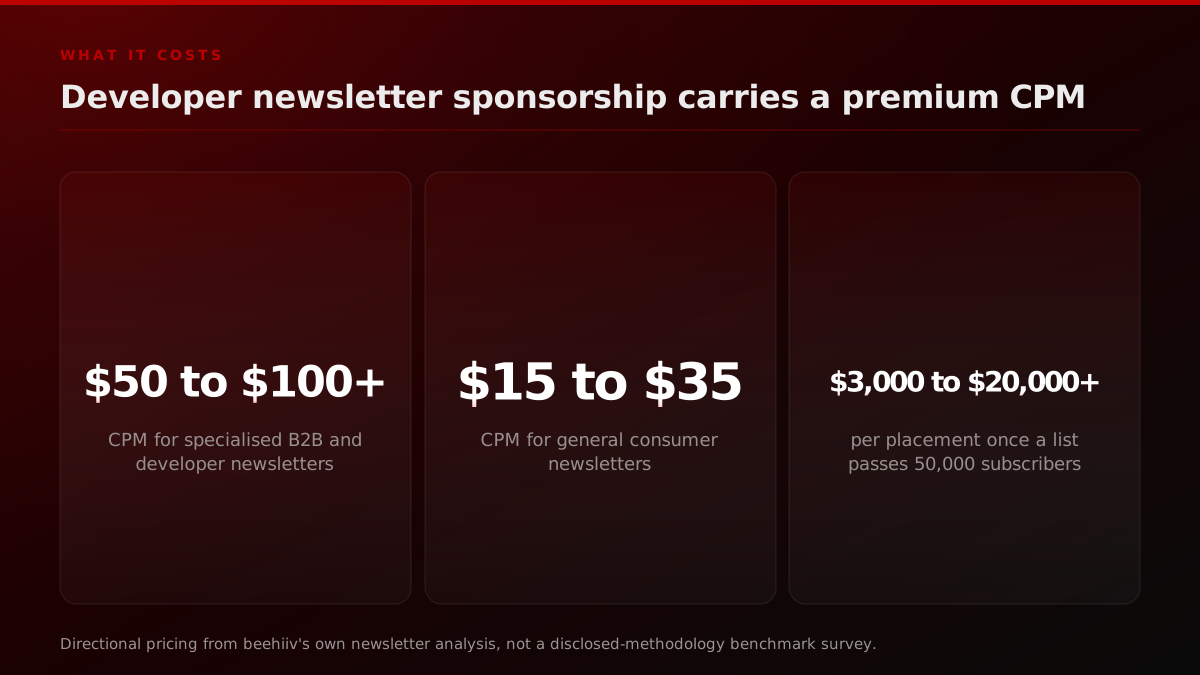
The reason the premium exists is straightforward. A developer newsletter list is small, expensive to build, hard to fake, and composed of people with purchasing influence over tooling budgets. A general consumer list of the same size is none of those things. When a creator quotes you a rate that looks high against a follower count, the question to ask is not whether the rate is fair against the market. It is what a qualified developer impression is worth against your other options, which our cost per qualified lead by channel breakdown puts in comparable terms.
Video and long-form creators price on the work rather than on reach, and this is where a budget is most often misallocated. A twenty-minute teardown of your tool against a real problem takes a creator several days including the failed takes, and a rate that reflects that will look expensive next to a newsletter slot and will outperform it on trial starts by a wide margin. Our influencer marketing pricing tiers breakdown sets out how a mix gets assembled across those shapes, and we surveyed real founder spend directly in what 30 founders said influencer marketing cost them.
The most useful cost data in this category is not published by a platform at all. It is published by founders who ran the experiment and reported the outcome without a sales motive. In June 2026 a solo founder wrote up reaching $5k MRR in two months and included the creator line item in full: a hand-built list of hundreds of contacts, roughly 30% responding with interest, about 10% worth working with, 5% ghosting, and two creators actually signed. Over sixty days those two posted short-form video every day.
Spend: $1000 per month per creator Return: Maybe 1/2 conversions, it is difficult to track and attribute conversion with this method.
How I reach $5k MRR in 2 months. What worked and didn't.
He did not conclude the channel was broken. He concluded it is a numbers game that needs at least ten creators posting regularly and testing hooks, that roughly 10% to 20% of them will perform, and that a realistic starting budget is $5,000 to $10,000. That is a more honest description of the economics than anything with a vendor logo on it, and it should reset the expectation that two creators and a coupon code constitute a programme.
How should the deal be structured?
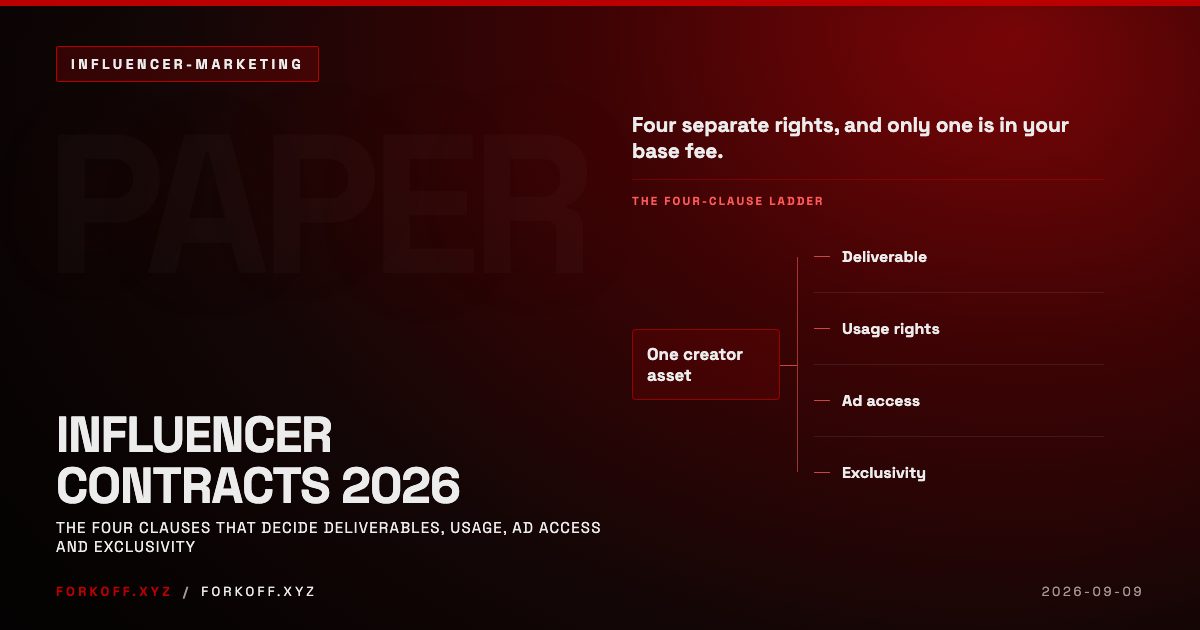
Around six clauses, each of which exists because its absence causes a specific and predictable failure. Deliverables get named in countable units. A source-visible proof segment is contractual rather than hoped for. Usage rights carry a term in days and a named territory. Exclusivity is scoped to one category for one window. Disclosure appears on every asset without exception. And correction rights specify what happens, and who pays, when a technical claim in the segment turns out to be wrong.
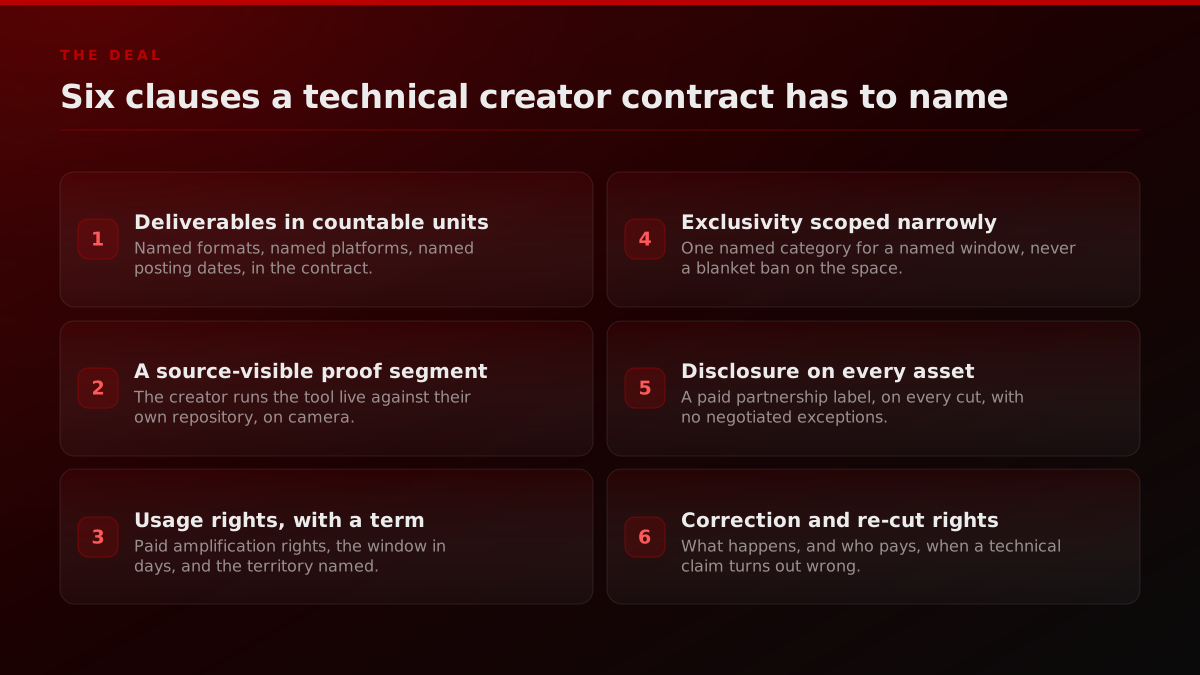
Countable units means formats, platforms and dates, not "a content partnership". The failure this prevents is the one every agency-side buyer eventually meets: a month ends, activity happened, and nothing in the agreement lets you say whether the deliverable arrived. Write down how many pieces, on which surfaces, in which weeks.
The source-visible proof segment is the clause specific to this audience. It says that at some point in the asset, the creator runs your tool live against their own repository or their own problem, on camera, without a cut. It is the single highest-converting thing a technical creator can do and it is the first thing that gets dropped when a production schedule slips. Contract for it explicitly and the rest of the creative can be left to them.
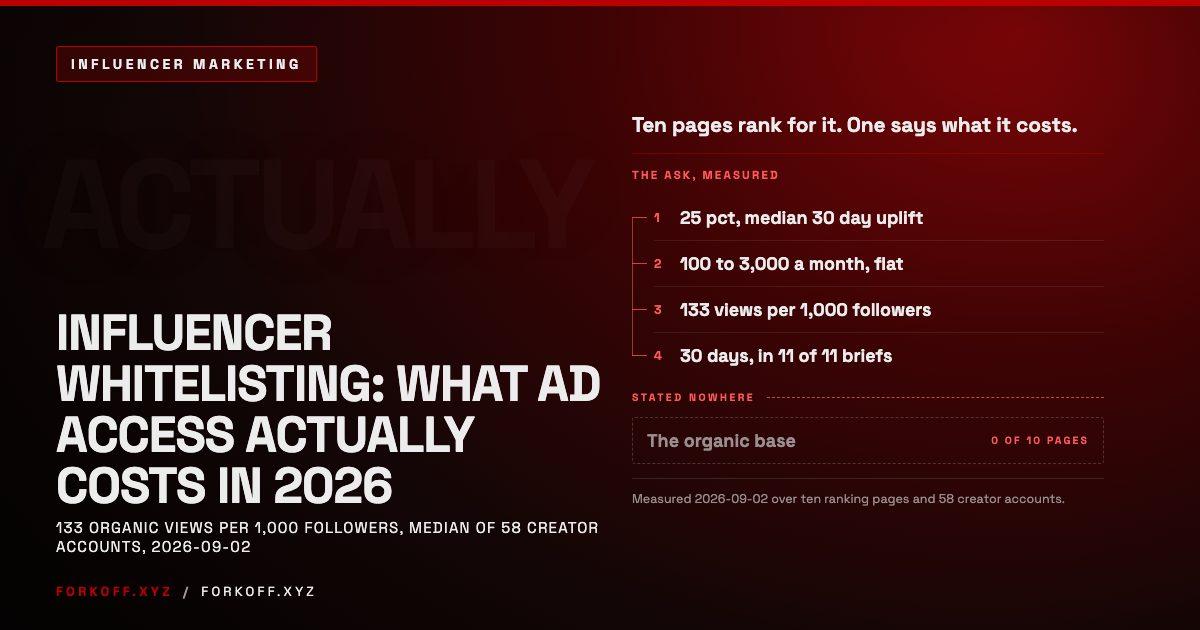
Usage rights are where money is quietly wasted. If you intend to run the segment as paid media, or cut it for your own channels, or put it on the pricing page, that is a separate right with a separate price and it is far cheaper to buy at signature than to renegotiate after the asset performs. Buy re-cut rights in the first contract as a matter of course: repurposing one good segment across formats costs less than commissioning a second mediocre one, and our clipping service exists precisely because that arithmetic holds across every category we work in.
Operator noteBuy the re-cut rights in the first contract. Repurposing one good segment costs less than commissioning a second mediocre one.
Exclusivity should be narrow enough that a good creator will sign it. A blanket ban on the whole category for a year is a term that only creators with no other options accept, which means it selects against exactly the people you want. One named competitor category, for a named window measured in weeks, is enforceable and reasonable.
Disclosure is not negotiable and treating it as a performance cost is the tell of an operator who does not understand this audience. The same instinct that installs an ad blocker detects an undisclosed paid read, and the punishment for being caught is applied to your brand rather than to the creator's. Our own distribution network has processed 5B+ views across creator campaigns, and the segments that hold up over time are the labelled ones. If you are comparing partners on how they handle this, our rankings of the best influencer marketing agencies and best KOL marketing agencies set out the questions we think should decide it.
What each attribution method can see, and what it structurally cannot
| Method | What it sees | What it misses | Honest verdict |
|---|---|---|---|
| Coupon or promo code | Deliberate, self-identified redemptions | Everyone who heard the mention and searched your name instead | Undercounts badly. Use as a floor, never as the measurement |
| Self-reported at signup | A stated first touch, in the buyer's own words | Recall error, and the touch they have already forgotten | The single most useful field on the form. Make it free text |
| Branded search lift | Aggregate demand created by a mention, with a visible time shape | Which specific creator caused which part of the lift | Good for the programme, useless for the individual invoice |
| Geographic or cohort holdout | Causal effect, by withholding spend from a comparable group | Nothing, if the groups are genuinely comparable and large enough | The only real answer, and the one almost nobody runs |
How do you attribute creator spend when the buying process is untrackable?
You accept that a clean last-click number does not exist for this audience, run three imperfect methods at once, and reconcile where they disagree. The SurveyMonkey and Reddit study found 83% of B2B decision-makers complete their research and self-select before ever speaking to a salesperson, which means the decisive part of the evaluation happens on surfaces you do not own and cannot instrument. Chasing a perfect attribution model for that is a project with no end state. Measuring it directionally with three cheap instruments is a week of work.
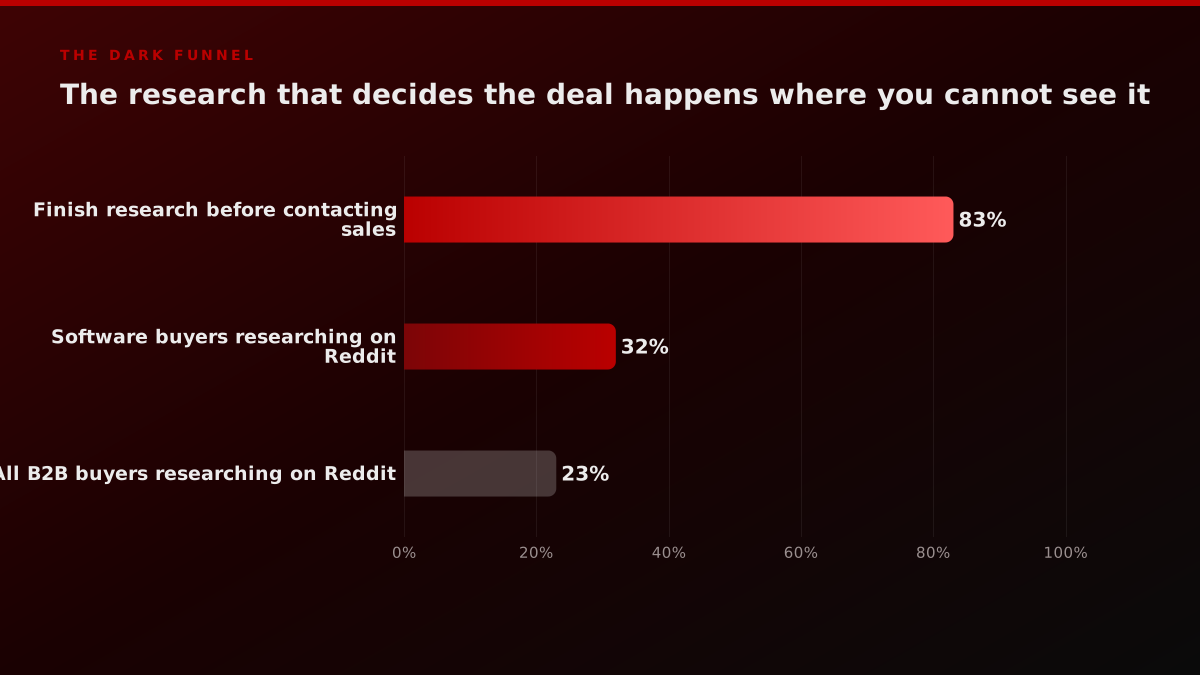
The dark channels are real and now measurable in aggregate. The same SurveyMonkey and Reddit study found 23% of B2B decision-makers have used Reddit for research, rising to 32% among software buyers. Nearly a third of software buyers are researching in a place where your analytics see nothing, your ads mostly do not reach, and a single skeptical comment outweighs a page of your own copy. Our guide to building a developer community on Reddit covers the participation side of that, and it is worth reading before you spend on creators, because a creator wave that drives a wave of Reddit questions nobody from your team answers is a net negative.
AI-assisted research adds a further layer without removing the problem. The TrustRadius B2B buying disconnect report found 94% of B2B buyers who use AI during purchase research fact-check its responses at least some of the time. The AI answer is a routing layer rather than a decision, and what it routes to is the same untrackable set of peer sources. A creator segment that gets quoted or summarised into one of those answers has influenced a purchase in a way no analytics package will ever attribute.
There is also a reason attribution disputes get heated internally that has nothing to do with the data. The Gartner sales survey on B2B buyer teams found 74% of them demonstrate unhealthy conflict during the decision process. The same dynamic runs on the vendor side, where an unattributable channel becomes the one every other channel owner is happy to defund. Deciding the measurement standard before the spend starts is the only protection against that argument, and it has to be decided by someone senior enough to hold the line in a bad month.
Operator noteMake the signup question free text, not a dropdown. The dropdown returns your own assumptions back to you every single time.
Three instruments, in order of usefulness. A free-text self-report field at signup, asking how the person heard about you, outperforms every dropdown because a dropdown returns your own assumptions back to you. Branded search lift tells you whether the programme created demand, with a visible time shape you can line up against posting dates, and it says nothing about which creator caused which part. A geographic or cohort holdout is the only method that produces a causal answer, and it is the one almost nobody runs because it requires deliberately withholding spend from a comparable group. If you spend meaningfully on this channel for more than two quarters, run one. Our influencer marketing statistics page collects the benchmark data you would compare a result against.
The last thing to say about attribution is that the founder at the top of this guide was not doing anything wrong. He ran the coupon code, which is the standard advice, and it returned one redemption against a visible revenue surge. The coupon was not broken. It was measuring the small subset of people who both remembered a code and chose to use it, which is a floor rather than a measurement, and any programme that treats that floor as the result will be cancelled while it is working.
When is creator spend the wrong call?
In five identifiable states, and in every one of them the honest move is to fix the state first. There is nothing priced to buy. The spike is already cold. The product breaks under load. Nobody owns the follow-up. Or you cannot say no to a bad brief, which means any creator with a rate card qualifies and you are buying impressions rather than adoption. We turn down work in all five, and not for reasons of principle. A campaign run into any of them produces a result neither side can defend three months later.
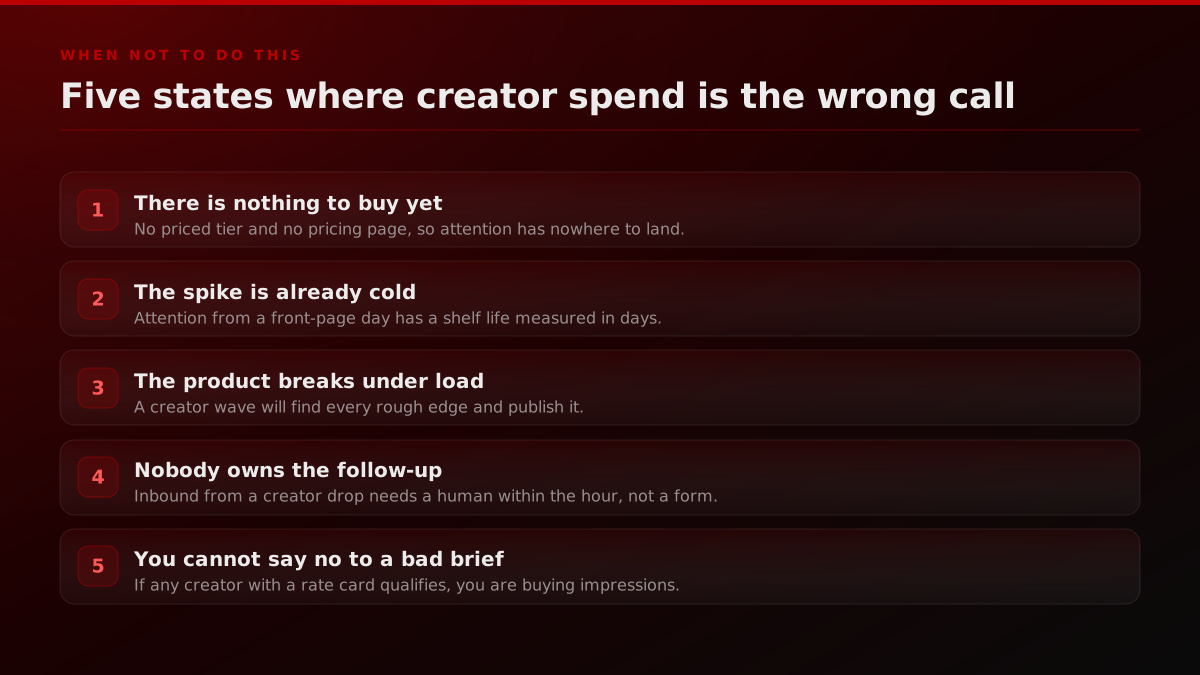
The buyer-side state is the one teams miss most often, because it is invisible from the outside. The Linux Foundation state of open source software study, run with Canonical across 851 responses, found 82% of organisations saying open source facilitates innovation and 83% saying it is valuable to their future. The same open source study found only 34% with a defined open source strategy and just 26% running an Open Source Program Office. Enthusiasm runs far ahead of process. The company that loves your project may have no mechanism for buying the commercial version of it, no budget line, and no internal owner, which means your creator campaign generated real desire inside an organisation that cannot act on it.
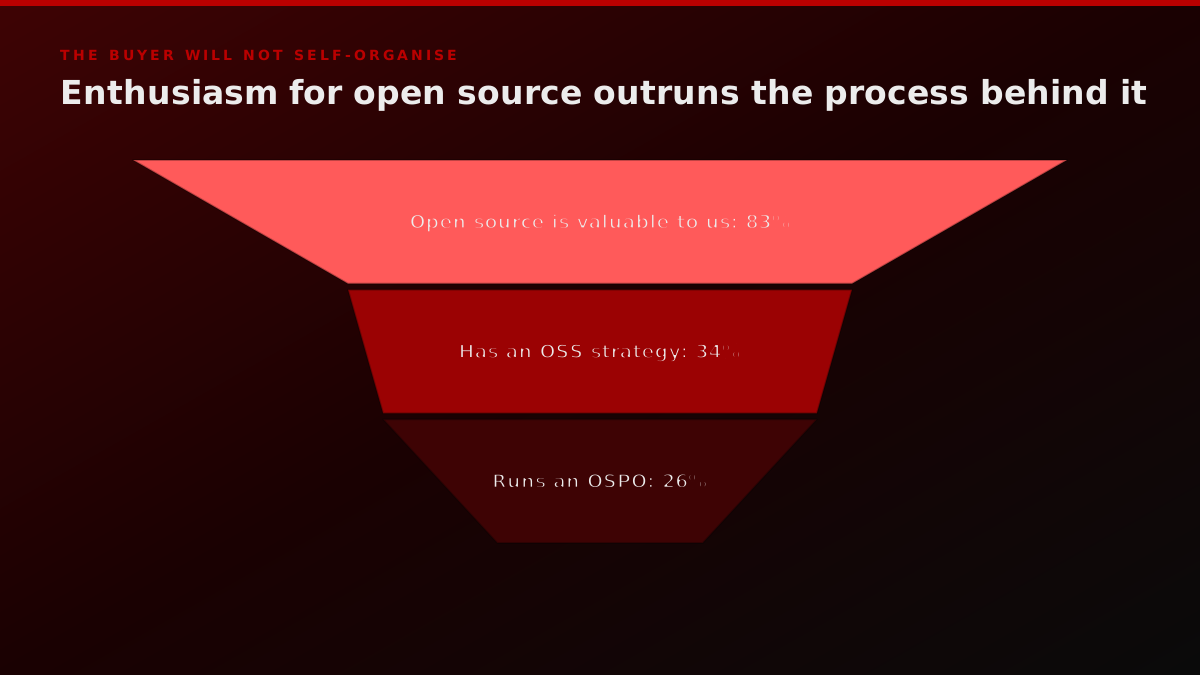
That is not a reason to skip the channel. It is a reason to engineer the path yourself rather than assuming the buyer will assemble it. Name the person inside a company who would sign, write the internal business case for them, and put it somewhere a developer can forward it. The developer is your champion and almost never your signer, and a campaign that ends at the developer's enthusiasm has stopped one step short of revenue.
Operator noteIf nobody can answer inbound within the hour, delay the campaign. A developer who gets a form response has already closed the tab.
The follow-up state deserves its own paragraph because it is cheap to fix and expensive to ignore. A developer who watches a segment, tries the tool, hits a real question and sends a message expects a human answer in minutes to hours. A form autoresponder closes that tab permanently. If your team cannot cover the window a campaign creates, delay the campaign. It is a scheduling problem, not a budget problem, and postponing costs nothing next to paying for attention you cannot receive.
How to Build an Open Source Business
a16z
The older canonical reference on open-source business models, published by a16z in 2019. It predates the AI tooling wave entirely, which is exactly why it is useful: the monetisation question it poses is unchanged and most teams still have not answered it.
The monetisation question underneath all of this is older than the current wave and mostly unanswered. The canonical reference on open-source business models predates AI tooling entirely, which is precisely what makes it useful: nothing about the hard part changed when the category got hot. The worked examples that are useful are the ones where a real repository people already used for free became a funded company, and where the founder is willing to describe the transition rather than the outcome.
Product Market Fit With Short Links | dub.co | Steven Tey
The Secret Sauce
A worked example of the transition this guide is about. The founder of an open-source link infrastructure project walks through finding product-market fit and building a funded company on top of a repository people already used for free.
Finally, the comparison most teams should run before spending anything. Creator spend competes against hiring a developer advocate, against your own founder posting, and against paid search, and the right answer changes with stage. Our devrel versus full-funnel agency comparison sets that trade out directly, and our ranking of the best SaaS marketing agencies is the page to read if you have decided to buy rather than build. If you want the version of this motion we would scope and run, our influencer marketing service states the deliverable in countable units and names what we decline, which is the part of any proposal worth reading first.