A Reddit AMA (Ask Me Anything) is a live, time-bound Q and A a founder or expert hosts inside one subreddit, publishing a post that invites questions and then answering them in the comments during a set window. Run well, it is a growth play that earns trust and signups from a skeptical audience. Run as a PR checklist, it dies in an empty thread. The difference is not luck. It is whether you pick the right community, warm it up before you go live, answer with candor instead of talking points, and track the result down to signups. This is the operator playbook for the version that converts.
TL;DR
A Reddit AMA is a growth play, not a PR checklist. The founders who get signups from it treat it as a loop: pick the subreddit where your buyers already are, get mod buy-in with an honest DM, pre-seed demand before you go live, write a clear title and bio with proof, answer fast and candidly during a one to two hour window, plant a few real questions so the thread is not empty, and close the loop with a tracked link so you measure signups instead of upvotes. AMAs are not dead, the celebrity format is, and a niche founder AMA converts better than a viral celebrity one ever did.
Running a Reddit AMA as a growth play means treating it as a loop: pick the subreddit where your buyers already are, earn mod buy-in, pre-seed demand, write a post with real proof, run a disciplined live hour, plant a few genuine questions, and attribute the result to signups. The sections below define what an AMA is and whether AMAs are still worth it, why most founder AMAs flop, then walk each step in order, from subreddit choice to mod outreach to the live hour to attribution, before covering how to turn one AMA into a recurring channel and how FORKOFF runs them. It is one tactic inside a broader B2B founder Reddit strategy.
About this guidance
This post draws on FORKOFF first-party operator experience running Reddit campaigns, plus publicly cited practitioner commentary from real founder AMAs and the platform documentation that ranks for these terms. Numbers framed as ranges or thresholds are directional rather than benchmarks, and any figure tied to a specific AMA is that host's public number, not an independently audited one. Individual outcomes vary by product, community, and offer. The examples are real, verified public AMAs, so you can read the threads yourself rather than take a summary on faith.

What a Reddit AMA is (and whether AMAs are dead)
A Reddit AMA is a live, text-based Q and A hosted inside a single subreddit. The host publishes a post inviting questions, then answers in the comments during a set window, usually one to two hours. Redditors upvote the questions they most want answered, so the best questions rise to the top and the host works down from there. It is public, it is unscripted, and that is exactly why it builds trust that a polished landing page cannot.
The question everyone asks first is whether AMAs are still worth it, because the celebrity r/IAmA era clearly faded. The honest answer is that the celebrity format declined, not the format itself. Founder and expert AMAs in niche communities are alive and, for a startup, more useful than the old celebrity version ever was. A niche AMA reaches fewer people than a viral one, but nearly everyone reading is a potential user, which is why it drives signups instead of just upvotes. Reddit's own learning hub frames the AMA as a live Q and A format, and the platform now actively supports hosting through its business AMA product.

AMAs Are Not Dead, The Celebrity Format Is
The what happened to Reddit AMA narrative is about the decline of the celebrity r/IAmA circuit, not the format itself. Founder and expert AMAs in niche communities are alive and, for a startup, more useful than the old celebrity version ever was, because they trade raw reach for an audience that can actually become customers. Writing off AMAs because r/IAmA got quieter is reading the wrong scoreboard.
Source: Practitioner discussion, Reddit and Hacker News
Here's How to Host a SUCCESSFUL Reddit AMA!
The Content Factory
A full walkthrough of hosting a successful Reddit AMA, covering the mechanics that Reddit rewards and the mistakes that get a thread ignored.
That reframe matters because it changes how you measure success. If you judge a founder AMA by celebrity-AMA reach, every one of them looks like a failure. If you judge it by signups from an audience that was already your target market, a quiet-looking thread can be one of the highest-converting hours you spend all quarter. This is the same relevance-beats-reach logic behind picking the right subreddits for B2B SaaS founders in the first place.
It also helps to set the right expectation for participation. Online communities follow a lopsided pattern that the Nielsen Norman Group named the 90-9-1 rule: roughly ninety percent of a community lurks and reads, nine percent comment occasionally, and one percent create most of the content. For an AMA that means the number of questions you see is a fraction of the number of people reading, so a thread with thirty visible questions may have been read by hundreds or thousands of silent lurkers who are the real audience for your answers. Social-media practitioners who write about Reddit for brands make the same point: on Reddit, the readers you never hear from outnumber the commenters many times over, and they are the ones who click the link and sign up. Write every answer for the lurker, not just the person who asked.
Why most founder AMAs flop
Most founder AMAs flop for one root reason: the founder runs a PR checklist instead of a growth play. They pick the biggest subreddit they can find, post a corporate-sounding introduction, pitch the product in every reply, and leave with a screenshot of upvotes and no idea whether anyone signed up. The mechanics were technically correct and the outcome was still nothing, because the mechanics are the easy half.
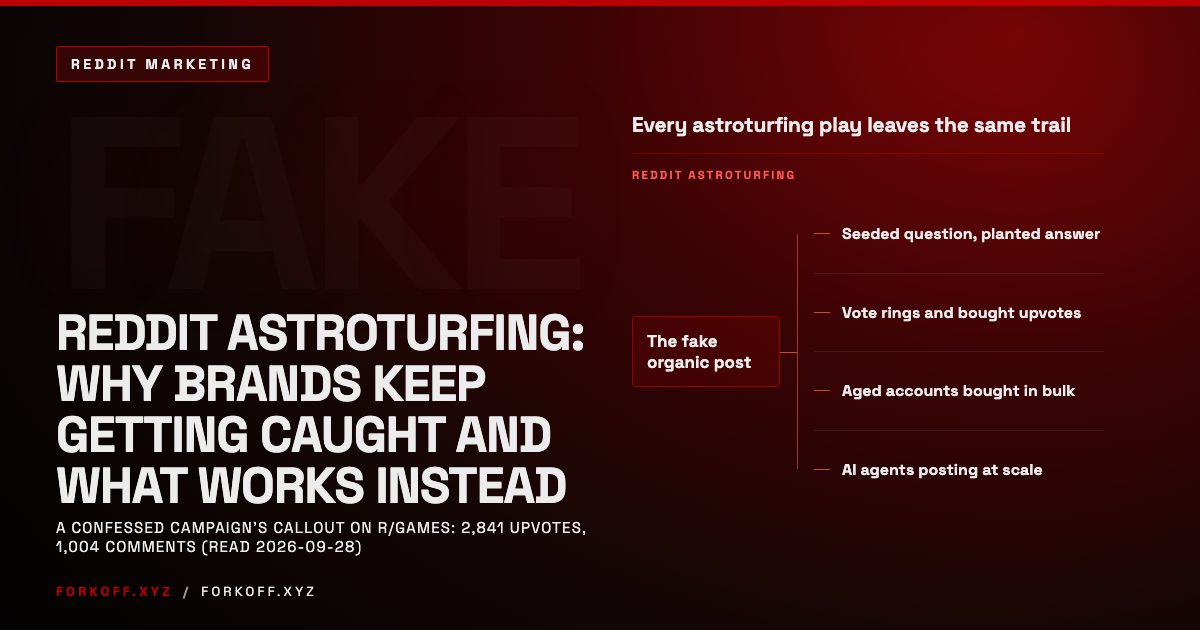
The five failure modes are predictable. The wrong subreddit, chasing reach over relevance. No pre-seeding, so the thread is empty when the first stranger arrives and looks dead. Corporate answers, which Reddit downvotes on sight. Pitching too hard, which gets the thread nuked or the account banned. And no tracking, so even a good AMA cannot be repeated with confidence because no one knows what it produced.

Reddit Rewards Candor And Punishes Pitches
The single rule that separates an AMA that works from one that dies is that Reddit rewards specific, candid answers and punishes generic marketing-speak with downvotes. The highest-performing founder AMAs lead with real numbers and free tips before any ask. The moment a reply reads like ad copy, the upvotes stop and the algorithm stops surfacing the thread, which is why value-first is not a nice-to-have but the mechanism of the whole channel.
Source: Operator commentary, r/iosdev AMA
The through-line is that Reddit rewards candor and punishes pitches. An institutional PR guide from Boston University and a publisher's how-to from Penguin Random House both get the mechanics right, and both stop at mechanics. The gap this playbook closes is everything that turns a correctly-executed AMA into an AMA that converts.
PR-Checklist AMA vs Growth-Play AMA
| Dimension | PR-checklist AMA (why it flops) | Growth-play AMA (how it converts) |
|---|---|---|
| Subreddit choice | Biggest sub you can find | The sub where your buyers already are |
| Before it goes live | Post and hope | Announce, warm, line up questions |
| The answers | Polished talking points | Real numbers and real failures |
| Linking the product | Hard pitch in every reply | One tracked link, value first |
| After the hour | Nobody owns it | Repurpose answers, track signups |
| Scoreboard | Upvotes and screenshots | Signups and pipeline |
Illustrative contrast of the two common approaches, not a benchmark. Outcomes vary by product, community, and offer.
Step 1: Pick the right subreddit
The first and most consequential decision is where to host. There are three options, and the instinct to pick the biggest is usually wrong. Flagship r/IAmA has the most reach but is a hard room for a founder: it rewards genuinely uncommon experiences, leading with credentials is table stakes, and the questions skew generic. A niche subreddit that matches your product has less reach but an audience that can actually become customers. Your own brand profile gives you full control but no built-in audience, so it only works once you already have a following to invite.
For most founders, the niche subreddit wins because relevance beats reach for a growth AMA. Fifty engaged readers who are your exact buyer are worth more than five thousand who will never use the product. The r/IAmA route makes sense when your story is genuinely remarkable enough to clear that sub's bar, and the own-profile route makes sense for an established brand tying an AMA to a real event.
A Niche Subreddit Usually Beats r/IAmA
The celebrity-driven r/IAmA is a harder room for a founder, where leading with credentials is table stakes and generic questions dominate. A smaller, on-topic subreddit reaches fewer people but nearly every reader is a potential user, so it converts better even with a fraction of the upvotes. The instinct to chase the biggest audience is exactly backwards for a growth AMA, where relevance beats reach.
Source: FORKOFF Reddit engagements, illustrative
IAmA cognitive scientist-turned-startup founder
To find the right sub, start from where your buyers already talk. Search Reddit for the problem your product solves, not your product category, and note which subreddits keep coming up in the results. Sort those communities by whether real people ask real questions there, how the mods treat self-promotion, and whether any founder has ever hosted an AMA and survived. A community that already runs AMAs, even informally, is a green light; one where every promotional post is downvoted to zero is a wall you should not try to climb. Guides on running a brand AMA campaign stress the same pre-work: the sub you choose determines the ceiling on the whole campaign before you write a word.
Whichever you pick, read the subreddit's rules and recent AMAs before you commit. Some communities ban self-promotion outright, some have a dedicated AMA flair or schedule, and some are hostile to founders no matter how you frame it. The subreddit-selection discipline is the same one behind any Reddit marketing for B2B founders play: match the room to the message before you say a word. It is also the same instinct behind a Reddit stack for AI startups, where the sub list is the whole game.
Step 2: Get mod buy-in (the DM that gets a yes)
The moderators are the gatekeepers, and treating them as a growth partner rather than an obstacle is the difference between a scheduled, promoted AMA and a post that gets removed in ten minutes. Most subreddits expect you to message the mods before hosting, and many will actively help: pin your thread, add an AMA flair, even announce it to the community if you approach them well.
The DM that gets a yes is short and honest. Say who you are, why you are credible, which community you want to host in and why it fits, the date and time you propose, and that you have read and will follow their rules. Do not pitch. Do not ask for anything beyond permission and a slot. Reddit's own guide to hosting a winning AMA and the mod discussions on the platform both make the same point: mods approve people who respect the room.
A useful structure is three short paragraphs. The first introduces you in one sentence and states plainly that you would like to host an AMA in their community. The second explains why the topic fits their audience, ideally referencing a recent thread or a common question the community has, so it is obvious you actually read the sub. The third proposes a specific date and time, confirms you have read the rules, and offers to provide verification however they prefer. That is the whole message. Agency write-ups on how to run a Reddit AMA converge on the same etiquette, because the mods have seen a thousand lazy copy-paste requests and a specific, respectful one stands out immediately. If a sub has a formal AMA request process, follow it exactly rather than DMing, since ignoring their stated process is the fastest way to a no.

Operator noteThe mods are the gatekeepers. An honest DM that respects their rules gets a yes far more often than posting cold and hoping.
I'm Prayank, Partner at Accel, Investor in AI. AMA
When the AMA is over, thank the mods publicly. It costs nothing and it is the single clearest signal that separates a respected host from a drive-by promoter, which is exactly what earns you a repeat invitation. That courtesy is also what keeps the whole channel open for the next founder, so it is worth doing even from pure self-interest.
Step 3: Pre-seed demand before you go live
Pre-seeding is the step every incumbent guide skips and the one that most often decides whether an AMA works. An AMA with no questions at launch looks dead, and a thread that looks dead stays dead, because strangers do not engage with an empty room. The fix is to warm the room before you go live so the first visitors arrive to an active conversation.
Pre-seeding has four moves. Announce the AMA a few days ahead in the same community or an adjacent one, so regulars know it is coming. Warm the subreddit by participating genuinely in the days before, so you are not a total stranger on the day. Line up three or four real questions from teammates or early users, so the thread has substance the moment it opens. And cross-post the link to your email list, your Twitter and X audience, and any community you already own.

GoodBarber
@goodbarber
Reddit AMA on r/GoodBarber: publishing your app on the App Store. Live on Thu, July 9, 4-6 PM CEST. Set a reminder and join us to ask your questions about App Review, App Store Connect, TestFlight, code signing, certificates, and much more!
The public announcement is the visible tip of this: a company posting its AMA time a few days ahead, with a reminder, is doing the warm-up in the open. Do the same across every channel you control, because the questions that are already answered when a stranger arrives are what make the thread look alive and worth joining. This is the same demand-capture logic as any three-ring SaaS product launch distribution motion: seed the owned channels first, then let the earned reach compound.
Step 4: Write the post (title, bio, and proof)
The post itself has a standard anatomy, and getting it right removes the friction that costs you questions. The title uses the familiar format, a plain "I am [name], [what makes you credible], ask me anything about [topic]," because Reddit readers scan for that shape and trust it. Vague or clever titles underperform; clarity wins.
The body is a short bio that answers who you are, why you are worth asking, and what you can talk about, followed by proof. Proof is non-negotiable on r/IAmA and appreciated everywhere: a post from your verified company account, a photo tied to your identity, or a link that ties the account to the real person. Then a first comment that kicks things off, often answering one of your pre-seeded questions, plus one tracked link so every click is measurable. One link, placed once, not a pitch in every reply.

Operator notePlanting three or four real questions is warm-up, not astroturf. The line is honesty. Real people, real questions, no fake accounts.
Keep the whole post readable in fifteen seconds. A wall of marketing copy signals a sales pitch and depresses engagement before a single question lands. The best Reddit marketing tools can help you monitor the thread and your tracked link once it is live, but the post itself is a writing job, not a tooling one.
Step 5: Run the live hour (answers that convert)
The live hour is where the AMA is won or lost. Reddit rewards specific, candid, fast answers and punishes short, generic, marketing-speak replies with downvotes that bury the whole thread. The founders whose AMAs convert lead with real numbers and free, useful advice before any mention of their product, because value first is not a nice gesture, it is the mechanism that earns the upvotes that earn the reach.
Answer fast, ideally within a few minutes early on, because early velocity signals an active thread and pulls in more participants. Answer the highest-upvoted questions first, since those are what the community most wants and where the visibility is. Share a real failure or a real number rather than a polished talking point, because candor is the currency. And link your product exactly once, in context, when it genuinely answers a question, never as a reflex in every reply.
Structure each answer so a lurker gets value even if they never had a question. Lead with the direct answer in the first line, then add the context or the story, then, only where it fits, a light pointer to how your product relates. Length signals effort, and effort is what Reddit upvotes, so a thoughtful three-paragraph reply to a good question beats ten one-line replies. Keep an eye on the clock and the queue: if questions are arriving faster than you can answer, prioritize the ones with the most upvotes and the ones a future reader is most likely to have, and let the low-value ones go. Practitioner breakdowns of running a Reddit AMA all land on the same discipline, that the live hour is a performance of generosity, and the audience can tell instantly whether you are there to help or to sell. Have a teammate watch the thread for rule issues or hostile turns so you can stay focused on writing good answers.

1 month old app, $2600 revenue, $19k net profit. AMA
I've always benefited from posts full of gems and value on here
The single fastest way to kill an AMA is to sound like an ad. A founder who answers a hard question with a candid, specific reply earns more trust in one comment than a week of polished marketing, and that trust is what converts a reader into a signup after the thread is over. Treat every answer as if the whole subreddit is judging whether you are worth following, because it is.
Step 6: Plant questions without astroturfing
Planting a few questions is warm-up, not manipulation, and the distinction is entirely about honesty. Lining up three or four genuine questions from teammates or early users, asked from their real accounts, so the thread is not empty at launch is good hosting. Creating fake accounts, writing fake praise, or upvoting yourself is astroturfing, and Reddit's spam detection and the community will punish it harder than any slow AMA ever would.
The ethical line is simple: real people, real questions, no fake accounts and no fake praise. A planted question should be one a genuine user would actually ask, answered as candidly as any other. Done right, it primes the pump so strangers arrive to a thread that already has substance. Done wrong, it is the fastest route to a banned account and a burned community, which is why the honesty test matters more than the tactic.
Reddit AMA Scorecard
| Signal | What it tells you | What to watch for |
|---|---|---|
| Upvote ratio | Whether the community welcomed you | Below 0.7 means the framing was off |
| Question volume | Whether pre-seeding worked | A near-empty thread means no warm-up |
| Tracked-link clicks | Whether the AMA drove traffic | Clicks with no signups means weak offer |
| Signups from the link | The only number that pays rent | Attribute with a UTM or landing page |
| Goodwill and mod rapport | Whether you can come back | A good AMA earns a repeat invite |
Signals are directional. Read upvote ratio and question volume live, and clicks and signups in the days after.
This is also where a mistake compounds: if the planted questions are softballs you answer with a pitch, you have built a fake-looking thread that reads as an ad, which is worse than an empty one. Plant the hard questions, the ones a skeptical buyer would ask, and answer them honestly. That is what a real community rewards, and it is the same trust-first posture behind surviving any Reddit community as a founder.
Step 7: Attribute the AMA to signups
The final step is the one almost every founder skips and the one that decides whether the AMA was worth it. Upvotes are a vanity metric. A thread can be full of praise and drive zero signups, and a quiet thread can carry real pipeline. If you measure by upvotes, you will scale the wrong thing and abandon the right one.
Put a single tracked link, a UTM or a dedicated landing page, in your bio and pinned comment, then read the funnel afterward: clicks the AMA drove, signups those clicks produced, and the cost in your time. Track the soft signals too, upvote ratio, question volume, and the goodwill you can point back to, but the number that decides whether you do it again is signups. Reddit posts genuinely drive traffic when the post earns it, and the only way to know is to measure it.
Set the tracking up before you go live, not after, because you cannot retrofit attribution once the clicks have already happened. The simplest version is one UTM-tagged link, with a campaign name like reddit-ama, used everywhere you mention the AMA so every click rolls up to one report. A dedicated landing page is even better, because it lets you tailor the message to someone arriving from an AMA and gives you a clean conversion number for that page alone. Watch the traffic in the hours and days after the thread, not just during it, since AMAs keep driving visits as lurkers return and the thread gets indexed. Reddit-marketing guides that cover AMA marketing all stress the same point that most hosts miss: the AMA is a demand event, and demand events are only worth repeating if you instrumented them well enough to prove they worked.

Jens
@jens_stjernberg
Posted today on Reddit for the first time in ages. Got 48 likes and 36 comments. Drove over 200 visitors of traffic to our page. Nothing so far has been as powerful as reddit. If you haven't done it already, now is the time.
Operator noteUpvotes are the vanity metric. Put one tracked link in the bio and pinned comment, then measure signups, not the thread's applause.
Once you have the number, repurpose the work. The best answers become social posts, an FAQ, or a blog section, so a two-hour AMA keeps paying out for weeks. Measure the whole thing the way FORKOFF measures every channel, against signups and pipeline rather than impressions, the same discipline behind reading Reddit versus LinkedIn for B2B distribution or costing out Reddit ads as a paid amplifier.
Nothing so far has been as powerful as reddit. If you haven't done it already, now is the time.
Turn one AMA into a recurring channel
The highest-leverage move after a good AMA is to not treat it as a one-off. Brands that return for a second, third, and fourth AMA build standing that compounds: the mods know them, the regulars expect them, and each session opens warmer than the last. The first AMA is really an audition for an ongoing presence, and the founders who understand that get far more from Reddit than the ones chasing a single viral hit.
A recurring AMA also lets you close the loop in public. You can come back and share what changed since last time, answer the follow-ups the last thread raised, and turn a community into something closer to a group of early users. That is a different and more durable asset than a one-time traffic spike, and it is only available to hosts who left the first AMA having earned the right to return.
The deeper reason this compounds is that a niche community is exactly where a founder finds their first true fans. Kevin Kelly's 1,000 True Fans essay argued that a creator or founder does not need a mass audience, only a few thousand people who genuinely care, and a subreddit full of your exact buyers is one of the few places on the internet where you can meet a hundred of them in an afternoon. A one-off AMA introduces you to that room. A recurring presence turns the room into a relationship, where the regulars become beta testers, then customers, then the people who recommend you to the next wave. Measured that way, the AMA is not a traffic tactic at all, it is a top-of-funnel for a community you can keep drawing from, which is why FORKOFF treats it as one node in a wider Reddit marketing for AI startups motion rather than a standalone stunt. The founders who win on Reddit are the ones who show up again, not the ones who post once and disappear.

An AMA Can Become A Recurring Channel
Treated well, an AMA is not a one-time stunt but the start of a durable relationship with a community. Brands that return for a second, third, and fourth AMA build standing that compounds: the mods know them, the regulars expect them, and each session starts warmer than the last. The founders who get the most from Reddit treat the first AMA as an audition for an ongoing presence, not a single transaction.
Source: Bells of Steel, 4th recurring AMA on r/homegym
Bells of Steel AMA with Kaevon, Founder and CEO
Common Reddit AMA mistakes
The most common Reddit AMA mistakes are the mirror image of this playbook: pitching in every reply, picking the biggest subreddit instead of the most relevant, skipping the mods, going live to an empty thread, answering in corporate-speak, and leaving with no tracking. Each one is cheap to avoid in planning and expensive to discover live, when the thread is already downvoted and the moment is gone.
Two deserve a second look. The first is pitching too hard, which is the single fastest way to get a thread nuked and an account banned, and it comes from treating the AMA as a sales event rather than a trust-building one. The second is skipping attribution, which is quieter but just as damaging, because it means you cannot tell a good AMA from a bad one and cannot improve. Fix those two and you are ahead of most founders who have ever posted one.

The subtlest mistake is choosing the wrong moment. An AMA tied to a real event, a launch, a funding round, a milestone, gives people a reason to show up, exactly as pairing it with a broader founder funnel does. An AMA with no news behind it and no pre-seeding is just a founder asking a room full of strangers to care, and most of the time they will not. The best moment is one where you have something genuinely new to say and a reason for the community to be curious about it, because curiosity is what turns a scheduled thread into a live conversation. If you cannot name why this week is the right week, the honest move is to wait until you can, or to build the reason first through a launch or a result worth discussing, then host the AMA on the back of it. Timing is not a detail. It is often the difference between a thread that fills up and one that echoes.
How FORKOFF runs Reddit AMAs
FORKOFF runs founder AMAs as a growth channel, not a one-off post. We pick the subreddit where your buyers actually are, handle the mod outreach, pre-seed the thread so it opens warm, prep your answers so they read as candid rather than corporate, run the live hour with you, and track the signups so you know exactly what it produced. It is the AMA version of the same Reddit marketing discipline we bring to every community play.
The reason we lead with the system rather than the post is that the post is the easy, visible half and the system, subreddit fit, mod rapport, pre-seeding, answer craft, and attribution, is the hard half that decides the outcome. A founder AMA that skips those and just posts and hopes is a PR checklist, and it will underperform no matter how good the founder is. If you are planning an AMA and want it to drive signups rather than a screenshot of upvotes, the gap is almost never the story. It is the system around it, which pairs with influencer marketing, a broader go-to-market plan, and clipping distribution for a full top-of-funnel measured against signups.
A special thanks to the moderators of r/IndiaTech for keeping everything running smoothly. Thanks again for a great session!