FORKOFF is a cross-vertical influencer marketing agency for SaaS, AI, tech, consumer, and B2B brands. Every placement is bot-screened for real audience before the buy, campaigns are priced on qualified views and revenue rather than impressions, and a founder-led launch-video track handles the high-stakes moments on X. Running a token or protocol? See the crypto KOL marketing sibling track.
An influencer marketing agency plans, sources, and runs creator campaigns for a brand across TikTok, Instagram, YouTube, and X. FORKOFF runs influencer marketing as an authenticity-first, cross-vertical motion: every placement is bot-screened for real audience through the RADAR grading, campaigns are engineered for qualified views and revenue rather than impressions, and a founder-led launch-video track has crossed 1M-plus views on X (MaveHealth 2.58M, Composio 2.03M, Lica 1.44M, audited from public data). FORKOFF is built for SaaS, AI, tech, consumer, and B2B brands across TikTok, Instagram, YouTube, X, and LinkedIn, priced on qualified views and pipeline, never on vanity reach. Engagements are by application. Crypto and web3 KOL work is handled on the dedicated /services/kol-marketing track.
As Featured In
Full press shelf


Influencer marketing is now one of the largest paid channels in digital, and one of the easiest to burn when the audience behind a placement is not real. Every figure below is a published benchmark with a named source and a checkable link. The crypto and web3 cut of this work lives on the sibling KOL marketing track, its London roster sits on KOL marketing in London, and you can see how any launch built its reach on RADAR.
The global influencer marketing industry reached an estimated 32.55 billion dollars in 2025, up from 24 billion in 2024 and 1.4 billion in 2014, a compound annual growth rate above 33 percent across the decade. (Influencer Marketing Hub, 2025)
US influencer marketing spend is on track to pass 13 billion dollars by 2027, growing faster than most other paid digital channels. (eMarketer, 2025)
Influencer fraud, meaning fake followers and bought engagement, cost brands an estimated 1.3 billion dollars, and in a study of 10,000 accounts roughly 25 percent of an influencer's followers were fake, the exact leak an authenticity screen is built to stop. (CHEQ and University of Baltimore, 2019)
88 percent of people said they trust recommendations from someone they know above every other form of advertising, the mechanism a real creator placement borrows and a farmed one cannot. (Nielsen Global Trust in Advertising, 2021)
58 percent of B2B marketing teams now run an always-on influencer program, and 99 percent of those always-on programs are rated effective by the teams running them. (TopRank Marketing, 2025)
FORKOFF has processed more than 5 billion qualified views across its distribution network, the bot-screened accounting base behind every influencer engagement it reports on. (FORKOFF, 2026)
Five patterns we see when a brand hires an influencer agency and the campaign reports big reach with zero pipeline behind it. Each row is the FORKOFF fix. Read it before you book the call.
The typical influencer agency leads with the size of its creator network. A 10,000-creator roster is the pitch. Nobody proves the followers and views inside that roster are real. The brand buys reach that looks big on a media plan and converts nothing, because half the audience is bots, giveaway hunters, and farmed engagement.
Roster size is not the product; audience authenticity is. Every shortlisted creator runs through the RADAR grading and the 5-signal qualified-view auditor before a single dollar moves. Bot ratio, account-age distribution, reply velocity, and watch-time decay are scored per creator. Creators above the fraud floor are cut before the brand sees a rate card.
Reporting stops at reach and impressions, the two numbers the platform inflates most. The brand cannot tell which creator drove qualified attention, which drove revenue, and which wasted the budget. Renewal is pitched on total reach even when the pipeline number was zero on most of the roster.
The engagement is anchored on qualified views (real audience, post bot-screen) and the revenue behind them, not raw impressions. The weekly ledger names each creator with the spend, the qualified-view count, and the qualified inbound attributed. The brand sees which placement worked and which did not, every week.
A creator posts once, the spike fades in 48 hours, and there is no compounding effect. The agency treats each placement as a discrete transaction, so the brand rebuilds awareness from zero every quarter. Nothing accrues to the brand's own owned channels or narrative.
Placements are briefed from a single narrative spine and structured as a program: creator sourcing, brief, placement, paid whitelisting and amplification of what performs, and a launch-video track for the high-stakes moments. The best-performing creator content is amplified through paid so the winners compound instead of decaying.
Most influencer agencies are Instagram and TikTok shops. For a SaaS, AI, DevTools, or B2B brand, the buyer cluster lives on X, LinkedIn, and YouTube, and the highest-leverage motion is a founder-led launch video that crosses a million views on X. The IG-centric agency does not run that motion, so the brand's most convertible channel goes unworked.
Cross-platform by design: TikTok, Instagram, and YouTube for consumer reach, X and LinkedIn for the B2B and founder-led cluster. The launch-video-virality track is the wedge IG-centric incumbents cannot run. Public launches on the mechanism crossed 2.58M, 2.03M, and 1.44M views, audited from public data.
Once the creator set is locked, the agency runs the same roster the whole flight even when a third of it has under-delivered for weeks. Capital flows to the wrong accounts. Top performers stay under-funded because the budget is pinned to the original media plan.
The weekly report flags underperformers. They are cut from the rotation, budget is re-allocated to the top performers on the same total spend, and the winners get paid whitelisting amplification. Capital compounds toward what is actually driving qualified views and revenue.
Most influencer agencies lead with the size of their creator network and report impressions. Nobody proves the followers and views are real. FORKOFF grades every shortlisted creator through RADAR and the 5-signal qualified-view auditor before the buy, cuts the farmed audiences, briefs every placement from one narrative spine, and reports qualified views and pipeline by name every week. The same qualified-view engine runs under the 5B-plus-view distribution network. See how any launch built its reach, earned or bought, on RADAR.
Three public launches verified per the launch-virality methodology, each carried by the distribution mechanism rather than the production budget, plus the network scale under every influencer program. Real numbers, no invented logos, no promised view count. See how any launch built its reach on RADAR, or read the longer write-ups inside our case-study hub.
MaveHealth launch on X. Newsworthy funding plus cluster activation, roughly 482x over the account's baseline. Audited per the launch-virality methodology, no invented logo, no forward guarantee.
Composio launch on X. Debate-principal tagging on a live argument plus wave-ride on the hype window. Audited per the launch-virality methodology.
Lica launch on X. An exact pain-point hook where the launch video did the work, roughly 400x over baseline. Audited per the launch-virality methodology.
Processed across the FORKOFF distribution network. The qualified-view accounting, bot-screen, and paid-amplification machinery under every influencer program is the same engine.
The qualification ledger changed how we report to the board. Real attention, verified weekly, not dashboard vanity.
Alex Morgan
Growth Lead, AI Infrastructure Startup
Three routes to influencer distribution. Match the route to whether you want proven-real audience priced on the outcome, a roster reported on impressions, or a lead you have to hire and ramp.
← scroll horizontally to see more →
| Feature | FORKOFF Influencer MarketingBot-screened · qualified-view priced · cross-platform · weekly reallocate | Roster-led influencer agencyRoster size as proof · impressions reported · IG and TikTok only | In-house influencer opsSalaried lead plus freelancers · DIY tooling · slow ramp |
|---|---|---|---|
| Audience authenticity | Every creator graded through RADAR plus the 5-signal qualified-view auditor before the buy. Creators above the fraud floor are cut. | Roster sold as-is. Follower and engagement quality rarely audited before the placement ships. | Manual sniff test by the in-house lead. No standardized authenticity score. |
| What you pay for | Qualified views (real audience) and the revenue behind them. Impressions are context, not the invoice. | Reach and impressions, the numbers the platform inflates. Bundled markup, margin hidden in the placement quote. | Salaried lead plus freelance production and reporting. Fixed cost, variable yield. |
| Platform coverage | TikTok, Instagram, YouTube for consumer reach, X and LinkedIn for B2B and founder-led, plus the launch-video track. | Instagram and TikTok primary. The B2B and founder-led X motion is usually out of scope. | Whatever the in-house lead already knows. Coverage outside that is thin. |
| Program vs one-off | A program: source, brief from one spine, place, amplify winners with paid whitelisting, report, reallocate. | Discrete posts. Each placement is a transaction; awareness is rebuilt from zero every quarter. | Depends on the week and the workload. Consistency drops when the team is stretched. |
| Failure mode | Underperformer cut from rotation. Budget re-allocated to the winners weekly and amplified through paid. | Underperformer stays in the flight. Renewal pitch arrives before the honest report does. | Underperformer stays because the in-house lead has a relationship with the creator. |
| Launch-video motion | A founder-led launch video engineered for X, on the mechanism that carried public launches past 1M views. | Rarely offered. IG and TikTok shops do not run the X founder-launch motion. | Not typically in scope for an in-house influencer lead. |
| Reporting surface | Weekly ledger: each creator by name, spend, qualified views, cluster overlap, qualified inbound attributed. | Monthly PDF: total reach, total impressions, total spend. Names not tied to outcomes. | Internal deck, often quarterly. No weekly qualified-view cadence. |
FORKOFF runs influencer marketing as a program, not a one-off post. Cluster-mapped creator set, every creator bot-screened through RADAR plus the 5-signal auditor, placements briefed from one narrative spine across TikTok, Instagram, YouTube, X, and LinkedIn, winners amplified through paid whitelisting, and a weekly report that names each creator by qualified views and pipeline. Pricing is outcome-anchored and by application, with creator media spend passed through at the disclosed rate. Aimed at SaaS, AI, tech, consumer, and B2B brands. Launching a token or protocol? Start on the KOL track.
An influencer marketing agency plans, sources, and runs creator campaigns for a brand across TikTok, Instagram, YouTube, and X. It maps the creators whose audience matches the brand's buyer, negotiates and briefs the placements, ships the content, and reports on the result. FORKOFF runs the motion as an authenticity-first, cross-vertical program: every placement is bot-screened for real audience via the RADAR grading, campaigns are engineered for qualified views and revenue rather than impressions, and a founder-led launch-video track on X handles the high-stakes moments. Crypto and web3 KOL work is handled on the dedicated /services/kol-marketing track.
Three differences. First, no fixed roster: every engagement starts with a cluster map matched to your buyer, not a list the agency pushes regardless of fit. Second, every creator is bot-screened before the buy via the RADAR grading and the 5-signal qualified-view auditor, so budget does not flow into farmed audiences. Third, the engagement is priced and reported on qualified views and revenue, not impressions, with a weekly report that names each creator and a kill-and-reallocate loop that moves budget to the winners. Most roster agencies lead with network size and report reach.
TikTok, Instagram, and YouTube for consumer reach; X and LinkedIn for B2B, DevTools, and founder-led motions. The platform mix is chosen per your buyer cluster, not defaulted to Instagram. The differentiated layer most IG-centric agencies do not run is the founder-led launch-video track on X, the same mechanism behind public launches that crossed 1M views. For crypto-native and web3 audiences, the dedicated KOL track lives at /services/kol-marketing.
Every shortlisted creator runs through the RADAR grading and the 5-signal qualified-view auditor before the buy: bot ratio, account-age distribution, reply velocity, semantic match between the audience and the content, and watch-time decay. Each creator gets a composite authenticity score, and creators above the fraud floor are cut from the shortlist before the brand sees a rate card. This is the wedge: incumbents brag about roster size, but almost none prove the audience is real.
Pricing is by application and outcome-anchored. Rather than a flat fee per post, the engagement is priced on qualified views (real audience, post bot-screen) and the pipeline behind them, with the weekly report as the accountability mechanism. Creator media spend is passed through with the negotiated rate and agency margin disclosed. This is a selective, cross-vertical engagement scoped to your brand and stage. Talk to a strategist for the number against your specific campaign.
Revenue and qualified views, not impressions. Impressions and reach are the numbers platforms inflate most and the metrics 2026 buyers have stopped trusting. FORKOFF anchors on qualified views (real audience after the bot-screen) and the qualified inbound and revenue attributed to each placement. The weekly ledger names every creator with spend, qualified views, and the pipeline traced back to them, so you can see which placement worked and which did not.
Both. FORKOFF is cross-vertical by design: consumer tech and D2C brands run on the TikTok, Instagram, and YouTube creator layer, while SaaS, AI, DevTools, Fintech, and B2B software brands lean on X and LinkedIn creators plus the founder-led launch-video track. B2B influencer marketing is one of the fastest-growing cuts of the category, and the buyer cluster there lives on X, which is exactly the surface most IG-centric agencies underwork.
They are siblings, not duplicates. Influencer marketing is the mainstream, cross-vertical motion for SaaS, AI, tech, consumer, and B2B brands across TikTok, Instagram, YouTube, X, and LinkedIn. KOL marketing at /services/kol-marketing is the crypto and web3 sub-vertical, built for token launches, DeFi, and DePIN with crypto-native creator clusters and vocabulary. If you are a mainstream brand, this page is your track. If you are launching a token or protocol, start on the KOL track. The bot-screen and qualified-view accounting are shared across both.
Yes, and that is the differentiated wedge here. Beyond the standard creator layer, FORKOFF runs a founder-led launch-video-virality track engineered for X, the mechanism behind public launches audited to 2.58M, 2.03M, and 1.44M views. It combines a tight first-second hook with a managed distribution event: a cluster warm-up, debate-principal tagging, recap-account seeding, and live first-window monitoring. It pairs with the ongoing creator program so the high-stakes moments get the full launch treatment. The dedicated page is /services/product-launch-video.

Creator set cluster-mapped to your buyer. Every creator bot-screened through RADAR before the buy. Placements briefed from one narrative spine, winners amplified through paid whitelisting, and qualified views plus pipeline reported by name every week. Pair the program with a launch-video track for the high-stakes moments, clipping for the always-on distribution engine, or the crypto KOL track when the audience is web3-native. Aimed at SaaS companies and AI startups by default.
The crypto and web3 sibling track. Same qualified-view accounting, built for token launches, DeFi, and DePIN clusters.
The founder-led launch-video track on X for the high-stakes moments. On the mechanism behind 1M-plus-view public launches.
The always-on distribution engine under the program. Outcome-priced on qualified views, the same 5B-plus-view network.
The ongoing organic founder spine that keeps the B2B cluster warm between creator campaigns.

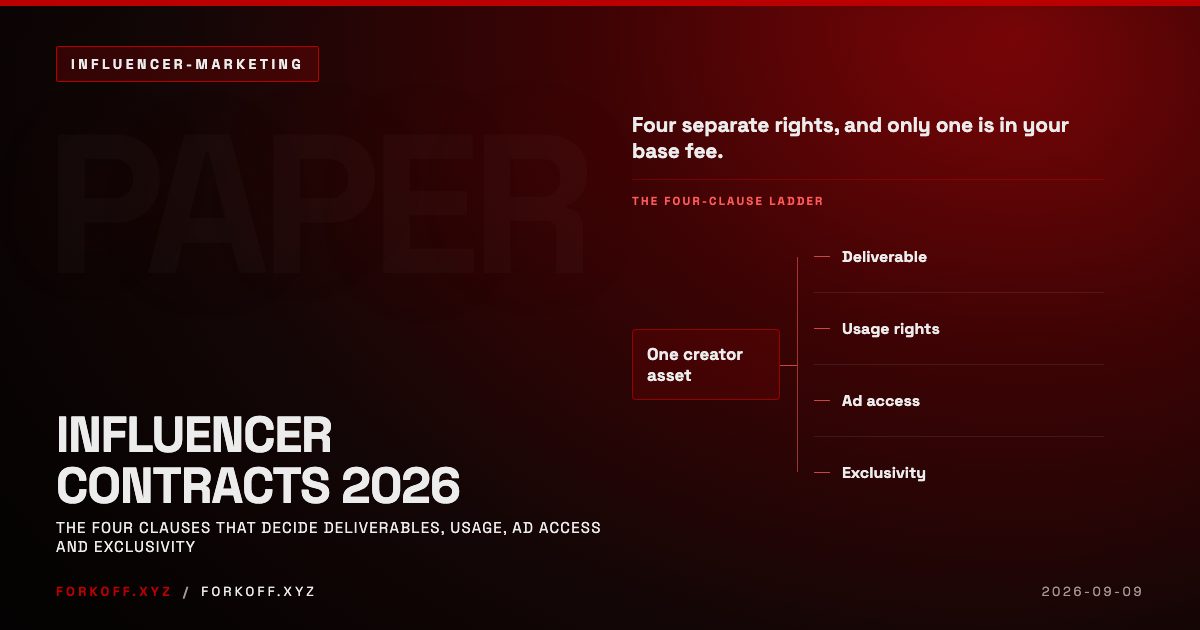
Influencer contracts in 2026: the four clauses covering deliverables, usage rights, ad access and exclusivity, plus the AI clause most templates miss.

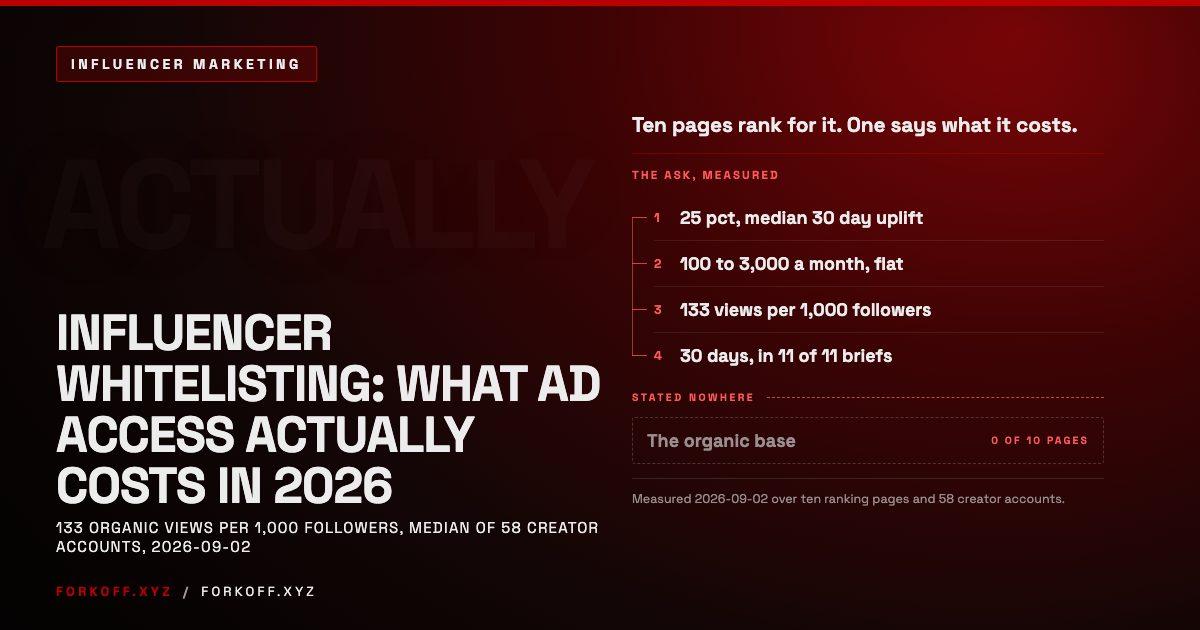
We read all ten pages ranking for influencer whitelisting. One states a price, a window and a renewal term. Here is what ad access really costs.

What to do in the 48 hours after an open-source traction spike: which creators survive a developer audit, what they cost, and how to attribute the spend.