




PHASE 01[PRE-EVENT]
01
Narrative + intros
Founder narrative locked T-30 to T-7.
Deliverables (3)
- ▸T-30 to T-7
- ▸30-account cluster
- ▸Pavilion intro engineering
FORKOFF Dreamforce activation is a 14-day operating cycle for SaaS founders, Pavilion CMO Summit attendees, and RIA + RevOps + sales-enablement teams shipping inside the Salesforce ecosystem in San Francisco. Pre-event narrative, on-site cadence, post-event compounding, audit-tracked outcomes.
Most teams pay by application for a Moscone booth. Some host a hotel-bar dinner and bounce. FORKOFF runs the Dreamforce week as a 14-day operating cycle.
Anonymized post-engagement. Names surfaced are Dreamforce 2025 ecosystem operators FORKOFF either ran intros into or co-attended Pavilion CMO Summit sessions with.
The Salesforce ecosystem compounds in ways no other software event week does. 170k attendees plus Pavilion CMO Summit adjacency plus AppExchange ISV density plus enterprise-IT buyer presence inside one 3-day window.
RIA, RevOps, sales-enablement buyers concentrated across Moscone plus the SoMa hotel grid plus Salesforce Park takeover.
Salesforce customers, AppExchange ISVs, and Pavilion CMOs all in-market during the same 72-hour window.
Side events make ecosystem operators reachable.
Press cluster and SaaS Twitter compound on residual.
The week breaks into a Moscone main-stage cluster, a side-event web across SoMa and Union Square, and a Pavilion CMO Summit adjacency circuit running parallel. Activating well means picking the right stripe of the week.
Sep 15-17, 2026
Main stage at Moscone Center (West, South, North halls). Salesforce Park takeover plus Marriott Marquis and St. Regis side events. Pavilion CMO Summit adjacency at Salesforce Tower. SoMa + Union Square hotel grid.
170,000+ attendees in 2025: 41% Salesforce-customer enterprise, 22% RIA + RevOps + sales-enablement buyers, 21% AppExchange ISVs and Salesforce-built SaaS, 16% press + analysts + KOLs.
Where the buyer-relevant rooms live. Pick 2 max for any single activation week.
Two prior cycles run on the FORKOFF audit ledger. Salesforce-built RevOps SaaS, AppExchange ISV pre-launch narrative. Both ledger entries delivered within T+30 of close.
Five days across the Moscone West main stage, the Ohana floor takeover circuit, and the Pavilion CMO Summit adjacency. Pre-event narrative, daily on-site cadence, post-event clip cascade. One operator carries every phase. Every phase closes with a verified entry.
Founder narrative locked T-30 to T-7.
Deliverables (3)
Daily founder posts from Moscone, Sun-Wed of Dreamforce week.
Deliverables (3)
On-site Salesforce-ecosystem KOLs activated through bot-screened placements.
Deliverables (3)
Clip cadence compounds T+1 to T+30.
Deliverables (3)
Strategy 12 weeks out. Production 4 weeks out. Execution event week. Compounding 30 days post. Each phase closes with a verified entry.
Sample schedule for a Standard-tier engagement. Tier-specific deliverables shown in the next section.
| Day | Date | Motion | FORKOFF owns |
|---|---|---|---|
| Sun (D-1) | Sep 14, 2026 | Land in SF · pre-event Pavilion-adjacent dinner setup | Venue + invite list + intro choreography |
| Mon | Sep 15 | Opening keynote attendance · founder posts from Moscone main stage | Daily post + on-site clip cadence |
| Tue | Sep 16 | ICP-account 1:1 meetings · Pavilion CMO Summit adjacency dinner | Meeting calendar + Pavilion-aware comms layer |
| Wed | Sep 17 | FORKOFF side event (intimate dinner / panel / moderated discussion) | Production + KOL invites + recording |
| Thu | Sep 18 | On-site podcast recording day · 3-4 founder interviews | Studio + production + same-week clip pipeline |
| Fri | Sep 19 | KOL placements live · partnership-conversation closes | KOL proof + per-post tracking |
| Sat | Sep 20 | Founder thread recap of week · Salesforce ecosystem reciprocation | Thread craft + cluster activation |
| Sun (D+7) | Sep 21 | Departure · post-event clip cascade live | Distribution sequencing + weekly verified proof |
Enterprise demo bookings from AppExchange buyer cluster. Side-event dinner converted Salesforce-customer execs.
Intro list delivered one week pre-event. Clips from on-site recordings feed the RevOps audience for 60 days.
Podcast recordings across Moscone adjacency venues. Each interview targets a Salesforce-ecosystem buyer persona.
Every recording, clip, and enterprise-intro proof stays with the founder at engagement end.
14-day pre-event narrative + 30-account Salesforce-ecosystem ICP map + qualified-intro list shipped before you land in SF. If we do not deliver the intro list inside 14 days, the by application comes back.
The qualification ledger changed how we report to the board. Real attention, verified weekly, not dashboard vanity.
Growth lead
Series A, 2026, AI infrastructure startup
We went from guessing pipeline attribution to seeing it in a weekly audit ledger. Finance signed off on the next quarter before the first one ended.
Marketing director
Mid-market, 2026, B2B SaaS platform
FORKOFF ran our conference activation across three cities in one quarter. Side events, content capture, post-event distribution. One operator, one ledger.
Head of events
Three cities, one quarter, DevTools company
Geo-routing pulled the campaign out of single-market mode. India and Southeast Asia carried the qualified attention count. The unit cost dropped by two thirds.
Campaigns lead
India + SEA launch, Q1 2026, Consumer tech brand
Two weeks of pre-event narrative + 30-account Salesforce-ecosystem cluster activation + Dreamforce-specific intro engineering. You leave with a verified record of qualified intros surfaced before you land in San Francisco. Lite tier scopes a single track. Selective on ICP, capped per quarter.
Three ways a team can show up at Dreamforce: a FORKOFF activation, a DIY booth bought through a sponsor package, or a traditional PR firm on retainer. Each is scored on the same 5 dimensions buyers ask about, from the pricing model and the pre-event narrative to the proof you get back after the week. No tier shell games, no asterisks.
← scroll horizontally to see more →
| Feature | FORKOFF activationOutcome-priced | DIY booth + sponsorLogo on banner | Traditional PR firmPress retainer |
|---|---|---|---|
| Pricing model | Outcome-priced. Per-event commit. by application tier band. | Booth fee plus travel plus founder hours. Often by application plus before any sourced lead. | Monthly retainer regardless of event outcome. monthly retainer, by application. |
| Pre-event narrative | 30-day RIA + RevOps cluster activation plus 30-account Pavilion intro engineering | Tweet announcing booth number one week before | Press release embargoed until keynote day |
| On-site cadence | Daily founder posts, Pavilion CMO Summit dinner, side event, KOL placements, podcast recordings | Founder at booth #B-1287, hopes the right buyer walks past | Press wrangling around the Marc Benioff keynote, no operating cadence on-site |
| Post-event compounding | 30-day clip cascade plus qualified-pipeline record sourced from Salesforce ecosystem | Folder of phone photos and a vague Slack debrief | Coverage clipping report, often disconnected from RIA + RevOps pipeline |
| Qualified-view proof, audited | Signed by operator, qualified-pipeline math, T+30 close | Whatever the founder remembers from Salesforce Park | Vanity coverage report, no pipeline math |
All tiers carry the verified record + qualified-pipeline reporting. Tier scales scope, not philosophy.
by application
By application
By application
Sep 2026 · San Diego · by application
Sep 2026 · Boston · Standard tier by application
Dec 2026 · Las Vegas · Standard tier by application
Dec 2026 · San Diego · Standard tier by application
Sep 2026 · Seoul · Standard tier by application
Oct 2026 · Singapore · Standard tier by application
Dreamforce is Salesforce's flagship San Francisco conference and the largest software event on the calendar. The 2025 edition drew 170,000+ attendees across the main conference at Moscone Center plus 200+ side events organized by AppExchange ISVs, Pavilion CMO Summit, and Salesforce-ecosystem operators. Dreamforce 2026 runs September 15-17 in San Francisco. The room is the highest-density gathering of RIA, RevOps, sales-enablement, AppExchange ISV, and Pavilion CMO Summit buyers in the world.
Most teams pay for a Moscone booth and hope. The FORKOFF activation is a 14-day operating cycle: pre-event narrative + 30-account RIA + RevOps + Pavilion CMO Summit intro engineering, on-site cadence + Pavilion-adjacent dinner + KOL placement, post-event clip cascade + qualified-pipeline record. Same operator, same dashboard, audit-tracked outcomes. Specifically tuned for SaaS founders shipping into the Salesforce ecosystem and Pavilion CMO Summit attendees who need a 14-day operating cycle.
Three tiers: Lite tier (single-track pre-event narrative or on-site Pavilion-adjacent dinner or side-event slot), Standard tier (recommended, full week-of presence), Full tier (sponsor-grade with side events + main-stage support + private dinner + Pavilion CMO Summit adjacency layer). All tiers carry the verified record + qualified-pipeline reporting. Tier scales scope, not the underlying philosophy. Reference point: a Moscone booth alone runs at standard sponsor rates before any sourced lead.
Yes. Standard + Full tiers include FORKOFF-produced side events (intimate dinner, moderated panel, founder talk format) at Pavilion-adjacent or AppExchange-ISV venues. We handle venue, invite list, KOL outreach, and on-site recording. Side events are the highest-leverage on-site moment. 30 right people in one Pavilion-adjacent room beats 30,000 random attendees at Salesforce Park. Recommended venues span the SoMa hotel grid plus Salesforce Tower plus the Marriott Marquis side-event circuit.
Our Full tier includes a Pavilion CMO Summit adjacency layer. We coordinate with the founder's positioning before any pre-event narrative goes live, route 30-account intros across Pavilion CMO members attending Dreamforce, and structure side events so Pavilion CMOs can participate in fractional-CMO buyer conversations. This is critical for SaaS founders who treat Dreamforce as the budget-anchor week for fractional CMO partnership decisions.
Yes. FORKOFF has working relationships with RIA, RevOps, and sales-enablement KOLs across the Salesforce ecosystem. Standard tier includes 1 ecosystem KOL placement; Full tier extends to 3-5 placements across RIA, RevOps, sales-enablement, and SaaS Twitter voices. Dreamforce is the one event week where Salesforce-customer enterprise buyers are reachable in the same room as AppExchange ISVs, and our intro engineering is built around that crossover.
Every podcast recorded on-site feeds the clipping pipeline at clips.forkoff.xyz. One 60-minute recording produces 8-12 cross-platform clips (X / TikTok / Reels / Shorts), distributed over the 30 days following Dreamforce. Each clip is tracked in the qualified-view record and reported in the T+30 audit close. The post-event cadence is what compounds the week's investment. For Dreamforce specifically, the SaaS Twitter cluster (Pavilion CMO members + AppExchange founders + Salesforce-ecosystem analysts) keeps the residual attention curve elevated.
Single-track entry tier by application: 14 days of pre-Dreamforce narrative cadence + 30-account Salesforce-ecosystem cluster activation + Pavilion-adjacent intro engineering, OR a single Pavilion-adjacent dinner, OR a side-event slot. You leave with a verified record of qualified intros surfaced before you land in SF. Lets you test fit before committing to Standard or Full tier.
Yes. Dreamforce is one of 8 plus events on the FORKOFF event roster. HubSpot Inbound, AWS re:Invent, NeurIPS, Korea Blockchain Week, Token2049 Singapore, ETHCC, Devcon, Consensus. Each event has its own activation page with cadence + tier pricing tuned to the event format and ICP. SaaS and AI startup ICPs map cleanly across events; see /for/saas-companies and /for/ai-startups for ICP-side detail.
Beyond Dreamforce week. SaaS-side ICP playbook for RIA + RevOps + sales-enablement buyers.
Pre-event narrative + intro engineering across 30 ICP accounts attending Dreamforce.
On-site podcast recording day during Dreamforce week. Studio + crew booked at partner venue.
Bot-screened Salesforce-ecosystem + Pavilion KOL placements during Dreamforce week.
Beyond Dreamforce week. SF Salesforce ecosystem GTM playbook + on-ground partner network.
Every event activation on the FORKOFF roster. Same operator, same verified proof.
As Featured In
Full press shelf





FORKOFF has run activations across 42 events since 2023, per our own operating record, including Korea Blockchain Week, ETHDenver, and Token2049. Each was a curated gathering or side event sized between 100 and 250 people, built around a pre-event narrative, an on-site cadence, and a post-event compounding motion. Dreamforce takes over downtown San Francisco every autumn and turns the whole city into a Salesforce ecosystem, which is exactly why an off-program room works so well there. The plan on this page comes from the reps we have actually logged running those rooms, not from a rented booth on the show floor.
Dreamforce draws SaaS operators, RevOps leaders, and the partner ecosystem, people who sit through vendor pitches all year and tune them out on reflex. Across our 42-event history the teams that won this room ran a working session, a customer roundtable, a focused operator dinner, and let the product conversation happen inside real peer context. A 100 to 250 person format aimed at the accounts you actually want beats a hall badge scan, because this audience trades intros based on who showed up with something useful to say.
Because we have run the pre-event to post-event loop dozens of times, a Dreamforce engagement does not begin from scratch. We know when to open the narrative so it peaks the week Salesforce owns the city, which side-event format a RevOps audience shows up for, and how to keep the pipeline warm after the tents come down. The full method is on the event management service page, every activation window lives on the events hub, and a SaaS founder weighing a bigger-tent play should read the SaaStr Annual breakdown alongside this one.
Reviewed by the FORKOFF events team, the operators who run these activations on the ground.
Lite activation single-track, by application. Standard tier end-to-end, by application. Full tier sponsor-grade, by application with Pavilion CMO Summit adjacency layer. verified proof on qualified pipeline across every tier.
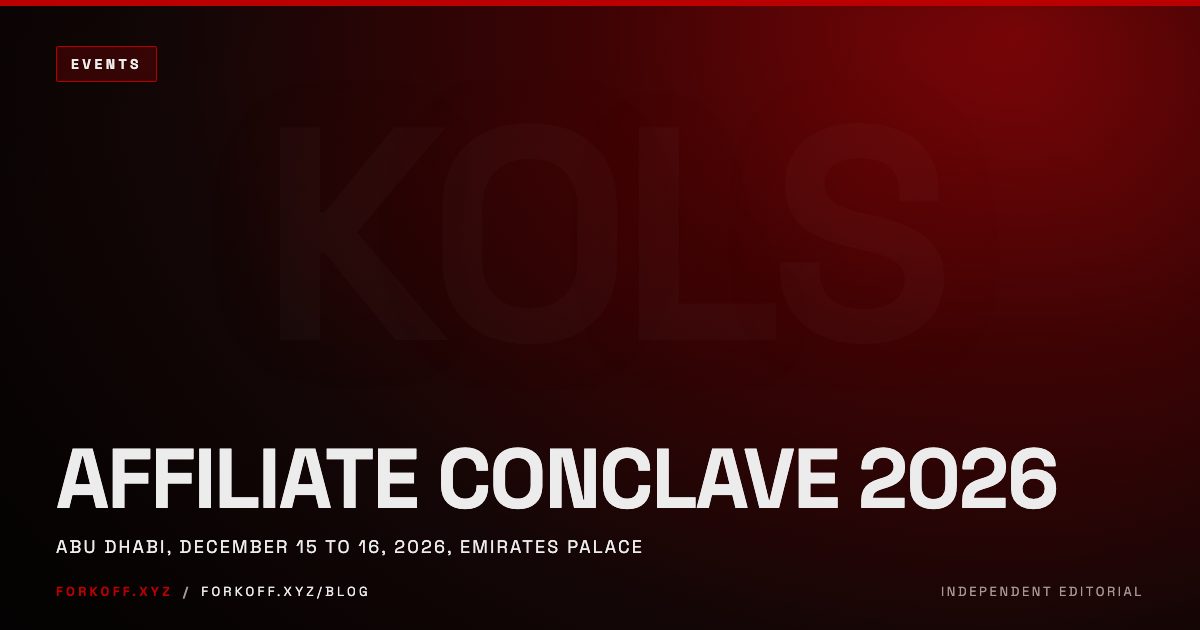
Affiliate Conclave 2026 runs December 15 to 16 at Emirates Palace, Abu Dhabi, co-located with Global Trading Show. Dates, tickets, tracks, a neutral read.
 Read
Read
The Algorithm Alliance is an AI and ML builder community run by VAP Group. Its editions, format, who it is for, and the next Singapore meetup, 6 October 2026.
Read
Crypto Mining Guild 2026 is a December 10 Global Blockchain Show side event at Space42 Arena, Abu Dhabi. Date, venue, format, and the mining-to-AI pivot.
Read