Service · Event Marketing Services · By application
Event marketing services that shipnarrative.
FORKOFF delivers event marketing services for founders across tech, SaaS, deep tech, Web3 and AI. We run side-event activation, sponsorships, and conference marketing at flagship conferences like Token2049, ETHCC, Devcon, and KBW, where our proof runs deepest today. 30-day pre-event narrative arc, on-site booth plus side event plus founder dinner, post-event clip waterfall, and qualified pipeline tracked by name in the verified weekly report, paired with the founder funnel.
Pricing by application. per single-event · 30-day lead timeBy application · 5 activations per quarterSelective on ICP · tech, SaaS, deep tech, Web3 and AI
250+Qualified intros per conference week, vs 30 to 80 from a booth alone
30 daysMinimum pre-event lead time
8-12Cross-platform clips per long-form session
14 daysPost-event clip turnaround
Proof · conference week activations
250+ qualified intros per conference week, and the meetings that follow.
A booth on its own buys foot traffic. Adding side events, founder dinners and the clip waterfall buys introductions you can name. Here is the result set, and where a booth-only buy or a production house still wins.
FORKOFF conference week activations by client shape, 2026
Activation
Side events
Qualified intros
Content views
Meetings booked
Global tech conference week
6
250+
1.7M
54
Web3 infrastructure protocol
5
250+
1.6M
50
Ethereum conference week
5
250+
1.5M
48
Web3 wallet infrastructure
5
250+
1.4M
45
SaaS conference week
4
250+
1.3M
42
Crypto fintech
3
250+
1M
31
One conference week per activation. Meetings booked are counted by name in the weekly report, never by badge scans.
Full activation vs a booth-only sponsorship vs a production house
← scroll horizontally to see more →
Feature
FORKOFF activationBooth, side events, dinners, clips
Booth-only sponsorshipFloor presence alone
Event production houseVenue, AV, staffing
Qualified introductions
Wins: 250+ per week on the activations above
30 to 80 per booth
Depends on your guest list
Main-stage and venue visibility
Booth and side events, stage slots only via the organiser
Time the launch to the conference week so the room is already warm.
If your next conference budget only buys a booth, adding side events and the clip waterfall can buy 3x to 8x the introductions and a content tail that lasts a month. Book a call and we map the activation for your next conference week.
DA 50 · 2025-11RedStone, FailSafe, Nibiru and ForkOff Announce The Capital Layer at Devconnect Buenos Aires 2025
An event is a dealflow system, not a visibility exercise.
We run presence at an event to produce qualified conversations and pipeline movement, not attendance volume or a booth photo.
What are event marketing services
Updated 2026-07-25
What are event marketing services, and how does founder-led event marketing work?
Event marketing services run the conference week for a founder as a single funnel rather than a stack of logistics line items. The work spans pre-event narrative, side-event and founder-dinner production, sponsorship and on-stage panel slots, and a post-event clip waterfall, all reported on qualified pipeline. FORKOFF delivers event marketing for founders across AI, crypto, and other high-stakes verticals, with the deepest proof at flagship conferences like Token2049, ETHCC, Devcon, and KBW. It is founder-led event marketing, not corporate galas or trade-show booths, priced on booked meetings and partnerships, not badges scanned.
What does event activation cost? Pricing is by application, per single-event activation, with a three-tier reveal (Lite, Standard, Full). Cost depends on the surface mix, side event versus founder dinner versus sponsorship and panel, and the post-event clip volume, so the engagement maps to the pipeline target and a 30-day minimum lead time rather than a flat logistics invoice. The formats themselves are written up individually, from the multi-day hacker house through the smaller founder dinners and livestreams, if you want to see what each one costs to run and what it is actually good for.
Five patterns we see when a founder shops for event management and the activation comes back as a logistics invoice with no pipeline. Each row is the FORKOFF fix. Read it before you book the discovery call.
fk_audit · events_reject_log.csv
#Reject reasonAudit detailFORKOFF fix
Row 0101
Reject reasonBooth staffing as the whole deliverable
Audit detail
Generic event agency invoices booth design, AV, step-and-repeat, branded swag, and 4 staffers in matching shirts. Founder spends three days handing out QR codes to walk-up traffic. Zero qualified pipeline shows up in the post-event ledger because the booth is the wrong instrument for buyer-intent capture.
FORKOFF fix
Fix
Booth is one layer of four, never the whole engagement. FORKOFF wraps it with a 30-day pre-event narrative arc that puts the founder on ICP buyer radar before the floor opens, plus a side-event and founder dinner that produce the qualified meetings the booth alone cannot.
Row 0202
Reject reasonNo pre-event narrative arc
Audit detail
Generic agency sends a calendar invite 7 days out plus a venue listing in a city guide. Founder shows up to a floor of strangers. ICP buyers walked the same floor having never heard the founder name on X, LinkedIn, or any podcast in the prior 90 days. Discovery is done from cold, on-site, on a 30-second elevator pitch.
FORKOFF fix
Fix
30-day pre-event founder content arc on podcast plus LinkedIn plus X. The pre-event content is not a teaser. It is the hook that makes ICP buyers seek the founder out at a side event or dinner before they ever walk the booth surface.
Row 0303
Reject reasonRecordings rot in a Drive folder
Audit detail
Generic agency captures a panel and 2 founder interviews on event-week. The footage lands in a shared Drive folder, gets cut into one 90-second recap reel 6 weeks later, and produces zero compounding distribution. The event ends on the closing-night party. There is no second wave.
FORKOFF fix
Fix
Every recorded panel, on-floor podcast episode, founder demo, and dinner Q and A becomes 8-12 cross-platform clips inside 14 days. One 60-minute recording becomes 90 days of compounding recall. The event is not the destination. It is the long-form moment that fuels the clip cadence.
Row 0404
Reject reasonVanity reporting on badges scanned
Audit detail
Post-event report shows booth foot-traffic count, badges scanned, photos taken, swag distributed. Numbers go up while booked discovery calls, partnership conversations, and ABM-warmed accounts stay flat. Reporting protects the agency invoice, not the founder pipeline.
FORKOFF fix
Fix
Weekly post-event ledger lists qualified meetings by name, booked discovery calls with attribution, partnership conversations triggered, and ABM-warmed cold-email reply rate lift on accounts that walked the side event or dinner. Vanity metrics print at the bottom, never as the success measure.
Row 0505
Reject reasonNo founder dinner or closed-door layer
Audit detail
Generic activation stops at the public booth and a happy hour. The highest-density qualified pipeline lives in the closed-door surface (15 to 30 person founder dinner, KOL night, panel after-party) where deals actually start. Without that surface, the engagement converts at floor-traffic rates and the spend looks like a cost center.
FORKOFF fix
Fix
Standard and Full activations include at least one founder dinner (15 to 30 people) plus optional KOL night. The closed-door surface is where partnership conversations and large-account deals start. The booth and side event feed the dinner; the dinner feeds the pipeline.
Booths produce foot traffic. FORKOFF runs events as the funnel.
Generic event management invoices booth design, AV, step-and-repeat, branded swag, and four staffers in matching shirts. FORKOFF wraps the booth with a 30-day pre-event narrative arc, a side event for volume, a founder dinner for partnership-grade pipeline, and a post-event clip cadence that compounds recall for 90 days across the conference cycle. Pairs cleanly with Podcast Marketing (the on-floor recording engine) and KOL Marketing (KOL nights at Web3 conferences).
Three numbers that decideif an event activation compounds.
14 / 7d
Qualified meetings booked inside 7 days post-event
Mid-stage L2 protocol at KBW 2025. Side event plus founder dinner. 4 partnership conversations active at day 60.
Pre-Series-A AI infra startup at AI Engineer 2025. 8 founder podcast episodes recorded on the floor. 90 days of compounding recall.
Cross-platform clips shipped inside 14 days post-event
96 / 14d
DePIN network sponsor-tier Token2049 activation. Booth plus side event plus 2 founder dinners plus on-stage panel.
Ecosystem partnerships closed inside 60 days post-event
3 / 60d
Application-only · selective on ICPAI, Web3, and frontier verticals · Seed to Series BWeekly post-event proof for 60 daysRecordings plus clip library owned by the founder
What plugs into the activation
Event Marketing doesn't run alone.
PHASE 01[WEEK -12 → -1]
01
Pre-Event
Narrative arc live. ICP buyers know the founder before the floor opens.
Deliverables (5)
▸Event brief plus ICP map (12 weeks out)
▸Side-event or dinner venue locked
▸30-day founder podcast plus LinkedIn plus X arc
▸Pre-event KOL outreach plus panel applications
▸Pre-event press plus podcast guest pitches
PHASE 02[EVENT WEEK]
02
On-Site
Booth plus side event plus dinner plus panel run as one funnel.
Deliverables (5)
▸Booth production plus AV plus IP
▸Side event (60 to 200 people)
▸Founder dinner (15 to 30 people)
▸On-floor podcast recordings with industry guests
▸Broadcast-grade capture for clip waterfall
PHASE 03[DAY 0 → 14]
03
Post-Event
8-12 clips per long-form session. 90 days of compounding recall.
Deliverables (5)
▸Episode 1 of founder podcast shipped same week
▸8-12 cross-platform clips per session
▸X plus TikTok plus Reels plus Shorts cadence
▸Long-form panel recap on YouTube plus LinkedIn
▸Press placements wraparound (when in scope)
PHASE 04[DAY 0 → 60]
04
Pipeline-Proof
Weekly proof on qualified meetings, partnerships, ABM lift.
Deliverables (5)
▸Weekly post-event proof (Slack delivery)
▸Qualified meetings logged by name plus surface
▸Booked discovery calls with attribution
▸Partnership conversations triggered on-site
▸ABM cold-email reply-rate lift on warmed accounts
What counts on the event proof
What countsas a shipped activation.
An event activation only counts when four signals hold across the cycle. 30-day pre-event narrative arc shipped, all four on-site layers (booth plus side event plus founder dinner plus capture) run, 8-12 cross-platform clips per long-form session inside 14 days, and qualified meetings traceable to a specific surface in the weekly post-event proof. A booth-only invoice with no narrative arc, no dinner, and no clip cadence is not an activation. It is a logistics proof.
Active check · PRE-EVENT
1 / 4Layers a single-event activation must run. Pre-event arc, on-site funnel, post-event waterfall, pipeline proof.
01 PRE-EVENT
30-day founder narrative arc shipped before event week.
01
PRE-EVENT
Daily founder posts on LinkedIn plus X for 30 days into event week. At least one podcast episode released that targets the conference theme or names a partner ICP attending. Skipped pre-event arc means buyers walk the floor never having heard the founder name. The pre-event surface is what makes the on-site surface convert.
fk_audit · qv_check_01
rule · 30-day founder narrative arc shipped before event week.
02
ON-SITE
Booth opens day one, side event runs day two evening (60 to 200 people), founder dinner closes the cycle (15 to 30 people, partnership-grade). Every panel and demo and Q and A captured in broadcast-grade audio plus video. A booth-only activation is a logistics invoice, not a funnel.
fk_audit · qv_check_02
rule · Booth plus side event plus founder dinner plus capture, all four layers.
03
POST-EVENT
Every captured panel, podcast, demo, and dinner Q and A becomes 8-12 cross-platform clips on X plus TikTok plus Reels plus Shorts within 14 days of the closing-night party. Long-form panel recap and founder podcast episode ship the same window. Footage that rots in Drive does not count.
Booked discovery call, partnership conversation, or ABM-warmed cold-email reply attributable to a specific event surface (booth, side event, founder dinner, panel). Tracked in the weekly post-event proof by name, originating surface, and outcome. Badge-scan totals print at the bottom, never as the success measure.
fk_audit · qv_check_04
rule · Qualified meetings, partnerships, and ABM lift attributed by name.
Counts in the weekly report
›30-day pre-event founder content arc shipped before event week
›Booth plus side event plus founder dinner plus capture, all four layers
›8-12 cross-platform clips per long-form session inside 14 days
›Qualified meetings logged with surface attribution and outcome
›ABM cold-email reply-rate lift on accounts warmed by event surface
Doesn't count
·Booth-only activation with no side event, dinner, or capture layer
·Recordings that rot in Drive past the 14-day window
·Vanity report on badges scanned with no pipeline attribution
·Pre-event arc skipped because the founder was busy
·Step-and-repeat sponsor logo as the entire deliverable
Outcomes from the activation
Qualified meetings, partnerships, and 90 days of compounding recall.
Three activations across an L2 protocol, a Pre-Series-A AI infra startup, and a DePIN network. Single-event activations that locked the pre-event arc, ran all four on-site layers, shipped the clip waterfall, and reported the weekly report the founder could read in two minutes. Read the longer write-ups inside our case-study hub or the live KBW 2026 activation page.
8-12 clips
Cross-platform clips per long-form session captured at the event. AI Engineer 2025 ran 8 founder podcast episodes inside 14 days for a Pre-Series-A AI infra startup. 96 clips total.
3 / 60d
Ecosystem partnerships closed inside 60 days of event week. DePIN network sponsor-tier Token2049 activation. Booth plus side event plus 2 founder dinners plus on-stage panel produced 3 partnership closes.
14 / 7d
Qualified meetings booked inside 7 days post-event from a side event plus founder dinner. Mid-stage L2 protocol at KBW 2025. 4 partnership conversations active 60 days later.
OWNED
Recordings, edited masters, clip library, and event-week IP all stay with the founder at engagement end.
What this looks like when it runs
Each engagement below names the company, the window the work ran in, and the numbers it returned. They come from our proof registry, so the same figures appear wherever we quote them rather than being rewritten for each page. Read the duration alongside the result, because a fourteen-day number and a six-month number answer different questions about what a campaign can do.
Devconnect
Conference week, 2026
side events
5
side events
qualified introductions
250+
qualified introductions
content views
1.5M
content views
meetings booked
48
meetings booked
5 side events run across the conference week, one operator, one ledger
250+ qualified introductions made on the ground
1.5M views on content captured during the week and cut afterwards
SaaStr Annual
Conference week, 2026
side events
4
side events
qualified introductions
250+
qualified introductions
content views
1.3M
content views
meetings booked
42
meetings booked
4 side events run across the conference week, one operator, one ledger
250+ qualified introductions made on the ground
1.3M views on content captured during the week and cut afterwards
Web Summit
Conference week, 2026
side events
6
side events
qualified introductions
250+
qualified introductions
content views
1.7M
content views
meetings booked
54
meetings booked
6 side events run across the conference week, one operator, one ledger
250+ qualified introductions made on the ground
1.7M views on content captured during the week and cut afterwards
The qualification ledger changed how we report to the board. Real attention, verified weekly, not dashboard vanity.
G
Growth lead
Series A, 2026, AI infrastructure startup
Brand
We went from guessing pipeline attribution to seeing it in a weekly audit ledger. Finance signed off on the next quarter before the first one ended.
M
Marketing director
Mid-market, 2026, B2B SaaS platform
Brand
FORKOFF ran our conference activation across three cities in one quarter. Side events, content capture, post-event distribution. One operator, one ledger.
H
Head of events
Three cities, one quarter, DevTools company
Partner
Geo-routing pulled the campaign out of single-market mode. India and Southeast Asia carried the qualified attention count. The unit cost dropped by two thirds.
C
Campaigns lead
India + SEA launch, Q1 2026, Consumer tech brand
Brand
AuditedSustained legitimacy rate
3.4xRetained attention vs prior agency
250+Qualified introductions
4.2MQualified views in 14 days
Featured engagements
Comparison
FORKOFF Events vs generic event agency vs in-house events team.
Three routes to event activation. Match the activation to your stage, your willingness to run all four layers, and your appetite for outcome-priced reporting on qualified pipeline before picking.
Booth foot-traffic count plus badges scanned plus photos taken.
Internal headcount plus spend tracking.
Failure mode
Zero qualified meetings post-event triggers a verified record flag plus scope rebuild.
Event happened plus invoice paid, regardless of pipeline.
Activation runs every quarter even when ROI is unclear.
Lead time
30 days minimum for the pre-event arc to ship.
14 days is normal. 7-day rush often accepted.
30 to 90 days for an in-house team to spin up.
Event activation fit diagnostic
Strong fit when 4+ are true. Skip when any disqualifier fires.
Who you are
›Founders across AI, Web3, and other frontier verticals attending flagships like Token2049, ETHCC, Devcon, Consensus, AI Engineer Summit, KBW, ETH Denver, ETH NYC, ETH India
›Founders willing to do podcast recordings, founder dinners, and on-stage panels at the event, not just booth duty
›Buyer journey involves a meeting (discovery call, partnership conversation, ABM-warmed account) not pure self-serve checkout
›Pre-event 30-day narrative arc is achievable (founder available for podcast plus LinkedIn plus X cadence in the run-up)
›Funded teams (Seed and up) ready for selective single-event spend with verified-proof reporting on qualified pipeline
›Annual event-funnel programs (4-6 flagship events with pipeline targets) for Series A plus brands tying activations to product launches
What FORKOFF delivers
›30-day pre-event founder content arc on podcast plus LinkedIn plus X
›Side-event venue plus production plus on-the-floor team plus booth IP and AV
›Founder dinner (15 to 30 people) plus optional KOL night for closed-door pipeline
›Broadcast-grade capture of every panel, podcast, demo, and Q and A on event week
›8-12 cross-platform clips per long-form session inside 14 days post-event
›Weekly post-event proof on qualified meetings, partnerships, and ABM-warmed cold-email lift
Not the right fit
×Booth-staffing-only requests with no narrative, no founder dinner, and no clip cadence
×Engagements with under 14 days lead time. Pre-event narrative arc requires 30 days minimum
×Pure consumer mobile or D2C e-commerce ICPs where buyers do not attend B2B conferences
×Sponsor-logo-on-step-and-repeat as the entire deliverable with no pipeline accountability
×Founders unwilling to record podcast episodes on the floor or host a closed-door dinner
Apply for the activation
Lite · Standard · Full · By application
FORKOFF runs Events as a per-activation engagement, not a recurring retainer. Three tiers reveal on the application call. Lite covers podcast on-site OR KOL-night only. Standard adds pre-event arc plus side event plus founder dinner plus capture plus post-event clip cadence. Full adds on-stage panel plus press wraparound plus 60-day pipeline proof. By application, capped at 5 single-event activations per quarter, selective on ICP, outcome-anchored against the verified weekly report.
FORKOFF is an event management agency that runs the conference week for founders across AI, crypto, and other high-stakes verticals as a four-layer funnel. (1) 30-day pre-event founder content arc on podcast plus LinkedIn plus X. (2) On-site activation across booth plus side event plus founder dinner plus on-stage panel and sponsorship slots. (3) Post-event clip waterfall: every captured long-form session becomes 8-12 cross-platform clips inside 14 days. (4) Weekly post-event proof reporting qualified meetings, booked discovery calls, partnership conversations, and ABM-warmed cold-email lift, attributed by name and originating surface. Our deepest proof runs at crypto and AI flagships like Token2049, ETHCC, Devcon, and KBW. This is founder-led activation, not corporate galas or trade-show booths.
How is FORKOFF different from a generic event marketing agency?
Three differences. First, scope: booth is one of four layers, never the whole engagement. Pre-event narrative plus on-site plus post-event clip cadence plus pipeline proof run as one funnel. Second, capture: every panel, founder podcast on-floor, demo, and dinner Q and A captured for an 8-12-clip waterfall inside 14 days, not a 90-second recap reel six weeks later. Third, reporting: weekly proof on qualified meetings and partnership conversations attributed by name, not booth foot-traffic plus badges scanned. The fix is what makes the activation produce pipeline.
Which events does FORKOFF activate at?
Tier-1 industry flagships where ICP density is highest. Web3: Token2049 (Singapore plus Dubai), ETHCC, Devcon, Consensus, KBW, ETH Denver, ETH NYC, ETH India. AI: AI Engineer Summit, NeurIPS-adjacent founder dinners, AI conference activations in Dubai plus New York plus Singapore. Sub-engagements available for pre-launch ecosystem moments. See the per-event activation page for KBW 2026 (live) plus pending pages for ETHCC, ETH NYC, Devcon, Consensus, Token2049 SG.
How much does FORKOFF event management cost?
Pricing by application. per single-event activation, with a three-tier reveal. Lite: podcast on-site OR KOL night only. Standard: pre-event arc plus side event plus founder dinner plus capture plus post-event clip cadence. Full: full four-layer funnel plus on-stage panel plus press wraparound plus 60-day post-event proof. Annual event-funnel programs (4-6 flagship events with pipeline targets) are custom-scoped on outcomes. By application, capped at 5 single-event activations per quarter.
How long does it take to plan an event activation with FORKOFF?
Minimum 30-day lead time for the pre-event narrative arc to ship. Side events plus founder dinners need 21-day venue booking. Sponsor-tier full activations need 60 to 90 days for production plus panel applications plus press pitches. Anything under 14 days lead time is a logistics-only engagement, which is not the FORKOFF model. The pre-event surface is what makes the on-site surface convert.
Do you do booth production and on-site staffing?
Yes, when it is part of the four-layer funnel. We do not sell booth-only engagements (no narrative, no dinner, no clip cadence) because the booth alone produces foot-traffic counts, not pipeline. Booth production plus AV plus IP is included in Standard plus Full activation packages. Lite tier swaps the booth for a podcast-on-site or KOL-night-only scope, depending on which surface produces more pipeline for the founder ICP.
How do you measure event marketing success?
Qualified pipeline, attributed by name and originating surface. Booked discovery calls, partnership conversations triggered, ABM-warmed cold-email reply-rate lift on accounts that walked the side event or dinner. Reported weekly post-event in a Slack-delivered proof for 60 days. Vanity metrics (booth foot-traffic, badges scanned, photos taken) tracked but never as the success measure. End-of-cycle scale call locks against the verified proof, never against badges.
What does FORKOFF do as an event sponsorship agency?
Sponsorship is the mechanism, not the whole engagement. FORKOFF builds the sponsor and partner stack for an activation: identifying co-funding and co-branding partners, structuring the sponsorship model so it is win-win rather than a rented booth slot, and running the guest architecture (panels, roundtables, partner showcases) sponsors actually want their name on. For FORKOFF-owned IP events, sponsorship and partner participation is the revenue model itself, not an add-on. Every sponsor relationship is tracked through the same 72-hour post-event intelligence loop as the rest of the activation: sponsor recap, warm lead mapping, and a renewal route, so sponsorship converts into next-cycle pipeline instead of a one-off logo placement.
How does FORKOFF events pair with podcast, founder funnel, and KOL marketing?
Events compound when paired with the FORKOFF stack. Founder podcast (see /services/podcast) supplies the long-form moment and on-floor recording cadence the event activates around. Founder funnel (see /services/founder-funnel) plus LinkedIn cadence (see /services/linkedin-marketing) plus Twitter cadence (see /services/twitter-marketing) ship the 30-day pre-event narrative arc. KOL marketing (see /services/kol-marketing) supplies KOL night activation at Web3 events. The event is the long-form moment that fuels 90 days of compounding recall through the channel surfaces afterward.
The FORKOFF event record
What our operating record says about event pipeline
FORKOFF has run activations across 42 events since 2023, per our own operating record, including Korea Blockchain Week, ETHDenver, and Token2049. That record now spans 150+ brands served, and it covers booth production, on-stage panels, founder dinners, and the post-event clip cadence that keeps a conference alive long after the closing party. Across those cycles one pattern held steady: the badge count never predicted the pipeline, the room a founder controlled did. Our curated side events run between 100 and 250 attendees each, small enough for a founder to hold a real conversation, large enough to seed the partnership that closes the following quarter.
What the flagship rooms reward
The rooms at Token2049, ETHCC, Devcon, and Korea Blockchain Week reward founders who arrive known rather than founders who arrive loud. A booth on the main floor collects walk-up traffic. A side event, a founder dinner, and an on-stage panel collect the buyers who already recognize the founder name from the pre-event content arc. Our history across those 42 events repeats the same lesson every cycle: the activation that books meetings is the one that runs the conference week as a single funnel, not a stack of logistics line items. The proof lives in the weekly report, named account by named account, not in a photo wall.
Where this sits in the FORKOFF stack
Event work rarely runs alone. The event management service page sets the operating model every city desk inherits, the events hub tracks the flagship calendar we activate against, and the Korea Blockchain Week 2026 page shows the working pattern end to end. Read those first, then bring a specific conference and a specific ICP, and the engagement maps to your pipeline target rather than a flat logistics invoice.
Reviewed by the FORKOFF events team, the operators who run these activations on the ground.
Questions buyers ask
How much does event marketing cost?
Event marketing costs land in two buckets, and most budgets only plan for one. Agency help bills roughly $100 to $149 an hour on Clutch, and the event itself runs far more: a trade show booth averages $20 to $40 per square foot for floor space alone, a custom build adds $100 to $250 per square foot, and an all-in exhibit commonly lands at $10,000 to $30,000 per show, with total spend usually three to five times the floor-space cost. Sponsorship tiers at crypto and AI flagships climb into six figures. That is the visible bill. The line almost nobody prices is activation and follow-through: the pre-event narrative, the side event and founder dinner, and the post-event attribution that turns a badge scan into a booked meeting. CEIR puts the average trade show cost per lead near $112, yet 94 percent of marketers never convert those leads into opportunities. FORKOFF prices events on outcomes rather than logistics hours, because a booth nobody remembers still returns zero.
Price agency time separately Event marketing agencies bill roughly $100 to $149 an hour on Clutch for strategy, production, and on-site management. That fee almost never includes space, build, food, or travel, so read any agency quote as labor only.
02
Budget space plus build Booth floor space averages $20 to $40 per square foot and eats about a third of the budget. A custom build adds $100 to $250 per square foot. All-in, a single show commonly runs $10,000 to $30,000, and CEIR's rule of thumb is total spend of three to five times the floor-space cost.
03
Read sponsorship as a six-figure line Named sponsor tiers at crypto and AI flagships like Token2049, Consensus, and Devcon regularly run into six figures, and the packages are bespoke and unpublished. A gated side event and founder dinner is often the cheaper way to reach the same room.
04
Price the layer nobody quotes The pre-event narrative, the side event, the founder dinner, and the on-site capture are the half that actually produces pipeline. A booth with no activation arc is a logo on a wall, not a funnel.
05
Fund the follow-up CEIR pegs the average trade show cost per lead near $112, but 94 percent of marketers never convert event leads into opportunities. Follow-up within 24 hours earns roughly a 48 percent email open rate versus 21 percent a week later, so budget the follow-through, not just the booth.
06
Price the denominator Compare cost per qualified meeting, not cost per badge scanned. A cheaper activation that books real buyers beats an expensive booth that fills a spreadsheet with names nobody calls.
The bill you see versus the bill that matters
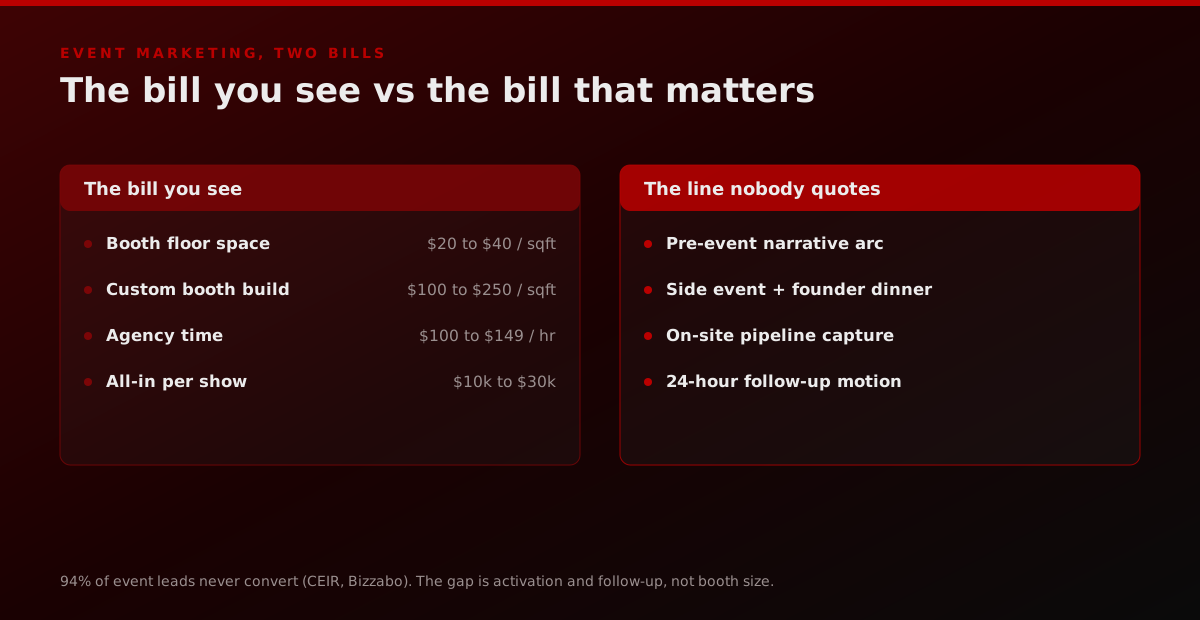
Most event budgets model the visible costs, the space, the build, the agency hours, and stop there. Clutch puts event marketing agency work at $100 to $149 an hour, booth floor space runs $20 to $40 per square foot, and CEIR and EXHIBITOR Magazine data land an all-in exhibit at $10,000 to $30,000 per show with total investment three to five times the floor-space cost. Those numbers are real and easy to quote. The bill that actually decides the return is the one almost no vendor itemizes: the pre-event narrative that gets the right people to your side event, the founder dinner where a deal-table forms, and the post-event follow-up that converts a conversation into a booked call.
The bill you see (floor space $20 to $40 per square foot, custom build $100 to $250, agency time $100 to $149 an hour, $10,000 to $30,000 all-in per show) versus the line nobody quotes, pre-event narrative, side event, on-site capture, and 24-hour follow-up.
Why the cheapest booth is often the most expensive per meeting
Cost per square foot is the wrong denominator. A $25,000 booth that produces a stack of unqualified badge scans has an effectively infinite cost per genuine meeting, because CEIR data shows 94 percent of event leads never convert into opportunities. A smaller spend routed into a gated side event, a warmed guest list, and a 24-hour follow-up motion can outperform it on pipeline while costing less. Model event marketing against qualified meetings booked, not against booth size or badge count.
Where does the event marketing budget usually go?
For a typical trade show, about a third goes to the space itself and the rest to everything around it: the booth build, shipping, travel, promotion, staff time and follow-up.
Exhibitor industry guides have used the one-third rule for years: if the floor space costs $10,000, plan for roughly $30,000 all in. That is why the realistic band for a single mid-size show sits around $10,000-30,000+ per show once you count the line items people forget. Sponsorship tiers at large conferences run higher, and a side event you host yourself can come in lower, because you control the venue and the guest list.
The split matters more than the total. A budget that spends almost everything on presence and almost nothing on pre-event promotion and post-event follow-up is paying to be seen by people it will never speak to again.
What event marketing costs in 2026 (cited bands)
Line item
Typical 2026 cost
What it covers
Source signal
Agency time
$100 to $149 per hour
Strategy, production, and on-site management, labor only
Clutch Event Marketing Pricing Guide 2026
Booth floor space
$20 to $40 per square foot
Raw exhibit-hall space, about a third of the budget
GES budgeting guide, CEIR Index
Custom booth build
$100 to $250 per square foot
Design, fabrication, and install of the stand
2026 exhibit-vendor pricing guides
All-in per show
$10,000 to $30,000
Space, build, services, shipping, and travel combined
CEIR Index and EXHIBITOR Magazine 2024
Crypto or AI flagship sponsorship
Six figures
Named sponsor tiers at Token2049, Consensus, Devcon
Crypto Daily, Ninjapromo 2026
CEIR's rule of thumb is total investment of three to five times the floor-space cost. These are directional public bands, not FORKOFF numbers; verify with each vendor before you budget.
How do you decide how much to spend on event marketing?
Work backwards from the outcome: decide how many qualified conversations or meetings the event must produce, then what each one is worth to you, and cap the budget at what those meetings can pay back.
Start with your main goal for the event, whether that is pipeline, partnerships, hiring or brand. Estimate the cost of each line item for the format you are considering. Compare it with the value of the outcome you expect, using your own close rate and deal size rather than an industry average. If the numbers only work on a best case, choose a smaller format or a different event.
Leave a contingency of around ten percent. Shipping delays, last-minute printing and extra staff travel arrive at almost every show, and a budget with no slack ends up cutting the follow-up, which is the part that turns spend into revenue.
How much do virtual events cost compared with in-person events?
Virtual events usually cost a fraction of an in-person show, because there is no venue, travel or booth build, but they also convert attention into meetings less reliably.
The main costs of a virtual event are the platform, production, speakers and promotion. A simple webinar can run on tools a company already pays for, while a produced multi-session virtual summit with a dedicated platform, studio production and paid promotion can approach the cost of a small physical event.
The trade-off is depth. Virtual formats reach more people for less, but a hallway conversation still does more for a complex B2B sale than a chat box. Many teams now use virtual sessions to fill the top of the funnel and save in-person budget for the rooms where their buyers actually gather.
What technology and tools does an event budget need?
Budget for four kinds of tools: registration and ticketing, lead capture at the event, a CRM that receives every contact the same day, and the analytics that tie meetings back to revenue.
Lead retrieval apps and badge scanners are often rented per device at each show, registration platforms charge per attendee or per event, and a virtual or hybrid format adds a streaming platform. None of these is large on its own, but together they decide whether the event produces data you can act on.
The most expensive tool failure is a spreadsheet of badge scans that reaches the sales team two weeks later. Wire capture straight into your CRM before the event, and test it, so every conversation has an owner and a next step while the buyer still remembers you.
What should event measurement and reporting include?
Report the full cost per qualified meeting and the pipeline each event created, not just attendance, booth traffic or leads scanned.
A useful event report has five numbers: total cost including staff time, qualified conversations held, meetings booked, pipeline opened and revenue closed within two quarters. Compare events on cost per qualified meeting first, because it is the number that tells you which rooms to return to.
Report on a fixed schedule: a first read a week after the event and a pipeline read at 90 days. Most of the value of an event shows up in the weeks after it, so a report written on the flight home measures the wrong thing.
How do you make event spend measurable?
Decide before the event what counts as a qualified conversation, tag every contact to the event in your CRM, and keep that tag through to closed revenue.
Measurability is a setup problem, not a reporting problem. Use a unique booking link and offer code for each event, give staff a two-question qualification to log with every scan, and assign follow-up owners in advance. With those in place, the cost per meeting and the pipeline per event calculate themselves.
Final checklist before you approve an event budget
Before you sign, check that you can answer each of these.
Who exactly will be in the room, and how many of them could buy from you this year? What is the all-in cost, including space, build, travel, staff time and follow-up? How many qualified meetings does the event need to produce to pay back, and is that realistic? How will leads reach the CRM, and who owns follow-up within 48 hours? What will you measure at one week and at 90 days? If any answer is unclear, fix that first. It is cheaper than the event.
What actually drives the cost of an event activation?
Five things move the number more than anything else: the city, the size and build of the space, permits and insurance, the creative concept, and how many people you staff it with.
Location sets the floor. The same footprint costs far more in a major convention city during a flagship conference week than in a regional venue, because space, labour union rates, hotels and catering all price to demand. Size and build come next: a pipe-and-drape booth with printed graphics is a different budget from a custom fabricated stand with screens, lighting and storage, and custom builds are where budgets most often run over.
Permits, insurance and venue compliance are small individually and easy to forget, which is why they surprise teams late. The creative concept decides how much of the budget is reusable: a modular build and evergreen graphics can travel to several shows, while a one-off concept is paid for in full every time. Staffing is the last lever, and the most underestimated, because a booth with the wrong people on it wastes every other line item. Two people who can qualify a buyer in a minute are worth more than six who hand out merchandise.
Price each of these before you commit, and decide which ones you would cut first if the quote comes in high. Cutting the build is usually safer than cutting promotion or follow-up.
The line nobody quotes: activation and attribution
Layer
Rough cost shape
What you get
Who owns the work
Do it yourself
$0 plus founder time
Booth duty, manual follow-up, a spreadsheet of scans
You and your team, nights and weekends
Booth-only vendor
Cost-plus on logistics
Staffing, photographer hours, a step-and-repeat backdrop
A logistics vendor, per event
Side event plus founder dinner
Venue plus production
A private room of real buyers and second-touch pipeline
CEIR puts the average trade show cost per lead near $112, yet 94 percent of marketers fail to convert event leads (Bizzabo). The gap is activation and follow-up, not booth size.
How FORKOFF prices event marketing
FORKOFF prices events on outcomes rather than logistics hours, by application per single-event activation, with no recurring retainer. Most agencies sell booth staffing, photographer hours, and a step-and-repeat backdrop invoiced cost-plus on logistics. FORKOFF runs the event as a funnel instead: a 30-day pre-event narrative arc across podcast, LinkedIn, and X, IRL activation across booth plus side event plus founder dinner plus on-stage panel, a post-event clipping cadence of 8 to 12 cross-platform cuts per long-form session, and a weekly ledger that reports qualified meetings, partnership conversations, and ABM-warmed cold-email lift attributed by name. Recordings, edited masters, and the clip library stay owned by the founder. One AI Engineer 2025 activation captured 8 founder podcast episodes inside 14 days and produced 96 clips.
How much does it cost to exhibit at a trade show?
An all-in exhibit commonly runs $10,000 to $30,000 per show, based on CEIR and EXHIBITOR Magazine data. Booth floor space alone averages $20 to $40 per square foot and eats about a third of the budget, and a common budgeting rule is total investment of three to five times the floor-space cost once you add build, services, shipping, and travel.
What does an event marketing agency charge?
Event marketing agencies bill roughly $100 to $149 an hour on Clutch for strategy, production, and on-site management. That rate is labor only; it typically excludes venue space, booth build, food and beverage, permits, and travel, which are budgeted separately and usually dwarf the agency fee.
How much does a crypto conference sponsorship cost?
Named sponsor tiers at flagships like Token2049, Consensus, and Devcon regularly run into six figures, and the packages are bespoke, so pricing is not published publicly. Many founders reach the same audience for less by hosting a gated side event and a founder dinner during the conference week rather than buying an official sponsorship.
Why is my event marketing ROI so low?
Because the spend usually stops at the booth. CEIR data shows 94 percent of marketers never convert event leads into opportunities, and the biggest single variable is follow-up speed: a reply within 24 hours earns about a 48 percent email open rate versus 21 percent a week later. Budget for pre-event narrative and post-event attribution, not just the stand.
What is a realistic event marketing budget for a startup?
For a single flagship, plan agency hours at $100 to $149 each plus a $10,000 to $30,000 activation, then reserve real budget for follow-up. The number that decides value is cost per qualified meeting, not cost per square foot. Outcome-priced providers scope the spend to booked pipeline instead of billing logistics hours.
Does FORKOFF charge a flat event marketing fee?
No. FORKOFF prices event marketing on outcomes, by application per single-event activation, with no recurring retainer. The engagement covers a pre-event narrative arc, IRL activation across booth plus side event plus founder dinner, a post-event clip cadence, and a weekly ledger of qualified meetings and partnership conversations attributed by name.
How do you choose an event marketing agency?
Choosing an event marketing agency comes down to matching the outcome you want against the kind of agency selling it. Event agencies split into three types: booth and logistics vendors that staff a stand and hand you photos, sponsorship and PR shops that buy placement, and full-funnel activation agencies that run pre-event narrative, on-site pipeline, and post-event attribution. Most founders overpay a logistics vendor, then discover the hard part, turning a badge scan into a booked meeting, is still theirs. Five checks separate a growth partner from a stand-builder: does it own a funnel or stop at the booth; can it show measurement you can audit, not badge counts; does it have track record at your kind of event; is pricing tied to delivered pipeline; and will it start on a bounded single-event scope. CEIR data shows a trade show lead closes in 3.5 sales calls versus 4.5 for a cold lead, yet 94 percent of marketers never convert those leads, which is why the attribution question decides everything. FORKOFF runs events as one funnel for tech, SaaS, deep tech and Web3/AI founders, priced on outcomes by application.
FORKOFF's own Event Marketing service is built for one number: according to HockeyStack's 198-company study, 52% of marketers attribute at least half of their 2024 closed-won deals to events, which is the bar an agency should be measured against. HockeyStack Labs, The State of Event Marketing in 2025 (via Vendelux)
Read the full answer
01
Name the outcome you are buying Decide first whether you need logistics (a staffed stand), sponsorship (placement and speaking slots), or pipeline (a distributed activation that books meetings). Hiring a booth vendor when you actually want meetings is the most common and costliest mismatch.
02
Require a funnel, not a booth A logistics vendor hands you photos and a lead list. A growth partner owns the pre-event narrative, the on-site capture, and the post-event follow-up. Ask whether the agency runs an activation arc around the event or stops at the stand and calls it marketing.
03
Demand measurement you can audit Badge scans and impressions are vanity numbers nobody can verify after the fact. Ask what the agency reports and whether you can audit it. A growth partner attributes qualified meetings and partnership conversations by name; CEIR puts the average cost per lead near $112, but 94 percent never convert.
04
Check event-type track record A crypto-flagship side event is a different job than a B2B trade show booth. Look for named activations at your kind of event, at venues like Token2049, ETHCC, Consensus, or an AI summit, not a generic experiential portfolio.
05
Test the pricing model and lock-in Cost-plus-on-logistics rewards spend even when nothing closes. Prefer pricing tied to delivered pipeline, a bounded single-event scope rather than an annual lock-in, and a plan for the leads after the show. Follow-up within 24 hours earns roughly a 48 percent open rate versus 21 percent a week later.
06
Start on one event Never commit an annual program to an unproven fit. A single-event scope lets you read the pipeline ledger, the clip output, and the follow-up discipline before you scale to a multi-event calendar.
The three agency types, and the one most founders pick by mistake
Event agencies are not interchangeable, and the label on the website rarely tells you which kind you are hiring. Booth and logistics vendors staff a stand, run the AV, and hand you photos and a badge-scan list; they make an event look professional but provide no narrative, no distribution, and no follow-up. Sponsorship and PR shops buy placement and speaking slots, which is a different job entirely. Full-funnel activation agencies fold the event into a pre-event narrative, on-site pipeline, post-event clips, and attribution. The expensive error is hiring a logistics vendor for a pipeline outcome: you pay cost-plus for a stand, then own the narrative, the capture, and the conversion yourself, which is where most of the value and most of the work actually live.
Event agency types compared
Agency type
What it does
What it leaves to you
Typical pricing
Booth / logistics vendor
Staffs a stand, runs AV, hands you photos and scans
Narrative, capture, follow-up, and attribution
Cost-plus on logistics, $100 to $149/hr (Clutch)
Sponsorship / PR
Buys placement and speaking slots
Your own room, pipeline, and measurement
Six-figure sponsor tiers at flagships
Full-funnel activation
Pre-event arc, on-site pipeline, post-event clips and attribution
Little; it owns the growth motion
Project or outcome-based
Outcome-priced (FORKOFF)
Narrative arc, booth plus side event plus founder dinner, clip waterfall, attributed ledger
Only showing up as the founder
By application, per single event
The costliest mistake is hiring a logistics vendor for a pipeline outcome, then owning follow-up (the hard part) yourself. FORKOFF reports qualified meetings and partnership conversations attributed by name, not badge scans.
Badge scans versus attributed pipeline: the measurement question that decides everything
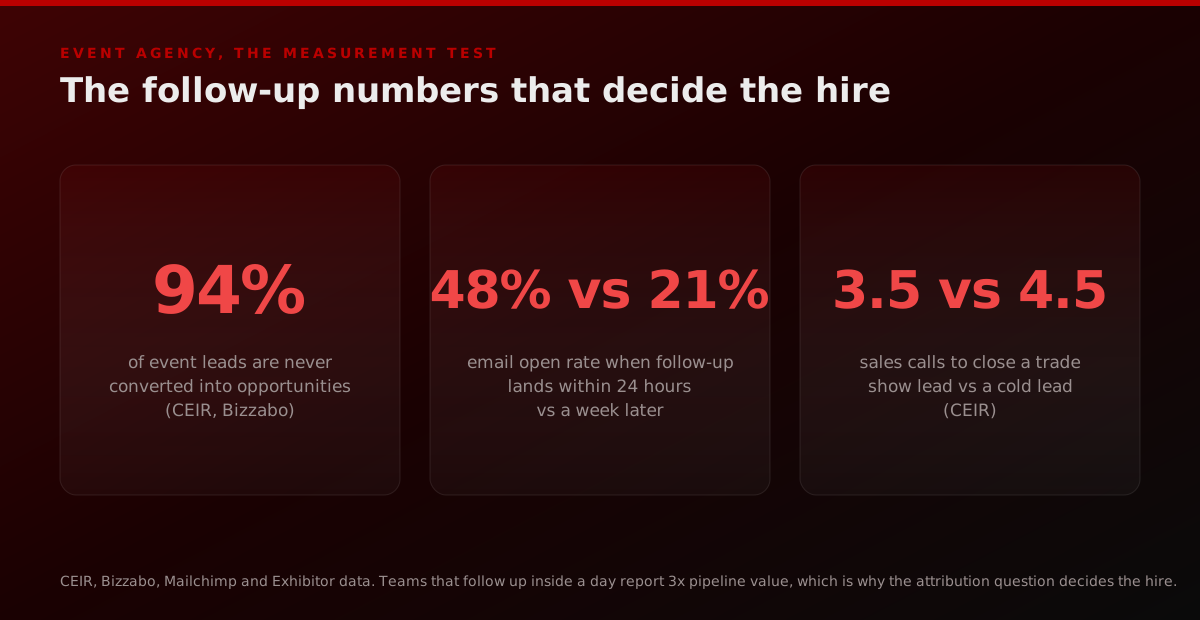
The fastest way to separate a growth partner from a stand-builder is to ask exactly what it reports and whether you can audit it. Most event vendors report badge scans, impressions, or booth traffic, numbers that include drive-by scans and say nothing about intent. A growth partner ties reporting to something checkable. CEIR data shows a trade show lead closes in 3.5 sales calls versus 4.5 for a cold lead, yet 94 percent of marketers never convert event leads into opportunities, and the single biggest variable is follow-up speed: Bizzabo reports 3x pipeline value for teams that follow up within a day. When one agency shows you a scan count and another shows you qualified meetings attributed by name, you are looking at two different definitions of the word results.
The measurement gap in event marketing, 94 percent of event leads never convert into opportunities, follow-up within 24 hours earns a 48 percent email open rate versus 21 percent a week later, and a trade show lead closes in 3.5 sales calls versus 4.5 cold.
Green flags and red flags before you sign
You do not need to take a pitch on faith. A growth-capable agency owns a pre-event, on-site, and post-event motion rather than stopping at the booth, reports pipeline you can audit rather than badge scans, can name activations at your event type, prices against delivered outcomes with a bounded single-event scope, and has a structured 24-hour follow-up plan. The warning signs are the mirror image: an agency that calls a staffed stand marketing, reports only impressions, shows a generic portfolio with no relevant events, asks for an annual lock-in billed cost-plus on logistics, and has no plan for the leads after the show. Run any shortlist through the table below before a call, not after.
Green flags versus red flags before you sign
What to check
Green flag
Red flag
Scope
Owns pre-event, on-site, and post-event follow-up
Stops at the booth and calls it marketing
Measurement
Pipeline attributed by name you can audit
Reports badge scans or impressions only
Track record
Named activations at your event type
Generic portfolio, no relevant events
Pricing
Tied to delivered pipeline, bounded single-event scope
Cost-plus on logistics, long annual lock-in
Follow-up
Structured 24-hour post-event follow-up plan
No plan for the leads after the show
Follow-up within 24 hours earns about a 48 percent email open rate versus 21 percent a week later (Mailchimp, Exhibitor), and Bizzabo reports 3x pipeline for teams that follow up inside a day. Run any shortlist through this table before the call.
What are the different types of event marketing agencies?
Three main types. Booth and logistics vendors staff a stand and hand you photos and a scan list but do not distribute or measure. Sponsorship and PR shops buy placement and speaking slots. Full-funnel activation agencies run pre-event narrative, on-site pipeline, post-event clips, and attribution. Match the type to the outcome you actually want before you compare prices.
What questions should I ask before hiring an event marketing agency?
Five: does it own a funnel or stop at the booth; what does it report and can you audit it; can it name activations at your event type; is pricing tied to delivered pipeline with a bounded single-event scope; and does it have a structured post-event follow-up plan. Clean answers to all five signal a growth partner. Vague answers or badge-scan reporting signal a logistics vendor sold as more.
How do I judge whether an agency actually drives pipeline?
Look past the booth render at the measurement and the follow-up. Ask for qualified meetings attributed by name rather than badge scans, a named activation in your event lane, and a 24-hour follow-up plan. CEIR data shows 94 percent of marketers never convert event leads, so an agency that can only show booth traffic is selling logistics, not pipeline.
Should I hire a booth vendor or a full-service agency?
If you already run the narrative and follow-up and only need a stand built and staffed, a logistics vendor is enough and cheaper. If you want the event to actually book meetings, a booth vendor leaves the hardest work, the narrative, the capture, and the conversion, with you. A full-funnel or outcome-priced agency owns that motion end to end, which is why founders who want pipeline choose it.
How much should an event marketing agency cost?
Agency time runs about $100 to $149 an hour on Clutch, on top of a $10,000 to $30,000 activation for a single show, and six-figure tiers for flagship sponsorships. Outcome-priced providers scope the spend to delivered pipeline instead. See the full cost breakdown on the event marketing cost answer page.
Why do most event leads never convert?
Because the spend stops at the booth. CEIR data shows 94 percent of marketers fail to convert event leads into opportunities, and the biggest variable is follow-up speed: a reply within 24 hours earns roughly a 48 percent email open rate versus 21 percent a week later. An agency without a structured follow-up and attribution motion leaves that pipeline on the floor.
The brand line
Stop renting badge scans. Build an event funnel that books meetings.
ICP map locked 12 weeks out. Side-event venue locked 4 weeks out. 30-day pre-event founder content arc shipped before event week. Booth plus side event plus founder dinner plus on-stage panel run as one funnel on the floor. 8-12 cross-platform clips per long-form session inside 14 days post-event. weekly proof on qualified meetings plus partnerships plus ABM lift for 60 days. Pair Events with Podcast Marketing, Founder Funnel, Twitter Marketing, or KOL Marketing depending on the conference cycle and the surface that produces the most pipeline. See the live KBW 2026 activation page for the working pattern. Aimed at Web3 protocols and AI startups Recent event write-ups include Global Trading Show 2026 and GWDC 2026 in Korea attending the 2026 Tier-1 conference cycle.