

Vinay Jain
@vinayjain404 · 2.8K followers
agencies leave. freelancers ghost. employees quit. this one stays. notch is an self learning ai ad agent that learns your brand permanently. your voice. your visuals. your audience. what converts. it studies your competitors weekly. remembers every session. gets sharper
notch launchDistribution-amplified signature
notch is a real product by a real founder (@vinayjain404). RADAR has tracked 1.8M views on this launch, according to the source post linked below. RADAR measures how the launch reach was built, not whether the product works or whether anyone was honest. This reading is verified confidence and every input is public.
By Simba, Launch Intelligence Analyst · Reviewed by JK · Published 22 Aug 2026 · Confidence: verified
Independent, methodology-derived signal, not a statement of fact about any person. RADAR reads how reach was built, a signature, not an accusation. See the methodology.
Did the notch launch go viral organically, or was the reach amplified?
The notch launch by @vinayjain404 drew 1.8M views on 316 likes, which is 5,824 views per like, well above the roughly 500 organic ceiling. RADAR reads a distribution-amplified signature in how that reach was built, a signature of the mechanics and not a claim about the product or the founder. This is a verified reading and every input is public and reproducible.
New here? Start with the product
What is RADAR, and what does this grade mean?
RADAR is FORKOFF's launch authenticity rating system. It reads whether a product launch earned its reach through real engagement or bought it through paid distribution, using only public signals anyone can pull from the launch post. Every reading carries a letter grade, a confidence label, and the date it was last checked, and links back to a published method you can reproduce. notch is a real product by a real founder (@vinayjain404). RADAR measures how the reach was built, not whether the product works or whether anyone was honest.
Distribution-amplified signature
Independent, methodology-derived signal, not a statement of fact about any person. RADAR reads how reach was built, a signature, not an accusation. See the methodology.
What this grade means
RADAR reads a distribution-amplified signature on this launch: the reach ran ahead of the engagement that organic reach produces. The grade describes how the reach was built, not whether the product works or whether anyone was honest. Paying for distribution is legal and common.
The signals RADAR reads
Views-to-likes ratio
Organic reach tops out near 500 views per like. When views climb far past that without the likes to match, the extra reach is arriving without the engagement organic reach produces.
Amplification wave shape
Organic amplification spreads over hours and days. A coordinated launch fires a synchronized burst of quote posts in the first few hours, read from each post's own timestamp.
Posting-time fingerprint
A post that fires exactly top of the hour on a weekday is scheduled. On its own it is weak, but it corroborates a coordinated launch alongside the other two signals.
Those three public signals sit on top of RADAR's five-component forensic read. The full method, the bands, and the confidence model are on the RADAR methodology page.
This launch in the data
Where does this reach sit against the tracked corpus?
Where it sits in the corpus
Rank 29 of 30 tracked launches by views per like, lowest (most organic) first. A lower ratio is the favorable end.
Against the benchmark
This launch's views per like next to the organic median (354) and the amplified median (1,441) across the tracked set.
 The product
What is notch?
notch sits in the marketing and advertising-automation market, specifically the growing category of AI agents built to replace or supplement a paid-media agency's day-to-day work: studying competitors, running and iterating ad creative, and remembering what has already been tried. The launch post states that notch studies competitors weekly, remembers every session, and gets sharper the more it is used, positioning it as a system with institutional memory rather than a one-off generator.
The product is priced directly against agency retainers in the launch copy itself, contrasted with a stated "$4k/month agency that also handles 11 other accounts" and described as costing "less than lunch." These are the company's own stated positioning claims, cited here as what the post asserts, not independently verified by RADAR. This reading is only about how the reach was built.
Who built it
- A self-learning AI ad agent, built to retain brand voice, visuals, and audience data across sessions.
- Studies competitors on a weekly cadence and adapts based on what has already converted.
- Built by usenotch.ai, co-founded by Vinay Jain (@vinayjain404).
- Positioned directly against agency and freelancer retainers on price and continuity.
How the notch launch worked
The launch was a single, stylized announcement posted at 9:57 AM Pacific, just ahead of the top of the hour, on Monday 18 May 2026, from co-founder Vinay Jain's own account, @vinayjain404.
The post is written in short, lowercase, staccato lines rather than a standard sentence-and-paragraph pitch: "agencies leave. freelancers ghost. employees quit. this one stays." It builds the loyalty framing before naming the product, then lists what notch retains (voice, visuals, audience, what converts) and what it does on a cadence (studies competitors weekly, remembers every session, gets sharper with use), before closing on the direct price contrast against a "$4k/month agency" and the line "you're training a teammate that never leaves and costs less than lunch."
The founder account
Jain's account bio describes him as "Your Autonomous growth marketer already shipped ads this morning" and states prior experience at Meta. The account itself was created in 2011, a long-standing handle rather than a fresh one, and carried 3,501 followers at the time of this teardown.
What usenotch.ai did during the launch
The launch relied on copy and framing rather than a product demonstration video, a different shape from most launches RADAR tracks in this vertical.
| Asset | What it did |
|---|---|
| Stylized, staccato copy | A retention-not-rotation framing built for screenshots and quote-tweets |
| A direct price contrast | "$4k/month agency" versus "costs less than lunch," a checkable, specific comparison |
| A memory and cadence claim | Weekly competitor study, per-session memory, positioning notch as improving over time rather than static |
| Timing: Monday 9:57 AM PT | Just before the top of the hour, start of the US work week |
The launch playbook itself is unremarkable and legitimate: sharp copy, a specific price claim, a Monday-morning slot. What stands out is not the playbook but the shape of the public engagement underneath it, covered below.
How the launch performed
The launch post reached 1,842,575 views on 315 likes, with 56 reposts, 61 replies, and 55 quotes. These are matured public metrics, re-pulled directly from the source post.
Every engagement layer is small against the reach at once. The 487 combined actions (likes, reposts, replies, quotes) sit at about 0.026 percent of the 1.84 million views, one of the thinnest engagement rates in RADAR's tracked set at this scale. Likes are the cheapest action to fake, so a thin like layer alone is suggestive rather than conclusive; the stronger signal is that every costly layer is thin at the same time.
Views per like (matured)
Over 11 times the 500 organic ceiling. A thin like layer under a large, fast-arriving view count.
Total engagement
315 likes, 56 reposts, 61 replies, 55 quotes, about 0.026% of the 1.84M views. One of the thinnest engagement rates RADAR tracks at this reach.
Coordinated pod clusters
A retroactive sample of 40 quote-tweets and 17 replies found seven tight-window engager clusters, together covering more than half the sampled engagement.
First-hour quote-tweet burst
Almost two thirds of the sampled quote-tweets landed within the first hour of posting, a front-loaded shape RADAR associates with a coordinated push rather than gradual word of mouth.
A quote-tweet wave that front-loaded almost entirely into the first hour
A retroactive sample of 40 quote-tweets citing the launch found 26 of them, about 65 percent, landing inside the first hour after posting, with the wave falling off sharply after that. A front-loaded burst this steep is a different shape from the launches in RADAR's set that read organic or lightly amplified, where the quote-tweet wave typically builds gradually across the first day or several days. The same retroactive check found seven distinct coordinated engager clusters, accounts posting within roughly two minutes of one another, together covering more than half of the sampled engagement, and flagged about a third of the sampled reach growth as carrying a non-organic burst signature.
Did the reach get earned or bought?
This is a verified reading (RADAR holds a full forensic trace for this launch), so the finding is stated with confidence about the shape of the public numbers. It is not a finding about who or what produced them. The numbers have moved only slightly since detection, from 1,840,244 views and 316 likes at the original pull to 1,842,575 views and 315 likes on this re-check, a ratio shift from 5,824 to 5,849, no material change to the reading.
- RADAR is <strong>not saying that Vinay Jain bought bots, paid for fake views, or did anything wrong</strong>. Nothing on this page asserts or implies that. RADAR has no evidence of who or what produced the view count, and it does not claim to. A view figure can be inflated by mechanisms a poster never chooses or even sees, including third-party amplification services contracted elsewhere in a marketing chain, automated accounts acting without any principal's involvement, or platform-side counting behavior. RADAR reads the shape of the public numbers, not intent, and not authorship of the reach.
- RADAR is <strong>not saying notch is fake, that the product does not work, or that usenotch.ai's traction claims are false</strong>. The company, the product, and the founder are real. The finding is about the public metrics on this one post, not the business.
- RADAR is <strong>not saying the small conversation under the post is fake</strong>. The 61 replies and 55 quotes read as a modest, plausible human reaction to the post's copy; they simply do not account for the scale of the view count sitting above them.
- RADAR is <strong>not making any claim about any third party</strong>. No amplifying account, agency, or tool is named on this page. The evidence above describes engager-timing patterns in a public, retroactive sample, not an identified actor.
- RADAR is <strong>not saying the post violated any platform rule</strong>. The finding is narrow and specific: on the public metrics, the 1.84 million view figure is decoupled from the engagement under it to a degree consistent with non-human or coordinated amplification. That is a statement about one number, not about a person or anyone's honesty.
What a founder can take from this launch
notch's copy did real work: a sharp, screenshot-ready hook and a specific price contrast are craft, not evidence of anything wrong on their own. The gap this teardown surfaces sits entirely in the public engagement pattern underneath the reach, not in the launch creative. A founder evaluating any distribution vendor or growth tactic should ask the same question RADAR asks here: does the engagement under a reach spike arrive gradually, the way a real audience discovers a post, or does it cluster into a tight window right after posting.
FORKOFF plans launch distribution that a check like this one holds up against, real reach, built to travel on its own. See how we approach it on the launch video service, or read the best product launch videos we track for more real examples.
Questions readers ask about this launch
What is notch?
+
Did the notch launch go viral organically?
+
How many views did the notch launch get?
+
Does a botted signature mean Vinay Jain or notch did something wrong?
+
What is a healthy views-to-likes ratio on X?
+
Sources
Primary citation: x.com/vinayjain404/status/2056419019905810849. Every number traces to a public pull; reads re-checked over time.
How RADAR read this launch, component by component
Each named component carries a plain-English definition and a directional read where the public data supports one. RADAR publishes the component names, never the weights or the formula.
View-velocity signature
Not publishedWhether the view curve grew the way organic spread does, or spiked like an injected burst.
Per-launch read not published in the public dataset. This component needs the forensic engine output.
Engagement coupling
Flags amplificationWhether likes, replies, and reposts grew in step with views (the organic signature), or the views ran out ahead.
At 5,824 views per like, reach runs well ahead of the likes, far above the roughly 500 organic ceiling.
Reply-network authenticity
Not publishedWhether the accounts replying are real, distributed people or a coordinated cluster posting together.
Per-launch read not published in the public dataset. This component needs the forensic engine output.
Amplifier-cluster pattern
Not publishedWhether the quote-tweet amplification looks like organic word of mouth or a known activation cluster.
Per-launch read not published in the public dataset. This component needs the forensic engine output.
Smart-follower activation
Not publishedWhether genuinely influential reference accounts engaged, or the reach was only low-quality volume.
Per-launch read not published in the public dataset. This component needs the forensic engine output.
Are you the founder of notch? You can claim or contest this read. RADAR attaches a founder response to the launch and re-examines any component you dispute.
Authorship
Simba
Co-founder, FORKOFF
Reviewed by: Kshitij JK
Last reviewed:
Published:
Methodology
RADAR verified reading of the notch launch from public metrics: the views-to-likes ratio against the roughly 500 organic ceiling and the posting-time slot, framed as a signature of how reach was built, not an accusation.
Sources cited
- RADAR methodology , FORKOFF
- notch source post , X
Where to go next
Understand launch authenticity
Three ways in, depending on what brought you here: learn how the score works, get a launch read or built, or get the plain answer on this launch.
Learn the score
What a launch authenticity score is
A launch authenticity score reads whether a launch earned its reach or bought it, from public signals. Start with the definitions and the checks you can run yourself.
Verify or build
Launch authenticity verification
Want a launch read by the same method, or a launch video made and distributed on the outcome? RADAR reads any public launch, and FORKOFF builds the launch behind the reach.
The skeptic's question
Is the notch launch legit?
If you are checking whether the notchlaunch was real users or bots, here is the honest read: RADAR's reading is Distribution-amplified signature, at verified confidence, computed from public metrics and reproducible from the source post. It measures how the reach was built, not whether the product works.
Peer launches
Launches with a similar read
Anoria launch
@michaelblhssn
5.7M views · 4,410 per likeRead
depthfirst launch
@andreamichi
1.6M views · 2,983 per likeRead
MetaMask Money Account launch
@MetaMask
3.7M views · 2,709 per likeRead
Libra AI launch
@CholagharGokul
1.9M views · 2,589 per likeRead
HyperAgent launch
@howietl
14.3M views · 2,265 per likeRead
Superblocks 2.0 launch
@bradmenezes
4.6M views · 2,088 per likeRead
The benchmark behind every reading
- The organic vs amplified benchmark. What a healthy launch ratio looks like, side by side.
- RADAR methodology. The bands, the confidence model, and how to reproduce a read.
- The Launch Authenticity Report 2026. The aggregate study across the tracked corpus.
- The X Launch Authenticity Study 2026. Two in three tracked launches show a bought-amplification signature.
- Verified-organic leaderboard. The launches RADAR reads as genuinely organic.
- Best product launch videos. The editorial cut of every tracked launch, ranked by views.
- Product launch video service. Get a launch video made and distributed, priced on the outcome.
Want a launch read by RADAR's method?
RADAR reads whether a launch's reach was earned or bought from public data, with the confidence label and the source citation on every reading.
Receipts, deep dives, and playbooks.
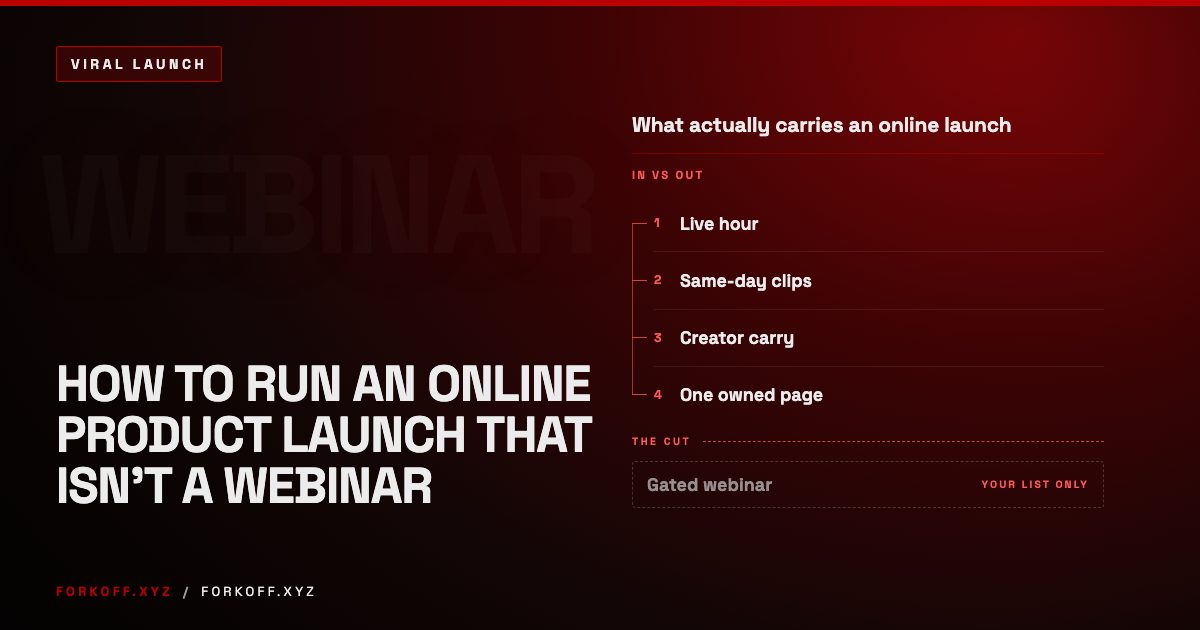
How to Run an Online Product Launch That Isn't a Webinar
An online product launch is a live moment cut into clips that creators carry, not a gated webinar. Here is the livestream, clip and creator stack for 2026.
 Read
Read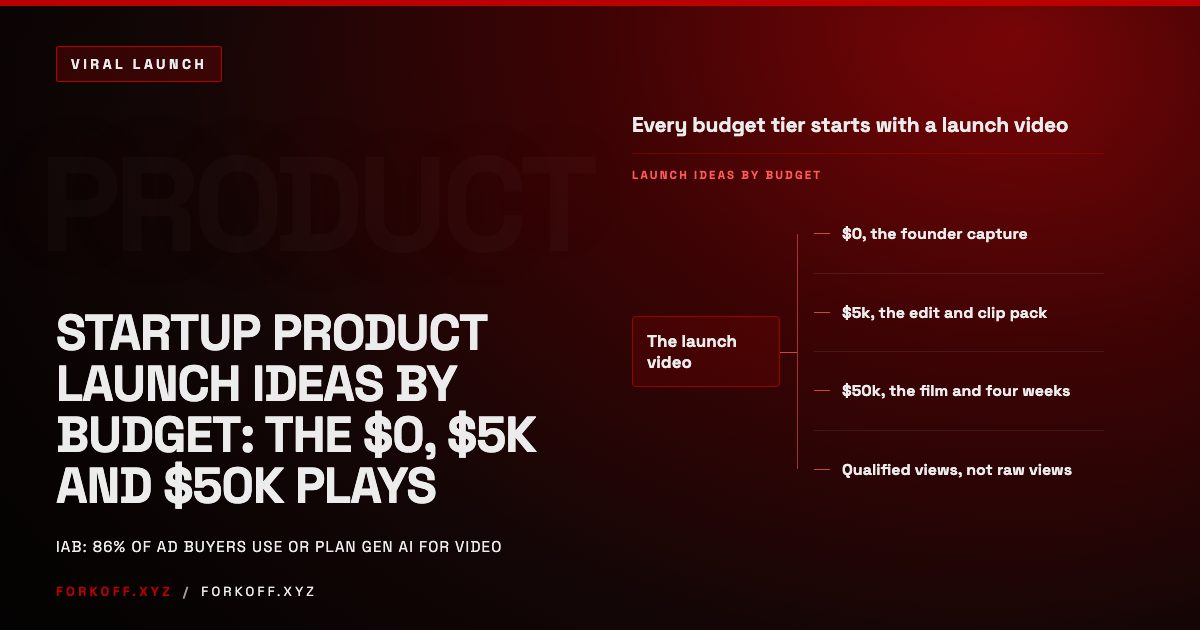
Startup Product Launch Ideas by Budget: The $0, $5k and $50k Plays
Product launch ideas for a SaaS startup sorted by budget: what the launch video should be at $0, $5k and $50k, and the distribution around it.
Read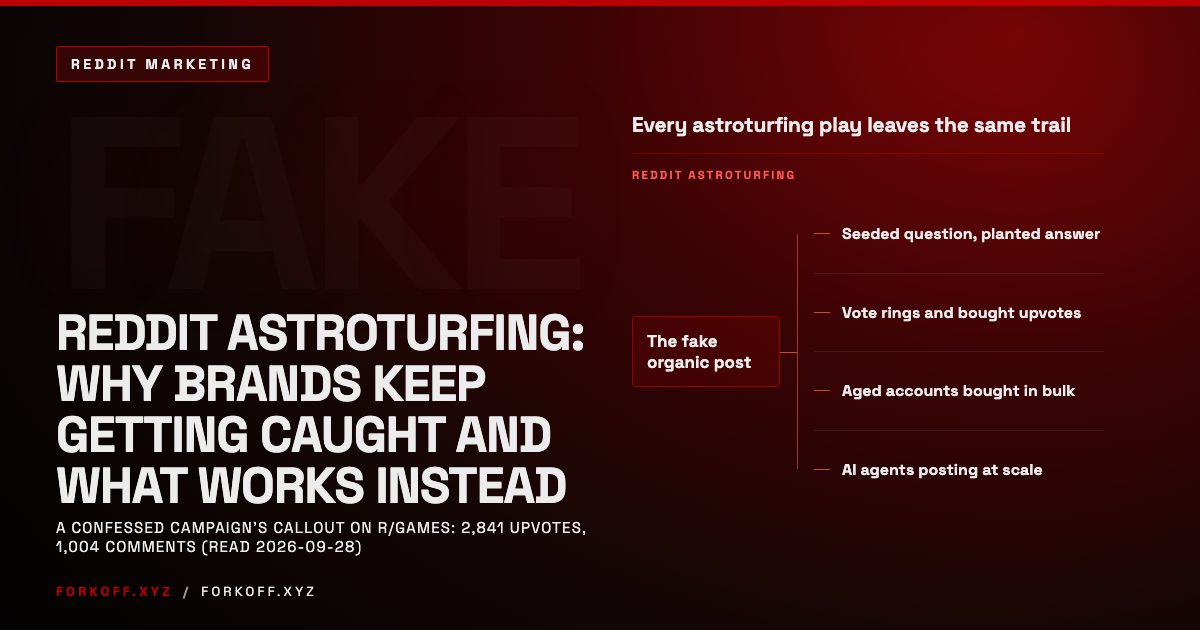
Reddit Astroturfing: Why Brands Keep Getting Caught and What Works Instead
Reddit astroturfing is paid promotion dressed up as organic talk. Why brands keep getting caught, what exposure costs, and the legitimate way to show up.
Read